
The Bank Robber Who Thought Lemon Juice Was Invisible Ink
Dunning: On April 19, 1995, a heavyset 45-year-old man named McArthur Wheeler walked into two Pittsburgh banks in broad daylight and robbed them at gunpoint. He made no attempt to disguise himself. He wore no mask, no hat pulled low, no sunglasses. He walked directly in front of the security cameras and looked straight into the lenses.
Police had clear footage. When they broadcast the images on the evening news that night, Wheeler was identified and arrested within the hour.
When officers showed Wheeler the surveillance footage at the station, his reaction was not guilt or resignation. It was bewilderment. "But I wore the juice," he reportedly said.
Wheeler had rubbed lemon juice on his face before each robbery. He believed - sincerely, completely - that lemon juice, which can be used as invisible ink when applied to paper and held over a flame, would render his face invisible to photographic film.
Nobody had told him this. He had not misheard some chemistry lesson. He had arrived at this conclusion himself, tested it (apparently by taking a Polaroid selfie that came out blank, almost certainly due to him pointing the camera wrong), and walked into two banks in broad daylight with the unshakeable conviction that he was invisible.
The Pittsburgh Police Department submitted the case to David Dunning, a social psychologist at Cornell University, as a curiosity - one of those stranger-than-fiction crimes that end up in police bulletins. Dunning was not merely amused. He was intellectually arrested by the case.
What Wheeler demonstrated was not simple ignorance. The more unsettling problem was that Wheeler lacked the knowledge necessary to recognize his own ignorance. He did not know enough about photography, chemistry, or basic optics to understand that his plan was nonsensical.
And because he lacked that knowledge, he had no mechanism for detecting its absence. His incompetence was self-concealing.
Dunning brought the puzzle to his graduate student Justin Kruger, and together they designed a series of experiments to test whether this dynamic - that the least skilled people are also the least equipped to recognize their own lack of skill - was a general psychological phenomenon rather than an isolated anecdote about a peculiar criminal.[12]
Their 1999 paper, "Unskilled and Unaware of It: How Difficulties in Recognizing One's Own Incompetence Lead to Inflated Self-Assessments," published in the Journal of Personality and Social Psychology, would become one of the most cited papers in all of social psychology, and the "Dunning-Kruger Effect" would become a fixture in popular culture.
What the Dunning-Kruger Effect Actually Is
The Dunning-Kruger Effect is the empirical finding that people with low competence in a domain systematically overestimate their performance, while people with high competence tend to underestimate their relative standing, because the metacognitive skills required to evaluate one's performance accurately are themselves a product of domain expertise.[2]
Dunning-Kruger Effect vs. Impostor Syndrome
These two phenomena are frequently confused or conflated. They are in fact near-opposites, and understanding the contrast clarifies both.
| Dimension | Dunning-Kruger Effect | Impostor Syndrome |
|---|---|---|
| Who experiences it | Low-competence individuals | High-competence individuals |
| Self-assessment direction | Overestimation of ability | Underestimation of ability |
| Relationship to actual skill | Inverse: less skill, more confidence | Inverse: more skill, less confidence |
| Mechanism | Missing metacognitive framework to detect errors | Social attribution of success to luck or deception |
| Resolution pathway | Gaining domain knowledge (which also reveals ignorance) | External validation, cognitive reframing of success |
| First described | Kruger & Dunning, 1999 | Clance & Imes, 1978 |
| Common domains | Technical skills, logical reasoning, factual knowledge | Academic achievement, professional expertise, creative work |
The impostor syndrome, described by psychologists Pauline Clance and Suzanne Imes in a 1978 paper in Psychotherapy: Theory, Research and Practice, afflicts people who have genuinely achieved mastery but attribute that success to external factors - luck, timing, deception, fooling the evaluators - rather than to their own competence.[7]
The Dunning-Kruger Effect is the structural inverse: those who have not achieved mastery attribute their deficiency to nothing, because they cannot perceive it.
There is also a possible sequential relationship. Some research suggests that as people move up the competence curve, they may pass through a phase of acute impostor syndrome - they have just acquired enough knowledge to understand how much they do not know, and may temporarily feel more uncertain than they did when they knew less.
The arc of expertise sometimes goes: unconscious incompetence (Dunning-Kruger zone) to conscious incompetence (acute uncertainty, possible impostor feelings) to conscious competence to unconscious competence.
The Cognitive Science of Not Knowing What You Don't Know
The original Kruger and Dunning (1999) paper echoed an observation made by philosopher and logician Bertrand Russell, who wrote in 1933 that "the fundamental cause of the trouble is that in the modern world the stupid are cocksure while the intelligent are full of doubt." The psychological machinery underlying this observation is what Dunning and Kruger sought to formalize.
Their central theoretical claim was this: competence in any domain requires a body of knowledge and a set of cognitive skills. Those same skills are required to evaluate one's own performance accurately.
Therefore, incompetent individuals are doubly cursed: they perform poorly, and they also lack the very capacity needed to recognize that they are performing poorly.
This is not merely motivated reasoning or ego protection. It is a structural feature of how domain knowledge is organized. A person who does not understand formal logic cannot recognize a logical fallacy - not just in their own reasoning, but at all.
A person who cannot identify a grammatical error cannot evaluate whether their writing is grammatically correct. The evaluative apparatus and the performance apparatus are the same cognitive machinery.
Psychologist Robert Bjork, whose work on memory and metacognition at UCLA spans several decades, has elaborated on what he calls "illusions of knowing" - a family of phenomena in which learners consistently overrate their own retention and understanding.[11]
Bjork's research, published across multiple issues of Psychological Review from the 1990s onward, demonstrated that fluency of processing is routinely mistaken for depth of understanding.
If something feels easy to read or recall, people assume they have learned it well. This creates systematic miscalibration at every level of expertise, but it is most severe at the lowest levels, where even the illusion of knowing cannot be checked against any accurate internal map.
Related work by Asher Koriat and Robert Goldsmith on the monitoring of memory, published in Psychological Review in 1996, demonstrated that confidence is often computed from cue familiarity rather than actual retrieval success - which means that for novices, who have many partial cues but few accurate memories, confidence can be high even when performance is low.[9]
Dunning himself elaborated on these mechanisms in a 2011 review in Advances in Experimental Social Psychology, titled "The Dunning-Kruger Effect: On Being Ignorant of One's Own Ignorance." In that review, he broadened the framework beyond the original studies to encompass medical diagnosis, political knowledge, financial decision-making, and organizational leadership.
These are domains in which miscalibration has high-stakes consequences and where the structure of feedback is often poor enough that incompetent performers never receive accurate information about their errors.
Four Case Studies Across Domains
Case Study 1: Political Knowledge and Civic Competence
In a study conducted by Dunning and colleagues examining political knowledge prior to the 2000 U.S.
presidential election, participants in the bottom quartile of political knowledge - as assessed by factual tests - rated their own political knowledge as above average and believed their views on policy were more nuanced and better-informed than those of most other citizens.
Their actual scores placed them near the floor of the distribution. This pattern was robust across political affiliations, suggesting the effect is not partisan but cognitive.
Participants in the top quartile, by contrast, tended to slightly underestimate their relative standing - a finding Dunning and Kruger interpreted as evidence that those who know more are better aware of how much others also know, and thus less inclined to feel exceptional.
The political knowledge domain is particularly important because miscalibration in civic competence has direct democratic implications.
Citizens who do not know what they do not know about policy, economics, or history are less likely to seek out corrective information and more likely to hold their existing views with unwarranted certainty.
Case Study 2: Medical Self-Diagnosis in the Digital Age
A 2015 study published in JAMA Internal Medicine examined patients who had used online symptom checkers before seeing a physician. Patients with the least medical background knowledge were most likely to rate their self-diagnoses as highly accurate and to resist correction by the treating physician.
They showed the characteristic Dunning-Kruger pattern: the least medically literate were the most confident in diagnoses that were, in a majority of cases, wrong.
Patients with some medical background - enough to understand the complexity of differential diagnosis - were significantly more likely to express uncertainty and to accept revision.
The stakes here extend beyond inconvenience. Overconfident self-diagnosis has been linked to delayed care-seeking (if patients believe they have correctly identified a benign condition), inappropriate self-medication, and, in aggregate, contributes to what researchers at the Johns Hopkins University School of Medicine have called the "informed patient paradox" - wherein access to medical information online increases confidence without proportionally increasing accuracy.
Case Study 3: Financial Literacy and Investment Behavior
Annamaria Lusardi and Olivia Mitchell, economists at George Washington University and the Wharton School respectively, have published a series of studies on financial literacy - beginning with a landmark 2011 paper in the Journal of Economic Literature - demonstrating that financial literacy is low across the general population but that self-assessed financial knowledge is consistently and substantially higher than measured financial knowledge.[10]
This gap is largest for those with the lowest actual literacy.
The behavioral consequences are measurable. People with low financial literacy but high self-assessed financial knowledge are more likely to hold undiversified portfolios, to fail to plan for retirement, and to fall victim to financial fraud.
The Dunning-Kruger structure here has a direct economic cost: the very people most in need of financial advice are those least likely to seek it, because they do not perceive a gap between what they know and what would be useful to know.
Case Study 4: Software Engineering and Code Quality
A study examining self-assessment in software development teams, published in the IEEE Transactions on Software Engineering (2010), found that developers who performed in the bottom quartile on code quality metrics - measured by peer review scores, bug rates, and maintainability indices - rated their own code quality as above the team median at significantly higher rates than top-quartile developers.
Top-quartile developers, when asked to estimate the quality of their code relative to peers, were more accurate, slightly conservative, and more likely to identify specific areas for improvement.
This pattern has practical implications for software team management. Peer review systems that rely on self-nomination ("raise your hand if you want your code reviewed") may systematically attract those least in need of review while the most miscalibrated developers, confident in their output, do not seek it.
Code review processes that are mandatory rather than voluntary partially correct for this structural problem.
Intellectual Lineage: Where Dunning-Kruger Fits in the History of Ideas
The Dunning-Kruger Effect did not emerge in a vacuum. It sits at the intersection of several intellectual traditions that span philosophy, psychology, and information theory.
The oldest antecedent is Socratic. The Platonic dialogues repeatedly dramatize the encounter between Socrates and confident Athenians - politicians, poets, craftsmen - who believe themselves wise in domains where they have, at best, partial knowledge.
Socrates, in the Apology, famously concludes that his own wisdom consists in knowing that he does not know. The structure of this claim is precisely the Dunning-Kruger insight: genuine competence includes accurate metacognition, while incompetence includes metacognitive failure.
In the 20th century, the philosopher Charles Sanders Peirce distinguished between "beliefs" and "genuine doubts." True inquiry, Peirce argued, begins only from genuine doubt - and genuine doubt requires enough background knowledge to identify a gap.
People who lack background knowledge cannot doubt effectively; they occupy a state he might have called "pseudo-certainty."
Within psychology, the direct intellectual ancestry runs through the above-average effect, documented by K. Patricia Cross in a 1977 paper in New Directions for Higher Education.[6]
Cross surveyed college faculty and found that 94% rated themselves above-average teachers - a mathematical impossibility that became one of the best-known demonstrations of positive self-illusion in the literature.
This above-average effect (also called illusory superiority or the Lake Wobegon Effect, after Garrison Keillor's fictional town where all the children are above average) is a necessary but insufficient condition for the Dunning-Kruger Effect.
Not everyone who believes themselves above average is demonstrating Dunning-Kruger; the specific Dunning-Kruger claim is that the effect is largest at the bottom of the skill distribution and is caused by metacognitive failure, not merely motivated self-enhancement.
Also related is the concept of "second-order ignorance" - not knowing that one does not know - which has roots in both epistemology and information theory.
Donald Rumsfeld's 2002 formulation of "unknown unknowns" (things we do not know we do not know) expressed a related idea in a policy context, though Rumsfeld was describing geopolitical intelligence rather than individual cognition.
Empirical Research: What the Studies Actually Show
The original Kruger and Dunning (1999) study, published in the Journal of Personality and Social Psychology (Vol.[1] 77, No. 6), ran four experiments testing competence and self-assessment in three domains: logical reasoning ability, English grammar, and the ability to identify what was funny (humor).
Participants completed tests in each domain, then estimated their own score and their percentile rank relative to other participants.
The findings were consistent across all three domains. Participants who scored in the bottom quartile (12th percentile on average for logical reasoning) estimated their performance at the 68th percentile on average - an overestimation of approximately 56 percentile points.
Participants who scored in the top quartile, by contrast, estimated their performance at approximately the 70th percentile, slightly underestimating their actual standing near the 86th percentile.
The top performers' underestimation was interpreted as a consequence of the false consensus effect: highly skilled people assume others find the tasks as easy as they do, and therefore anchor their self-assessments closer to the middle of the distribution.
Ehrlinger, Johnson, Banner, Dunning, and Kruger (2008) published an important replication and extension in Organizational Behavior and Human Decision Processes.[4] This study introduced the key test of whether the Dunning-Kruger Effect was a genuine metacognitive phenomenon or simply an artifact of regression to the mean.
They gave participants the opportunity to opt in or out of a science competition, predicting that miscalibrated low performers would opt in at higher rates than their actual skill warranted.
They did: bottom-quartile participants overestimated both their quiz performance and their probability of doing well in the competition, and participated at rates inconsistent with their actual scores. This behavioral consequence established that miscalibration has real-world implications beyond self-report surveys.
Burson, Larrick, and Klayman (2006), publishing in the Journal of Personality and Social Psychology, offered an alternative explanation: differential regression.[3]
Their argument was that the Dunning-Kruger pattern could be produced by a statistical artifact - when tasks are difficult, everyone overestimates (because scores are near the floor and estimates regress toward the middle); when tasks are easy, everyone underestimates (because scores are near the ceiling).
On this account, the relationship between skill level and self-assessment error is not primarily metacognitive but arithmetical. This critique did not refute the Dunning-Kruger Effect but reframed part of it as a domain-difficulty phenomenon rather than a pure competence-metacognition relationship.
Dunning and Kruger acknowledged the regression artifact issue in subsequent work and argued that even after correcting for it, metacognitive failure remains a real and significant contributor to the bottom-quartile overconfidence pattern.
The two explanations - regression artifact and metacognitive failure - are not mutually exclusive, and both likely contribute to the observed data.
Limits and Nuances: The Statistical Artifact Problem
The most rigorous methodological challenge to the Dunning-Kruger Effect as typically understood comes from Gignac and Zajenkowski, whose 2020 paper "The Dunning-Kruger Effect is (Mostly) a Statistical Artefact" was published in Intelligence (Vol.[5]
80). This paper deserves careful attention because it represents not a debunking but a precision-upgrade of the original findings.
Gignac and Zajenkowski analyzed the standard Dunning-Kruger paradigm using simulated data and demonstrated that a substantial portion of the observed effect - possibly the majority of it - can be reproduced without any metacognitive mechanism at all.
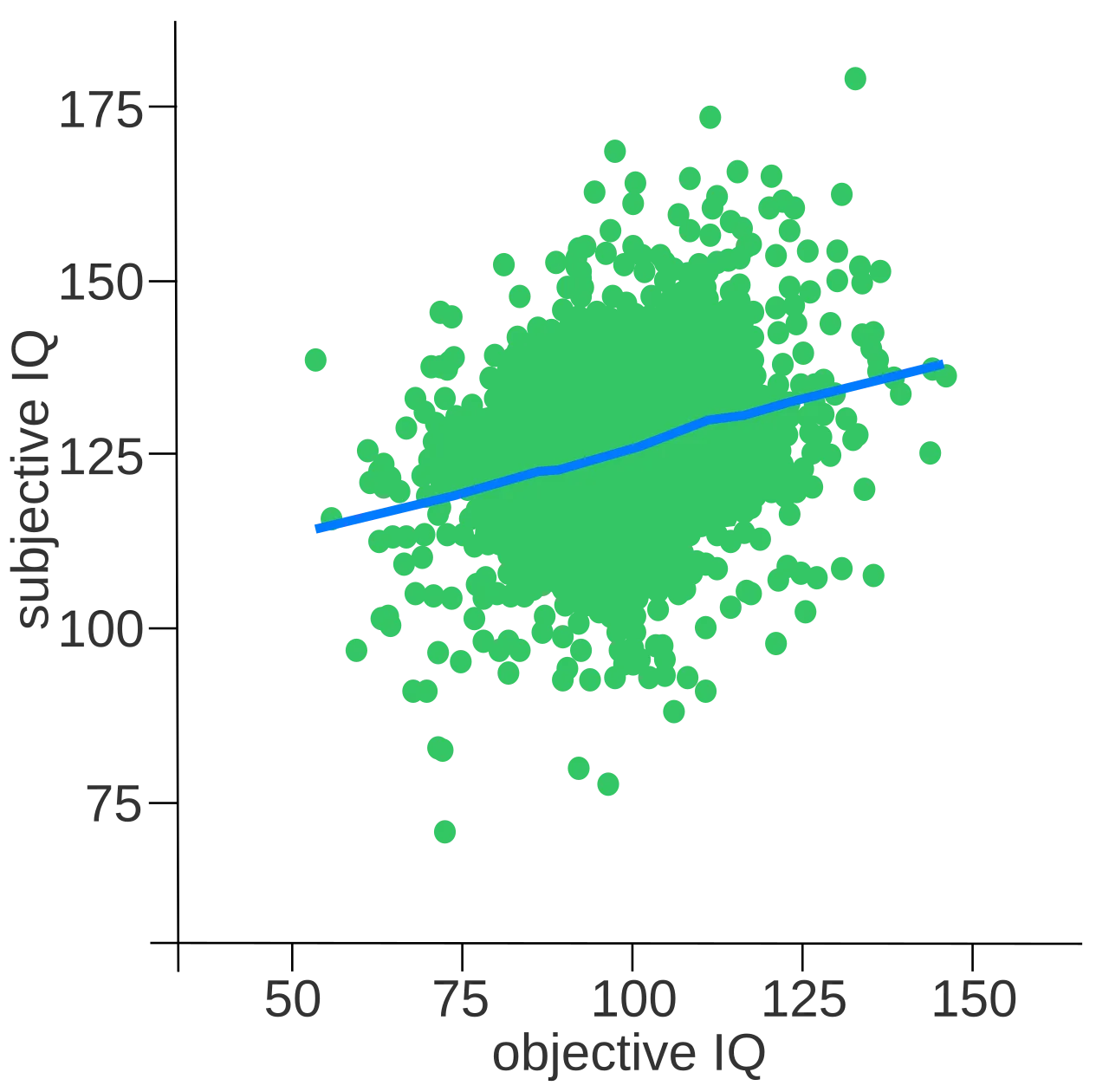
The artifact they identified works as follows. When you plot actual performance on the x-axis and self-assessed performance on the y-axis, you will always see a pattern where low performers overestimate and high performers underestimate if there is any imperfect correlation between actual and self-assessed performance.
This is because both variables are measured with error, and the correlation between them is less than 1.0 (it typically runs around .3 to .5 in Dunning-Kruger paradigm studies).
In any scatterplot with this structure, averaging within quartiles will produce apparent overestimation at the bottom and underestimation at the top - even if the underlying relationship between skill and self-assessment is perfectly uniform across the skill distribution.
Using IQ as their competence measure (which has stronger psychometric properties than the task-specific measures used in most Dunning-Kruger studies), Gignac and Zajenkowski found that the relationship between actual intelligence and self-assessed intelligence, when analyzed using methods that account for the statistical artifact, was much weaker than popular presentations of Dunning-Kruger suggest.
The effect was not absent, but it was modest. People with lower IQ scores did overestimate their IQ slightly, and people with higher IQ scores underestimated slightly, but the magnitude was far smaller than the dramatic 50-plus percentile-point gaps in the original studies.
This critique has several important implications. First, much of what is casually attributed to the Dunning-Kruger Effect in popular discourse - the image of the dramatically overconfident incompetent who thinks they are an expert - may be an exaggerated representation of a more modest statistical pattern.
Second, the specific claim that incompetent people are more overconfident than merely-competent or highly-competent people (as opposed to everyone being overconfident, with the bottom end showing a slightly larger gap) is not robustly supported once regression artifacts are controlled.
Third, the practical implications change: if the effect is a modest statistical regularity rather than a strong psychological law, it should be invoked cautiously as an explanation for specific observed behavior.
What is not contested by Gignac and Zajenkowski, or by other critics, is the core empirical finding that people are poorly calibrated about their own abilities, and that this miscalibration has real consequences. The debate is about mechanism and magnitude, not about whether competence-related overconfidence exists.
Several additional nuances deserve mention. The Dunning-Kruger Effect appears to be weaker or absent in cultures with strong collectivist norms, particularly East Asian cultures, where self-effacement in self-assessment is socially valued.
Studies conducted in Japan and China by Heine and colleagues (published in Psychological Review in 2001) found that the above-average bias either disappeared or reversed in Japanese samples.[8]
This cultural variability suggests the effect is not a fixed feature of human cognition but is shaped by social norms around self-presentation and self-evaluation.
Domain expertise in narrow areas does not confer metacognitive accuracy in adjacent areas. Chess grandmasters, for example, are accurately calibrated about their chess skill but may exhibit Dunning-Kruger-style overconfidence in domains where their chess training provides no relevant knowledge.
Expertise is domain-specific; the metacognitive skills it provides are not fully general.
Finally, the Dunning-Kruger Effect says nothing about intelligence in the general sense. The original studies used task-specific competence measures, not IQ.
A highly intelligent person who is a novice in a specific domain will show the same pattern of overconfidence as a person of lower general ability. The effect is about domain knowledge, not general cognitive capacity.
What Knowing About It Does Not Fix
One of the more uncomfortable implications of the Dunning-Kruger Effect is that learning about it does not protect against it.
Knowing the name and the general shape of the finding creates an illusion of inoculation - people learn that the "stupid are cocksure" and immediately apply this understanding to others while remaining as miscalibrated as before about their own domains of ignorance.
This was partially addressed in the Ehrlinger et al. (2008) extension studies: informing participants about self-assessment biases before they completed self-assessments did not significantly improve calibration.
The mechanism that produces miscalibration - the structural overlap between performance knowledge and evaluative capacity - is not corrected by abstract information about the bias.
The only reliable corrective is acquiring genuine domain competence, which itself comes with the side effect of making the scope of one's remaining ignorance more visible.
Dunning, in his 2011 review, made this point sharply: "The first rule of the Dunning-Kruger club is you don't know you're a member of the Dunning-Kruger club." This is not merely a clever formulation.
It describes a structural feature of the phenomenon that makes it particularly resistant to the usual tools of cognitive debiasing.
McArthur Wheeler was not a stupid man in any simple sense. He was a man who lacked the relevant knowledge to know what he did not know. The tragedy of the Dunning-Kruger Effect is that this condition is not unusual, not rare, and not confined to bank robbers with lemon juice.
It is, in some degree and in some domain, the baseline condition of all human knowers - because we all have knowledge frontiers, and at every frontier, we cannot see what lies beyond.
The question is only how far the frontier is from the center, and whether we have enough competence in the domain to know that the frontier exists at all.
Sources & Further Reading
Kruger, J., & Dunning, D. (1999). Unskilled and unaware of it: How difficulties in recognizing one's own incompetence lead to inflated self-assessments. Journal of Personality and Social Psychology, 77(6), 1121-1134.
Dunning, D. (2011). The Dunning-Kruger effect: On being ignorant of one's own ignorance. Advances in Experimental Social Psychology, 44, 247-296.
Burson, K. A., Larrick, R. P., & Klayman, J. (2006). Skilled or unskilled, but still unaware of it: How perceptions of difficulty drive miscalibration in relative comparisons. Journal of Personality and Social Psychology, 90(1), 60-77.
Ehrlinger, J., Johnson, K., Banner, M., Dunning, D., & Kruger, J. (2008). Why the unskilled are unaware: Further explorations of (absent) self-insight among the incompetent. Organizational Behavior and Human Decision Processes, 105(1), 98-121.
Gignac, G. E., & Zajenkowski, M. (2020). The Dunning-Kruger effect is (mostly) a statistical artefact: Valid approaches to testing the hypothesis with individual differences data. Intelligence, 80, 101449.
Cross, K. P. (1977). Not can, but will college teaching be improved? New Directions for Higher Education, 17, 1-15.
Clance, P. R., & Imes, S. A. (1978). The impostor phenomenon in high achieving women: Dynamics and therapeutic intervention. Psychotherapy: Theory, Research and Practice, 15(3), 241-247.
Heine, S. J., Lehman, D. R., Markus, H. R., & Kitayama, S. (2001). What's wrong with cross-cultural comparisons of subjective Likert scales? The reference-group effect. Journal of Personality and Social Psychology, 82(6), 903-918.
Koriat, A., & Goldsmith, M. (1996). Monitoring and control processes in the strategic regulation of memory accuracy. Psychological Review, 103(3), 490-517.
Lusardi, A., & Mitchell, O. S. (2011). Financial literacy around the world: An overview. Journal of Pension Economics and Finance, 10(4), 497-508.
Bjork, R. A., Dunlosky, J., & Kornell, N. (2013). Self-regulated learning: Beliefs, techniques, and illusions. Annual Review of Psychology, 64, 417-444.
Dunning, D., Johnson, K., Ehrlinger, J., & Kruger, J. (2003). Why people fail to recognize their own incompetence. Current Directions in Psychological Science, 12(3), 83-87.