
Hindsight: In the autumn of 1972, before Richard Nixon boarded Air Force One for Beijing, Baruch Fischhoff and Ruth Beyth at the Hebrew University of Jerusalem recruited subjects and asked them to predict the outcomes of Nixon's historic visit to China.
Would Nixon meet Mao Zedong personally? Would the two nations establish formal diplomatic relations? Would both sides publicly describe the summit as a success? Each subject wrote down probability estimates for fifteen specific outcomes, sealed their predictions, and waited.
Nixon went, met Mao, and returned. Then Fischhoff and Beyth did something that had not been done before in systematic psychological science: they went back to the subjects and asked them to recall what they had originally predicted.[2]
The results, published in 1975 in the journal Organizational Behavior and Human Performance, were quietly devastating. Subjects whose predictions had come true remembered their original estimates as having been higher - more confident - than the written records showed.
Subjects whose predictions had failed remembered their estimates as lower than recorded. In every direction, memory had bent toward the known ending. People had not fabricated their recollections consciously; they were sincerely reporting what they believed they had predicted.
But what they believed was systematically, measurably wrong. The past, viewed from the present, had reorganized itself around the outcome.
Fischhoff and Beyth called the phenomenon "I knew it all along." The literature that followed would call it hindsight bias, and it would prove to be among the most robust, practically consequential, and genuinely difficult-to-defeat systematic errors in the entire history of cognitive psychology.
That same year, Fischhoff published the founding theoretical paper in the field: "Hindsight = Foresight: The Effect of Outcome Knowledge on Judgment Under Uncertainty," in the Journal of Experimental Psychology: Human Perception and Performance (1975, 1(3), 288-299).
In a series of elegantly simple experiments, he presented subjects with ambiguous historical scenarios - battles, medical cases, legal decisions - and manipulated whether they were told the outcome.
Subjects who knew the outcome assigned it systematically higher probability, by 15 to 25 percentage points, compared to ignorant controls.[1] More striking still: when subjects who had been told an outcome were instructed to ignore that knowledge and reason as if they did not have it, they could not do it.
The outcome had not merely entered their minds; it had altered how the entire scenario was understood. This failure of "unlearning" became the central explanatory puzzle of the field.
"Once an event has occurred, people tend to believe that they would have predicted it - the knew-it-all-along effect distorts learning from experience." - Baruch Fischhoff, 1975
Three Forms of the Bias: A Structural Comparison
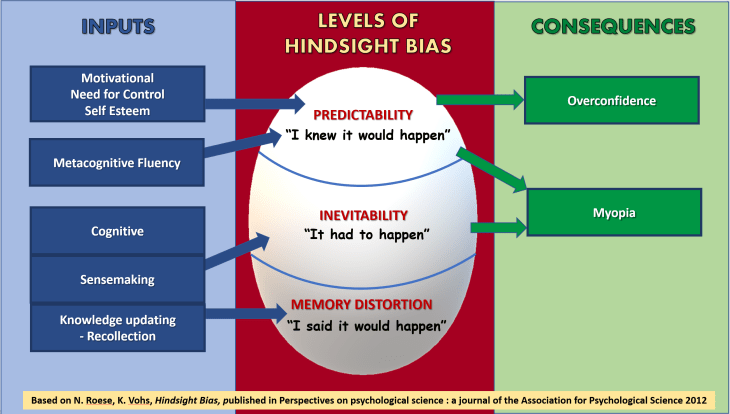
Hindsight bias is not a unitary phenomenon. Following the theoretical framework advanced by Harald Blank, Steffen Nestler, Gernot von Collani, and Volkmar Fischer in their 2008 paper in Journal of Experimental Psychology: General, the literature now recognizes three distinct but interrelated manifestations, each with its own cognitive mechanism, its own method of measurement, and its own characteristic real-world consequence.
| Manifestation | Mechanism | How It Is Measured | Real-World Consequence |
|---|---|---|---|
| Memory Distortion ("I knew it all along") | Outcome knowledge is integrated into reconstructed memory of prior beliefs; recalled predictions shift toward the known outcome | Prospective recording of predictions compared to recalled estimates after outcome disclosure (Fischhoff & Beyth, 1975 design) | People cannot accurately learn from experience; they believe past judgments were better-calibrated than they were, reinforcing overconfidence in future predictions |
| Inevitability Judgment (Creeping Determinism) | Causal sense-making narratives make the outcome appear to have been the only plausible trajectory; alternative possibilities are mentally suppressed | Subjects rate the subjective probability of an outcome before vs. after knowing it; or rate how inevitable it seemed (Fischhoff, 1975 design) | Historical and political analysis becomes distorted; decision-makers are blamed for failing to prevent outcomes that were genuinely uncertain prospectively |
| Foreseeability Attribution | Individuals attribute to themselves or others the belief that the outcome was personally predictable in advance, even without distorted memory | Subjects rate whether "anyone paying close attention" would have predicted the outcome; distinct from direct memory probes (Blank et al., 2008) | Legal negligence determinations are corrupted; professional misconduct evaluations assign blame for failures that were reasonable given available information |
These three components often co-occur but can be experimentally dissociated. A person may correctly recall their prior probability estimate (no memory distortion) while still judging the outcome as inevitable (inevitability judgment) and blaming a physician for failing to foresee it (foreseeability attribution).
Blank and colleagues' 2008 three-level model was important precisely because it demonstrated these dissociations empirically, showing that interventions which reduced one component often left the others intact.[6]
Understanding the structural independence of the three components explains why hindsight bias is so resistant to correction: debiasing memory does not automatically debias inevitability judgments, and debiasing inevitability does not automatically debias foreseeability attributions.
The Cognitive Science: Mechanisms, Models, and Key Findings
Sense-Making and Anchoring
The mechanistic account of hindsight bias has been developed most systematically by Neal Roese and Kathleen Vohs in their 2012 comprehensive review in Perspectives on Psychological Science (7(5), 411-426) - a paper that surveyed more than 800 studies and synthesized three decades of theoretical development.[3]
Roese and Vohs proposed four cognitive operations that jointly produce hindsight bias across all three of its manifestations.
Sense-making is the first and most fundamental operation. When people learn that something happened, they automatically construct a causal narrative explaining why it happened.
This narrative is not a neutral inventory of prior evidence - it is a selective, outcome-directed account that retrieves and weights information consistent with the known ending.
The narrative is generated rapidly, without deliberate effort, and it restructures how the entire prior situation is mentally represented.
Events and signals that were not particularly salient before the outcome become retrospectively prominent because they fit the causal story; alternatives that did not occur are retrospectively suppressed.
Anchoring is the second operation. Once the causal narrative is constructed around the known outcome, it serves as an anchor for reconstructing what was known or believed before the event.
The problem is that this anchor is contaminated by outcome knowledge: it is not a veridical retrieval of prior belief, but a reconstruction of prior belief from a present mental model that has already absorbed the outcome.
Crucially, this is not a matter of forgetting - even subjects who have written records of their prior predictions show residual hindsight effects in their foreseeability judgments, because memory distortion is only one of the three manifestations.
Reconstructive memory is the third operation. Human memory is not archival retrieval but active reconstruction, and reconstruction of prior beliefs recruits all currently available knowledge - including, inescapably, outcome knowledge - as raw material.
The outcome functions as scaffolding for the reconstruction, shaping which fragments of prior experience are retrieved and how they are assembled. The result is a "remembered" prior belief that is systematically more outcome-consistent than the actual prior belief was.
Attribution processes are the fourth operation. Once the outcome seems inevitable and one's prior "belief" seems consistent with it, people attribute the outcome to predictable causes and assign responsibility accordingly - concluding that whoever failed to anticipate it must have been negligent, incompetent, or inattentive.
The Role of Counterfactual Suppression
A complementary mechanism was identified by researchers examining counterfactual thinking - the generation of "what if" alternatives to actual events.
Roese and Olson, in work published in the 1990s, found that outcome knowledge suppresses counterfactual generation: once an event is known, the alternatives that did not occur become harder to mentally simulate.
This counterfactual suppression contributes to inevitability judgments - if you cannot readily imagine the outcome having been otherwise, it begins to feel as if it could not have been otherwise.
Mark Pezzo, in a 2003 paper in Memory & Cognition, extended this analysis to show that the emotional salience of an outcome influences hindsight bias magnitude.
Negative, surprising, and personally relevant outcomes produce larger hindsight effects, because they motivate stronger sense-making efforts - people work harder to explain outcomes that disturb them, and this harder sense-making effort produces a more thoroughly integrated causal narrative that is harder to reason around.
The Meta-Analysis Record
The first major quantitative synthesis of the hindsight bias literature was conducted by Scott Hawkins and Reid Hastie in 1990, published in Psychological Bulletin (107(3), 311-327).
Their meta-analysis confirmed the robustness of the effect across experimental designs and subject populations, and importantly, identified moderating variables: hindsight bias was larger for outcomes that were surprising before the fact, for outcomes with clear causal explanations, and for outcomes judged by people who lacked domain expertise.
The Hawkins and Hastie (1990) analysis established that the effect size was not trivially small - it was large enough, by the standards of applied psychology, to matter in real-world judgment contexts.[4]
Jay Christensen-Szalanski and Cynthia Fobian Willham published a competing meta-analysis in 1991 in Organizational Behavior and Human Decision Processes (48(1), 147-168), reaching a more cautious conclusion.
Their analysis found that the average effect was smaller than often claimed, and that methodological variations - particularly the difference between memory designs (comparing recalled predictions to documented prior predictions) and comparison designs (comparing outcome-informed to outcome-ignorant judgment) - produced substantially different effect size estimates.
Christensen-Szalanski and Willham's critique was methodologically important: it distinguished genuinely strong evidence of memory distortion from weaker evidence of inevitability judgment, and called for more precise measurement of which component was actually being studied in any given experiment.
Roese and Vohs's 2012 review, coming two decades later with a much larger evidence base, largely reconciled these competing meta-analyses: the effect is real and robust, the magnitude varies predictably with well-characterized moderators, and the three-component structure explains why earlier analyses using different measurement approaches produced different estimates.
Intellectual Lineage
Hindsight bias as a formal scientific construct was created by Baruch Fischhoff.
The founding papers - the theoretical study of probability judgment (1975, Journal of Experimental Psychology: Human Perception and Performance) and the prospective memory study with Beyth (1975, Organizational Behavior and Human Performance) - were both published in the same year and together established the phenomenon's scope.
There was no significant predecessor work in experimental psychology that had studied this specific effect; Fischhoff identified it and named it.
The immediate intellectual context was the heuristics-and-biases research program being launched by Daniel Kahneman and Amos Tversky.[12]
Their landmark 1974 paper in Science (185(4157), 1124-1131) documented systematic errors in probabilistic reasoning - availability, representativeness, anchoring and adjustment - and established the research agenda that Fischhoff's work joined and complemented.
Where Kahneman and Tversky focused on prospective judgment under uncertainty, Fischhoff asked what happened to judgment and memory after outcomes were known.
Fischhoff has explicitly acknowledged the influence of the Kahneman-Tversky research program in shaping the questions he asked, even though his specific phenomenon was original.
Paul Slovic, a collaborator of both Kahneman and Fischhoff in the 1970s at Decision Research, contributed to early experimental work on hindsight bias and on debiasing, including the 1977 paper with Fischhoff in Journal of Experimental Psychology: Human Perception and Performance that tested "consider the opposite" as a corrective strategy.[10]
The legal applications of hindsight bias research were pioneered by Jeffrey Rachlinski, whose 1998 paper in the University of Chicago Law Review provided the theoretical foundation for procedural reform in negligence litigation, and by Kim Kamin and Rachlinski's 1995 empirical study in Law and Human Behavior.
Rachlinski's work drew directly on Fischhoff's experimental findings and extended them into a normative framework for evaluating how legal standards should account for cognitive limitations.
The three-component model that now anchors theoretical discussion was formalized by Blank, Nestler, von Collani, and Fischer in 2008 in the Journal of Experimental Psychology: General, building on Fischhoff's original two-component framework (probability judgment and memory distortion) and adding the foreseeability attribution component as a theoretically and empirically distinct manifestation.
Roese and Vohs's 2012 synthesis in Perspectives on Psychological Science represents the current state of the field - the most comprehensive integration of the empirical literature, the strongest theoretical model, and the broadest account of moderating variables, adaptive functions, and applied implications.
Empirical Research: What the Evidence Shows
The empirical record on hindsight bias is among the most replicated in psychology. Roese and Vohs (2012) reviewed research spanning over 800 studies across more than five decades, conducted in dozens of countries, using subjects ranging from young children to professional experts.
The effect has been documented in every domain examined: medicine, law, finance, politics, sports, military intelligence, and everyday personal prediction.
Fischhoff's original 1975 experiments found that knowing an outcome elevated its perceived prior probability by 15 to 25 percentage points compared to subjects who did not know the outcome - a large effect by any standard, comparable in magnitude to well-established effects in social psychology such as the bystander effect.
Replications using diverse historical scenarios, fictional cases, and real-time predictions have consistently found effects in this range, with the largest effects associated with outcomes that are emotionally significant, causally coherent, and personally unfamiliar to the subject.
The Fischhoff and Beyth (1975) Nixon study demonstrated that the memory-distortion component specifically bends recalled predictions toward actual outcomes - not toward a neutral regression midpoint, but directionally and specifically toward what happened.
Subjects shifted their recalled probabilities for events that had occurred upward, and for events that had not occurred downward. This directional specificity distinguishes genuine hindsight bias from mere memory degradation.
Hawkins and Hastie's 1990 meta-analysis in Psychological Bulletin confirmed robustness across designs and identified key moderators: surprise value of the outcome (more surprising outcomes produce larger hindsight effects), causal coherence (outcomes with clear causal stories produce larger effects), and expertise (experts sometimes show smaller memory-distortion effects when they have well-formed prior models, but not always).
The Christensen-Szalanski and Willham (1991) meta-analysis introduced an important caveat: effect sizes measured by memory comparison designs (documented prior prediction vs.[5]
recalled prediction) are smaller and more variable than those measured by comparison designs (outcome-informed vs. outcome-ignorant groups), suggesting that the two methods capture somewhat different phenomena.
Ulrich Hoffrage, Ralph Hertwig, and Gerd Gigerenzer's 2000 paper in Journal of Experimental Psychology: Learning, Memory, and Cognition (26(3), 566-581) proposed that hindsight bias is a by-product of rational knowledge updating rather than a cognitive error per se.[9]
On their account, people's memory systems adapt correctly to incorporate new information; the "error" is that they do not maintain a veridical record of prior beliefs alongside the updated current belief.
This reframing positioned hindsight bias not as a malfunction but as the normal cost of a memory system optimized for current relevance rather than historical accuracy.
Four Named Case Studies
Case Study 1: Nixon in China - Fischhoff and Beyth, 1975
The Fischhoff and Beyth study remains the methodological gold standard of hindsight bias research because it is one of the few published studies with prospective measurement: subjects' actual prior predictions were documented before the outcome was known, enabling direct comparison with recalled predictions rather than relying on experimental group comparisons.
For fifteen specific outcomes of Nixon's 1972 China visit, subjects' recalled probability estimates for outcomes that had occurred were systematically higher than their recorded predictions; recalled estimates for outcomes that had not occurred were systematically lower.
The distortion was correlated with outcome clarity: unambiguous outcomes produced larger memory shifts than ambiguous ones. Subjects expressed high confidence in their recalled predictions.
This combination - systematic distortion, directional specificity, and subjective confidence - established the three defining features of hindsight memory bias that subsequent research consistently replicates.
Case Study 2: Medical Malpractice - Caplan, Posner, Cheney, and Ward, 1991
Robert Caplan, Karen Posner, Frederick Cheney, and Karen Ward's research on anesthesia-related adverse events, published in Anesthesiology in 1991, examined how physician reviewers evaluated medical care when outcome information was varied.[8]
Reviewers assessing cases in which patients had died judged the quality of care as significantly lower than reviewers assessing clinically identical cases without death as the recorded outcome.
The same decisions - the same choices about anesthetic agents, monitoring protocols, and emergency responses - were rated as negligent in one condition and as reasonable in another, depending solely on whether the reviewer knew the patient had died.
This study became a landmark in the medical malpractice literature because it demonstrated that the standard mechanism for evaluating physician judgment in litigation - retrospective peer review by physicians who know the outcome - is systematically biased in favor of finding negligence, regardless of the quality of the prospective decision.
Case Study 3: Juries and Negligence - Kamin and Rachlinski, 1995
Kim Kamin and Jonathan Rachlinski's 1995 study in Law and Human Behavior (19(1), 89-104) assigned mock jurors to read about a city's decision not to install a particular flood-control device.[7] In the prospective condition, subjects evaluated the decision knowing that it had not yet resulted in a flood.
In the retrospective condition, subjects evaluated the identical decision knowing that a devastating flood had subsequently occurred.
Jurors who knew of the flood rated the city's decision as negligent at substantially higher rates than prospective evaluators, and estimated that the probability of a flood had been far higher than did the prospective group.
The study tested several debiasing instructions - including explicit warnings about hindsight bias and instructions to set aside outcome knowledge - and found that while instructions modestly reduced the effect, they did not eliminate it.
The one intervention that worked reasonably well was asking jurors to generate specific reasons why the flood might have been unforeseeable before the decision was made, a procedure that partially reconstructs a prospective cognitive frame.
Case Study 4: The Three-Level Model - Blank, Nestler, von Collani, and Fischer, 2008
Harald Blank and colleagues' 2008 paper in the Journal of Experimental Psychology: General was theoretically important because it moved the field beyond treating hindsight bias as a single entity.
Their studies demonstrated that the three components - memory distortion, inevitability judgment, and foreseeability attribution - could be experimentally dissociated and responded differently to the same manipulations.
In one key finding, a manipulation that increased the causal coherence of an event narrative (making the outcome seem more explicable) increased inevitability judgments without increasing memory distortion.
Conversely, a manipulation that enhanced memory for prior predictions reduced the memory-distortion component without affecting inevitability or foreseeability judgments.
These dissociations established that the three components are not merely conceptually distinct but mechanistically distinct, and that interventions must target the specific component relevant to the applied context in question.
Limits, Critiques, and Nuances
The robust replication record of hindsight bias has not been without significant criticism. Christensen-Szalanski and Fobian Willham's 1991 meta-analysis raised methodological concerns that remain partially unresolved.
Because most hindsight bias research uses between subjects comparison designs rather than within-subjects prospective measurement, what is typically measured is the difference between how outcome-informed and outcome-ignorant subjects judge the same event - not necessarily a demonstration that any individual's memory or judgment has been distorted.
The difference could theoretically reflect accurate Bayesian updating rather than error: outcome knowledge genuinely changes the probability that an event was predictable, because knowing that an event occurred provides real information about the underlying base rate.
On this reading, some portion of what is measured as hindsight bias may be epistemically appropriate.
Stephen Hoch and George Loewenstein, in a 1989 paper in Journal of Forecasting, introduced a genuinely important nuance: hindsight bias does not always impair learning.
In some contexts, the confident retrospective certainty that an outcome was predictable motivates learning of the right kind - searching for general patterns, updating models, improving domain knowledge.
The question is whether hindsight-derived lessons are appropriately calibrated or overfit to the specific case.
Hoch and Loewenstein found that when hindsight certainty was high and accurate - when the outcome was genuinely predictable from prior data - hindsight bias accelerated learning.[11]
When hindsight certainty was high but inaccurate - when the outcome was retrospectively rationalized but was genuinely not predictable - hindsight bias produced false learning that harmed future prediction.
The adaptive account offered by Hoffrage, Hertwig, and Gigerenzer (2000) also constitutes a genuine critique of the standard framing.
If hindsight bias is a by-product of rational knowledge updating, the appropriate response is not to debias the individual but to design institutional systems that preserve prospective records - written predictions, pre-registered hypotheses, documented decision rationales - so that the inevitable updating of individual memory does not destroy information about the actual prospective epistemic state.
Finally, the debiasing literature is more sobering than researchers initially hoped. Fischhoff's own early work found that even telling subjects explicitly that they were probably showing hindsight bias, and asking them to correct for it, produced only modest reductions.
Slovic and Fischhoff's 1977 "consider the opposite" procedure - asking subjects to generate specific arguments for why the outcome was not inevitable - was more effective, but required cognitive effort that subjects often did not invest spontaneously.
The most effective institutional debiasing strategy remains prospective documentation: writing down predictions, decision rationales, and probability estimates before outcomes are known, in a form that cannot be silently revised afterward.
Sources & Further Reading
Fischhoff, B. (1975). Hindsight = foresight: The effect of outcome knowledge on judgment under uncertainty. Journal of Experimental Psychology: Human Perception and Performance, 1(3), 288-299.
Fischhoff, B., & Beyth, R. (1975). "I knew it would happen": Remembered probabilities of once-future things. Organizational Behavior and Human Performance, 13(1), 1-16.
Roese, N. J., & Vohs, K. D. (2012). Hindsight bias. Perspectives on Psychological Science, 7(5), 411-426.
Hawkins, S. A., & Hastie, R. (1990). Hindsight: Biased judgments of past events after the outcomes are known. Psychological Bulletin, 107(3), 311-327.
Christensen-Szalanski, J. J. J., & Fobian Willham, C. (1991). The hindsight bias: A meta-analysis. Organizational Behavior and Human Decision Processes, 48(1), 147-168.
Blank, H., Nestler, S., von Collani, G., & Fischer, V. (2008). How many hindsight biases are there? Journal of Experimental Psychology: General, 137(1), 26-53.
Kamin, K. A., & Rachlinski, J. J. (1995). Ex post ex ante: Determining liability in hindsight. Law and Human Behavior, 19(1), 89-104.
Caplan, R. A., Posner, K. L., Cheney, F. W., & Ward, R. J. (1991). Effect of outcome on physician judgments of appropriateness of care. Anesthesiology, 75(2), 284-291.
Hoffrage, U., Hertwig, R., & Gigerenzer, G. (2000). Hindsight bias: A by-product of knowledge updating? Journal of Experimental Psychology: Learning, Memory, and Cognition, 26(3), 566-581.
Slovic, P., & Fischhoff, B. (1977). On the psychology of experimental surprises. Journal of Experimental Psychology: Human Perception and Performance, 3(4), 544-551.
Hoch, S. J., & Loewenstein, G. F. (1989). Outcome feedback: Hindsight and information. Journal of Experimental Psychology: Learning, Memory, and Cognition, 15(4), 605-619.
Kahneman, D., & Tversky, A. (1974). Judgment under uncertainty: Heuristics and biases. Science, 185(4157), 1124-1131.