
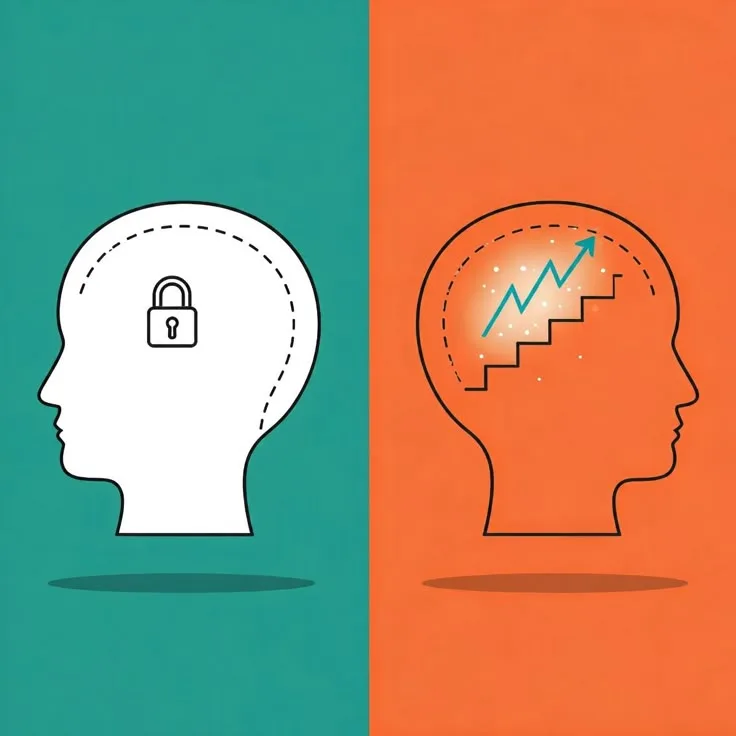
Growth mindset frames abilities as developable through effective strategies, effort, feedback, and help, rather than as fixed traits that failure exposes. Exploring growth mindset clarifies why challenges can invite learning or threaten self-image. Research supports some benefits, but effects are modest and context-dependent, so praise and interventions should not exaggerate what the framework can achieve.
What Is Growth Mindset?
Growth mindset is the belief that intelligence, abilities, and talents are qualities that can be developed through dedication, effective strategies, and learning from feedback - as opposed to a fixed mindset, which treats these capacities as static traits you either have or lack.
Developed by Stanford psychologist Carol Dweck through decades of research on how children respond to difficulty and failure, the framework proposes that beliefs about the nature of ability shape motivation, resilience, and achievement.[1]
Large-scale research has confirmed that growth mindset effects are real, though more modest and context-dependent than early popularizations claimed, making honest application of the framework dependent on understanding both its genuine insights and its limitations.
In 1988, a Stanford psychology professor named Carol Dweck published a series of studies on how fifth-grade students responded to difficulty.
She and her colleagues had noticed something striking in earlier work: some children who encountered an obstacle became energized by it, treating it as a puzzle to solve, while other children with equivalent or higher measured ability fell apart, attributing failure to a lack of ability they felt unable to change.
The difference, Dweck theorized, lay not in intelligence but in beliefs about intelligence - specifically, whether children believed their ability was a fixed entity they possessed or an expandable quality they could develop.
Those early observations generated a theoretical framework that Dweck refined over the next two decades, named in her 2006 book Mindset: The New Psychology of Success, and that eventually became one of the most widely cited concepts in education, management, sports psychology, and popular self-help culture.
The growth mindset idea - that believing abilities can be developed produces better outcomes than believing they are fixed - is now cited in school district improvement plans, corporate learning-and-development programs, parenting books, and coaching frameworks across the world.
The popularity is both a testament to the framework's intuitive appeal and a source of genuine concern among researchers who study it carefully.
Large-scale replication efforts have found effects that are real but modest, highly context-dependent, and often absent in populations where commercial growth mindset programs are aggressively marketed.
The gap between what the research actually shows and what the growth mindset industry has promised is significant enough that even Dweck herself has publicly acknowledged widespread misapplication.[9]
Understanding both the genuine insights and the honest limitations is necessary for applying the framework usefully rather than naively.
"In a growth mindset, challenges are exciting rather than threatening. So rather than thinking, oh, I'm going to reveal my weaknesses, you say, wow, here's a chance to grow." - Carol Dweck, Stanford commencement address, 2014
Key Definitions
Growth mindset: The belief that intelligence, abilities, and talents are qualities that can be developed through dedication, effective strategies, and help from others. Associated with greater resilience in the face of setbacks and a tendency to embrace challenging tasks.[11]
Fixed mindset: The belief that intelligence and abilities are static traits - you either have them or you do not. Associated with performance-avoidance goals, sensitivity to failure as evidence of low ability, and avoidance of challenging tasks where failure is possible.
| Dimension | Fixed Mindset | Growth Mindset |
|---|---|---|
| Belief about ability | Abilities are fixed traits you either have or lack | Abilities can be developed through effort and learning |
| Response to failure | Failure means you lack ability; avoid it or hide it | Failure is information; it shows where to grow |
| Response to challenges | Avoid challenges to protect self-image | Embrace challenges as learning opportunities |
| Response to criticism | Defensive; criticism threatens identity | Useful feedback to improve |
| Others' success | Threatening - if they succeed, I look worse | Inspiring - evidence that growth is possible |
Implicit theory of intelligence: Dweck's original academic term for the beliefs people hold about whether intelligence is an entity (fixed) or incremental (developable).[8] The growth/fixed mindset labeling came later in her popular writing.
Neuroplasticity: The brain's ability to form new neural connections and reorganize existing ones in response to learning and experience. Frequently cited in growth mindset interventions as scientific grounding for the belief that ability can be developed.
Mindset intervention: A structured educational or psychological program designed to shift students' or employees' beliefs from fixed to growth orientation, typically through education about neuroplasticity, attribution training, and reflection exercises.
The Original Research: Dweck and Mueller (1998)
The most direct experimental evidence for the power of mindset-consistent feedback came from Dweck's collaboration with Claudia Mueller, published in 1998 in the Journal of Personality and Social Psychology.[2] The study used a clean experimental manipulation: after an initial test, children received one of three types of feedback.
One group was praised for their intelligence ("You must be smart at these problems"). A second group was praised for their effort ("You must have worked really hard"). A third group received neutral informational feedback.
What followed differentiated the groups strikingly. When subsequently offered a choice between an easy task and a challenging one that would teach them new things, children praised for intelligence chose the easy task significantly more often than children praised for effort.
When all groups were given a difficult set of problems (designed to make everyone struggle), intelligence-praised children showed greater performance decline, reported less enjoyment, and were more likely to attribute their difficulty to low ability than effort-praised children.
In a final round of problems at the original difficulty level, intelligence-praised children showed lower performance than in the initial round, while effort-praised children showed improved performance.
The study also found that when asked to report their scores to a peer, intelligence-praised children were significantly more likely to lie - inflating their performance - than effort-praised children.
The mechanism was clear: praise for intelligence activated entity beliefs (my performance reflects my ability level), which made subsequent difficulty threatening. Praise for effort activated incremental beliefs (my performance reflects how hard I tried), which made difficulty a natural part of the learning process.
The study has been widely replicated in its broad outlines, though effect sizes in replications have generally been smaller than in the original. The finding that praise type matters for subsequent learning behavior is among the better-supported specific findings in the mindset literature.
The Neuroplasticity Connection: Pascual-Leone and the Brain Change Evidence
A critical component of growth mindset interventions is teaching students that intelligence is not fixed because the brain changes with learning.
This claim rests on neuroplasticity research - the finding that the brain is not hardwired in early development but continues to form new neural connections, prune existing ones, and reorganize in response to experience throughout life.
Alvaro Pascual-Leone's research at Harvard Medical School provided some of the most striking demonstrations.[6]
His 1995 study using transcranial magnetic stimulation (TMS) mapped the cortical representation of finger movements in blind individuals who read Braille - and found that the cortex devoted to Braille-reading fingers was substantially expanded compared to sighted controls, extending into regions normally devoted to vision.
The brain had reorganized in response to skill demand.
A 2004 study following medical students through examination periods showed measurable changes in gray matter density in memory-related regions during intense study, with partial regression during the exam recess.
The broader neuroplasticity literature - including landmark work on London taxi drivers' expanded hippocampal navigation areas (Maguire et al.[7] 2000) and adult musicians' enlarged motor cortex representations - firmly establishes that the brain changes structurally and functionally in response to learning and practice.
Using this evidence in growth mindset interventions to communicate "your brain can change" is scientifically accurate as a general point.
The question - where the intervention literature gets more complicated - is whether demonstrating this general biological principle reliably translates into changed attributions and improved academic outcomes.
Large-Scale Replications: What the Evidence Actually Shows
Sisk et al. 2018 Meta-Analysis
In 2018, Victoria Sisk and colleagues published a pre-registered meta-analysis of 43 studies examining the relationship between growth mindset and academic achievement.[3] The findings were more modest than the popular narrative suggested.
The average correlation between implicit theories of intelligence (mindset) and academic achievement was r=0.10 - a small effect. Mindset interventions showed an average effect size of d=0.10 on academic achievement outcomes - also small, comparable in magnitude to a few weeks of additional instruction at typical rates.
For context, effect sizes typically considered educationally meaningful (enough to matter for policy and practice) are usually d=0.40 or greater.[10]
However, the meta-analysis found significant moderation: effects were larger and more consistent for students from lower socioeconomic backgrounds.
This suggests that growth mindset interventions may be genuinely useful for students whose academic challenges are partly attributable to threat-related appraisals of ability (common among students who have received messages - explicit or implicit - that people like them are not academic achievers), while being redundant or ineffective for students who already hold growth-oriented beliefs.
Yeager et al. 2019: The National Study of Learning Mindsets
The most methodologically rigorous large-scale test of growth mindset intervention was published in Science in 2019 by David Yeager and Carol Dweck's research group.[4]
The National Study of Learning Mindsets was a randomized controlled trial conducted across 76 nationally representative US public high schools, involving approximately 12,490 ninth-grade students.
The intervention was brief: two 25-minute online sessions in which students read about neuroplasticity, wrote letters to younger students explaining that the brain grows with challenge, and were introduced to growth mindset framing of academic difficulty.
The average effect on grade point average was modest: approximately 0.10 GPA points - about a quarter of a letter grade.
But the moderating patterns were more informative than the average effect. The intervention had significantly larger effects for students who were underperforming academically (below the class median GPA at their school).
For low-performing students, the effect on GPA was approximately 0.19 points, and the probability of taking advanced mathematics courses the following year increased by approximately 8 percentage points.
Critically, Yeager and colleagues found that the effect depended on the school context: the intervention was significantly more effective in schools where teachers held growth-oriented beliefs about students' potential.
In schools where teachers held fixed beliefs about student ability, the student-level mindset intervention showed attenuated effects - suggesting that changing individual beliefs without changing the surrounding institutional context produces limited benefits.
Li and Bates (2019): A Contrary Finding
Not all large-scale studies find positive effects. Li and Bates (2019) examined growth mindset and academic achievement in a large, longitudinal UK sample using both correlational and quasi-experimental methods.
They found no significant effect of mindset beliefs on academic achievement when controlling for prior achievement and socioeconomic status.[5]
The paper argued that in this sample, mindset was not an independent predictor of achievement - the apparent relationship in simpler analyses was largely accounted for by prior ability and background.
Li and Bates's findings were contested by Dweck's research group, who argued that the measure of mindset used was not adequately validated and that the null result reflected methodological limitations rather than a genuine absence of effect.
The exchange illustrates the contested nature of the evidence base and the importance of not treating any single study as definitive.
The Implementation Problem: False Growth Mindset in Practice
Carol Dweck has written explicitly about what she calls the "false growth mindset" problem: the widespread adoption of growth mindset language without the substantive implementation necessary to make it effective.
False growth mindset takes several forms:
Effort praise without strategy. Teachers who praise students for trying hard regardless of whether effective strategies are being used do not implement growth mindset research; they implement a distorted version of it.
The Mueller and Dweck (1998) research showed that effort praise produces better outcomes than ability praise - but effort praise works because it focuses children on controllable factors (what they did) rather than fixed traits.
Praising effort when a child is using an ineffective strategy does not help them learn; it validates the ineffective strategy.
Growth mindset as slogan. Organizations and schools that post growth mindset posters, use the terminology in communications, and require staff to complete growth mindset training without changing evaluation practices, resource allocation, or how difficulty and failure are responded to institutionally are performing growth mindset, not practicing it.
Yeager's finding that school culture moderates intervention effects directly implies that organizational context determines whether individual mindset change produces behavioral change.
Fixed structures with growth language. Tracking students into ability groups while telling them their abilities can grow is a structural contradiction.
Students who are streamed into lower-level courses receive a powerful institutional message about their ability level that undermines whatever growth mindset message is delivered in the classroom.
The implementation problem is not simply about teacher communication; it is about alignment between stated beliefs and institutional practices.
Dweck has been direct about this: the commercial growth mindset industry - the programs, the assessments, the training packages - has often sold something much simpler and less effective than the research-based framework actually requires.
Criticisms and the Replication Landscape
Beyond Li and Bates, the growth mindset literature has faced several other challenges.
Scott Alexander's analysis of the replication record noted that many of the original impressive effects came from small, highly controlled laboratory studies with researcher-administered interventions, while large pre-registered field trials consistently find smaller effects.
This "lab to field" attenuation is common across psychology but is particularly pronounced in growth mindset research.
The mechanisms proposed - that mindset interventions work by changing implicit theories of intelligence, which then change attribution patterns, which then change persistence and achievement - have been difficult to demonstrate in chain form in large-scale studies.
Many intervention studies show outcome effects without demonstrating the proposed mediating mechanism.
The claim that growth mindset is more important than actual ability has not been supported. Meta-analyses consistently find that prior achievement, cognitive ability, and socioeconomic status explain substantially more variance in academic outcomes than mindset beliefs.
Growth mindset appears to be a modest moderator, not a primary driver.
What Is Actually Supported and How to Apply It
The research does support several conclusions worth taking seriously:
Implicit theories matter at the margins. For students who are struggling and who have internalized messages about fixed ability, growth mindset interventions - when well-implemented and culturally aligned - can produce meaningful improvements.
The effect is not transformative across the board but can be real for the students who need it most.
Praise type matters. The specific finding that process-focused feedback (what you did, how you approached it) produces better learning responses than ability-focused feedback is well-replicated and practically implementable without a full organizational overhaul.
Context matters as much as individual belief. Mindset interventions work better in environments that actually respond to growth with opportunity, not just in environments that say they do. Changing individuals without changing systems is limited.
Effort alone is not the message. The simplified version - "just try harder, anything is possible" - is not what the research supports and can be harmful if it implies that effort is sufficient without access to effective strategies, appropriate challenge level, and adequate resources.
Neuroplasticity is real; specific skill development is real; general intelligence as a fixed ceiling may not be. The scientific grounding of growth mindset in brain plasticity research is valid as a general biological principle.
What it does not establish is that any particular ability can be developed to any level with sufficient effort - the relevant question for most academic and professional contexts.
For related frameworks on learning and the cognitive basis of skill development, see the articles on why most learning fails and learning myths that refuse to die.
Sources & Further Reading
- Dweck, C.S. Mindset: The New Psychology of Success. Random House, 2006. View source
- Mueller, C.M. & Dweck, C.S. "Praise for Intelligence Can Undermine Children's Motivation and Performance." Journal of Personality and Social Psychology, 75(1), 33-52, 1998. DOI: 10.1037/0022-3514.75.1.33
- Sisk, V.F., Burgoyne, A.P., Sun, J., Butler, J.L., & Macnamara, B.N. "To What Extent and Under Which Circumstances Are Growth Mind-Sets Important to Academic Achievement?" Psychological Science, 29(4), 549-571, 2018. DOI: 10.1177/0956797617739704
- Yeager, D.S., Hanselman, P., Walton, G.M., Murray, J.S., Crosnoe, R., Muller, C., Tipton, E., Schneider, B., Hulleman, C.S., Hinojosa, C.P., Paunesku, D., Romero, C., Flint, K., Roberts, A., Trott, J., Iachan, R., Buontempo, J., Yang, S.M., Carvalho, C.M., ... Dweck, C.S. "A National Experiment Reveals Where a Growth Mindset Improves Achievement." Science, 365(6451), 2019. DOI: 10.1126/science.aam8433
- Li, Y. & Bates, T.C. "You Can't Change Your Basic Ability, But You Work at Things, and That's How We Get Hard Work and Push Ourselves to Do Better: Testing the Role of Growth Mindset on Response to Setbacks, Educational Attainment, and Cognitive Ability." Journal of Experimental Psychology: General, 148(9), 1640-1655, 2019. DOI: 10.1037/xge0000669
- Pascual-Leone, A., Amedi, A., Fregni, F., & Merabet, L.B. "The Plastic Human Brain Cortex." Annual Review of Neuroscience, 28, 377-401, 2005. DOI: 10.1146/annurev.neuro.27.070203.144216
- Maguire, E.A., Gadian, D.G., Johnsrude, I.S., Good, C.D., Ashburner, J., Frackowiak, R.S.J., & Frith, C.D. "Navigation-Related Structural Change in the Hippocampi of Taxi Drivers." PNAS, 97(8), 4398-4403, 2000. DOI: 10.1073/pnas.070039597
- Blackwell, L.S., Trzesniewski, K.H., & Dweck, C.S. "Implicit Theories of Intelligence Predict Achievement Across an Adolescent Transition." Child Development, 78(1), 246-263, 2007. DOI: 10.1111/j.1467-8624.2007.00995.x
- Dweck, C.S. "The Perils and Promises of Praise." Educational Leadership, 65(2), 34-39, 2007. View source
- Hattie, J. Visible Learning: A Synthesis of Over 800 Meta-Analyses Relating to Achievement. Routledge, 2009. View source
- Yeager, D.S. & Dweck, C.S. "Mindsets That Promote Resilience: When Students Believe That Personal Characteristics Can Be Developed." Educational Psychologist, 47(4), 302-314, 2012. DOI: 10.1080/00461520.2012.722805