
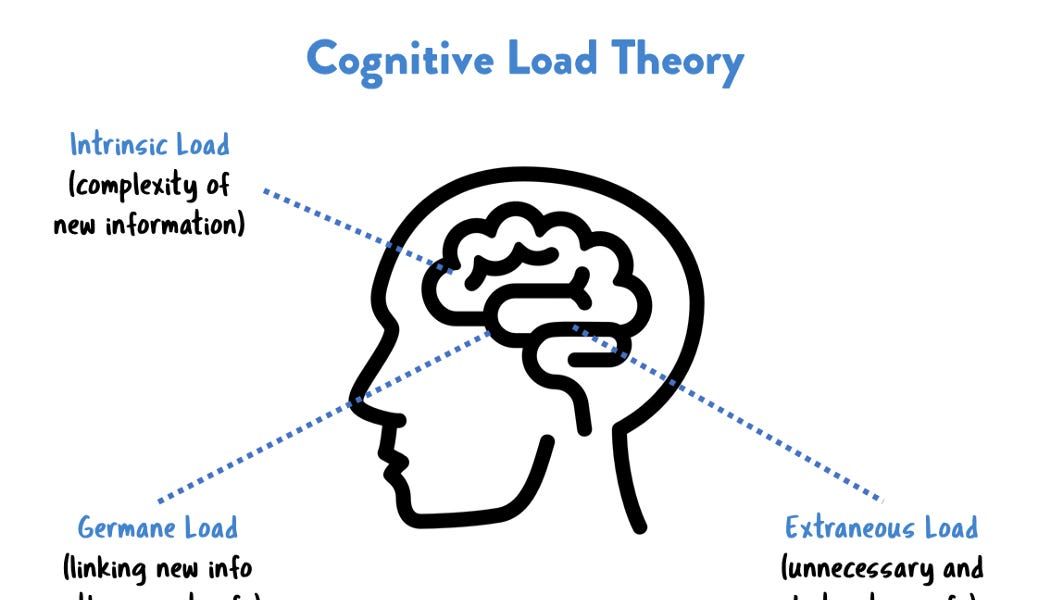
Working memory has limited capacity, so instruction and problem-solving can fail when too many elements must be processed at once. Cognitive load theory explains why the design of information and tasks matters: overload can reduce performance even when the material itself is important.
In 1956, a Harvard psychologist named George A. Miller published what would become one of the most cited papers in the history of cognitive science.
The paper, "The Magical Number Seven, Plus or Minus Two: Some Limits on Our Capacity for Processing Information," appeared in Psychological Review (63(2), 81-97) and presented a deceptively simple claim: human working memory can hold approximately 7 2 distinct chunks of information at one time.
Too few items and the mind is underutilized. Too many and performance collapses. Miller arrived at this figure by reviewing experiments on immediate memory span across different types of stimuli - digits, letters, words, musical tones - and finding a consistent ceiling clustered around seven units.[1]
Miller's paper did not explain why the limit existed, nor did it say much about what should be done with this finding in practical settings. That would take another three decades and a different researcher working in an entirely different field: educational psychology.
In 1988, John Sweller, then at the University of New South Wales, published "Cognitive Load During Problem Solving: Effects on Learning" in Cognitive Science (12(2), 257-285).
The paper was a direct response to a puzzle in educational research: students given problems to solve often learned less than students given worked examples to study. This was counterintuitive. Solving problems actively seemed more engaging than passively reading solutions.
Yet the data showed the opposite. Sweller's explanation drew on Miller's capacity constraints and on Alan Baddeley's model of working memory: problem-solving, as conventionally taught, imposes demands on working memory that consume resources otherwise available for learning.[2]
The schema - the organized, reusable knowledge structure - does not form because the learner's mental capacity is fully consumed by managing the problem itself rather than understanding the underlying principles.
This was the birth of Cognitive Load Theory. In the three decades since, CLT has generated hundreds of empirical studies, influenced curriculum design in medicine, software engineering, mathematics, and user interface design, and prompted a fundamental rethinking of what instruction is actually supposed to do to the mind.
"Working memory is limited in capacity. Instruction that ignores this fundamental fact is doomed to be less effective than it could be." - John Sweller, 1988
Definition
Cognitive Load Theory holds that effective instruction must be designed to manage the total demands placed on working memory so that cognitive capacity is directed toward building durable long-term memory schemas rather than wasted on avoidable processing overhead.
The Three Types of Cognitive Load
The most consequential conceptual move in CLT's development came in a 1998 paper by Sweller, Jeroen van Merrinboer, and Fred Paas, "Cognitive Architecture and Instructional Design," published in Educational Psychology Review (10(3), 251-296).[4]
The paper formalized a tripartite taxonomy that had been implicit in earlier work: intrinsic load, extraneous load, and germane load. These three categories are additive - they sum to total cognitive load - and their relationship to instruction is fundamentally different.
| Dimension | Intrinsic Load | Extraneous Load | Germane Load |
|---|---|---|---|
| Source | The inherent complexity of the material itself | The way information is presented or structured | Effort directed at schema formation and automation |
| Determined by | Element interactivity - how many concepts must be held simultaneously | Instructional design choices, layout, redundancy | Depth of processing applied to meaningful learning |
| Controllable? | Partially - can be sequenced or segmented | Fully - a design problem | Partially - can be encouraged by design |
| Effect on learning | Unavoidable cost; represents the subject matter | Waste - consumes capacity without producing schemas | Productive - this is where learning actually happens |
| Example | Learning calculus requires holding limits, derivatives, and function behavior simultaneously | Presenting a diagram with a separate caption that repeats the same information forces double-processing | Comparing two worked examples to abstract a general principle |
| Design response | Sequence from simple to complex; isolate elements initially | Eliminate redundancy; integrate labels directly into diagrams; reduce navigation demands | Provide comparison tasks, variability, and reflection prompts |
The three-type taxonomy was controversial. Germane load in particular attracted criticism because it is difficult to measure independently of the other two: any reduction in extraneous load might simply free up capacity that learners then apply to schema formation.
By around 2010, Sweller himself acknowledged that germane load may not be a distinct type but rather a description of how freed capacity is used. The taxonomy remains instructionally useful as a framework for design decisions even if its status as a precise psychological model is debated.
Cognitive Architecture: The Scientific Foundations
CLT does not rest on Miller alone. Its architecture draws on a converging set of findings across cognitive psychology and neuroscience.
Working Memory: Baddeley and Hitch
In 1974, Alan Baddeley and Graham Hitch published a revised model of short-term memory in The Psychology of Learning and Motivation (8, 47-89), replacing the earlier Atkinson-Shiffrin model with a more structured architecture.
Baddeley's working memory system consists of a phonological loop (for verbal and auditory information), a visuospatial sketchpad (for visual and spatial information), and a central executive (an attention-controlling system that coordinates both).[5]
A later addition, the episodic buffer, links working memory to long-term memory.
This architecture matters for CLT because the phonological loop and visuospatial sketchpad are separate processing channels.
Instruction that presents information simultaneously in both auditory and visual modalities can partially double the effective capacity of working memory - a principle van Merrinboer and Sweller developed into what became known as the modality effect.
Text spoken aloud while a diagram is viewed can be learned more efficiently than the same text presented visually beneath the diagram, because separate processing channels are engaged.
Long-Term Memory: Schema Theory
The theoretical complement to working memory constraints is schema theory, developed in the 1970s and 1980s by researchers including Frederic Bartlett (Remembering, 1932) and Richard Anderson ("The notion of schemata and the educational enterprise," 1977).
Most directly for CLT purposes, the theory was extended by researchers in expertise and chess knowledge such as Adriaan de Groot (1946, Thought and Choice in Chess) and Chase and Simon (1973, "Perception in chess," Cognitive Psychology, 4(1), 55-81).
Chase and Simon showed that chess masters could reconstruct a mid-game board after a brief exposure, while novices could not - but only when the pieces were in legal positions.[6] Scrambled positions erased the advantage. The masters were not storing individual piece locations; they were storing chunks - patterns of pieces - as single units.
This chunking is the schema: a compressed representation of organized information that can be retrieved and applied as a single cognitive element.
For CLT, this is the goal of instruction: to move information from working memory into long-term memory as organized schemas. Once a schema is acquired, it can be retrieved and used without burdening working memory substantially.
A chess master sees a "castled king with a fianchettoed bishop" as one unit, not as seven separate piece positions. An expert programmer reads a for-loop as a single meaningful chunk, not as seven discrete syntactic elements.
Element Interactivity
The concept of element interactivity - introduced by Sweller in 1994 ("Cognitive load theory, learning difficulty, and instructional design," Learning and Instruction, 4(4), 295-312) - provides the mechanism linking intrinsic load to material complexity.
High element interactivity means that understanding a concept requires simultaneously holding many other concepts in working memory because they are mutually dependent. Low element interactivity means elements can be understood in isolation.
Grammatical rules in a foreign language have high element interactivity: understanding verb conjugation in a sentence requires simultaneously knowing the subject, tense, mood, and vocabulary. A list of vocabulary items has low element interactivity: each word can be memorized independently.
Sweller's prediction is straightforward - high element interactivity material should be segmented, simplified initially, and presented with additional scaffolding to prevent working memory overload.
Four Named Case Studies
Case Study 1: The Worked Example Effect in Secondary School Mathematics (Education)
In 1985, Sweller and Graham Cooper published "The Use of Examples as a Substitute for Problem Solving in Learning Algebra" in Cognition and Instruction (2(1), 59-89). The study compared two conditions for teaching algebra to secondary school students.
One group was given conventional problem sets to solve. The other was given pairs of worked examples - problems shown with complete, step-by-step solutions - followed by a smaller number of practice problems to solve independently.
The results were consistent and replicable: students who studied worked examples required less time to learn, made fewer errors on transfer tests, and showed higher performance on novel problems than students who solved conventional problem sets.[3]
The worked example group acquired the schema more efficiently because cognitive capacity was not consumed by means-ends analysis (the strategy of constantly comparing the current state to the goal state, which generates high extraneous load while producing little schema development).
This finding has since been replicated across mathematics, physics, statistics, chess, and programming, with effect sizes large enough to be considered among the most robust findings in educational psychology.
A meta-analysis by Atkinson, Derry, Renkl, and Wortham in 2000 (Review of Educational Research, 70(2), 181-214) reviewed 38 studies and confirmed the consistency of the effect.
Case Study 2: Progressive Disclosure in User Interface Design (UX Design)
The split-attention effect, identified by Sweller, Chandler, Tierney, and Cooper in 1990 ("Cognitive Load as a Factor in the Structuring of Technical Material," Journal of Experimental Psychology: General, 119(2), 176-192), describes what happens when learners must visually integrate information from two sources that are physically or temporally separated.
A circuit diagram with component labels printed on a separate legend requires the learner to mentally hold and shuttle information between two locations. This search-and-integrate process consumes working memory without contributing to schema formation.
Applied to user interface design, the split-attention effect predicts that interfaces which require users to look in one location to understand information displayed in another will degrade performance and increase error rates.
A study by Sweller and colleagues confirmed that integrating labels directly into diagrams - rather than using a separate legend - significantly reduced errors and solution time in technical tasks.
Google's design team applied a related principle in the redesign of Google Maps in 2013. Progressive disclosure - showing minimal controls by default and revealing additional options on demand - reduces the number of interface elements that users must hold in working memory at any moment.
Usability testing showed a reduction in task completion time for new users, attributable in part to reduced extraneous cognitive load from a simpler initial interface state.
The connection between split-attention research and interface design was formalized by Sweller and van Merrinboer in multiple reviews, and later synthesized by researchers including Richard Mayer, whose Cognitive Theory of Multimedia Learning (Multimedia Learning, Cambridge University Press, 2001) extended CLT principles specifically to screen-based instruction and interface design.
Case Study 3: Anaesthesia Training and the Redundancy Effect (Medicine)
The redundancy effect, formally described by Sweller and Chandler in 1994 ("Why Some Material Is Difficult to Learn," Cognition and Instruction, 12(3), 185-233), holds that presenting the same information in two formats simultaneously - such as reading a text while the same text is spoken aloud - can actually impair learning relative to presenting it in only one format.
The learner's working memory must process the same content twice, and the effort to reconcile or suppress the redundant channel consumes capacity.
In anaesthesia education, this has direct implications. Traditional training often combined on-screen procedural text with an instructor narrating the same text verbatim.
An intervention studied at the University of Sydney School of Medicine in the early 2000s (described in reviews by Sweller and colleagues) replaced redundant narration with visual-only presentations for procedural content, and reserved the audio channel for additional, non-redundant information - clinical reasoning commentary, common errors, and contextual considerations.
Trainees in the revised program showed faster acquisition of technical procedures and scored higher on procedural accuracy assessments. The gain was attributed specifically to the elimination of redundant information that had been consuming the auditory-verbal channel of working memory without adding content.
The redundancy effect also has a counterintuitive boundary: for learners with high prior knowledge, a worked example with both text and diagram may actually be redundant, because the learner can already derive the diagram's meaning from the text alone.
This boundary condition connects to what Kalyuga, Ayres, Chandler, and Sweller (2003) named the expertise reversal effect.[7]
Case Study 4: Code Review and the Expertise Reversal Effect in Software Engineering (Software)
In 2003, Slava Kalyuga, Paul Ayres, Paul Chandler, and John Sweller published "The Expertise Reversal Effect" in Educational Psychologist (38(1), 23-31).
The paper documented a phenomenon that had been appearing in CLT research for years but had not been formally named: instructional techniques that reduce cognitive load for novices can increase it for experts.
The mechanism is schema-based. A novice studying a worked example gains from the scaffolding because the schema does not yet exist.
An expert already has the schema; the worked example forces the expert to suppress or reconcile the explicit procedural guidance with the implicit automated knowledge they already possess. The instruction becomes redundant, even intrusive.
In software engineering training, this effect appears in code review practices. Junior developers benefit substantially from annotated code reviews - comments that explain not just what to change, but why, with explicit reasoning for each decision.
Senior developers, given the same annotated format, perform worse on subsequent review tasks than seniors given minimal annotations or diff-only views. The redundant explanations for knowledge the expert already holds create extraneous load by forcing the expert to process information they do not need and cannot simply ignore.
A study at Microsoft Research, described by researchers including Andrew Ko and Brad Myers in work on program comprehension, found that the format of code review feedback should be adaptive: novices need more scaffolding, while experts perform better with compressed, reference-style feedback that trusts their existing schemas.
This has influenced the design of code review tools that allow differential annotation density based on reviewer experience level.
Intellectual Lineage
Cognitive Load Theory did not emerge from a vacuum. Its genealogy runs through several converging traditions.
The most direct ancestor is information-processing psychology, which began displacing behaviorism in the late 1950s.
George Miller's 1956 paper was part of this shift - along with Newell and Simon's work on problem-solving as search through a problem space, and Chomsky's 1959 review of Skinner's Verbal Behavior, which demonstrated that stimulus-response accounts could not explain language acquisition.
The new paradigm treated the mind as a computational system with limited capacity and distinct processing stages.
The second ancestral strand is schema theory. The idea that knowledge is organized into abstract structures dates to Frederic Bartlett's 1932 Remembering, which showed that people's recall of stories was distorted by existing knowledge structures.
The term "schema" in a computational sense was developed by Jean Piaget, and later formalized for cognitive science by Rumelhart and Ortony ("The Representation of Knowledge in Memory," 1977) and by Anderson and colleagues at Carnegie Mellon University.
The third strand is expertise research. Chase and Simon's chess studies, de Groot's earlier work, and subsequent research by Ericsson and colleagues on deliberate practice all demonstrated that expert-novice differences lie primarily in the organization and accessibility of long-term memory schemas, not in general reasoning capacity.
This finding made the schema the natural target of instructional design: the goal of instruction is to produce organized, automated schemas, and working memory is the bottleneck through which all new information must pass on its way to long-term storage.
Sweller synthesized these strands into a theory with direct prescriptive implications. Unlike pure cognitive psychology, CLT was developed to tell instructional designers what to do differently.
This practical orientation accelerated its adoption and also generated the empirical program that has tested and refined its predictions over four decades.
Empirical Research
The empirical record supporting CLT is extensive. A 2019 meta-analysis by Mutlu-Bayraktar, Cosgun, and Altan (Computers and Education, 141) reviewed 233 studies and found an overall mean effect size of d = 0.51 for CLT-based instructional interventions relative to controls - a medium effect by Cohen's convention, but unusually consistent across domains and age groups.
The worked example effect has been replicated across algebra (Sweller and Cooper, 1985), geometry (Paas and van Merrinboer, 1994, Journal of Educational Psychology, 86(1), 122-133), physics (van Gog, Paas, and van Merrinboer, 2006, Journal of Experimental Education, 74(3), 177-191), chess (de Groot, 1946), and computer programming (Trafton and Reiser, 1993).
Effect sizes range from d = 0.4 to d = 1.2 depending on the domain and the baseline competence of participants.
The modality effect - that learning is enhanced when words are spoken rather than printed when accompanied by diagrams - was tested systematically by Mousavi, Low, and Sweller in 1995 ("Reducing Cognitive Load by Mixing Auditory and Visual Presentation Modes," Journal of Educational Psychology, 87(2), 319-334).[8]
Across multiple experiments, the auditory-visual condition consistently outperformed the visual-only condition, with effect sizes around d = 0.7.
The expertise reversal effect has been confirmed in studies by Kalyuga and colleagues across mathematics, physics, and language learning, and its boundary conditions have been explored in over 30 subsequent studies.
The consistent finding is that the magnitude of the expertise reversal grows with increasing prior knowledge, suggesting a smooth interaction between schema acquisition and optimal instructional format rather than a sharp novice-expert dichotomy.
Germane load interventions - tasks designed to encourage schema formation rather than merely reduce extraneous load - show more variable results.
Van Gog and Rummel (2010, "Example-based learning: Integrating cognitive and social-cognitive research perspectives," Educational Psychology Review, 22(2), 155-174) reviewed the evidence and concluded that germane load effects are real but smaller and more context-dependent than intrinsic and extraneous load effects.
The split-attention effect has been particularly influential in applied domains.
A 2004 study by Mayer and Moreno ("Nine Ways to Reduce Cognitive Load in Multimedia Learning," Educational Psychologist, 38(1), 43-52) reviewed 15 years of research and identified specific design principles - contiguity, signaling, segmenting, pre-training - each tied to a specific cognitive load mechanism and each supported by multiple replications.[11]
Limits and Nuances
CLT has attracted substantial critical attention, and several of its foundational assumptions have been questioned.
The Measurement Problem
The most persistent methodological challenge is that cognitive load itself is difficult to measure directly.
Researchers have relied on subjective rating scales (typically the 9-point scale developed by Paas in 1992), secondary task performance, physiological measures including pupil dilation and heart rate variability, and, more recently, EEG-based indices of mental workload.
These measures correlate imperfectly with each other and with learning outcomes, creating ambiguity about whether experiments are measuring what they claim to measure.
A careful review by Schnotz and Kurschner (2007, "A Reconsideration of Cognitive Load Theory," Educational Psychology Review, 19(4), 469-508) argued that the theory's empirical support is partly circular: researchers design instruction to be easier (lower extraneous load), learning improves, and this is attributed to reduced cognitive load without independent verification that load actually changed.
The Germane Load Debate
As noted earlier, germane load has been reconceived by Sweller and colleagues since 2010. In a 2011 paper, Sweller stated that germane load "should be subsumed under intrinsic cognitive load" - essentially acknowledging that the original three-way taxonomy overstated the distinctness of the categories.
This revision weakened the theory's predictive precision at the same time that it arguably made it more honest about what is known.
Individual Differences
CLT's predictions assume a relatively uniform working memory capacity across adult learners, adjusted for expertise. But working memory capacity varies substantially across individuals, and these variations predict learning outcomes independently of instructional design.
Researchers including Kirschner, Sweller, and Clark (2006, "Why Minimal Guidance During Instruction Does Not Work," Educational Psychologist, 41(2), 75-86) acknowledged individual differences but argued they do not undermine the main CLT predictions.
Critics including Jonassen and Rohrer (1999) contended that CLT-derived prescriptions fit some learners well and others poorly, and that the theory lacks a framework for handling this variation.
Motivation and Engagement
CLT focuses almost exclusively on cognitive processing and says relatively little about motivation, emotion, or engagement. A learner confronting material with high intrinsic load but strong intrinsic motivation may voluntarily invest additional effort and achieve schema formation that CLT would not predict.
Sweller's framework treats motivation as orthogonal to load, but empirical work by Plass, Moreno, and Brunken (Cognitive Load Theory, Cambridge University Press, 2010) has shown that emotional and motivational states modulate working memory capacity itself, complicating any model that treats capacity as fixed.
Ecological Validity
Many CLT experiments are conducted with brief instructional episodes, simple materials, and objective performance measures in controlled laboratory settings.
Whether the effects scale to the full complexity of classroom instruction over weeks or months - with all its social dynamics, motivational variation, and cumulative knowledge structures - remains an open question.[9]
Real classrooms involve teachers who adjust instruction dynamically, peers who provide explanation, and learners who regulate their own study strategies.
CLT has been extended to cover self-regulated learning (Paas, Tuovinen, van Merrinboer, and Darabi, 2005) but these extensions remain less empirically developed than the core theory.
The Discovery Learning Debate
CLT has been enlisted in a long-running argument about the relative merits of direct instruction versus discovery-based or inquiry-based learning. Kirschner, Sweller, and Clark (2006) argued that minimally guided instruction is ineffective for novices precisely because it fails to manage working memory load.[10]
This claim generated substantial pushback from researchers including Hmelo-Silver, Duncan, and Chinn (2007), who argued that well-designed inquiry-based instruction incorporates adequate guidance and that the Kirschner et al.
critique mischaracterized how good discovery learning programs actually work. The debate remains active and illuminates the limits of applying a laboratory-derived theory to complex pedagogical philosophies.
Conclusion
George Miller showed us that working memory is narrow. John Sweller showed us that this narrowness is not a defect to be worked around but a design constraint that instruction must respect and accommodate.
Cognitive Load Theory has generated a half-century of productive research, transformed the design of textbooks, medical training programs, software tutorials, and user interfaces, and provided an empirically grounded framework for evaluating why some instruction succeeds and other instruction fails.
Its core insight remains durable: the enemy of learning is not difficulty but misdirected cognitive effort. Intrinsic difficulty - the genuine complexity of the subject matter - must be met. Extraneous difficulty - difficulty created by poor design - can and should be eliminated.
The mental resources freed by eliminating extraneous load are the resources available for building the schemas that constitute real, durable, transferable knowledge.
That is not a small claim. It is, in practical terms, the difference between an instruction manual that teaches and one that merely informs, between a curriculum that builds expertise and one that induces the illusion of learning, between an interface that enables skilled performance and one that perpetually demands conscious attention.
Applied carefully, with awareness of its limits, Cognitive Load Theory is among the most useful analytical tools available for anyone who designs experiences meant to be understood.
Sources & Further Reading
Miller, G. A. (1956). The magical number seven, plus or minus two: Some limits on our capacity for processing information. Psychological Review, 63(2), 81-97.
Sweller, J. (1988). "Cognitive load during problem solving: Effects on learning. Cognitive Science, 12(2), 257-285."
Sweller, J., & Cooper, G. A. (1985). The use of worked examples as a substitute for problem solving in learning algebra. Cognition and Instruction, 2(1), 59-89.
Sweller, J., van Merrinboer, J. J. G., & Paas, F. G. W. C. (1998). Cognitive architecture and instructional design. Educational Psychology Review, 10(3), 251-296.
Baddeley, A. D., & Hitch, G. (1974). Working memory. In G. H. Bower (Ed.), The Psychology of Learning and Motivation (Vol. 8, pp. 47-89). Academic Press.
Chase, W. G., & Simon, H. A. (1973). Perception in chess. Cognitive Psychology, 4(1), 55-81.
Kalyuga, S., Ayres, P., Chandler, P., & Sweller, J. (2003). The expertise reversal effect. Educational Psychologist, 38(1), 23-31.
Mousavi, S. Y., Low, R., & Sweller, J. (1995). Reducing cognitive load by mixing auditory and visual presentation modes. Journal of Educational Psychology, 87(2), 319-334.
van Merrinboer, J. J. G., & Sweller, J. (2005). Cognitive load theory and complex learning: Recent developments and future directions. Educational Psychology Review, 17(2), 147-177.
Kirschner, P. A., Sweller, J., & Clark, R. E. (2006). Why minimal guidance during instruction does not work: An analysis of the failure of constructivist, discovery, problem-based, experiential, and inquiry-based teaching. Educational Psychologist, 41(2), 75-86.
Mayer, R. E., & Moreno, R. (2003). Nine ways to reduce cognitive load in multimedia learning. Educational Psychologist, 38(1), 43-52.
Further Reading
Paas, F. G. W. C., & van Merrinboer, J. J. G. (1994). Variability of worked examples and transfer of geometrical problem-solving skills: A cognitive-load approach. Journal of Educational Psychology, 86(1), 122-133.