
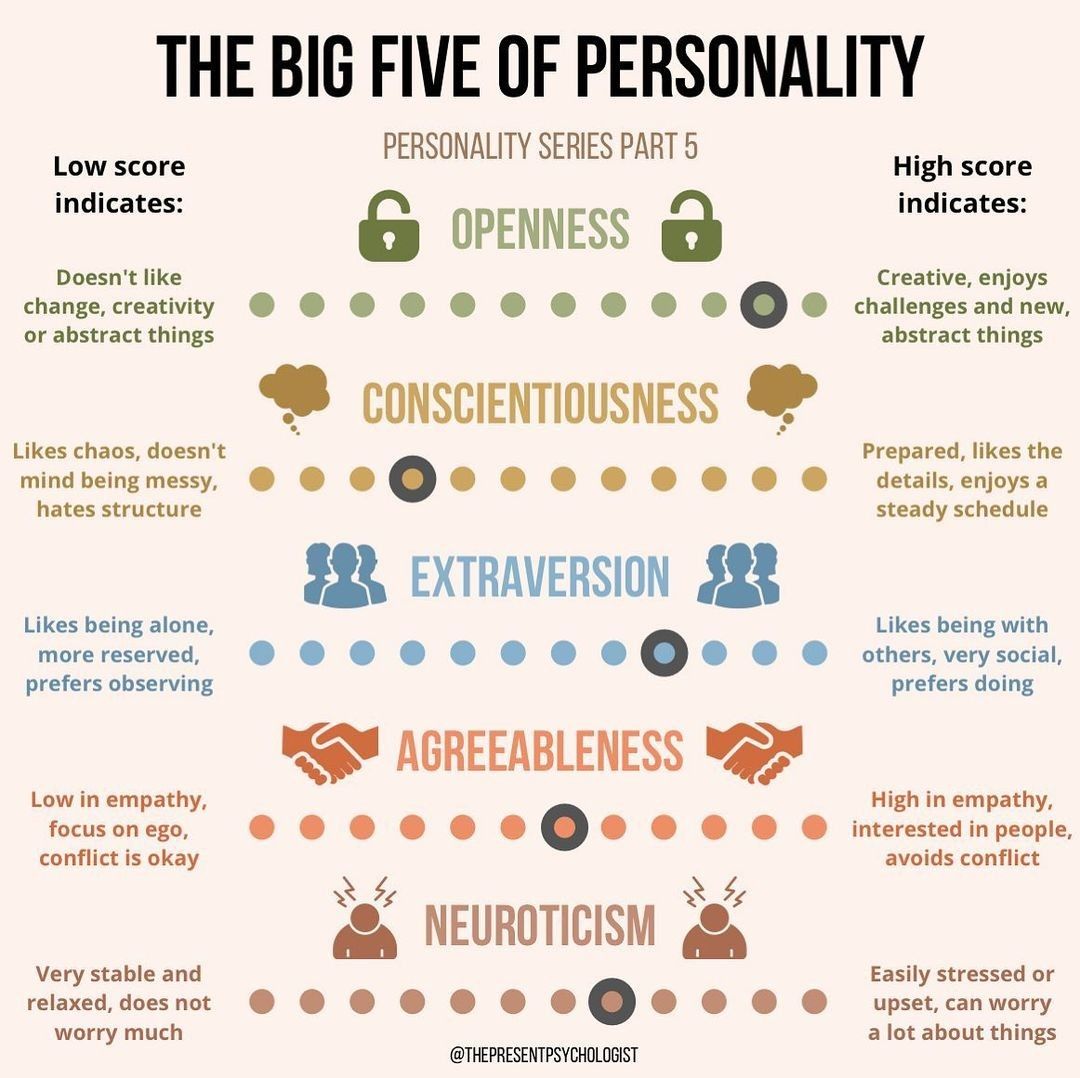
What is personality psychology? It examines stable patterns of thought, feeling, and behavior that distinguish people across time and situations. Trait research uses the lexical hypothesis and factor analysis to identify underlying dimensions of individual difference. The Big Five model, covering openness, conscientiousness, extraversion, agreeableness, and neuroticism, has strong support from independent research and links traits to important life outcomes.
Personality psychology is the branch of psychology that studies the stable, characteristic patterns of thought, feeling, and behavior that distinguish individuals from one another and persist across time and situations.
It asks why two people placed in identical circumstances respond so differently, why someone is reliably bold in one decade of life and reliably bold in the next, and what the underlying structure of individual differences actually looks like.
The field sits at the intersection of scientific rigor and something deeply human: the attempt to understand what, at the deepest level, makes each person who they are.
The stakes of this inquiry extend well beyond academic curiosity. Personality traits predict job performance, relationship quality, health behavior, academic achievement, and longevity with effect sizes comparable to those of established medical interventions.
Understanding personality psychology is not merely self-indulgence: it is a prerequisite for effective personnel decisions, clinical treatment, educational design, and self-understanding.
Foundations: Allport, the Lexical Hypothesis, and Early Trait Theory
The scientific study of personality as a formal subdiscipline is typically traced to Gordon Allport at Harvard, who in 1936 published a foundational paper with H.S. Odbert examining the vocabulary of personality description in the English language.
Allport and Odbert worked through an unabridged English dictionary and identified approximately 17,953 words that described personal characteristics.
Behind this exercise lay a powerful theoretical claim: the lexical hypothesis. The hypothesis holds that important personality differences will become encoded as single words in any language that has had sufficient time to develop vocabulary around them, because those differences matter for the social coordination of human communities.
If a trait is important enough that people regularly need to predict whether someone will be aggressive, reliable, or open to new experience, the language will grow words to describe it. This methodological foundation provided the basis for all subsequent statistical work on personality structure.
Allport himself was skeptical of purely statistical reductions of personality. He distinguished three levels of traits: cardinal traits (a single dominating passion that defines some lives, think of the way we refer to a Machiavellian or a narcissistic personality), central traits (the handful of main characteristics most people would mention when describing someone), and secondary traits (context-specific tendencies).
He insisted on the uniqueness of individuals through what he called idiographic as opposed to nomothetic understanding. Subsequent researchers moved decisively in the nomothetic, statistical direction.
From Words to Factors: Cattell's Contribution
Raymond Cattell took the lexical approach and applied the then-new technique of factor analysis to it systematically.
Beginning in the 1940s, Cattell reduced the Allport-Odbert word list through iterative clustering and factor analysis to arrive at 16 source traits, the basis for his 16PF (Sixteen Personality Factors) questionnaire, which remains in use today in organizational and clinical contexts.
Cattell's methodological contribution was significant: he demonstrated that the enormous vocabulary of personality description could be compressed into a much smaller number of underlying dimensions without losing essential structure.
His specific 16-factor solution has not proven robust: independent researchers using the same data have often found fewer factors, but his demonstration that factor analysis could extract meaningful personality structure from lexical data was foundational.
Hans Eysenck offered an influential competing framework in the same era, proposing a three-factor model emphasizing Extraversion, Neuroticism, and Psychoticism.
Eysenck grounded his model in biological theory: Extraversion, he argued, reflected individual differences in cortical arousal baseline, with introverts being chronically more aroused and therefore seeking less external stimulation.
This neurobiological ambition distinguished Eysenck's approach from more purely descriptive trait models and has continued to inspire biological approaches to personality.
The Big Five: Structure, Development, and Validity
The Big Five personality model, also known as the Five Factor Model or the OCEAN model, identifies five broad dimensions of personality that together capture the major axes of human individual difference.
The model emerged from decades of factor-analytic work and was independently developed by several research groups before converging on the same basic structure, a convergence that gave it substantial credibility.
Paul Costa and Robert McCrae at the National Institute on Aging developed the NEO Personality Inventory (NEO-PI), which became the standard instrument for Big Five measurement. Warren Norman's factor-analytic work in the 1963 had already found a similar five-factor solution from peer ratings.
Lewis Goldberg at the University of Oregon refined the lexical approach in the 1980s and 1990s, producing the influential International Personality Item Pool (IPIP) and advocating for the "Big Five" label.
The independent convergence of researchers using different data sets, different methods, and different theoretical starting points on the same five-factor structure remains the strongest argument for the model's validity.
| Dimension | High Scorer Characteristics | Key Outcome Associations |
|---|---|---|
| Openness to Experience | Curious, imaginative, aesthetically sensitive | Creativity, academic performance, ideological flexibility |
| Conscientiousness | Organized, responsible, self-disciplined | Job performance, academic achievement, health behaviors, longevity |
| Extraversion | Sociable, assertive, positive affect | Occupational success in people-oriented roles, leadership emergence |
| Agreeableness | Cooperative, trusting, empathic | Relationship quality, prosocial behavior |
| Neuroticism | Emotionally unstable, anxious, prone to negative affect | Mental health outcomes, relationship conflict |
The mnemonic OCEAN (or CANOE) summarizes the five. Conscientiousness has emerged as particularly consequential: meta-analyses by Brent Roberts and colleagues (2007, Journal of Personality and Social Psychology) identified it as the single best personality predictor of job performance, academic achievement, and health behaviors including longevity.
A large-scale study by Howard Friedman and colleagues following up the Terman "gifted children" study found that conscientious children in the early twentieth century lived measurably longer as adults, with effects comparable in size to those of established medical risk factors such as blood pressure.
The Big Five dimensions have several properties that have secured their broad acceptance in scientific psychology. They replicate across measurement methods (self-report, peer ratings, behavioral observation).
They show cross-cultural replication across more than 50 languages and diverse cultures, though relative factor strength and cultural expression vary.
They have substantial heritability: twin studies consistently estimate that roughly 40-60 percent of the variance in Big Five scores is attributable to genetic differences, with the remainder reflecting environmental influences, particularly non-shared environments (factors that make siblings in the same family different from each other).
"Tell me to what you pay attention and I will tell you who you are." (Jose Ortega y Gasset)
Facets Within the Five: Going Deeper Than OCEAN
An important limitation of discussing personality only at the Big Five level is that each dimension contains substantial internal heterogeneity. Conscientiousness, for example, encompasses at least six distinct facets: competence, order, dutifulness, achievement striving, self-discipline, and deliberation.
These facets can diverge: a person might be high in achievement striving but low in order, working intensely toward goals while maintaining a chaotic workspace.
Research increasingly shows that facet-level analysis provides substantially better prediction of specific outcomes than the broader domain scores.
Nuanced personality research by Mõttus, Kandler, and colleagues (2017, Journal of Personality and Social Psychology) has found that much of the predictive power of personality lies at the facet level and below, in specific, narrow traits that are partially obscured when they are averaged into broad domain scores.
This has implications for applied personality assessment: broad facets are useful for general predictions but inadequate for fine-grained occupational or clinical prediction.
The MBTI: Popularity, Problems, and the Science
The Myers-Briggs Type Indicator (MBTI) is the world's most widely administered personality assessment, used by an estimated 1.5 to 2 million people annually, predominantly in corporate settings, career counseling, and team-building programs.
It was developed by Isabel Briggs Myers and her mother Katharine Cook Briggs, neither a trained psychologist, based on Carl Jung's theory of psychological types from his 1921 work.
The MBTI classifies people into one of 16 types defined by combinations of four dichotomies: Extraversion/Introversion (E/I), Sensing/Intuition (S/N), Thinking/Feeling (T/F), and Judging/Perceiving (J/P). The result is a type label such as INTJ or ENFP.
Personality psychologists have raised several serious methodological objections:
Test-retest reliability is poor. When people retake the MBTI after weeks to months, a substantial proportion (in some studies exceeding 50 percent) receive a different type classification. This level of inconsistency is problematic for a measure claimed to assess stable personality.
The forced dichotomy is inconsistent with the data. The underlying dimensions appear to be continuous rather than bimodal: most people cluster in the middle rather than at the poles.
When continuous dimensions are artificially forced into two categories, small measurement variations near the boundary produce large apparent changes in type, explaining the poor test-retest reliability.
Correspondence with the validated Big Five structure is limited. The MBTI's four dimensions partially capture some Big Five dimensions (E/I maps reasonably onto Big Five Extraversion; J/P correlates with Conscientiousness; T/F correlates with Agreeableness), but Neuroticism is conspicuously absent, even though it is among the most predictively important dimensions in personality research.
Jung's theoretical framework, which emphasized psychological growth and type development, did not include the dimension that best predicts psychopathology and life outcomes.
Predictive validity for practical outcomes is modest. Despite widespread corporate use, the MBTI's prediction of job performance is substantially weaker than Conscientiousness from the Big Five. A review by Michael Ashton (2007) found effect sizes for MBTI job performance prediction roughly half those found for the Big Five.
These criticisms have not reduced the MBTI's commercial popularity but have largely excluded it from academic personality research.
The Person-Situation Debate
One of the most significant controversies in the history of personality psychology was triggered in 1968 when Walter Mischel of Stanford published "Personality and Assessment," challenging the basic premise of trait psychology.
Reviewing empirical evidence for behavioral consistency across situations, Mischel found that correlations between personality measures and actual behavior typically fell around 0.30, a ceiling he called the personality coefficient.
He argued that situational factors were far more powerful than personality traits and that the concept of stable cross-situational traits might be largely illusory.
The controversy this unleashed, known as the person-situation debate, ran for decades. Defenders of trait approaches pointed out that a correlation of 0.30 is not trivial: it is comparable to the effect of aspirin on heart attacks, which is considered clinically meaningful.
Seymour Epstein (1979) argued that the relevant question is not whether a single observation correlates with a personality measure, but whether behavior aggregated across many situations shows consistent patterns.
When aggregated, correlations with personality measures rise substantially, often exceeding 0.70 for well-measured traits compared with aggregated behavioral observations.
The resolution that most psychologists now accept is an interactionist position: behavior is a joint function of personality and situation.
Mischel himself contributed to the resolution through his concept of the behavioral signature: rather than behaving consistently across all situations, people have consistent if-then patterns (if this type of situation arises, then I tend to do this).
These patterns are what personality actually consists in. The debate raised methodological standards across the field and focused productive attention on measuring both personality and situation rather than inferring one from the other.
Personality Stability Across the Lifespan
The evidence on personality stability across the lifespan points to a nuanced picture: personality is moderately stable in the short to medium term, substantially stable over longer periods in adults, and shows predictable patterns of normative change.
Brent Roberts and colleagues articulated the cumulative continuity principle: rank-order stability of personality traits increases with age. In adolescence and early adulthood, personality is relatively labile.
By middle adulthood, rank-order stability of Big Five traits reaches its peak, with test-retest correlations over ten-year periods in the range of 0.60-0.75.
Roberts and Mroczek (2008, Current Directions in Psychological Science) identified the maturity principle: across cultures, people tend to become more conscientious, agreeable, and emotionally stable (lower neuroticism) from young adulthood into middle age, while extraversion and openness to experience decline modestly.
These changes parallel the demands of adult social roles (parenthood, career commitment, civic responsibility) and appear to reflect genuine personality development rather than merely situational adjustment.
| Trait | Direction of Mean Change: Young to Middle Adulthood |
|---|---|
| Conscientiousness | Increases |
| Agreeableness | Increases |
| Neuroticism | Decreases |
| Extraversion | Modest decrease |
| Openness | Modest decrease |
The relative contributions of genes and environment to personality change remain under study. While heritability of personality is substantial at any single time point, gene expression changes across the lifespan in ways that contribute to the maturity pattern.
Life experiences including stable partnerships, occupational demands, and significant adverse events can produce lasting personality change.
Can Personality Be Deliberately Changed?
A relatively recent research program has examined whether personality traits can change as a result of deliberate effort. Brent Roberts and colleagues (2017, Journal of Personality and Social Psychology) conducted a study in which participants set intentional goals to change specific personality traits over a 15-week period.
The results showed meaningful change in the targeted traits: participants who aimed to become more extraverted, more conscientious, or more open to experience showed movement on those dimensions as rated by themselves and by independent informants.
Nathan Hudson and Chris Fraley have conducted a series of studies (2015-2019) further documenting that personality change through volitional effort is possible, though the effect sizes are modest and the changes require sustained behavioral effort rather than mere intention.
This line of research has shifted the field away from a strictly deterministic view of personality and toward a more dynamic model in which traits are stable but not fixed.
The Dark Triad
The dark triad is a cluster of three overlapping but distinct personality traits that share a common core of callousness, manipulativeness, and disregard for others: narcissism, psychopathy, and Machiavellianism.
The term was introduced by Delroy Paulhus and Kevin Williams in a 2002 paper in the Journal of Research in Personality that demonstrated the three traits were measurably distinct while sharing significant statistical overlap.
Narcissism in the personality literature refers to the subclinical trait of grandiosity, entitlement, and need for admiration.
Research has found modest positive associations between narcissism and short-term social success (narcissists tend to make strong first impressions), but negative associations with relationship quality and long-term outcomes.
W. Keith Campbell and colleagues (2006, Journal of Personality) documented the "narcissistic paradox": narcissists are initially popular but become less liked over time as the gap between their self-image and actual behavior becomes apparent.
The inflated and fragile self-image of the narcissist generates sensitivity to perceived criticism and a tendency to exploit others for self-enhancement.
Psychopathy in the trait sense involves callousness, lack of empathy, fearlessness, disinhibition, and superficial charm. Robert Hare's decades of research at the University of British Columbia developed the Psychopathy Checklist (PCL-R), the gold-standard clinical instrument for psychopathy assessment.
Trait psychopathy is associated with risk-taking, impulsivity, and reduced sensitivity to punishment signals.
High psychopathy scores predict antisocial behavior at population level, but the majority of those with elevated scores are not criminals: many function effectively in high-stimulation occupations that reward fearlessness and social manipulation.
Machiavellianism, named for Niccolo Machiavelli, characterizes a cynical worldview, instrumental manipulation for personal gain, and an absence of conventional moral scruple. High Machiavellianism predicts strategic exploitation in social interactions.
Dark triad research has expanded to propose a dark tetrad by adding sadism (pleasure in others' pain) as a fourth construct.
The cluster has attracted significant attention in occupational psychology because, while dark triad traits predict antisocial behavior, they also predict the dominant, ruthless advancement that sometimes characterizes corporate and political leaders.
Peter Jonason and colleagues (2012) found dark triad traits more prevalent in business executives and politicians than in the general population, findings that have provoked both concern and productive debate about the selection pressures that operate in competitive hierarchies.
Cross-Cultural Personality
One of the most important questions in personality psychology is whether the trait structures identified primarily in Western samples are universal or culturally specific.
The evidence suggests a complex answer: the broad five-factor structure shows meaningful cross-cultural replication, but the expression, valuation, and distribution of traits vary substantially.
Cross-cultural replication of the Big Five structure has been demonstrated in studies across more than 50 countries using both translated questionnaires and measures developed from locally generated descriptors. Cultural differences in mean levels of Big Five traits are documented and substantial.
East Asian populations tend to score lower on extraversion and agreeableness compared to North American and Western European populations in most large-scale studies. Neuroticism scores vary across nations in ways that correlate with national well-being indicators.
Geert Hofstede's cultural dimensions framework, which characterizes cultures along dimensions including individualism-collectivism and power distance, is frequently invoked in cross-cultural personality work.
Individualistic cultures tend to value and elicit extraversion, assertiveness, and self-promotion; collectivistic cultures tend to value agreeableness, harmony-maintenance, and emotional restraint.
The apparent extraversion difference between East Asian and Western populations may partly reflect this cultural valuation difference rather than a fundamental difference in underlying sociability.
Michele Gelfand and colleagues (2011, Science) introduced the concept of tight versus loose cultures: cultures that differ in the strength of social norms and the tolerance for deviance.
Tight cultures (higher rule enforcement, less tolerance for deviance) show different personality distributions than loose cultures in ways that interact with but are not reducible to the individualism-collectivism dimension.
This adds a further layer of complexity to cross-cultural personality comparisons.
"Individual differences are systematic and important, they are not noise to be removed but signal to be explained." (Lewis Goldberg)
Biological Foundations of Personality
The substantial heritability of personality traits implies biological underpinnings, and research has increasingly sought to identify the specific genetic, neurological, and physiological mechanisms involved.
Molecular genetics: The transition from twin-study heritability estimates to specific gene identification has proven more challenging than early researchers expected.
The early literature on single-gene associations with personality traits (particularly the serotonin transporter polymorphism 5-HTTLPR and neuroticism) did not replicate well when tested in large independent samples.
The current consensus is that personality traits are polygenic: influenced by hundreds or thousands of genetic variants, each of small effect.
Genome-wide association studies (GWAS) with sample sizes in the hundreds of thousands are beginning to identify robust associations, but the genetic architecture of personality is far more complex than early researchers hoped.
Neuroscience: Brain imaging research has identified neural correlates of Big Five traits. Colin DeYoung and colleagues (2010, Psychological Science) conducted a landmark study linking Big Five facets to specific brain volumes.
Extraversion was associated with greater volume in medial orbitofrontal cortex (involved in processing reward). Neuroticism was associated with greater volume in brain regions involved in threat response and emotional memory.
Agreeableness was associated with regions involved in understanding others' mental states. These associations provide biological plausibility for the trait dimensions and help explain their stability.
Temperament: Developmental psychologists have documented stable individual differences in emotional reactivity and self-regulation in infants as young as a few months old, far too early to be explained by learning or socialization.
Jerome Kagan's longitudinal research identified behavioral inhibition (fearfulness and withdrawal in novel situations in infancy) as a precursor to adult introversion and anxiety.
These findings suggest that adult personality traits have roots in early-appearing temperamental biases that are substantially biological in origin.
Practical Applications
Personality psychology has wide practical application:
Personnel selection: Conscientiousness is among the strongest single predictors of job performance across occupations (Schmidt and Hunter, 1998 meta-analysis). Combining personality measures with cognitive ability tests produces better predictions than either alone.
A 2016 meta-analysis by Paul Sackett and colleagues (Journal of Applied Psychology) found that personality-based selection added incremental validity above cognitive ability alone across diverse occupational categories.
Clinical psychology: The Big Five and related frameworks inform case conceptualization, treatment planning, and outcome evaluation. High neuroticism is a strong transdiagnostic risk factor for anxiety and depressive disorders.
Personality disorder diagnosis in DSM-5 has moved toward a dimensional model drawing on Big Five research: the Alternative Model of Personality Disorders explicitly uses a trait profile based on Big Five dimensions rather than categorical type diagnoses.
Health behavior: Meta-analyses by Timothy Bogg and Brent Roberts (2004, Psychological Bulletin) found that conscientiousness predicted virtually every category of health-relevant behavior across 194 studies, including diet, physical activity, safe sex, and avoidance of risky substances.
The mechanisms appear to include both direct behavioral discipline and the tendency of conscientious individuals to better maintain medical regimens and follow preventive health advice.
Relationship outcomes: Agreeableness and emotional stability are among the most consistent personality predictors of relationship satisfaction, documented in studies by M. Brent Donnellan and colleagues (2004) and replicated across cultures.
Neuroticism is particularly problematic for relationships: its association with negative affect, sensitivity to conflict, and threat interpretation creates recurring friction even when the objective circumstances of a relationship are favorable.
Educational design: Research by Arthur Poropat (2009, Psychological Bulletin) conducted a meta-analysis across 138 studies and found that Conscientiousness was a better predictor of academic GPA than measured intelligence, particularly at university level.
This has implications for educational interventions: programs that develop self-regulatory skills, time management, and goal persistence may matter as much as those targeting cognitive skills.
The scientific study of personality has moved decisively from philosophical speculation about human character to a sophisticated empirical enterprise grounded in psychometrics, behavioral genetics, and longitudinal methodology.
What has emerged is a picture of human individuality that is simultaneously more stable than common intuition suggests and more nuanced than simple type classifications allow.
Personality is neither destiny nor fiction: it is a genuine, measurable, consequential dimension of human difference that can be understood, predicted, and, within limits, shaped.