
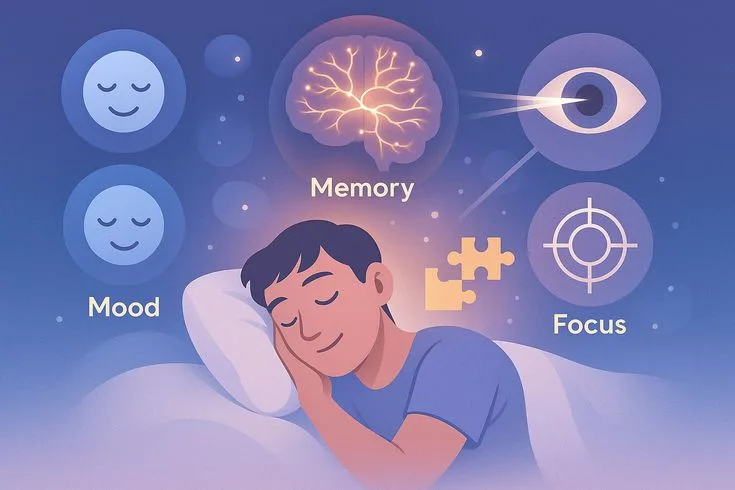
For most of modern history, sleep was treated as the brain going offline: a passive recovery state in which nothing particularly interesting happened. The body rested, the mind went dark, and learning waited for waking hours.
That picture turned out to be almost entirely wrong. Sleep is one of the most active and computationally intensive states the brain enters.
During sleep, it is reorganizing what it learned during the day, selectively strengthening some memories and pruning others, integrating new information with old knowledge, and regulating the emotional weight of experiences.
Far from pausing learning, sleep is where a large portion of learning actually gets done.
The Basics of Sleep Architecture
Sleep is not uniform. A typical night cycles through four to six sleep cycles of roughly 90 minutes each, and the composition of those cycles shifts across the night.
NREM sleep (non-rapid eye movement sleep) has three stages:
- Stage 1 is light sleep, the transition between waking and sleep
- Stage 2 is characterized by sleep spindles and K-complexes, brain wave patterns associated with memory consolidation
- Stage 3 is slow-wave sleep (SWS), the deepest and most physically restorative stage, dominated by delta waves
REM sleep (rapid eye movement sleep) is the stage most associated with dreaming. The brain is highly active during REM; the body's voluntary muscles are temporarily paralyzed to prevent acting out dreams.
Early in the night, sleep cycles are dominated by slow-wave sleep. In the final cycles before waking, REM sleep predominates. This means that cutting sleep short, even by one or two hours, disproportionately cuts REM sleep.
The Role of Sleep Spindles
One of the most important and underappreciated features of Stage 2 NREM sleep is the sleep spindle: a burst of synchronized neural activity lasting roughly half a second to two seconds, visible as a distinctive waveform on EEG recordings.
Sleep spindles are generated by the thalamus and reflect coordinated communication between the thalamus and the prefrontal cortex.
Matthew Walker and colleagues at UC Berkeley have shown that individual differences in sleep spindle density reliably predict next-morning memory performance.
Participants who generated more sleep spindles during the night retained more declarative information and showed better performance on learning tasks the following day (Walker et al., 2002).
This is significant because it suggests spindle generation is not just a byproduct of sleep but a mechanism of active memory processing.
Later research by Jan Born and colleagues at the University of Lubeck found that artificially boosting sleep spindles using targeted memory reactivation during sleep enhanced subsequent memory consolidation, strengthening the causal case for their role.
Memory Consolidation During Sleep
The foundational insight is that memory is not fixed at the moment of learning. It requires a consolidation process to become stable and accessible over the long term. Sleep is the primary window for that consolidation.
The mechanism involves a dialogue between the hippocampus, the brain region that acts as a temporary storage buffer for new experiences, and the neocortex, where knowledge is ultimately integrated into long-term networks.
Slow-Wave Sleep and Declarative Memory
During slow-wave sleep, the hippocampus undergoes memory replay. Neurons that fired during learning reactivate in compressed sequences, and this replay is coordinated with slow oscillations in the cortex and sleep spindles in the thalamus.
This coordinated reactivation transfers memories from the hippocampus to cortical networks where they become integrated with prior knowledge.
Studies disrupting slow-wave sleep by playing sounds that prevent delta wave formation, without waking participants, show that this is not simply about rest: it is the specific neural activity of slow-wave sleep that drives consolidation.
Participants in such studies show significantly impaired recall of facts and word pairs learned the day before.
Neuroscientist Matthew Walker, director of the Center for Human Sleep Science at UC Berkeley, summarizes the mechanism with an analogy: the hippocampus is a short-term memory USB drive, and slow-wave sleep is the overnight transfer of files to the long-term hard drive of the cortex.
The specificity of this process is striking. In a landmark series of studies by Susanne Diekelmann and Jan Born (2010), researchers were able to selectively cue the reactivation of specific memories during sleep using odor cues that had been associated with specific learning tasks during the day.
When those odor cues were delivered during slow-wave sleep, the associated memories were consolidated more strongly than uncued memories, demonstrating that memory replay during sleep can be directed and is not simply random.
REM Sleep and Procedural and Emotional Memory
REM sleep plays different but equally important roles. Its primary memory functions appear to involve:
Procedural learning. Motor skills, musical instrument practice, athletic patterns, and perceptual learning all show post-sleep improvement.
If you practice a piano piece, you will play it measurably better after a night of sleep than immediately after practice, a phenomenon called sleep-dependent motor memory consolidation. REM sleep appears critical here; selective REM deprivation blocks this improvement.
A 2002 study by Stickgold, James, and Hobson at Harvard Medical School trained participants on a procedural finger-tapping task and measured performance before and after either a full night of sleep or an equivalent waking interval. The sleep group showed significant overnight improvement that was absent in the wake group.
Critically, the amount of improvement correlated with the amount of Stage 2 NREM and REM sleep obtained, further specifying which sleep stages drive motor consolidation.
Emotional memory processing. Walker and colleagues have shown that REM sleep selectively attenuates the emotional charge of distressing memories while preserving their factual content.
The neurochemistry of REM sleep is distinctive: the stress neurochemical noradrenaline is virtually absent during REM sleep (a property unique to this stage).
Walker proposes that this low-noradrenaline environment allows the brain to replay emotionally significant experiences without the full physiological stress response, gradually "stripping off" the emotional tag while retaining the memory.
Creative integration. REM sleep has been associated with the formation of remote associative connections: linking information that was learned at different times and stored in different cortical locations.
Several famous examples of creative insight occurring during sleep or upon waking (including Kekule's dream of the benzene ring) may reflect this REM-mediated integration process.
Walker's group tested this in a controlled study by training participants on a hidden mathematical shortcut within a number transformation task.
Participants who slept between training and testing were nearly three times more likely to discover the shortcut than those who remained awake, a finding that was published in Nature (Wagner et al., 2004) and became one of the most cited demonstrations of sleep's role in insight and creativity.
What Happens When You Don't Sleep Enough
The research on sleep deprivation and cognitive function is consistent and alarming.
Acute Deprivation
After 17 to 18 hours of wakefulness, cognitive performance on standardized tests declines to a level equivalent to a blood alcohol content of 0.05 percent, just below the legal driving limit in many jurisdictions. After 24 hours without sleep, performance equals approximately 0.10 percent blood alcohol, well above legal limits.
These figures come from a foundational study by Williamson and Feyer (2000), published in Occupational and Environmental Medicine.
The critical mechanism is the failure of the prefrontal cortex, the brain region supporting working memory, planning, impulse control, and complex reasoning, under sleep deprivation.
fMRI studies show dramatically reduced prefrontal activity after sleep deprivation, alongside heightened activity in the amygdala, which processes emotional and threat-related information. This creates a state of poorer rational thinking combined with heightened emotional reactivity.
Harrison and Horne (2000) demonstrated that sleep-deprived individuals showed particular impairment in innovative thinking: the ability to update their approach when circumstances change, even when basic alertness tests suggested only modest impairment.
Decision-makers who feel "fine" after a night of poor sleep may still be significantly compromised in their ability to adapt to new information.
Chronic Mild Restriction
More insidious than acute total deprivation is chronic mild restriction, which characterizes most modern working adults. David Dinges and Hans Van Dongen at the University of Pennsylvania ran a controlled study in which participants were restricted to six hours of sleep per night for two weeks.
Cognitive performance declined continuously across the two weeks, reaching levels equivalent to total sleep deprivation by the end.
The critical finding was that subjects significantly underestimated their own impairment. Because the decline was gradual, they adapted to feeling moderately impaired and rated themselves as doing fine. Caffeine partially masked the subjective feeling of impairment without restoring cognitive performance.
"After ten days of just seven hours of sleep, the brain is as dysfunctional as it would be after twenty-four hours of total sleep deprivation. The kicker: those individuals felt only 'slightly sleepy.'" (Matthew Walker, Why We Sleep, 2017)
Economic Costs of Sleep Loss
A 2016 RAND Corporation analysis estimated that sleep deprivation costs the US economy approximately $411 billion annually in lost productivity, increased mortality risk, and healthcare costs.
The analysis found that employees sleeping less than six hours per night lose, on average, 11.3 days of productivity annually compared to those sleeping seven to nine hours.
Japan and Germany showed comparable patterns. The study concluded that even a modest improvement in average sleep duration among the workforce, 30 to 60 additional minutes per night, would have substantial economic returns.
The healthcare implications are equally significant. A landmark meta-analysis by Francesco Cappuccio and colleagues (2010), published in Sleep, found that short sleep duration (less than six hours) was associated with a 12 percent increased risk of death from all causes compared to sleeping six to eight hours.
Long sleep duration (more than nine hours) was associated with a 30 percent increased risk, possibly reflecting underlying illness rather than a causal relationship.
The association between inadequate sleep and cardiovascular disease, type 2 diabetes, and immune dysfunction is now well-established in the epidemiological literature.
Sleep Deprivation and Academic Performance
The educational consequences of chronic sleep restriction deserve specific attention, given that adolescents and young adults are among the most sleep-deprived demographics.
A 2019 study by Conner and colleagues, tracking 101 college students over nine weeks using daily diaries, found that nights with more sleep than average were followed by better academic performance the next day.
The relationship held even when controlling for study time, suggesting sleep was an independent predictor beyond effort.
A separate analysis of data from over 55,000 high school students found that each additional hour of sleep per night was associated with a 0.07 increase in GPA, a modest but statistically significant effect that compounded across a semester.
Schools that have shifted start times later in response to adolescent circadian biology have documented improvements in attendance, academic performance, and even graduation rates.
Sleep Before Learning
Much of the early research on sleep and memory focused on sleep after learning. More recent work by Walker and colleagues has established that sleep before learning is equally important.
The hippocampus has limited capacity. After a night without sleep, its ability to encode new information is significantly reduced. Walker found that participants who pulled an all-nighter before a learning session showed roughly 40 percent impairment in their ability to form new memories compared to participants who had slept normally.
The mechanism appears to involve the failure to clear the hippocampal buffer overnight. During slow-wave sleep, the hippocampus "downloads" the day's experiences to cortical storage, freeing up capacity for new learning the following day.
Without that overnight transfer, the hippocampus remains partially occupied with unprocessed experiences and cannot optimally encode new information.
This is directly relevant to students who stay up all night before an exam. The all-nighter may allow more study hours, but it compromises the brain's ability to encode what is studied and significantly impairs recall performance: a well-documented net negative in terms of exam outcomes.
Naps and Learning
A full night of sleep is not always available. The research on napping offers a useful alternative.
What a Nap Does
A 10-20 minute power nap primarily delivers Stage 2 NREM sleep. It reliably improves alertness and procedural learning in the hours following the nap. It does not typically reach slow-wave or REM sleep, so its effects on declarative memory consolidation are modest.
A 60-90 minute nap, timed to occur during the post-lunch dip in circadian alertness (roughly 1-3 pm for most adults), typically includes slow-wave sleep and, if the nap is long enough, some REM sleep.
Sara Mednick at UC Irvine showed in a controlled study that such a nap produced memory consolidation benefits comparable to a full night of sleep for material learned in the morning.
Specifically, the napping group maintained their morning-level performance on a perceptual discrimination task across the afternoon, while the non-napping group showed a 50 percent deterioration in performance by the day's end (Mednick et al., 2003, Nature Neuroscience).
The NASA Napping Study
NASA studied napping in military pilots and astronauts, finding that a 40-minute scheduled nap improved performance by 34 percent and alertness by 100 percent compared to a no-nap condition.
Many major corporations, including Google, Nike, and Ben and Jerry's, subsequently introduced designated rest spaces or nap pods as productivity interventions.
The broader scientific literature on workplace napping suggests these corporate investments are well-founded.
A 2020 review by Lovato and Lack in Sleep Medicine Reviews found consistent evidence that naps of 5-30 minutes produce immediate improvements in alertness, reaction time, and cognitive performance, with effects lasting one to three hours.
Longer naps (60-90 minutes) produced greater improvements in complex cognitive tasks but risked sleep inertia: the grogginess that follows waking from deep slow-wave sleep, which could temporarily impair performance immediately upon waking.
Targeted Memory Reactivation During Naps
One of the more striking recent findings extends the science of memory consolidation into napping contexts. Ken Paller and colleagues at Northwestern University have shown that it is possible to selectively strengthen specific memories by presenting associated cues during sleep, a technique called targeted memory reactivation (TMR).
In a 2012 study published in Science, participants learned the locations of pairs of objects on a grid, each object associated with a distinctive sound. While participants took a 90-minute afternoon nap, half the object sounds were replayed softly at low volume during slow-wave sleep.
Objects whose sounds were played during the nap were remembered more accurately than those whose sounds were not, without any waking awareness of the cues being delivered.
The practical implications of TMR for education and skill learning are still being explored, but the finding demonstrates that the memory consolidation process occurring during naps can be specifically modulated, not merely allowed to proceed.
Optimal Sleep for Cognitive Performance
Research converges on the following recommendations, though individual variation is real:
| Population | Recommended Hours | Key Sleep Considerations |
|---|---|---|
| Adults (18-64) | 7-9 hours | Consistent timing matters as much as duration |
| Teenagers (14-17) | 8-10 hours | Delayed circadian phase requires later school start times |
| Older adults (65+) | 7-8 hours | Slow-wave sleep decreases with age; naps help compensate |
| Active learners / students | 8-9 hours | Sleep before and after learning both critical |
| High-performance athletes | 8-10 hours | Motor learning and tissue repair both sleep-dependent |
| Healthcare shift workers | Variable | Strategic napping and anchor sleep essential |
| Chronic stressed individuals | 8+ hours | Stress elevates cortisol, which fragments sleep architecture |
Consistency of sleep timing, going to bed and waking at the same time, matters alongside duration. Irregular sleep schedules disrupt the circadian rhythm, the internal 24-hour clock that coordinates the timing of sleep stages. Even with adequate total hours, highly variable timing degrades sleep quality.
Research by Jessica Lunsford-Avery and colleagues (2018) at Duke University found that irregular sleep schedules in college students were associated with lower GPAs, poorer mood, higher rates of depression and anxiety, and greater stress.
The irregular-sleep group performed significantly worse academically even when total sleep time was equivalent to the regular-sleep group, suggesting that sleep timing, not just quantity, has independent effects on cognitive performance.
The Caffeine Trap
Caffeine is the world's most widely consumed psychoactive substance. Its mechanism is instructive: it blocks adenosine receptors in the brain. Adenosine is a chemical that accumulates during waking hours and drives the increasing pressure to sleep. Caffeine masks this pressure without eliminating it.
When caffeine wears off, adenosine that has been building up floods the now-unblocked receptors, producing the characteristic "caffeine crash." More importantly for learning, caffeine consumed in the afternoon or evening delays the onset of deep sleep and reduces the total amount of slow-wave sleep obtained, impairing memory consolidation even for individuals who fall asleep within a normal time.
Researchers estimate the half-life of caffeine (the time for the body to eliminate half a dose) at approximately five to seven hours in most adults. A coffee at 2 pm means half of it is still active at 7-9 pm, and it is measurably affecting sleep architecture at midnight.
A 2013 study by Drake and colleagues, published in the Journal of Clinical Sleep Medicine, found that caffeine consumed even six hours before bedtime significantly reduced sleep duration and quality compared to a placebo.
Participants often did not notice the reduction in sleep quality, mirroring the chronic mild restriction research in which people underestimate their own impairment.
The implication for cognitive performance is meaningful: regular afternoon coffee drinkers may be systematically impairing their own memory consolidation while believing they are optimizing their afternoon productivity. The short-term alertness benefit comes at a cost to overnight learning consolidation.
Sleep and Emotional Regulation
Beyond its role in memory, sleep plays a crucial function in emotional regulation: the ability to experience and process emotions without being overwhelmed by them.
Sleep deprivation significantly amplifies amygdala reactivity. In Walker's neuroimaging studies, sleep-deprived participants showed 60 percent greater amygdala response to emotionally provocative images compared to well-rested controls, and showed weaker connectivity between the amygdala and the prefrontal cortex, the regulation circuit.
This has direct implications for learning and performance. Anxiety is one of the greatest obstacles to effective learning. Sleep-deprived individuals are more anxious, more reactive to setbacks, and less able to maintain the calm engagement that supports deep learning.
Addressing sleep problems may be one of the most powerful levers available for improving both emotional wellbeing and learning outcomes.
A 2019 study by Simon and Walker, published in Nature Human Behaviour, found that even a single night of inadequate sleep significantly increased anxiety levels the following day, with the anxiety concentrated in the brain regions and networks associated with chronic anxiety disorder.
This suggests that sleep deprivation does not merely impair cognition: it produces a transient state that closely resembles clinical anxiety in its neural profile.
Sleep and Trauma Processing
One of the most clinically significant applications of sleep-emotion research concerns post-traumatic stress disorder (PTSD).
REM sleep's normal function of processing emotional memories is disrupted in PTSD, partly because noradrenaline levels during REM sleep are elevated in PTSD patients, preventing the normal emotional de-tagging process.
Chronic REM disruption in PTSD creates a cycle in which traumatic memories cannot be adequately processed, maintaining their full emotional intensity.
This understanding has informed treatment approaches. Research by Murray Raskind and colleagues found that prazosin, a medication that blocks noradrenaline activity, reduced PTSD nightmares and improved overall PTSD symptoms, consistent with the model that REM sleep's low-noradrenaline environment is essential for healthy emotional memory processing.
Sleep's Role in Physical Health and Learning Capacity
The interaction between physical health and cognitive performance is mediated in part through sleep. Growth hormone, which drives tissue repair, muscle building, and cellular maintenance, is released primarily during slow-wave sleep.
Athletes who prioritize sleep show faster recovery from physical training, reduced injury rates, and superior motor skill consolidation.
Research specifically on sleep and athletic performance has produced striking numbers.
A Stanford University study of the basketball team by Cheri Mah and colleagues (2011) found that extending sleep to 10 hours per night for 5-7 weeks improved sprint times by 5 percent, shooting accuracy by 9 percent, and reaction times measurably.
These gains emerged without any change in training load: sleep alone was the intervention.
The immune system shows similar sleep dependence. A study by Prather and colleagues (2015) exposed participants to the common cold virus and monitored illness development. Participants who slept fewer than six hours per night were 4.2 times more likely to develop a cold than those sleeping seven or more hours.
The immune suppression caused by inadequate sleep is not merely a theoretical concern: it translates directly to illness rates.
Practical Takeaways
The research yields a clear set of actionable principles:
Sleep after learning the same night. The consolidation window begins within hours of learning. Delaying sleep significantly reduces the consolidation benefit.
Protect your last two hours of sleep. Because REM sleep concentrates in the final sleep cycles, cutting sleep short by even 90 minutes eliminates a disproportionate share of REM. If creative or emotional processing is important to your work, those last two hours matter.
Stop caffeinating after noon. For most people, this is the minimum needed to protect slow-wave sleep architecture.
Nap strategically. If your schedule prevents adequate nighttime sleep, a 60-90 minute afternoon nap with adequate sleep opportunity can partially compensate for morning learning.
Do not cram. Distributed practice across multiple sessions with sleep intervals between them is dramatically more effective than massed practice before sleep because each sleep period consolidates the preceding day's learning before the next session adds to it.
Maintain consistent sleep timing. Going to bed and waking at the same time each day, including weekends, preserves circadian alignment and sleep architecture quality in ways that variable schedules cannot match.
Treat sleep as a non-negotiable learning tool. For students, professionals, and anyone whose performance depends on cognitive function, sleep is not a lifestyle preference to be optimized away.
The evidence across neuroscience, education research, and occupational health is consistent: there is no cognitive performance metric that is not measurably impaired by inadequate sleep.
Summary
Sleep is not downtime for the brain. It is the period when newly acquired information is transferred from short-term hippocampal storage to long-term cortical networks, when emotional memories are processed and their distress-charge reduced, when procedural skills are consolidated, and when the brain's capacity for new learning the following day is restored.
Slow-wave sleep drives declarative memory consolidation through hippocampal replay and sleep spindle activity; REM sleep drives procedural and emotional memory processing through its unique low-noradrenaline neurochemistry.
Sleep deprivation, even mild, chronic restriction to six or seven hours, produces impairments that accumulate silently while individuals underestimate how impaired they are.
The economic, educational, and health costs of population-level sleep deprivation are enormous and well-documented. For anyone whose work involves learning, creating, or sound judgment, sleep is not a lifestyle choice.
It is a cognitive necessity, and increasingly, the science makes clear it is one of the highest-leverage investments available for anyone serious about performance and wellbeing.