
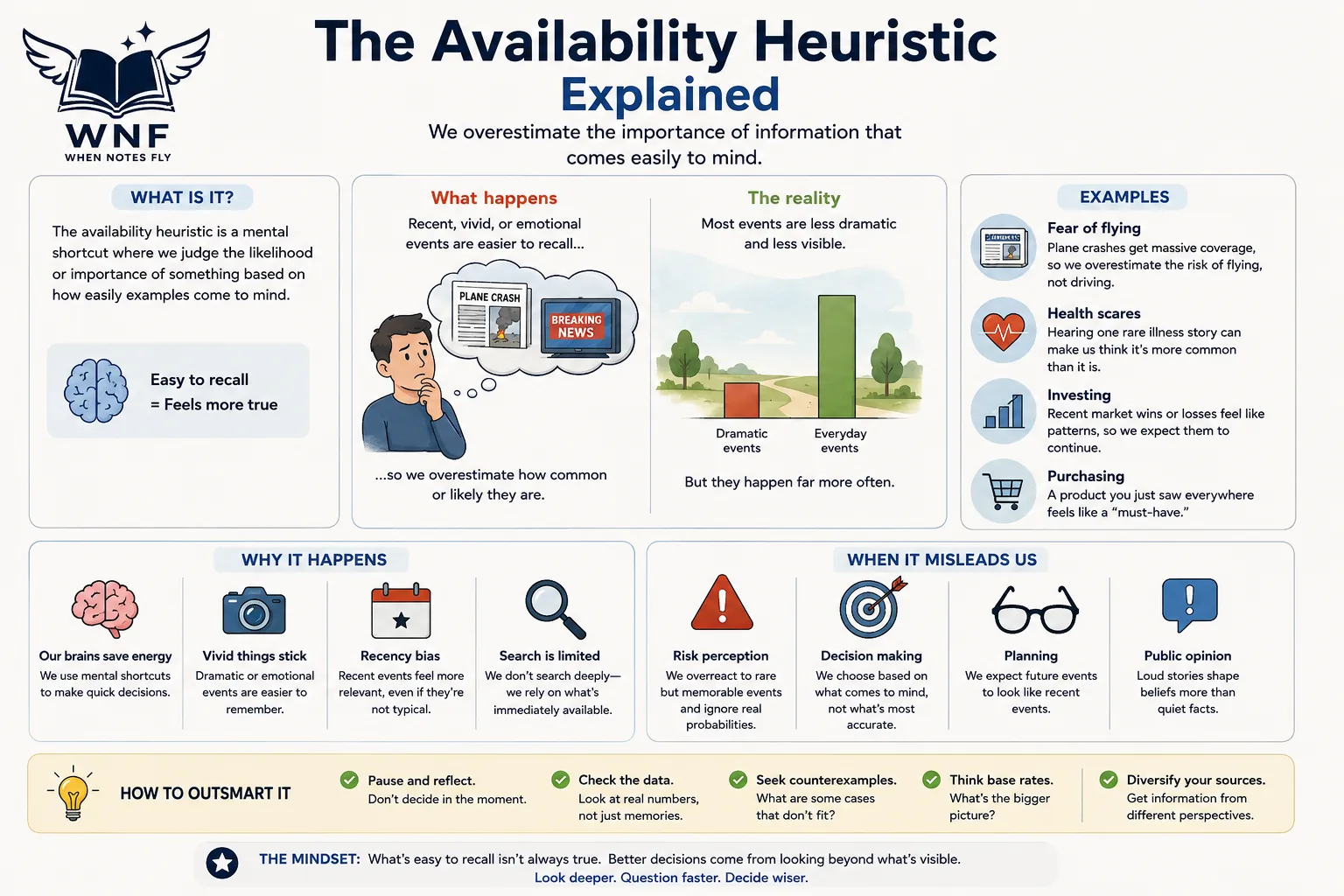
The availability heuristic estimates frequency or likelihood by how easily examples come to mind. It often works because common events are usually easier to recall, but vivid, recent, emotional, famous, or heavily reported events can feel more likely than they are. This shortcut systematically inflates spectacular risks and overlooks common, quiet harms, shaping decisions by individuals, juries, voters, and institutions.
Ask people whether more deaths are caused by tornadoes or by asthma, and most will confidently choose tornadoes. The real answer is that asthma kills far more people. Ask whether shark attacks or quieter, more mundane beach hazards pose a greater danger to the average swimmer, and the shark wins every poll, even though it is one of the rarest ways to die. The pattern is not random ignorance.
It is a systematic, predictable distortion in how the human mind estimates probability, and it has a name: the availability heuristic.
The mind is not a statistician. When you ask it how likely something is, it does not retrieve a frequency table. Instead it performs a quiet substitution: it asks how easily examples come to mind, and treats that ease as a proxy for likelihood. Most of the time this shortcut works well enough, because common things genuinely are easier to recall than rare ones.
But the shortcut is hijacked by anything that makes an event memorable for reasons unrelated to its frequency, which is why a single dramatic plane crash on the evening news can do more to shape your sense of danger than thousands of quiet, statistically deadlier car trips. Vivid beats likely, and the gap between them quietly shapes the decisions of individuals, juries, voters, and entire societies.
“People assess the frequency of a class or the probability of an event by the ease with which instances or occurrences can be brought to mind.” - Amos Tversky and Daniel Kahneman, Judgment Under Uncertainty: Heuristics and Biases (1974)
What the Availability Heuristic Actually Is
The availability heuristic is a mental shortcut in which people estimate the frequency, probability, or causal importance of something based on how easily relevant examples can be retrieved from memory. The easier the retrieval, the higher the estimate. It was first described in a landmark 1973 paper by Amos Tversky and Daniel Kahneman, two psychologists whose collaboration would eventually reshape economics and earn Kahneman a Nobel Prize.
The key move is what Kahneman later called attribute substitution.[7] The mind is asked a hard question, “How probable is this?”, and silently answers an easier one, “How easily can I think of an example?” Because the two questions usually correlate, the substitution is invisible and often helpful.
The trouble begins when ease of recall is driven by something other than true frequency, such as recency, emotional intensity, media coverage, or personal experience. In those cases the heuristic produces confident, fluent, and wrong answers.
The original 1973 paper was careful about this dual nature. Tversky and Kahneman stressed that availability is, in fact, a useful cue most of the time, because instances of frequent events usually are easier and faster to recall than instances of rare ones.[2] The heuristic is not a flaw bolted onto an otherwise rational machine; it is a normally reliable estimator whose calibration can be broken.
The Original Experiments
Tversky and Kahneman did not merely assert the bias; they engineered situations that exposed it. Their most famous demonstration is the letter K problem. They asked participants whether the letter K is more likely to appear as the first letter of an English word or as the third letter. A clear majority said the first position was more common.
In reality, in typical English text K appears roughly twice as often in the third position as in the first. The reason for the error is mechanical: it is far easier to generate words that start with K (king, kitchen, kite) than words with K in the third slot (acknowledge, ask, like). Retrieval ease, not actual frequency, drove the judgment.
The same pattern held across the five consonants (K, L, N, R, V) Tversky and Kahneman tested.[1] People were not estimating frequency at all; they were estimating how readily examples surfaced.
| Study | What Participants Judged | The Distortion |
|---|---|---|
| Tversky & Kahneman (1973), letter K | Whether K is more common in 1st or 3rd position | Said 1st (easier to recall); 3rd is actually about twice as common |
| Tversky & Kahneman (1973), name lists | Whether a list had more men or women | Judged the gender with more famous names as more numerous |
| Lichtenstein et al. (1978), causes of death | Relative frequency of 41 causes of death | Overestimated dramatic causes, underestimated quiet ones |
In another elegant study from the same period, participants heard lists of names containing both men and women. In some lists the women were more famous; in others the men were. Afterward, people judged the gender with the more famous names to be more numerous, even when it was actually the minority. Fame made the names easier to recall, and ease of recall masqueraded as frequency.
Why Vivid Beats Likely
The deepest practical consequence of the availability heuristic is the systematic privileging of the vivid over the probable. Events that are dramatic, emotionally charged, recent, or heavily publicized are easier to retrieve, so the mind inflates their likelihood. Events that are common but dull, slow, or undramatic fade from memory and get underestimated.
This is precisely the dynamic captured by a classic 1978 study by Sarah Lichtenstein, Paul Slovic, Baruch Fischhoff, Mark Layman, and Barbara Combs.[3] They asked people to estimate the relative frequency of forty-one causes of death. The results were a near-perfect catalog of the bias.
Spectacular, newsworthy causes such as tornadoes, floods, fires, and homicide were dramatically overestimated, while undramatic, ubiquitous killers such as stroke, diabetes, asthma, and stomach cancer were underestimated. People judged accidents to cause roughly as many deaths as disease, when disease in fact causes many times more.
They also judged homicide to be a more frequent killer than suicide, when suicide is in fact the more common of the two.
“People tend to assess the relative importance of issues by the ease with which they are retrieved from memory - and this is largely determined by the extent of coverage in the media.” - Daniel Kahneman, Thinking, Fast and Slow (2011)
The media amplifies this enormously. A newsroom does not report deaths in proportion to their frequency; it reports them in proportion to their drama. Homicides and plane crashes lead the broadcast; the far more numerous deaths from heart disease and diabetes rarely do. As a result, the public’s mental sample of “what kills people” is wildly unrepresentative of reality, and risk perception drifts accordingly.
It Is Not Just What You Recall, But How Easily
A subtle and important refinement came in 1991, when Norbert Schwarz and colleagues asked whether the bias is driven by the content of what you recall or by the experience of how easily it comes.[4] They designed a clever test. One group was asked to recall six instances in which they had behaved assertively; another group was asked to recall twelve such instances. Afterward, everyone rated how assertive they were in general.
Common sense predicts that the people who recalled twelve examples should feel more assertive, since they generated more evidence. The opposite happened. People asked for six examples, which is easy, rated themselves as more assertive than those asked for twelve, which is hard.
Struggling to come up with twelve examples felt difficult, and that feeling of difficulty was read as evidence that assertive episodes must be rare. The metacognitive experience of ease, not the number of recalled instances, drove the judgment.
This finding matters because it shows the availability heuristic operates on a felt sense of fluency. It is not a database query returning a count; it is a gut feeling about how smoothly memory cooperated. Anything that makes recall feel effortless inflates the estimate, and anything that makes it feel laborious deflates it, regardless of the actual evidence retrieved.
The Availability Cascade
The heuristic does not stay locked inside individual heads; it propagates through groups. The legal scholar Cass Sunstein and the economist Timur Kuran described this social amplifier as an availability cascade: a self-reinforcing cycle in which a story gains public attention, that attention makes the underlying risk feel more available and therefore more probable, the heightened concern generates still more coverage and discussion, and the spiral feeds on itself.[5]
“An availability cascade is a self-reinforcing process of collective belief formation by which an expressed perception triggers a chain reaction that gives the perception increasing plausibility through its rising availability in public discourse.” - Timur Kuran and Cass R. Sunstein, Availability Cascades and Risk Regulation (1999)
Cascades explain how relatively minor hazards can come to dominate public anxiety and policy while genuinely larger risks are ignored. Kuran and Sunstein noted that “availability entrepreneurs”, activists who deliberately manipulate the content of public discourse, can trigger such cascades to advance an agenda.
The cascade is why public attention to risk so often tracks the news cycle rather than the actuarial tables, and why a vivid anecdote can outweigh a mountain of statistics in shaping regulation.
Everyday Consequences
The availability heuristic is not a laboratory curiosity. It quietly governs ordinary decisions.
After a widely reported plane crash, ticket cancellations spike and some travelers switch to driving, even though driving is far more dangerous per mile.
The psychologist Gerd Gigerenzer documented exactly this displacement in the months following the September 11 attacks: Americans flew less and drove more, and fatal highway crashes rose above the baseline of previous years for about a year afterward.[6] The vivid horror of the attacks made flying feel deadly and driving feel safe, inverting the real per-mile risks and, by Gigerenzer’s estimate, costing a substantial number of additional lives on the road.
| Domain | The Vivid, Available Input | The Distorted Judgment |
|---|---|---|
| Personal safety | News coverage of crashes and attacks | Fearing flight more than the riskier drive |
| Investing | A recent market crash or boom | Over- or under-estimating future returns |
| Health | A dramatic anecdote about a side effect | Overrating rare risks, skipping common precautions |
| Workplace | A vivid recent failure | Over-correcting for the last mistake, not the likeliest one |
The same machinery shapes how we judge ourselves and others. We tend to overestimate our own contribution to shared work because our own efforts are more available to us than our partner’s. We fear the rare, sensational tragedy more than the common one, and we buy insurance against the disaster we just heard about. In each case the input is recall ease, and the output is a probability estimate that feels objective but is anchored to memory rather than to the world.
Availability Versus Representativeness
The availability heuristic is often confused with its sibling, the representativeness heuristic, also introduced by Tversky and Kahneman. The two are distinct mental shortcuts that produce different errors, and keeping them apart sharpens understanding of both.
Availability answers “how probable?” with “how easily does an example come to mind?” Representativeness answers “how probable?” with “how much does this resemble my prototype of the category?”
The famous “Linda problem”, in which people judge that a politically active woman is more likely to be “a bank teller and a feminist” than simply “a bank teller”, is a representativeness error driven by resemblance, not by recall ease. Availability errors, by contrast, are driven by memory accessibility.
Both are forms of attribute substitution, swapping a hard question for an easier one, but they substitute different easy questions.
The Adaptive Logic
It would be a mistake to treat the availability heuristic purely as a defect. For most of human history, and for most everyday judgments, it is a remarkably efficient and accurate tool. In a stable environment, things that happen often genuinely are easier to recall than things that happen rarely, so retrieval ease is a reasonable proxy for frequency. The brain gets a fast, cheap estimate without the metabolic cost of maintaining precise statistics about everything.
The heuristic fails only when the link between recall ease and true frequency is broken, and that decoupling is largely a modern problem. Mass media, viral content, and algorithmic feeds flood the mind with vivid, emotionally selected examples that bear no relationship to their real-world frequency.
A hunter-gatherer’s mental sample of dangers came from direct experience and tribal memory, which roughly tracked reality. A modern person’s mental sample comes from a global firehose of the most shocking events on the planet, curated for engagement. The heuristic did not change; the information environment did, and it broke the calibration the shortcut depends on.
The Animal Dimension
The substitution of ease-of-retrieval for true frequency is not a uniquely human quirk; it reflects a general principle of how nervous systems weight experience, and that principle is visible across the animal kingdom. Many animals rely on recency and vividness to guide behavior, because evolution tuned memory to flag what is salient rather than what is statistically common.
A single intensely aversive encounter can produce lasting avoidance through one-trial learning: a rat that becomes ill after consuming a novel-tasting substance will avoid that taste afterward, a phenomenon known as conditioned taste aversion, or the Garcia effect, first demonstrated by John Garcia and colleagues in irradiated rats in the 1950s and 1960s.
A single vivid, aversive instance dominates future behavior far out of proportion to its frequency, much as a single plane crash dominates a human’s sense of flight risk.
The logic is sound for survival. When the cost of a rare event is death, weighting the vivid instance heavily is adaptive, even if it overestimates true frequency. Foraging animals likewise tend to return to recently rewarding patches and to overweight recent outcomes, a recency bias that parallels the human tendency to judge probability by what comes easily to mind.
The availability heuristic, in this light, can be read as the cognitive descendant of an ancient and broadly shared strategy: let the easily retrieved, emotionally salient memory stand in for a frequency count the brain was never built to keep.
How to Defend Against It
Because the heuristic runs automatically and feels like genuine knowledge, you cannot simply will yourself out of it. The defenses all work by forcing the mind to consult something other than memory’s felt ease.
The first is to seek base rates and actual statistics rather than trusting your sense of likelihood. If you want to know what kills people, read the mortality data, not the headlines. The second is to be suspicious of any risk that has recently been vivid in the news, deliberately asking whether your concern tracks reality or merely tracks coverage.
The third is to recognize that a struggle to recall examples does not mean an event is rare, since difficulty of recall has many causes. The fourth is to widen your sample on purpose, asking not “can I think of a case?” but “out of how many cases?”
| Defense | What It Replaces | Why It Helps |
|---|---|---|
| Consult base rates and data | Memory’s felt ease | Anchors to real frequency, not recall |
| Discount recent vivid news | Recency-driven retrieval | Separates coverage from probability |
| Ask “out of how many?” | Single-example reasoning | Forces a denominator into the estimate |
| Notice the feeling of fluency | Trust in gut likelihood | Flags when ease, not evidence, is talking |
“Nothing in life is as important as you think it is while you are thinking about it.” - Daniel Kahneman, Thinking, Fast and Slow (2011)
Kahneman called this the focusing illusion, and it is the availability heuristic’s close relative: whatever is currently in mind feels disproportionately significant simply because it is in mind. The cure is the same in both cases, which is to remember that the spotlight of attention is not a measure of importance or probability, only a measure of where the spotlight happens to be pointing.
Why It Matters
The availability heuristic reframes a great deal of apparently irrational behavior as the predictable output of a normally useful shortcut running in an abnormal environment. People are not stupid for fearing terrorism more than heart disease, or for buying lottery tickets after hearing about a winner, or for overhauling a policy in response to a single tragedy.
They are running an ancient frequency estimator that was calibrated for direct experience and is now fed a diet of the world’s most vivid, least representative events.
The practical lesson is humility about the feeling of likelihood. When something seems probable, dangerous, or important, it is worth pausing to ask whether that impression rests on actual evidence or merely on how easily an example sprang to mind. The two feel identical from the inside, which is exactly why the heuristic is so powerful and so hard to catch.
The disciplines that protect against it, namely statistics, base rates, and the deliberate question “out of how many?”, are not natural to the mind. They are corrections imposed on a system that, left to itself, will always let the vivid outvote the likely.
Related Resources
- The Representativeness Heuristic and the Conjunction Fallacy
- Confirmation Bias: Why We See What We Expect
- Loss Aversion: Why Losses Loom Larger Than Gains
- How the Brain Estimates Risk
References
- Tversky, A., & Kahneman, D. (1973). Availability: A heuristic for judging frequency and probability. Cognitive Psychology, 5(2), 207-232. https://doi.org/10.1016/0010-0285(73)90033-9
- Tversky, A., & Kahneman, D. (1974). Judgment under uncertainty: Heuristics and biases. Science, 185(4157), 1124-1131. https://doi.org/10.1126/science.185.4157.1124
- Lichtenstein, S., Slovic, P., Fischhoff, B., Layman, M., & Combs, B. (1978). Judged frequency of lethal events. Journal of Experimental Psychology: Human Learning and Memory, 4(6), 551-578. https://doi.org/10.1037/0278-7393.4.6.551
- Schwarz, N., Bless, H., Strack, F., Klumpp, G., Rittenauer-Schatka, H., & Simons, A. (1991). Ease of retrieval as information: Another look at the availability heuristic. Journal of Personality and Social Psychology, 61(2), 195-202. https://doi.org/10.1037/0022-3514.61.2.195
- Kuran, T., & Sunstein, C. R. (1999). Availability cascades and risk regulation. Stanford Law Review, 51(4), 683-768. https://doi.org/10.2307/1229439
- Gigerenzer, G. (2006). Out of the frying pan into the fire: Behavioral reactions to terrorist attacks. Risk Analysis, 26(2), 347-351. https://doi.org/10.1111/j.1539-6924.2006.00753.x
- Kahneman, D. (2011). Thinking, Fast and Slow. Farrar, Straus and Giroux.