
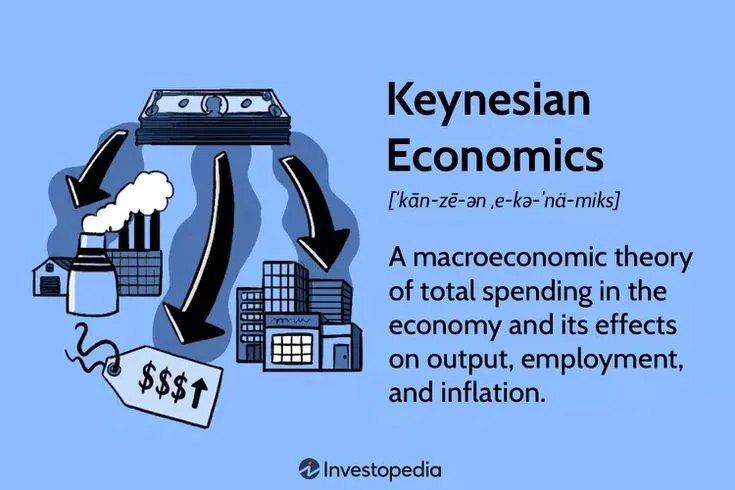
Understanding keynesian economics begins with the claim that aggregate demand can determine output and employment in the short run. Because wages and prices may adjust slowly, an economy can remain stuck with involuntary unemployment rather than self-correcting. Keynesian policy therefore uses fiscal and monetary tools to stabilize fluctuations, while concepts such as the multiplier and paradox of thrift explain how spending and saving affect the wider economy.
In the spring of 1919, John Maynard Keynes sat in the Palace of Versailles watching the victorious Allied powers dismantle the defeated economies of Central Europe and concluded that the economists and statesmen around him had lost their minds.
He resigned his position at the British Treasury and spent the next six months writing a book that would make him famous and establish a template for what it meant to be a public intellectual: a person who applied serious analytic thought to the most consequential political questions of the day and was willing to say, loudly and precisely, where the powerful were wrong.
He would be more right and more wrong than he imagined, and he would spend the rest of his life elaborating, defending, and revising his ideas.
The economic framework that emerged from that process, developed through two world wars, the Great Depression, and decades of debate, reshaped how governments understood their responsibilities to their economies.
Keynesian economics did not simply describe how markets work. It argued that markets, left alone, could fail catastrophically and persistently, and that societies did not have to accept that failure.
"The ideas of economists and political philosophers, both when they are right and when they are wrong, are more powerful than is commonly understood. Indeed the world is ruled by little else."
- John Maynard Keynes, The General Theory, 1936
Key Definitions
Keynesian economics is a macroeconomic framework holding that aggregate demand is the primary short-run determinant of output and employment, that markets may fail to self-correct to full employment, and that government fiscal and monetary policies can and should stabilize economic fluctuations.[1]
Aggregate demand is the total spending on goods and services in an economy over a period, comprising consumption (C), investment (I), government expenditure (G), and net exports (X minus M).
The fiscal multiplier is the ratio of the change in GDP to the change in government spending that caused it; if spending of one dollar raises GDP by 1.5 dollars, the multiplier is 1.5.
Involuntary unemployment refers to workers who are willing to work at the prevailing wage but cannot find employment, a condition Keynes argued markets could sustain indefinitely without automatic correction.
Keynesian vs. Classical Economics: Core Disagreements
| Question | Classical View | Keynesian View |
|---|---|---|
| What determines output? | Productive capacity and supply | Aggregate demand (total spending) |
| Does unemployment self-correct? | Yes, falling wages restore full employment | No, markets can be stuck at high unemployment indefinitely |
| Role of government in recessions | Minimal; markets self-correct | Active fiscal stimulus needed to close output gap |
| Savings effect | Higher savings fund investment | "Paradox of thrift": if everyone saves more, total demand falls |
| Speed of adjustment | Rapid, via flexible prices and wages | Slow; wages and prices are sticky downward |
Keynes's Intellectual Biography
John Maynard Keynes (1883-1946) was the son of John Neville Keynes, an economist and logician at Cambridge. He was educated at Eton and read mathematics at King's College, Cambridge, where he studied under Alfred Marshall, whose neoclassical synthesis dominated British economics.
Keynes was brilliant, restless, and supremely self-confident. He worked as a civil servant in the India Office, lectured at Cambridge, edited the Economic Journal for three decades, speculated successfully in currencies and commodities (enriching himself and his college), participated in the Bloomsbury Group, and advised governments on both world wars.[10]
His first major intervention was 'The Economic Consequences of the Peace' (1919), written after his resignation from the Paris Peace Conference.[2]
The book argued that the open-ended reparations being imposed on Germany were economically unworkable because Germany lacked the trade surplus necessary to service them without destabilizing the entire European economy.
Keynes predicted political catastrophe. The hyperinflation of the early 1920s, the rise of National Socialism, and the eventual repudiation of reparations did not fully vindicate the book's specific claims, but its central thesis, that punitive peace terms embedded in an economically interconnected world were self-defeating, looked prescient by the 1930s.
During the 1920s Keynes worked on monetary theory. His 'Tract on Monetary Reform' (1923) attacked the gold standard as an obsolete constraint that prevented nations from managing their domestic economies.
His 'Treatise on Money' (1930) offered a sophisticated analysis of the relationship between savings, investment, and the price level.
But the treatise was already partly obsolete before it was published; the Great Depression demanded a deeper reconceptualization that the treatise's framework could not accommodate.
The Challenge of the Great Depression
Classical economics, following Ricardo and Marshall, held that unemployment was a temporary market disequilibrium. If workers were unemployed, wages would fall until it became profitable to hire them, restoring full employment. This might take time, but the mechanism was reliable.
Say's Law, loosely interpreted as 'supply creates its own demand,' meant that there could be no general glut of goods.
The Great Depression shattered this confidence. By 1933, US unemployment exceeded 25 percent. It had persisted for three years with no sign of self-correction. Wages had fallen significantly but employment had not recovered. Something was wrong with the theoretical framework.
The General Theory: Core Ideas
'The General Theory of Employment, Interest and Money' (1936) was Keynes's attempt to provide a theoretical account of why depressions could persist and what could be done about them.
It was deliberately polemical, addressed to fellow economists, and written in a compressed and sometimes obscure style that made it productive for multiple interpretations.
Aggregate Demand and Effective Demand
Keynes's fundamental departure from classical economics was to place aggregate demand, total spending, at the center of the theory of output and employment. The economy produces the level of output that businesses expect to be demanded.
If expected demand is low, firms produce little, hire few workers, and aggregate income falls. The level of output is not determined by the productive capacity of the economy or the real wage but by the level of spending.
Effective demand is the point at which expected demand equals actual demand, determining the equilibrium level of employment. Critically, this equilibrium can occur at any level of unemployment, including mass unemployment.
There is no automatic mechanism driving the economy back to full employment; effective demand may persistently fall short of the level required to employ all willing workers.
Investment, the Marginal Efficiency of Capital, and Animal Spirits
Investment is the most volatile component of aggregate demand and the primary driver of economic fluctuations. The marginal efficiency of capital is the expected return on a new capital investment. When business confidence is high, investment is buoyant.
When confidence collapses, investment may fall catastrophically regardless of the interest rate, because no interest rate can make a negative expected return positive.
Keynes captured the psychology of investment through his concept of animal spirits: the spontaneous urge to action rather than inaction that drives entrepreneurs to invest, even when the rational case is uncertain. Animal spirits are inherently unstable.
Mass psychology can shift rapidly between optimism and pessimism, and these shifts are amplified through the financial system.
Liquidity Preference and the Trap
Keynes departed from classical loanable funds theory in his account of interest rates. Rather than being determined purely by saving and investment, interest rates reflect liquidity preference, the desire to hold wealth as liquid money rather than as interest-bearing bonds.
Money demand has two components: transactions demand (money held to facilitate purchases) and speculative demand (money held because bond prices are expected to fall, meaning interest rates are expected to rise).
This framework generates the liquidity trap: when interest rates are very low, the expected return from holding bonds is small while the risk of capital loss if rates rise is large. In these conditions, people prefer to hold any additional money supply as cash rather than buy bonds.
Monetary policy, which increases money supply by purchasing bonds and driving down interest rates, loses traction because it cannot reduce rates below zero and cannot convert added liquidity into spending.
The Paradox of Thrift
One of Keynes's most counterintuitive insights is the paradox of thrift. Individual prudence, saving more, is collectively harmful during a downturn.
If all households simultaneously increase their saving rates, aggregate consumption falls, business revenue falls, output contracts, and incomes fall until the desired level of saving cannot be achieved because there is less income to save from.
The attempt to save collectively fails, but at the cost of lower output. Keynes's point was that the macroeconomy is not simply a scaled-up individual household; fallacies of composition abound.
The IS-LM Model and the Neoclassical Synthesis
John Hicks's 1937 paper 'Mr Keynes and the Classics' translated the General Theory into the IS-LM diagram that dominated the teaching of macroeconomics for decades.[3] The IS curve (Investment-Saving) plots output-interest rate combinations consistent with goods market equilibrium.
The LM curve (Liquidity preference-Money supply) plots combinations consistent with money market equilibrium. Their intersection determines the joint equilibrium.
Alvin Hansen elaborated the framework and Paul Samuelson's 'Economics' textbook disseminated it to generations of students.
The neoclassical synthesis that emerged held that in the long run, with flexible prices and wages, classical economics applies; in the short run, with sticky prices and wages, Keynesian insights about aggregate demand determine output.
Monetary policy could shift the LM curve; fiscal policy could shift the IS curve.
The practical implication was demand management: governments should run deficits during recessions (shifting IS right, raising output) and surpluses during booms to prevent overheating. Central banks should lower interest rates in recessions and raise them in booms.
The postwar decades, characterized by strong growth, low unemployment, and moderate inflation across the industrialized world, seemed to validate this approach.
The Phillips Curve and the Postwar Consensus
A.W. Phillips published in 1958 an empirical study showing a stable negative relationship between wage inflation and unemployment in British data from 1861 to 1957.[4]
Paul Samuelson and Robert Solow adapted this as the inflation-unemployment tradeoff: policymakers could choose a point on the curve, accepting more inflation to buy lower unemployment. The curve became the empirical foundation of demand management policy in the 1960s.
The Phillips curve relationship appeared to hold through the 1960s. Unemployment in the United States fell from around 6 percent in the early 1960s to 3.4 percent by 1969 as the Kennedy-Johnson administration expanded fiscal and monetary policy.
Inflation rose from under 2 percent to nearly 6 percent. Policymakers interpreted this as a stable tradeoff.
The Stagflation Crisis and Monetarist Challenge
The 1970s destroyed this framework. Milton Friedman, in his 1968 American Economic Association presidential address, and Edmund Phelps, in a paper published the same year, had already delivered the theoretical critique. The long-run Phillips curve, they argued, was vertical.
Any attempt to push unemployment below the natural rate through demand stimulus would merely accelerate inflation, not permanently reduce unemployment.[5] Workers and employers would adjust their expectations, demanding higher nominal wages, and the economy would return to the natural rate but with higher inflation.
The natural rate of unemployment (or NAIRU, the non-accelerating inflation rate of unemployment) was determined by structural factors: skill mismatches, geographic mobility, search friction, labor market institutions. It was not something aggregate demand management could alter.
The oil price shock of 1973, when OPEC quadrupled the price of crude oil, provided the empirical test. Supply shocks could cause both higher inflation and higher unemployment simultaneously. Keynesian demand management had no answer: stimulating demand would worsen inflation; tightening it would worsen unemployment.
The simultaneous occurrence of double-digit inflation and high unemployment (stagflation) in many industrial countries appeared to vindicate Friedman and discredit Keynes.
The monetarist prescription was that central banks should target steady money supply growth rather than attempting to fine-tune output.
The rational expectations critique, associated with Robert Lucas, went further: if private agents fully anticipated policy changes, anticipated demand stimulus would be fully offset by preemptive wage and price increases, with no real effect at all.
Policy effectiveness depended on surprise, and a credible central bank committed to price stability would not generate the surprises needed for Keynesian multipliers to operate.
New Keynesian Economics: Rebuilding with Microfoundations
The critique from Friedman and Lucas was powerful enough that economists who believed in aggregate demand's importance had to respond on the terrain of microfoundations. New Keynesian economics, developed through the 1980s and 1990s by N.
Gregory Mankiw, David Romer, Olivier Blanchard, Lawrence Summers, and many others, sought to demonstrate that wage and price stickiness, and therefore short-run non-neutrality of money, could be derived from rational individual behavior under imperfect competition.[8]
Menu costs are the literal or metaphorical costs of changing prices. In a model with imperfect competition, where firms have pricing power, a small menu cost can make it individually rational for a firm not to change its price in response to a small demand shock.
Because each firm's optimal price depends on other firms' prices, strategic complementarities can mean that small individual stickiness aggregates into substantial macroeconomic price rigidity.
Efficiency wages explain nominal wage rigidity. Firms pay wages above the market-clearing level to improve worker morale and productivity, reduce turnover, and deter shirking. At the efficiency wage, more workers want to work than are employed, creating equilibrium unemployment.
This unemployment is not frictional but structural, and it means the labor market does not clear the way a competitive market would.
New Keynesian models incorporating these mechanisms, combined with central bank reaction functions, became the core of central bank forecasting models worldwide.
The basic New Keynesian three-equation model, combining a dynamic IS equation, a New Keynesian Phillips curve, and a monetary policy rule, is analytically tractable and broadly consistent with empirical regularities of business cycles.
Fiscal Policy in the Great Recession
The 2008-2009 financial crisis provided the largest real-world test of Keynesian fiscal policy in a generation. The collapse of Lehman Brothers in September 2008 triggered a global financial panic, a collapse of investment and consumption, and the deepest recession since the 1930s.
With interest rates already near zero in the United States and approaching zero elsewhere, monetary policy was constrained. The liquidity trap that Keynes had described as a theoretical possibility was arguably being observed in practice.
The Obama administration's American Recovery and Reinvestment Act (February 2009) authorized approximately $787 billion in spending and tax cuts over several years.
Christina Romer and Jared Bernstein, writing for the incoming administration, estimated that the package would save or create 3.5 million jobs, using a fiscal multiplier of approximately 1.55 for government spending and 0.99 for tax cuts.[12]
Alberto Alesina and Silvia Ardagna published influential research in 2009-2010 arguing that some historical fiscal consolidations (spending cuts) had been expansionary, the "expansionary austerity" hypothesis.[7]
This research influenced the European turn toward austerity in 2010-2012, particularly in the United Kingdom under Chancellor Osborne and in the eurozone under German-influenced fiscal rules.
Subsequent empirical work substantially challenged these findings. Olivier Blanchard and Daniel Leigh published an IMF working paper in 2013 showing that IMF growth forecasts for 2010-2011 had systematically underestimated the contractionary effects of fiscal austerity in countries that implemented it.[6]
Countries that undertook larger fiscal consolidations saw larger-than-predicted output losses. The implied multipliers were substantially above 1, not the 0.5 assumed in the IMF's own models. Countries that maintained or expanded fiscal support recovered faster.
Keynes vs Hayek: An Enduring Argument
The intellectual contest between Keynes and Friedrich Hayek, who arrived in London from Vienna in 1931, is one of the most celebrated debates in intellectual history.
Hayek argued that the business cycle was caused by credit-fueled malinvestment: banks, by lending at below-market interest rates, induced entrepreneurs to invest in projects that appeared profitable but would not be sustainable when interest rates normalized.[11]
The remedy was to allow the liquidation of these investments and let the economy restructure from a sound base, not to pump in further demand that would only delay and worsen the adjustment.
Keynes thought Hayek's framework confused cause and effect and was catastrophically wrong in its policy prescriptions. The problem was not overinvestment in the boom but the collapse of demand in the slump.
Allowing the liquidation process to run its course meant allowing years of unemployment, poverty, and social disruption for people who had done nothing wrong.
When Hayek argued that workers needed to accept wage cuts to restore competitiveness, Keynes replied that this ignored the paradox of thrift: if all workers cut wages simultaneously, purchasing power fell, demand fell further, and the depression deepened.
The debate continues in attenuated forms today. Every recession produces a version of the argument: those who believe deficits crowd out private investment and that only supply-side reforms can generate sustainable growth versus those who believe that in a recession with idle resources and low interest rates, government spending is the only mechanism available to restore demand.[9]
Cross-References
- For how behavioral biases affect the consumption decisions that drive Keynesian models, see Decision Journaling for Better Judgment Over Time
- For Kahneman and Tversky's prospect theory and its relation to Keynes's animal spirits, see Anchoring Bias: The First Number Shapes Your Mind
- For systems thinking and feedback loops relevant to understanding macroeconomic dynamics, see How Feedback Loops Work
- For how social psychology explains coordinated behavior in markets, see What Is Social Psychology?
Sources & Further Reading
- Keynes, J.M. (1936). The General Theory of Employment, Interest and Money. Macmillan, London.
- Keynes, J.M. (1919). The Economic Consequences of the Peace. Macmillan, London.
- Hicks, J.R. (1937). Mr Keynes and the classics: a suggested interpretation. Econometrica, 5(2), 147-159.
- Phillips, A.W. (1958). The relation between unemployment and the rate of change of money wage rates in the United Kingdom, 1861-1957. Economica, 25(100), 283-299.
- Friedman, M. (1968). The role of monetary policy. American Economic Review, 58(1), 1-17.
- Blanchard, O. and Leigh, D. (2013). Growth forecast errors and fiscal multipliers. American Economic Review, 103(3), 117-120.
- Alesina, A. and Ardagna, S. (2010). Large changes in fiscal policy: taxes versus spending. Tax Policy and the Economy, 24, 35-68.
- Mankiw, N.G. (1985). Small menu costs and large business cycles: a macroeconomic model of monopoly. Quarterly Journal of Economics, 100(2), 529-537.
- Lerner, A.P. (1943). Functional finance and the federal debt. Social Research, 10(1), 38-51.
- Skidelsky, R. (2003). John Maynard Keynes: 1883-1946: Economist, Philosopher, Statesman. Macmillan, London.
- Hayek, F.A. (1931). Prices and Production. Routledge, London.
- Romer, C.D. and Bernstein, J. (2009). The job impact of the American Recovery and Reinvestment Plan. Council of Economic Advisers Working Paper.