
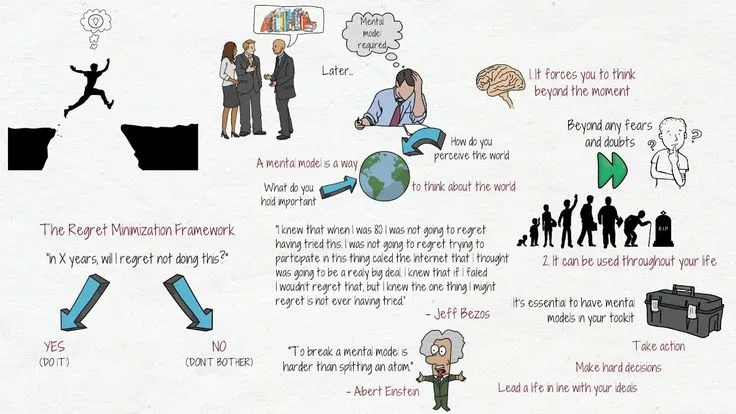
The regret minimization framework is a decision-making method in which you project yourself forward to age 80, look back on your life, and ask which choice will produce more lasting regret: taking action and risking failure, or never having tried at all.
Developed by Jeff Bezos in 1994 when he was deciding whether to leave a lucrative Wall Street career to start an online bookstore, this framework has become one of the most widely referenced mental models for navigating high-stakes, irreversible life decisions.
It works because it leverages a well-documented pattern in psychology: over long time horizons, people regret the things they did not do far more than the things they did.
In 1994, Bezos had what most people would consider an extremely good situation. He was 30 years old, a senior vice president at D.E. Shaw - one of the most successful quantitative hedge funds in the world - earning well into six figures, with clear advancement ahead.
The internet was growing at 2,300% annually. Bezos had an idea for an online bookstore.
He had to decide whether to quit.
The problem was not that the idea was bad. Bezos had analyzed the opportunity carefully and was convinced the internet represented a transformational commercial platform.
The problem was fear - the specific, immediate, visceral fear of leaving something certain for something that would very probably fail. Most startups fail. Most ideas, even good ones, fail. The people who knew him thought he was making a mistake.
Bezos resolved the decision by inventing a framework. He projected himself forward to age 80, looking back at his life:
"I want to have minimized the number of regrets I have. I knew that when I was 80 I was not going to regret having tried this. I was not going to regret trying to participate in this thing called the Internet that I thought was going to be a really big deal.
I knew that if I failed I wouldn't regret that, but I knew the one thing I might regret is not ever having tried. I knew that that would haunt me every day." - Jeff Bezos, MIT interview (2001)
He quit. He and his wife drove cross-country to Seattle, where he wrote the business plan in the car. Amazon was founded in 1994.
Why This Framework Exists: The Psychology of Regret
The regret minimization framework is not simply a motivational slogan. It is calibrated to one of the most robust findings in the psychology of decision-making: the temporal asymmetry of regret. Understanding this asymmetry is essential to understanding why the framework works and when it should be applied.
The Discovery of Inaction Regret
Thomas Gilovich and Victoria Husted Medvec documented this pattern in a landmark 1994 study published in the Journal of Personality and Social Psychology, and elaborated on it in a 1995 paper in Psychological Review. They found a reliable temporal pattern in how people experience regret:
- In the short term, action regrets dominate. If you made a bad investment last week, that action is more painful than the investment you failed to make.
- Over longer time horizons, inaction regrets dominate. When people reflect on their entire lives, the things they most regret are typically the opportunities they did not pursue: the education they did not complete, the creative work they did not attempt, the relationship they did not pursue, the entrepreneurial bet they did not make.
"In the long run, people of every age and in every walk of life seem to regret inaction more than action." - Thomas Gilovich and Victoria Husted Medvec, Psychological Review (1995)
The mechanism Gilovich and Medvec identified explains why this asymmetry exists. People can rationalize past actions relatively easily - they find ways to see the silver lining, to reframe the outcome, to construct narratives in which the choice was reasonable given what was known at the time.
Even a failed business produces stories of learning, resilience, and personal growth. Inactions are harder to rationalize.
The alternative path was never taken, so it remains imaginatively open - it stays "what might have been" rather than becoming "what was and turned out to have some silver lining." The counterfactual stays alive, nagging, unresolvable.
Confirming Research Across Decades
Janet Landman and Jean Manis documented in a 1992 study in the British Journal of Psychology that regrets about education, career, and romance are the most common significant regrets across adult populations - and that these are precisely the domains where the most consequential regrets involve inaction rather than action.
People more often regret not having pursued a degree, not having changed careers, not having maintained a relationship, than having pursued, changed, or maintained and failed.
Neal Roese and Amy Summerville published a comprehensive meta-analysis of regret research in 2005 in Personality and Social Psychology Bulletin. Their analysis of multiple studies and thousands of participants found that life domain, opportunity availability, and perceived responsibility all predict the intensity of regret.
Most significantly: regrets are most intense in domains where opportunities for correction or alternative action are still perceived to be available. The burning quality of "I could still do this and I am not" is what gives inaction regrets their persistent sting.
A more recent 2018 study by Shai Davidai and Thomas Gilovich, published in Emotion, surveyed over 370 Americans about their biggest regrets and found that roughly 76% of respondents identified regrets about failing to live up to their ideal self - the person they wished they could be - rather than their ought self - the person they felt they should be.
The ideal-self regrets were overwhelmingly about inaction: not pursuing passions, not taking risks, not being bold enough.
This is precisely what Bezos identified in his own decision process: the certainty that if he did not try, he would spend years knowing the opportunity existed and that he had not taken it.
Action Regret vs. Inaction Regret Over Time
| Time Horizon | Dominant Regret Type | Psychological Mechanism | Example |
|---|---|---|---|
| Short-term (days to weeks) | Action regret | Bad outcomes are fresh and emotionally salient | "I should not have taken that job" |
| Medium-term (months to years) | Mixed | Actions can still be partially undone; outcomes remain uncertain | "I wish I had negotiated harder" |
| Long-term (decades) | Inaction regret | Unchosen paths stay imaginatively open; rationalization softens past failures | "I wish I had started that company" |
| Life review (age 80+) | Inaction regret dominates | Rationalization has fully softened past actions; omissions remain raw and unresolved | "I never tried to write that book" |
Key Concepts
Regret minimization framework - A decision-making method in which the evaluator projects themselves to age 80 and asks, for each available option, whether not taking that option will produce lasting regret. The method prioritizes minimizing regret of inaction over minimizing risk of failure.
Developed by Jeff Bezos and described publicly starting in 2001.
Prospective regret - Regret anticipated before a decision is made, about a hypothetical future in which a particular choice was or was not made. Distinct from retrospective regret, which is experienced after outcomes are known.
The regret minimization framework asks for prospective regret from a very distant future standpoint - age 80 - rather than from the current moment.
Temporal discounting - The cognitive tendency to weight present costs and benefits more heavily than future ones. Fear of current failure, current embarrassment, and current financial risk are all subject to temporal discounting: they loom large now but will matter much less later.
The regret minimization framework counteracts temporal discounting by deliberately adopting the future perspective from which current fears will be most diminished.
Loss aversion - The well-documented tendency, identified by Daniel Kahneman and Amos Tversky in their foundational prospect theory work (1979), to weigh potential losses roughly twice as heavily as equivalent potential gains.
For a given decision, the fear of losing what you currently have often outweighs the prospect of gaining something better.
Loss aversion creates systematic bias toward inaction in high-stakes decisions. The regret minimization framework helps correct for this by reframing inaction as a loss - a loss of what could have been - rather than as the safe default.
Omission bias - The tendency to judge harmful actions as worse than equivalent harmful inactions. Related to loss aversion, omission bias creates a systematic preference for doing nothing as a default, even when doing nothing carries its own costs.
The regret minimization framework directly confronts omission bias by forcing explicit evaluation of the cost of not acting.
Reversibility - The degree to which a decision can be undone or its effects corrected if the outcome is poor. This is a key variable in applying the framework correctly: it is designed for high-stakes, difficult-to-reverse decisions.
For easily reversible decisions, standard expected-value reasoning or simpler heuristics are more appropriate.
Bezos himself later formalized this distinction at Amazon, calling irreversible decisions "one-way doors" and reversible ones "two-way doors."
How to Apply the Framework: The Three-Question Structure
The regret minimization framework can be reduced to three sequential questions:
Question 1: What Is the Worst Realistic Outcome if I Take This Action?
Be specific and honest. Not catastrophizing - the actual, realistic worst case. For Bezos in 1994: the startup fails within two years, he spends his savings, and has to return to finance or find another job. Painful, but recoverable.
This step is critical because many people operate on a vague, unexamined sense of catastrophe rather than a concrete assessment of the actual downside.
Sara Blakely, founder of Spanx, has described a similar practice. Her father asked her and her brother every week at the dinner table: "What did you fail at this week?" The exercise reframed failure as evidence of attempt rather than evidence of inadequacy.
By the time Blakely was deciding whether to invest her savings in an untested product, she had already internalized that the worst case - product failure - was not the same as personal failure.
Question 2: At Age 80, Will I Regret Having Tried?
Again, be specific. Not: "will I regret that it failed?" but "will I regret the attempt itself?" For decisions involving genuine effort toward something meaningful, the answer is almost always no. Failure at something you genuinely pursued typically generates pride in having tried, even when the outcome is poor.
The research on counterfactual thinking supports this: people construct narratives of growth and meaning around genuine attempts far more readily than around safe defaults.
Question 3: At Age 80, if I Do Not Take This Action, Will I Regret Not Having Tried?
This is the core question. The answer must be assessed honestly, from the perspective of age 80, not from the perspective of current fear. If the action is consistent with your values, meaningfully connected to what you find important, and plausibly productive - the answer is usually yes.
If the answer to Question 2 is no and the answer to Question 3 is yes, the framework yields a clear direction: take the action.
The Temporal Shift: Why the Age-80 Perspective Changes Everything
The most important element of the framework is the temporal shift: explicitly adopting the standpoint of age 80 rather than evaluating from the present. This is not a metaphor - it is a cognitive move that has measurable effects on decision quality.
Research by Hal Hershfield at UCLA, published in the Journal of Marketing Research (2011), used age-progressed avatars to help participants vividly imagine their future selves. Those who interacted with realistic depictions of their older selves allocated significantly more money to retirement savings than control participants.
The mechanism is the same one the regret minimization framework exploits: making the future self vivid and concrete overcomes the temporal discounting that keeps people trapped in short-term thinking.
From the standpoint of age 80:
- Current financial anxiety about a career change appears much smaller - in retrospect, you will have seen whether you recovered from failure or built something significant
- Social concern about what colleagues or family think appears almost entirely irrelevant - the opinions of the people you are currently worried about will not register from that distance
- The fear of looking foolish dissipates - by 80, you will have seen enough variation in life outcomes to know that bold attempts are respected even when they fail
"Cleverness is a gift, kindness is a choice. Gifts are easy - they're given after all. Choices can be hard. You can seduce yourself with your gifts if you're not careful, and if you do, it'll probably be to the detriment of your choices." - Jeff Bezos, Princeton Commencement Address (2010)
The age-80 perspective systematically discounts the concerns that drive inaction in the present - social judgment, current financial comfort, fear of failure - and amplifies the concerns that matter most at life's end: whether you pursued what mattered to you, whether you took meaningful risks, whether you gave yourself the chance to discover what you were capable of.
Domains Where the Framework Applies
Career and Entrepreneurship
The framework's most direct application is to career decisions. Career changes - from secure employment to uncertain entrepreneurship, from one field to another, from employment to creative independence - are exactly the decisions where short-term fear of loss systematically outweighs long-term potential for meaning.
The pattern Gilovich and Medvec document in their research applies precisely to career regrets: people who stay in safe careers they do not find meaningful frequently report, years later, that they regret not having attempted the riskier alternatives.
People who attempt the alternatives and fail report, much less frequently, that they wish they had stayed in the safe career.
A 2016 survey by Allianz Life Insurance found that 40% of Americans reported regret about how they handled their careers - making career the single most common regret category.
Among those with career regret, the overwhelming majority identified inaction: not pursuing a different path, not changing industries, not starting something of their own.
Creative Work
Creative pursuits - writing a book, building a company, starting a creative practice - are systematically underinvested because they involve high probability of failure in an area that feels personally expressive. Failing at something you have identified as meaningful is more threatening than failing at something routine.
The framework addresses this by asking whether, at 80, you will wish you had tried - and for most creative ambitions, the answer is yes.
Relationships and Commitments
The framework extends to relationship decisions. The person you did not ask out, the conversation you did not have, the commitment you avoided - these are among the most common subjects of lasting regret. The framework reframes them: would you, at 80, regret not having tried?
For meaningful relationships and important unresolved conversations, the answer is generally yes.
Major Life Changes
Geographic moves, educational investments, significant lifestyle changes - decisions where the cost of taking the action is primarily short-term disruption and the cost of not taking it is a permanent divergence from an alternative life - are well suited to regret minimization reasoning.
Limits and Misapplications
The Framework Does Not Apply to Every Decision
The regret minimization framework is a method for high-stakes, difficult-to-reverse decisions with significant long-term implications. It is not appropriate for:
- Routine or low-stakes decisions: Which restaurant to pick, which route to drive, which product to buy. These decisions do not warrant elaborate future projection. For everyday choices, simpler heuristics like satisficing vs. maximizing are more practical.
- Decisions with symmetric reversibility: If trying something and stopping is easy, the regret calculus is less important - try it and see. Bezos's own "two-way door" framework at Amazon makes this distinction explicit.
- Time-pressured decisions: The framework requires reflection that is incompatible with genuinely urgent decisions.
- Decisions primarily affecting others: The framework is optimized for individual life choices. Decisions with major consequences for others require different ethical reasoning.
Regret Minimization Is Not Risk Blindness
A common misreading of the framework treats it as an argument to take every risk. This misunderstands it. The framework does not say "the bold path is always better." It says: evaluate the regret of inaction against the regret of failure, from the 80-year perspective.
Some risks are genuinely bad bets where the downside is severe and the probability of success is low - and where, from the 80-year perspective, a rational person would not regret having declined them.
The framework is not a trump card for rationalization. Bezos left a specific job in a specific moment to pursue a specific opportunity he had analyzed carefully.
He was not advocating for unexamined adventurism; he was describing a method for evaluating whether his fear of the known was systematically overwhelming his honest assessment of the opportunity.
The Failure of Imagination Problem
The framework asks you to imagine yourself at 80 with accuracy about what will matter. This requires honest self-knowledge: what do you actually value? What kind of life would you actually find meaningful?
Regret minimization reasoning conducted with a vague or poorly understood sense of your own values will produce vague and poorly calibrated decisions.
The framework works best when you have done the prior work of understanding what you find genuinely important - what regrets would feel like genuine losses versus which would be more abstract preferences - and are using the 80-year perspective to evaluate specific choices against those values.
Tools like decision journaling and pre-mortem analysis can help clarify your values and assumptions before applying the regret minimization lens.
Survivorship Bias in the Bezos Story
It is worth noting that Bezos's story is a survivorship bias case study. We hear about his framework because Amazon succeeded spectacularly. We do not hear from the thousands of people who applied similar reasoning, left secure jobs, and failed without recovery.
The framework's value is not that it guarantees success - it does not. Its value is that it helps you make choices aligned with your values under uncertainty, and that the psychological research supports the claim that inaction produces more lasting regret than failed action.
But the framework should be applied with clear-eyed assessment of actual risk, not with the assumption that boldness is always rewarded.
Connecting the Framework to Other Decision Tools
The regret minimization framework is most powerful when used alongside complementary mental models rather than in isolation:
- Pre-mortem analysis helps you identify what could go wrong before committing, ensuring your "worst realistic outcome" assessment in Question 1 is genuinely realistic.
- Second-order thinking pushes you to consider the downstream consequences of both action and inaction - what happens after the first outcome?
- Probabilistic thinking helps you estimate the actual likelihood of different outcomes, preventing both overconfidence and excessive pessimism.
- Sunk cost awareness prevents you from staying in a bad situation simply because you have already invested in it - the mirror image of the inaction trap the regret minimization framework addresses.
Together, these tools create a more complete decision-making system: the regret minimization framework provides the motivational clarity to act on what matters, while the analytical tools ensure that the action is well-considered rather than merely bold.
Sources & Further Reading
- Bezos, J. (2001). Interview at MIT. Published via various sources; core description in Wired, October 2011.
- Bezos, J. (2010). Princeton University Commencement Address. Text available at Princeton University public records.
- Gilovich, T., & Medvec, V. H. (1994). The Temporal Pattern to the Experience of Regret. Journal of Personality and Social Psychology, 67(3), 357-365. DOI: 10.1037/0022-3514.67.3.357
- Gilovich, T., & Medvec, V. H. (1995). The Experience of Regret: What, When, and Why. Psychological Review, 102(2), 379-395. DOI: 10.1037/0033-295X.102.2.379
- Landman, J., & Manis, J. D. (1992). What Might Have Been: Counterfactual Thought Concerning Personal Decisions. British Journal of Psychology, 83(4), 473-477. DOI: 10.1111/j.2044-8295.1992.tb02453.x
- Morrison, M., Epstude, K., & Roese, N. J. (2018). Life Regrets and the Need to Belong. Emotion, 18(6), 855-868. DOI: 10.1037/emo0000427
- Roese, N. J., & Summerville, A. (2005). What We Regret Most... and Why. Personality and Social Psychology Bulletin, 31(9), 1273-1285. DOI: 10.1177/0146167205274693
- Hershfield, H. E. (2011). Future Self-Continuity: How Conceptions of the Future Self Transform Intertemporal Choice. Annals of the New York Academy of Sciences, 1235, 30-43. DOI: 10.1111/j.1749-6632.2011.06201.x
- Kahneman, D., & Tversky, A. (1979). Prospect Theory: An Analysis of Decision Under Risk. Econometrica, 47(2), 263-292.
- Stone, B. (2013). The Everything Store: Jeff Bezos and the Age of Amazon. Little, Brown and Company.