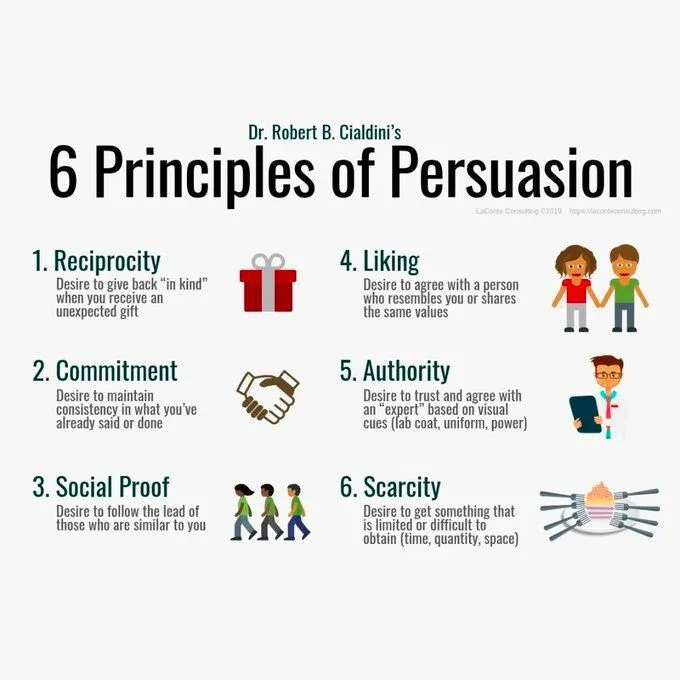
In the late 1970s, Robert Cialdini spent years going undercover. He trained as a car salesman, worked with direct mail fundraisers, studied door-to-door sales operations, and immersed himself in the world of professional influence. He wanted to understand not why people tried to persuade others, but why people said yes.
The result, published in 1984 as Influence: The Psychology of Persuasion, became one of the best-selling social science books ever written and one of the most cited works in marketing, management, and behavioral economics.
Cialdini identified six principles that trigger automatic compliance, principles rooted not in cunning or deception but in the psychological shortcuts that help humans navigate a complex world efficiently.
In 2016, in Pre-Suasion, Cialdini added a seventh principle, completing a framework that has since been applied to marketing campaigns, political communication, public health initiatives, negotiation, and management, as well as dissected by ethicists concerned about its potential for misuse.
The Historical Context: Where Persuasion Science Began
Cialdini's work did not emerge in isolation. The scientific study of attitude change and persuasion has a longer history, beginning with Carl Hovland's pioneering research at Yale during and after World War II.
Hovland's "Yale Attitude Change Approach" established a framework for understanding how source credibility, message structure, and audience characteristics interact to determine whether a persuasive message succeeds.
His work established that expertise and trustworthiness of the communicator were independent variables, both mattered, but in different ways.
In the 1960s and 1970s, William McGuire developed inoculation theory, the finding that exposing people to weakened versions of counterarguments made them more resistant to full-strength persuasion attempts.
This insight has applications in public health (vaccine messaging), political campaigns (pre-bunking disinformation), and negotiation training.
Cialdini's contribution was to move the study of persuasion from laboratory attitude measurement to the study of actual behavior change in real commercial settings, and to identify the specific mechanisms that practitioners had been using, often without fully understanding why they worked.
The significance of the timing: Cialdini published Influence in 1984, exactly as the discipline of behavioral economics was beginning to crystallize. Daniel Kahneman and Amos Tversky's prospect theory (1979) had recently established that human decision-making departed systematically from rational models in predictable ways.
Cialdini's principles provided a complementary map of the social influence mechanisms that operated alongside the cognitive biases Kahneman and Tversky had documented.
Why Persuasion Works: The Shortcut Model
Before examining the seven principles individually, it is worth understanding the mechanism they share. Cialdini's framework rests on a central insight: humans rely on cognitive shortcuts when making decisions, especially under time pressure, cognitive load, or uncertainty.
These shortcuts, sometimes called heuristics, evolved because they work well most of the time. When an expert recommends something, following their recommendation is usually a good idea. When many people are doing something, it is usually worth considering.
When something is scarce, it often is more valuable. The principles of persuasion are powerful precisely because they target real patterns of reliable behavior, not quirks or weaknesses.
The ethical implications follow from this: the same shortcuts that guide good decisions can be exploited to guide bad ones. Whether persuasion is ethical depends not on the technique but on whether it aligns the influenced person's interests with the influence attempt.
Dual Process Theory: System 1 and System 2
The cognitive architecture underlying Cialdini's principles was formally described by Daniel Kahneman in Thinking, Fast and Slow (2011), drawing on decades of research with Tversky and others. Kahneman described two modes of cognitive processing:
System 1 is fast, automatic, associative, and emotional. It operates without conscious attention and handles the vast majority of daily decisions. It is the system that processes social cues, interprets tone of voice, and responds to the visual design of a website before conscious evaluation begins.
System 2 is slow, effortful, logical, and deliberate. It is activated when problems are genuinely novel or when stakes are high enough to justify the cognitive cost of careful analysis.
Cialdini's principles work primarily through System 1. Social proof, authority, and liking all operate through fast, automatic processing, they produce responses before System 2 has a chance to evaluate them.
This is why recognizing a persuasion technique intellectually does not always neutralize its emotional effect. The System 1 response has already occurred.
The implication for ethical persuasion: techniques that bypass System 2 entirely, that prevent careful evaluation rather than merely shaping it, are more ethically problematic than techniques that inform and influence System 2 reasoning.
The Seven Principles
1. Reciprocity
Reciprocity is the social norm that when someone gives us something, we feel obligated to give something back. It is among the most deeply embedded social norms in human societies, documented across virtually every culture studied, and one of the most powerful.
Cialdini's research documented reciprocity in operation across many contexts:
- Free samples in supermarkets increase purchases far out of proportion to their cost
- Charity organizations that include small gifts (address labels, postcards, coins) with donation requests dramatically increase response rates
- Negotiators who make concessions create felt pressure for matching concessions from the other side
- The Hare Krishna fundraising strategy, giving flowers to airport travelers before asking for donations, generated substantial revenue even from recipients who did not want the flower
The mechanism is felt obligation: receiving something creates a debt, and the discomfort of carrying an unreturned favor motivates action to discharge it. Critically, the obligation is triggered even by uninvited gifts, which cannot be refused without triggering the social awkwardness of rejection.
Dennis Regan's classic 1971 study at Cornell demonstrated the power of reciprocity with precise elegance.
Participants were more willing to buy raffle tickets from a confederate who had previously, without being asked, bought them a soft drink, even when they rated that confederate as unlikeable. The obligation overrode the liking calculation entirely.
The favor, not the relationship, drove the compliance.
The ethical application is straightforward: provide genuine value before asking for anything in return. The manipulative version involves manufacturing hollow gifts designed purely to trigger obligation, with no genuine interest in the recipient's benefit.
2. Commitment and Consistency
Once people commit to a position, especially publicly, they experience strong psychological pressure to behave consistently with that commitment.
Commitment and consistency is the principle underlying Cialdini's famous observation that people rationalize poor decisions after making them rather than acknowledging the decision was poor.
The mechanism runs through cognitive dissonance: holding beliefs or taking actions inconsistent with prior commitments creates psychological discomfort that people reduce by adjusting their beliefs and behaviors to align with the commitment.
This principle underlies several well-documented persuasion techniques:
- Foot-in-the-door: Getting someone to agree to a small request makes them significantly more likely to agree to a larger related request later. Having committed to the small one, consistency requires the larger one.
- Low-balling: Getting agreement on an attractive offer, then changing the terms, is surprisingly effective, people who have committed to a purchase often continue when the deal worsens, because they have mentally committed to the purchase.
- Written commitments: Written commitments are more binding than verbal ones. Asking employees, students, or patients to write down their goals, intentions, or pledges significantly increases follow-through.
"It is, quite simply, our nearly obsessive desire to be (and to appear) consistent with what we have already done. Once we have made a choice or taken a stand, we will encounter personal and interpersonal pressures to behave consistently with that commitment.", Robert Cialdini, Influence (1984)
Jonathan Freedman and Scott Fraser's landmark 1966 study demonstrated foot-in-the-door with striking results. They asked homeowners to place a large, ugly "Drive Carefully" sign in their front yards. Most refused.
But homeowners who had previously agreed to display a small window sticker with the same message were significantly more likely to agree to the large sign, 76% versus 17%.
The small commitment had altered their self-image; they now saw themselves as the kind of people who support road safety, and the large sign was consistent with that identity.
3. Social Proof
Social proof is the tendency to look to others' behavior as a guide for our own, especially in uncertain or ambiguous situations. The fundamental logic is: if others are doing this, it is probably the right thing to do.
Social proof is most powerful when:
- The situation is ambiguous or unfamiliar
- The reference group consists of people similar to the target (peer social proof is more powerful than general social proof)
- Large numbers of people are observed doing something
- The behavior is visible
Research findings on social proof include:
- Hotel towel reuse rates increase substantially when signs say "most guests in this room reuse their towels" compared to generic environmental messages
- Charity telethons running a scrolling list of donors increase subsequent donations
- Showing customers that "most people who buy X also buy Y" is more persuasive than most product-based sales pitches
- The bystander effect, people less likely to help when others are present, is a dark form of social proof (everyone assumes someone else will act)
Noah Goldstein, Cialdini, and Griskevicius (2008) ran a series of field experiments in Arizona hotels testing variations on towel-reuse messaging. The most effective message, "75% of guests who stayed in this room reused their towels", produced a 33% higher reuse rate than the standard environmental-appeal message.
The finding demonstrates that peer social proof specific to the immediate context ("this room") outperforms both general social proof and values-based appeals.
The important qualifier: social proof based on false numbers or fabricated testimonials is fraud. Ethically, social proof means accurately communicating genuine patterns of behavior among real, relevant people.
4. Authority
People defer to experts and legitimate authorities. This is generally a reasonable shortcut: expertise is real, and following expert guidance usually produces better outcomes than ignoring it.
The authority principle describes how signals of authority, titles, credentials, uniforms, institutional affiliations, trigger compliance and trust even when the expertise is not actually relevant.
Classic demonstrations include:
- Milgram's obedience experiments, in which ordinary people administered what they believed were dangerous electric shocks because a person in a white lab coat told them to
- Studies showing that the same medical advice is rated as more credible when attributed to a titled specialist versus an unspecified source
- Audit research showing that compliance with requests increases significantly when the requester wears a uniform or identifies as an authority
Stanley Milgram's obedience experiments (Yale, 1961-1963) remain among the most disturbing and consequential in the history of psychology.
In the original study, 65% of participants, ordinary Americans recruited through newspaper ads, were willing to administer what they believed to be 450-volt electric shocks to strangers when instructed by an authority figure in a lab coat.
The authority signal (coat, title, institutional context) was sufficient to override participants' own moral judgment.
Milgram's work established that authority compliance is not limited to unusually obedient personalities, it is a pervasive feature of human social behavior triggered by environmental cues.
The difference between legitimate and manipulative use of authority: legitimate authority means genuinely having relevant expertise, being transparent about its scope and limits, and not exaggerating credentials.
Manipulation involves fabricating authority signals, using credentials in domains where they do not apply, or exploiting the halo effect of authority in one domain to claim it in another.
5. Liking
People are significantly more likely to comply with requests from people they like. Liking is driven by several factors that Cialdini identified through research:
| Liking Factor | Description | Research Finding |
|---|---|---|
| Physical attractiveness | Attractive people are rated as more trustworthy, competent, and likeable | Halo effect well documented |
| Similarity | People like those who share backgrounds, values, or preferences | Similarity-attraction effect |
| Familiarity | Repeated exposure to a person increases liking | Mere exposure effect |
| Compliments | Positive feedback increases liking even when not wholly earned | Flattery works within limits |
| Association | People associate the messenger with the message | "Kill the messenger" and its inverse |
The liking principle explains why organizations invest in likeable salespeople, why celebrity endorsements work, and why people are more likely to donate to friends of friends than to strangers. It also explains why Tupperware parties and multi-level marketing structures leverage social ties: we buy from people we like.
Robert Zajonc's mere exposure effect (1968) demonstrated that simply seeing something or someone more frequently increases positive evaluation, even when the exposure is too brief to reach conscious awareness.
The effect is particularly strong in social contexts: people rate photographs of faces they have been exposed to subliminally as more pleasant than faces seen for the first time.
The practical consequence in sales and marketing: familiarity through content, social media presence, conference appearances, and media coverage builds the liking that precedes sales conversations. Prospects who have encountered a salesperson's name and ideas before the first call begin at a higher trust baseline.
Ethically, the principle supports investing in genuine relationship-building, warmth, and finding authentic commonalities. Manipulatively, it is deployed through manufactured rapport, false flattery calculated to trigger obligation, and exploiting existing relationships.
6. Scarcity
People assign more value to things that are rare or that may become unavailable. Scarcity drives urgency and desire disproportionate to the objective value of what is scarce.
Loss aversion, the documented tendency to be more motivated by the prospect of losing something than by an equivalent gain, amplifies the effect: scarcity frames acquisition as loss prevention.
Scarcity is pervasive in commercial persuasion:
- "Limited time offer" countdowns in e-commerce
- "Only 3 left in stock" on product pages
- Exclusive memberships and invitation-only products
- Auction dynamics that make competition visible
Research consistently confirms that scarcity messaging increases purchase intent and purchase rates, even when buyers know the technique. The psychological response is partly automatic and not easily overridden by consciously recognizing the manipulation.
Worchel, Lee, and Adewole (1975) ran a classic cookie jar experiment: participants rated cookies as significantly more desirable and better-tasting when they were scarce (two cookies in the jar) than when they were abundant (ten cookies in the jar). The cookies were identical.
The scarcity created perceived value where no objective difference existed.
Kahneman and Tversky's loss aversion research quantified the effect: losses are approximately twice as psychologically impactful as equivalent gains.
Scarcity converts a potential gain ("I might buy this") into a potential loss ("I might lose the chance to buy this"), roughly doubling the motivational weight of the decision.
The ethical line: genuine scarcity (a restaurant table is actually full; a limited-run product is actually limited) is straightforward value information.
Manufactured scarcity, fake countdown timers, artificial stock restrictions, fake "only a few left" indicators, is deception that may in some jurisdictions constitute consumer fraud.
7. Unity (Added 2016)
In Pre-Suasion, Cialdini added a seventh principle not present in the original six: unity, the sense of shared identity between influencer and influenced.
Unity goes beyond liking, it is not about feeling positive toward someone but about feeling that someone is fundamentally "one of us," a member of the same tribe, family, community, or identity group.
Unity is more powerful than surface liking because it taps into group membership mechanisms that humans evolved over millions of years. In-group members are trusted more, forgiven more, helped more, and persuaded more easily than out-group members.
Unity is activated by:
- Shared family relationships ("I'm a fellow alumnus of your university")
- Shared group memberships ("We're both veterans")
- Shared adversity ("We went through that together")
- Shared identity ("We're both parents of young children")
The unity principle explains why community-focused marketing, tribal branding, and identity-based appeals are so potent. It also explains why political messaging increasingly focuses on identity affiliation rather than policy substance: identity-based appeals bypass deliberative reasoning in ways that policy arguments do not.
Henri Tajfel and John Turner's Social Identity Theory (1979) provides the foundational research for the unity principle.
Tajfel and Turner showed that people categorise themselves and others into groups, derive part of their self-esteem from group membership, and systematically favour in-group members across a wide range of behaviors, including trust, generosity, and persuasion susceptibility.
The effect emerged even when group membership was assigned randomly and arbitrarily ("minimal group paradigm"), suggesting the mechanism is triggered by the mere perception of shared identity rather than by any objective common interest.
The Research Behind the Principles
The six original principles emerged from a decade of Cialdini's direct observation in commercial persuasion contexts, followed by experimental laboratory and field studies. They have since been tested and extended by hundreds of researchers in contexts ranging from organ donation consent to tax compliance to charitable giving.
| Principle | Primary Research Context | Effect Magnitude |
|---|---|---|
| Reciprocity | Charity donations, tips, sales | Large; free gifts increase donations 100%+ in some studies |
| Commitment/Consistency | Petition-to-donation sequences | Moderate to large |
| Social Proof | Hotel towel reuse, voting | Moderate; 25-30% in towel studies |
| Authority | Medical compliance, financial advice | Large in high-uncertainty contexts |
| Liking | Sales across contexts | Moderate; explains referral-based sales premium |
| Scarcity | E-commerce, auction behavior | Moderate to large |
| Unity | Political messaging, in-group charity | Large for strong identity groups |
Pre-Suasion: The Principle of Attention
Cialdini's 2016 Pre-Suasion introduced a broader framework around when persuasion happens, not just how. The central thesis: what is prominent in attention at the moment of decision disproportionately determines the decision.
Skilled persuaders, Cialdini argues, prime the considerations they want to be active before the influence attempt itself.
Examples of pre-suasion in action:
- Asking people to recall a time they felt adventurous before presenting a novel product
- Playing French music in a wine shop significantly increased sales of French wine versus German music (which increased German wine sales)
- Presenting a high-anchor price before the actual price makes the actual price feel more reasonable
- Framing a charity appeal in terms of personal connection before asking for money
North, Hargreaves, and McKendrick's wine music study (1999), published in the Journal of Applied Psychology, demonstrated the contextual priming effect with unusual clarity. French accordion music in a supermarket wine aisle produced a ten-to-one ratio of French to German wine sales.
German music reversed the ratio. Neither the quality nor the price of the wines changed, only the associative context. Customers surveyed denied that the music had influenced their choice.
Pre-suasion extends the Cialdini framework from the moment of request to the entire context that precedes it, suggesting that persuasion begins before the persuader says anything about the target behavior.
Attentional Focus and Decision Weighting
The cognitive mechanism behind pre-suasion is attentional weighting: considerations that are active in working memory at the moment of decision receive disproportionate weight, while considerations not currently active receive less weight regardless of their objective importance.
Timothy Wilson and Jonathan Schooler's research on introspection (1991) showed that explicitly thinking about reasons for a preference can sometimes degrade decision quality, when people verbalize reasons for preferring things they evaluate holistically (like art or food), their subsequent choices are less aligned with their true preferences.
The finding suggests that some System 1 evaluations are more reliable than System 2 analysis, and that skilled persuaders can improve or impair decision quality by shaping which system is engaged.
Ethical Applications
The science of persuasion is a set of tools, and tools do not carry moral valence. Their ethics depend entirely on how they are used.
Ethical applications include:
- Public health campaigns that use social proof and authority to encourage vaccination, safety belt use, and preventive screening
- Clinical conversations that use commitment prompts and implementation intentions to improve medication adherence
- Fundraising by genuine nonprofits that provide real value before asking for donations
- Negotiation training that helps people recognize influence techniques being used against them
Manipulative applications include:
- Dark patterns in user interface design that exploit commitment and scarcity to prevent cancellation
- False scarcity and manufactured urgency in e-commerce
- Multi-level marketing structures that weaponize liking and unity to recruit and retain members against their financial interests
- Political disinformation campaigns that use social proof and unity to spread false beliefs
Cialdini himself has been explicit about the ethical dimension: the principles describe psychological realities, not prescriptions. Using them honestly, providing accurate social proof, genuine authority, real scarcity, produces good persuasion. Using manufactured or false versions of the same signals produces manipulation.
Nudge Theory: Persuasion in Policy
Richard Thaler and Cass Sunstein's concept of "nudging", documented in their 2008 book Nudge: Improving Decisions About Health, Wealth, and Happiness, applies persuasion science specifically to public policy.
Nudges are interventions that alter the choice architecture of a decision environment to steer people toward better outcomes without restricting options.
Classic nudges include:
- Automatic enrollment in pension schemes (commitment and default bias): employees who are automatically enrolled save at dramatically higher rates than those who must actively opt in
- Cafeteria placement of healthy foods at eye level and unhealthy options at the ends of lines (pre-suasion through salience)
- Social comparison energy bills that show household energy use relative to neighbors (social proof): recipients who use more than their neighbors reduce consumption; those who use less maintain their lower consumption
Thaler and Sunstein's work won Thaler the Nobel Prize in Economics in 2017. The practical demonstration that persuasion science could improve population-level decisions on health and finance legitimised the field's application to policy and established a benchmark for ethical use.
How to Recognize and Resist These Principles
Understanding the principles of persuasion creates a form of inoculation against their misuse.
When you recognize that a sense of urgency is being deliberately triggered, that scarcity messaging is appearing without evidence of genuine limitation, or that a claimed authority may not be relevant, you can pause the automatic compliance response and evaluate the request on its merits.
Practical resistance strategies include:
- Slow down: Automatic compliance is triggered by fast, automatic processing. Taking time to evaluate any high-stakes decision reduces the influence of shortcuts.
- Check the scarcity claim: Is this actually limited, or is the limitation manufactured? Real scarcity has verifiable evidence.
- Ask who benefits: Does the influence attempt serve your interests or the influencer's? Genuine reciprocity involves real value; manufactured reciprocity involves gifts you did not want.
- Identify the authority claim: Is the authority genuine and relevant to this specific decision? Medical authority on health questions is legitimate; celebrity authority on financial decisions is not.
- Distinguish liking from endorsement: The fact that you like or trust someone is not evidence that their recommendation is right for you.
McGuire's inoculation theory suggests that the most effective inoculation is not simply being told that these techniques exist, it is being exposed to weakened versions of the techniques and actively generating counterarguments against them.
This is why negotiation training that includes role-playing exercises in which participants experience influence techniques being used against them is more effective than lectures about those techniques.
Persuasion in Digital Environments
The digital context has amplified the reach and precision of persuasion techniques in ways that Cialdini could not have anticipated when he published Influence in 1984. Recommendation algorithms apply social proof at scale (millions of users' behavior shapes what is shown to each individual).
Rating systems leverage authority through peer credentialing. Countdown timers and limited-availability messaging deploy scarcity continuously.
Dark patterns, user interface designs that deliberately make it difficult to cancel subscriptions, decline data sharing, or remove items from shopping carts, represent the most systematic deployment of commitment, consistency, and loss aversion in commercial environments.
Harry Brignull, who coined the term in 2010, catalogued dozens of patterns and found them widespread in e-commerce and software-as-a-service products.
The FTC's 2022 report on dark patterns found that "tens of millions" of US consumers were enrolled in recurring subscription charges they had difficulty cancelling, and that interface design contributed materially to their inability to do so.
The report identified commitment escalation (progressively larger "are you sure?" screens), hidden costs (scarcity of pricing information), and deliberately confusing unsubscribe flows as dominant patterns.
The digital amplification of persuasion techniques has provoked significant regulatory attention. The EU's Digital Markets Act and the UK's Online Safety Bill both address dark patterns. Several US states have enacted or proposed regulations specifically targeting manufactured urgency and false scarcity in e-commerce.
Summary
Cialdini's seven principles, reciprocity, commitment and consistency, social proof, authority, liking, scarcity, and unity, are not tricks but descriptions of genuine psychological mechanisms that evolved to help humans navigate social life efficiently.
They are powerful precisely because they usually work well: experts are usually worth listening to, scarcity usually does indicate value, social proof usually does reflect useful information.
Their misuse is possible because the same shortcuts that guide good decisions can be triggered by manufactured signals. The ethical line runs between using real signals honestly and manufacturing false signals to exploit psychological automation.
For anyone in sales, negotiation, marketing, public health, or management, understanding these principles is both a practical tool and a responsibility. The science of persuasion is genuinely useful; using it well requires knowing not just how it works but when it should and should not be deployed.
Sources & Further Reading
- Cialdini, R. Influence: The Psychology of Persuasion. Harper Business, 1984. Revised edition 2006.
- Cialdini, R. Pre-Suasion: A Revolutionary Way to Influence and Persuade. Simon & Schuster, 2016.
- Kahneman, D. Thinking, Fast and Slow. Farrar, Straus and Giroux, 2011.
- Kahneman, D., & Tversky, A. "Prospect Theory: An Analysis of Decision Under Risk." Econometrica 47(2), 1979.
- Milgram, S. "Behavioral Study of Obedience." Journal of Abnormal and Social Psychology 67(4), 1963.
- Freedman, J., & Fraser, S. "Compliance Without Pressure: The Foot-in-the-Door Technique." Journal of Personality and Social Psychology 4(2), 1966.
- Regan, D. "Effects of a Favor and Liking on Compliance." Journal of Experimental Social Psychology 7(6), 1971.
- Goldstein, N., Cialdini, R., & Griskevicius, V. "A Room with a Viewpoint: Using Social Norms to Motivate Environmental Conservation in Hotels." Journal of Consumer Research 35(3), 2008.
- Worchel, S., Lee, J., & Adewole, A. "Effects of Supply and Demand on Ratings of Object Value." Journal of Personality and Social Psychology 32(5), 1975.
- Zajonc, R. "Attitudinal Effects of Mere Exposure." Journal of Personality and Social Psychology Monograph Supplement 9(2), 1968.
- Tajfel, H., & Turner, J. "An Integrative Theory of Intergroup Conflict." In Austin, W. & Worchel, S. (eds.), The Social Psychology of Intergroup Relations. Brooks/Cole, 1979.
- North, A., Hargreaves, D., & McKendrick, J. "The Influence of In-Store Music on Wine Selections." Journal of Applied Psychology 84(2), 1999.
- Hovland, C., Janis, I., & Kelley, H. Communication and Persuasion. Yale University Press, 1953.
- McGuire, W. "Inducing Resistance to Persuasion: Some Contemporary Approaches." Advances in Experimental Social Psychology 1, 1964.
- Thaler, R., & Sunstein, C. Nudge: Improving Decisions About Health, Wealth, and Happiness. Yale University Press, 2008.
- Wilson, T., & Schooler, J. "Thinking Too Much: Introspection Can Reduce the Quality of Preferences and Decisions." Journal of Personality and Social Psychology 60(2), 1991.
- Brignull, H. "Dark Patterns: Inside the Interfaces Designed to Trick You." darkmotifs.com, 2010.
- Federal Trade Commission. Bringing Dark Patterns to Light: An FTC Staff Report. FTC.gov, 2022.
Frequently Asked Questions
What are Cialdini's principles of persuasion?
Robert Cialdini originally identified six principles of persuasion in his 1984 book Influence: reciprocity, commitment and consistency, social proof, authority, liking, and scarcity. In his 2016 book Pre-Suasion, he added a seventh principle: unity, which refers to shared identity between influencer and influenced. Each principle represents a reliable psychological mechanism that affects how people respond to requests and information.
What is the reciprocity principle in persuasion?
Reciprocity is the deeply embedded human tendency to return favors and match concessions. When someone gives us something, a gift, information, a concession in a negotiation, we feel obligated to give something back. Cialdini’s research showed that free samples dramatically increase purchase rates, that charity donation requests accompanied by small gifts significantly boost donations, and that uninvited favors create felt obligations even when the recipient did not ask for the favor.
What is social proof and why is it so powerful?
Social proof is the tendency to look to others’ behavior as a guide for our own, particularly in uncertain or ambiguous situations. People assume that if others are doing something, it is probably the correct thing to do. Research shows that adding phrases like ‘most people in your situation choose X’ significantly increases compliance. Hotel towel reuse rates increase substantially when signs say ‘most guests reuse their towels’ compared to signs citing environmental reasons alone.
What is the unity principle that Cialdini added in 2016?
Unity refers to perceived shared identity between the influencer and the target of influence, being from the same group, family, community, or holding the same identity. Unlike liking (which is about positive feelings toward someone), unity is about feeling that someone is ‘one of us.’ Research shows that shared identity creates compliance pressures that go beyond other principles because they tap into group membership and in-group loyalty.
What is the difference between ethical persuasion and manipulation?
Ethical persuasion uses influence principles to help people make decisions that genuinely align with their interests and values, with accurate information and honest framing. Manipulation uses these same principles to exploit psychological vulnerabilities in ways that serve the influencer at the expense of the target, often using false scarcity, fabricated social proof, manufactured authority, or creating felt obligations through gifts the person never asked for and did not want.