Psychology: In the early 1970s, members of the Hare Krishna movement began appearing in airports, train stations, and shopping centers across the United States. They would approach passersby, press a flower or small book into their hands, and then, when the person attempted to return it, decline.
"It is a gift," they would say. "We ask only for a donation to support our work." Donations came, reliably - even from people who found the group's beliefs peculiar, even from people who had no interest in the flower, even from people who resented the approach.
The social psychologist Robert Cialdini was watching. The Hare Krishna strategy, he realized, was not really about the flower at all. It was about activating one of the most deeply embedded principles of human social behavior: reciprocity.
Receiving something, even an unsolicited gift, even one you did not want, creates a felt obligation to give back. The feeling is so powerful that rational evaluation of whether the exchange is actually fair is largely bypassed.
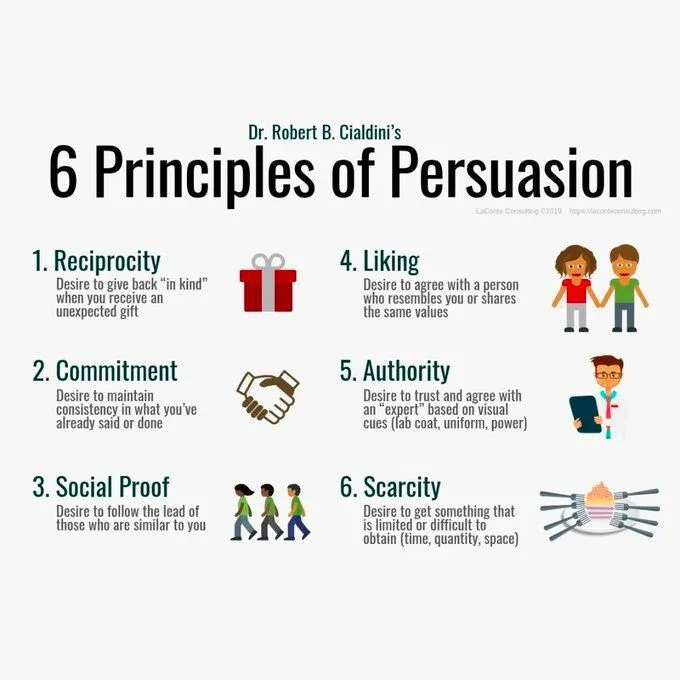
Cialdini would spend the next decade studying this and five other principles like it, and the resulting 1984 book Influence: The Psychology of Persuasion became one of the most consequential social science books ever published.[1]
Understanding what Cialdini found - and what Aristotle articulated 2,300 years before him, and what neuroscientists have since mapped at the level of brain chemistry - is among the highest-leverage intellectual investments a professional in any field can make.
Persuasion is everywhere: in every sales conversation, every meeting where resources are allocated, every performance review, every job interview, every piece of writing that intends to change anyone's mind. The question is not whether you will use it. It is whether you will use it deliberately and ethically.
"Rhetoric is the art of discovering, in any particular case, all the available means of persuasion."
Aristotle
What Persuasion Actually Is
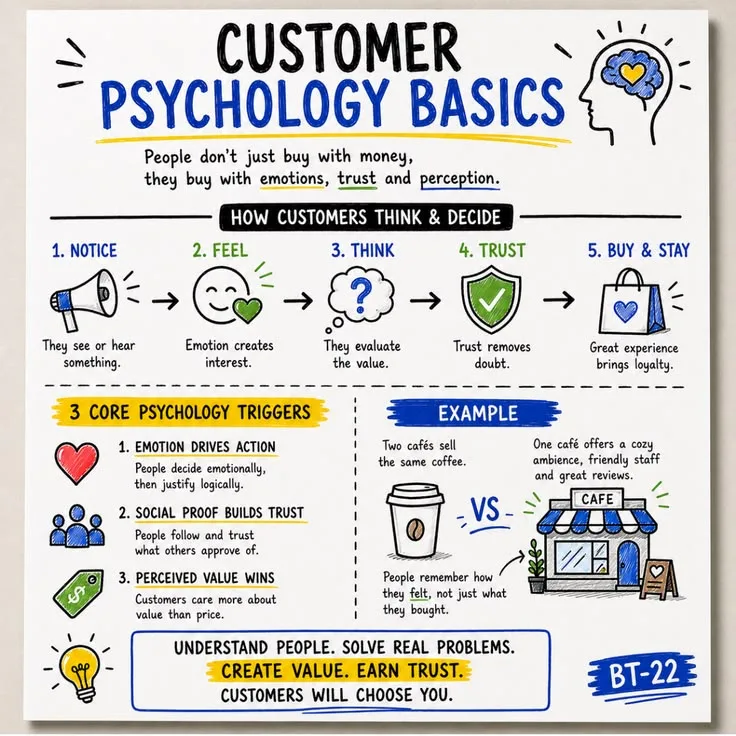
Persuasion is the process of changing or reinforcing another person's beliefs, attitudes, or behaviors through communication rather than through force. It operates by engaging the cognitive and emotional processes through which people form judgments and make decisions.
This definition contains an important negative: through communication rather than through force. That exclusion is what separates persuasion from coercion and what creates its ethical character. Coercion removes choice.
A person who hands over their wallet at gunpoint is not persuaded; they have had their alternatives artificially restricted to the point where compliance is the only survivable option. Persuasion, formally, leaves the person free to choose.
This is why the ethics of persuasion turn on what happens inside that formal freedom - whether the communication gives the person what they need to choose genuinely well, or engineers conditions in which they cannot.
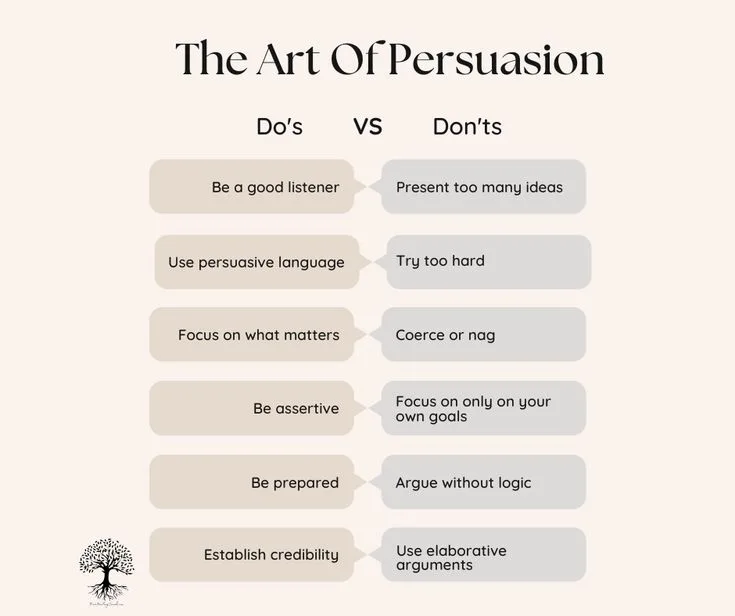
The distinction between persuasion and manipulation occupies this same contested territory. Both intend an outcome and employ influence techniques to achieve it. The difference lies in honesty and respect for the other person's rational autonomy.
Ethical persuasion provides accurate information, genuine evidence, honest emotional appeals, and legitimate appeals to the person's actual interests and values. It leaves them better equipped to decide well.
Manipulation exploits cognitive biases, creates false impressions, withholds relevant information, or engineers emotional states - fear, urgency, flattery - to produce a decision the person would not make if they were thinking clearly and had complete information.
The same behavioral lever can be either persuasion or manipulation depending on how it is used. Pointing to genuine customer evidence - "three companies in your industry have reduced costs by 18 percent using this approach" - is social proof as persuasion.
Manufacturing a sense of consensus that does not exist - presenting cherry-picked testimonials as representative - is social proof as manipulation. The mechanism is identical; the honesty is not.
The test that cleaves the two most reliably is transparency: would you be comfortable if the person you were trying to influence fully understood how you were doing it? Ethical persuasion survives this test. Manipulation typically does not.
"The most important thing in communication is hearing what isn't said."
Peter Drucker (on the foundation of genuine influence)
Aristotle's Three Modes: Still the Best Framework
In the fourth century BC, Aristotle wrote the Rhetoric - a systematic analysis of the art of persuasion that remains, more than two millennia later, the most comprehensive foundational framework available.[2] His central contribution was identifying three modes through which persuasion operates, which he called ethos, pathos, and logos.
Ethos is persuasion through credibility and character. People are more likely to believe and be influenced by sources they trust, find competent, and perceive as genuinely concerned with their wellbeing rather than purely self-interested.
Ethos is not simply claimed - "trust me, I'm an expert" - it is established through demonstrated expertise, consistent integrity between words and actions, and evidence of genuine concern for the audience's interests.
A doctor recommending a treatment has high ethos with patients who trust medicine. The same doctor selling a supplement on a late-night infomercial has compromised ethos, because the commercial context raises questions about whether their concern is for patient health or product revenue.
Logos is persuasion through reason and evidence. A well-structured argument that moves from premises to conclusion, supported by accurate data, relevant examples, and sound logical inference. Logos appeals to the deliberate, analytical mode of thought - Kahneman's System 2 - that evaluates claims carefully against evidence.
High-logos persuasion works best when the audience is motivated to think carefully, when the topic rewards analytical engagement, and when the argument genuinely withstands scrutiny.
It works least well when the audience lacks the technical background to evaluate the evidence or is not in a deliberative mental mode.
Pathos is persuasion through emotional appeal. Not manipulation - not manufactured fear or false urgency - but honest emotional engagement that connects the argument to the audience's actual values, concerns, and motivations.
Stories are the primary vehicle for pathos: they make abstract arguments concrete, put faces and experiences on statistical claims, and activate the emotional engagement that drives behavioral change in ways that pure argumentation typically does not.
Research by Melanie Green at the University of North Carolina has shown that narrative transport - being genuinely absorbed in a story - reduces psychological resistance to the story's embedded messages in ways that argumentative persuasion does not.
The most effective real-world persuasion typically deploys all three modes simultaneously and in the right proportion for the specific audience and context. A scientist presenting research to peer reviewers needs primarily logos.
A political candidate addressing swing voters needs primarily pathos, with enough logos to establish credibility.
A leader asking a team to sacrifice short-term comfort for a strategic goal needs high ethos (they need to believe the leader genuinely believes this is right), meaningful pathos (they need to feel the purpose), and enough logos to believe the strategy is sound.
Cialdini's Six Principles in Depth
The Hare Krishna airport experiment was one data point in three years of research that Cialdini conducted by going underground - taking sales training courses, working with fundraisers, learning how compliance professionals in real settings were achieving their results.
The six principles he identified are not normative claims about how people should reason. They are descriptive findings about how people actually respond, almost automatically, to specific social stimuli.
"Influence is not manipulation. Manipulation is attempting to get someone to do something that is not in their interest. Influence is showing them that it actually is in their interest."
Robert Cialdini
| Principle | Psychological Basis | Ethical Example | Manipulative Misuse |
|---|---|---|---|
| Reciprocity | Universal social norm: repay what you receive | Free consultation that genuinely helps; valuable content offered before any pitch | Unsolicited "gift" engineered to create disproportionate obligation |
| Commitment & Consistency | Drive to remain consistent with prior public positions | Small, genuine commitments that authentically build toward a larger relationship | "Foot-in-the-door" tactics that engineer escalating commitments toward a predetermined endpoint |
| Social Proof | Using others' behavior as a signal of the correct choice | Showing genuine, representative customer evidence and real adoption numbers | Fake reviews, manufactured download counts, cherry-picked testimonials presented as typical |
| Authority | Deference to legitimate expertise is usually adaptive | Citing real, relevant credentials and accurate evidence from genuine experts | Invoking credentials outside one's actual domain; celebrity endorsement as expertise |
| Liking | People comply more readily with those they like | Authentic rapport-building; finding genuine common ground; sincere appreciation | Performed similarity, mirrored speech patterns, false flattery - the behavioral playbook of con artists |
| Scarcity | Loss aversion: potential losses feel twice as powerful as equivalent gains | Communicating genuine availability constraints, real deadlines, true pricing changes | Artificial countdown timers that reset, fake "low stock" warnings, deadlines that silently renew |
Reciprocity
The obligation to repay what we receive is among the most universal norms documented by anthropologists. Every human society studied has a reciprocity norm.
The evolutionary function is clear: systems of exchange require trust that giving will be followed by receiving, and the felt obligation to reciprocate is the psychological enforcement mechanism.
Cialdini's research showed that the reciprocity effect operates even when the initial gift is small, even when it is unsolicited, and even when the expected return greatly exceeds the gift in value. The Hare Krishna flower - worth essentially nothing - reliably produced donations of several dollars.
In a study by Dennis Regan, a confederate who gave subjects an unsolicited soft drink doubled their subsequent willingness to buy raffle tickets compared to subjects who received nothing - a multi-dollar return on a dime investment.[7]
The business application is straightforward and widely practiced: provide genuine value before asking for anything. The "freemium" model in software, the free consultation in professional services, the sample at the grocery store all activate reciprocity.
The ethical version provides value that is genuine - the free consultation that actually helps - rather than the manipulative version that provides a nominal gift while engineering an inflated felt obligation.
Commitment and Consistency
People have a powerful drive to remain consistent with positions they have previously taken, particularly when those commitments have been made publicly, voluntarily, and in writing.
Jonathan Freedman and Scott Fraser demonstrated this with the "foot-in-the-door" technique in 1966: homeowners who agreed to display a small "Be a Safe Driver" sign in their window were later far more likely (76 percent vs 17 percent in the control group) to allow a large, ugly "Drive Safely" billboard to be installed on their lawn.[6]
The small prior commitment had changed how they saw themselves - as the kind of person who cares about safe driving - and the larger request was consistent with that identity.
Cialdini found commitment and consistency at work throughout commercial persuasion. Car dealerships that use "low-balling" - quoting an attractively low price that is later revised upward after the commitment to purchase has been established - exploit this principle.
Subscription services that offer free trials bet that the commitment of setting up an account and beginning use will generate enough consistency pressure to convert trialists.
The ethical application of this principle involves starting relationships with small, genuine commitments and building them authentically rather than manipulating escalation. The manipulative application involves engineering commitments that the person would not make if they understood where the escalation would lead.
Social Proof
Solomon Asch's conformity experiments in the 1950s remain among the most disturbing in social psychology.[5] Subjects were asked to judge which of three comparison lines matched a standard line - a task with an objectively correct answer obvious to any sober observer.
When confederates unanimously chose an obviously wrong answer before the subject responded, 75 percent of subjects conformed at least once. The pressure of apparent consensus overrode clear visual evidence.
Social proof - using others' behavior as evidence of the correct choice - is not irrational in environments where individual knowledge is limited. If you arrive in an unfamiliar city and see one restaurant full and the one next door empty, inferring that the full one is better is reasonable.
The heuristic fails when the evidence of what others are doing is manufactured or unrepresentative, which is what makes it such a powerful manipulation tool.
Online reviews, testimonials, download counts, social sharing numbers, and "people also bought" recommendations all activate social proof.
The line between legitimate use (showing genuine evidence of what real customers have found) and manipulation (selective presentation, fake reviews, manufactured numbers) is the familiar transparency test: would the influence survive disclosure?
Authority
Stanley Milgram's obedience experiments, conducted at Yale beginning in 1961, were designed to understand how ordinary people could have participated in systematic atrocities.[4]
Subjects were instructed by an experimenter in a white coat to administer electric shocks to a "learner" (actually a confederate) when the learner made errors.
The shocks were not real, but the subjects did not know that. Despite the learner's apparent distress - screams, protests, silence - 65 percent of subjects continued to the maximum 450-volt shock level when instructed to do so by the authority figure.
The Milgram results are regularly misread as evidence of human evil. They are more accurately evidence of the power of perceived legitimate authority to override individual moral judgment - a power that evolved because deference to genuine expertise and social authority is usually adaptive.
Problems arise when the cues of authority - credentials, titles, uniforms, confident demeanor - are present without the actual competence or legitimacy they signal.
In persuasion practice, authority is legitimately invoked when the claimed expertise is real and relevant. A cardiologist recommending aspirin therapy is high-legitimate authority. A celebrity endorsing a weight-loss supplement is low-legitimate authority - the fame signal is present, the relevant expertise is not.
Practitioners who cite their credentials or evidence base in ways that are honest and relevant are using authority ethically; those who manufacture credentials or invoke authority outside their actual domain of competence are not.
Liking
People say yes far more readily to those they like. This truism has specific mechanisms: we like people who are similar to us, who compliment us sincerely, who are familiar from repeated contact, and who are physically attractive. All of these have been studied experimentally.
The similarity effect is particularly well-documented. People respond more favorably to requests from those who share characteristics with them - similar backgrounds, interests, values, even clothing choices.
Research by Avis Bahrick found that medical patients rated doctors who verbally aligned with their lifestyle and values as more effective, and were more likely to follow their advice.
Sales training programs that teach rapport-building - finding genuine points of connection with a prospect before making any pitch - activate the liking principle through its similarity channel.
The ethical version is authentic likability: being genuinely interested in the person you are trying to influence, finding real common ground, offering sincere appreciation.
The manipulative version is performed similarity - mirroring someone's speech patterns, manufacturing shared interests, deploying false flattery - which is the behavioral playbook of con artists.
Scarcity
Stephen Worchel and colleagues demonstrated in 1975 what became known as the cookie jar study: subjects rated cookies from a jar that contained only two cookies more favorably than identical cookies from a jar containing ten. Nothing about the cookies had changed. The apparent scarcity increased their perceived value.
Loss aversion - the finding by Kahneman and Tversky that losses are felt roughly twice as intensely as equivalent gains - provides the psychological substrate. The prospect of losing access to something activates emotional systems in ways that the prospect of gaining it does not.
"Limited time offer" and "only three left in stock" work by converting a neutral choice into an apparent loss situation, which dramatically increases decision urgency.
The ethical use of scarcity in persuasion requires that it be true. A product that genuinely has limited availability, a deadline that is real, a price that will actually increase - communicating these facts honestly activates a legitimate cognitive response to real information.
Artificial scarcity - countdown timers that reset, fake "low stock" warnings, deadlines that renew - is a straightforward lie that exploits the scarcity heuristic without the honest conditions that would justify it.
The Elaboration Likelihood Model
Richard Petty and John Cacioppo at Ohio State University developed the Elaboration Likelihood Model (ELM) in the early 1980s to explain when and why different persuasion strategies work.[3]
Their central insight: people process persuasive communication through two qualitatively different routes depending on their motivation and ability to think carefully.
The central route involves effortful, careful processing: evaluating the quality of arguments, weighing evidence, considering implications.
People use this route when the topic is personally relevant, when they have the cognitive resources available, and when they are motivated to reach an accurate conclusion rather than simply a comfortable one.
Central route persuasion produces attitude changes that are more durable and more resistant to subsequent counter-persuasion, because the new position has been genuinely integrated through reasoning.
The peripheral route involves heuristic processing: using cognitive shortcuts - credibility cues, likability, social proof, emotional associations - rather than careful evaluation of argument quality.
People use this route when motivation or ability to process carefully is low: when the topic feels less relevant, when they are cognitively depleted, when time pressure prevents deliberation, or when they lack the technical background to evaluate the arguments.
The ELM explains something that experienced persuaders know but rarely articulate: the most effective persuasion strategy depends on the audience's processing mode.
An audience engaged in deliberate central-route processing needs strong arguments and genuine evidence - peripheral cues without substance will be seen through and may actively backfire, generating reactance.
An audience in peripheral mode is more responsive to cues like the persuader's attractiveness, likability, and social proof, and less responsive to complex argumentation they are not processing carefully.
The practical implication is that matching communication to processing mode matters enormously. The audience for a technical vendor evaluation is in central-route mode; they need the arguments. The audience for a charity fundraising appeal is more commonly in peripheral mode; they need the story and the emotional appeal.
Persuasion in Practice
In Sales and Negotiation
Effective sales persuasion begins with what Chris Voss, former FBI hostage negotiator turned negotiation consultant, calls tactical empathy: demonstrating accurate understanding of the other person's situation, concerns, and goals before any attempt to influence them.
Demonstrating genuine comprehension of a prospect's problems is itself the most persuasive thing a salesperson can do, because it activates both the authority principle (you clearly know their world) and the liking principle (you clearly care about their situation rather than just your quota).
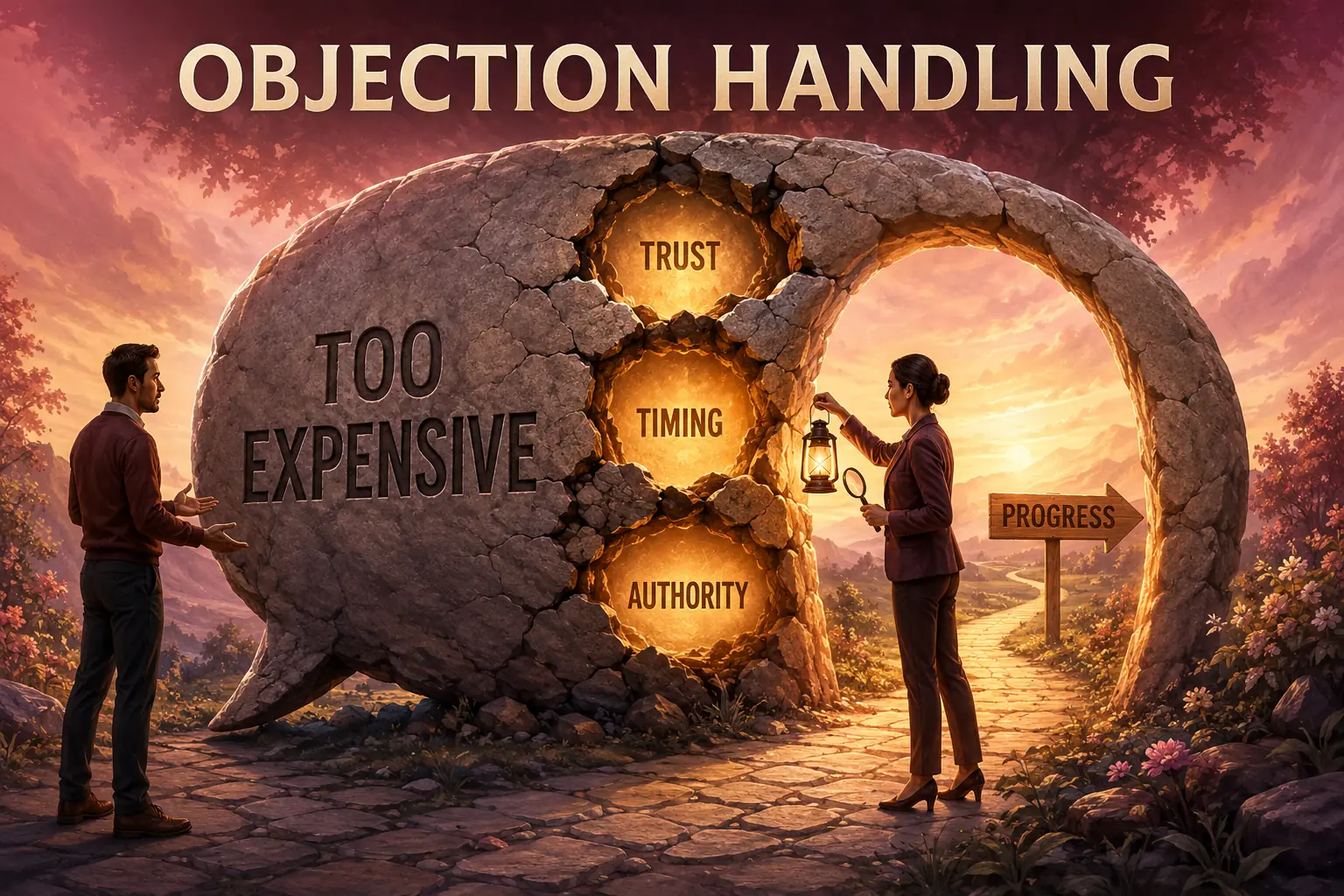
Legitimate objection-handling - acknowledging genuine limitations of your offering honestly, rather than deflecting or minimizing - increases trust and persuasiveness rather than reducing them.
A seller who says "there is one thing you should know about our approach that might be a drawback in your situation" and then names it honestly is generating far more credibility than one who relentlessly minimizes every concern.
Roger Fisher and William Ury'sGetting to Yes, the foundational text of interest-based negotiation, argues that the most durable persuasion in negotiation involves identifying and appealing to the other party's underlying interests rather than their stated positions.
Positions are the surface demands; interests are the actual goals those demands are intended to serve. Persuasion that addresses interests directly - finding solutions that satisfy what they actually need rather than just negotiating positions - generates agreements that hold.
In Leadership
Leadership persuasion is most effective when it operates at the level of identity rather than arguments.
Research by Vanessa Bohns at Cornell shows that direct personal asks are roughly 34 times more effective than email requests, because the social presence of the asker activates reciprocity, liking, and social proof in ways that asynchronous text does not.
At a larger scale, leaders who can frame an organizational direction in terms of the group's identity - "this is who we are" rather than "this is what we have calculated we should do" - activate the consistency principle at the collective level.
The most durable organizational change, as Nadella demonstrated at Microsoft, involves changing the cultural identity rather than the behavioral rules. When people believe that learning and growth are what it means to work here, they produce the associated behaviors without needing constant direction.
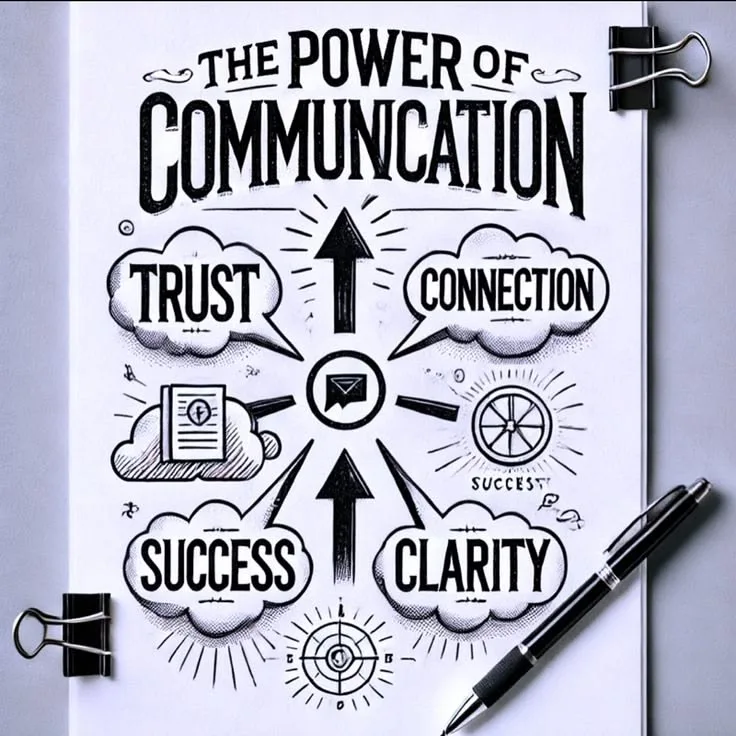
"The most important investment you can make is in yourself. The more you learn, the more you'll earn. Communication is the most important skill any leader can possess."
Warren Buffett
In Writing
Persuasive writing works through the same mechanisms as spoken persuasion but with one crucial difference: the reader controls the engagement. A reader who is not persuaded by paragraph two will not read paragraph three.
This makes the opening move in persuasive writing unusually consequential. Research on reading behavior shows that headlines and first paragraphs determine whether most readers continue. The opening must immediately activate enough interest, recognition, or emotional engagement to justify continued investment of attention.
Starting with a striking specific fact, an unexpected story, or a vivid concrete situation - rather than abstract claims or generic context - is not a stylistic preference. It is how readers are retained.
How to Become More Persuasive
The most important foundation for persuasion skill is the one least discussed in persuasion literature: genuine understanding of the person you are trying to influence. Aristotle built his entire framework on the centrality of audience analysis, and the point has not aged.
Persuasion that begins by accurately demonstrating that you understand the other person's perspective, concerns, and goals is dramatically more effective than persuasion that leads with your own position.
In practice, this means investing substantially in the diagnostic phase before any persuasive communication. What does this person actually care about? What are their real concerns, not their stated positions? What would a successful outcome look like from their perspective?
The more accurately you can answer these questions, the more specifically you can design your communication to address what actually matters to them.
Storytelling is the other highest-leverage skill. Narrative activates emotional engagement, reduces psychological resistance, and makes abstract arguments concrete and memorable in ways that argumentation does not.
The persuasive principle embedded in a story is absorbed without generating the counter-arguing that explicit claims typically provoke.
Learning to find and tell good stories - specific, concrete, emotionally honest, with a clear point - is one of the most transferable persuasion skills available.
How to Resist Manipulation
The primary defense against manipulation is recognizing the conditions under which careful reasoning is being bypassed.
Most manipulative persuasion works by preventing deliberate thought: creating urgency that demands immediate decision, generating emotional activation that crowds out analysis, or using peripheral cues so skillfully that the audience never enters the central route.
When you notice artificial urgency - "this offer expires in thirty minutes" - treat it as a signal to pause rather than to accelerate. Genuine urgency deserves a genuine response; manufactured urgency deserves skepticism. The manipulation is typically in the urgency itself, not in the underlying offer.
When authority is invoked, verify the relevance of the claimed expertise before deferring to it. A Nobel Prize winner in physics is not thereby an authority on nutritional science. Celebrity is not expertise. Confidence is not accuracy.
Check whether the authority's credentials are real, whether they are relevant to the specific question, and whether the claimed authority has any stake in the conclusion they are advancing.
The most important meta-practice is noticing when you are in a state of emotional activation during a decision. Pressure, excitement, flattery, fear, and urgency are all warning signals that your deliberate reasoning may be compromised.
The rule of thumb is simple: if you are feeling pressure to decide now, the right response is almost always to wait.
Practical Takeaways
Persuasion is a skill that operates continuously in professional and personal life, regardless of whether it is practiced deliberately or not. The choice is not between being persuasive and not being persuasive - you are always communicating in ways that influence or fail to influence.
The choice is between doing it consciously, ethically, and effectively, or doing it unconsciously and leaving outcomes to chance.
Build your foundation in Aristotle's triad: establish genuine credibility before making claims (ethos), make honest emotional appeals that connect to what the audience actually cares about (pathos), and construct arguments that withstand logical scrutiny (logos).
The three modes reinforce each other. Strong logos without ethos is expert testimony without trust. Strong pathos without logos is emotional manipulation without substance. Strong ethos without pathos is credible but unmemorable.
Study Cialdini's six principles not only to use them but to recognize when they are being used on you. Awareness of the mechanisms does not eliminate their effect entirely, but it creates the pause for deliberate evaluation that most manipulative persuasion works to prevent.
And apply the transparency test to your own influence attempts: if you would be comfortable with the person you are persuading fully understanding how you are doing it, proceed. If not, reconsider.
Sources & Further Reading
- Cialdini, R.B. (2006). Influence: The Psychology of Persuasion (Revised ed.). Harper Business.
- Aristotle (4th century BC / 2007). On Rhetoric: A Theory of Civic Discourse (G.A. Kennedy, Trans.). Oxford University Press.
- Petty, R.E. & Cacioppo, J.T. (1986). "The Elaboration Likelihood Model of persuasion." Advances in Experimental Social Psychology, 19, 123-205.
- Milgram, S. (1963). "Behavioral study of obedience." Journal of Abnormal and Social Psychology, 67(4), 371-378.
- Asch, S.E. (1951). "Effects of group pressure upon the modification and distortion of judgments." In H. Guetzkow (Ed.), Groups, Leadership and Men. Carnegie Press.
- Freedman, J.L. & Fraser, S.C. (1966). "Compliance without pressure: The foot-in-the-door technique." Journal of Personality and Social Psychology, 4(2), 195-202.
- Regan, D.T. (1971). "Effects of a favor and liking on compliance." Journal of Experimental Social Psychology, 7(6), 627-639.