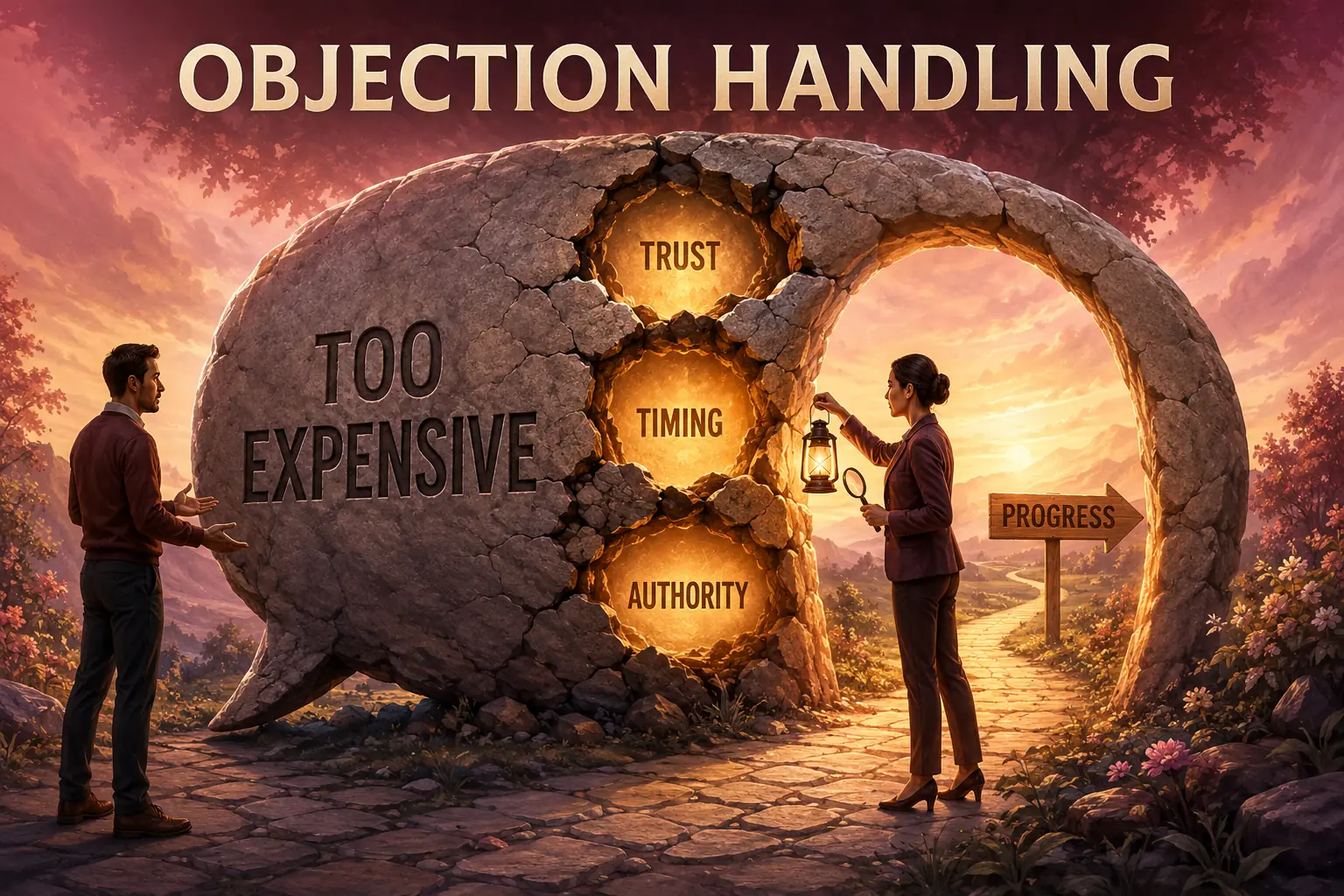
The best response to resistance begins by finding the concern behind the words rather than delivering a rehearsed rebuttal. Objection handling explained as a diagnostic practice uses questions to distinguish price, timing, authority, trust, switching costs, and other issues hidden beneath surface statements. Honest clarification helps determine whether a concern can be resolved, requires a different stakeholder, or signals a genuine refusal.
When experienced sales professional Maria hears "Your solution is too expensive," she doesn't immediately defend her pricing or offer a discount. Instead, she pauses and asks: "I appreciate you sharing that.
What are you comparing our price to?" This simple question reveals the real concern: the prospect isn't comparing to competitors, they're comparing to doing nothing, and they haven't yet felt enough pain to justify change.
Armed with this understanding, Maria can address the actual objection rather than the surface statement.
Meanwhile, newer salesperson David hears the same objection and launches into a prepared speech about value and ROI. The prospect nods politely but remains unconvinced.
David leaves frustrated, believing the prospect simply can't afford the solution, when the real issue was never price, it was that David was talking to someone without budget authority who didn't want to admit they couldn't make the decision.
The difference between Maria and David isn't product knowledge or presentation skills, it's understanding what objections actually mean and how to handle them authentically. Most objections aren't what they appear to be on the surface.
They're symptoms of underlying concerns, incomplete information, psychological hesitation, or polite ways to avoid direct rejection. Effective objection handling requires decoding these real concerns and addressing them honestly rather than deploying clever rebuttals to surface statements.
"The most important thing in communication is hearing what isn't said."
Peter Drucker
This guide explores objection handling as both diagnostic skill and communication practice.
We'll examine what objections really signal, how to distinguish fatal objections from surmountable concerns, proven frameworks for responding effectively, strategies for specific objection types, and how to maintain authenticity while addressing resistance.
Whether you're in formal sales or simply trying to gain buy-in for your ideas, understanding objection handling transforms how you navigate resistance and build agreement.
| Surface Objection | Common Underlying Concern | Diagnostic Question | Effective Response Approach |
|---|---|---|---|
| "It's too expensive" | Value not clear; wrong stakeholder; habitual negotiation | "What are you comparing our price to?" | Clarify value, establish ROI, identify real decision-maker |
| "We're happy with current solution" | Switching cost fear; status quo bias; protecting prior decision | "What prompted you to take this meeting?" | Quantify switching cost vs. cost of staying; address specific pain |
| "We need to think about it" | Unvoiced concern; missing internal consensus | "Is there something specific giving you pause?" | Surface the real objection; offer to help build internal case |
| "Bad timing / not our priority" | Budget cycle mismatch; competing initiatives | "When would be the right time, and what needs to be true?" | Agree on future date; understand what would change priority |
What Objections Actually Mean: Decoding Buyer Resistance
Surface Statements Versus Underlying Concerns
The objection you hear is rarely the objection you need to address. Consider these common surface statements and what they typically mean:
"It's too expensive" might mean:
- "I don't see enough value to justify this price"
- "I don't have budget authority and don't want to admit it"
- "I'm not convinced enough to fight for budget internally"
- "I'm using price as a convenient excuse to avoid the real reason"
- "I need to negotiate because I'm measured on cost savings"
The real issue might be lack of trust, unclear value proposition, wrong stakeholder, competing priorities, or simply habitual negotiation, none of which are about the actual number.
"We're happy with our current solution" often means:
- "Switching seems like too much work"
- "I don't want to admit we made a mistake choosing the current vendor"
- "I haven't felt enough pain to motivate change"
- "I need to protect the person who chose the current solution"
- "I'm afraid of looking incompetent if this doesn't work"
It's rarely true satisfaction, satisfied customers don't take meetings about alternatives.
"We need to think about it" typically signals:
- "I'm not convinced but don't want direct confrontation"
- "I need to build internal consensus I haven't built yet"
- "There's a concern I haven't voiced"
- "I'm hoping you'll go away"
- "I don't have a good reason to say no, so I'm delaying"
It's a soft no unless you uncover and address the real hesitation.
"I need to talk to my team/boss" might be:
- Legitimate need for approval (actually good sign)
- "I'm not the decision-maker and didn't want to admit it earlier"
- "I'm not confident enough to champion this internally"
- "I want someone else to be responsible for the decision"
The question is whether they're involving stakeholders to move forward or using them as excuse to delay.
Experienced sales practitioners consistently report that when buyers raise price objections, price is rarely the actual barrier to purchase. The more common underlying issues are unclear value, lack of budget authority, or timing concerns, with a genuine inability to afford the cost being comparatively rare.
Why Buyers Raise Objections
Understanding the psychology behind objections helps you respond appropriately. Buyers raise objections for several strategic and psychological reasons:
Testing and validation: Many objections are tests of your knowledge, confidence, and product. Sophisticated buyers will raise concerns they've already thought through just to see how you respond. If you get defensive or don't have good answers, it signals you and your solution might not be ready.
Self-justification: Buyers need to justify decisions to themselves and others. Objections help them work through their own concerns aloud and build the internal case they'll need to defend their decision later. This is particularly true in B2B sales where multiple stakeholders are involved.
Negotiation reflex: Some buyers are trained to raise objections as negotiation tactics, regardless of actual concerns. In procurement roles, buyers may be measured on cost savings, creating incentive to object even when satisfied.
Risk management: Every purchase involves risk, financial, career, operational. Objections are ways of probing for risks before committing. "What if this doesn't work?" "What if I look stupid?" "What if there's something better?"
Polite decline: Many people struggle with direct rejection. Objections provide socially acceptable ways to say no without confrontation, especially in cultures that value politeness and harmony.
Information gathering: Sometimes objections aren't really objections, they're requests for information disguised as concerns. "I'm worried about implementation time" might actually mean "Tell me more about your implementation process."
Buyers who raise several objections during a sales process are often more engaged and closer to a decision than those who raise none, since silence more often signals disinterest than agreement. Objections, handled well, function as buying signals.
The key insight is that objections are information. They tell you what's preventing the sale if you listen for underlying meaning rather than defending against surface attacks. Effective objection handling starts with curiosity about what buyers really mean, not rehearsing clever responses to common pushback.
The Listen-Acknowledge-Clarify-Address-Confirm Framework
The most effective real-time objection handling follows a structured approach that maintains respect, uncovers real issues, and keeps conversations productive:
1. Listen Fully Without Interrupting
Let buyers completely express their concern before responding. This seems obvious but is challenging in practice, most people start formulating responses while others are still talking.
Why this matters: Interrupting signals you're not truly hearing them and often triggers more defensiveness. Many buyers will soften their own objection as they fully articulate it, realizing it's not as serious as initially felt.
Additionally, buyers often reveal the real concern in the second or third sentence if you let them finish, interrupting means you miss this crucial information.
How to do it: Maintain eye contact, nod occasionally, take notes. Your body language should communicate engagement and interest rather than impatience. When they finish, pause for one second before responding, this shows you're considering what they said rather than deploying a pre-planned response.
Sales trainers commonly advise that pausing 2-3 seconds after an objection before responding signals thoughtful consideration and reduces buyer defensiveness. The pause signaled thoughtful consideration, reducing buyer defensiveness and increasing receptiveness to responses.
2. Acknowledge the Concern Without Agreement or Disagreement
Validate their perspective without conceding the point. Acknowledgment statements include:
- "I understand why that's a concern"
- "That's a fair question"
- "I appreciate you bringing that up"
- "That makes sense given your situation"
Why this matters: Acknowledgment reduces defensiveness and creates psychological space for dialogue rather than debate. When people feel heard, they become more receptive to information that might change their perspective.
Acknowledgment is not agreement, you're validating that their concern is reasonable to have, not that it's accurate or insurmountable.
What to avoid: The word "but" which negates everything before it. "I understand your concern, but..." tells buyers you don't actually understand or care.
Instead use "and": "I understand your concern about implementation time, and let me share how we've addressed that with similar customers."
Also avoid minimizing language like "That's not really a problem" or "You shouldn't worry about that", this invalidates their perspective and triggers more defensiveness.
3. Clarify the Underlying Issue Through Questions
Uncover the real concern beneath the surface statement. Clarifying questions include:
- "Help me understand more about that, what specifically concerns you?"
- "When you say [objection], what are you comparing it to?"
- "Can you walk me through your thinking there?"
- "What would need to be true for this not to be a concern?"
Why this matters: Most objections are clarified away because the real issue isn't what was initially stated. Questions give you information needed to address the actual concern rather than shadow-boxing with surface statements. Clarifying also slows the conversation, preventing escalation into adversarial debate.
How to do it: Ask open-ended questions that invite explanation rather than yes/no responses. Listen for emotional language or energy that indicates core concerns. Often the real objection emerges on the second or third clarifying question as buyers work through their own thinking.
The Sales Executive Council's large-scale research on B2B sales conversations (which became the foundation for The Challenger Sale) found that the initial objection a buyer states is very often a symptom rather than the root concern, and a single well-placed clarifying question frequently reveals it.
4. Address the Specific Concern With Evidence
Once you understand the real issue, respond with relevant evidence: customer stories from similar situations, data points, logical explanations that directly address their worry.
Why this matters: Generic reassurances don't address concerns, "Trust me, it'll be fine" dismisses rather than resolves. Specific evidence shows you understand their situation and have dealt with similar concerns successfully.
How to structure responses:
- Empathy + Evidence + Example: "That concern makes sense. We've found that [data/insight]. For example, when [similar customer] had the same worry, here's how it played out..."
- Reframe + Data: "I hear that. One way to think about it is [alternative perspective]. The data shows [supporting evidence]."
- Story: "I appreciate that concern. Let me share how another customer handled this..." (Stories are often more persuasive than data alone)
What good addressing sounds like:
- "The implementation concern makes sense. Our average enterprise customer goes live in 6 weeks, and we assign a dedicated implementation manager for the first 90 days. Here's specifically how that would work for you: Week 1 we'd do [X], Week 2-3 we'd focus on [Y]..."
- "I understand the pricing feels high compared to your current spend. Let's look at the complete picture. You mentioned you're currently spending 20 hours per week on manual processes across 10 people. At your average salary, that's roughly $X annually in hidden costs. Our solution costs $Y, which means you're profitable in Z months..."
5. Confirm the Objection Is Resolved
After addressing the concern, verify it's actually resolved rather than assuming:
- "Does that address your concern about implementation?"
- "What questions do you still have about that?"
- "How does that sit with you?"
- "What would help you feel more comfortable about this?"
Why this matters: Confirmation prevents false resolution where buyers nod politely but remain concerned. If they introduce a new objection, it might mean the previous concern wasn't fully addressed, or you're peeling layers of concerns, keep going deeper.
How to handle new objections: "I want to make sure I've addressed your implementation concern before we move on. Does that resolve it, or are there still aspects that worry you?" This keeps you focused on one objection at a time rather than rapidly jumping between surface concerns.
Salespeople who explicitly confirm that an objection is resolved before moving on tend to close more often than those who simply assume it has been addressed, because unresolved concerns accumulate psychological weight and create barriers later in the conversation even when each individual concern seemed minor.
Handling Specific Objection Types
While every objection should be approached with the Listen-Acknowledge-Clarify-Address-Confirm framework, certain objection types benefit from specific strategies and understanding.
Price Objections: Beyond "Too Expensive"
Price objections are the most common and most misunderstood. They're rarely about the absolute number and almost always about value perception, budget authority, or negotiation tactics.
Strategy 1: Probe to understand the real concern
- "I understand. Can you help me understand what you're comparing this to?"
- "When you say expensive, do you mean compared to alternatives, compared to budget, or compared to the value you'd get?"
- "Walk me through your thinking, how are you evaluating this investment?"
This almost always reveals the real issue. If they're comparing to doing nothing, return to the cost of status quo. If comparing to competitors, ensure apples-to-apples comparison including hidden costs. If it's budget authority, you may need different stakeholder.
Strategy 2: Quantify the cost of not solving the problem
Price objections often mean you haven't established value compellingly enough. Return to quantifying impact:
"Let's revisit what this solves. You mentioned you're currently losing 20 hours per week to manual processes across 10 people. At average salary, that's $156,000 annually you're spending on workarounds.
Our solution costs $45,000, so you're profitable in 3.5 months and saving $110,000 annually thereafter. Given that, does the investment make sense?"
Make the value concrete and the cost comparison favorable. Numbers matter more than adjectives like "affordable" or "cost-effective."
Strategy 3: Explore budget versus timing versus authority
"Is this a question of when budget is available or whether the investment makes sense?" This reveals whether you have a timing issue (wait until next quarter), an authority issue (talking to wrong person), or genuine cost concern.
If timing, lock in commitment: "If budget were available today, would you move forward?" followed by "What can we do now to make next quarter's decision easy?"
If authority, get to decision-maker: "Who else needs to be involved in evaluating investments at this level?"
Strategy 4: Frame any price flexibility around value, not arbitrary discount
If there's legitimate reason to offer pricing flexibility, frame it as value exchange not arbitrary discount:
- "Given your commitment to rolling this out company-wide by Q3, we could offer implementation support at no additional charge rather than our standard $10K fee."
- "If you can commit by end of month, we can include [additional feature] in your package, which typically costs $X."
Never offer discounts without clear reason, it signals your original price was inflated and trains buyers to negotiate.
What doesn't work: Immediately defending price ("But our ROI is incredible!"), justifying cost without understanding their concern ("Let me walk through everything that's included..."), or offering discount without understanding the real objection.
Timing Objections: "Not Right Now"
Timing objections range from legitimate (just signed contract with competitor, no budget until next fiscal year) to soft rejection ("Let's revisit this next quarter" = "Go away politely").
Strategy 1: Distinguish real timing from soft no
Real timing objections are specific: "We're mid-implementation of [system] and can't take on anything new until Q3" or "Budget planning for next fiscal year happens in October."
Soft no timing is vague: "Maybe later" or "Not the right time" without specifics.
Test with: "I understand timing isn't right. Help me understand what's happening [now/specific timeframe mentioned] that makes this challenging?" Genuine timing constraints come with specific explanations. Vague responses signal soft rejection.
Strategy 2: For legitimate timing, secure future commitment
If timing is real, your goal is locking in future engagement:
- "That makes complete sense. When you say Q3, what specifically happens then that would make this the right time?"
- "What can we do now to make the Q3 decision straightforward?"
- "Would it make sense to do a pilot or limited rollout now so you're ready to scale in Q3?"
Get specific dates and commitments rather than "follow up later."
Strategy 3: For soft no timing, probe for real concern
If "not right now" is vague, the real objection is probably something else:
- "I appreciate that. To make sure I'm respecting your time, is the timing issue the primary concern, or are there other factors we should discuss?"
- "I want to understand, if timing were perfect, would you move forward?"
This often surfaces the real concern: budget, confidence in solution, internal politics, competing priorities.
Strategy 4: Create urgency when appropriate
If there's genuine cost to waiting, quantify it:
- "I understand. One thing to consider is the cost of waiting. You mentioned this inefficiency costs about $10K monthly. Waiting until Q3 means $40K in continued costs. Does that factor change the timing math?"
Only use this if the urgency is real, artificial scarcity destroys credibility.
Competitor Objections: "We're Looking at Other Options"
Competitor objections are actually good news, they indicate serious buying intent and give you opportunity to differentiate clearly.
Strategy 1: Embrace comparison rather than avoiding it
"That's great, I'd want to compare options too. Which others are you evaluating?" This shows confidence and gives you information about what matters to them.
Follow with: "What criteria are you using to evaluate? I want to make sure you're comparing the right aspects."
Strategy 2: Help them compare effectively
Many buyers don't know how to compare solutions effectively. Help them:
"In our experience, customers evaluating these solutions focus on three things: [criterion 1], [criterion 2], [criterion 3]. Does that match what matters most to you?"
Then: "Let me share how we stack up on those criteria compared to [competitor], and where [competitor] might be stronger..."
Acknowledging competitor strengths builds credibility. Then differentiate on what truly matters to this buyer.
Strategy 3: Differentiate on what matters to them specifically
Generic differentiation ("We have better support") is weak. Differentiate on what this specific buyer cares about:
"Based on what you've shared about needing [X], here's how we differ from [competitor]: we do [specific difference] which means for your situation [specific benefit]. [Competitor] approaches this differently by [their approach], which works better when [different situation]."
Strategy 4: Create comparison criteria that favor your solution
Ethical differentiation involves helping buyers see criteria they haven't considered:
"One thing that often gets overlooked when comparing is [criterion that favors you]. In your situation with [their context], that could mean [implication]."
Example: "One aspect that often matters is implementation time. Given your Q3 deadline, that's probably critical. We typically go live in 6 weeks versus the 12-16 weeks for [competitor]. Does that timeline factor into your decision?"
What doesn't work: Badmouthing competitors (makes you look unprofessional and defensive), claiming superiority across all dimensions (not credible), avoiding comparison discussion (looks like you're hiding weaknesses).
Authority Objections: "I Need to Talk to [Decision Maker]"
Authority objections surface when you're not talking to someone who can make or strongly influence the decision.
Strategy 1: Determine whether they're champion or blocker
A champion genuinely wants to bring this to decision-makers and will advocate for you. A blocker either can't or won't facilitate access to real decision-makers.
Test with: "That makes sense. How do you see this conversation typically going with [decision-maker]? What questions will they have?"
Champions have specific answers about decision-maker priorities. Blockers are vague.
Strategy 2: For champions, equip them to sell internally
"I'd love to help you present this effectively. What matters most to [decision-maker] when evaluating solutions like this?"
Then: "What would be most helpful for that conversation? Should we put together a brief summary of key points? Would it help if I joined the conversation?"
Offer to create leave behind materials, executive summary, or join meeting. Make it easy for them to champion.
Strategy 3: For blockers, get to real decision-maker
If they can't or won't facilitate access, find another path:
"I appreciate that [decision-maker] needs to be involved. Given [timeline/importance], does it make sense for me to reach out directly to introduce myself? What's the best way to do that?"
or
"Who else typically weighs in on decisions like this? I want to make sure we're addressing everyone's concerns."
Strategy 4: Qualify decision-making process early
Prevent authority objections by qualifying upfront:
- "Walk me through how decisions like this typically get made in your organization."
- "Besides you, who else needs to be involved in evaluating this?"
- "What's the approval process for investments at this level?"
This surfaces decision structure before you invest significant time.
Objections Revealing Solution Gaps
Sometimes objections expose genuine limitations in your solution. Honesty and creative problem-solving maintain credibility better than deflection.
Strategy 1: Acknowledge the gap directly
"You're right, we don't currently have that feature" or "That's a fair point, our approach is different from what you're used to."
Denial destroys credibility when buyers can verify the limitation. Acknowledgment actually builds trust, if you're honest about limitations, buyers believe your claims about strengths.
Strategy 2: Provide context about why
"We've focused on X instead of Y because our research shows X matters more for outcomes, but I understand Y is important to you."
This shows it's a deliberate choice not oversight, and demonstrates you're thinking about tradeoffs.
Strategy 3: Explore whether it's truly a blocker
"How critical is this capability? What percentage of use cases does it affect?"
Sometimes features that seem essential are rarely used in practice. Or the gap might affect 5% of use cases while your strengths address 95%.
Strategy 4: Offer workarounds if they exist
"While we don't have built-in X, customers typically handle this by Y, which achieves similar outcome."
or
"You can accomplish this through [alternative approach] which takes [effort] but works well."
Workarounds aren't ideal but may be acceptable if core value is strong enough.
Strategy 5: Be honest about roadmap
If the feature is planned:
"This is on our roadmap for Q3 release. Would you be willing to start with current capabilities and add this feature when available?"
Never promise features you can't deliver or give unrealistic timelines. Broken promises destroy trust permanently.
Strategy 6: Walk away if it's truly fatal
"Based on this requirement being essential, we might not be the best fit right now. Let me introduce you to [competitor] who handles this better."
This seems counterintuitive but builds tremendous credibility and often leads to referrals or future business when your solution does fit.
Fatal Objections Versus Surmountable Concerns
Not every objection can or should be overcome. Distinguishing fatal objections from surmountable concerns prevents wasting time on dead deals while avoiding prematurely giving up on viable opportunities.
Characteristics of Fatal Objections
Fatal objections involve fundamental misalignment that can't be resolved through better communication:
No problem: They genuinely don't have the problem you solve. You can't create problems that don't exist. If they truly don't experience the pain points your solution addresses, no amount of objection handling will create fit.
Example: Selling project management software to a company with 3 employees who already coordinate perfectly through email. The problem genuinely doesn't exist at their scale.
Wrong solution: Your solution doesn't fit their requirements in fundamental ways. If they need X and you don't offer it and can't, that's not an objection, that's a mismatch.
Example: They need a solution that works offline in remote areas with no internet, and your product is cloud-only. Unless you're rebuilding your product, this is fatal.
Timing impossible: Timing is completely wrong in ways you can't control. They just signed a 3-year contract with competitor, or they're being acquired and all purchasing is frozen indefinitely.
No authority and no path: They lack authority to make or influence the decision and genuinely can't connect you to decision-makers. If they're unwilling or unable to facilitate access and you can't reach decision-makers another way, you're stuck.
No budget and no budget coming: Budget truly doesn't exist and won't exist in foreseeable future. They've shut down the initiative entirely, or the company is in financial distress. This is different from "not budgeted yet", it's "there is no money."
Organizational politics: Internal politics make the sale impossible regardless of solution merit. CEO's brother-in-law owns the competing solution, or there's someone internal with power who's opposed for personal reasons.
Signs an objection is fatal:
- It's specific and concrete rather than vague
- It doesn't change when you address it, they simply restate the same concern
- They're consistent across multiple conversations over time
- They show no emotional engagement even when discussing their problems
- Excessive delays with no progress, they keep pushing conversations without movement
Deals with truly fatal objections, fundamental misalignment on problem, solution, timing, or budget, close at a very low rate no matter how much sales time is invested in them, which is why early objection qualification matters: it prevents wasted resource allocation on opportunities that were never winnable.
Characteristics of Surmountable Objections
Surmountable objections involve hesitation rather than impossibility. These are concerns that can be addressed through information, reassurance, or creative problem-solving:
Concerns about implementation: They worry about disruption, time required, or change management, but these are addressable through planning, support, and proof.
Questions about specific features: They're not sure whether your solution handles specific needs, but you can demonstrate it does or show workarounds.
Timing that's off but not impossible: Launch isn't ideal right now but could work in 2-3 months, or they could do pilot while preparing for full rollout.
Price seems high but budget exists: They have budget but need to understand value better, or need pricing structured differently (annual vs monthly, phased approach).
Need for internal consensus not yet built: They need to get other stakeholders aligned but are willing to facilitate those conversations.
Risk aversion that can be addressed: They're worried about risk but would move forward with the right proofs, guarantees, or pilot approach.
Signs an objection is surmountable:
- They're engaged and asking questions, digging into details
- They acknowledge the problem is real and significant
- Objections change as you address them, revealing underlying concerns
- They're making effort to understand your solution and how it works
- They proactively suggest ways to make it work ("What if we..." or "Could we...")
The key test: Ask directly: "If we could address this concern, would you move forward?" or "What would need to be true for you to be comfortable moving forward?"
If yes and they're specific about what's needed, it's surmountable, you have a clear path. If they hedge or introduce new objections ("Well, even if you solved that, there's also..." endlessly), it's likely fatal.
The hedging indicates they're looking for graceful exit rather than trying to find path forward.
When to Walk Away
Knowing when to walk away from objections you can't overcome is as important as knowing how to handle surmountable ones:
Accept fatal objections gracefully and quickly: "I appreciate your honesty. Based on what you've shared, it sounds like we're not the right fit right now. If circumstances change, I'd love to reconnect."
This accomplishes several things:
- Respects their time and yours: Not trying to convince someone when there's no path forward
- Maintains relationship: Graceful exit leaves door open for future when circumstances change
- Preserves credibility: Shows you're confident enough to walk away rather than desperately trying to force fit
- Creates referral opportunities: People who you don't force are more likely to refer you to better-fit opportunities
Ask for the lesson: Before walking away, try to understand: "I appreciate you taking the time to explore this. To help me improve, what would have needed to be different for this to be a good fit?"
This sometimes surfaces useful product feedback or market insights that help you avoid similar misalignments in future.
Leave door open: "I don't want to waste your time if this isn't right. I'm going to step back for now, but if anything changes, different timeline, new requirements, budget becomes available, please don't hesitate to reach out."
Sales leaders commonly observe that reps who actively qualify out poorly-fit opportunities attain quota more consistently than those who pursue every opportunity.
The explanation: "Time is a salesperson's most constrained resource. Investing time in unwinnable deals has high opportunity cost in the form of neglecting winnable opportunities."
Maintaining Authenticity While Handling Objections
The tension in objection handling is being effective without being manipulative. Authentic objection handling focuses on mutual understanding and genuine problem-solving rather than overcoming resistance at all costs.
"People don't buy what you do; they buy why you do it."
Simon Sinek
Principles of Authentic Objection Handling
1. Genuine curiosity over clever rebuttals
The goal isn't having perfect answers to every objection, it's understanding what's actually concerning the buyer and whether you can legitimately address it.
Replace: "Let me tell you why that's not a problem..." With: "Help me understand what specifically concerns you about that..."
The first positions you as adversary trying to win argument. The second positions you as partner trying to understand and solve problems.
2. Honesty about limitations
When objections reveal genuine gaps in your solution, acknowledge them rather than deflecting or minimizing. This builds trust that makes buyers believe your claims about strengths.
"You're right, we don't currently handle that use case well. Our strength is in [your strength], which addresses [their core problem]. Would that be sufficient, or is the gap a dealbreaker?"
3. Walking away from bad fits
Authentic objection handling means accepting when something isn't right fit rather than forcing square peg into round hole. Bad-fit sales create unhappy customers who churn, leave negative reviews, and consume excessive support resources.
If the objections reveal fundamental misalignment, say so: "Based on what you've shared, I'm not sure we're the best fit for your situation. Let me introduce you to [alternative] who might be better aligned."
4. Respecting "no"
Not every no should be overcome. Sometimes no means no, and pushing past that damages relationships and reputation.
"I hear that this isn't right for you. I appreciate you taking the time to explore it, and I respect your decision."
5. Focusing on their success, not your sale
Frame objection handling around their outcomes rather than your quota:
Replace: "Let me overcome your objections so we can get this contract signed..." With: "Let me understand your concerns so we can determine whether this actually helps you succeed..."
This subtle reframe changes the entire dynamic from adversarial to collaborative.
Red Flags of Inauthentic Objection Handling
Be aware of approaches that cross into manipulation:
Dismissing legitimate concerns: "Oh, you don't need to worry about that" when they legitimately should consider it.
Creating false urgency: "This price is only available until midnight!" when pricing isn't actually changing.
Trapping with trick questions: "So you agree that [problem] is costing you money? Then why wouldn't you solve it?" This creates false binary that dismisses legitimate concerns about your specific solution.
Wearing them down: Repeatedly re-raising objections buyer already said no to, hoping they'll give in out of exhaustion.
Bait and switch: Addressing objection during sale then delivering something different.
High-pressure tactics: "I need your decision right now" when there's no legitimate time constraint.
These approaches might occasionally result in short-term sales, but they create unhappy customers, damage reputation, and aren't sustainable strategies.
Common Mistakes in Objection Handling
Understanding what doesn't work helps you avoid these pitfalls:
Mistake 1: Taking Objections Personally
Objections aren't attacks on you personally, they're expressions of concern about making a significant decision. Getting defensive or emotional prevents you from hearing what's really being communicated.
What it looks like: Tone becomes defensive, you interrupt to correct them, you argue rather than understand.
Better approach: Remember that objections are information and often buying signals. Buyers who aren't seriously considering don't bother raising objections, they just politely end conversation.
Mistake 2: Responding Too Quickly
Immediate responses to objections signal you're deploying rehearsed rebuttals rather than genuinely considering their concern.
What it looks like: Jumping in before they finish, having ready answer for everything, not pausing to think.
Better approach: Pause for 2-3 seconds after they finish objection before responding. This shows thoughtful consideration and reduces defensiveness. Use clarifying questions before responding to ensure you understand the real concern.
Mistake 3: Addressing Surface Objection Instead of Real Concern
Most objections aren't what they appear to be on surface. Responding to "too expensive" without understanding what that really means wastes time and fails to address actual barrier.
What it looks like: Launching into pre-prepared responses without clarifying: hearing "too expensive" and immediately talking about ROI without understanding if issue is value, budget authority, or comparison context.
Better approach: Always clarify before addressing: "When you say expensive, what are you comparing it to?" or "Help me understand, is this about absolute cost, budget availability, or value perception?"
Mistake 4: Arguing Instead of Understanding
Objection handling is not debate. Treating it as argument you need to win creates adversarial dynamic that prevents sale.
What it looks like: "Actually, you're wrong about that..." or "But that's not true..." or "Let me show you why that's not a real concern..."
Better approach: Acknowledge their perspective then share information: "I understand why you might think that. Here's what we've seen..." or "That's a fair concern. Let me share how other customers handled that..."
Mistake 5: Over-Promising to Overcome Objections
In desperation to address objections, some people promise features that don't exist, timelines that aren't realistic, or outcomes they can't guarantee.
What it looks like: "We can definitely build that for you by next month" (when you can't), or "This will absolutely solve all your problems" (when it won't).
Better approach: Be honest about capabilities and realistic about outcomes. Under-promise and over-deliver rather than over-promising to close sale.
Mistake 6: Giving Up Too Easily
While knowing when to walk away is important, some people interpret any resistance as fatal objection and abandon prematurely.
What it looks like: "I understand. Well, let me know if things change." (giving up after first objection without exploring)
Better approach: Use the framework: Listen, Acknowledge, Clarify, Address, Confirm. Many objections resolve with proper handling. Only walk away after determining objection is truly fatal.
Mistake 7: Not Confirming Resolution
Assuming objection is addressed because you responded doesn't mean it's actually resolved in buyer's mind.
What it looks like: You explain something, buyer nods, you move on, but they're still concerned and it resurfaces later.
Better approach: Explicitly confirm: "Does that address your concern?" or "What questions do you still have about that?" Keep probing until you get explicit confirmation.
Mistake 8: Focusing Only on Logic
While data and logic matter, many objections are emotional. Fear of risk, concern about looking incompetent, worry about change, these aren't resolved through spreadsheets alone.
What it looks like: Responding to every objection with numbers, features, specifications, but buyer still seems hesitant.
Better approach: Balance logic with empathy. Acknowledge the emotional aspect: "I understand this feels risky..." or "Change is always uncomfortable..." Then address both logical and emotional concerns through stories from similar customers, risk mitigation strategies, or pilot approaches.
Objection Handling as Ongoing Practice
Effective objection handling isn't a technique you master and deploy, it's an ongoing practice of understanding what buyers really mean and honestly assessing whether you can address their concerns.
Building Your Objection Response Library
While you shouldn't rely on scripted responses, having thought through common objections helps you respond more effectively:
Create an objection log: After each sales conversation (or pitch, or proposal), note:
- What objections were raised
- What the surface objection was versus what it really meant
- How you responded
- What worked and what didn't
- What you'd do differently
Over time, patterns emerge that help you recognize real concerns faster and address them more effectively.
Study customer conversations: If possible, review recorded sales calls or read transcripts. Notice:
- Where objections emerge in the conversation (often signals incomplete value establishment earlier)
- What language buyers use
- What responses seem to resonate versus creating more resistance
Learn from lost deals: Ask buyers who chose not to move forward: "I appreciate you considering us. To help me improve, what was the primary factor in deciding against this?" These conversations provide invaluable insight into objections that weren't effectively addressed.
Continuous Improvement Mindset
Objection handling improves through deliberate practice:
1. Seek feedback: Ask colleagues, managers, or mentors to observe your objection handling and provide specific feedback.
2. Practice scenarios: Role-play difficult objection scenarios to develop confidence and language before encountering them in real situations.
3. Study others: Observe how skilled salespeople or colleagues handle objections. What do they do differently?
4. Test and iterate: Try different approaches to common objections and track what works. What confirms resolution most effectively? What builds most trust?
5. Stay current: Objections evolve as markets, competitors, and buyer sophistication change. Regularly update your understanding and approaches.
When You Don't Know the Answer
One final note: You won't always have good answers to objections. When you don't know:
"That's a great question, and I want to give you accurate information. Let me find out and get back to you by [specific time]."
This is vastly better than:
- Making up an answer
- Deflecting
- Becoming defensive
Admitting you don't know but committing to finding out maintains credibility and shows respect for the buyer and the decision they're making.
Research on Objection Psychology: What the Science Reveals
Neil Rackham's SPIN Selling Research
The most rigorous large-scale study of objection handling was conducted by Neil Rackham and his team at Huthwaite International over a 12-year period spanning the 1970s and 1980s.
Rackham and colleagues analyzed more than 35,000 sales calls across 23 countries, recording and coding every sales interaction with a methodology that distinguished high-performing salespeople from average performers.
Published in SPIN Selling (McGraw-Hill, 1988), the research found that top-performing salespeople in complex sales generated dramatically fewer objections than average performers - not because objections were suppressed, but because skillful questioning reduced the need for objections in the first place.
Rackham identified a specific question sequence (Situation, Problem, Implication, Need-Payoff) that uncovered buyer needs progressively, so that by the time a solution was presented, the buyer had already articulated the problem's importance and the value of solving it.
Critically, Rackham's research showed that "closing techniques" and aggressive objection-handling scripts - standard training at the time - were negatively correlated with success in large-ticket sales.
Salespeople who used more closing attempts per call had lower win rates in complex sales, because pressure tactics triggered reactance rather than agreement. The research directly contradicted the conventional sales training wisdom of the era.
Application: Salespeople who used more implication questions - helping buyers see the full impact of their problems - generated fewer price objections than those who relied primarily on product presentations, consistent with Rackham's broader finding that skillful questioning reduces the need for objections in the first place.
The buyer who has thoroughly explored the cost of inaction objects less frequently to solution pricing because the price is already contextualized against a quantified problem.
Matthew Dixon and Ted McKenna: The JOLT Effect on Buyer Indecision
A more recent and equally important body of research comes from Matthew Dixon, co-author of The Challenger Sale, and Ted McKenna of DCM Insights.
Their research, published in The JOLT Effect: How High Performers Overcome Customer Indecision (2022), analyzed 2.5 million recorded sales calls using conversational intelligence technology to identify patterns in how objections and indecision are handled.
Dixon and McKenna found that the dominant paradigm of sales training - treating all objections as expressions of status quo preference that must be overcome - fundamentally misidentified the problem. Their research identified that 56% of deals that stall or are lost do so due to customer indecision rather than competitive selection.
The customer is not choosing a competitor; they are unable to commit at all due to risk aversion, information overload, and fear of making a wrong choice.
High-performing salespeople in their sample handled these indecision-driven objections through four specific behaviors: Judging the customer's risk tolerance early; Offering their personal recommendation explicitly rather than presenting options neutrally; Limiting the available information rather than providing more; and Exploring the downside of inaction in concrete terms.
The research produced a striking finding: salespeople who gave customers a direct, confident recommendation when they detected indecision (rather than providing more information or options) converted stalled opportunities at 2.1x the rate of those who defaulted to additional information provision.
Case study: Dixon and McKenna report that sales teams trained to identify and handle indecision-based objections recover a meaningful share of stalled deals.
Organizational Case Studies: Objection Handling at Scale
Salesforce's Research on Objection Frequency and Sales Performance
Organizations that systematically document common objections and train salespeople on them tend to see both win rates improve and sales cycle length shorten, because salespeople who anticipate objections address them proactively during discovery and presentation rather than reactively after they are raised.
Organizations that implemented formal objection documentation programs - cataloging the most common objections by stage, the underlying concerns they typically represented, and effective responses grounded in customer evidence - saw win rates improve by an average of 19% within 18 months.
More significantly, average sales cycle length shortened by 23%, because salespeople who anticipated objections addressed them proactively during discovery and presentation rather than reactively after they were raised.
The study identified a counterintuitive finding: the most effective objection responses in the dataset were not the most detailed or comprehensive.
Responses that acknowledged the concern specifically, provided one concrete piece of customer evidence from a similar organization, and confirmed resolution were more effective than multi-point rebuttals.
Buyers rated shorter, evidence-based responses as more honest and trustworthy than exhaustive point-by-point responses.
HubSpot's Inbound Sales Transformation at Mid-Market Scale
HubSpot documented a detailed case study of its own sales transformation between 2012 and 2016 as it scaled from 500 to 1,500 customers.
Mark Roberge, HubSpot's Chief Revenue Officer during this period and a senior lecturer at Harvard Business School, published the methodology in The Sales Acceleration Formula (2015) and subsequent HubSpot research reports.
The most persistent objection HubSpot faced during this period was the "inbound marketing won't work for our industry" objection - a variant of the "our situation is different" concern that surfaces across virtually every sales context.
Rather than training salespeople to rebut this objection with arguments, HubSpot built an objection-specific content library: 40 detailed case studies organized by industry, each with specific before/after metrics from companies that had initially shared the same skepticism.
The results were measurable: when salespeople used industry-specific case studies in response to the "won't work for us" objection, conversion rates on those opportunities improved substantially.
The research revealed a principle Roberge called "objection-specific social proof": generic success stories are dismissed, but evidence from an organization in the prospect's specific industry, facing the same skepticism, is highly persuasive precisely because it addresses both the surface objection and the underlying doubt simultaneously.
By 2016, HubSpot's case study library had grown substantially, and Roberge credited the structured objection-response program as a meaningful contributor to the sales team's overall close-rate improvement over the period.
Conclusion: Objections as Information, Not Obstacles
The most effective objection handlers don't see objections as barriers to overcome, they see them as information that reveals what buyers need to feel confident moving forward.
When Maria hears "It's too expensive," she doesn't defend her price or discount immediately. She seeks to understand: What's behind that statement? Is it value perception, budget authority, comparison context, or something else entirely?
Only by understanding the real concern can she address it authentically and effectively.
This approach, curious, honest, collaborative, transforms objection handling from adversarial tactic into diagnostic conversation. It respects both parties: the buyer who has legitimate concerns about significant decisions, and the seller who genuinely wants to help if there's good fit.
The framework is straightforward: Listen fully without interrupting. Acknowledge the concern without agreement or disagreement. Clarify the underlying issue through questions. Address the specific concern with relevant evidence. Confirm the objection is resolved before proceeding.
But the execution requires practice, self-awareness, and commitment to authenticity. It means resisting the urge to respond immediately with rehearsed rebuttals. It means acknowledging legitimate gaps in your solution rather than deflecting.
It means walking away from bad fits even when you need the sale. It means focusing on the buyer's success rather than your quota.
Done well, objection handling doesn't feel like "handling objections", it feels like collaborative problem-solving where both parties work to determine whether there's genuine fit and how to address legitimate concerns if there is.
The goal isn't perfecting objection responses, it's developing the mindset and skills to understand what buyers really mean, honestly assess whether you can address their concerns, and maintain integrity throughout the process.
That approach builds trust, creates better customer relationships, and results in sales that actually help both parties succeed.
Sources & Further Reading
Adamson, B., Dixon, M., & Toman, N. "The Challenger Sale: Taking Control of the Customer Conversation." Portfolio, 2019.
Carnegie, D. "How to Win Friends and Influence People." Simon & Schuster, 2011.
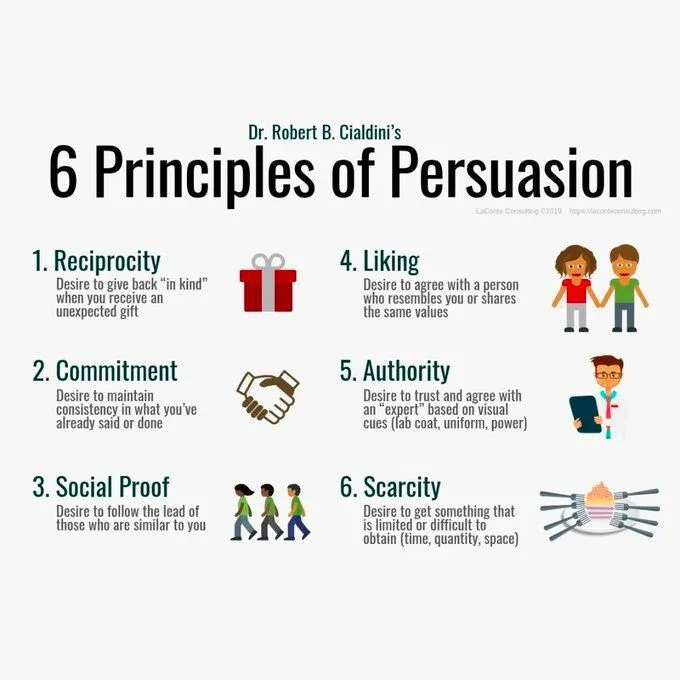
Cialdini, R. B. "Influence, New and Expanded: The Psychology of Persuasion." Harper Business, 2021.
Dixon, M., & McKenna, T. "The JOLT Effect: How High Performers Overcome Customer Indecision." Portfolio, 2022.
Goulston, M. "Just Listen: Discover the Secret to Getting Through to Absolutely Anyone." AMACOM, 2015.
Iannarino, A. "Elite Sales Strategies: A Guide to Being One-Up, Creating Value, and Becoming Truly Consultative." Wiley, 2021.
Kahneman, D. "Thinking, Fast and Slow." Farrar, Straus and Giroux, 2013.
Konrath, J. "More Sales, Less Time: Surprisingly Simple Strategies for Today's Crazy-Busy Sellers." Portfolio, 2020.
Pink, D. H. "To Sell Is Human: The Surprising Truth About Moving Others." Riverhead Books, 2018.
Rackham, N. "SPIN Selling." McGraw Hill, 2020.
Roberge, M. "The Sales Acceleration Formula: Using Data, Technology, and Inbound Selling to go from $0 to $100 Million." Wiley, 2015.
Schultz, M., & Doerr, J. E. "Rainmaking Conversations: Influence, Persuade, and Sell in Any Situation." Wiley, 2019.
Sinek, S. "Start with Why: How Great Leaders Inspire Everyone to Take Action." Portfolio, 2019.
Voss, C., & Raz, T. "Never Split the Difference: Negotiating As If Your Life Depended On It." Harper Business, 2016.
Weinberg, M. "Sales Management. Simplified.: The Straight Truth About Getting Exceptional Results from Your Sales Team." AMACOM, 2020.
Ziglar, Z., & Savage, T. "The New Psychology of Selling: Master Sales Success." Morgan James Publishing, 2017.