
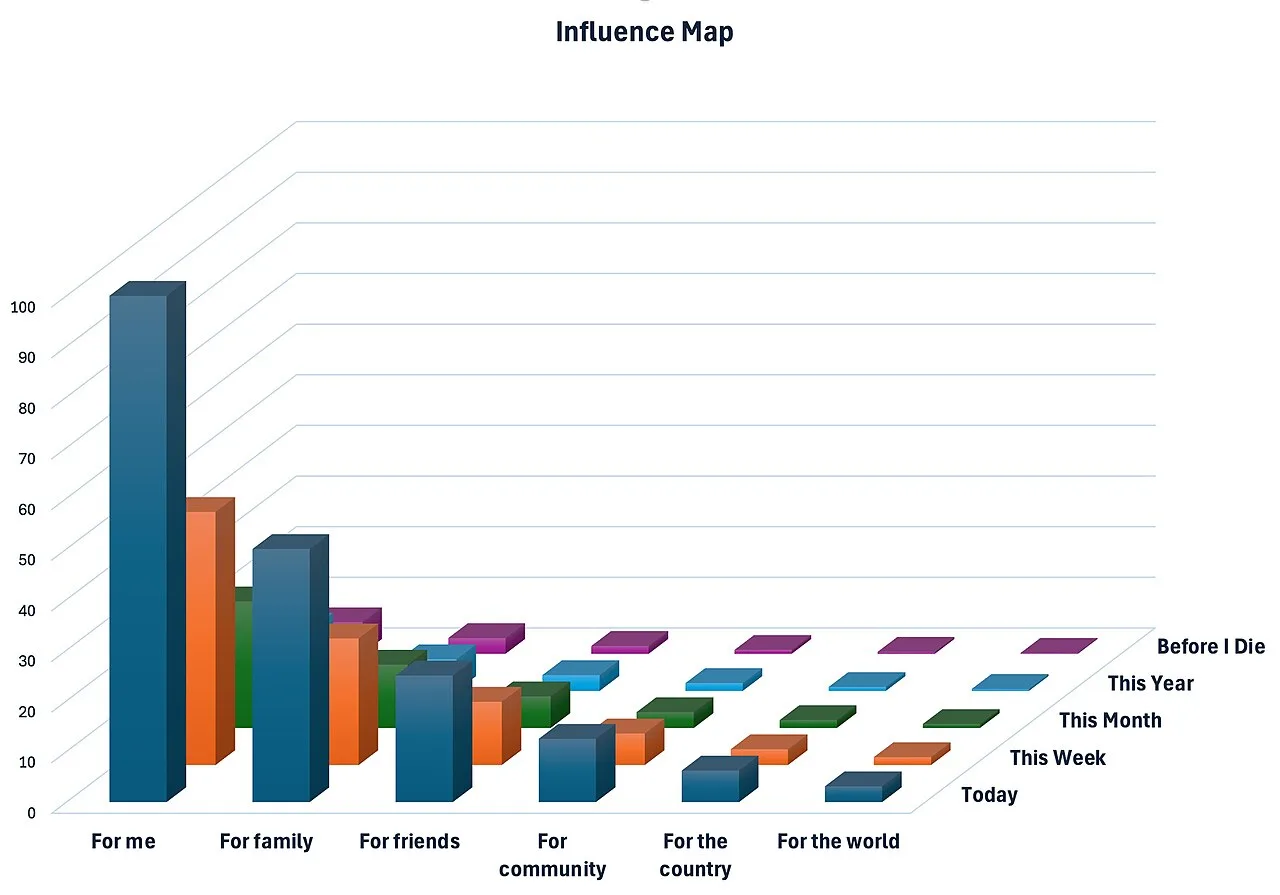
Social influence on behavior is a basic feature of human cognition, shaped by the need for cooperation, belonging, and social learning. Conformity, social proof, and obedience can change actions or beliefs through uncertainty, group norms, authority, visibility, and fear of exclusion. These mechanisms often help coordination, but they can also lead people to follow a group or order they privately recognize as wrong.
You enter a meeting. No one is sitting in the chairs nearest the door. Without thinking, you sit further back. Later, you realize you always do this-but why? The room was empty when the pattern started, yet it persists. Someone sat in back once, others followed, now it's "where people sit."
This is social influence: Other people's behavior shapes your behavior, often without your awareness or consent.
Not occasionally. Constantly.
You dress differently around different groups. You laugh at jokes that aren't funny when others laugh. You adopt opinions you've never personally verified because people you respect hold them. You avoid behaviors that would make you stand out, even when rationally they make sense.
Social influence is not a occasional phenomenon that happens to weak-willed people. It's a fundamental feature of human cognition that shapes behavior continuously for everyone.
Understanding how social influence works-the mechanisms, the conditions that strengthen it, and when it leads us astray-is essential for making autonomous decisions rather than unconsciously following the crowd.
Why Humans Are So Socially Influenced
Evolutionary Foundation
Humans evolved in small groups where:
- Survival depended on cooperation
- Group exclusion meant death
- Social learning was faster than individual trial-and-error
- Conformity enabled coordination
Result: Strong psychological mechanisms for social influence
Evidence:
Social pain uses same neural circuits as physical pain:
- Brain regions (anterior cingulate cortex, insula) activate for both
- Social rejection genuinely hurts
- Evolutionary logic: Physical pain protects body, social pain protects group membership
Social rewards activate reward circuits:
- Being liked, included, respected triggers dopamine
- Social approval is reinforcing
- We pursue social rewards like other rewards
Implication: Social influence isn't weakness or irrationality. It's deeply embedded cognitive architecture.
Mechanisms of Social Influence
1. Conformity
Definition: Changing behavior to match group behavior
Not: Agreement (can conform without believing)
Function: Fit in, avoid standing out
Classic experiment (Asch, 1951):
Setup:
- Group of 7-9 participants (typically 6-8 confederates, 1 real participant)
- Task: Which line (A, B, or C) matches reference line?
- Answer obvious (correct line clearly longer)
Manipulation: Confederates unanimously choose wrong answer
Result:
- 75% of real participants conformed at least once
- On average, participants conformed about 33% of trials
- Control condition (no group pressure): about 0.7% errors
Despite obvious correct answer, majority conformed to incorrect group at least once.[5]
"The tendency to conformity in our society is so strong that reasonably intelligent and well-meaning young people are willing to call white black." - Solomon Asch
Why conform?
Informational influence:
- Assume others know something you don't
- "Maybe I'm wrong, they must see something I don't"
- Genuine belief change
Normative influence:
- Desire to fit in, avoid rejection
- Don't genuinely believe group answer
- Behavioral compliance without belief change
Asch's interviews: Most participants knew right answer, conformed to avoid standing out[6]
When conformity increases:
| Factor | Effect |
|---|---|
| Group size | Increases up to 3-4 people, plateaus after |
| Unanimity | Even one dissenter drastically reduces conformity |
| Public response | Higher conformity when responses visible vs. private |
| Ambiguity | More conformity when correct answer unclear |
| Cohesion | More conformity in tight-knit groups |
| Status | More conformity when group high status |
2. Social Proof
Principle: People assume actions of others reflect correct behavior
Cialdini's formulation:
"We view a behavior as more correct in a given situation to the degree that we see others performing it." - Robert Cialdini, Influence[3]
Applications:
Persuasion:
- "Best-selling" (others bought it, you should too)
- Testimonials (others benefited, you will too)
- Ratings/reviews (others liked it, you will too)
- Crowdfunding (others backed it, you should too)
Behavior modification:
- Energy bills: "Your neighbors use less energy" → reduced consumption[12]
- Hotel towel reuse: "Most guests reuse towels" → increased reuse (more effective than environmental message)
- Tax compliance: "Most people pay taxes on time" → increased compliance
Why it works:
Informational shortcut:
- Don't know what to do → copy others
- Usually works (most people usually right)
- Efficient (saves cognitive effort)
Social validation:
- Others doing it → safer, more acceptable
- Reduces uncertainty and anxiety
When social proof strongest:
1. Uncertainty
- Don't know correct behavior → rely on others
- Ambiguous situations → look for cues
2. Similarity
- Similar others more influential
- "People like me" matters more than "people generally"
3. Numbers
- More people doing something → stronger influence
- But: Sometimes single expert > large crowd
3. Obedience to Authority
Definition: Following orders from authority figure
Not necessarily: Agreeing with orders (can obey while disagreeing)
Milgram experiment (1963):
Setup:
- Participant = "teacher"
- Confederate = "learner" (strapped to chair, electrodes attached)
- Authority = experimenter in lab coat
- Task: Teach word pairs, give electric shock for wrong answers
- Shocks escalate: 15 volts → 450 volts (labeled "Danger: Severe Shock", "XXX")
Reality: No real shocks, learner acting (screaming, pleading, eventually silent)
Question: How far will people go?
Prediction (psychiatrists): <1% will administer maximum shock
Result: 65% administered maximum 450-volt shock
"The social psychology of this century reveals a major lesson: often it is not so much the kind of person a man is as the kind of situation in which he finds himself that determines how he will act." - Stanley Milgram
Despite:
- Learner screaming in pain
- Learner pleading to stop
- Learner mentioning heart condition
- Learner eventually going silent (implying unconsciousness or worse)
Why?
- Authority figure (experimenter) instructed continue
- Incremental escalation (each shock only slightly higher)
- Authority accepted responsibility ("I'm responsible, continue")
Factors increasing obedience:
| Factor | Obedience Rate |
|---|---|
| Standard condition | 65% |
| Authority nearby | 65% |
| Authority distant (phone) | 21% |
| Ordinary person gives orders (not experimenter) | 20% |
| Peer administers shock | 93% (participant just reads words) |
| Two experimenters disagree | 0% (at the point of disagreement) |
Proximity to authority + perceived legitimacy drive obedience
Real-world parallels:
Organizational hierarchies:
- Employees follow orders they privately disagree with
- "Just following orders" common justification
- Responsibility diffusion ("boss decided")
Medical settings:
- Nurses administer medications despite concerns
- Questioning doctors difficult
- Authority gradient steep
Military:
- Following orders even when morally questionable
- Chain of command structure
- Explicit obedience training
4. Groupthink
Definition: Desire for harmony/consensus in group leads to dysfunctional decision-making[4]
Not: Stupidity of individuals (smart people in groups can produce terrible decisions)
Characteristics:
1. Illusion of invulnerability
- Group feels invincible
- Overconfidence in group decisions
- Downplay risks
2. Collective rationalization
- Discount warnings contradicting assumptions
- Justify past decisions
- Ignore disconfirming evidence
3. Belief in inherent morality
- Group believes in rightness of cause
- Ignore ethical consequences
- "We're the good guys"
4. Stereotyped views of out-groups
- Opponents viewed as weak, evil, stupid
- Underestimate adversaries
- Oversimplify opposition
5. Direct pressure on dissenters
- Members pressured to conform
- Disagreement discouraged
- Loyalty demanded
6. Self-censorship
- Members suppress doubts
- Don't voice concerns
- Conform outwardly even when disagree privately
7. Illusion of unanimity
- Silence interpreted as agreement
- Dissent invisible
- False consensus
8. Self-appointed mindguards
- Some members protect group from contradictory information
- Filter out dissenting views
- Shield leader from doubts
Famous examples:
Bay of Pigs invasion (1961):
- Kennedy administration planned Cuban invasion
- Multiple flaws in plan
- Advisors had private doubts but didn't voice
- Conformity pressure silenced dissent
- Result: Complete failure
Challenger disaster (1986):
- Engineers warned against launch in cold weather
- Management pressure to launch
- Dissent downplayed
- Group consensus to proceed
- Result: Shuttle exploded, 7 crew members died
2008 Financial crisis:
- Banks ignored warning signs
- Group consensus: Housing prices can't fall
- Dissenters marginalized
- Result: Global economic collapse
Preventing groupthink:
| Strategy | Mechanism |
|---|---|
| Leader impartiality | Leader doesn't state preference early |
| Encourage dissent | Explicitly invite criticism, assign devil's advocate role |
| Multiple groups | Different groups work on same problem independently |
| Outside experts | Bring in people without group loyalty |
| Second-chance meeting | Revisit decision after initial consensus |
| Anonymous feedback | Reduce normative pressure via anonymity |
5. Social Norms
"The distinctiveness of social identity is that it is based on membership in a group." - Henri Tajfel
Definition: Unwritten rules about acceptable behavior in group[7]
Types:
Descriptive norms: What most people do
- "Most students binge drink" (whether true or not)
- Informational influence
Injunctive norms: What ought to be done
- "Littering is wrong"
- Normative influence
Power:
Norms shape behavior more than personal attitudes:
- You might personally oppose something
- But if group does it → you do it
- Behavior follows norms, not private beliefs
Example: Binge drinking on campus
- Students overestimate peer drinking
- Believe "everyone" drinks heavily
- Descriptive norm (perceived) drives behavior
- Reality: Many students uncomfortable with drinking but conform to perceived norm[8]
- Intervention: Correct misperceptions of norm → behavior changes
Pluralistic ignorance:
- Everyone privately rejects norm
- Everyone believes others support norm
- Everyone conforms to norm no one actually supports
Example:
- College students privately uncomfortable with risky drinking
- Each assumes others comfortable
- Each conforms to perceived norm
- Result: Group engages in behavior no individual actually wants
When Social Influence Helps
"We are connected to each other, and our health and wellbeing depend on the health and wellbeing of others-and on the structure of the networks that surround us." - Nicholas Christakis, Connected
Not all social influence is bad.
Beneficial functions:
1. Social learning
- Learn faster by observing others
- Don't need personal trial-and-error
- Accumulate cultural knowledge
2. Coordination
- Traffic conventions (drive on right/left)
- Language (arbitrary but shared)
- Social rituals enable cooperation
3. Collective action
- Social movements require coordination
- Norms enable large-scale cooperation
- Shared standards facilitate trade, collaboration
4. Cultural evolution
- Good ideas spread
- Innovations adopted
- Practices refined over generations
When social influence works well:
| Condition | Result |
|---|---|
| Wisdom of crowds | Diverse independent estimates average to accurate answer |
| Informational cascades with feedback | Copying others' success, market corrects errors |
| Cultural evolution | Beneficial practices spread, harmful practices abandoned (eventually) |
When Social Influence Leads Astray
Problems arise when:
1. Informational Cascades
Mechanism:
- Early adopters choose (based on limited info)
- Others observe choice, assume private information
- Others copy (rationally, given observation)
- Cascade: Everyone copies earlier people
- Later people's private information ignored
Result: Early random choices determine group behavior
Example: Restaurant choice
Street with two restaurants:
- Restaurant A: objectively better food
- Restaurant B: objectively worse
First customer: Randomly chooses B
Second customer:
- Privately prefers A (based on menu, reviews)
- But sees person in B
- Thinks: "Maybe they know something"
- Chooses B
Third customer:
- Sees two people in B, none in A
- Thinks: "Must be good"
- Chooses B
Cascade: Everyone chooses B despite A being better
Private information (which restaurant is better) never aggregated, early random choice dominates[11]
2. Pluralistic Ignorance
Everyone privately disagrees with norm but publicly conforms:
Mechanism:
- Each person privately holds belief X
- Observes others acting as if belief Y
- Assumes others truly believe Y
- Conforms to Y to avoid standing out
- Others observe conforming behavior, assume support for Y
- Cycle continues
Result: Group publicly supports norm privately rejected by most members
Examples:
Political opinions:
- Many privately moderate
- Perceive extremes as typical
- Self-censor moderate views
- Vocal minorities dominate
Workplace practices:
- Excessive working hours
- Everyone privately wants better balance
- Each assumes others committed to long hours
- Everyone works late (visible), resents it (private)
3. Group Polarization
Definition: Group discussion shifts members toward more extreme position[9]
Not: Compromise or moderation
Instead: Amplification
Mechanism:
Before discussion:
- Individuals hold moderate opinions
- Range of views, but generally moderate
During discussion:
- Hear arguments supporting initial inclination
- Social comparison (want to be perceived favorably)
- Don't want to be moderate outlier
- Shift toward more extreme version
After discussion:
- Group more extreme than average pre-discussion opinion
- Consensus around extreme position
Example:
Mock jury study:
- Individuals read case, make initial judgments (moderately in favor of plaintiff)
- Group discussion
- Final judgments significantly more pro-plaintiff than initial individual judgments
Online communities:
- Conspiracy theory forums
- Each member arrives with doubts about official narrative
- Exposure to community strengthens convictions
- Members become more extreme than when joined
4. Deindividuation
Definition: Loss of self-awareness in group settings
When: Anonymity, large groups, arousal, altered states
Result: Behave differently than would alone
Classic study (Zimbardo):
- Participants administered shocks
- Some wore identifying name tags
- Some wore hoods (anonymous)
- Anonymous participants gave significantly longer/more intense shocks[10]
Online:
- Anonymous comments more aggressive
- Reduced accountability → reduced restraint
Crowds:
- Riots, mob violence
- Individuals do things would never do alone
- "Caught up in moment"
Resisting Social Influence
Awareness and Strategies
1. Recognize mechanisms
Ask:
- Am I conforming to fit in?
- Am I assuming others know something I don't?
- Is authority figure's legitimacy deserved?
- Is group silencing dissent?
2. Seek dissenting views
Deliberately:
- Find people who disagree
- Consider arguments against consensus
- Break unanimity (even one dissenter drastically reduces conformity pressure)
3. Make private commitment
Before group exposure:
- Decide position privately
- Write down reasoning
- Harder to abandon after public
4. Delay response
Time reduces influence:
- Immediate response → stronger conformity
- Delay → process independently
- "Let me think about it"
5. Reduce anonymity
Self-awareness counters deindividuation:
- Mirror presence reduces antisocial behavior
- Cameras increase prosocial behavior
- Personal identification increases accountability
6. Structure dissent
Organizations can:
- Assign devil's advocate (legitimize disagreement)
- Require anonymous feedback
- Leader withholds opinion initially
- Reward dissenting views
Practical Implications
For Individuals
Recognize you are socially influenced:
- Not question of whether, but how much and when
- Awareness doesn't eliminate, but enables examination
Check your reasoning:
- "I believe X because [people I respect / everyone I know / it's obvious] believe X"
- That's social influence, not independent reasoning
Cultivate diverse networks:
- Echo chambers strengthen group polarization
- Diverse views provide cognitive ballast
- Disagreement is valuable
Distinguish information from norms:
- Others' behavior may provide information (descriptive)
- But doesn't make it right (injunctive)
- Popular → correct
For Organizations
Reduce conformity costs:
- Make dissent safe
- Reward constructive disagreement
- Anonymous feedback channels
Structure decisions:
- Private votes before discussion
- Multiple independent groups
- Outside experts
- Second-chance meetings
Break uniformity:
- Assign devil's advocate
- Rotate who plays role
- Make disagreement explicit job
Correct pluralistic ignorance:
- Survey private opinions
- Make distribution visible
- "Many of you think X, but believe you're alone"
For Society
Recognize manipulation:
- Social proof used in advertising, politics
- "Everyone is doing it" may be manufactured
- Numbers can be faked
Design better defaults:
- Opt-out organ donation (conformity to good default)
- Default savings rate
- Social norms messaging for prosocial behavior
Protect dissent:
- Whistleblower protections
- Academic freedom
- Journalistic independence
Conclusion: Navigate Social Influence
You are not immune.
No one is.
Social influence is feature of human cognition, not bug affecting only "weak" people.
Key insights:
- Conformity is powerful (75% conformed in Asch experiment despite obviously wrong answer)[1]
- Social proof drives behavior (others doing it → you do it)
- Authority commands obedience (65% delivered maximum shock in Milgram)[2]
- Groups make worse decisions (groupthink sacrifices quality for harmony)
- Norms override personal beliefs (pluralistic ignorance sustains unpopular norms)
- Anonymity reduces restraint (deindividuation enables behavior wouldn't do alone)
- Groups polarize (discussion makes individuals more extreme)
The path forward:
Understand mechanisms:
- Recognize when being influenced
- Distinguish information from conformity pressure
- Question consensus
Build resistance:
- Seek dissenting views
- Make private commitments
- Delay responses
- Diversify networks
Design better systems:
- Structure decisions to reduce groupthink
- Make dissent safe
- Use social influence for good (prosocial defaults)
- Correct misperceptions of norms
Social influence will continue shaping your behavior.
The question is whether it happens unconsciously (following crowd wherever it goes) or consciously (recognizing influence, choosing when to follow and when to resist).
Independence isn't freedom from social influence-that's impossible.
It's awareness of social influence and deliberate choice about when to let it guide you.
What Research Actually Shows About Social Influence
The landmark studies of Asch, Milgram, and Cialdini established the broad outlines of social influence. Subsequent research has refined, replicated, and in some cases challenged their findings.
Bond and Smith's 1996 meta-analysis of 133 studies using Asch's line-judgment paradigm across 17 countries found conformity rates averaging 25% across cultures - lower than Asch's original 37%, with conformity declining in US studies after the 1950s.
The meta-analysis found that collectivist cultures (Japan, China, Brazil) showed significantly higher conformity rates than individualist cultures (United States, United Kingdom, France), suggesting that the evolutionary pressure toward conformity manifests differently depending on cultural context.
Milgram's obedience experiments have been replicated under ethical review by Jerry Burger at Santa Clara University (2009).
Burger replicated the key conditions of Milgram's experiment up to the point of 150 volts - the point at which Milgram found that most participants who would eventually go to 450 volts made their decision - and found that about 70% of participants continued past 150 volts, a rate slightly lower than (not statistically different from) Milgram's comparable rate, despite 45 years of increased awareness of the experiment.
Burger's finding suggests that cultural knowledge of Milgram's work has not produced protective awareness.
Cialdini's social proof research extended into digital environments by Noah Goldstein, Robert Cialdini, and Vladas Griskevicius (2008).
Hotel towel reuse studies compared multiple message types: environmental messages, messages stating that 75% of guests reuse towels, and messages stating that 75% of guests who stayed in "this room specifically" reused towels.
The room-specific social proof message increased reuse by 33% compared to the environmental message, demonstrating that social proof effectiveness is amplified by similarity and proximity - behavior attributed to people "like you in your exact situation" is more influential than behavior attributed to people generally.
Solomon Asch's original research contained a finding frequently overlooked in popular accounts: a single dissenter dramatically reduced conformity. When one confederate gave the correct answer before the others gave the wrong answer, conformity dropped from 33% to approximately 5.5%.
David Myers at Hope College synthesized follow-up research showing that the dissenter's effect persisted even when they gave a different wrong answer - the mere existence of someone contradicting the majority reduced social pressure sufficiently to free participants to trust their own perception.
This finding has direct organizational implications: one vocal dissenter can free an entire group.
Real-World Applications: When Social Influence Was Deliberately Engineered
Social influence principles have been applied deliberately in public health, consumer behavior, and organizational management.
The OPOWER energy reduction program (now Oracle Utilities) sent household energy reports showing a given customer's energy use compared to their neighbors. By 2015, the program had been deployed to roughly 60 million households worldwide, generating measurable reductions of about 1.5-3.5% in energy consumption.
Researcher Hunt Allcott at NYU (2011) published an independent evaluation confirming an average effect of roughly 2% and finding that it decayed over time but persisted.
The mechanism was purely social proof - no financial incentive, just information about what neighbors were doing - demonstrating that descriptive norms alter behavior at scale.
The Stanford Prison Experiment (Zimbardo, 1971), often cited as evidence of deindividuation and situational control over behavior, has faced significant replication challenges.
Thibault Le Texier's 2019 archival analysis found that Zimbardo actively coached guards to be harsh, that the experiment was stopped not when participants couldn't endure it but when Zimbardo's girlfriend objected, and that many participants were consciously performing expected roles rather than being genuinely transformed.
The lesson may be different from the standard account: people comply with authority figures' implicit expectations about how they should behave, which is itself a social influence finding, though a more mundane one than "ordinary people become sadists in 6 days."
The Robbers Cave experiment by Muzafer Sherif (1954) at the University of Oklahoma studied group formation, intergroup conflict, and conflict resolution among 22 twelve-year-old boys at a summer camp (Robbers Cave State Park).
Sherif found that dividing boys into two groups and introducing competition for scarce resources generated hostility and in-group preference within days.
The study also found that superordinate goals (challenges requiring cooperation between groups) reduced intergroup hostility more effectively than mere contact.
These findings directly influenced corporate team-building practices and diversity initiatives over the following decades.
Google's Project Aristotle (2012-2015) studied 180 Google teams to identify what made some teams consistently outperform others.
The researchers, including Julia Rozovsky, found that the strongest predictor of team effectiveness was psychological safety - the degree to which team members felt safe to take risks and dissent without fear of punishment.
This is essentially the organizational application of Asch's finding: groups that make dissent safe produce fewer conformity errors.
Teams with high psychological safety were rated as more effective by executives and were more likely to bring in more revenue.
Quantified Case Studies: When Social Influence Changed Outcomes at Scale
Beyond controlled experiments, several large natural experiments have permitted researchers to measure social influence effects in populations of millions.
The Facebook emotional contagion study, conducted by Adam Kramer, Jamie Guillory, and Jeffrey Hancock (2014) and published in the Proceedings of the National Academy of Sciences, manipulated the emotional content of news feeds for 689,003 Facebook users without their knowledge.
Users shown more positive posts subsequently produced more positive posts themselves; those shown more negative posts produced more negative content.
The study generated significant ethical controversy for its lack of informed consent, but its methodological contribution was demonstrating emotional contagion at population scale in a real-world digital environment - not merely in laboratory settings with student participants.
The effect sizes were small (changes of approximately 0.1% in emotional word usage) but statistically robust across nearly 700,000 participants.
The "social contagion of obesity" research by Nicholas Christakis and James Fowler at Harvard, published in the New England Journal of Medicine in 2007, followed 12,067 people in the Framingham Heart Study from 1971 to 2003.
Using network analysis, they found that obesity spread through social networks in patterns consistent with contagion: if a mutual friend became obese, a person's own risk of obesity increased by 171% over the subsequent years (mutual friends; 57% for friends overall).
If a sibling became obese, the risk increased by 40%. If a neighbor became obese with no additional social connection, the risk did not increase significantly. The pattern suggested that social influence was the operative mechanism, not shared environments or genetics.
The researchers found similar contagion patterns for smoking cessation (published 2008) and loneliness (published 2009). These findings have influenced public health intervention design, shifting attention from individual-targeted behavior change toward network-level interventions.
South Korea's MERS outbreak response in 2015 provided a case study in how social influence amplified a public health crisis. The Middle East Respiratory Syndrome coronavirus infected 186 people and killed 38 in South Korea in 2015.
World Health Organization analysis found that the outbreak was sustained primarily through hospital transmission, but its social impact was disproportionate: 2,500 schools closed, 1.9 million people cancelled travel plans, and economic losses exceeded $10 billion.
Risk perception researchers led by Wändi Bruine de Bruin at Carnegie Mellon documented that Koreans' fear levels were driven primarily by social media sharing of alarming content (availability cascade) rather than statistical risk assessment.
People who discussed MERS more frequently with their networks reported higher fear and more protective behavior changes, including behaviors (avoiding crowded restaurants) that epidemiologists confirmed were not actually protective against hospital-acquired transmission.
The ALS Ice Bucket Challenge of 2014 provided a measurable case study in social proof and normative cascade. The challenge - pouring ice water over one's head and donating to ALS research - generated $115 million in donations to the ALS Association in eight weeks, compared to $2.8 million in the same period the previous year.
Researchers at Johns Hopkins and Brown University who analyzed social network data found that the campaign's spread followed a contagion model: participation was strongly predicted by having multiple connections who had already participated, consistent with social proof mechanisms.
The ALS Association subsequently funded six research projects that would not have been possible without the funding surge, including the 2016 discovery of NEK1 as a gene contributing to ALS - a research outcome directly traceable to a social influence cascade.
The Science Behind Social Contagion
Social influence operates through mechanisms that researchers are increasingly able to trace at neural and network levels.
Nicholas Christakis and James Fowler at Harvard and UC San Diego documented social contagion effects in the Framingham Heart Study dataset, which tracked 12,067 people from 1971 to 2003.
Their 2007 analysis published in the New England Journal of Medicine found that obesity spread through social networks in ways that could not be explained by shared environments.
If a friend became obese, your risk of obesity increased by 57%. If a friend's friend became obese, your risk increased by 20%.
Effects extended three degrees of separation - to friends of friends of friends - and were stronger for mutual friendships than one-sided ones.
The same researchers found that happiness, smoking cessation, and alcohol consumption spread through social networks using similar mechanisms.
Christakis argued that humans function not merely as individuals but as components of social networks that have emergent properties - collective behaviors and health outcomes that cannot be predicted from individual characteristics alone.
The practical implication is that interventions targeting individuals (anti-smoking campaigns, fitness apps, dietary counseling) may be less effective than interventions targeting network structure or social norms within communities.
Mirror neurons, discovered by Giacomo Rizzolatti and colleagues at the University of Parma in the 1990s, provide a neural substrate for social influence. These neurons fire both when a primate performs an action and when it observes the same action performed by another.
While the direct application of mirror neuron research to human social behavior remains contested, the basic finding that observation of behavior activates similar neural circuits to performing the behavior helps explain automatic imitation - why we unconsciously adopt the posture, speech patterns, and emotional states of people around us.
Chartrand and Bargh's "chameleon effect" research (1999) documented that people unconsciously mimic the mannerisms of interaction partners within minutes, and that this mimicry increases liking and social cohesion - the behavioral expression of what mirror neuron research suggests occurs neurologically.
Sources & Further Reading
Asch, S. E. (1951). "Effects of Group Pressure upon the Modification and Distortion of Judgments." In H. Guetzkow (Ed.), Groups, Leadership, and Men (pp. 177-190). Carnegie Press.
Milgram, S. (1963). "Behavioral Study of Obedience." Journal of Abnormal and Social Psychology, 67(4), 371-378.
Cialdini, R. B. (2006). "Influence: The Psychology of Persuasion" (Revised Edition). Harper Business.
Janis, I. L. (1972). Victims of Groupthink: A Psychological Study of Foreign-Policy Decisions and Fiascoes. Houghton Mifflin.
Bond, R., & Smith, P. B. (1996). "Culture and Conformity: A Meta-Analysis of Studies Using Asch's Line Judgment Task." Psychological Bulletin, 119(1), 111-137.
Deutsch, M., & Gerard, H. B. (1955). "A Study of Normative and Informational Social Influences upon Individual Judgment." Journal of Abnormal and Social Psychology, 51(3), 629-636.
Sherif, M. (1936). The Psychology of Social Norms. Harper & Brothers.
Prentice, D. A., & Miller, D. T. (1993). "Pluralistic Ignorance and Alcohol Use on Campus: Some Consequences of Misperceiving the Social Norm." Journal of Personality and Social Psychology, 64(2), 243-256.
Sunstein, C. R. (2002). "The Law of Group Polarization." Journal of Political Philosophy, 10(2), 175-195.
Zimbardo, P. G. (1969). "The Human Choice: Individuation, Reason, and Order versus Deindividuation, Impulse, and Chaos." Nebraska Symposium on Motivation, 17, 237-307.
Bikhchandani, S., Hirshleifer, D., & Welch, I. (1992). "A Theory of Fads, Fashion, Custom, and Cultural Change as Informational Cascades." Journal of Political Economy, 100(5), 992-1026.
Schultz, P. W., Nolan, J. M., Cialdini, R. B., Goldstein, N. J., & Griskevicius, V. (2007). "The Constructive, Destructive, and Reconstructive Power of Social Norms." Psychological Science, 18(5), 429-434.
Further Reading
Latané, B., & Darley, J. M. (1970). The Unresponsive Bystander: Why Doesn't He Help? Appleton-Century-Crofts.
Surowiecki, J. (2004). "The Wisdom of Crowds." Doubleday.
Turner, J. C., Hogg, M. A., Oakes, P. J., Reicher, S. D., & Wetherell, M. S. (1987). Rediscovering the Social Group: A Self-Categorization Theory. Basil Blackwell.
About This Series: This article is part of a larger exploration of psychology and behavior. For related concepts, see How the Mind Actually Works, Why Awareness Doesn't Remove Bias, Gap Between Thinking and Behavior, and Groupthink and Collective Delusion.