
Attention is one of the most studied and most practically consequential phenomena in cognitive science. It determines what we perceive, what we remember, what we learn, and ultimately what we accomplish.
Yet it is also one of the most poorly understood - not because the science is lacking, but because "attention" turns out to be not a single process but a family of related but distinct capacities that interact in complex ways.
From the cocktail party problem to the gorilla experiment, from ADHD to the attention economy, the science of attention has transformed how we understand the human mind and the conditions under which it flourishes or fails.
Defining Attention: William James and the Paradox of the Obvious
William James, the founding figure of American psychology, opened his 1890 Principles of Psychology with what remains one of the most quoted sentences in cognitive science:
"Everyone knows what attention is. It is the taking possession by the mind, in clear and vivid form, of one out of what seem several simultaneously possible objects or trains of thought. Focalization, concentration, of consciousness are of its essence.
It implies withdrawal from some things in order to deal effectively with others." - William James, Principles of Psychology (1890)
James's definition captures the essential features that subsequent cognitive science has elaborated: attention is selective (it takes one thing rather than others), it is limited (taking one thing requires withdrawing from others), and it is active (taking possession implies agency, not mere passive registration).
Despite a century of experimental work, this intuitive definition has held up remarkably well.
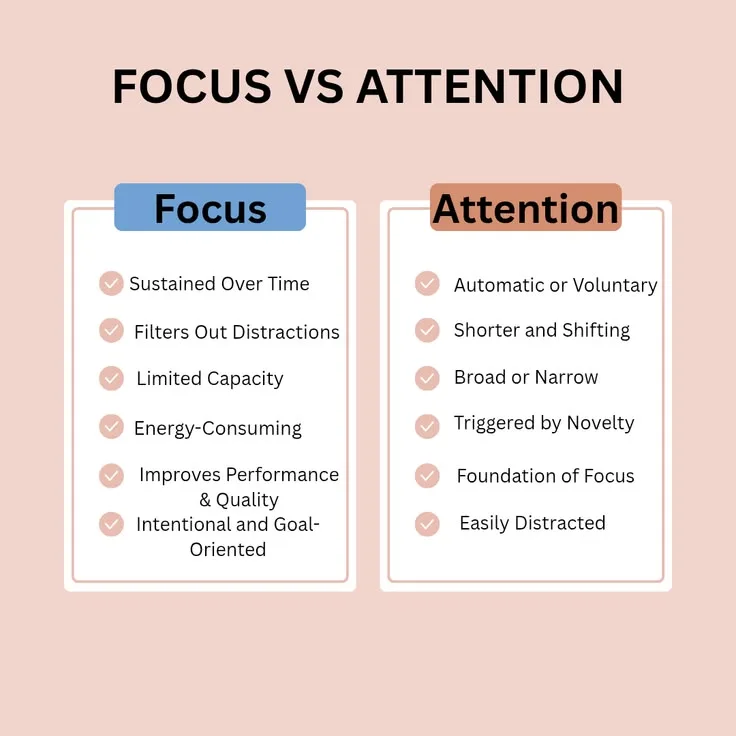
However, "attention" is not a single process but a family of related but distinct capacities. Cognitive psychologists distinguish:
| Type of Attention | What It Involves |
|---|---|
| Selective attention | Choosing one stimulus from among competing stimuli |
| Sustained attention (vigilance) | Maintaining focus on a task over an extended period |
| Divided attention | Attempting to process two or more tasks simultaneously |
| Executive attention | Top-down control of attentional allocation in complex situations |
| Alerting | Achieving and maintaining a high-sensitivity state to detect signals |
| Orienting | Directing attentional resources to a specific location or feature |
These different types of attention engage partially different neural systems and have different behavioral characteristics.
The right prefrontal cortex and right parietal cortex are particularly implicated in alerting; the superior parietal lobe and temporoparietal junction in orienting; and the anterior cingulate cortex and lateral prefrontal cortex in executive attention.
Michael Posner and colleagues' work on these three attentional networks has been foundational since the 1990s.
Selective Attention: The Cocktail Party Problem
Selective attention is the capacity to focus on one stimulus while filtering out competing stimuli.
Its systematic experimental study began with Colin Cherry's dichotic listening experiments in 1953, which gave rise to the "cocktail party problem": how is it possible to follow one conversation at a noisy party where many people are talking simultaneously?
Cherry had participants wear headphones playing different messages to each ear and asked them to "shadow" (repeat aloud) the message in one ear. Participants could do this successfully and could recall the content of the attended message.
From the unattended ear, they could report almost nothing - not the words spoken, the topic, or whether the language changed from English to German. They could report physical properties: whether the unattended channel was a voice or a tone, and whether the voice changed from male to female.
Donald Broadbent formalized this as filter theory (1958): a selective filter blocks most unattended information from higher processing on the basis of physical characteristics (location, pitch).
This explained Cherry's data but faced a challenge: people often hear their own name spoken in an unattended conversation - the name has been processed semantically (for meaning) despite being in the unattended channel.
Anne Treisman (1960) responded with attenuation theory: rather than blocking unattended channels completely, attention attenuates (reduces) their signal. Stimuli with very low thresholds for reaching consciousness - especially highly personally relevant ones like one's own name - can still reach awareness even when attenuated.
This modification preserved filter theory's basic architecture while accommodating what has become known as the own-name effect.
Modern cognitive neuroscience has shown that attention modulates processing at multiple levels, including early visual and auditory cortex, suggesting that the selective filter operates throughout the processing hierarchy rather than at a single stage.
Attention genuinely changes the neural representation of stimuli: attended stimuli produce stronger, more precise neural responses in sensory areas compared to the same stimuli when unattended.
Inattentional Blindness: The Gorilla in the Room
Inattentional blindness is the failure to notice an unexpected but clearly visible stimulus when attention is directed elsewhere. The phenomenon demonstrates that visual awareness is not equivalent to visual input - we can fail to consciously perceive objects that fall directly on our retinas when our attention is occupied elsewhere.
The most famous demonstration is the selective attention test conducted by Daniel Simons and Christopher Chabris in 1999. Participants watched a video of two teams of people - one wearing white shirts, one wearing black - passing basketballs among themselves.
They were asked to count the number of passes made by the white-team players. Midway through the video, a person in a gorilla suit walked into the scene, stopped in the center, thumped their chest, and walked off. The gorilla was on screen for approximately nine seconds.
When asked afterward whether they had noticed anything unusual, approximately 46% of participants said they had not seen the gorilla - despite having watched the scene. The result was broadly replicated and became one of the most discussed findings in psychology, explored in Simons and Chabris's book The Invisible Gorilla (2010).
Inattentional blindness has significant applied implications. Trafton Drew and colleagues (2013) demonstrated the effect with radiologists: when a gorilla image was superimposed on CT scans being examined for lung nodules, 83% of radiologists failed to spot it despite their eyes passing directly over it.
Their attention was dedicated to the task of detecting nodules - exactly the kind of focused expert attention that produces this effect.
Related phenomena include change blindness - failure to detect changes in visual scenes, particularly when the change occurs during a saccade, blink, or brief disruption.
Ronald Rensink's scene perception research showed that even dramatic changes to central objects in images can go unnoticed when the change coincides with a visual disruption.
Together, inattentional blindness and change blindness reveal that visual consciousness is not a passive recording of what falls on the retina but a highly selective, constructive process driven by attentional priorities.
Can People Really Multitask?
The short answer from cognitive psychology is that for most people, multitasking involving two cognitively demanding tasks is not genuinely simultaneous processing but rapid task-switching, which comes at a cost.
When people attempt to do two cognitively demanding things at once, performance on one or both typically suffers compared with doing each alone.
The dual-task paradigm has reliably demonstrated interference effects across a wide range of task combinations.
Driving while holding a phone conversation - even hands-free - produces measurable impairment comparable to driving at the legal blood alcohol limit of 0.08% BAC, according to research by David Strayer and colleagues at the University of Utah.
The interference is not simply a matter of motor coordination but reflects shared cognitive resources - attentional capacity, working memory, executive control - that are drawn on by both tasks simultaneously.
Strayer and Jason Watson (2010) conducted a study explicitly looking for supertaskers - people who genuinely show no dual-task cost when performing a demanding driving simulation simultaneously with a phone conversation.
They found that approximately 2.5% of their sample qualified as supertaskers, showing statistically equivalent performance on both tasks simultaneously versus alone.
This finding is remarkable because it demonstrates that the cognitive limitation is not universal, but it equally underscores how exceptional genuine multitasking ability is.
Research on habitual media multitasking has produced counterintuitive results. Clifford Nass and colleagues at Stanford (2009) found that heavy media multitaskers performed worse than light multitaskers on laboratory measures of attentional filtering, task-switching, and working memory - the very capacities one might expect heavy multitaskers to have trained.
They were more susceptible to distracting irrelevant stimuli. The heavy multitaskers appeared to have developed a broader, less selective attentional disposition.
For routine tasks (walking and talking, folding laundry and listening to a podcast) that are highly automated, dual-task costs are minimal. The interference is most pronounced when both tasks require conscious, controlled processing - when both call on the limited pool of executive attentional resources.
ADHD: An Attention Disorder or Something Deeper?
Attention deficit hyperactivity disorder (ADHD) is a neurodevelopmental condition diagnosed on the basis of persistent patterns of inattention, hyperactivity, and impulsivity inconsistent with developmental level and impairing functioning across settings.
Estimated prevalence around 5-7% of children globally makes it among the most prevalent neurodevelopmental conditions in childhood, and it is now recognized as persisting into adulthood in a majority of those diagnosed.
The naming of ADHD suggests a primary disorder of attention. This characterization is partially accurate - people with ADHD show characteristic difficulties in sustaining attention, filtering distracting stimuli, and completing tasks that are not intrinsically engaging.
However, the most influential theoretical account, developed by Russell Barkley, argues that the core deficit is not in attention per se but in behavioral inhibition - the capacity to inhibit prepotent responses, to stop ongoing responses when required, and to protect goal-directed behavior from interference.
In Barkley's model, poor behavioral inhibition is primary and impairs four executive functions that depend on it:
- Working memory - the capacity to hold information in mind and manipulate it across time
- Self-regulation of affect and motivation - the ability to motivate oneself for non-rewarding tasks
- Internalization of speech - inner speech used for self-instruction and problem-solving
- Reconstitution - the ability to mentally take apart and recombine behaviors to generate novel responses
This model explains a puzzling feature of ADHD: people with the condition can sustain intense attention - hyperfocus - on activities they find intrinsically engaging or that provide immediate feedback, such as video games. If the core problem were attentional capacity, this hyperfocus would be inexplicable.
But if the core problem is behavioral inhibition, the puzzle dissolves: external stimulation and immediate reward can drive behavior that internal self-regulation cannot.
Neuroimaging and genetic studies have implicated the prefrontal cortex, basal ganglia, and dopaminergic and noradrenergic pathways in ADHD. The prefrontal cortex, which matures later than other brain regions and continues developing through the mid-twenties, shows reduced activation and altered structural development in ADHD.
Stimulant medications (methylphenidate, amphetamine salts) that increase dopamine and norepinephrine activity in prefrontal circuits are the most effective pharmacological treatments, with large effect sizes from hundreds of randomized trials.
Flow: The Optimal Attention State
If ADHD represents a dysregulated, fragmented attentional state, flow - described by Mihaly Csikszentmihalyi in his 1990 book Flow: The Psychology of Optimal Experience - represents its opposite: a state of complete absorption in a challenging but manageable task, characterized by effortless concentration, a distorted sense of time, and intrinsic reward.
Csikszentmihalyi identified flow as arising at the intersection of two dimensions: skill level and challenge level. When both are high and roughly matched, flow emerges. When challenge exceeds skill, anxiety results; when skill exceeds challenge, boredom.
Flow states are associated with reduced activity in the default mode network (the brain regions active during self-referential rumination and mind-wandering), suggesting that the self-monitoring that normally consumes attention is suspended during flow.
Flow research has practical implications for education and workplace design: tasks that are appropriately challenging relative to skill, that provide clear goals and immediate feedback, and that allow autonomy tend to promote flow.
The tension between the conditions that promote flow (absorbed concentration on a single task) and the demands of contemporary digital work environments (constant switching, notifications, multitasking) helps explain the widespread sense of attentional depletion.
The Attention Economy: Scarcity in the Information Age
The attention economy is the conceptual framework holding that human attention is a scarce resource that is bought, sold, and competed for by media companies, advertisers, and technology platforms, with significant consequences for individual cognition, culture, and democracy.
The concept is most often attributed to economist and cognitive scientist Herbert Simon, who wrote in 1971: "A wealth of information creates a poverty of attention and a need to allocate that attention efficiently among the overabundance of information sources that might consume it." As the supply of information increases, the bottleneck shifts from information to attention - the scarce resource is no longer data but the human cognitive capacity to process it.
Tristan Harris, a former design ethicist at Google, has been among the most prominent critics of how technology companies engineer their products to exploit attentional vulnerabilities.
Variable reward schedules - the intermittent reinforcement of social media notifications and infinite scrolling - engage the same dopaminergic reward systems that drive slot machine gambling.
Recommendation algorithms optimize for engagement, which typically means escalating emotional arousal and novelty rather than depth or accuracy.
Tim Wu's The Attention Merchants (2016) traced the history of advertising's colonization of attention from nineteenth-century newspapers through radio, television, and digital media, showing that the business model of selling attention to advertisers is not new but has been systematically intensified by digital technology's ability to measure and optimize for engagement with unprecedented precision.
James Williams's Stand Out of Our Light (2018) argued that the attention economy poses a fundamental threat to human autonomy: when our attention is systematically captured by external design, our capacity for self-directed reasoning and deliberation - the basis of democratic citizenship - is undermined.
This is not merely an argument about distraction but about the conditions for genuine agency.
"The goal of every newspaper, radio station, and TV channel is to capture the attention of the largest audience possible for as long as possible. The internet has made this competition faster, more personal, and more intense than anything that came before." - Tim Wu, The Attention Merchants (2016)
The neuroscientific evidence on the effects of heavy smartphone and social media use on attentional capacities is still developing, and causal claims are difficult to establish given the correlational designs of most studies.
Jean Twenge and Jonathan Haidt's work on declining adolescent mental health, synthesized in Haidt's The Anxious Generation (2024), argues that smartphone and social media adoption explains much of the deterioration in adolescent mental health since around 2012 - though the causal mechanisms and strength of evidence remain contested among researchers.
Practical Implications: Designing for Better Attention
Understanding the science of attention has concrete implications for education, work design, and technology policy.
For learning, the evidence supports reducing dual-task demands during acquisition of new skills, minimizing irrelevant interruptions (each interruption not only consumes time but requires a "switch cost" to re-engage the original task), and designing materials that support rather than splinter attention.
Gloria Mark and colleagues at the University of California Irvine found in 2005 that it takes an average of 23 minutes and 15 seconds to fully return to a task after an interruption - a figure that suggests the true cost of interruption-heavy work environments is far larger than the interruption itself.
For individuals, research consistently supports single-tasking for demanding cognitive work, scheduled rather than perpetual monitoring of communications, and environments that minimize interruption during sustained work.
The practice of attentional training through meditation has genuine empirical support: a 2007 randomized trial by Jha and colleagues found that mindfulness training improved attentional performance on laboratory tasks compared to control conditions, and subsequent neuroimaging work has identified changes in frontoparietal attentional networks following sustained meditation practice.
For technology policy, the question of whether attention-capturing design practices constitute a legitimate commercial activity or a form of exploitation requiring regulation is actively debated.
Some jurisdictions have begun considering restrictions on certain design patterns - infinite scroll, autoplay, and notification design - on the grounds that they exploit psychological vulnerabilities in ways that undermine user autonomy.
Conclusion
Attention is simultaneously one of our most limited and most powerful cognitive resources.
Its limits - the fact that we can truly attend to only one demanding thing at a time, that our visual awareness is far more selective than we naively suppose, that sustained attention requires conscious effort and degrades under load - are not failures of the mind but features of an evolved system optimized for a very different environment than the one we now inhabit.
The science of attention offers both a map of these limits and, increasingly, guidance about how to work with them rather than against them. In an era systematically organized to capture and fragment attention, that understanding is not merely academically interesting but practically essential.