
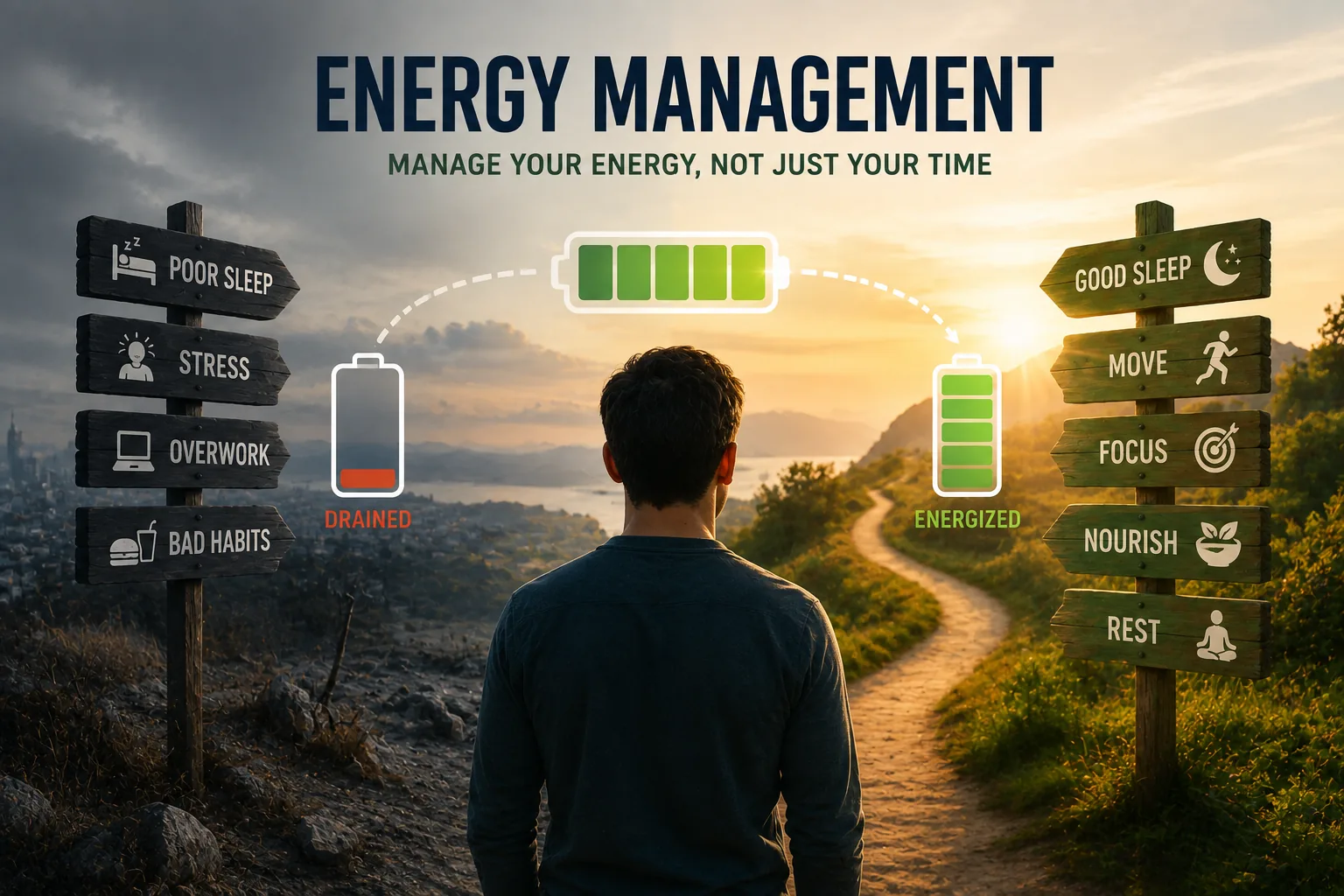
Performance depends not only on time but on aligning demanding work with periods of energy, taking strategic breaks, and protecting recovery. Energy management focuses on those rhythms, treating sustained output as something that requires renewal rather than constant effort alone.
In 2005, Tony Schwartz, CEO of The Energy Project, was consulting with executives at Wachovia Bank when he made an observation that would reshape how organizations think about performance.
Employees who participated in energy management training-learning to align demanding work with peak energy periods, take strategic breaks, and protect recovery time-outperformed a control group by every meaningful measure.
They generated 13 percent more revenue from loans and 20 percent more from deposits.
The difference was not that these employees worked longer hours. They worked with better energy. The same time investment yielded dramatically different results depending on whether employees were energized or depleted when doing the work.
This finding challenges a foundational assumption of modern productivity culture: that time is the fundamental resource to manage. Traditional time management treats every hour as equivalent-a 9 AM hour has the same potential as a 3 PM hour.
But anyone who has tried to write a strategic document at 4 PM after six hours of meetings knows this is false. Energy management recognizes that human performance fluctuates predictably throughout the day, week, and season, and that aligning work demands with energy availability produces superior results with less strain.
The question shifts from "how do I fit more into my schedule?" to "how do I match my most important work to my most energized hours?"
This article explores the science behind energy fluctuation, practical frameworks for tracking and optimizing personal energy patterns, strategies for protecting and renewing energy across physical, mental, emotional, and spiritual dimensions, and the organizational implications of treating energy-not time-as the primary performance currency.
Whether you are an individual contributor seeking sustainable productivity or a leader designing team workflows, understanding energy management transforms how you approach work.
The Science of Human Energy
Circadian Rhythms and Daily Energy Patterns
Every human body runs on a roughly 24-hour internal clock, the circadian rhythm, governed by the suprachiasmatic nucleus in the brain. That clock regulates hormone production, body temperature, cognitive alertness, and dozens of other physiological processes. Most people hit peak cognitive performance 2-4 hours after waking, when cortisol is elevated and body temperature is climbing toward its daily maximum.
There's large-scale evidence for the pattern. Daniel Pink, in When: The Scientific Secrets of Perfect Timing (2018), analyzed over 500 million tweets and found the same emotional shape across cultures: positive affect peaks in the morning, drops sharply in the early afternoon, then partially recovers in the evening.[3] Cognitive performance tracks it closely. Morning hours favor analytical thinking, logical reasoning, focused problem-solving.
Afternoons, especially the post-lunch stretch between 1 PM and 3 PM, show measurable declines in vigilance, working memory, and decision quality.
Individual variation cuts across all of it, though. Chronotype, your genetic predisposition toward morning or evening alertness, shifts the whole curve. Roughly 25 percent of people are strong "larks" who peak before noon. Another 25 percent are "owls" who hit their stride after 6 PM.
The remaining 50 percent land somewhere in the middle. Force an owl into deep work at 7 AM, or a lark into strategy at 10 PM, and you're fighting biology instead of using it.
Example: Haruki Murakami, the novelist, wakes at 4 AM and writes for five to six hours, then gives afternoons to physical activity and evenings to leisure. Franz Kafka did the opposite, holding a day job and writing exclusively between 10 PM and 2 AM. Both produced masterworks by matching their most demanding creative work to their biological peak. They just had different peaks.
Ultradian Rhythms and the 90-Minute Cycle
Underneath the daily cycle sits a shorter one. Energy also fluctuates in ultradian cycles of roughly 90-120 minutes. Sleep researcher Nathaniel Kleitman first spotted these during sleep studies in the 1950s, observing the brain moving through 90-minute stages of light and deep sleep.[7] Later research found the cycles don't stop when you wake up. They keep running all day, alternating higher and lower alertness.
In the active phase, everything works better. Attention sharpens, working memory capacity goes up, complex reasoning flows more naturally. Then after roughly 90-120 minutes the body starts asking for recovery: attention wanders, yawning picks up, the urge to stretch or move gets hard to ignore. Ignoring these signals and pushing through burns energy reserves faster than honoring them with a 15-20 minute break ever would.
The performance research points the same direction. Anders Ericsson, the psychologist behind deliberate practice research, found that elite performers across domains, such as violinists, rarely practiced in sessions longer than about 60 to 90 minutes without a break, and typically capped deliberate practice at around four hours a day.[5] That's the real finding: the world's best weren't the ones logging the most total hours.
They were the ones who practiced with the highest concentration inside defined blocks, separated by genuine recovery.
Example: Ernest Hemingway famously stopped writing each day at a point where he already knew what came next, so he could pick back up with momentum. He typically wrote for 90-minute to two-hour sessions in the morning, then spent afternoons on entirely different activities. That rhythm protected the quality of his morning output and the renewal he needed to keep producing it across decades.
The Four Dimensions of Energy
Energy isn't monolithic. Jim Loehr and Tony Schwartz, in The Power of Full Engagement (2003), identified four interconnected dimensions that together set your performance capacity:
| Energy Dimension | Description | Key Indicators | Renewal Strategies |
|---|---|---|---|
| Physical | Foundation of all energy; bodily vitality | Sleep quality, stamina, illness frequency | Sleep, exercise, nutrition, hydration |
| Mental | Cognitive capacity for focus and reasoning | Concentration ability, creativity, problem-solving | Breaks, variety, stimulation management |
| Emotional | Quality of internal experience | Mood stability, motivation, patience | Social connection, hobbies, self-expression |
| Spiritual | Sense of purpose and meaning | Engagement, values alignment, fulfillment | Purposeful work, reflection, contribution |
They interact in both directions, which is what makes them hard to manage separately. Poor sleep (physical) degrades focus (mental), which breeds frustration (emotional), which eats away at your sense of purpose (spiritual). Run it the other way and deeply meaningful work (spiritual) lifts mood (emotional), sharpens focus (mental), and can temporarily override physical fatigue outright. Managing energy well means watching all four, not just the body.
Most workplace productivity advice ignores three of them. Time management techniques, focus strategies, distraction elimination, all of it targets mental energy alone. But mental energy sits on physical foundations. No productivity system compensates for chronic sleep deprivation.
No focus technique gets you past persistent emotional distress. And no time-blocking strategy manufactures motivation for work that has no purpose in it.
"Manage your energy, not your time." - Jim Loehr and Tony Schwartz
Tracking and Understanding Your Energy
The Energy Audit
Before you can optimize energy you have to know your own patterns, and those are more individual than most people realize. The standard advice to "do important work in the morning" fails roughly half the population, the half whose peak lands later in the day. An energy audit swaps the assumption for data.
The process is simple enough. For one to two weeks, rate your energy hourly on a 1-10 scale. Log the time, the rating, what you were doing, and anything notable: poor sleep the night before, skipped lunch, just finished exercise. Two weeks in, patterns surface that may genuinely surprise you. Maybe your energy peaks at 10 AM and again at 4 PM. Maybe meetings reliably drain you while walks restore you. Maybe the post-lunch dip is much worse on days you eat heavy carbohydrate-rich meals.
A more advanced audit tracks all four dimensions separately, because they don't move together. Physical energy might peak in the morning while emotional energy runs highest after a good team interaction in the afternoon. Mental energy might be strongest right after exercise and then fall off a cliff after 90 minutes of continuous analytical work. Those distinctions matter, since different tasks draw on different energy types.
Example: when Basecamp co-founder Jason Fried tracked his own patterns, he found his most creative thinking happened in the early morning, before anyone else got to work. So he rebuilt the day around protecting that window, pushing meetings to the afternoon and batch-processing email at set intervals instead of continuously. He didn't end up working more hours. He ended up using his best ones far better.
Identifying Energy Drains and Energy Sources
Daily rhythms are only half of it. The other half is knowing which specific activities, people, and environments consistently drain or restore you. The usual energy drains: unnecessary meetings with no clear agenda, prolonged context switching between unrelated tasks, toxic interpersonal dynamics, work that cuts against your values, long stretches without physical movement.
The usual energy sources run the other way: real progress on goals you care about, social connection with supportive colleagues, physical activity even in small doses, creative expression, learning something new, time in nature. Think of these as investments. They cost some energy and return more than they take.
What determines whether you're building reserves or burning them is the ratio between the two across a typical week. A week dominated by drains produces progressive exhaustion no matter how well you sleep and eat. A week that balances demanding work against genuine renewal sustains performance indefinitely.
Example: Sheryl Sandberg, during her time as COO at Meta, talked publicly about leaving work at 5:30 PM to have dinner with her children. That boundary wasn't a concession to work-life balance ideology. It was an energy management decision.
Evening family time delivered the emotional and spiritual renewal that let her sustain high performance during working hours. Without it, the relentless pace of executive leadership would have drained her capacity far faster.
Individual Chronotypes and Working Styles
Sleep researcher Michael Breus identified four chronotypes, each with its own energy curve and optimal work window: the Bear (the majority, following the solar cycle), the Lion (early risers), the Wolf (evening types), and the Dolphin (light sleepers with irregular patterns).[10] Knowing which one you are keeps you from fighting your own biology.
The windows differ sharply. Lions do their best between 8 AM and noon, which makes that their slot for strategic and creative work. Bears peak between 10 AM and 2 PM. Wolves think best between 5 PM and midnight. Dolphins are more variable and need to lean harder on tracking.
Here's the catch: organizational structures almost never accommodate any of this. The standard 9-to-5 workday, morning meetings and afternoon deadlines, optimizes for Bears and Lions while systematically disadvantaging Wolves. Remote and flexible arrangements open up room to honor individual chronotypes, which is a significant and underrecognized benefit of remote collaboration.
Matching Work to Energy Levels
Peak Energy: Protect It Ruthlessly
Your peak energy window, typically 2-4 hours daily, is the most valuable professional resource you have. During those hours you've got maximum capacity for complex reasoning, creative problem-solving, strategic thinking, learning difficult material, high-stakes communication. That work produces disproportionate career value, and you cannot replicate it during low-energy periods. Not for lack of trying.
Which means protecting those hours is proactive calendar work, not good intentions. Block your peak hours for deep work before meetings fill them. Treat the blocks as non-negotiable, the same way you'd treat a client meeting or a board presentation. Colleague wants to meet at 9am and that's your window?
Propose another time. Email beckoning? Defer it. Spending peak energy on shallow work carries an enormous opportunity cost, you're burning premium fuel on tasks that depleted energy would handle just fine.
What actually belongs in that window depends on the role. Architectural design or debugging complex systems, for a software engineer. Market analysis or long-range planning, for a strategist. Drafting original content, for a writer. Difficult conversations or performance reviews, for a manager. The common thread is work that needs your full cognitive capacity.
Example: Bill Gates famously took "Think Weeks," week-long retreats twice a year where he did nothing but read and think about Microsoft's strategic future. Extreme, sure. But the practice recognized something real: strategic thinking requires protected, high-energy, distraction-free time. The insights from those weeks shaped Microsoft's direction for years, producing value far beyond what any amount of meeting attendance could generate.
Moderate Energy: Collaboration and Routine
Moderate energy covers the hours surrounding your peak, plus the recovery period after the post-lunch dip. This is where collaborative work belongs, along with routine execution and anything with a clear process behind it. Meetings, email correspondence, project coordination, familiar workflow execution, none of it needs peak cognitive capacity to function adequately.
Putting meetings here does double duty. The social interaction provides mild stimulation that partially compensates for your reduced individual focus, and the meeting eats time that would otherwise go to mediocre solo work anyway.
Routine tasks with established processes slot in naturally too. Data entry, report formatting, standard communications, file organization. Minimal cognitive load, and they still need doing. Moderate energy is the right place for them.
Low Energy: Simple and Mechanical Tasks
Low energy periods aren't wasted time. They're an opportunity for low-cognitive-demand work: simple administrative tasks, organizing digital files, light reading, planning tomorrow's schedule, routine correspondence. All of it needs minimal mental effort, and all of it produces genuine value when you allocate it to the hours where complex work would simply fail.
Here's the critical part: don't fight low energy with willpower. Attempting strategic thinking while exhausted doesn't produce strategic thinking. It produces poor-quality output while accelerating your energy depletion. Accept the low energy, match task difficulty to the capacity you actually have, and you preserve what's left for the next high-energy cycle.
These periods double as natural recovery windows too. Take a genuine break, walk outside, stretch, have a brief conversation with someone. That supports the ultradian cycle coming next. The break isn't lost productivity. It's an investment in the next productive block.
"The difference between a good life and a bad life is how well you walk through the fire." - Carl Jung
Energy Renewal Strategies
Physical Energy: The Non-Negotiable Foundation
Sleep is the single most powerful energy management intervention there is. Research consistently puts adult needs at 7-9 hours of quality sleep, and chronic sleep debt produces cumulative cognitive impairment on par with legal intoxication. That comparison is literal, not rhetorical. After 17 hours awake, cognitive performance resembles a blood alcohol concentration of 0.05 percent. After 24 hours it hits 0.10 percent, above the legal driving limit in most jurisdictions.
Exercise seems like it shouldn't work. It costs energy, yet it reliably returns more than it takes. A 2008 study published in Psychotherapy and Psychosomatics found that previously sedentary adults with persistent fatigue who started low-intensity exercise three times weekly for six weeks reported a 20 percent increase in energy (and a 65 percent reduction in fatigue relative to controls was seen in the high-intensity-comparison analysis).[12] The effect shows up on much shorter timescales too.
Even a 10-minute walk produces measurable improvements in alertness, mood, and cognitive function.
Nutrition works through blood glucose stability. High-sugar meals spike you then drop you. Complex carbohydrates, protein, and healthy fats release energy steadily instead. Hydration matters more than most people realize: even mild dehydration, 1-2 percent of body weight, impairs concentration, mood, and cognitive function. And regular meals head off the decision-quality decay that comes with hunger.
Example: Jeff Bezos has publicly said he prioritizes eight hours of sleep and won't schedule important meetings before 10 AM. His reasoning is straightforward enough: decision quality worth billions of dollars at Amazon's scale rests on physical energy foundations.
Mental Energy: Strategic Recovery
Mental energy depletes through sustained cognitive effort and replenishes through genuine cognitive rest. That word genuine is carrying weight. Checking email during a "break" is not rest. It's switching from one cognitive demand to another while keeping the mental load that prevents recovery in the first place. Real mental breaks activate the brain's default mode network: walking without purpose, daydreaming, watching nature, sitting quietly.
Attention restoration theory, developed by psychologists Rachel and Stephen Kaplan, shows that exposure to natural environments reliably restores depleted attention capacity.[8] A 2008 University of Michigan study (Berman, Jonides & Kaplan) found that a walk of about 50 minutes in an arboretum improved directed-attention (backward digit span) performance by roughly 20 percent, while a walk along busy streets produced no improvement.
Same duration, same effort, different result. Nature engages "soft fascination," the gentle involuntary attention that lets directed-attention mechanisms recover.
Variety helps too. Alternating between types of cognitive work, analytical then creative, solitary then collaborative, heads off the specific fatigue that builds up during extended engagement with a single cognitive mode. Which argues for spreading diverse tasks across the day instead of running marathon sessions on one project.
Emotional Energy: Connection and Expression
Emotional energy drives motivation, resilience, and interpersonal effectiveness. It depletes through conflict, through suppressing what you actually feel, through prolonged isolation, and through work that violates your values. It renews through genuine social connection, through activities that produce joy, through creative expression and real experiences of accomplishment.
At work, most of this comes down to relationship quality. Gallup research consistently finds that having a close friend at work ranks among the strongest predictors of employee engagement and performance. The mechanism isn't social activity for its own sake. It's emotional energy renewing through trusted connection.
Leaders carry a heavier load here, because leadership demands constant emotional regulation. Holding composure during a crisis. Reassuring an anxious team. Absorbing organizational stress without passing it along. Skip deliberate emotional renewal and you get what psychologists call empathy fatigue, a progressive loss of exactly the emotional attunement the role depends on.
Spiritual Energy: Purpose and Meaning
Spiritual energy, the sense that your work matters and lines up with deeply held values, provides extraordinary resilience. People doing purpose-aligned work sustain effort through difficulties that would flatten someone doing meaningless work. It's why some people hold their energy through grueling startup phases while others burn out in comfortable but purposeless corporate roles.
It renews through reflection, through contributing to causes larger than yourself, through periodically reconnecting with your values and long-term purpose. Something as simple as a weekly look back at "what meaningful work did I do?" can keep this dimension alive.
And when it's gone, when the work feels fundamentally meaningless, nothing else compensates. Not physical rest, not mental breaks, not social connection. This is the hardest dimension to fix precisely because the fix is usually structural, a change of role, organization, or career direction, rather than a tactical adjustment to your daily routine.
Common Energy Killers
Context Switching and Always-On Culture
Context switching is among the most potent energy drains in modern knowledge work. Every switch between unrelated tasks costs you cognitive resources three times over: disengaging from the old context, loading the new one into working memory, then rebuilding focus from scratch.
The numbers are worse than most people assume. Research by Gloria Mark at UC Irvine found office workers get interrupted or self-interrupt every 3 minutes on average, and then need 23 minutes to return to the original task at the same depth of focus.[6] Do that math across a full day and the cost of multitasking compounds into progressive mental exhaustion.
Always-on culture does its damage differently. The expectation of immediate availability by email, messaging, and phone prevents the recovery cycles that sustained performance depends on. Check email through evenings, weekends, and vacations and you never fully disengage from work demands. The result isn't more productivity. It's chronic partial engagement, never fully working, never fully resting.
Organizations that take this seriously see measurable gains. Boston Consulting Group ran experiments where teams took planned, predictable nights off, no email, no calls. Fewer total hours worked, and yet those teams reported higher satisfaction, better communication, and no drop in client satisfaction or work quality. Genuine disconnection restored enough energy to more than cover the lost hours.
Poor Sleep and Physical Neglect
The CDC estimates that one-third of American adults sleep less than the recommended seven hours per night, and the productivity consequences are severe. Sleep-deprived workers are less creative, more error-prone, worse at interpersonal communication, and more likely to make risky decisions. Yet plenty of organizational cultures still treat sleep deprivation as evidence of commitment.
Sitting is its own problem, separate from sleep. Sedentary patterns, 8-10 hours daily with minimal movement, progressively deplete physical energy no matter how well you slept. The human body evolved for movement, and prolonged stillness produces fatigue, reduced circulation, diminished cognitive function. Brief movement breaks every 60-90 minutes counteract most of it.
Then the smaller erosions: chronic dehydration, irregular meals, excessive caffeine dependency. Caffeine deserves particular suspicion, since it masks fatigue without restoring any energy, which sets up a cycle of artificial stimulation followed by deeper crashes.
Toxic Relationships and Meaningless Work
Some interpersonal dynamics function as energy vampires, interactions that reliably leave you more depleted than you were going in. Chronic complainers who offer no solutions. Micromanagers who drain autonomy. Passive-aggressive communicators who manufacture constant uncertainty. Competitive colleagues who undermine collaboration. Managing those relationships is an energy management priority, not a soft skill.
And underneath all of it sits the hardest one. Work that lacks clear purpose, or any visible connection to outcomes that matter, drains emotional and spiritual energy faster than physical and mental strategies can offset. If "why does this matter?" has no satisfying answer, tactical energy management buys you only marginal improvement. Closing that gap takes structural change: reframing the work to connect with purpose, changing roles, or adjusting what you contribute to the organization.
Designing an Energy-Managed Day
A Practical Framework
An energy-managed day throws out the uniform 8-hour workday model and replaces it with a rhythm of strategic engagement and recovery:
| Time Block | Energy Level | Optimal Activities |
|---|---|---|
| Morning (first 2-4 hours after waking) | Peak | Deep work, creative problem-solving, strategic decisions |
| Late morning | Moderate-high | Complex collaboration, important meetings |
| Post-lunch (1-3 PM) | Low | Simple admin, light reading, organizing, walking |
| Mid-afternoon (3-5 PM) | Moderate recovery | Routine work, email, planning tomorrow |
| Evening | Variable | Recovery, renewal, personal interests |
None of those clock times are sacred. The framework adapts to chronotype, so a Wolf (evening type) might slide the whole pattern later: administrative morning, peak creative work from 4-8 PM, social engagement late in the evening. What matters is the structure, not the specific hours. Match task demand to available energy, whenever your peak happens to land.
Inside each block, ultradian rhythms add their own sub-structure: 90-120 minutes of focused engagement, then 15-20 minutes of genuine recovery. A typical day holds 2-3 deep focus cycles at most. Not 8 hours of continuous concentration. Accepting that limit is genuinely liberating, because you're not failing to focus for 8 hours. You're succeeding at focusing for 3-4 hours, which is what elite performers actually manage.
Example: Cal Newport, author of Deep Work, runs morning deep work blocks, batches his administrative tasks in the afternoon, and stops hard at 5:30 PM.[4] That gets him roughly four to five hours of deep work a day, a rate that has produced seven books, a tenured Georgetown professorship, and a popular podcast. Peak performance from energy-aligned intensity, not extended hours.
The Weekly Energy View
Energy patterns run longer than a single day. Most people feel higher energy Tuesday through Thursday, with Monday needing ramp-up time and Friday running on declining reserves. Plan the week accordingly: most demanding work mid-week, lighter administrative work on Mondays and Fridays.
Monthly patterns matter too. Hormonal cycles affect energy for many women, producing predictable stretches of higher and lower capacity. Seasonal changes shift things through daylight exposure and temperature. Acknowledging all this beats expecting uniform performance across every week and month of the year, it makes planning more realistic and takes the sting out of naturally lower-energy periods.
Good planning systems build these multi-timescale patterns in. A weekly review asks not just what needs doing, but when you'll have the energy to do each thing well. Quarterly planning looks ahead at predictable high-demand stretches, end-of-quarter reporting, annual reviews, and deliberately schedules lighter weeks on either side.
Energy Management vs. Pushing Through
The Sustainability Equation
Traditional productivity culture glorifies "pushing through." Work despite exhaustion. Lean on willpower and caffeine. Ignore what your body is telling you. It produces short-term results at long-term cost, the same way skipping recovery days does for an athlete. Push through consistently and you accumulate energy debt that eventually forces a crash: burnout, illness, relationship breakdown, a sharp drop in performance.
The sustainability equation is blunt. High output + Low recovery = Burnout. Aligned output + Adequate recovery = Long-term high performance. Elite athletes get this instinctively, no marathon runner trains at race pace every day. Knowledge workers have to learn it: performance isn't constant, and rest isn't the opposite of productivity. It's the prerequisite.
The arithmetic backs it up. Work at 85 percent capacity with proper recovery and you can sustain that indefinitely. Work at 120 percent for two years and you typically get a burnout episode that costs months of recovery. Stretch the horizon out to five years and the sustainable approach produces more total output, despite the lower daily intensity.
Example: Arianna Huffington collapsed from exhaustion in 2007, breaking her cheekbone on her desk.[9] That incident sent her into the research that became Thrive, which argued that Silicon Valley's culture of sleep deprivation and overwork wasn't a badge of honor but a public health crisis. She went on to found Thrive Global, a company built around sustainable performance.
It exists because she lived through the failure of the push-through model herself.
Signs Your Energy Management Is Failing
Watch for chronic fatigue that hangs around despite adequate sleep. Declining work quality, more errors, less creativity, slower processing. Trouble concentrating on tasks that used to feel manageable. Rising irritability or emotional volatility. Physical symptoms too: persistent headaches, muscle tension, getting sick more often than you used to.
When those show up, the right response isn't "try harder." It's "invest in recovery." Cut the workload, fix sleep quality, get exercise back in, lower performance expectations for a while and let the reserves rebuild. In achievement-oriented cultures this feels like giving up. The alternative is worse: continued depletion until illness or breakdown forces the recovery on you, at far higher cost.
Regular self-assessment is what keeps it from getting that far. A weekly check-in that asks one question, "Am I sustainable at this pace?", catches problems while the course correction is still small, instead of after accumulated exhaustion demands a major intervention.
The Organizational Dimension
Creating Energy-Aware Teams
Individual energy management runs into a wall when organizational structures undermine it. Meeting-heavy cultures that shred calendars into fragments. Always-on communication expectations. Workloads that exceed what anyone could sustain. Any one of those defeats individual optimization efforts, no matter how disciplined the individual. Leaders who understand this build environments where their teams can actually practice it.
What does that look like in practice? Meeting-free blocks reserved for deep work. Explicit norms about response times, because not everything requires an immediate reply. Boundaries around evenings and weekends that people actually respect. And workload design that accounts for recovery, which usually means capping deep work expectations at 4-5 hours daily instead of assuming 8 hours of continuous cognitive output.
Organizations that go this route often adopt async communication norms too, which cuts the interruption load on individual contributors. Once most communication is asynchronous, workers can batch their message processing into moderate-energy periods and keep peak energy for the demanding work.
"The greatest weapon against stress is our ability to choose one thought over another." - William James
The Mindset Shift
The fundamental shift goes from "I should be able to work 8 productive hours daily" to "I have 2-4 hours of peak energy, how do I spend them on my most important work?" That isn't lowering standards. It's accurately understanding human cognitive capacity and optimizing within the constraints that actually exist.
A few other things get reframed along the way. Breaks stop being wasted time and become essential recovery that enables the next focus block. Evenings and weekends stop being time you could have been working and become an investment in tomorrow's energy. Saying no to a low-value demand stops being unhelpful and becomes protection of your capacity for high-value contributions.
All of which comes down to working with your biological system instead of against it. Time is fixed, you can't create more hours. Energy is different. It's renewable, expandable, manageable. Focus on energy quality rather than time quantity and you can get more meaningful work done in fewer hours, while keeping the health and vitality that sustain performance across a career spanning decades.
Research on Energy Management: What the Studies Show
Four separate fields went looking at this from different directions, sleep science, chronobiology, cognitive psychology, organizational behavior, and they converged on the same conclusion. That convergence is the actual case for treating energy as the primary productivity variable.
It started with tennis. Jim Loehr spent 30 years coaching professional players and noticed something about the best of them: they weren't distinguished by how hard they trained but by how well they recovered. The telling detail sat between points, those 15-20 seconds where elite players deliberately controlled breathing and posture, which produced measurable differences in sustained performance across a five-set match.
Loehr and Tony Schwartz built that observation into the research they ran at the Human Performance Institute in Orlando with athletes, military personnel, and corporate executives, published as The Power of Full Engagement in 2003.[2] Then they tested it on office workers, in a longitudinal study at Wachovia Bank in 2005, where participants generated 13 percent more revenue from loans and 20 percent more from deposits than a matched control group, while working no additional hours.
Chronobiology explains why the timing matters as much as the recovery. Till Roenneberg of Ludwig Maximilian University of Munich ran the largest chronotype study in history, over 500,000 participants across multiple countries, with key findings published in Current Biology in 2012. Chronotype, the biological timing of your peak cognitive performance, turns out to be roughly 50 percent heritable, and it moves across a lifetime: later through adolescence, peaking in the mid-twenties, drifting earlier again through middle age.
What wrecks it is the mismatch between your biology and your calendar. Roenneberg named that mismatch "social jet lag" and calculated that about 70 percent of the working population lives with it chronically. The cost is physical, not just subjective: each hour of social jet lag is associated with a 33 percent higher rate of obesity, plus significant elevations in cortisol, a stress hormone that impairs memory consolidation and decision-making when it stays high.
Fight your circadian rhythm and the damage shows up in the work itself. Russell Foster, at the University of Oxford's Sleep and Circadian Neuroscience Institute, co-authored a 2017 review in Nature Reviews Neuroscience synthesizing evidence that working against your own rhythm cuts cognitive throughput by 20-30 percent, raises error rates by up to 50 percent, and elevates rates of clinical depression and anxiety disorders. The UK National Health Service took that seriously enough to redesign shift scheduling around it, and a 2019 implementation study across four NHS trusts found 18 percent fewer medication errors alongside significantly improved staff wellbeing once shift patterns were aligned better with circadian biology.
Sleep research supplies the hardest numbers. Matthew Walker, who directs the Center for Human Sleep Science at the University of California, Berkeley, found that after 17 hours awake cognitive performance drops to the equivalent of a 0.05 percent blood alcohol concentration, and after 24 hours it reaches 0.10 percent, above the legal driving limit in most jurisdictions. His 2017 book Why We Sleep gathered research showing a single night of six hours instead of eight cuts peak muscle strength by roughly 30 percent and cognitive processing speed by 20 percent.
Here's the part that should worry anyone running on short sleep: those effects accumulate across a week without the person noticing the decline at all. Walker calls it "performance blindness."
And then there's what the modern office does to all of it. Gloria Mark at the University of California, Irvine has run the most rigorous field research on workplace attention. Her earlier field research (González & Mark, 2004) observed information workers at two companies and found they switched work spheres roughly every 3 minutes (3 minutes 5 seconds on average per task).
The figure of 23 minutes 15 seconds, widely attributed to Mark, comes from interviews rather than her peer-reviewed publications; her 2008 CHI study found interrupted workers compensated by working faster at the cost of more stress. She later tracked workers for three days with and without email access; the no-email group showed consistently lower heart rate variability, a physiological marker of reduced stress, and reported significantly better focus and productivity.
The energy arithmetic is unforgiving. Every interruption costs not just the minutes it takes but up to 23 more to climb back, which makes constant interruption one of the largest energy drains in knowledge work.
Case Studies: Organizations That Applied Energy Management at Scale
Five organizations tested this at a scale no laboratory can reach, and they tested five different levers: protected time off, enforced disconnection, psychological safety, voluntary health programs, and finally what happens when every natural recovery interval disappears at once.
The most rigorous test came from consulting, an industry built on availability. Leslie Perlow of Harvard Business School embedded herself in Boston Consulting Group teams and found consultants locked in an "always on" spiral where the expectation of constant reachability made genuine recovery impossible. Her 2009 Harvard Business Review study remains the most rigorous organizational test of energy management principles.[11] The intervention was modest: six BCG teams adopted "predictable time off," one planned evening per week where each member was completely unreachable.
Fewer total hours worked, and yet job satisfaction rose 22 percentage points, internal communication improved markedly, and client satisfaction held level with control teams. BCG rolled it out to 900 teams across 40 countries and the findings replicated. Genuine disconnection allowed cognitive recovery, and the recovery improved the work done during connected hours.
Volkswagen went further and took the choice away entirely. In 2012 the German automaker programmed its servers to stop routing email to employees' phones 30 minutes after a shift ended, resuming 30 minutes before the next one, covering roughly 1,100 German employees under collective bargaining agreements. A Hans Bockler Foundation survey in 2013 found lower work-related stress, better sleep quality, and better energy recovery across evenings and weekends.
Productivity metrics showed no decline in output, which is the finding that matters: recovery time wasn't subtracted from productivity, it was a precondition for it.
Google's Project Aristotle (2012-2015) found the same principle operating socially rather than temporally. A two-year study of 180 Google teams led by researcher Julia Rozovsky, published in detail in 2016, found psychological safety, the ability to take interpersonal risks without exhausting social vigilance, was the single strongest predictor of team effectiveness, outranking average cognitive ability, experience, and individual skill.
The energy mechanism is straightforward once you see it. People in unsafe environments burn cognitive and emotional fuel on self-protection, monitoring threats, calibrating responses to dodge judgment, suppressing what they actually think. All of that is energy unavailable for the work.
Safe teams simply had more of it left over.
Then Aetna Insurance put a number on the return. CEO Mark Bertolini, who had personally recovered from a skiing accident through integrative health practices, began offering voluntary yoga, meditation, and sleep improvement programs in 2010. By 2015 roughly 12,000 of Aetna's 50,000 employees had taken part.
The company calculated productivity gains worth $2,000 per participating employee per year plus healthcare cost reductions of another $2,000, a combined $4,000 return against a program cost of several hundred dollars per employee, derived from absenteeism changes, productivity surveys calibrated against output metrics, and healthcare claims data. Motivated employees self-selected into a voluntary program, which complicates any causal claim, but the sheer magnitude of the return is what established energy management as a serious strategy inside major US corporations.
And then the pandemic ran the experiment nobody designed. Microsoft's Work Trend Index (2020-2022) tracked behavioral data from hundreds of millions of Microsoft 365 users and documented what happens when commutes, lunch breaks, and the walk between meeting rooms all vanish simultaneously. Collaboration hours rose 252 percent between 2020 and 2022.
Meeting time doubled, until the average Microsoft employee was spending 57 percent of the workday in meetings by 2022, alongside a 40 percent increase in after-hours activity outside 9 AM to 5 PM local time. Total working hours didn't fall, yet self-reported burnout climbed measurably, exactly as energy management theory predicts once the recovery intervals are stripped out.
Microsoft's response was to build the interval back as a product, a "virtual commute" feature in Teams providing deliberate transition time between work and personal life, a design decision grounded explicitly in the energy recovery research.
Concise Synthesis
Energy management is a reorientation. Away from time, which is fixed and external, and toward energy, which is renewable, internal, and decides the quality of every hour you work.
The science behind it is settled enough. Circadian rhythms create predictable daily performance cycles. Ultradian rhythms set up 90-120 minute focus-rest patterns inside them. Individual chronotypes vary widely, so none of it lands at the same clock time for everyone. And energy itself spans four dimensions, physical, mental, emotional, spiritual, which interact and compound rather than operating in isolation.
Putting it to work means tracking your own patterns first, then protecting peak energy ruthlessly for the most demanding and valuable work you have. Match moderate and low-energy periods to tasks that actually fit them. Invest deliberately in renewal across all four dimensions, not just the one you notice.
The energy killers need structural answers, not willpower. Context switching, always-on culture, poor sleep, physical neglect, toxic relationships, meaningless work. You don't endure these. You change the conditions that produce them.
Organizations have real levers too: meeting-free blocks, async communication, sustainable workloads, cultures that respect recovery. The ones that pull those levers see measurable performance improvements.
Here's the essential insight. Sustainable high performance across a career doesn't come from maximizing hours. It comes from optimizing the energy inside them, working with your biological rhythms instead of against them, and treating recovery as a productive investment rather than time you lost.
Sources & Further Reading
- Schwartz, T. and McCarthy, C. (2007). "Manage Your Energy, Not Your Time." Harvard Business Review, October 2007.
- Loehr, J. and Schwartz, T. (2003). The Power of Full Engagement. Free Press.
- Pink, D. (2018). When: The Scientific Secrets of Perfect Timing. Riverhead Books.
- Newport, C. (2016). Deep Work: Rules for Focused Success in a Distracted World. Grand Central Publishing.
- Ericsson, A. and Pool, R. (2016). Peak: Secrets from the New Science of Expertise. Houghton Mifflin Harcourt.
- Mark, G. et al. (2008). "The Cost of Interrupted Work: More Speed and Stress." Proceedings of CHI 2008.
- Kleitman, N. (1963). Sleep and Wakefulness. University of Chicago Press.
- Kaplan, R. and Kaplan, S. (1989). The Experience of Nature: A Psychological Perspective. Cambridge University Press.
- Huffington, A. (2014). Thrive: The Third Metric to Redefining Success. Harmony Books.
- Breus, M. (2016). The Power of When. Little, Brown and Company.
- Perlow, L. and Porter, J. (2009). "Making Time Off Predictable-and Required." Harvard Business Review, October 2009.
- Puetz, T. et al. (2008). "A randomized controlled trial of the effect of aerobic exercise training on feelings of energy and fatigue." Psychotherapy and Psychosomatics, 77(3), 167-174.