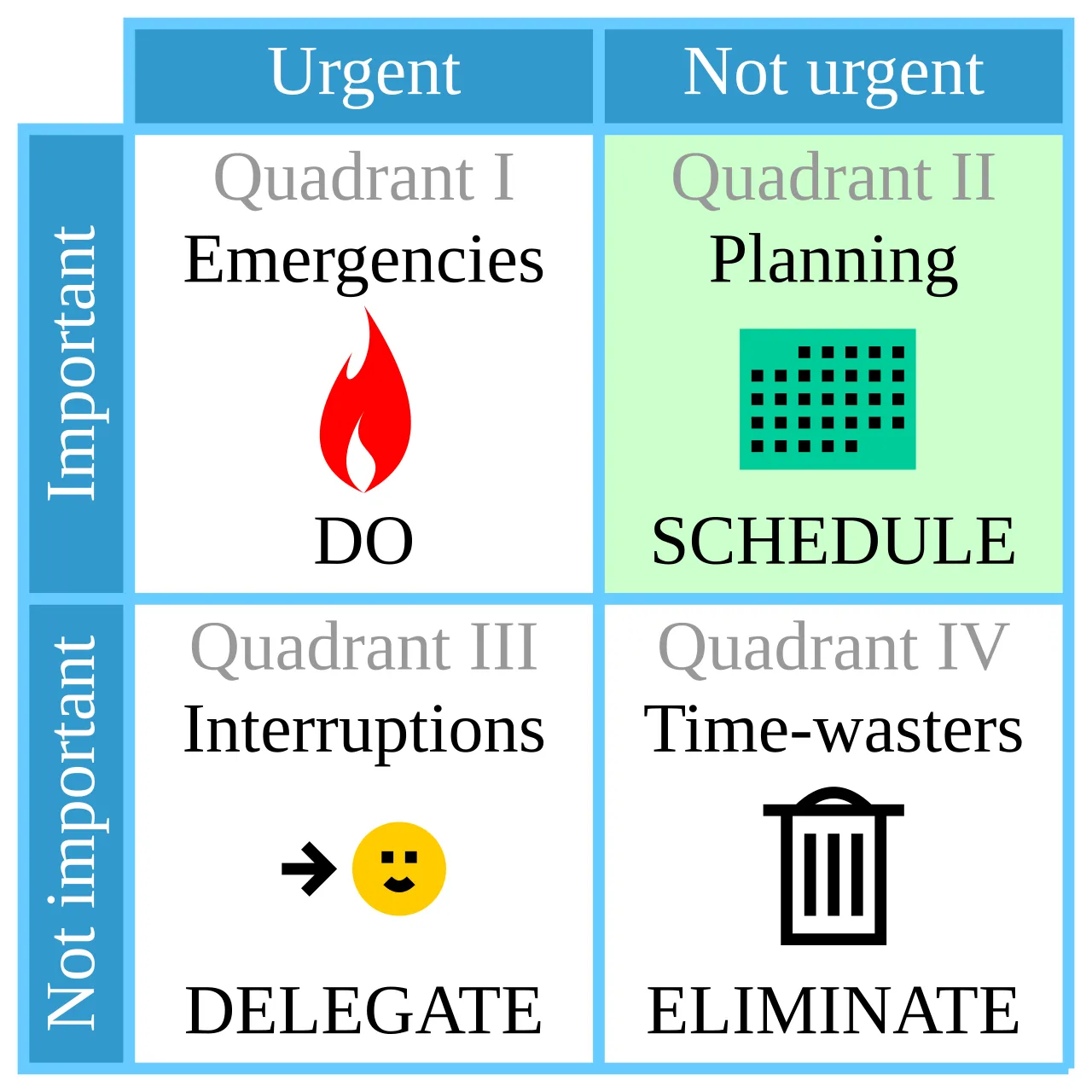
Eisenhower: There is a particular kind of exhaustion that comes not from doing too much, but from doing too much of the wrong things. You spend a day answering emails, attending meetings, handling requests, putting out fires, and by evening the work that actually matters most has not advanced at all. The calendar was full. The results were not.
This is the problem the Eisenhower Matrix was designed to solve. It is one of the oldest and most widely used frameworks in personal productivity, simple enough to sketch on a napkin, powerful enough to reorient how an entire organization spends its time.
The Origin Story
The matrix is named after Dwight D. Eisenhower, Supreme Allied Commander in World War II and 34th President of the United States. He is widely credited with a statement about the nature of his work: that he faced two kinds of problems, the urgent, which were not important, and the important, which were never urgent.
The actual historical record is more nuanced. In a 1954 speech to the Second Assembly of the World Council of Churches, Eisenhower quoted J. Roscoe Miller, then president of Northwestern University, who had made this observation.
Eisenhower's genius for productivity was not a formal system he published, it was evident in his operational discipline and his reputation for delegating effectively and preventing crises through long-horizon planning.
The matrix as a formal four-quadrant tool was developed and popularized by Stephen Covey in his 1989 book "The 7 Habits of Highly Effective People," in which he called it the "Time Management Matrix" and attributed its underlying insight to Eisenhower.
The name "Eisenhower Matrix" became common usage after Covey's work spread widely.
"I have two kinds of problems, the urgent and the important. The urgent are not important, and the important are never urgent.", Attributed to J. Roscoe Miller, quoted by Dwight Eisenhower, 1954
The Four Quadrants
The matrix creates a two-by-two grid using two dimensions:
Urgency: Does this require immediate attention? Is there an imminent deadline, an immediate consequence for delay, or active pressure to act now?
Importance: Does this contribute meaningfully to significant goals, values, or outcomes? Will completing this make a substantial difference to what you care about most?
These dimensions produce four quadrants, each calling for a different response:
| Urgent | Not Urgent | |
|---|---|---|
| Important | Q1: Do immediately | Q2: Schedule deliberately |
| Not Important | Q3: Delegate | Q4: Eliminate |
Quadrant 1: Urgent and Important (Do)
Q1 contains genuine crises, pressing deadlines, and emergencies, situations where both the stakes are high and the time window is short. Examples include a server outage when a product is live, a sick child who needs care, a deadline for a critical deliverable due today, or a safety issue that has just emerged.
Q1 work cannot be avoided, some of it is genuinely necessary. The problem comes when Q1 becomes the default mode of work: when everything feels urgent and important, when there is always a fire to fight, when the calendar is perpetually driven by the latest crisis.
People who live primarily in Q1 are reactive. They are exhausted, because genuine urgency is stressful. And they are trapped, because they have no time to do the Q2 work that would prevent future Q1 crises from occurring in the first place.
Quadrant 2: Important but Not Urgent (Schedule)
Q2 is where Covey, and most serious students of productivity, locate the most important work of all.
This quadrant contains activities that are deeply valuable but carry no immediate deadline pressure: strategic planning, relationship building, professional development, exercise and health maintenance, learning, creative work, preventive maintenance, and long-horizon thinking.
Q2 activities are important because they shape capacity and outcomes over time. Regular exercise protects against the health crisis that would become Q1. Good relationships prevent the communication breakdowns that create Q1 crises. Strategic planning prevents the reactive firefighting that characterizes Q1 organizations.
But Q2 activities have a critical weakness: they are optional in the short term. Nothing bad happens tomorrow if you skip the strategic planning session, skip the exercise, skip the relationship conversation. The consequences of neglecting Q2 are distant and diffuse. The consequences of neglecting Q1 are immediate and visible.
This asymmetry means Q2 is systematically crowded out in the absence of deliberate protection. Incoming Q1 crises always have an argument for immediate attention. Q3 interruptions always feel like they need a response. Q4 time-wasting activities are always available as an escape.
Q2 loses in competition with all of them unless it is scheduled and defended as a non-negotiable commitment.
Quadrant 3: Urgent but Not Important (Delegate)
Q3 contains activities that feel pressing but do not significantly advance important goals. Many interruptions live here: emails and messages that demand a response but do not require your specific expertise, meeting requests that could be handled by someone else, requests routed to you out of habit rather than genuine necessity.
The danger of Q3 is the illusion of productivity. Q3 activity is visible, responsive, and socially rewarded. Answering every message quickly feels industrious. Attending every meeting feels engaged. Being available and responsive is valued in most organizational cultures.
The problem is that Q3 busyness consumes the time and attention that Q2 work requires, without generating the long-term value that Q2 would create.
Covey's prescription for Q3 is to delegate it, move it to someone for whom it may be Q2 (developmental tasks that build their skills) or simply to decline it clearly. This requires the willingness to distinguish between apparent urgency and genuine importance, which is socially uncomfortable in many environments.
Quadrant 4: Not Urgent and Not Important (Eliminate)
Q4 is the clearest category: activities that neither advance important goals nor demand immediate attention. Mindless scrolling, excessive meeting attendance as social participation rather than productive work, excessive detail-orientation on low-stakes tasks, gossip, and entertainment that is not genuinely restorative.
Covey was clear that some Q4 activity is legitimate recovery and rest. The issue is unconscious, habitual Q4 as an escape from the discomfort of Q2 work, or as a response to the depletion created by excessive Q1 activity.
The goal is not the elimination of rest or leisure but the elimination of activities that waste time without providing genuine restoration.
Why Q2 Is the Hardest to Protect
Among the four quadrants, Q2 is the most strategically important and the most consistently neglected. Understanding why helps explain both the problem and the solution.
No one is asking for Q2. Q1 crises have explicit requesters. Q3 interruptions have people waiting for responses. Q2 has no equivalent external pressure. Nobody sends you a urgent message saying "please spend time on your long-term professional development today."
Q2 requires uncomfortable choices. Saying no to Q3 requests in a culture that values responsiveness creates friction. Protecting time for strategic thinking when the team has urgent needs requires visible prioritization that can be questioned.
Q2 benefits are distant. The payoff from strategic planning, relationship investment, or skill development is months or years away. The human brain systematically underweights distant payoffs relative to immediate ones, the well-documented phenomenon of hyperbolic discounting works against Q2.
Q2 requires initiation. Unlike Q1 crises, which impose themselves, Q2 work requires starting without an external trigger. Creative work, strategic thinking, and relationship investment all require deliberate initiation in the absence of urgency. This is cognitively and motivationally harder than responding to demands.
The practical solution is to treat Q2 like Q1: schedule it in advance, put it on the calendar as a non-negotiable commitment, and defend it against encroachment.
This means making the implicit explicit, moving Q2 from "I'll get to it when I have time" (which means never) to "this block is reserved for Q2 work" (which means sometimes).
Common Mistakes
Treating Everything as Q1
The most common misuse is applying "urgent and important" as the default classification for incoming work. This happens when people either lack the framework to distinguish urgency from importance, or when organizational culture rewards urgency signals and makes everything feel like a crisis.
When everything is Q1, the matrix stops being useful and becomes a reflection of the dysfunction it was meant to address.
Failing to Actually Delegate Q3
Identifying Q3 tasks and labeling them "delegate" without acting on the delegation is extremely common. Delegation requires trust, investment in developing others, willingness to accept imperfect results, and in many cases a direct conversation, all of which have short-term costs.
Without actually moving Q3 work to others, it remains on the person who labeled it.
Applying the Matrix to Individual Tasks Instead of Categories
The matrix is most practically useful when applied to categories of recurring activity rather than individual tasks. Is "checking email" Q2 or Q3?
That question is less useful than "what is my policy for email response time and which messages get handled by me versus delegated?" The matrix provides a framework for building structural responses to recurring types of work.
Neglecting Q4 as Genuine Recovery
Treating all rest and leisure as Q4 waste is a mistake. Genuine recovery, sleep, exercise, meaningful recreation, is Q2 (important, non-urgent). The legitimate target of Q4 elimination is unconscious time-wasting, not deliberate restoration.
Practical Implementation
Start with an audit. For one week, track how your time is actually spent and categorize activities. Most people are surprised by how much time goes to Q3 and Q4, and how little to Q2.
Block Q2 time first. Before scheduling anything else, place non-negotiable Q2 blocks in the calendar. This might be one morning per week for strategic thinking, daily exercise time, weekly one-on-ones for key relationships. Q2 blocks fill with Q1 and Q3 if they are not protected in advance.
Create a not-to-do list. Alongside a task list, maintain a list of activities you are actively choosing not to do. This makes the elimination of Q4 and the delegation of Q3 explicit rather than aspirational.
Establish Q3 routing systems. Rather than deciding each Q3 request individually (expensive attention), build systems: auto-replies for routine emails, standard operating procedures for common requests, designated recipients for categories of questions. Systematic handling is more efficient and more consistent than individual decisions.
Review regularly. The classification of tasks changes over time. Activities that were Q2 investments become Q1 if neglected too long. Q1 crises that get resolved can be prevented from recurring through Q2 work. The matrix is not a one-time exercise but a recurring lens for evaluating how time is being spent.
The Larger Picture
The Eisenhower Matrix is ultimately about the difference between reacting and investing. Reactive work, responding to what is incoming, urgent, and visible, is necessary but insufficient.
Investing in what matters over the long term, the Q2 quadrant, is where compounding returns accrue: health, skills, relationships, strategic capability, and the organizational capacity to handle crises gracefully rather than desperately.
The matrix does not make prioritization easy. It makes the priorities visible. Once visible, the choice about how to spend finite time and attention becomes at least somewhat more deliberate. That is the beginning of working on what matters rather than just working hard.
The Matrix in Organizational Contexts
While the Eisenhower Matrix is most commonly applied to individual productivity, its framework is equally useful, and perhaps more consequential, when applied to team and organizational priorities.
In organizations, the Q1/Q2 dynamic manifests at a structural level. Teams and companies that operate primarily in Q1 mode are characterized by:
- Reactive product roadmaps driven by customer escalations rather than strategic foresight
- Constant firefighting that prevents investment in infrastructure, technical debt reduction, or team development
- Burnout at high rates, because Q1 activity is stressful and Q2 recovery is perpetually deferred
- Strategic drift, because no one has the bandwidth for the long-horizon thinking that would provide direction
Teams that protect Q2 time at the organizational level, through mechanisms like dedicated innovation time, strategic planning retreats, mandatory post-mortems that convert Q1 lessons into Q2 improvements, and explicit policies against interrupting focused work time, consistently outperform Q1-dominated organizations over long time horizons.
The irony is visible in the Q1/Q2 relationship: organizations that invest adequately in Q2 have fewer Q1 crises, because Q2 work includes the prevention, preparation, and relationship-building that stops problems from becoming emergencies.
Organizations that perpetually sacrifice Q2 for Q1 generate more Q1 crises, because the prevention work is never done.
Urgency Bias and Why It Persists
The systematic over-investment in Q1 and Q3 (urgent work) at the expense of Q2 (important but not urgent work) is not simply a matter of poor planning. It reflects a genuine cognitive bias documented in behavioral economics research.
Urgency bias, the tendency to prioritize tasks with tight deadlines over tasks with longer or no deadlines, regardless of importance, has been demonstrated experimentally by Meng Zhu and colleagues at Johns Hopkins.
Their research found that people choose urgency cues over importance cues even when the important task offers substantially greater rewards, and even when participants are explicitly told that the urgent task is less valuable.
The mechanism appears to involve the psychological discomfort of unresolved urgency. Urgent tasks create a sense of open loops, unfinished business, that competes with focused attention on non-urgent work.
The cognitive tension of leaving an urgent task undone is uncomfortable enough that people often complete the urgent task first, even when they know the other work is more important.
This is why the Eisenhower Matrix alone, as a cognitive framework, is insufficient for most people. The pull of urgency is not fully overcome by knowing the matrix.
The behavioral solution requires structural changes: turning Q2 commitments into calendar appointments with specific times (making them feel more concrete and deadline-like), removing access to Q3 interruptions during Q2 blocks, and building accountability mechanisms that make Q2 progress visible.
Adapting the Matrix for Different Roles
The matrix's application needs adjustment for different types of work. The framework was developed with executive decision-making in mind. Its direct application to other roles requires some translation.
| Role Type | Typical Q1 | Typical Q2 | Common Q3 Trap |
|---|---|---|---|
| Individual contributor | Blocking bugs, urgent client requests | Skill development, deep project work | Meeting overload, non-critical emails |
| Manager | Team crises, escalations | Coaching, strategic planning, hiring | Status update meetings, low-stakes decisions they could delegate |
| Executive | Board communications, business crises | Strategy, culture, talent development | Operational detail that should live two levels down |
| Creative professional | Client-imposed deadlines | Skill refinement, concept exploration | Administrative tasks, social media |
The matrix is most useful when the categories are calibrated to one's actual role and goals rather than applied generically. What is Q2 (investment with long-term return) differs substantially between a software engineer and a sales manager and a startup founder, even if the underlying logic of the framework is identical.
A Note on Eisenhower Himself
Dwight Eisenhower's productivity as Supreme Allied Commander and as President was legendary. His management of the D-Day planning, coordinating the largest amphibious invasion in history across dozens of allied nations and commands, required extraordinary prioritization under genuine crisis conditions.
What is notable about the historical record is that Eisenhower was as famous for what he did not do as what he did. He delegated extensively, trusted his subordinates, and concentrated his own attention on the decisions that genuinely required his judgment.
He held firm to scheduled vacations and leisure time when others might have worked through them, not because he was disengaged, but because he understood that sustained performance required recovery.
The framework attributed to him, the distinction between the urgent and the important, was not a personal organizational system he published or formalized. It was an observation drawn from the experience of managing genuinely consequential priorities under real pressure.
That origin is part of what makes it compelling as a framework: it was not designed from theory, but distilled from practice.
Frequently Asked Questions
What is the Eisenhower Matrix?
The Eisenhower Matrix is a prioritization framework that categorizes tasks across two dimensions: urgency (whether a task demands immediate attention) and importance (whether a task contributes meaningfully to long-term goals and values). The resulting four quadrants direct different responses: do immediately (urgent + important), schedule deliberately (not urgent + important), delegate (urgent + not important), and eliminate (not urgent + not important).
Did Eisenhower actually invent the Eisenhower Matrix?
The matrix as a formal tool was popularized by Stephen Covey in his 1989 book ‘The 7 Habits of Highly Effective People,’ not by Eisenhower himself. The connection to Eisenhower comes from a 1954 speech in which he quoted university president J. Roscoe Miller, saying ‘I have two kinds of problems, the urgent and the important. The urgent are not important, and the important are never urgent.’ Covey built the quadrant model from this observation and named it after Eisenhower.
Why is Quadrant 2 the most important?
Quadrant 2 (important but not urgent) contains activities that create the most long-term value: strategic planning, relationship building, skill development, health maintenance, and preventive action. These activities are important because they shape future capacity and outcomes, but they feel optional in the short term because no deadline is pressing. Without deliberate protection, Q2 time is routinely consumed by Q1 crises and Q3 interruptions.
What is the difference between urgent and important?
Urgency is about time pressure: a task is urgent if it demands or appears to demand immediate action, often because of an external deadline, an incoming request, or a real or perceived crisis. Importance is about significance: a task is important if completing it contributes meaningfully to core goals, values, or long-term outcomes. Tasks can be urgent without being important (most interruptions), important without being urgent (strategic work), both, or neither.
What are common mistakes when using the Eisenhower Matrix?
The most common mistakes include: treating all incoming requests as Q1 urgent-important by default; overloading Q1 by failing to invest in Q2 prevention; keeping tasks in the matrix that should simply be eliminated; not actually delegating Q3 tasks (just labeling them as delegate without acting on it); and applying the matrix to individual tasks rather than categories of recurring work, which is more practical for ongoing use.