
Critical: In January 2003, a team of senior engineers at NASA's Columbia accident investigation board faced a question that would define the investigation: why had so many technically brilliant people at the agency looked at evidence of foam strike damage to the space shuttle Columbia and concluded that it posed no serious risk?
The foam had struck the shuttle's left wing during launch on January 16. Engineers at Boeing calculated the debris energy was large enough to potentially cause structural damage. They asked NASA for detailed imagery to assess the extent.
The request was declined, partly on the grounds that nothing could be done even if damage existed. On February 1, Columbia disintegrated on reentry, killing all seven crew members.
The board's eventual conclusion was not that the engineers lacked intelligence or expertise. It was that a specific set of thinking errors, operating within an institutional culture that suppressed uncertainty and dissent, had allowed dangerous assumptions to persist unchallenged.
Decision-makers had confused the absence of evidence of disaster with evidence of the absence of disaster. They had relied on historical precedent - foam had struck previous shuttles without incident - without adequately examining whether conditions were comparable. They had not asked the right questions at the right time.
This is what the failure of critical thinking looks like in practice. Not stupidity. Not ignorance. The systematic failure to examine the assumptions embedded in an apparently reasonable conclusion.
What Critical Thinking Actually Is
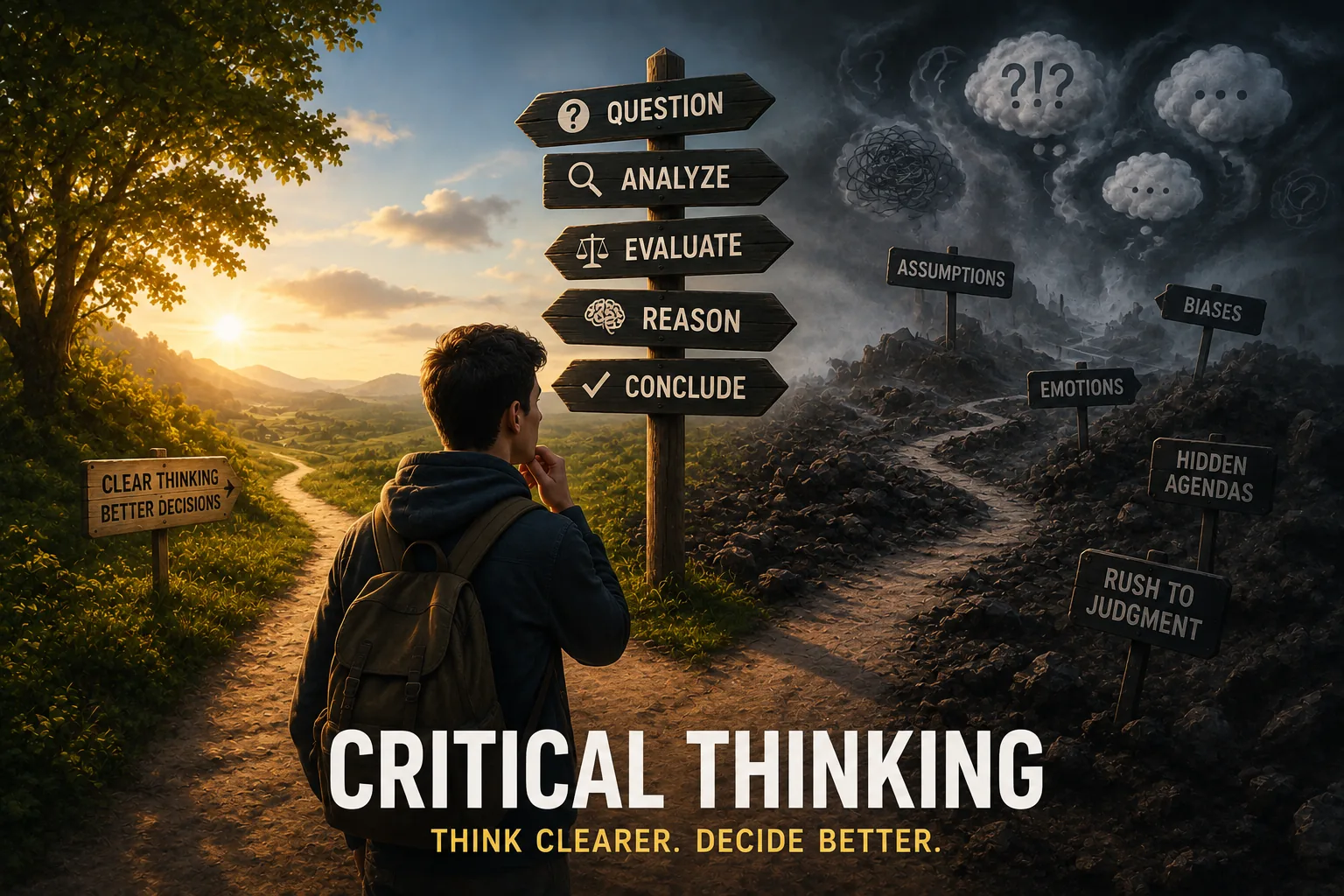
Critical thinking is the disciplined practice of evaluating information, arguments, and conclusions rather than accepting them at face value.[5]
It involves identifying the assumptions underlying a claim or decision, assessing the quality and relevance of evidence, checking whether conclusions actually follow from the reasoning offered, and considering alternative explanations or options before committing to a course of action.
In professional contexts, this is not about being contrarian or difficult. It is about improving the quality of decisions by surfacing what is actually known, what is assumed, and what is uncertain before significant resources are committed.
The question it habitually asks is not only "how do we execute this?" but first "should we do this, why, and what are we assuming will be true if we do?"
The philosopher Robert Ennis, one of the leading researchers on critical thinking in education, defined it in 1987 as "reasonable, reflective thinking focused on deciding what to believe or do." The definition is compact but carries several important implications.[1]
Reasonable means the thinking is based on evidence and logic rather than preference or habit. Reflective means it involves conscious examination of one's own reasoning process and its potential failures, not only the subject being reasoned about.
And focused on deciding means it is practical - the goal is better decisions and better actions, not simply more sophisticated analysis.
"The first principle is that you must not fool yourself - and you are the easiest person to fool." - Richard Feynman
Why the Most Valuable Employees Think Critically
The premium on critical thinking in professional environments has increased, not decreased, as AI and automation have advanced.
When information was scarce, the most valuable cognitive skill was acquiring it. Domain expertise meant access to knowledge that most people did not have. When information is abundant - when anyone can retrieve a plausible answer to almost any factual question within seconds - the premium skill shifts to evaluating it.
Knowing what to trust, what to question, and what conclusions the available evidence actually supports versus what it is being selectively used to argue.
This is precisely the domain where automated systems remain unreliable. Large language models generate fluent, confident text, but they cannot reliably evaluate the quality of their own reasoning, identify when their training data is unrepresentative of the current situation, or assess whether a given conclusion is appropriate for a genuinely novel context.
The distinctively human contribution in an information-abundant, AI-capable environment is judgment: the capacity to reason through genuinely uncertain and novel situations where the right answer is not already known.
Organizations also generate conditions that make critical thinking rare and valuable simultaneously. The social pressures of hierarchical environments - deference to authority, desire for consensus, pressure to appear collaborative - all work against independent critical evaluation.
The most valuable employees are those who can maintain the habits of critical evaluation even in conditions that pressure conformity, and who can do so in a way that is constructive rather than merely oppositional.
"It is the mark of an educated mind to be able to entertain a thought without accepting it." - Aristotle (attributed)
In a study of 400 companies published by the American Management Association, 72 percent of respondents said critical thinking was among the most sought-after skills in hiring but one of the hardest to find.
The scarcity and the demand coexist because the educational and organizational systems that most people pass through do not systematically develop the skill.
Core Skills: Breaking Down What Critical Thinking Requires
Critical thinking is not a single skill. It is a cluster of related cognitive practices that can be developed and exercised independently.
Breaking down complex problems means decomposing a large, vague question into specific, tractable sub-questions.
"Should we enter this market?" is not a question that can be directly answered; it is a container for dozens of sub-questions about market size, competitive dynamics, required capabilities, regulatory environment, capital requirements, and strategic fit.
Critical thinkers instinctively structure complexity rather than treating it as an undifferentiated whole.
Distinguishing fact from interpretation is foundational and widely neglected. "Sales are down 15 percent" is a fact. "Sales are down 15 percent because our pricing is uncompetitive" is an interpretation - it includes a causal claim that requires evidence and may or may not be correct.
Professional conversations routinely treat interpretations as facts, often because the interpretation is the first explanation that came to mind or the one preferred by people with authority. Critical thinkers flag the distinction explicitly: "We know X. We believe Y. We're assuming Z."
Evaluating source credibility means recognizing that not all evidence is equally good, and that the confidence you place in a claim should reflect the quality of the evidence supporting it. The strongest evidence comes from well-designed studies with adequate sample sizes and relevant populations.
Weaker evidence includes single anecdotes, self-reported data, small or non-representative samples, and findings from contexts very different from the current one.
The incentive structure of the source is also relevant: a pharmaceutical company reporting positive results for its own drug is providing evidence that must be evaluated differently than an independent academic study of the same drug.
Identifying logical fallacies means recognizing patterns of reasoning that are superficially persuasive but structurally invalid. In professional settings, several recur frequently. The sunk cost fallacy drives continued investment in failing projects because of past spending rather than future expected value.
Correlation-causation confusion treats co-occurrence as evidence of causation without establishing mechanism or ruling out confounds. False dichotomy frames a decision as binary when more options exist.
Ad hominem arguments dismiss a proposal based on who made it rather than on its merits. Straw man arguments misrepresent an opposing position to make it easier to refute. Appeal to authority accepts a claim because an authority figure said it rather than because the evidence supports it.
Recognizing these patterns in real time - in meetings, in reports, in your own thinking - requires practice. But it is a learnable skill, not a fixed trait.
Critical Thinking and Intelligence: Not the Same Thing
One of the most persistent misconceptions about critical thinking is that it is a natural byproduct of intelligence. Smart people, the assumption goes, think critically by default. The evidence suggests otherwise.
Intelligence - typically measured in terms of processing speed, working memory capacity, and fluid reasoning ability - correlates weakly with the quality of critical thinking in practice.
Jonathan Baron at the University of Pennsylvania has argued that much of what makes smart people poor critical thinkers is myside bias: the tendency to evaluate evidence and arguments in terms of whether they support positions you already hold.
Intelligent people are often better at generating and defending justifications for their existing beliefs, not better at evaluating whether those beliefs are correct. They use their intelligence in service of conclusion-first reasoning rather than evidence-first reasoning.
Domain knowledge shows a similar double-edged relationship with critical thinking.
Deep expertise helps within its domain - an experienced cardiologist evaluates cardiac symptoms more reliably than a generalist - but it can impair critical thinking when applied outside the domain or when it leads to overconfidence that discourages genuine examination.
Expert overconfidence is a real and well-documented phenomenon, studied extensively by Philip Tetlock of the University of Pennsylvania in his work on forecasting accuracy (compiled in Superforecasting, 2015).
Tetlock found that experts in a field were often less accurate at forecasting events within that field than thoughtful non-experts who used more explicit, evidence-based reasoning.
Critical thinking is better understood as a set of habits and dispositions than as a cognitive capacity.
The disposition to seek disconfirming evidence, to examine assumptions explicitly, to consider alternative explanations, to evaluate sources critically - these habits can be developed by anyone with the motivation to develop them, regardless of baseline intelligence.
"The whole problem with the world is that fools and fanatics are always so certain of themselves, and wiser people so full of doubts." - Bertrand Russell
How Groupthink Kills Critical Thinking in Organizations
The conditions for good critical thinking are most difficult to maintain precisely when the stakes are highest: in high-pressure organizational settings where decisions have major consequences and social cohesion is valued.
Groupthink - the phenomenon where group cohesion suppresses dissent and produces false consensus - was identified and named by social psychologist Irving Janis in 1972, following his analysis of foreign policy disasters including the Bay of Pigs invasion and the failure to anticipate the attack on Pearl Harbor.[3]
Janis found that in each case, a group of highly intelligent, experienced people had reached a confident collective decision that suppressed and failed to examine substantial contrary evidence, because dissent felt threatening to group cohesion.
The mechanisms of groupthink are social, not cognitive. When the group norm is agreement, expressing a contrary view feels like a social violation, a signal of disloyalty or a desire to disrupt.
When a powerful person states a position early in a discussion, subsequent contributions tend to cluster around that position rather than challenging it.
When the group has high morale and esprit de corps, members are reluctant to introduce concerns that might dampen enthusiasm or suggest the group is wrong.
These dynamics are not pathological - they are features of social functioning that are adaptive in many contexts. The problem is that they are incompatible with the conditions good critical thinking requires.
Structural countermeasures have been developed specifically to address this. The pre-mortem, developed by psychologist Gary Klein, asks a team before finalizing a decision to imagine they are in the future and the decision has already failed, and to identify retrospectively why it failed.[4]
This reframes the social permission for concern-raising: in a pre-mortem, identifying failure modes is the task, not a violation of team norms. Research suggests it significantly improves the range and quality of risk identification.
Red team exercises assign a group the explicit role of challenging and attacking a plan as rigorously as possible - adversarially, without the social constraints that normally inhibit criticism. The military has used red teaming for decades; it has been adopted in product development, policy analysis, and strategic planning.
The key is that the adversarial role is structurally defined, not personally chosen, which allows participants to raise concerns without taking personal ownership of pessimism.
Assigning a designated devil's advocate role in key decisions serves a similar function, though with somewhat weaker effect because the role is known to be artificial and other group members discount the objections accordingly.
Tools for Structured Critical Thinking
Beyond the structural interventions designed for groups, several tools help individuals think more critically in real time.
| Tool | Purpose | How to Use | Example |
|---|---|---|---|
| 5 Whys | Surface root causes beneath proximate symptoms | Ask "why?" five times in sequence, each time about the previous answer | Oil spill on factory floor traced through machine, seal, and purchasing process back to a cost-cutting decision |
| Pre-mortem | Identify failure modes before committing to a plan | Assume the plan has already failed; work backward to explain why | Before a product launch, team imagines it flopped and lists every plausible reason |
| Steelmanning | Stress-test your position by strengthening the best counterargument | Articulate the opposing view as compellingly as possible before rebutting it | Before dismissing a competitor's strategy, write their strongest possible case for it |
| Red Teaming | Adversarially attack a plan to find weaknesses | Assign a team or individual to argue against the plan with no constraints | Military planners have a dedicated team try to defeat their own strategy |
| Socratic Questioning | Surface hidden assumptions through disciplined dialogue | Ask: What are we assuming? How do we know that? What else might explain this? What would change our conclusion? | A project proposal is probed with "Why do we believe the customer wants this?" before build begins |
The 5 Whys, developed by Sakichi Toyoda at Toyota and central to lean manufacturing methodology, addresses the tendency to act on surface causes. When a problem occurs, asking "why?" produces an explanation. Asking "why?" about that explanation produces a deeper cause.
Repeating this five times (more or fewer, depending on the situation) typically surfaces the root cause rather than the proximate symptom.
Socratic questioning - a disciplined sequence of probing questions that surface assumptions and test the consistency of arguments through dialogue - is among the oldest critical thinking tools in the Western tradition. In professional contexts it sounds like: "What are we assuming here?
How do we know that? What would change our conclusion? What else might explain this? Who disagrees, and why?" The questions are not hostile; they are genuine inquiries aimed at strengthening the analysis.
Steelmanning is the practice of developing the strongest possible version of an opposing argument before engaging with it. This is the opposite of the straw man fallacy: rather than misrepresenting the opposing view to make it easier to dismiss, you represent it as compellingly as possible.
This forces genuine engagement with what makes the opposing view attractive, surfaces objections you might otherwise miss, and produces more robust conclusions because they have been tested against the strongest opposition.
First principles thinking, associated with Aristotle and explicitly practiced by Elon Musk (who has described it as central to SpaceX's rocket development approach), involves decomposing a problem to its most basic verified truths and reasoning upward from them, rather than by analogy to existing solutions.
When SpaceX was developing reusable rockets, conventional industry thinking held that rocket costs were irreducibly high.
First principles analysis showed that the raw materials for a rocket represent a small fraction of the production cost; the high costs came from manufacturing and discarding expensive hardware on every launch.
This analysis led directly to the reusable rocket program that has fundamentally disrupted the space launch market.
How to Develop Critical Thinking Deliberately
"Extraordinary claims require extraordinary evidence." - Carl Sagan
Critical thinking develops most effectively through deliberate practice in real situations with feedback, not through passive exposure to concepts. Reading about logical fallacies does not automatically produce the habit of spotting them in real-time meetings.
The most practical developmental habit is building a standard set of questions that you ask before accepting important claims or making significant decisions. Not in a rote, mechanical way - but as a genuine practice. What is the evidence? What are we assuming? What are the alternatives?
What would have to be true for this to be wrong? Whose perspective is missing here?
A decision journal - a record of significant decisions, including the reasoning and evidence at the time, reviewed periodically afterward - is one of the most effective tools for developing critical thinking over time. The review reveals patterns in your reasoning errors that are invisible when you evaluate each decision in isolation.
Annie Duke, professional poker player and author of Thinking in Bets, advocates a version of this practice specifically because poker involves repeated decisions under uncertainty where the quality of reasoning and the quality of outcomes can be tracked independently.
Reading widely and specifically in the history and philosophy of science develops deep intuitions about evidence quality and the fallibility of expert consensus.
Thomas Kuhn'sThe Structure of Scientific Revolutions (1962) documents how scientific communities maintain consensus around paradigms long past the point where the evidence supports it.
Nassim Taleb's work, particularly The Black Swan (2007), examines the systematic failure to account for rare, high-impact events.
These are not abstract intellectual exercises; they build the mental models that make critical thinking habitual rather than effortful.
Seeking out people who genuinely disagree with you - not to argue, but to understand - is one of the most effective and least common practices for developing critical thinking. Most professional networks are homogeneous in worldview, which means they provide poor feedback on assumptions that everyone in the network shares.
Teaching Critical Thinking to a Team
Developing critical thinking at the team level requires cultural change as well as individual skill development. The individual practices are necessary but not sufficient; the organizational conditions must make critical thinking safe and expected.
The most important leadership behavior is modeling intellectual humility: visibly and genuinely changing positions in response to good arguments, acknowledging uncertainty rather than projecting false confidence, and welcoming challenge as a contribution to quality rather than reading it as disloyalty.
Retrospectives on major decisions - structured post-project reviews that explicitly examine what the reasoning missed, not just what the outcomes were - institutionalize critical examination as a normal part of organizational life.
Blameless post-mortems, widely used in engineering organizations following Google's SRE (Site Reliability Engineering) practice, examine failure without assigning personal blame, on the understanding that most failures are systemic rather than individual.
This makes participants more willing to surface uncomfortable truths because the exercise is about improvement rather than accountability.
Teams can also build critical thinking into their decision processes structurally. Pre-mortems before major launches, red team exercises for significant strategy decisions, and required documentation of key assumptions in project proposals all make critical examination a process feature rather than a personality trait.
Why Education Systems Fail to Develop This Skill
The absence of critical thinking in organizational settings is at least partly explained by the educational systems that produced the people in those organizations.
Most formal education, particularly in its testing and assessment dimensions, rewards the production of correct answers to defined questions rather than the examination of whether the questions are well-formed or whether the expected answers are correct.
Students who master the material and reproduce it accurately receive high grades. Students who question the premises of the material, or who produce unconventional but defensible analyses, are frequently marked down for deviating from expected responses.
The consequence is that most educated professionals have been systematically trained, across twelve or more years of schooling, to reproduce correct answers within defined frameworks - and have received very little training in evaluating the frameworks themselves, questioning whether the "correct" answer is actually correct, or working through genuinely novel problems without a template.
Graduate education varies more in this dimension: good doctoral programs, law schools, and case-method MBA programs develop critical thinking substantially. But these are minority experiences, and the habits they develop often compete with organizational cultures that reward deference and consensus.
"The unexamined life is not worth living." - Socrates
Practical Takeaways
Build the habit of explicitly distinguishing what you know from what you are assuming. In any significant discussion or analysis, make these categories visible: "We know X. We believe Y. We're assuming Z." This alone surfaces a substantial proportion of the reasoning gaps that lead to poor decisions.
Before accepting an important claim, run it through a source quality check. How was this data collected? How large and representative is the sample? Has the finding been replicated? What incentive does the source have to present the data this way?
Practice steelmanning opposing views before dismissing them. This is the single habit most correlated with better-quality analysis, and it is also the hardest to sustain because it requires genuine cognitive effort to argue against your own position.
Use pre-mortems before significant commitments. Imagining future failure is consistently shown to surface risks that forward-looking analysis misses, and the pre-mortem frame makes raising concerns socially acceptable.
Keep a decision journal. Review it periodically. The patterns in your reasoning errors are more visible in retrospect and across multiple decisions than in any single case.
Create team conditions where critical examination is structurally expected, not personally volunteered. Formal retrospectives, red team exercises, and required assumption documentation all make critical thinking a process feature rather than a personality trait.
The goal is not to be skeptical of everything equally - that produces paralysis rather than insight.
It is to calibrate your skepticism to the stakes and the quality of the evidence: high confidence where the evidence is strong and replicated, explicit uncertainty where it is thin, and active examination where the stakes are high enough that the cost of being wrong is large.
What Research Shows About Critical Thinking Development
The empirical study of critical thinking has produced a body of findings that challenge common assumptions about how the skill develops, who possesses it, and how effectively it can be taught.
Peter Facione at Loyola University Chicago led the American Philosophical Association's Delphi Project from 1988 to 1990, which assembled 46 critical thinking researchers and educators in a two-year consensus-building study published as Critical Thinking: A Statement of Expert Consensus for Purposes of Educational Assessment and Instruction (1990).[7]
The study produced the most widely adopted operational definition in educational research: critical thinking is "purposeful, self-regulatory judgment which results in interpretation, analysis, evaluation, and inference, as well as explanation of the evidential, conceptual, methodological, criteriological, or contextual considerations upon which that judgment is based."
Facione's subsequent work measuring the California Critical Thinking Skills Test (CCTST) across 600 college students at 10 institutions found that only 29% of graduating seniors showed strong critical thinking skills despite four years of higher education - a finding that shocked educators and prompted national curriculum reform debates.
Facione's data also showed that students who had taken at least one course with explicit critical thinking instruction scored 17% higher on the CCTST than matched controls who had not.
Keith Stanovich at the University of Toronto spent three decades studying the relationship between intelligence (IQ) and rational thinking, culminating in What Intelligence Tests Miss (2009) and The Rationality Quotient (2016, with Richard West and Maggie Toplak).
Stanovich's most significant finding: IQ and critical thinking are largely independent.[6]
His studies of 1,000+ university students showed that the correlation between IQ scores and performance on rational thinking tasks - tasks requiring the application of the kind of logical and evidential reasoning that defines critical thinking - was only r = 0.20 to 0.35.
This means that knowing someone's IQ explains less than 12% of the variance in their critical thinking performance.
Stanovich coined the term "dysrationalia" to describe the phenomenon of intelligent people reasoning poorly because they lack the specific cognitive dispositions (actively open-minded thinking, need for cognition, epistemic regulation) that critical thinking requires.
His research demonstrated that these dispositions are relatively independent of raw intelligence, malleable through education, and more predictive of real-world decision quality than IQ in complex, ambiguous situations.
Tim van Gelder at the University of Melbourne conducted a series of studies from 2000 to 2005 examining how rapidly critical thinking skills develop in university students and what interventions accelerate development.
His research, published in Educational Psychology Review (2005), found that informal logic courses - where students are taught to identify argument structures, evaluate evidence, and detect fallacies in real-world texts - produced measurable improvements in critical thinking skill within a single semester, with effect sizes averaging 0.62 standard deviations.[9]
More importantly, van Gelder found that students who used argument-mapping software (a visual tool for diagramming the logical structure of arguments) showed improvements 3.5 times larger than students in conventional lecture-based courses covering the same material.
The finding that the specific pedagogy mattered as much as the curriculum content has influenced how critical thinking is taught at institutions including the United States Military Academy at West Point, which adopted argument-mapping tools following van Gelder's research.
Diane Halpern at Claremont McKenna College conducted longitudinal studies tracking critical thinking development across undergraduate education.[8]
Her research, summarized in Thought and Knowledge: An Introduction to Critical Thinking (5th ed., 2014), found that explicit instruction in specific critical thinking skills - hypothesis testing, argument analysis, and the recognition of reasoning errors - produced improvements that persisted at 18-month follow-up assessments, whereas general education without explicit critical thinking instruction showed no significant improvement in the same skills.
Halpern's data, collected from 3,000+ students at multiple institutions, showed that the critical thinking skill showing the most improvement from targeted instruction was argument evaluation (the ability to identify assumptions and assess evidence quality), while the skill showing the least improvement was probabilistic reasoning - suggesting that the intuitive difficulty of probability calculations requires more extensive intervention than other critical thinking components.
Critical Thinking Under Organizational Pressure: What the Evidence Shows
Critical thinking is most difficult to sustain precisely in the high-pressure organizational conditions where it matters most. Research across business, military, and medical domains documents the specific mechanisms by which organizational pressure degrades reasoning quality.
James Reason at the University of Manchester, working from accident data gathered by the UK Health and Safety Executive and the Air Accidents Investigation Branch over a 20-year period, developed the Swiss Cheese Model of organizational failure (Human Error, 1990).[12]
Reason's analysis of 100 major industrial accidents showed that 80% were caused not by individual skill failures but by organizational conditions - cultures that normalized deviation from safety standards, communication structures that filtered bad news upward, and incentive systems that rewarded production speed over safety compliance.
The critical thinking failure in these organizations was institutional: the information needed to make good decisions existed but did not reach decision-makers because organizational dynamics made sharing it professionally risky.
Reason's finding that organizational culture explains more variance in decision quality than individual skill has been replicated in aviation, healthcare, and nuclear power safety research.
Amy Edmondson at Harvard Business School conducted a landmark study of hospital nursing teams published in Administrative Science Quarterly (1999) that revealed a counterintuitive finding about organizational learning and critical thinking.
Edmondson measured "psychological safety" - the degree to which team members felt they could speak up with concerns without fear of humiliation - across 51 work teams at a major hospital.[10] She also measured team performance on clinical outcomes and learning behaviors.
The finding: the teams with the highest psychological safety also reported the most errors - not because they were performing worse, but because they were more willing to report errors rather than conceal them. The high-safety teams then learned from reported errors at a significantly higher rate than low-safety teams.
Edmondson's research demonstrates that critical thinking at the organizational level requires more than individual reasoning skill; it requires an environment where raising concerns is institutionally safe.
Her broader body of research reinforces that psychological safety is a strong predictor of team learning behavior across many organizational settings.
Charlan Nemeth at the University of California, Berkeley conducted a series of studies on the effect of minority dissent on group decision quality, published in European Journal of Social Psychology (1986) and subsequently summarized in In Defense of Troublemakers: The Power of Dissent in Life and Business (2018).[11]
Nemeth's experiments showed that groups exposed to consistent minority dissent - even when the minority was factually wrong - generated more creative solutions and found more correct answers than groups with unanimous consensus.
The mechanism: minority dissent forced the majority to think more carefully and consider alternatives they had dismissed.
A 1977 study by Nemeth found that groups with one persistently dissenting member identified 48% more correct answers in a visual perception task than groups without dissent, because the dissent prompted re-examination of assumptions.
In her 1986 study of mock juries, groups with even one dissenting juror were 3x more likely to consider alternative explanations for crime evidence than unanimous groups.
These findings explain why structural mechanisms for critical thinking - designated devil's advocates, formal red teams, required pre-mortems - are effective: they provide the dissent that improves reasoning quality even when the content of the dissent is not itself the point.
Philip Tetlock at the University of Pennsylvania conducted the most extensive longitudinal study of expert forecasting ever undertaken, following 284 political and economic experts over 20 years and collecting 80,000+ predictions.[2]
His results, published in Expert Political Judgment (2005), showed that expert forecasters performed only modestly better than chance, and that famous, highly confident experts who provided simple, sweeping explanations ("hedgehogs" in Tetlock's framework) performed significantly worse than less prominent experts who acknowledged uncertainty, considered multiple perspectives, and updated their views on new evidence ("foxes").
The foxes' critical thinking habits - actively seeking disconfirming evidence, maintaining calibrated uncertainty, and aggregating multiple analytical frameworks - produced forecasting accuracy 50-70% better than hedgehog experts on comparable questions.
Tetlock's subsequent Good Judgment Project (2011-2015), tracking 25,000 participants, found that training in probabilistic thinking and structured analytical habits raised average forecasting accuracy by 14% within weeks - demonstrating that the cognitive habits underlying critical thinking are teachable skills rather than fixed traits.
Sources & Further Reading
- Ennis, R.H. (1987). "A taxonomy of critical thinking dispositions and abilities." In J.B. Baron & R.J. Sternberg (Eds.), Teaching Thinking Skills: Theory and Practice. W.H. Freeman.
- Tetlock, P.E. (2005). Expert Political Judgment: How Good Is It? How Can We Know? Princeton University Press.
- Janis, I.L. (1972). Victims of Groupthink: A Psychological Study of Foreign-Policy Decisions and Fiascoes. Houghton Mifflin.
- Klein, G. (2007). "Performing a project premortem." Harvard Business Review, 85(9), 18-19.
- Paul, R. & Elder, L. (2006). Critical Thinking: Tools for Taking Charge of Your Learning and Your Life (2nd ed.). Pearson Prentice Hall.
- Stanovich, K.E. (2009). What Intelligence Tests Miss: The Psychology of Rational Thought. Yale University Press.
- Facione, P.A. (1990). Critical Thinking: A Statement of Expert Consensus for Purposes of Educational Assessment and Instruction. American Philosophical Association.
- Halpern, D.F. (2014). Thought and Knowledge: An Introduction to Critical Thinking (5th ed.). Psychology Press.
- van Gelder, T. (2005). "Teaching Critical Thinking: Some Lessons from Cognitive Science." Educational Psychology Review, 45(1), 41-48.
- Edmondson, A. (1999). "Psychological Safety and Learning Behavior in Work Teams." Administrative Science Quarterly, 44(2), 350-383.
- Nemeth, C.J. (2018). In Defense of Troublemakers: The Power of Dissent in Life and Business. Basic Books.
- Reason, J. (1990). Human Error. Cambridge University Press.