
Understanding: In 2003, the United States invaded Iraq based on intelligence asserting Iraq possessed weapons of mass destruction (WMD). Secretary of State Colin Powell presented evidence to the United Nations: satellite photos, intercepted communications, testimony from defectors.
The argument's structure: "Intelligence agencies confirm WMD exist. Colin Powell-a trusted military leader-vouches for the evidence. Therefore, WMD exist and invasion is justified."
The outcome: No WMD were found. The intelligence was wrong. The defector testimony fabricated. The photos ambiguous. The invasion justified by flawed reasoning had enormous consequences-thousands of lives lost, trillions spent, regional destabilization lasting decades.
The logical fallacy: Appeal to Authority. The argument's validity rested on Powell's credibility and intelligence agency authority rather than evaluable evidence. When authorities are wrong-through bias, incomplete information, or deception-arguments built solely on their authority collapse.
This isn't unique to geopolitics. Logical fallacies pervade workplace decisions daily, with real consequences: wasted resources, failed projects, missed opportunities, team conflicts, and poor strategic choices.
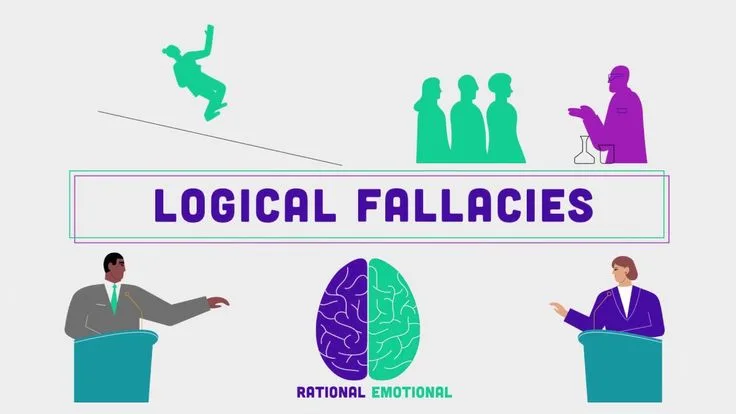
A logical fallacy is a flaw in reasoning structure-an argument that seems persuasive but doesn't hold up to scrutiny.[1] The conclusion might accidentally be correct, but it doesn't follow logically from the premises.
Why they matter professionally: Business decision-making involves uncertainty, incomplete information, time pressure, and persuasion. This environment is fertile ground for fallacious reasoning. Recognizing fallacies-in others' arguments and your own-improves decision quality, prevents costly mistakes, and elevates discourse.
This article explains logical fallacies comprehensively: the most damaging fallacies in professional contexts (with workplace examples), how to recognize them, how to counter them without seeming argumentative, how to catch yourself committing them, why they're persuasive despite being invalid, and frameworks for clearer reasoning.
| Fallacy | Description | Professional Example | Why It Works |
|---|---|---|---|
| Appeal to authority | Claim is valid because an authority says so | "The McKinsey report says so" - without examining the methodology | Deference to expertise is usually efficient |
| False dichotomy | Presents only two options when more exist | "We either launch now or lose the market" | Forces a choice that feels binary |
| Slippery slope | Small step leads inevitably to extreme outcome | "If we allow remote work, everyone will stop working" | Future fears are hard to disprove |
| Ad hominem | Attack the person rather than the argument | "That's what you'd expect from someone in sales" | Discrediting source avoids engaging the argument |
| Hasty generalization | Broad conclusion from insufficient evidence | "We ran this once and it failed, so the approach doesn't work" | Single examples feel like evidence |
| Sunk cost | Past investment justifies continued investment | "We've spent $2M on this; we can't stop now" | Loss aversion and consistency bias |
Understanding Logical Fallacies: Structure Matters
Logical fallacy: An error in reasoning that undermines argument validity.
Validity vs. Soundness
Valid argument: Conclusion follows logically from premises
Example:
- Premise 1: All humans are mortal
- Premise 2: Socrates is human
- Conclusion: Socrates is mortal
Structure is valid-if premises true, conclusion must be true.
Sound argument: Valid structure AND true premises
Invalid argument (fallacy): Structure is broken-even if premises are true, conclusion doesn't necessarily follow
Example:
- Premise 1: Successful companies use data analytics
- Premise 2: We use data analytics
- Conclusion: We will be successful
Fallacy: Affirming the consequent. Data analytics might be necessary but not sufficient. Many companies use analytics and still fail.
Why Fallacies Are Persuasive
If fallacies are invalid, why do they convince people?
Reason 1: Psychological resonance: Appeal to emotions, intuitions, or cognitive biases (confirmation bias, authority deference, social proof).[2]
Reason 2: Surface plausibility: Seem reasonable on quick inspection. Only careful analysis reveals the flaw.
Reason 3: Partial truth: Often contain kernel of truth making them harder to dismiss entirely.
Reason 4: Rhetorical power: Fallacies are often simple, memorable, emotionally compelling-more persuasive than complex valid arguments.
Reason 5: Time pressure: Spotting fallacies requires deliberate analysis. Under time constraints, invalid arguments slip through.
The Most Damaging Workplace Fallacies
Not all fallacies are equal. These ten cause the most professional damage.
Fallacy 1: Sunk Cost Fallacy (Escalation of Commitment)
Structure: "We've already invested X, so we must continue to avoid wasting that investment."
Why invalid: Past costs are sunk-irrecoverable. Future decisions should consider only future costs vs. future benefits. Past investment is irrelevant to whether continuing is wise.
Workplace examples:
Example 1: Failing projects
Situation: Software project 18 months in, $2M spent. Original business case no longer valid (market changed, technology outdated, requirements drifted). Team knows project won't deliver expected value.
Sunk cost reasoning: "We've invested $2M and 18 months. We can't abandon it now. We need to finish."
Correct reasoning: "If we were starting today, knowing what we know, would we invest another $500K and 6 months in this? If no, we should stop regardless of past investment."
Example 2: Bad hires
Situation: Employee underperforming. Six months of training invested. Still not meeting expectations.
Sunk cost reasoning: "We've invested heavily in training. We need to give them more time."
Correct reasoning: "Is future investment likely to yield acceptable performance? If not, past training investment shouldn't prevent making change."
Example 3: Legacy systems
Situation: Outdated technology platform. Maintenance costs high. Alternatives more efficient. But organization has deep investment in existing system.
Sunk cost reasoning: "We've built everything on this platform. Switching means losing all that investment."
Correct reasoning: "Compare future costs of maintaining current system vs. transitioning to new system. Past development is sunk."
Why damaging: Organizations waste enormous resources continuing failed initiatives.[7] "Throwing good money after bad" becomes institutionalized.
How to spot:
- Justifications referencing past investment, effort, or time
- "We've already...", "We can't waste...", "We've come too far..."
- Emphasis on past rather than future
Counter:
- "If we were starting fresh today with current knowledge, would we invest in this?"
- "What are the future costs and benefits, ignoring what's already spent?"
- "Is there a scenario where cutting losses now is wiser than continuing?"
Fallacy 2: Appeal to Authority (Argument from Authority)
Structure: "X is true because important/expert person Y says so."
Why invalid: Authority's opinion isn't proof. Authorities can be wrong, biased, speaking outside expertise, or have outdated information. Need to evaluate reasoning and evidence, not just who says it.
Workplace examples:
Example 1: Executive decisions
Situation: CEO declares: "We need to adopt blockchain for our supply chain."
Appeal to authority: Team accepts without analysis because CEO said it. CEO may lack technical understanding, be influenced by hype, or be acting on limited information.
Correct approach: "Let's understand the CEO's reasoning. What problem does blockchain solve? Is it the best solution for our specific needs?"
Example 2: Consultant recommendations
Situation: Expensive consulting firm recommends organizational restructuring. Recommendation accepted based on firm's reputation rather than analysis of whether it fits organization's context.
Appeal to authority: "McKinsey recommended it, so it must be right."
Correct approach: Evaluate recommendation substance. Does analysis apply to our situation? Are assumptions valid? What's the evidence?
Example 3: Industry experts
Situation: Famous industry figure advocates for specific technology/methodology in keynote. Teams rush to adopt because "X said so."
Appeal to authority: Expertise in one domain doesn't guarantee correctness in all pronouncements. Experts have biases, incentives, and blind spots.
Why damaging: Poor decisions made without critical evaluation. Waste resources on inappropriate solutions. Discourages independent thinking.
How to spot:
- "X person/company does this..."
- "Industry leader believes..."
- "Experts recommend..." without accompanying reasoning
- Credentials substituted for arguments
Counter:
- "That's interesting. What's the reasoning behind it?"
- "What evidence supports this?"
- "Does this solve our specific problem, or is it a solution looking for a problem?"
- "Let's evaluate the idea on its merits, not just the source."
Fallacy 3: Bandwagon (Appeal to Popularity / Argumentum ad Populum)
Structure: "Many people/companies do X, therefore X is correct/we should do X."
Why invalid: Popularity doesn't equal correctness or appropriateness. Different contexts have different needs. Herd behavior often leads entire industries into mistakes.
Workplace examples:
Example 1: Technology adoption
Situation: "All our competitors have migrated to microservices architecture. We need to switch too."
Bandwagon fallacy: Ignores whether your scale, team, or problem requires microservices. Competitors might be making mistakes. Your monolith might serve you better.
Correct approach: "What problems do microservices solve? Do we have those problems? What are the tradeoffs for our specific context?"
Example 2: Management fads
Situation: OKRs, Agile, Six Sigma-whatever methodology is trending. Adoption justified by "everyone successful uses this."
Bandwagon fallacy: What works for Google doesn't necessarily work for your 50-person startup or 100-year-old manufacturer. Context matters.
Example 3: Market timing
Situation: "Everyone's launching in Q4. We should too."
Bandwagon fallacy: Maybe Q4 is saturated with launches. Maybe your product benefits from off-season launch. Popularity doesn't determine optimal timing.
Why damaging: Adopting solutions that don't fit context. Following trends into failure. Lack of differentiation. Wasted resources on inappropriate tools.
How to spot:
- "Everyone", "all successful companies", "industry standard", "best practice" as primary justification
- Emphasis on what others do rather than why it makes sense
- FOMO (fear of missing out) driving decisions
Counter:
- "Does this solve OUR specific problem?"
- "How is our context different from companies where this works well?"
- "What are we trying to achieve, and is this the best tool for that goal?"
- "What's the downside if we don't follow the trend?"
Fallacy 4: False Dichotomy (Either-Or, False Dilemma, Black-and-White Thinking)
Structure: "Either X or Y" when more options exist.
Why invalid: Artificially limits solution space to two options, forcing choice between extremes when middle ground or alternatives exist.
Workplace examples:
Example 1: Quality vs. Speed
Situation: "Either we ship this quarter with quality issues, or we miss the market opportunity entirely."
False dichotomy: Other options exist-ship reduced scope with quality, extend by 2-4 weeks instead of full quarter, soft launch to early adopters, ship beta version with clear expectations.
Example 2: Hiring decisions
Situation: "Either we hire immediately even though candidates aren't great, or we leave position vacant and fall behind."
False dichotomy: Other options-extend search, use contractors temporarily, redistribute work, reconsider whether role is needed.
Example 3: Budget allocation
Situation: "Either we invest in marketing or product development. Can't do both."
False dichotomy: Options between all-or-nothing. Could split budget. Could sequence investments. Could get creative with resource allocation.
Why damaging: Misses better solutions. Forces suboptimal choices. Creates artificial conflicts ("marketing vs. engineering").
How to spot:
- "Either...or" language with only two dramatically different options
- Presentation of extremes without middle ground
- Framing that makes one option clearly bad to push toward the other
Counter:
- "Are these really the only options?"
- "What's between these two extremes?"
- "What other possibilities haven't we considered?"
- "Can we combine elements of both?"
"A great many people think they are thinking when they are merely rearranging their prejudices." - William James
Fallacy 5: Post Hoc Ergo Propter Hoc (False Cause)
Structure: "After this, therefore because of this." Event B followed event A, therefore A caused B.
Why invalid: Temporal sequence doesn't prove causation. Correlation does not equal causation. Could be coincidence, common cause, reverse causation, or complex multicausality.
Workplace examples:
Example 1: Attribution errors
Situation: Company redesigns website. Next quarter, sales increase 20%. Leadership credits redesign.
Post hoc fallacy: Sales increase followed redesign, but causation not established. Could be: seasonal trend, marketing campaign running simultaneously, competitor exit, new sales team, market expansion, economic conditions.
Correct approach: "What else changed? Is there causal mechanism? What would controlled test show?"
Example 2: Management changes
Situation: New manager appointed. Six months later, team performance improves. Manager credited.
Post hoc fallacy: Improvement might be due to: project cycle completion, team maturation, resolution of unrelated issues, previous manager's changes taking effect.
Example 3: Process changes
Situation: Implement new software development methodology. Bugs decrease. Methodology credited.
Post hoc fallacy: Bug reduction might be due to: developers gaining domain expertise over time, codebase stabilizing, technical debt payoff, improved hiring, not methodology itself.
Why damaging: Credit wrong causes. Double down on things that didn't work. Fail to identify actual drivers. Repeat ineffective actions expecting same results.
How to spot:
- "After we did X, Y happened" presented as proof that X caused Y
- No discussion of alternative explanations
- No controlled comparison (what would have happened without X?)
Counter:
- "What else changed during that period?"
- "What's the causal mechanism connecting X to Y?"
- "What would a controlled experiment show?"
- "Could Y have happened anyway? How do we know?"
Fallacy 6: Confirmation Bias (Cherry-Picking Evidence)
Structure: Highlighting evidence supporting your position while ignoring contradicting evidence.
Why invalid: One-sided analysis doesn't reflect reality. Ignoring counterevidence prevents accurate assessment.
Workplace examples:
Example 1: Feature prioritization
Situation: Product manager arguing for Feature A: "Customer X requested it. Survey showed interest. Competitor has it."
Cherry-picking: Customer X is 1 of 1,000 customers. Survey showed 15% interest (85% neutral/opposed). Competitor's version is unused. Supporting evidence highlighted, contradicting evidence ignored.
Complete picture: Most customers didn't request it. Usage data on competitor's version suggests low value. Implementation cost high relative to value.
Example 2: Hiring decisions
Situation: Team wants to hire candidate. References positive traits: "Smart, great communicator, lots of experience."
Cherry-picking: Ignores: lacks specific needed skills, overqualified (flight risk), poor culture fit signals, concerning job-hopping pattern.
Example 3: Market analysis
Situation: Arguing for market entry: "Growing market, underserved segment, competitor weakness."
Cherry-picking: Ignores: high customer acquisition costs in that market, regulatory barriers, distribution challenges, competitor about to launch improved product.
Why damaging: Overconfident decisions based on incomplete analysis. Build wrong features. Enter wrong markets. Hire wrong people. Systematic bias toward preferred conclusions.
How to spot:
- Argument cites only supporting evidence
- Counterevidence dismissed, minimized, or unmentioned
- "All the data shows..." when you know contradicting data exists
- Selective use of time periods, metrics, or examples
Counter:
- "What's the evidence AGAINST this?"
- "What would make us change our mind?"
- "Let's actively seek disconfirming data."
- "Assign someone to make strongest possible case against this position."
Fallacy 7: Slippery Slope (Without Evidence)
Structure: "If we do X, then Y will happen, then Z, ultimately leading to catastrophe"-without evidence that steps are likely or inevitable.
Why invalid: Chain of consequences presented as certain when each step is speculative. Catastrophic endpoint asserted without demonstrating mechanism or probability.
Workplace examples:
Example 1: Remote work
Situation: "If we allow remote work, productivity will decline, then team cohesion will erode, then culture will die, then company will fail."
Slippery slope: Each step speculative. Many remote companies are successful. Decline not inevitable. Can implement safeguards.
Example 2: Policy changes
Situation: "If we make this exception to policy once, employees will expect exceptions constantly, then policy becomes meaningless, then chaos."
Slippery slope: Single exception doesn't necessarily lead to policy collapse. Can make exception with clear boundaries.
Example 3: Competitive moves
Situation: "If we lower price, competitors will match, then price war will escalate, then industry margins will collapse, then everyone loses."
Slippery slope: Price reduction doesn't inevitably trigger price war. Competitors might not match. Industry might be irrational but you can control your actions.
Why damaging: Paralyzes decision-making. Prevents beneficial changes due to unfounded fears. Creates culture of risk aversion.
How to spot:
- Chain of increasingly negative consequences presented as inevitable
- "If...then...then...then catastrophe" structure
- Little evidence for probability of each step
- Endpoint dramatically worse than initial action
Counter:
- "What's the evidence that each step would actually occur?"
- "Is this progression inevitable or just one possibility?"
- "What safeguards could prevent the slide?"
- "What's the actual probability, not just the worst case?"
Fallacy 8: Straw Man (Misrepresenting Opponent's Position)
Structure: Distort opponent's argument to weaker/more extreme version, refute that version, claim victory.
Why invalid: Doesn't engage with actual position. Defeats argument no one is making.
Workplace examples:
Example 1: Timeline discussions
Actual position: "We should add two weeks to timeline for proper testing."
Straw man: "You want to delay forever and never ship anything!"
Result: Real concern about quality-speed tradeoff ignored. Reasonable timeline extension distorted into perfectionism.
Example 2: Budget discussions
Actual position: "We should invest in improving code quality and reducing technical debt."
Straw man: "You want to halt all feature development and rewrite everything from scratch!"
Result: Reasonable maintenance investment distorted into complete rewrite. Real argument not addressed.
Example 3: Process improvement
Actual position: "Our current approval process has redundant steps we could streamline."
Straw man: "You want to remove all oversight and let people do whatever they want!"
Result: Process optimization distorted into chaos. Actual inefficiencies not examined.
Why damaging: Real concerns dismissed. Team talks past each other. Conflicts escalate. Actual issues unresolved. Creates unproductive adversarial dynamic.
How to spot:
- Opponent's position exaggerated or simplified
- Focus on extreme interpretation rather than nuanced reality
- "So you're saying..." followed by something they didn't say
- Reductio ad absurdum of reasonable position
Counter:
- "Let me state your position as I understand it... Is that accurate?"
- "I don't think that's quite what I'm suggesting. Let me clarify..."
- "That's an extreme interpretation. What I actually mean is..."
- Practice steel-manning: State opponent's position in strongest, most charitable form before responding
Fallacy 9: Hasty Generalization
Structure: Drawing broad conclusion from insufficient evidence or unrepresentative sample.[9]
Why invalid: Small samples often unrepresentative. Outliers mislead. Anecdotes aren't data. Need larger, representative evidence for general claims.
Workplace examples:
Example 1: Customer feedback
Situation: "Two customers complained about pricing. Our pricing is clearly wrong."
Hasty generalization: Two customers out of 10,000. Not representative. Could be outliers with unusual circumstances.
Correct approach: "Two customers complained. Let's survey larger sample to see if this is common concern or outlier."
Example 2: Process failure
Situation: "This process failed once. It's broken and we need to replace it."
Hasty generalization: Single failure doesn't prove systematic problem. Could be unusual circumstances, user error, or edge case.
Correct approach: "Examine whether this is pattern or isolated incident. What were specific circumstances?"
Example 3: Hiring based on graduates from specific schools
Situation: "Our best performers came from Stanford. We should only hire from Stanford."
Hasty generalization: Correlation between school and performance might be spurious. Small sample. Selection bias (maybe only hired strong candidates from Stanford).
Why damaging: Overreact to outliers. Make changes based on non-representative data. Miss bigger picture. Incorrect pattern recognition.
How to spot:
- Conclusions based on one or few examples
- Anecdotes presented as general patterns
- "This happened, therefore it always happens"
- No consideration of sample size or representativeness
Counter:
- "How many instances have we observed?"
- "Is this sample representative of the population?"
- "What's the base rate?"
- "Could these be outliers rather than typical?"
Fallacy 10: Ad Hominem (Attacking the Person)
Structure: Dismissing argument by attacking person making it rather than addressing substance.
Why invalid: Argument's merit is independent of who makes it. Good ideas can come from flawed people. Bad people can make valid points.
Workplace examples:
Example 1: Cross-functional conflict
Situation: Marketing proposes product change.
Ad hominem: "This is from marketing. What do they know about product decisions?"
Result: Proposal dismissed based on department, not merits. Potentially good idea rejected due to tribal thinking.
Example 2: Dismissing junior employees
Situation: Junior employee identifies process inefficiency.
Ad hominem: "You've only been here six months. You don't understand why we do it this way."
Result: Fresh perspective dismissed based on tenure. Real inefficiency not examined.
Example 3: Motivation questioning
Situation: Engineer argues against feature.
Ad hominem: "You're just trying to avoid work" or "You always resist change."
Result: Technical concerns dismissed by questioning motives. Actual arguments not evaluated.
Why damaging: Good ideas rejected based on source. Team siloing and tribalism reinforced. People defensive about proposing ideas. Innovation from unexpected sources rejected.
How to spot:
- Focus on person's characteristics, department, experience, or motivations
- "You're just...", "You always...", "Of course YOU would say that..."
- Dismissing position without engaging substance
- Attacking credibility or motives rather than arguments
Counter:
- "Let's evaluate the idea itself, regardless of who proposed it."
- "What's the substance of the argument? Does it make sense?"
- "Ad hominem. Can we address the actual point being made?"
- Separate person from argument systematically
Recognizing Fallacies in Your Own Thinking
Spotting fallacies in others is easy. Catching yourself is hard. Motivated reasoning leads us to fallacious thinking supporting preferred conclusions.
Warning Signs You Might Be Fallacy-Prone
Sign 1: You're defending a position by citing past investment
If justifications focus on "We've already spent...", "We've come this far...", you're likely committing sunk cost fallacy. Pause. Ask: "Would I start this project today knowing what I know?"
Sign 2: You're citing authorities without explaining reasoning
If your argument is "X company/person does this", you're appealing to authority. Explain WHY it makes sense for your context.
Sign 3: You're using "everyone does it" as justification
Bandwagon. Pause. Ask: "Does this solve OUR problem? How is our situation different?"
Sign 4: You're framing decisions as binary
If thinking in "either...or" terms, check for false dichotomy. Force yourself to generate third, fourth, fifth options before deciding.
Sign 5: You're only collecting evidence that supports your position
Confirmation bias. Force yourself to: "What would disprove my hypothesis? Let me actively seek that data."
Sign 6: You're attributing outcomes to most recent actions
Post hoc fallacy. Ask: "What else changed? What's the causal mechanism? How do I know this caused that?"
Sign 7: You're dismissing counterarguments without engaging
Could be straw man, ad hominem, or other fallacy. Force yourself to steel-man: state opposing view in its strongest form before responding.
Practices for Clearer Thinking
Practice 1: Pre-mortem analysis
Before committing to decision, imagine it failed spectacularly. What went wrong? This surfaces assumptions and potential fallacies.
Practice 2: Devil's advocate
Assign someone (or play role yourself) to make strongest possible case AGAINST your position.
Practice 3: Steel-manning
Before countering argument, state it in strongest, most charitable form. Ensures you're engaging with real position, not straw man.
Practice 4: Disconfirmation seeking
For every belief, ask: "What evidence would change my mind?" Actively seek that evidence.
Practice 5: Reasoning transparency
Document your reasoning explicitly. Forces you to examine whether logic is sound.
Practice 6: Outside view
Consult people with no stake in outcome. They'll spot fallacies you're blind to due to motivated reasoning.
Practice 7: Time delay
Don't decide immediately. Sleep on it. Emotional investment fades, making fallacies more apparent.
Countering Fallacies Without Seeming Argumentative
Pointing out fallacies can seem confrontational, pedantic, or rude. How do you maintain rigorous thinking while preserving relationships?
Frame as Collaborative Truth-Seeking
Not: "That's a sunk cost fallacy!"
Instead: "I want to make sure we're making this decision for the right reasons. If we were starting fresh today, would we invest in this?"
Not: "You're cherry-picking evidence!"
Instead: "This is interesting evidence. What would the evidence on the other side show? Let's make sure we're looking at the full picture."
Not: "False dichotomy!"
Instead: "I'm hearing two options. Are there other possibilities we haven't considered? Let's brainstorm alternatives before choosing."
Use Curious Questions
Questions less threatening than declarations:
- "What would change your mind about this?"
- "What are we assuming here?"
- "Could there be other explanations?"
- "What if we're wrong-what would that look like?"
- "How would we test this assumption?"
Steel-Man First
Show you understand their position before critiquing:
"I hear you're concerned about X, and that makes sense given Y. Let me make sure I understand your reasoning... [steel-man their argument]. Is that accurate? Okay, here's where I see potential issues..."
Focus on Reasoning, Not Person
Not: "You're wrong."
Instead: "Let's examine the logic here..."
Not: "That doesn't make sense."
Instead: "Help me understand the reasoning..."
Offer Alternative Explanations
Not: "That's post hoc fallacy!"
Instead: "Another possibility might be... How could we distinguish between these explanations?"
Position Yourself as Helping Strengthen the Argument
"I really want this proposal to succeed. Let me play devil's advocate so we can anticipate objections and strengthen our case..."
Pick Your Battles
Not every fallacy needs calling out. Save intervention for:
- High-stakes decisions
- Patterns of fallacious thinking
- Times when speaking up will be heard
Let small stuff slide to preserve capital for important moments.
Why Logical Fallacies Persist Despite Education
If fallacies are known for millennia, why do smart people keep committing them?
Reason 1: Cognitive Ease
Fallacies are often cognitively easier than valid reasoning. Appeals to authority are simpler than evaluating evidence. Bandwagon reasoning requires less analysis than independent assessment.
System 1 vs. System 2 (Kahneman): Fallacies operate via System 1 (fast, automatic, intuitive).[3] Valid reasoning often requires System 2 (slow, deliberate, analytical). Under time pressure, System 1 dominates.
Reason 2: Motivated Reasoning
We're not neutral truth-seekers. We have preferred conclusions. Motivated reasoning leads us to accept fallacious arguments supporting desired conclusions while scrutinizing valid arguments against them.
"It is the mark of an educated mind to be able to entertain a thought without accepting it." - Aristotle
Reason 3: Social and Political Function
Fallacies serve purposes beyond truth-finding:
- Building coalitions: Bandwagon appeals create in-group solidarity
- Deferring responsibility: Appeal to authority lets you avoid accountability ("Expert said so")
- Winning arguments: Ad hominem and straw man are effective rhetorical tactics even if logically invalid
- Maintaining status quo: Slippery slope arguments resist change
Reason 4: Evolutionary Mismatch
Human reasoning evolved for small-group social contexts, not formal logic. Heuristics (fast, approximate rules) often worked well ancestrally. Modern complex decisions require more rigorous analysis than intuition provides.
Reason 5: Genuine Difficulty
Valid reasoning is hard. Causal inference is hard. Distinguishing correlation from causation is hard. Probabilistic thinking is hard. Fallacies persist partly because getting it right consistently is genuinely difficult.[11]
Institutional Practices for Reducing Fallacious Reasoning
Beyond individual practices, organizations can structure decision-making to reduce fallacies.
Practice 1: Pre-Commitment to Decision Criteria
Define how you'll decide BEFORE seeing data. Reduces cherry-picking and post-hoc rationalization.
Practice 2: Designated Skeptics
Assign devil's advocate role. Makes skepticism normal rather than adversarial.
Practice 3: Structured Decision Processes
Frameworks (pre-mortems, red team/blue team, scenario planning) force consideration of alternatives and counterevidence.[8]
Practice 4: Psychological Safety for Dissent
If speaking up against leader or consensus is punished, fallacies (especially appeal to authority and bandwagon) go unchallenged.
Practice 5: Post-Decision Reviews
Examine whether reasoning was sound after outcomes known. Builds organizational learning about which reasoning patterns work.
Practice 6: Training in Logic and Critical Thinking
Explicit education on fallacies, valid reasoning, and probabilistic thinking.
Practice 7: Slowing Down High-Stakes Decisions
Create mandatory pause before major commitments. Allows System 2 thinking rather than System 1 reactions.
What Research Shows About Why Logical Fallacies Are So Difficult to Eliminate
The persistence of logical fallacies despite widespread awareness of them has been studied systematically by cognitive scientists, organizational researchers, and philosophers.[6] The findings reveal that fallacy-correction is substantially harder than fallacy-identification.
Ziva Kunda at Princeton University published a landmark 1990 paper in Psychological Bulletin, "The Case for Motivated Reasoning," documenting through a series of experiments that people do not reason neutrally toward whatever conclusion the evidence supports.[4]
Instead, they engage in directional reasoning: they first determine what conclusion they want to reach, then construct the most plausible justification for that conclusion they can find.
Kunda and colleagues' experiments (Kunda, 1987; Sherman & Kunda) showed that when subjects were told that caffeine consumption was linked to breast disease, female heavy coffee drinkers rated the evidence as less convincing than female light drinkers or men - the threat to their behavior motivated them to find flaws in the evidence.
This mechanism explains why fallacious reasoning is so persistent: it is not accidental but purposive. People are highly skilled at constructing logically flawed arguments that sound valid because they have practiced doing exactly this throughout their lives.
Kunda's work suggests that teaching people to recognize fallacies is insufficient; organizations must create structural conditions that reduce the motivation to reason fallaciously.
Hugo Mercier at the Centre National de la Recherche Scientifique in France conducted research with Dan Sperber (Institute Jean Nicod, Paris) synthesized in The Enigma of Reason (2017) that offers a provocative evolutionary explanation for fallacy persistence.[5]
Their "argumentative theory of reason" proposes that human reasoning did not evolve to help individuals find truth but to help them construct arguments in social contexts and evaluate others' arguments.
This theory explains a consistent finding in reasoning research: people are substantially better at detecting fallacies in others' arguments than in their own.
In Mercier and colleagues' experiments, people were often poor at spotting flaws in their own arguments yet markedly better at detecting flaws in the same arguments when attributed to others.
The asymmetry suggests that fallacies are not primarily the result of cognitive incapacity but of motivated deployment of reasoning capacity - a finding with direct implications for organizational practice.
Independent review, adversarial challenge, and cross-functional evaluation are not merely "nice to have" processes but compensations for a fundamental feature of human reasoning architecture.
Timothy Wilson at the University of Virginia and Jonathan Schooler at UC Santa Barbara documented an important constraint on fallacy-correction in their research on "verbal overshadowing" (1991, Journal of Personality and Social Psychology).
Their experiments showed that asking people to verbalize their reasoning while making decisions could actually impair accuracy by inducing a level of System 2 deliberation that overrode correct intuitions in domains where the person had genuine expertise.
An expert wine taster's ability to identify a wine accurately was degraded when asked to explain their reasoning out loud. This finding complicates the straightforward prescription to "make reasoning explicit." In domains of genuine expertise, forced verbalization of reasoning may degrade performance rather than improve it.
The practical implication: encouraging explicit reasoning about fallacies is most valuable in novel situations and for non-experts; in domains of deep expertise, a lighter-touch approach to analytical intervention may be more appropriate.
Peter Wason at University College London designed in 1966 what became the most replicated experiment in the psychology of reasoning: the Wason selection task.
Subjects were shown four cards (showing E, K, 4, 7) and asked which cards must be turned over to test the rule "If a card has a vowel on one side, it has an even number on the other." The logically correct answer (E and 7) was chosen by only 10-25% of subjects across hundreds of replications.
The nearly universal error - turning over E and 4 (confirming rather than falsifying the rule) - is a clean experimental demonstration of confirmation bias in logical reasoning.
Later research by Richard Griggs and James Cox (1982) showed that the error rate dropped dramatically (to roughly 70-75% correct) when the same logical structure was presented in a social context: "If a person is drinking beer, they must be over 19." The identical logical structure produced dramatically different accuracy rates depending on content.
Workplace fallacies persist partly because the relevant context activates social reasoning (where humans are relatively competent) less often than abstract analytical reasoning (where humans are systematically error-prone).
How Fallacies Spread Through Organizations: The Group Dynamics Problem
When Bad Reasoning Becomes Institutional Policy
Individual logical fallacies are damaging enough. Organizational fallacies - where flawed reasoning is collectively validated and embedded in strategy - are catastrophic.
Research by Cass Sunstein and Reid Hastie, published in their 2015 book Wiser: Getting Beyond Groupthink to Make Groups Smarter, documented a counterintuitive finding: group deliberation regularly makes reasoning worse, not better.
When a group contains a majority who share a fallacious belief, discussion tends to intensify and entrench that belief rather than correct it.
The mechanism is social: people update their views based on what the group appears to think, not purely on the logical merit of arguments. A sunk cost fallacy held by five of eight team members becomes stronger after the team discusses the decision, because the three dissenters update toward the majority rather than the reverse.
The Challenger space shuttle disaster of 1986 illustrates this dynamic at the highest stakes. Engineers at Morton Thiokol had substantial data showing that O-ring performance degraded at low temperatures. The launch temperature forecast for January 28 was 29 degrees Fahrenheit - far outside any previous launch temperature.
When engineers raised concerns, NASA managers applied pressure for an answer supporting the launch schedule. The organizational and political dynamics drove the group toward a fallacious conclusion: that the absence of previous catastrophic failures at warmer temperatures meant there would not be a failure at colder temperatures.
This is a textbook post hoc fallacy combined with hasty generalization - but it was not the reasoning of a single careless person. It was the collective output of a group of technically sophisticated people operating under institutional pressure.
The Presidential Commission investigation found that O-ring erosion and blow-by had been observed on multiple prior flights and had been rationalized as an acceptable risk.
The Fallacy Cascade in Corporate Strategy
A documented pattern in corporate failure cases is what management researchers call "cascading commitment": an initial decision justified by fallacious reasoning creates institutional momentum that makes the fallacy harder to challenge at each subsequent decision point.
Motorola's Iridium satellite phone project, launched commercially in November 1998 after roughly a decade of development and approximately $5 billion in costs, illustrates this. By the time Iridium launched commercially, the original market analysis - built on assumptions about the limits of cellular coverage - was badly outdated.
Cellular networks had expanded dramatically during the project's development. But sunk cost logic, appeal to authority (the project had senior executive champions), and anchoring to the original market size projections made it nearly impossible for the organization to accurately reassess the product's commercial viability.
Iridium filed for bankruptcy within eight months of commercial launch. The fallacies that drove continued investment were not secret - they were the official reasoning documented in board presentations. The organizational dynamics had made fallacious reasoning the institutionally correct position.
What distinguishes organizations that escape this dynamic? Research by Amy Edmondson at Harvard Business School, particularly her 2018 book The Fearless Organization, identifies psychological safety as the critical variable: teams where members feel safe challenging reasoning - including the reasoning of senior leaders - are substantially better at detecting and correcting fallacious arguments before they become embedded in decisions.
The organizational antidote to logical fallacies is not smarter individuals; it is structures that make dissent safe and skepticism welcome.
Conclusion: Logic as Professional Skill
The Iraq War decision revealed a crucial truth: Even smart, well-intentioned people with access to information can reason fallaciously-with catastrophic consequences.
Logical fallacies aren't just academic curiosities. They're daily professional hazards causing wasted resources, failed projects, missed opportunities, and poor decisions.
The key insights:
1.
Most damaging workplace fallacies are identifiable patterns-sunk cost (past investment as justification), appeal to authority (belief without reasoning), bandwagon (popularity as correctness), false dichotomy (artificial limitation to two options), and false cause (correlation as causation).
Also common: confirmation bias (cherry-picking evidence), slippery slope (unfounded catastrophe), straw man (attacking distorted position), hasty generalization (small sample conclusions), and ad hominem (attacking source not substance).
Each causes specific damage.
2. Fallacies are reasoning structure flaws, not just wrongness-invalid reasoning with accidentally correct conclusion is still fallacious.[10] Valid reasoning structure matters regardless of outcome. Process correctness is distinguishable from result correctness.
3. Spotting fallacies in yourself is harder than in others-motivated reasoning creates blindness to our own fallacious thinking. Practices help: pre-mortems, devil's advocates, steel-manning, disconfirmation seeking, reasoning transparency, outside views, time delays.
4. Countering fallacies requires social skill-frame as collaborative truth-seeking, use curious questions, steel-man positions first, focus on reasoning not people, offer alternatives, position as strengthening arguments. Pick battles wisely.
5. Fallacies persist because they're cognitively easy, socially useful, and evolutionarily ingrained-System 1 thinking, motivated reasoning, coalition-building, responsibility diffusion, and genuine difficulty of valid reasoning all contribute to persistence.
6. Organizations can reduce fallacious reasoning systemically-pre-commitment to criteria, designated skeptics, structured processes, psychological safety, post-decision reviews, training, and enforced pauses all help.
7. Logical rigor is competitive advantage-organizations that reason more validly make better decisions. Over time, this compounds into significant performance differences. Logical thinking isn't pedantry-it's practical advantage.
As Colin Powell later reflected on the Iraq intelligence failure: "I'm mad, and I'm disappointed... I will always carry [the UN speech] as a blot on my record." The answer: More rigorous reasoning. Less deference to authority. More scrutiny of evidence. Greater willingness to question consensus.
And as philosopher Bertrand Russell observed: "The whole problem with the world is that fools and fanatics are always so certain of themselves, and wiser people so full of doubts."
The paradox: Those most confident in their reasoning are often most fallacious. Those aware of fallacies are more uncertain-because they see the complexity valid reasoning requires.
Excellence isn't avoiding all fallacies-that's impossible. It's recognizing them, in yourself and others, frequently enough to prevent the worst mistakes. It's building culture where logic matters more than authority, evidence more than intuition, and clear reasoning more than persuasive rhetoric.
That's not pedantry. That's wisdom.
Sources & Further Reading
- Elder, L., & Paul, R. (2006). The thinker's guide to fallacies: The art of mental trickery and manipulation. Foundation for Critical Thinking Press.
- Gilovich, T. (1991). How we know what isn't so: The fallibility of human reason in everyday life. Free Press.
- Kahneman, D. (2011). Thinking, fast and slow. Farrar, Straus and Giroux.
- Kunda, Z. (1990). The case for motivated reasoning. Psychological Bulletin, 108(3), 480-498. DOI: 10.1037/0033-2909.108.3.480
- Mercier, H., & Sperber, D. (2017). The enigma of reason. Harvard University Press.
- Pohl, R. F. (Ed.). (2004). Cognitive illusions: A handbook on fallacies and biases in thinking, judgement and memory. Psychology Press.
- Staw, B. M. (1976). Knee-deep in the big muddy: A study of escalating commitment to a chosen course of action. Organizational Behavior and Human Performance, 16(1), 27-44. DOI: 10.1016/0030-5073(76)90005-2
- Tetlock, P. E., & Gardner, D. (2015). Superforecasting: The art and science of prediction. Crown Publishers.
- Tversky, A., & Kahneman, D. (1974). Judgment under uncertainty: Heuristics and biases. Science, 185(4157), 1124-1131. DOI: 10.1126/science.185.4157.1124
- Walton, D. (1995). A pragmatic theory of fallacy. University of Alabama Press.
- Woods, J. (2013). Errors of reasoning: Naturalizing the logic of inference. College Publications.
- Kahneman, D. Thinking, Fast and Slow. Farrar, Straus and Giroux, 2011.
- Tversky, A., and Kahneman, D. "Judgment Under Uncertainty: Heuristics and Biases." Science, 1974.
- Staw, B. M. "Knee-Deep in the Big Muddy: A Study of Escalating Commitment to a Chosen Course of Action." Organizational Behavior and Human Performance, 1976.
- Gilovich, T. How We Know What Isn't So: The Fallibility of Human Reason in Everyday Life. Free Press, 1991.
- Kunda, Z. "The Case for Motivated Reasoning." Psychological Bulletin, 1990.
- Tetlock, P. E., and Gardner, D. Superforecasting: The Art and Science of Prediction. Crown Publishers, 2015.
- Elder, L., and Paul, R. The Thinker's Guide to Fallacies: The Art of Mental Trickery and Manipulation. Foundation for Critical Thinking Press, 2006.
- Mercier, H., and Sperber, D. The Enigma of Reason. Harvard University Press, 2017.
- Walton, D. A Pragmatic Theory of Fallacy. University of Alabama Press, 1995.
- Pohl, R. F. (Ed.). Cognitive Illusions: A Handbook on Fallacies and Biases in Thinking, Judgement and Memory. Psychology Press, 2004.