
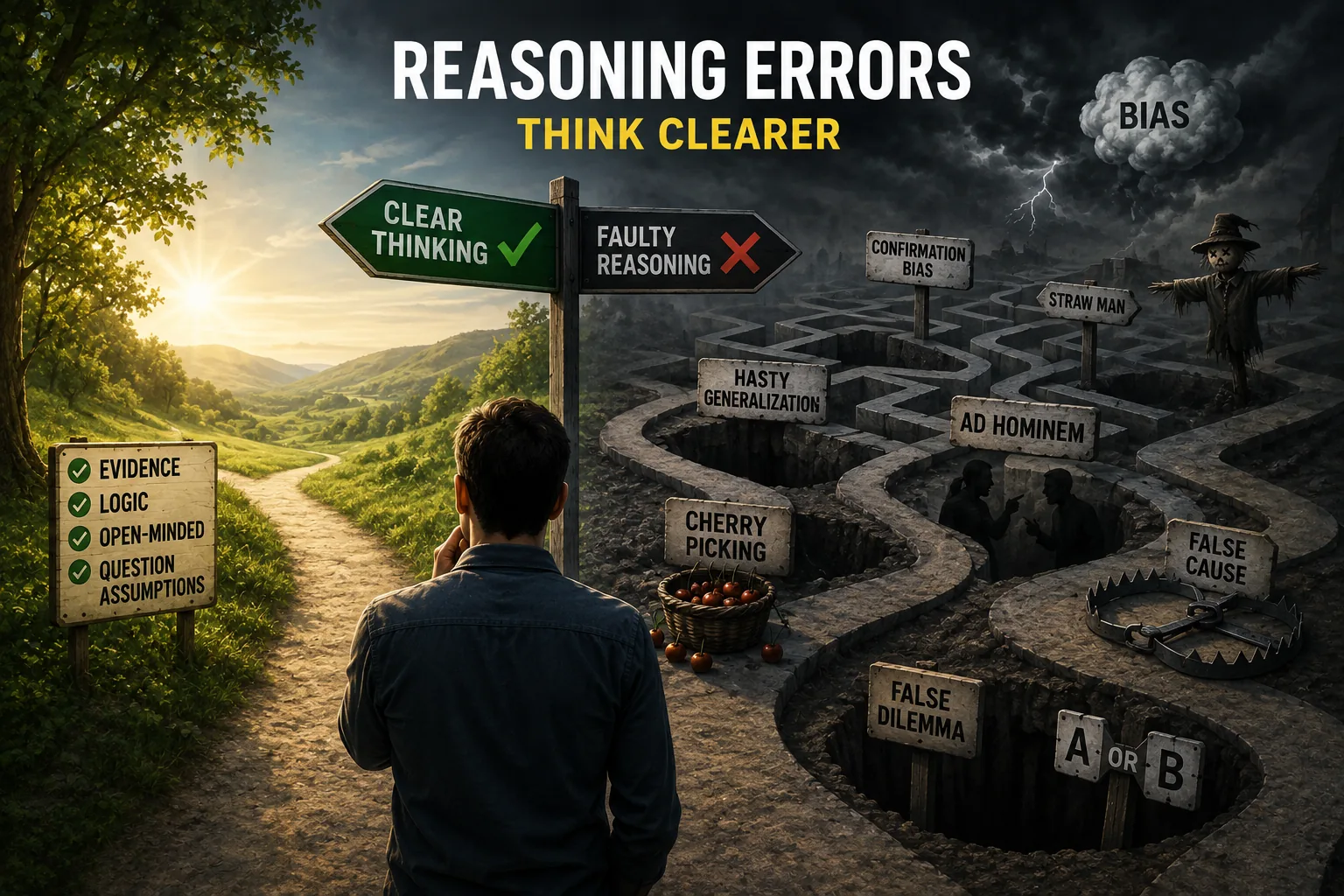
Reasoning errors explained in professional settings are flaws in moving from evidence to a conclusion, not merely mistakes in facts. False cause reasoning mistakes sequence or correlation for causation, hasty generalization treats a small sample as representative, and confirmation bias turns analysis into advocacy. Counterfactual questions, representative evidence, base rates, and symmetrical standards of proof help expose these persuasive but invalid arguments.
In 2012, Yahoo's board hired Marissa Mayer as CEO partly because she came from Google. The implicit reasoning was straightforward: Google is successful, Mayer was a senior leader at Google, therefore Mayer will make Yahoo successful.
This argument - a blend of appeal to authority and false cause - seemed compelling at the time but contained a fundamental logical flaw.
Google's success was driven by search monopoly economics, advertising infrastructure, and network effects that had nothing to do with any single executive's management style.
Mayer's impressive track record at Google did not transfer to Yahoo's entirely different competitive position, technology stack, and organizational culture. Five years and $5 billion in failed acquisitions later, Yahoo was sold to Verizon at a fraction of its former value.
The board's reasoning error was not a failure of intelligence - it was a failure of logic.
Reasoning errors are systematic patterns of flawed logic that lead to incorrect conclusions regardless of the quality of available information. Unlike factual errors (where wrong data produces wrong answers), reasoning errors corrupt the process of moving from evidence to conclusion.
You can have perfect data and still reach catastrophically wrong decisions if the reasoning connecting data to conclusion contains logical fallacies.
These errors are pervasive in professional settings - meeting rooms, strategy documents, performance reviews, and investment decisions are saturated with logical fallacies that go undetected because they sound persuasive even when they are structurally invalid.
This article catalogues the most consequential reasoning errors in professional contexts, explains why intelligent people make them, provides real-time detection techniques, and offers systematic frameworks for building more reliable reasoning habits.
The Most Damaging Workplace Fallacies
Post Hoc Ergo Propter Hoc (False Cause)
"After this, therefore because of this" is the fallacy of assuming that because event B followed event A, A caused B. This is arguably the most expensive reasoning error in business because it drives organizations to invest in initiatives that appear to have caused positive outcomes when the actual causes were entirely different.
1.The mechanism: Human brains are wired to detect causal relationships - an evolutionary advantage when a rustling bush might signal a predator. But this wiring produces false positives, especially when two events occur in close temporal proximity. We see causation where only correlation (or coincidence) exists.
Example: "We hired a consulting firm and revenue increased 20% the following quarter.
The consultants caused the growth." But revenue might have increased due to seasonal patterns, a competitor's product recall, a macroeconomic upturn, or product improvements that were in the pipeline before the consultants arrived. The temporal sequence proves nothing about causation.
2.Why it persists in organizations: False cause reasoning survives because it creates satisfying narratives. Leaders who implemented initiatives want to claim credit for subsequent improvements. Teams that invested effort want their work to matter.
And the alternative - admitting that the cause of improvement is unknown - feels unsatisfying and reduces the sense of control.
3.The counterfactual test: Always ask: "What would have happened if we had NOT done X?" If you cannot answer this question, you cannot claim that X caused the outcome. Example: A/B testing exists precisely to address this fallacy.
When Booking.com tests a website change, half the users see the old version and half see the new one. The difference in behavior between groups isolates the causal effect of the change from everything else happening simultaneously.
Hasty Generalization
Drawing broad conclusions from insufficient evidence - extrapolating from too small a sample or too few observations to a universal claim.
1.Small samples mislead. Three customer complaints do not mean "customers hate the product" when there are 50,000 active users. The vocal minority is not representative of the silent majority.
Example: A product manager attends three user interviews where all three participants struggle with a feature. They conclude: "Users find this feature confusing. We need to redesign it." But three interviews from a user base of 100,000 is a sample size that supports no generalizable conclusion.
The three participants might have been selected from a segment that is not representative, or they might have been confused by the interview format rather than the feature itself.
2.Survivorship bias is a related error that generalizes from visible successes while ignoring invisible failures. Example: "Successful entrepreneurs are college dropouts" (citing Gates, Zuckerberg, Jobs) ignores the millions of college dropouts who did not become billionaires.
The success stories are visible; the failures are invisible.
3.The base rate question: Always ask: "How common is this in the broader population? What is the sample size? Is this representative or an outlier?"
Confirmation Bias as Reasoning Error
Selectively citing evidence that supports your position while ignoring contradictory evidence transforms analysis from truth-seeking into advocacy.
1.Cherry-picking data: Presenting the three metrics that show improvement while omitting the seven that show decline.
Example: A quarterly business review that highlights user growth (+15%) and engagement time (+10%) while omitting churn rate (+25%), customer satisfaction score (-15 points), and support ticket volume (+40%). The selected evidence creates a misleading picture of health.
2.Asymmetric evidence standards: Accepting supporting evidence at face value while demanding extraordinary proof for contradictory evidence. If a positive customer testimonial is taken as evidence of product quality, a negative review should receive equal analytical weight - but it rarely does.
"It ain't what you don't know that gets you into trouble. It's what you know for sure that just ain't so." - Mark Twain
False Dichotomy
Presenting only two options when more exist artificially constrains thinking and forces choices between suboptimal alternatives.
1.Binary framing in strategy: "Either we cut costs or we increase revenue" ignores options like improving operational efficiency, pivoting to higher-margin products, or restructuring pricing.
Example: When Blockbuster faced Netflix's challenge, internal debates framed the choice as "protect our stores or go digital." This false dichotomy prevented exploration of hybrid models that could have leveraged Blockbuster's physical presence alongside digital offerings - a combination that might have been competitive.
2.False urgency creates false dichotomies: "Either we ship by Q2 or we lose the market." This framing ignores: shipping a reduced scope by Q2, a soft launch to a subset of customers, extending to Q3 with a stronger product, or finding a creative middle ground.
3.The expansion question: Whenever you notice "either/or" language, ask: "What are the options we are not considering? Is this truly binary?"
Reasoning Errors About People and Authority
Appeal to Authority
"X is true because an important person said so" substitutes reputation for evidence. Authorities can be wrong, biased, speaking outside their expertise, or operating with outdated information.[5]
1.Position does not equal expertise in all domains. A CEO's opinion on market strategy may be well-informed, but their opinion on database architecture is no more valid than any engineer's unless they have specific expertise.
Example: When a Board member with a finance background insists that the company should build a particular technology feature, their authority on financial matters does not transfer to technology product decisions.
2.Expert consensus is different from individual authority. One expert's opinion is an anecdote. The consensus of hundreds of experts who have reviewed evidence is substantially more reliable. Confusing the two leads to giving single voices disproportionate weight.
3.The substance test: "That is an interesting perspective. What is the reasoning behind it?" This question redirects from who said it to why they said it, forcing the argument to stand on its merits.
Ad Hominem
Attacking the person making the argument rather than the argument itself dismisses potentially valid reasoning based on irrelevant personal characteristics.
1.Discrediting by role or background: "This proposal is from the marketing team - what do they know about engineering constraints?" dismisses the proposal without evaluating its content. Marketing teams can have valuable insights about engineering prioritization, particularly regarding customer impact.
2.Discrediting by tenure or experience: "She just started here - she doesn't understand how we do things" discounts the fresh perspective that newcomers uniquely offer. Sometimes "how we do things" is exactly what needs to change.
3.The separation principle: Evaluate the argument independently of the arguer. A junior employee can make a brilliant point, and a senior executive can make a logical error. Judge the reasoning, not the resume.
Bandwagon Fallacy
"Everyone else is doing it, so we should too" substitutes popularity for analysis.[6] Different organizations have different contexts, constraints, and objectives - what works for one may fail for another.
1.Technology adoption by mimicry: "All our competitors use microservices. We should too." But competitors may have different scale requirements, different team compositions, or be making mistakes that you would be copying.
Example: When numerous startups adopted Kubernetes in 2018-2020 because "everyone is using it," many discovered that their small teams and simple architectures did not justify the operational complexity.
A simpler deployment model would have been more appropriate for their actual needs, but the bandwagon effect prevented objective evaluation.
2.The context question: "Does this actually solve OUR specific problem? What is the reasoning beyond 'others do it'?"
Catching Reasoning Errors in Real Time
Detection Strategies for Meetings
1.Learn trigger phrases. Certain linguistic patterns signal specific fallacies:
- "After we did X, Y happened" - check for false cause
- "Three customers said..." - check for hasty generalization
- "Either we do X or disaster..." - check for false dichotomy
- "Competitor X does Y..." - check for bandwagon
- "We have already spent..." - check for sunk cost
- "Expert Z says..." - check for appeal to authority
2.Use the pause-and-clarify technique. When you sense an error but cannot articulate it immediately: "Can we slow down for a second? Let me make sure I understand the reasoning.
You are saying X leads to Y because Z - is that the argument?" This pause creates space for analysis and makes the reasoning explicit for everyone to evaluate.
3.Ask questions, not challenges. Frame corrections as curiosity: "What else could explain this?" is less confrontational than "That's a logical fallacy" and achieves the same analytical purpose.
| Fallacy | Trigger Phrase | Diagnostic Question |
|---|---|---|
| False cause | "After we did X, Y happened" | "What else changed during that period?" |
| Hasty generalization | "Customers want..." (based on few) | "What is the sample size? Is it representative?" |
| Confirmation bias | Selective data presentation | "What does the contradictory data show?" |
| False dichotomy | "Either X or Y" | "What other options exist?" |
| Sunk cost | "We have invested so much" | "Starting fresh today, would we choose this?" |
| Appeal to authority | "The CEO says" | "What is the reasoning behind that view?" |
| Bandwagon | "Everyone is doing it" | "Does this solve our specific problem?" |
| Straw man | Exaggerated opposing view | "Is that what they actually proposed?" |
| Ad hominem | Attack on person, not argument | "What about the argument itself?" |
| Slippery slope | "If we do X, eventually catastrophe" | "What would prevent that progression?" |
The Steel-Man Approach
Before critiquing any argument, restate it in its strongest possible form. This technique, the opposite of the straw man fallacy, ensures that you engage with the actual argument rather than a weakened version.
1. "The strongest version of your argument is [steel-man]. My concern is [specific logical gap]." This demonstrates that you have listened carefully and that your objection is substantive, not dismissive.
Example: Weak argument: "We should adopt new technology because it is trendy." Steel-man: "The strongest argument for this technology is that it addresses our specific scalability bottleneck, has strong community support reducing risk, and aligns with our team's existing expertise." Then address: "My concern is whether the migration cost and timeline justify the scalability benefit given our current growth trajectory."
Systematic Frameworks for Better Reasoning
The Toulmin Model
Stephen Toulmin's model of argumentation provides a structure for evaluating whether an argument is complete and well-supported.[2]
1.Claim: What are you arguing? 2.Data: What evidence supports it? 3.Warrant: Why does the data support the claim? 4.Backing: Why is the warrant valid? 5.Qualifier: How certain are you? 6.Rebuttal: What could counter this?
Example: Claim: We should expand to the enterprise segment. Data: Five enterprise customers generated 40% of revenue last quarter. Warrant: Enterprise customers provide disproportionate value per account. Backing: SaaS industry data shows enterprise customers have 90% retention versus 60% for SMB.
Qualifier: Assuming we can acquire and support enterprise customers at scale. Rebuttal: Enterprise sales cycles are 6-12 months longer, requiring significant upfront investment before revenue.
When any element is missing, the argument has a structural weakness. Most workplace arguments are missing the qualifier (degree of certainty) and the rebuttal (counterarguments), which creates false confidence.
Pre-Mortem Analysis
Developed by psychologist Gary Klein, the pre-mortem technique counters optimism bias by asking teams to imagine that a project has failed and then explain why.[7]
1. "It is one year from now. This initiative has failed spectacularly. What happened?" 2. Each team member independently writes causes of failure. 3. The team discusses common themes and surprising failure modes. 4. The plan is revised to address the identified risks.
This technique works because it gives people permission to voice concerns that social pressure normally suppresses, and it surfaces reasoning assumptions that would otherwise remain unexamined.
The Scientific Method Applied to Business
1. Observe a pattern or anomaly. 2. Form a specific, testable hypothesis about the cause. 3. Design a test that could disprove the hypothesis. 4. Collect data. 5. Analyze results. 6. Refine or reject the hypothesis.
Example: Observation: Conversion rate dropped 15%. Hypothesis: The new checkout flow confuses users. Test: A/B test showing old checkout flow to 50% of users and new flow to 50%. Data: Old flow converts at 4.2%, new flow at 3.6%. Analysis: New flow reduces conversion by 0.6 percentage points.
Conclusion: Hypothesis confirmed - revert or iterate on the checkout flow.
The key discipline is step 3: designing tests that could disprove your hypothesis, not just confirm it. This is the opposite of confirmation bias and the foundation of reliable reasoning.
Recovering from Reasoning Errors
When You Catch Yourself
The most valuable reasoning skill is the ability to recognize and correct your own errors - and the willingness to do so publicly rather than defending flawed logic.
1.Acknowledge immediately. "You're right - that was a hasty generalization. Let me reconsider with a broader data set." Brief, specific, and forward-looking.
2.Correct the reasoning. Show that you understand the error by demonstrating the correct reasoning process. This transforms an embarrassing moment into a display of intellectual rigor.
3.Thank the corrector. "Thanks for catching that - it helps us make a better decision." This creates an environment where reasoning errors are seen as collective problems to solve rather than personal failures to hide.
"The measure of intelligence is the ability to change." - Albert Einstein
4.The credibility paradox: People who quickly acknowledge reasoning errors build more credibility than those who never make them (or never admit to them). Consistent intellectual honesty signals that you prioritize truth over ego - a trait that earns lasting trust.
Distinguishing Reasoning Errors from Legitimate Disagreement
Not All Disagreement Is Fallacious
Legitimate disagreement stems from different values, priorities, or risk tolerance, while faulty reasoning violates logical principles regardless of perspective.
1.Different values produce different conclusions from the same facts. A product manager who prioritizes speed and learning may prefer launching a minimum viable product, while an engineer who prioritizes reliability may prefer delaying for quality assurance.
Both positions are logically sound - they reflect different weightings of competing values, not reasoning errors.
2.Different risk tolerance leads to different decisions. A conservative investor and an aggressive one may disagree about a particular investment without either making a logical error. They simply have different utility functions for risk and reward.
3.The test: Can both parties accurately state the other's position? In legitimate disagreement, each side can articulate the opposing view fairly. In faulty reasoning, one or both sides misrepresent, cherry-pick, or use logical fallacies to support their position.
Before labeling someone's reasoning as fallacious, check whether they might have information you lack, be expressing values differently, or be assessing risk differently. The goal is better collective reasoning, not winning arguments.
Concise Synthesis
Reasoning errors are systematic patterns of flawed logic - false cause, hasty generalization, confirmation bias, false dichotomy, appeal to authority, bandwagon fallacy, sunk cost reasoning, straw man arguments, ad hominem attacks, and slippery slope thinking - that produce wrong conclusions regardless of the quality of available information.
They persist in professional settings because they sound persuasive, exploit cognitive shortcuts, and are rarely challenged in real-time discussion.
Detection requires learning trigger phrases, using pause-and-clarify techniques, asking diagnostic questions, and applying the steel-man approach before critique.
The most important insight is that reasoning quality is a learnable skill, not a fixed trait. Frameworks like the Toulmin model, pre-mortem analysis, and hypothesis-driven investigation provide structural safeguards against the most common logical failures.
And the single most powerful habit is intellectual honesty: the willingness to catch your own errors, acknowledge them publicly, and correct course.
Organizations where reasoning errors are surfaced and corrected without shame consistently outperform those where flawed logic goes unchallenged because challenging it feels socially uncomfortable.
Industry Case Studies: Reasoning Errors With Measurable Consequences
The academic literature on reasoning errors gains practical weight from documented cases where specific logical failures produced quantifiable outcomes - in some cases, catastrophic ones.
Long-Term Capital Management and Tail Risk Underestimation (1998)
LTCM was founded in 1994 by John Meriwether and included two Nobel Prize-winning economists - Myron Scholes and Robert Merton - on its board. By 1997 it had produced annual returns exceeding 40%.
The fund's collapse in 1998, which required a Federal Reserve-orchestrated bailout to prevent global financial contagion, is a documented case of the hasty generalization fallacy operating in a quantitative rather than qualitative form.
LTCM's risk models were based on historical data from 1987-1997 - a period that excluded every major financial crisis in the 20th century. The models showed that the fund's positions could not lose more than $35 million in a single day; in August and September 1998, losses reached $500 million per day.
The reasoning error was treating a period of relative stability as representative of all possible market conditions.[8]
Roger Lowenstein documented in When Genius Failed (2000) that LTCM's partners had specifically discussed fat-tail risks and concluded that the historical data was sufficient to model them - a conclusion that required ignoring the logical incompleteness of their reference period.
The fund lost $4.6 billion in under four months, demonstrating that sophisticated quantitative reasoning does not prevent the hasty generalization fallacy when the underlying logical structure is flawed.
Enron and Confirmation Bias in Financial Analysis (1996-2001)
Enron's collapse is studied at business schools primarily as a governance failure, but Bethany McLean and Peter Elkind'sThe Smartest Guys in the Room (2003) documents a reasoning error dimension.
Enron's stock was rated a "strong buy" by 16 of 18 Wall Street analysts covering it as late as October 2001, despite multiple publicly available indicators of financial distress.
The analysts' error was confirmation bias operating at scale: they had previously issued positive recommendations, and each quarter's report was evaluated through a frame that sought confirmation of the existing positive assessment rather than independent evaluation.
Analysts who questioned Enron publicly faced social and professional consequences - Merrill Lynch analyst John Olson was reassigned after Enron CEO Ken Lay complained directly to Merrill Lynch management.
This case illustrates how confirmation bias can be institutionalized through incentive structures that punish disconfirmatory analysis, creating organization-wide reasoning failures that no individual's critical thinking can correct.
The Thalidomide Approval Process (1950s-1960s)
The thalidomide crisis - in which a morning sickness drug caused severe birth defects in approximately 10,000 children - illustrates how false cause reasoning operates in scientific and regulatory contexts.
Thalidomide's manufacturer, Chemie Grunenthal, conducted animal safety tests that showed no toxicity in adult animals and concluded that the drug was safe for human use.
The reasoning error was assuming that safety in adult test subjects established safety during fetal development - a false cause inference that ignored the mechanistic question of whether the drug interacted with fetal development pathways.
The U.S. regulator Frances Kelsey at the FDA, applying more rigorous causal reasoning, refused to approve thalidomide in the U.S. on the grounds that the available evidence did not establish the specific causal pathway of fetal safety, only adult safety.
Her insistence on distinguishing between these two different causal questions prevented the American thalidomide disaster while approvals proceeded in Europe and Australia where the false cause reasoning was accepted.
Kelsey was awarded the President's Award for Distinguished Federal Civilian Service in 1962 specifically for applying rigorous causal reasoning against organizational pressure.
The 2008 Housing Crisis and Base Rate Neglect
Michael Burry's analysis of mortgage-backed securities, documented in Michael Lewis's The Big Short (2010) and in Burry's own investor letters, illustrates how a single analyst applying correct causal reasoning identified an error that was simultaneously being made by thousands of PhD economists, ratings analysts, and investment professionals.
The consensus reasoning - that housing prices could not fall simultaneously nationwide because they never had - was a straightforward base rate neglect combined with a hasty generalization from a historically unrepresentative sample.
Burry's correct reasoning was causal rather than historical: he analyzed the specific loan structures underlying the securities (teaser rates that would reset to higher rates, borrowers with no income documentation, loan-to-value ratios exceeding 100%) and concluded that the defaults would occur regardless of what housing prices had done historically.
His fund made approximately $700 million on this analysis. The contrast between Burry's causal reasoning and the industry's historical reasoning demonstrates that reasoning errors are not correlated with expertise or intellectual resources - they are correlated with the presence or absence of specific analytical habits.
What Research Shows About Reasoning Errors
Kahneman and Tversky: Heuristics and Biases
The scientific study of reasoning errors accelerated dramatically in the 1970s when Daniel Kahneman and Amos Tversky published a series of papers in Psychological Review and Science demonstrating that logical fallacies are not random mistakes but predictable, systematic patterns traceable to specific cognitive mechanisms.[1]
Their "heuristics and biases" research program, summarized in the landmark 1974 Science paper "Judgment Under Uncertainty: Heuristics and Biases," showed that intelligent, educated people make the same reasoning errors repeatedly, under similar conditions, in ways that can be predicted and (with effort) corrected.[3]
Stanovich's Mindware Gaps
Keith Stanovich at the University of Toronto refined this framework in What Intelligence Tests Miss (2009) and The Rationality Quotient (2016, with Richard West and Maggie Toplak).[9]
Stanovich introduced the distinction between "mindware" (the reasoning tools available to a thinker) and "mindware gaps" (the absence of tools needed for sound reasoning).
His research demonstrated that many reasoning errors are not failures of processing power but failures to possess or apply the correct logical framework.
The sunk cost fallacy, for example, persists not because people lack intelligence but because they lack the specific "mental program" that distinguishes past costs (irrelevant to future decisions) from future costs and benefits (the relevant considerations).
Crucially, Stanovich's studies showed that explicit instruction in logical frameworks significantly reduced the frequency of corresponding reasoning errors - evidence that these errors are correctable through education.[11]
Mercier and Sperber's Interactionist Theory
Hugo Mercier and Dan Sperber proposed a provocative alternative to the standard "reasoning errors as individual failures" view in their 2011 paper in Behavioral and Brain Sciences and their 2017 book The Enigma of Reason.[4]
Their "interactionist" theory argues that human reasoning evolved primarily for argumentation and persuasion in social contexts, not for individual truth-seeking.
This explains why reasoning errors are so common in individual decision-making but less common when people are evaluating others' arguments: we are much better at spotting flaws in reasoning we are trying to refute than in reasoning we are trying to support.
The practical implication is that reasoning quality improves dramatically when organizational structures create genuine adversarial review - red teams, designated devil's advocates, and structured debate formats - rather than relying on individuals to critically examine their own reasoning.
A 2020 meta-analysis by Sellier, Scopelliti, and Morewedge in the Journal of Marketing Research, examining 52 training studies across debiasing interventions, found that the most effective method for reducing reasoning errors was "consider the opposite" training - explicitly generating reasons why your conclusion might be wrong before finalizing it.
This intervention reduced base rate neglect, overconfidence, and anchoring bias by 20-30% on average, with effects persisting 3 months after training.
Less effective interventions included warning people about biases without giving them specific correction strategies, and providing general critical thinking instruction without specific application to the target reasoning error.
Real-World Case Studies in Reasoning Errors
Yahoo's Authority Fallacy and the Marissa Mayer Decision (2012)
The Yahoo board's reasoning error in hiring Marissa Mayer illustrates how the appeal to authority fallacy operates in high-stakes contexts. Board members including directors from Warner Bros.
and other major corporations reasoned that Google's success implied that Google executives would succeed anywhere.
The error ignored the specific mechanism of Google's success (search monopoly economics, advertising auction systems, network effects that scale automatically) and whether any of those success factors were transferable to Yahoo's situation (an identity-confused media company with no comparable structural advantages).
Post-mortem analysis by Douglas MacMillan (WSJ, 2017) identified that no board member appeared to have asked the diagnostic question: "What specifically did Mayer do at Google that addresses Yahoo's actual problem?" The authority argument substituted prestigious attribution for causal analysis.
The NASA Challenger Disaster and Confirmation Bias (1986)
The Challenger launch decision is the most extensively documented organizational reasoning error in aerospace history.
Presidential Commission member Richard Feynman documented that NASA managers had engaged in systematic confirmation bias by repeatedly reclassifying evidence of O-ring damage from "anomaly" to "acceptable deviation" without investigating the underlying mechanism.
The same data pattern - O-ring damage increases as temperature decreases - was available to both engineers (who concluded the launch was dangerous) and managers (who concluded it was acceptable).
The difference was not access to information but the reasoning process applied to it: engineers sought explanations for the pattern, while managers sought thresholds at which the pattern became "acceptable." Feynman's famous bathtub experiment with an O-ring and ice water at the commission hearing made the flaw in the threshold-seeking reasoning immediately visible.
The 2008 Financial Crisis and Hasty Generalization
The 2008 mortgage crisis was substantially driven by hasty generalization in the risk models used by major financial institutions.
Rating agency analysts and investment bank risk managers had generalized from the historical performance of residential mortgages (which had never experienced nationwide simultaneous decline) to assign AAA ratings to mortgage-backed securities.
Michael Burry, the hedge fund manager whose reasoning process is documented in Michael Lewis's The Big Short (2010), identified the reasoning error: the historical data supporting the generalization came entirely from periods when housing prices were rising.
Burry conducted a methodologically rigorous analysis asking whether there was any precedent for housing prices declining nationwide simultaneously - and found that the sample underlying the generalization was systematically biased toward favorable conditions.
He bet $1.3 billion against mortgage-backed securities and made approximately $700 million when the generalization proved false.
Robert McNamara and the Sunk Cost Fallacy in Vietnam
Former U.S. Secretary of Defense Robert McNamara acknowledged in his 1995 memoir In Retrospect that a primary driver of escalation in Vietnam was sunk cost reasoning - the belief that the deaths of previous soldiers created an obligation to continue the war that could be justified only by victory.
McNamara wrote: "We didn't have the courage to say to the President, 'This is dead wrong.
Our previous commitment doesn't change the fact that we're on the wrong path.'" The sunk cost fallacy in military strategic reasoning contributed to approximately 58,000 additional American deaths after the point at which McNamara and other advisors had concluded the war was unwinnable.
The reasoning error - treating past investment as a reason to continue future investment - is among the most costly that organizational leaders can make.[10]
Evidence-Based Approaches to Reducing Reasoning Errors
Research identifies specific, high-evidence strategies for reducing reasoning errors in both individual and organizational contexts.
What Works: Structured Debiasing Through "Consider the Opposite"
The most robustly replicated debiasing intervention is the simple instruction to generate reasons why your conclusion might be wrong before finalizing it.
Research by Charles Lord, Mark Lepper, and Elizabeth Preston (1984, Journal of Personality and Social Psychology) showed that this intervention reduced confirmation bias by 34% in experimental conditions.
The effect was specific to the instruction to consider opposing evidence; a general "be fair and balanced" instruction produced no significant improvement.
The implication for organizational practice: checklists and meeting norms that explicitly require teams to articulate the strongest argument against their preferred conclusion before deciding are among the highest-leverage interventions available.
What Works: Pre-Commitment to Decision Criteria
Research by Stanovich and by Paul Meehl shows that reasoning errors are substantially reduced when decision criteria are specified before evidence is gathered, not after. Once evidence is in hand, motivated reasoning retroactively shapes what criteria seem relevant.
An investment committee that specifies "we will not invest if the company's product requires customer behavior change in more than two dimensions" before seeing the pitch is less susceptible to being swept up in an enthusiastic founder's presentation than a committee that forms its criteria during evaluation.
What Fails: Simply Educating People About Biases
Multiple studies, including a comprehensive review by Lilienfeld and colleagues (2009) in Perspectives on Psychological Science, found that teaching people about specific cognitive biases without providing them with concrete corrective strategies and practice opportunities produced little lasting reduction in those biases.
People who learn about confirmation bias may acknowledge it exists but continue to exhibit it unless they also learn and practice specific operational techniques (like actively seeking disconfirming evidence before concluding an analysis). Awareness without tools does not produce behavioral change.
What Fails: Increasing Deliberation Time Without Structure
A counterintuitive finding from reasoning error research is that giving people more time to think does not reliably improve reasoning quality and sometimes worsens it.
Timothy Wilson and Jonathan Schooler (1991, Journal of Personality and Social Psychology) showed that asking people to verbalize their reasoning while making decisions can actually impair accuracy by engaging System 2 processes that override accurate intuitions.
More important than time is the structure of deliberation: guided analytical frameworks consistently outperform extended unstructured reflection in reducing reasoning errors.
Sources & Further Reading
- Kahneman, D. (2011). Thinking, Fast and Slow. Farrar, Straus and Giroux.
- Toulmin, S. E. (2003). The Uses of Argument. Cambridge University Press.
- Ariely, D. (2008). Predictably Irrational. Harper Collins.
- Mercier, H., & Sperber, D. (2017). The Enigma of Reason. Harvard University Press.
- Tetlock, P. E. (2005). Expert Political Judgment. Princeton University Press.
- Cialdini, R. B. (2006). Influence: The Psychology of Persuasion. Harper Business.
- Klein, G. (2007). "Performing a Project Premortem." Harvard Business Review.
- Taleb, N. N. (2007). The Black Swan. Random House.
- Stanovich, K. E. (2009). What Intelligence Tests Miss. Yale University Press.
- Bazerman, M. H., & Moore, D. A. (2012). Judgment in Managerial Decision Making. John Wiley & Sons.
- Nisbett, R. E. (2015). Mindware: Tools for Smart Thinking. Farrar, Straus and Giroux.