
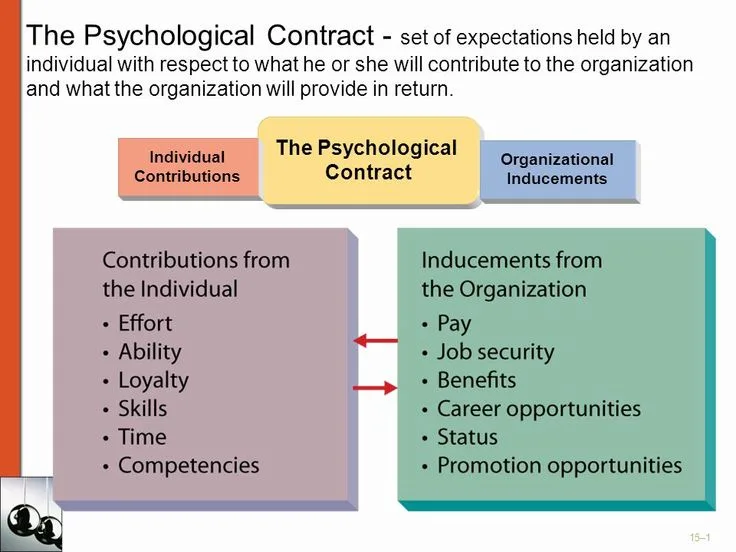
When an employee accepts a job offer, they sign a formal contract specifying salary, working hours, and notice periods. But alongside that signed document, they carry a second, invisible agreement - a set of beliefs about what the employer has implicitly promised and what obligations they have taken on in return.
This is the psychological contract, and it shapes day-to-day work behavior far more profoundly than most organizations recognize.
Psychological contracts are not written, not discussed in detail, and rarely acknowledged until they break. Yet their condition - whether employees feel the agreement is being honored - is one of the strongest predictors of engagement, discretionary effort, and voluntary turnover.
Understanding them is essential for managers, HR professionals, and anyone trying to build organizations where people genuinely want to do their best work.
The Origins of the Concept
The term psychological contract was first used by organizational psychologist Chris Argyris in 1960 to describe the informal understandings between employees and their foremen in a factory setting.[3] Sociologist Levinson and colleagues expanded on the idea in the mid-1960s, framing it as a mutual exchange of obligations.
The framework most organizations use today was developed by Denise Rousseau, who published her foundational paper in 1989 and her book Psychological and Implied Contracts in Organizations in 1995.[2]
Rousseau's critical contribution was reframing the contract from a shared agreement to an individual's subjective perception of what the employer has promised.
This shift matters because it means two employees in identical roles can have radically different psychological contracts, and both can believe their version is accurate.
Rousseau defined the psychological contract as an individual's belief regarding the terms and conditions of a reciprocal exchange agreement between that person and their organization.[1]
The key word is belief: whether or not the employer ever intended to make a particular promise is largely irrelevant. What matters is whether the employee believed a promise was made.
Why the Concept Gained Traction When It Did
The timing of the psychological contract's rise in organizational research is not coincidental. The 1980s and 1990s were a period of mass corporate restructuring across the United States and Western Europe.
Lifetime employment, which had been the implicit expectation in large organizations through much of the postwar decades, was dismantled rapidly and sometimes brutally through waves of downsizing.
When IBM laid off 60,000 workers between 1991 and 1993 - a company previously known for its policy of never laying off permanent employees - it was not just an economic event. It was a mass psychological contract violation on an industrial scale.
Researchers like Rousseau were responding to a practical problem: why did downsized survivors often perform worse, not better? Why did workers who had been "fortunate" enough to keep their jobs frequently disengage, become cynical, or leave voluntarily in the years following layoffs?
The psychological contract framework provided an explanation that pure economic models of labor could not: the violation of the implicit agreement produced emotional and behavioral consequences that outlasted the economic shock.
Transactional vs. Relational Contracts
Psychological contracts exist on a spectrum. Rousseau identified two archetypal forms, though most real employment relationships blend elements of both.
Transactional Contracts
Transactional contracts are short-term, economically focused, and specific. The employee offers a defined set of skills in exchange for clear compensation and benefits. There is limited expectation of job security, career development, or loyalty beyond what is explicitly agreed. Both parties treat the relationship as a market exchange.
Transactional contracts are common in gig work, short-term consulting, and roles with high turnover. They can be healthy when both parties understand and accept the terms.
Problems arise when an employer creates transactional conditions but expects relational behaviors - such as expecting employees to go beyond their job description without offering the job security, development, or recognition that would justify such investment.
A 2019 study published in the Journal of Applied Psychology found that employees with predominantly transactional contracts showed significantly less organizational citizenship behavior - the voluntary, beyond-the-job contributions that drive organizational performance - than those with relational contracts, even when controlling for pay satisfaction.
The implication for organizations is clear: transactional employment structures produce transactional behavior, precisely when many organizations say they want something else.
Relational Contracts
Relational contracts involve broader, longer-term obligations. The employer implicitly promises job security, career advancement, learning opportunities, recognition, and genuine investment in the employee's growth.
In return, the employee is expected to offer loyalty, flexibility, willingness to go above and beyond, and commitment to organizational goals beyond immediate job requirements.
Relational contracts were dominant in large organizations through much of the 20th century, when lifetime employment was a realistic expectation in many industries.
The shift toward project-based work, restructuring, and workforce flexibility since the 1990s has eroded relational contracts in many sectors, sometimes without employers clearly communicating this change to employees - a source of significant friction.
The erosion of relational contracts has been most pronounced in manufacturing, financial services, and technology.
A 2021 Gallup survey found that only 32% of US employees considered their employer genuinely committed to their long-term career development, down from 41% in 2014 - a trend that tracks closely with the structural shift away from relational contract norms.
Ideological Contracts
A third category identified in later research is the ideological contract, where employees are motivated by the organization's mission or values. They contribute effort in exchange for the organization upholding principles they believe in - such as sustainability, social impact, or a particular ethical stance.
Violations of this contract through organizational behavior that contradicts stated values can be particularly damaging, as they strike at identity rather than just economics.
The ideological contract has become increasingly salient among younger workers. A 2023 Deloitte Global Millennial and Gen Z Survey found that 44% of Gen Z respondents said they had rejected a job or assignment because it conflicted with their personal values - more than double the rate reported in 2019.[7]
Organizations that use mission-driven language prominently in recruitment but fail to back it with consistent organizational behavior are creating ideological contract violations at scale.
How Psychological Contracts Form
Psychological contracts form through signals, communications, and inferences that employees collect and interpret across every stage of the employment relationship.
Recruitment and Onboarding
The contract begins forming before the employee starts work. Job postings, recruiter conversations, interview discussions about culture, and offer letter language all contribute to expectations.
Statements like "we really invest in our people here" or "this role has a clear path to senior management" create perceived promises even when no formal commitment exists.
Onboarding reinforces or begins to erode initial impressions. When new employees discover that the organization described in interviews differs from what they experience, early contract incongruence - and sometimes early violation - can set in within weeks of starting.
Research published in the Journal of Organizational Behavior in 2017 found that psychological contract breach within the first six months of employment was the single strongest predictor of first-year turnover - stronger than job satisfaction, role fit, or manager relationship quality.
This finding has significant implications for onboarding design: the conversations about expectations that organizations typically defer to the three-month or six-month review should be happening in the first weeks.
Day-to-Day Working Experience
Ongoing signals continuously update the psychological contract. How managers respond to requests for flexibility, whether promised training materializes, how performance reviews are conducted, whether colleagues who go above and beyond are visibly recognized - all of these communicate what the implicit terms of the agreement actually are.
Employees are particularly attentive to how exceptions are handled. When a colleague is permitted to work remotely permanently, others update their beliefs about what is available to them. When someone is promoted unexpectedly or denied a promotion after clear signals it was forthcoming, the psychological contract adjusts accordingly.
The Role of Organizational Communication
Formal organizational communications - all-hands meetings, strategic announcements, policy changes - also shape the psychological contract in ways leaders often underestimate.
Research by Sandra Robinson and Elizabeth Wolfe Morrison (2000) found that employees interpret silence as much as communication: when organizations fail to update employees on matters that were previously discussed, employees typically infer the worst, generating breach perceptions from omission rather than commission.[5]
This finding has practical implications for how leaders communicate during organizational uncertainty. Saying "we don't have a decision yet but here's what we know" consistently outperforms silence in maintaining psychological contract health, even when the information content is minimal.
Psychological Contract Breach and Violation
Breach
Contract breach is the cognitive assessment that the organization has failed to fulfill one or more perceived obligations. It is a judgment about facts: the thing that was expected did not happen.
Common causes of breach include:
- Promised promotions or salary reviews that do not occur
- Reduced job scope or responsibility without explanation
- Changes to remote work arrangements
- Organizational restructuring that eliminates expected career paths
- Management changes that alter the culture an employee signed up for
Breach does not automatically produce strong negative reactions. Its impact depends on how significant the obligation was, how the employee explains the failure (intentional vs. accidental, within vs. outside organizational control), and how much trust existed before the failure.
A landmark 1994 study by Robinson and Rousseau found that 54% of employees reported at least one psychological contract breach within the first two years of employment - suggesting that breach is the norm rather than the exception, and that what distinguishes healthy employment relationships is not the absence of breach but the quality of the organization's response to it.[4]
Violation
Psychological contract violation is the emotional response to breach - the feelings of betrayal, anger, and disillusionment that arise when an employee concludes the organization has deliberately or recklessly broken a significant promise.
Rousseau's research distinguishes violation from breach because the emotional intensity of violation produces qualitatively different behavioral outcomes.
Employees experiencing violation often:
- Withdraw discretionary effort, doing the minimum required
- Become actively disengaged and vocal about their dissatisfaction
- Begin looking for alternative employment
- Engage in counterproductive work behaviors
"Breach engages the head; violation engages the heart. You can logic your way through a breach. Violation changes how you feel about the organization in a way that is much harder to reverse." - Adapted from Rousseau's framework
Incongruence
Incongruence is a quieter, more pervasive problem than violation. It occurs when employer and employee have genuinely different understandings of what was agreed without either party believing a promise was broken. A manager believes they have been clear about promotion criteria.
The employee believes different criteria were implied in an early conversation. Neither is lying; they simply perceived the agreement differently.
Incongruence can persist for years, driving low-level dissatisfaction and misaligned expectations without ever producing the acute crisis of violation. It is often only surfaced in exit interviews - too late to address.
A 2018 SHRM study found that only 31% of employees felt their expectations had been clearly communicated to them during the hiring and onboarding process, while 74% of managers believed they had communicated expectations clearly.[10]
This 43-point gap is a structural incongruence factory: organizations systematically produce misaligned expectations by assuming communication has occurred when it has not.
The Employer's Perspective
While Rousseau's framework focuses on the employee's subjective perceptions, employers also carry expectations of employees, and these are not always communicated clearly.
A useful tool is the inducements-contributions model, which maps what the organization offers against what it expects in return:
| Employer Inducements | Employee Contributions |
|---|---|
| Competitive salary and benefits | Competent task performance |
| Job security (or transparency about its absence) | Willingness to learn and adapt |
| Career development opportunities | Loyalty and commitment |
| Meaningful work and autonomy | Proactive problem-solving |
| Recognition and respect | Representing the brand positively |
| Flexibility and work-life support | Flexibility during organizational demands |
| Psychological safety | Honest feedback and constructive challenge |
| Transparent leadership communication | Effort beyond minimum requirements |
When either column is significantly out of balance with what was expected, friction emerges. The challenge for employers is that inducements are often visible and concrete (pay, policies, benefits) while employee contributions that are expected beyond the job description (effort, advocacy, cultural fit) are rarely made explicit.
The Cost of Breach at Scale
The organizational cost of widespread psychological contract breach is substantial and measurable. Gallup's 2023 State of the Global Workplace report found that disengaged employees - a condition strongly associated with contract breach - cost employers an estimated 34% of their annual salary in lost productivity.
Globally, Gallup estimated the cost of low engagement at $8.8 trillion in lost productivity annually, equivalent to 9% of global GDP.[6]
Voluntary turnover driven by unmet expectations is an additional cost center. A 2022 McKinsey study found that the top driver of employee attrition was not compensation but feeling that their employer did not value their contribution or potential - a direct description of relational contract breach.[9]
The replacement cost for a mid-level professional is typically estimated at 50-200% of annual salary once recruiting, training, and productivity ramp-up are included.
Psychological Contracts and Employer Branding
Employer branding - the practice of shaping perceptions of the organization as a place to work - is directly connected to psychological contract formation. Every piece of employer brand communication creates expectations that become contractual terms in employees' minds.
Organizations that make strong claims in recruitment materials ("we're like a family here," "your career development is our priority," "we believe in radical transparency") create correspondingly strong implicit promises.
When these claims are not backed by organizational reality, the gap between promise and experience is a source of early contract breach - and a driver of negative reviews on platforms like Glassdoor.
The most effective employer branding is accurate rather than aspirational. It describes the actual conditions of working at the organization honestly, which attracts candidates whose expectations align with reality and reduces early attrition from disappointment.
A 2023 LinkedIn Talent Trends report found that 75% of job seekers research an employer's reputation before applying, with Glassdoor being the most consulted source.[11] Organizations with Glassdoor ratings below 3.5 out of 5 reported 18% longer time-to-fill on open roles and 23% higher first-year attrition.
This data suggests that the employer brand damage from consistent contract breach accumulates in visible, quantifiable ways.
Psychological Contracts Across Different Employee Groups
One of the most important insights from two decades of research after Rousseau's foundational work is that psychological contracts are not uniform across the workforce. Different employee groups enter employment with different baseline expectations, and organizations often fail to account for this variation.
Early-Career Workers
Employees entering the workforce in the 2010s and 2020s - broadly millennials and Gen Z - bring psychological contracts shaped by different baseline assumptions than previous generations.
Research by the Chartered Institute of Personnel and Development (CIPD) in 2022 found that workers under 35 were significantly more likely than older cohorts to include the following in their relational contract: mental health support, values alignment, meaningful work, and developmental feedback.[8]
They were significantly less likely to include job security or long-term organizational loyalty.
Organizations that attempt to build relational contracts with early-career workers using the same inducements that worked for earlier generations - stability, pension contributions, linear promotion ladders - are often speaking the wrong language.
Remote and Hybrid Workers
The expansion of remote and hybrid work has created a new contract complexity: the physical absence of workers from the workplace means that many of the informal signals that update the psychological contract - observing how colleagues are treated, experiencing the culture directly, reading nonverbal cues from management - are attenuated or absent.
Remote workers are more reliant on explicit communication for contract formation and more vulnerable to incongruence when that communication is inadequate.
A 2023 study in the Journal of Vocational Behavior found that remote workers reported significantly higher rates of psychological contract incongruence than their in-office counterparts, not because their contracts were more frequently breached but because the signals they needed to calibrate expectations were harder to access.
Contingent and Gig Workers
Workers engaged through contingent, freelance, or gig arrangements occupy an unusual position in psychological contract theory: they are often categorized as having purely transactional contracts, but research increasingly finds that many contingent workers develop relational contract expectations over time, particularly around respect, recognition, and consistent treatment.
The legal classification of these workers as non-employees does not eliminate the psychological contract; it simply creates a gap between the perceived contract and the organization's formal acknowledgment of any obligations.
The Post-Pandemic Psychological Contract
The COVID-19 pandemic represents the most significant mass renegotiation of the employment psychological contract in decades. Almost overnight, millions of workers were asked to work from home - a request that required them to blur work and personal life, dedicate personal space to work, and demonstrate trust and autonomy.
For many, this was received not as a temporary emergency measure but as evidence that remote work was viable, and it was interpreted as a signal of expanded organizational trust.
When employers subsequently pushed for office returns, many employees experienced this as a unilateral alteration of the psychological contract - a withdrawal of something they now believed had been granted.
Research published in 2022 and 2023 consistently found that employees whose remote work expectations were not met reported lower job satisfaction, lower organizational commitment, and higher turnover intention than those whose expectations were honored.
The post-pandemic period also accelerated other shifts in the psychological contract:
- Wellbeing as an obligation: Employees increasingly expect employers to actively support mental and physical health, not merely provide an EAP phone number
- Psychological safety: The expectation that honest dissent is safe and that performance feedback is delivered respectfully
- Alignment on values: Particularly among younger workers, visible organizational action on social and environmental issues has become part of the relational contract
- Transparency: Expectations around communication about organizational strategy, financial health, and decision-making rationale have risen
A 2023 Edelman Trust Barometer report found that only 48% of employees trusted their employer to be honest with them about the company's future direction - a record low.[12] This baseline distrust means that psychological contract management has never required more deliberate, consistent effort from organizational leaders.
Repairing a Broken Psychological Contract
Once breached - and especially once violated - a psychological contract is difficult but not impossible to repair. Research by Rousseau and Morrison (1994) identified several effective repair mechanisms:
Explanation and Acknowledgment
Providing a clear, honest explanation for why an obligation was not fulfilled reduces the emotional intensity of violation even when it does not reverse the breach. Employees can tolerate disappointment more easily than they can tolerate feeling deceived or disregarded.
A 2016 study in the Academy of Management Journal found that the quality of organizational accounts - explanations that acknowledged the breach, provided genuine rationale, and expressed respect for the affected employees - reduced violation responses by approximately 40% compared to situations where no explanation was provided or where explanations were perceived as inadequate.
Renegotiation
When circumstances have permanently changed - an organizational restructuring, a shift in strategy, a pandemic - attempting to pretend the old contract still holds is counterproductive.
Explicit renegotiation acknowledges what has changed and invites employees to discuss revised expectations openly. This is uncomfortable but far more effective than hoping employees will quietly accept the new reality.
Consistency and Follow-Through
Repairing trust requires behavioral consistency over time. Organizations that have violated employee expectations need an extended period of demonstrable follow-through - delivering on stated commitments, responding to feedback, and making the costs of not delivering visible and consequential for managers.
Manager Quality
The direct manager is the primary conduit through which organizational promises are made and experienced. Research consistently finds that the quality of the manager relationship is more predictive of psychological contract health than organizational policies.
This places significant responsibility on managers to understand what their team members expect, communicate clearly about what is and is not possible, and advocate for their teams within the organization.
Gallup's research spanning two decades consistently finds that people leave managers, not companies.
The practical implication is that investments in manager capability - specifically the capacity to have honest, expectation-clarifying conversations - return more on psychological contract health than almost any other organizational intervention.
Measuring Psychological Contract Health
Organizations that take the psychological contract seriously need tools to assess it. Several validated instruments exist in the research literature, but simpler approaches are available for organizational practice.
The most commonly used structured measure is the Psychological Contract Scale developed by Rousseau and Tijoriwala (1998), which assesses fulfillment and breach across relational and transactional dimensions.
For organizations that cannot administer a full survey instrument, three diagnostic questions - used in pulse surveys or stay interviews - capture much of the essential information:
- "Does your manager communicate clearly about what you can expect regarding your role, career development, and how decisions that affect you are made?"
- "Over the past six months, have there been any significant differences between what you expected from this job and what you have actually experienced?"
- "Do you feel that the organization delivers on the commitments it makes to employees?"
Low scores on these questions, particularly when clustered in specific teams or tenure brackets, reliably predict elevated turnover risk and disengagement.
Practical Implications for Organizations
Understanding psychological contracts has several practical applications for how organizations are managed:
During hiring: Be explicit about what the role realistically offers and what it demands. Avoid overselling culture or advancement prospects that the organization cannot consistently deliver.
During onboarding: Explicitly discuss expectations in both directions. Ask new employees what they understood to have been promised and surface any early incongruence before it solidifies.
During performance management: Link recognition, development, and advancement conversations to the commitments that were made when employees joined. Delivering on these signals not just to the individual but to everyone watching.
During organizational change: Communicate the rationale for changes that affect working conditions, career paths, or cultural norms. Involving employees in shaping the new reality where possible reduces breach perceptions.
During exit interviews: Ask departing employees directly whether their expectations were met. The candor that departure permits is rare and valuable data for understanding where the contract is consistently failing.
Summary
The psychological contract is the invisible architecture of the employment relationship. It shapes whether employees give discretionary effort or do the minimum, whether they advocate for the organization or quietly undermine it, and whether they stay through challenges or leave at the first opportunity.
Its power comes precisely from its informal nature: because it is never fully written down, it is susceptible to miscommunication, divergent interpretation, and unilateral change - all without anyone noticing until the damage is done.
Organizations that treat the psychological contract seriously - attending to the expectations they create, communicating clearly about what is and is not possible, and honoring commitments consistently - build the foundation for genuine employee engagement.
Those that treat employment as a purely transactional exchange and hope for relational behavior in return are writing a story that ends in attrition statistics they struggle to explain.
The psychological contract is not a management concept that applies only in moments of crisis or reorganization.
It is active every day, in every interaction between managers and their teams, in every organizational communication that goes out or fails to go out, in every promise made during hiring that is or is not honored six months later.
The organizations that understand this - and build their people practices accordingly - consistently outperform those that do not, in retention, engagement, and the discretionary effort that separates good performance from great.
Sources & Further Reading
- Rousseau, D.M. (1989). Psychological and Implied Contracts in Organizations. Employee Responsibilities and Rights Journal, 2(2), 121-139.
- Rousseau, D.M. (1995). Psychological and Implied Contracts in Organizations. Employee Responsibilities and Rights Journal Press.
- Argyris, C. (1960). Understanding Organizational Behavior. Dorsey Press.
- Robinson, S.L., & Rousseau, D.M. (1994). Violating the psychological contract: Not the exception but the norm. Journal of Organizational Behavior, 15(3), 245-259.
- Morrison, E.W., & Robinson, S.L. (2000). The development of psychological contract breach and violation: A longitudinal study. Journal of Organizational Behavior, 21(5), 525-546.
- Gallup. (2023). State of the Global Workplace Report 2023. gallup.com
- Deloitte. (2023). Global Millennial and Gen Z Survey 2023. deloitte.com
- CIPD. (2022). Good Work Index: Employee Expectations Survey 2022. cipd.co.uk
- McKinsey & Company. (2022). The Great Attrition is Making Hiring Harder. Are You Searching the Right Talent Pools? mckinsey.com
- SHRM. (2018). Employee Job Satisfaction and Engagement: Revitalizing a Changing Workforce. shrm.org
- LinkedIn. (2023). Talent Trends Report 2023. linkedin.com/talent-solutions
- Edelman. (2023). Edelman Trust Barometer 2023: Trust in the Workplace. edelman.com