
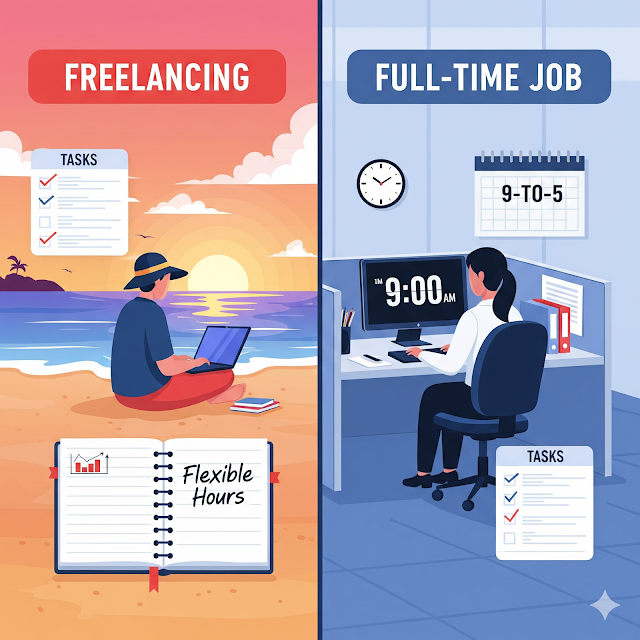
Independence and flexibility are real benefits of self-employment, but they sit alongside irregular work, taxes, and the responsibility of finding clients. Freelancing vs full-time employment is a tradeoff between these different forms of freedom, security, and financial risk for workers.
The appeal of freelancing is sold in a particular register: freedom, flexibility, being your own boss, naming your own rate, working from wherever you want. These things are real, but they are the marketing version of the decision - the part that goes in the Instagram caption.
The full picture includes the self-employment tax bill you were not expecting, the month with no clients and nothing in the pipeline, the health insurance premium that took two hours to research and still feels uncertain, and the retirement account you have been meaning to set up for eight months.
Freelancing is a business model, and like all business models, it rewards people who treat it like one and punishes people who treat it like an escape.
The financial comparison between freelancing and full-time employment is widely misunderstood because most people compare gross numbers. A freelancer earning $100,000 gross revenue and a salaried employee earning $100,000 look equivalent on the surface.
They are not. The salaried employee receives employer-paid health insurance, a 401(k) match, paid time off, disability insurance, and employer-side payroll taxes that collectively represent $25,000-$40,000 in additional compensation invisible in the salary number.
The freelancer must fund all of these independently out of that $100,000 - and also pay both sides of Social Security and Medicare taxes.
This article does the arithmetic honestly, explains the specific structural advantages and disadvantages of each model, and identifies the personal and professional characteristics that predict who will genuinely thrive working for themselves.
The decision between freelancing and employment is not primarily a question of income potential - skilled freelancers can earn more than salaried equivalents. It is a question of whether you have the skills, temperament, and circumstances to reliably generate that income while managing the business overhead that comes with it.
Key Definitions
True hourly rate: The actual hourly wage after accounting for all business costs, unbillable time, taxes, and the cost of benefits not provided by an employer. The true hourly rate of a freelancer is almost always significantly lower than their stated billing rate.
Billable utilisation rate: The percentage of total working hours that are billable to clients. For most solo freelancers, this ranges from 50-70% of total working hours. The remaining 30-50% goes to business development, administration, finance, marketing, and professional development.
Self-employment tax: In the US, self-employed individuals pay 15.3% of net self-employment income toward Social Security and Medicare - effectively both the employee and employer shares. Employees see only 7.65% withheld because their employer pays the other half.
Benefits gap: The total value of employer-provided benefits in a full-time position - health insurance, retirement match, paid time off, disability and life insurance - that a freelancer must fund independently. This typically represents 25-40% of base salary in total compensation value.
The Real Financial Comparison
| Factor | Full-Time Employee | Freelancer |
|---|---|---|
| Gross income | $100,000 salary | $100,000 gross revenue |
| Employer health insurance contribution | ~$7,000 (individual) | Must purchase separately |
| Employer 401(k) match (4%) | $4,000 | None |
| Paid time off (20 days) | ~$7,700 equivalent | Non-billable unpaid days |
| Employer FICA taxes paid | $7,650 | You pay both sides ($15,300) |
| Business expenses | Employer covers | $5,000-$15,000 from gross |
| Disability/life insurance | Often employer-provided | Self-funded |
| Total effective compensation | ~$125,000-$130,000 | ~$80,000-$85,000 net |
The $100,000 freelancer in this example does not net $100,000. After self-employment tax, income taxes, health insurance, retirement contributions, and business expenses, the take-home is closer to $65,000-$75,000 - roughly equivalent to a $80,000-$85,000 salaried position.
Calculating Your True Hourly Rate
This calculation is worth doing explicitly before any decision about going independent.
Start with your desired annual take-home income - the net amount you want to actually spend or save. Example: $80,000.
Add back taxes: At $80,000 net, total tax burden (SE tax plus income tax) might be $30,000-$35,000. Gross revenue target: approximately $110,000-$115,000.
Add benefits: Health insurance for one person costs $4,000-$8,000 per year. Dental and vision: $1,000-$2,000. A 10% retirement contribution to a Solo 401(k): $11,000. Disability insurance: $2,000-$3,000 annually. Total benefits addition: $18,000-$24,000. Running total: approximately $130,000-$140,000.
Add business expenses: Software subscriptions, accounting fees, professional development, home office costs, equipment, professional liability insurance. Depending on your field: $5,000-$15,000 per year. Running total: approximately $135,000-$155,000.
Account for non-billable time: If you work 2,000 hours per year and 60% are billable, you have 1,200 billable hours annually. Divide your target gross revenue ($145,000) by billable hours (1,200): you need to charge approximately $120 per hour just to reach $80,000 take-home.
If you can command $120/hour in your field and sustain near-full utilisation, freelancing works financially. If your market rate is $60-70/hour, the math may not work to replicate your current salaried income.
The Benefits Gap: What You Are Actually Giving Up
Health Insurance
An employer-sponsored individual health insurance plan has an average employer contribution of approximately $6,000-$8,000 per year in the US. For family coverage, the employer contribution averages $13,000-$15,000. As a freelancer, you purchase your own coverage on the ACA marketplace or through a professional association.
Individual premiums for a 35-year-old in decent health might run $400-$600 per month for a mid-tier plan - $4,800-$7,200 per year, possibly with higher deductibles.
The Kaiser Family Foundation 2024 Employer Health Benefits Survey found that employees with employer-sponsored insurance pay an average of just 17% of individual premium costs and 29% of family premium costs - the employer absorbs the rest.[4]
That invisible subsidy represents one of the largest single components of the employment benefits package.
Retirement
Employer 401(k) matches of 3-6% of salary are essentially free money that disappears when you leave employment. An $80,000 employee with a 4% match receives $3,200 per year in employer retirement contributions.
Over 20 years at 7% growth, that $3,200 per year compounds to approximately $139,000 - purely from the match, not from your own contributions.
Freelancers can use Solo 401(k) or SEP-IRA accounts with high contribution limits, which is an advantage for high earners. But you fund all contributions yourself with no match.
The Solo 401(k) has a 2024 contribution limit of $69,000 (or 100% of self-employment income, whichever is less), making it a powerful wealth-building tool for freelancers earning above $150,000. The SEP-IRA allows contributions of up to 25% of net self-employment income.[17]
Both instruments are meaningfully better than a standard individual IRA for high-earning independent workers - but neither comes with the employer match.
Paid Time Off
Two weeks of vacation plus standard US holidays represents roughly 25 days per year - approximately 10% of working days. If you earn $80,000 as a salaried employee and take 25 days of paid time off, your employer is effectively paying you $8,000 for non-work.
As a freelancer, those 25 days are non-billable, and the cost is borne directly by you in reduced annual hours.
The Bureau of Labor Statistics 2023 National Compensation Survey found that private-sector employees with access to paid leave received an average of 15 days of paid vacation plus 7-8 paid holidays - roughly 22-23 days total.[12][3]
Adding sick days, the total paid non-working time often exceeds 30 days per year for employees at mid-to-large companies. Every one of those days represents a direct financial subsidy that a freelancer must price into their billing rate.
Disability and Life Insurance
Employer-provided disability insurance - which typically replaces 60% of income in the event of a disabling illness or injury - is frequently overlooked in benefits comparisons because most people never need it.
The Social Security Administration (2023) estimates that more than 1 in 4 people entering the workforce today will become disabled at some point before retirement age.[13]
Short-term disability insurance premiums for self-employed individuals run $50-$150 per month; long-term disability premiums for a 35-year-old in an office role run $150-$300 per month.
The Tax Reality
Self-Employment Tax Mechanics
On $100,000 of net self-employment income, SE tax is approximately $14,130 (92.35% x $100,000 x 15.3%).[5] You can deduct half - roughly $7,065 - as an above-the-line deduction. But the remaining SE tax obligation still needs to be funded.
Total tax burden on $100,000 of freelance income approaches $30,000+ including federal income and state taxes.
Many new freelancers are shocked by their first tax bill. The solution is to set aside 25-30% of every invoice payment in a separate tax reserve account and make quarterly estimated tax payments to the IRS to avoid underpayment penalties.
Business Deductions
The flip side is that legitimate business expenses are deductible. Home office, equipment, software, professional development, professional services (accounting, legal), business insurance, and health insurance premiums (fully deductible for self-employed) all reduce taxable income.
A well-managed freelance business with $20,000-$30,000 in legitimate deductions can meaningfully lower the tax burden.
S-Corporation Election
Freelancers with consistent annual income above approximately $80,000-$100,000 often benefit from electing S-corporation status. Under an S-corp structure, the business owner pays themselves a reasonable salary (on which SE tax is owed) and takes additional distributions that are not subject to SE tax.
A freelancer earning $150,000 net who structures as an S-corp with a $70,000 salary might save $10,000-$12,000 annually in SE taxes, though this comes with additional administrative overhead (payroll processing, business bank accounts, additional filings).
Consult a tax professional before making this decision - the IRS scrutinises S-corp salary levels.
What the Research Shows About Freelancer Income and Stability
MBO Partners' 2024 State of Independence report surveyed over 3,000 independent workers and found a bifurcated income picture.[1] Among full-time freelancers:
- 28% earned more than $100,000 annually
- 39% earned between $50,000 and $100,000
- 33% earned below $50,000
The high earners shared consistent characteristics: they specialized rather than generalized, had worked independently for more than three years, had a defined client pipeline rather than relying on platforms alone, and treated their practice as a business with financial discipline.
Upwork's Freelancing in America 2023 report found that income volatility was the most commonly cited challenge among freelancers who had returned to employment, cited by 61% of respondents.[2] The second most common challenge was benefits access (54%), and the third was isolation (41%).
These are structural features of solo work, not problems solved by sufficient hustle.
The same research found that 63% of freelancers who had been independent for more than five years reported higher income than they would have earned in a comparable salaried role - but only 31% of freelancers in their first two years reported the same.
The learning curve and pipeline-building required to reach high-income freelancing is real and takes time.
McKinsey Global Institute's 2022 analysis of independent work found that approximately 36% of US workers engaged in some form of independent work as a primary or supplementary income source - up from roughly 27% in 2016.[15][9]
The pandemic accelerated this shift: remote work normalised the logistics of independent contracting, and the Great Resignation of 2021-2022 generated a wave of new independent workers.
Stability vs Freedom: The Real Tradeoff
Income Variability
The fundamental psychological challenge of freelancing is income variability. Months with full client loads feel financially comfortable; months where projects end and the pipeline is thin feel precarious. The uncertainty is stressful in ways that are hard to appreciate before experiencing them.
Some people adapt well; others find it corrosive to their wellbeing and decision-making.
The practical mitigation is maintaining an emergency fund of 6 months of expenses specifically designated as a business buffer - higher than the 3 months recommended for salaried employees, because the risk of temporary income loss is substantially higher.
A 2021 study published in the Journal of Vocational Behavior found that income variability in freelance work was one of the strongest predictors of psychological distress - but that this relationship was significantly moderated by financial reserves.
Freelancers with substantial savings reported stress levels comparable to employed counterparts even during slow periods. The buffer is not just financial preparation; it is a psychological resource.
Career Development
One underappreciated disadvantage of freelancing is the potential slowdown in skill development. Full-time employment at a well-run company provides mentorship, structured feedback, access to senior colleagues' knowledge, and organised professional development.
A solo freelancer working on largely similar projects for a stable client roster may develop expertise in a narrow area while missing the breadth of exposure that employment can provide.
This is more pronounced in fast-moving technical fields - software engineering, data science, machine learning - where employer-sponsored training, conference attendance, and exposure to new technologies are significant career assets.
Freelancers who do not actively invest in professional development risk becoming less competitive over time even while appearing financially successful in the short term.
The Isolation Factor
Research on freelancer wellbeing consistently identifies isolation as a significant quality-of-life cost. The informal social infrastructure of employment - daily interaction with colleagues, team identity, institutional belonging - disappears.
Freelancers who compensate through coworking spaces, professional communities, and deliberate social scheduling tend to report higher wellbeing than those who work exclusively from home.[16] This is not a minor consideration for people whose social needs are significantly met by their work environment.
A 2022 Gallup poll found that remote and independent workers who reported high wellbeing were significantly more likely to maintain strong social connections outside their immediate households and to have regular scheduled interactions with professional peers.[14]
Wellbeing among fully isolated home-based independent workers trended lower - the commute and office context, frustrating as they often are, serve real social functions.
The Competitive Dynamics: Platform vs Direct Client Work
The Platform Trap
Many new freelancers begin on platforms like Upwork, Fiverr, Toptal, or 99designs. These platforms solve the discovery problem - they bring clients to you - but at a substantial cost.[7]
Since 2023, Upwork charges freelancers a flat 10% service fee rather than the older tiered structure that ran 20% on the first $500 with a client, 10% between $500 and $10,000, and 5% beyond $10,000.
Platform work also positions you as a commodity, making rate increases difficult and client relationships shallow.[8]
The strategic goal for any serious freelancer should be building direct relationships that bypass platform fees entirely. The fastest path is usually client referrals from within your network - a far higher conversion rate than cold platform bids, and typically higher rates because the client already has a baseline of trust.
Specialisation Premium
The single strongest predictor of high freelance income is specialisation. Generalist freelancers compete for a wide range of work at mid-range rates; specialists command premium rates in narrow markets with less competition.
| Specialisation Level | Approximate Rate Premium | Client Acquisition Difficulty |
|---|---|---|
| General skill (e.g., "graphic design") | Base rate | High competition, slow |
| Industry specialist (e.g., "healthcare marketing design") | 20-40% premium | Moderate |
| Role specialist (e.g., "SaaS onboarding email design") | 40-80% premium | Lower, targeted |
| Expert-in-residence (e.g., named expert in a framework) | 100-300% premium | Low - clients seek you |
The progression from generalist to specialist to expert is the primary lever available to freelancers seeking to grow income beyond the hourly rate ceiling. Productising services - packaging specific deliverables at fixed prices rather than billing hourly - is often the next step after establishing a specialisation.
Who Thrives Freelancing
Successful long-term freelancers tend to share a consistent profile:[6]
Strong self-marketing and business development instincts: The ability to sell, network, and generate client relationships is at least as important as technical skill. Many excellent practitioners fail as freelancers not because their work is poor but because they dislike or are not skilled at business development.
High tolerance for income variability: People with low financial reserves, dependents who depend on stable income, or significant anxiety around money predictability face higher costs from this variability.
Pre-existing professional network: Freelancers who launch with a network of potential clients or referral sources succeed far more quickly than those starting from zero relationships. The majority of freelance work comes through referrals.
Genuine preference for autonomy: The freedom and variety of freelancing are motivating for people who value autonomy. For people who thrive in collaborative environments with clear role definition, the isolation and ambiguity of freelancing can be depleting.[10]
Financial discipline: Managing irregular income requires systematic financial habits that many people lack. Freelancers who treat every invoice payment as personal income - rather than separating taxes and business expenses first - consistently struggle at tax time and underestimate the true cost of independence.
The Hybrid Models
A growing number of workers are adopting hybrid arrangements that combine elements of both employment and independent work:
Part-time employment plus freelancing: A 3-day-per-week or 4-day employment arrangement combined with 1-2 days of freelance work provides stability while building independent income. This is particularly viable in consulting-adjacent fields where former employers often become clients.
Fractional executive work: Experienced professionals serving as fractional CMO, CFO, or CTO across multiple companies simultaneously - typically 10-15 hours per week per engagement. This model has grown significantly since 2020 as mid-size companies sought senior expertise without full-time executive cost.
Portfolio career: Multiple income streams from different sources - one or two anchor clients, a productised service, online course revenue, speaking fees. This model is more complex to manage but significantly reduces the income volatility risk of single-client dependency.
Comparing the Models Across Lifestyle Factors
| Factor | Full-Time Employment | Freelancing | Notes |
|---|---|---|---|
| Income stability | High | Low-moderate | Depends on pipeline depth |
| Income ceiling | Capped by company bands | Uncapped | Requires rate growth strategy |
| Schedule flexibility | Low-moderate | High | More client-dependent than many assume |
| Career development | Structured | Self-directed | Risk of narrow specialisation |
| Benefits | Employer-provided | Self-funded | Significant cost at family coverage level |
| Tax simplicity | Employer-managed | Complex | CPA investment worth it above $75K |
| Social connection | Built-in | Self-managed | Real wellbeing consideration |
| Sick day impact | Paid | Lost income | Critical insurance gap for freelancers |
| Retirement | Match + structure | Higher ceiling | Solo 401(k) better for high earners |
| Sense of purpose | Role-dependent | Project-dependent | Both have high variance |
Practical Recommendations
Run the true hourly rate calculation before making the jump. Calculate the gross revenue needed to match your current total compensation (salary plus benefits), divide by realistic billable hours, and verify this rate is achievable in your market.[11]
Build a 6-month financial buffer before launching. This buffer allows you to pursue better clients, turn down poor-fit work, and weather slow months without making decisions from financial desperation.
Raise your rate early and maintain it. New freelancers routinely underprice, then struggle to raise rates for existing clients. It is easier to start at market rate and maintain it than to start low and increase.
Set up retirement and tax infrastructure from day one. Open a Solo 401(k), establish a tax reserve account, and file quarterly estimated taxes. These administrative tasks are easier to build as habits from the start than to retrofit after several years.
Consider starting with part-time freelancing before going full-time. Building a client base and testing your market rate while still employed substantially reduces the financial risk of the transition. Most successful full-time freelancers built their first clients and refined their positioning while still drawing a salary.
Hire an accountant from year one. The cost of a CPA or tax professional - typically $500-$2,000 per year for a solo freelancer - consistently pays for itself through legitimate deductions, tax strategy, and avoidance of costly errors.
The self-employment tax code has enough nuance that attempting to navigate it without professional help is rarely cost-effective above $60,000 annual income.
The Long-Term Picture: Freelancing as a Wealth-Building Strategy
For high-earning freelancers with financial discipline, the tax and retirement vehicles available to the self-employed can actually produce better long-term wealth accumulation than employment. The Solo 401(k) contribution limit of $69,000 in 2024 is more than triple the $23,000 employee limit.
A freelancer earning $200,000 who maximises Solo 401(k) contributions can shelter a far larger percentage of income from current taxes than any salaried employee.
Combined with the deductibility of health insurance premiums, the ability to write off legitimate business expenses, and the eventual option to elect S-corporation status, the self-employed tax position - while more complex - can be meaningfully more efficient for high earners who structure it properly.
The caveat is that these advantages compound only for people who have the income to exploit them. At $80,000 gross revenue, the tax burden and benefits costs largely negate the gains.
At $200,000+, the structure begins to favour the independent model on a pure financial basis - which is one reason why the freelancers who have been independent for 5+ years report higher income satisfaction than those in their first two years.
Sources & Further Reading
- MBO Partners. (2024). The state of independence in America. MBO Partners Research.
- Upwork and Freelancers Union. (2023). Freelancing in America annual report. Upwork.
- Bureau of Labor Statistics. (2024). Contingent and alternative employment arrangements. US Department of Labor.
- Kaiser Family Foundation. (2024). 2024 employer health benefits survey. KFF.
- Internal Revenue Service. (2024). Self-employment tax: Topic No. 554. IRS Publication 334.
- Horowitz, S. (2021). Freelance Nation: The Future of Working for Yourself. Portfolio.
- Kessler, S. (2018). Gigged: The Gig Economy, Your Job and the Future of Work. St. Martin's Press.
- Weil, D. (2017). The Fissured Workplace: Why Work Became So Bad for So Many and What Can Be Done to Improve It. Harvard University Press.
- Manyika, J., Lund, S., et al. (2016). Independent work: Choice, necessity, and the gig economy. McKinsey Global Institute.
- Spreitzer, G., Cameron, L., & Garrett, L. (2017). Alternative work arrangements. Annual Review of Organizational Psychology, 4, 473-499.
- Kitces, M. (2023). How to calculate the true cost of going independent. Kitces Financial Advisor Success Podcast.
- Bureau of Labor Statistics. (2023). National compensation survey: Employee benefits in private industry. US Department of Labor.
- Social Security Administration. (2023). Disability and death probability tables for insured workers. SSA Publication No. 13-11536.
- Gallup. (2022). State of the global workplace report. Gallup Press.
- McKinsey Global Institute. (2022). The future of work after COVID-19. McKinsey & Company.
- Norgate, S., & Cooper, C. (2020). Flexible work: Designing our healthier future lives. Routledge.
- IRS. (2024). Publication 560: Retirement plans for small business (SEP, SIMPLE, and qualified plans). Internal Revenue Service.
Further Reading
- Collins, R. (2020). Real artists don't starve. HarperCollins Leadership.