
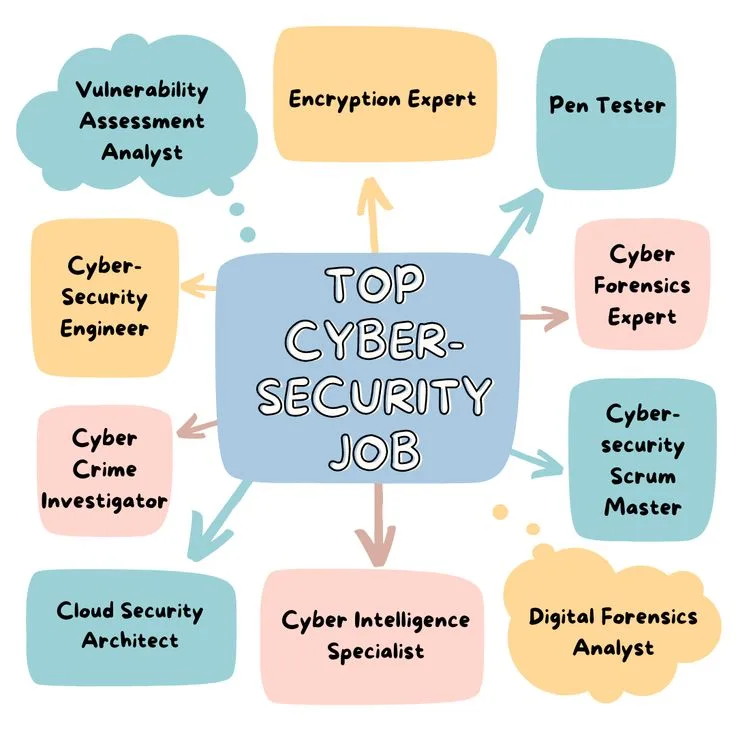
Cybersecurity contains distinct careers with different daily work, skills, organisational settings, and personality fit. Exploring cybersecurity career opportunities requires comparing those specialisations before committing to credentials, because technical testing and governance work can demand very different strengths in daily practice.
Cybersecurity is not a single career - it is a family of careers that share a common theoretical foundation but diverge substantially in day-to-day work, required skills, organisational context, compensation, and personality fit.
A penetration tester and a governance, risk, and compliance analyst both work in cybersecurity, but their jobs are as different from each other as surgery and hospital administration are within medicine.
Understanding these distinctions before committing to a specialisation saves years of credential accumulation in the wrong direction.
The field broadly organises into five major tracks: offensive security (red team, penetration testing), defensive security (blue team, SOC, detection engineering), governance, risk, and compliance (GRC), cloud security, and digital forensics and incident response (DFIR).
Each track has its own certification ecosystem, career progression structure, salary trajectory, and culture.[11] Each also has distinct barriers to entry that require different strategies to overcome.
This article gives each major track a full treatment: what the work actually involves day-to-day, what it pays at entry through senior levels according to ISC2 and ISACA 2024 salary data, what certifications matter most, how long it takes to reach each level, and an honest assessment of who is suited to each path.
The goal is to give you enough detail to identify which track aligns with your skills, working style, and career goals - and which you should rule out before investing significant time and money.
The ISC2 2024 Cybersecurity Workforce Study surveyed over 15,000 professionals globally and found that average cybersecurity salaries in North America reached $147,000, up from $119,000 in 2021.[1]
The ISACA State of Cybersecurity 2024 report found that 75% of organisations reported a cybersecurity skills shortage, creating meaningful structural demand across all five tracks described here.[2]
'Most people entering cybersecurity think they want to be hackers. After a year in a SOC, many of them discover they are actually very good at detection engineering.
The field has a way of sorting people into where they fit, if you let it.' - Chris Sanders, author of 'Applied Network Security Monitoring,' SANS Institute, 2023[6]
Key Definitions
Red Team: An adversarial simulation function within an organisation that emulates real-world attack techniques to test defences. Red teams operate with more scope, duration, and sophistication than standard penetration tests, often simulating multi-stage campaigns over weeks or months.
Blue Team: The defensive security function responsible for monitoring, detecting, containing, and recovering from security incidents. SOC analysts, detection engineers, and incident responders are all blue team functions.
GRC (Governance, Risk, and Compliance): The management discipline that oversees an organisation's security policies, regulatory compliance obligations, risk assessment processes, and third-party vendor risk. GRC professionals sit at the intersection of legal, operational, and technical domains.
Cloud Security: The specialisation focused on securing infrastructure, applications, and data in public cloud environments (AWS, Azure, GCP).[14] Distinct from traditional network security in architecture, tooling, and threat model.
DFIR (Digital Forensics and Incident Response): The specialisation covering post-incident investigation (forensics) and real-time crisis management (incident response). DFIR professionals often serve as internal specialists or external consultants during significant security breaches.
Offensive Security: Red Team and Penetration Testing
What the work involves day to day
Offensive security professionals are hired to attack systems, find vulnerabilities, and demonstrate the real-world impact of those vulnerabilities before actual threat actors can exploit them.[12]
The work spans multiple engagement types: network penetration testing (compromising internal network infrastructure), web application testing (finding injection flaws, authentication bypasses, insecure APIs), social engineering (testing human defences through phishing, phone calls, or physical access attempts), red team operations (sustained adversarial simulation campaigns), and cloud penetration testing.
A standard penetration test engagement runs 1-2 weeks. The tester works through a defined methodology: reconnaissance (gathering intelligence about the target), scanning and enumeration (identifying live systems and services), exploitation (attempting to compromise identified vulnerabilities), post-exploitation (demonstrating impact - could an attacker reach sensitive data?), and reporting (documenting findings with severity ratings and specific remediation guidance).
Day to day, an offensive security professional might spend the morning reviewing scope and rules of engagement for a new web application test, spend the afternoon running automated and manual testing against a client's API, and spend the evening writing up a critical finding with a proof-of-concept exploit and remediation recommendation.
The unglamorous truth: reporting is the skill that separates average pentesters from excellent ones. A finding is only valuable if it is communicated in a way that allows developers and engineers to actually fix the problem.
Red team engagements are longer and more complex. A multi-week red team operation might involve initial access via phishing, lateral movement through the network using legitimate credentials, privilege escalation to domain administrator, and exfiltration simulation.
The red team then debriefs the blue team on every technique used, turning the operation into a learning exercise.
Salary data by level (ISC2/ISACA 2024)
| Level | Experience | Salary Range (US) | Primary Certifications |
|---|---|---|---|
| Junior penetration tester | 0-2 years | $70,000-$90,000 | CompTIA Security+, eJPT, PNPT |
| Mid-level penetration tester | 2-5 years | $100,000-$145,000 | OSCP, GPEN, GWAPT |
| Senior/specialist | 5-8 years | $145,000-$195,000 | OSCP, CRTO, OSED |
| Red team lead / principal | 8+ years | $180,000-$240,000+ | CRTE, CRTO, custom research |
| Independent contractor | N/A | $150-$350/hr billable | OSCP + experience |
Fastest path to entry
Complete the TryHackMe or Hack The Box learning paths, earn the PNPT (Practical Network Penetration Tester) from TCM Security or the CompTIA PenTest+, and build a portfolio of documented CTF solutions and home lab configurations.[10]
Junior roles at consulting firms (not corporate red teams) are the most accessible entry point; corporate red team positions typically require at least 2-3 years of consulting penetration testing.
Career ceiling
Principal Security Researcher, Head of Red Team, or founding an independent penetration testing consultancy. Many experienced offensive security professionals move into vulnerability research, exploit development, bug bounty programs, or security tool development.
The bug bounty ecosystem (HackerOne, Bugcrowd) creates an alternative track where top researchers earn $200,000-$500,000 annually from vulnerability disclosures.[13]
Defensive Security: Blue Team, SOC, and Detection Engineering
What the work involves day to day
Blue team work is the complement to offensive security: rather than finding vulnerabilities, blue teamers build defences, monitor for intrusions, detect attacks in progress, and respond to incidents. The organisational structure has a well-defined ladder that makes it one of the most accessible paths into security.
Tier 1 SOC analyst: The entry point. Analysts monitor a SIEM dashboard, triage alerts generated by detection rules, and determine whether an alert represents a genuine security incident or a false positive.
A typical shift might involve reviewing 50-200 alerts, opening tickets for confirmed or suspected incidents, and escalating complex cases to Tier 2. The work is repetitive and process-driven - which suits some people and exhausts others.
Tier 2-3 analyst: More complex triage, threat hunting, and incident response coordination. Tier 3 analysts are deeply technical, able to investigate malware samples, conduct memory forensics, and understand attacker tradecraft at the level required to write detection rules.
Detection engineer: Detection engineers design and maintain the rules, queries, and logic that feed into the SIEM and EDR systems.
This role requires understanding attacker behaviour deeply enough to write rules that catch real attacks without generating so many false positives that analysts are overwhelmed. It is a blend of security engineering, data analysis, and attacker emulation.
Threat hunter: Proactively searches for evidence of compromise that automated tools have not flagged. Threat hunters develop hypotheses about how an attacker might be operating in the environment, then query logs and telemetry to test those hypotheses. This role is the most intellectually demanding in the blue team track at mid-career.
Salary data by level (ISC2/ISACA 2024)
| Level | Experience | Salary Range (US) | Primary Certifications |
|---|---|---|---|
| Tier 1 SOC analyst | 0-1 years | $55,000-$75,000 | CompTIA Security+, CySA+ |
| Tier 2-3 analyst | 2-4 years | $80,000-$115,000 | CySA+, GCIA, GCIH |
| Detection engineer | 3-6 years | $115,000-$155,000 | GCIA, GCIH, Splunk certifications |
| Threat hunter | 4-7 years | $120,000-$160,000 | GCIH, GCFA, FOR508 |
| Security operations manager | 6-10 years | $140,000-$185,000 | CISSP, CISM |
Fastest path to entry
Tier 1 SOC analyst positions are the most accessible entry point in all of cybersecurity. Many employers hire candidates with CompTIA Security+ and six months of home lab experience.[16]
The Google Cybersecurity Certificate and CompTIA CySA+ together provide a credible baseline for a first application. Government and MSSP (Managed Security Service Provider) SOC positions are particularly accessible to career changers.
Governance, Risk, and Compliance (GRC)
What the work involves day to day
GRC professionals manage the policy, regulatory, and risk management dimensions of cybersecurity.
This includes developing and maintaining security policies, conducting risk assessments, managing compliance programmes (ISO 27001, SOC 2, PCI-DSS, NIST CSF, GDPR, HIPAA), overseeing third-party vendor risk, and preparing reports for leadership and regulators.[7]
A typical week for a GRC analyst might include reviewing a vendor's security questionnaire (does this third-party processor meet our data protection standards?), updating a risk register following a new system deployment, drafting a policy exception request for a business unit that cannot comply with a specific control, and preparing materials for an external ISO 27001 audit.
GRC is the least technically demanding path into cybersecurity and the one most accessible to people from legal, audit, business, or public policy backgrounds.
It is also a path that leads directly to CISO and security leadership positions - because the skills most required at executive level (risk communication, regulatory navigation, business process understanding) are the core of GRC work.
ISACA's 2024 State of Cybersecurity report found that 72% of CISO positions went to candidates with GRC or risk management backgrounds rather than purely technical backgrounds, reflecting the increasing business and regulatory demands placed on security leadership.
Salary data by level (ISC2/ISACA 2024)
| Level | Experience | Salary Range (US) | Primary Certifications |
|---|---|---|---|
| Junior GRC analyst | 0-2 years | $60,000-$82,000 | CompTIA Security+, ISO 27001 Lead Implementer |
| GRC analyst/manager | 3-6 years | $90,000-$130,000 | CISM, CRISC |
| Senior GRC / risk director | 6-10 years | $130,000-$185,000 | CISM, CRISC, CISSP |
| CISO / VP of Security | 10+ years | $200,000-$350,000+ | CISSP, CISM, executive MBA |
Fastest path to entry
GRC is the fastest track to enter from a non-technical background. A candidate with a business or legal degree, the CompTIA Security+, and an ISO 27001 Foundation certificate can credibly apply for junior GRC analyst roles.
Many employers in financial services and healthcare specifically prefer candidates with business or audit backgrounds for GRC positions.
Cloud Security
What the work involves day to day
Cloud security professionals secure an organisation's use of public cloud platforms (AWS, Azure, GCP, multi-cloud environments).
This involves securing cloud infrastructure configurations (IAM policies, network security groups, storage permissions), monitoring cloud-specific threats, implementing cloud-native security tools (AWS GuardDuty, Azure Defender, GCP Security Command Center), and reviewing cloud architecture for security risks.
The day-to-day work has two modes. In a proactive mode, cloud security engineers review new infrastructure deployments for security misconfigurations, write policy-as-code (using tools like Open Policy Agent or AWS Config Rules) to prevent misconfigured resources, and build automated scanning pipelines that check every code commit for security issues.
In a reactive mode, they investigate cloud-specific alerts - unusual API calls, unexpected data transfer patterns, privilege escalation events in IAM - and respond to incidents.
Cloud security is the fastest-growing security specialisation by job posting volume. Gartner's 2023 research predicts that by 2026, 75% of enterprise workloads will run in the cloud.
Critically, Gartner also found that 99% of cloud security failures through 2025 will be the customer's fault - meaning misconfiguration and permission errors, not vendor vulnerabilities.[3] This creates perpetual demand for professionals who can prevent and detect those misconfigurations.
Cloud security roles are generally not accessible to complete beginners. They require either a background in cloud engineering/DevOps or a strong foundation in traditional network security, plus specific cloud platform certification.[15] Entry typically requires 2-4 years of prior experience in a related field.
Salary data by level (ISC2/ISACA 2024)
| Level | Experience | Salary Range (US) | Primary Certifications |
|---|---|---|---|
| Cloud security engineer | 2-5 years | $125,000-$165,000 | AWS Security Specialty, SC-200 |
| Senior cloud security engineer | 4-7 years | $155,000-$200,000 | AWS Security Specialty, CCSP |
| Cloud security architect | 6-10 years | $185,000-$230,000 | CCSP, Microsoft SC-100 |
| Principal / staff cloud security | 8+ years | $200,000-$260,000+ | CCSP, TOGAF (architecture) |
Cloud security roles pay a consistent 20-30% premium over equivalent on-premise security roles at the same level, reflecting the skills shortage in the specialisation.
Digital Forensics and Incident Response (DFIR)
What the work involves day to day
DFIR professionals investigate security incidents after the fact (forensics) and manage active incidents in real time (incident response).
Forensic work involves recovering deleted files, analysing memory dumps, reconstructing attack timelines, and preserving evidence for potential legal proceedings. Incident response involves leading or supporting the containment and eradication phase of major security incidents.
A day in DFIR consulting looks radically different from a day in an internal SOC.
A consulting DFIR analyst might fly on Monday to a client site where ransomware encrypted 40% of the company's file servers over the weekend, spend Tuesday through Thursday conducting memory analysis, reviewing event logs, and rebuilding the initial access chain (typically a phishing email or unpatched VPN vulnerability), and spend Friday writing an incident report that will be shared with the company's board, insurers, and potentially regulators.
DFIR specialists at consulting firms (Mandiant, CrowdStrike Services, PwC Incident Response, Unit 42 at Palo Alto) are billed at $300-$600 per hour during active breach response.[5] A three-week engagement following a major ransomware attack can generate $500,000-$2,000,000 in fees.
Internal DFIR professionals at large organisations are among the most highly paid security specialists.
The Mandiant M-Trends 2024 report found that the median dwell time (how long attackers are in a network before detection) has dropped from 416 days in 2012 to 10 days in 2023 - partly because DFIR specialists are detecting intrusions faster, and partly because modern ransomware operators work much faster to maximise impact.[4]
This reduction in dwell time has made incident response work simultaneously more intense and more technically demanding.
Salary data by level (ISC2/ISACA 2024)
| Level | Experience | Salary Range (US) | Primary Certifications |
|---|---|---|---|
| DFIR analyst | 1-3 years | $85,000-$115,000 | GCFE, GCIH |
| Senior DFIR specialist | 3-6 years | $120,000-$165,000 | GCFE, GCIH, GCFA |
| DFIR consultant (firm) | 4-8 years | $140,000-$190,000 | GCIH, GREM, FOR508 |
| DFIR lead / manager | 6-10 years | $170,000-$220,000 | CISSP, GCIH, GREM |
Career Path Comparison: All Five Tracks
| Track | Entry Difficulty | Time to First Role | Avg Senior Salary (US) | Best Senior Certs | Exit to CISO? | Work Style |
|---|---|---|---|---|---|---|
| Offensive/Red Team | High | 6-18 months | $180,000-$240,000 | OSCP, CRTO | Rare | Creative, autonomous |
| Blue Team/SOC | Low-Moderate | 0-6 months | $140,000-$185,000 | GCIA, GCIH | Moderate path | Analytical, systematic |
| GRC | Low | 0-6 months | $200,000-$350,000 | CISM, CRISC, CISSP | Strong path | Policy, process, risk |
| Cloud Security | Moderate-High | 12-24 months | $200,000-$260,000 | CCSP, AWS Security | Moderate path | Engineering, architecture |
| DFIR | Moderate-High | 6-18 months | $170,000-$220,000 | GCIH, GREM, GCFA | Some path | Investigative, forensic |
Sources: ISC2 Cybersecurity Workforce Study 2024, ISACA State of Cybersecurity 2024.
Skills That Transfer Across Tracks
One of the most useful things to understand is that the five tracks are not sealed compartments. Professionals move between them - particularly in the first five years - and certain skills create unusually strong bridges.
Networking fundamentals (TCP/IP, routing, protocols) are relevant in all five tracks. Understanding how data moves across a network is foundational for offensive testing, detection engineering, cloud security architecture, and forensic traffic analysis.
Python scripting appears in all five tracks: for automating penetration test tasks, writing detection queries, building compliance automation, configuring cloud security controls, and parsing forensic artefacts.
Understanding attacker techniques (MITRE ATT&CK framework) is explicitly or implicitly required in four of the five tracks.
GRC professionals need it to assess controls; blue teamers use it to design detections; red teamers use it to plan operations; DFIR professionals use it to reconstruct incidents. The MITRE ATT&CK framework is the single most useful shared reference across the field.[8]
Report writing is underestimated by almost everyone entering cybersecurity. A penetration tester who cannot communicate findings clearly provides less value than a mediocre tester who can. GRC work is almost entirely written communication. DFIR reports become legal documents.
Detection engineering requires writing runbooks that SOC analysts at 3 AM can follow without errors.
Which Path Is Fastest to Enter
Based on entry requirements, available training pathways, and hiring patterns:[9]
GRC - Fastest. A business or legal background plus Security+ and an ISO 27001 foundation certificate is sufficient for many junior roles. No hands-on technical skills required at entry.
Blue Team/SOC - Fast. Tier 1 SOC analyst positions regularly hire candidates with only CompTIA Security+ and basic networking knowledge. MSP and MSSP environments are particularly accessible.
DFIR - Moderate. Requires some technical foundation (operating system internals, log analysis, networking) but many firms hire from the SOC and provide DFIR training in-house.
Cloud Security - Slower. Typically requires 2-4 years of prior experience (cloud engineering, DevOps, or network security) before transitioning. AWS or Azure certifications help but do not substitute for experience.
Offensive/Red Team - Slowest. Corporate red team positions require 3-5 years of experience. Junior consulting penetration testing roles are accessible earlier (1-2 years) but still require demonstrated technical skill and certifications.
Sources & Further Reading
- ISC2 Cybersecurity Workforce Study 2024. isc2.org
- ISACA State of Cybersecurity 2024. isaca.org
- Gartner, 'Cloud Security and the Shared Responsibility Model.' 2023. gartner.com
- Mandiant M-Trends 2024 Threat Intelligence Report. mandiant.com
- CrowdStrike Global Threat Report 2024. crowdstrike.com
- Chris Sanders and Jason Smith, 'Applied Network Security Monitoring' (No Starch Press, 2013)
- NIST Cybersecurity Framework 2.0 (2024). nist.gov/cyberframework
- MITRE ATT&CK Framework v14. attack.mitre.org
- SANS Institute Course Catalogue 2024. sans.org
- TCM Security, 'Practical Network Penetration Tester (PNPT) Certification.' 2024. tcm-sec.com
- GIAC Certification Directory 2024. giac.org
- Offensive Security, 'OSCP Certification Overview.' 2024. offensive-security.com
- HackerOne, '2024 Hacker-Powered Security Report.' hackerone.com
- AWS Security Documentation. docs.aws.amazon.com/security
- (ISC)2 CCSP Certification Overview. isc2.org/ccsp
- CompTIA Cybersecurity Career Pathway 2024. comptia.org