
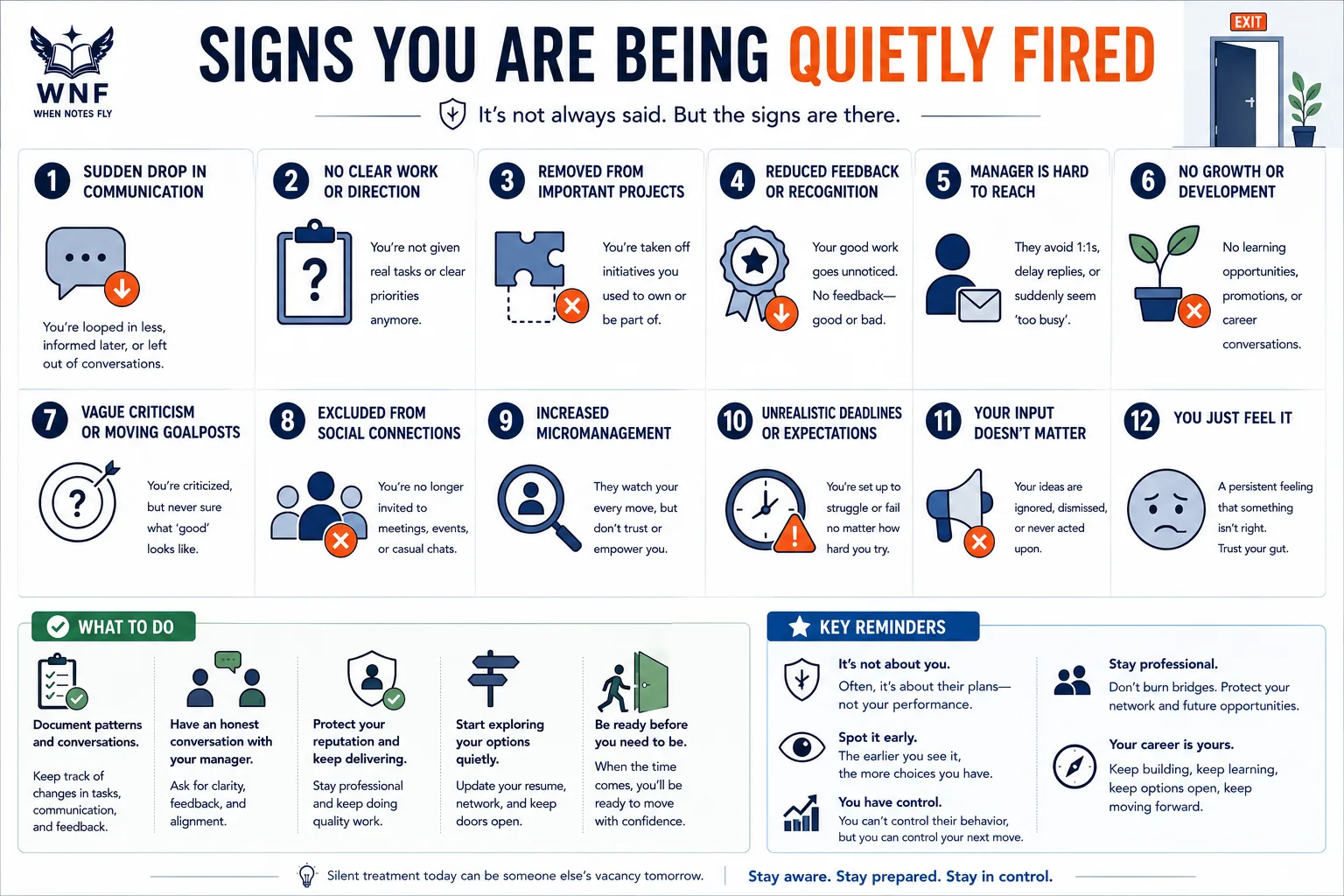
Quiet firing is the managerial practice of making an employee's job worse until they leave on their own. It avoids the legal exposure, severance costs, and morale damage of a formal termination by outsourcing the decision to the employee.
A manager who has decided a direct report has no future at the company does not tell them directly. Instead, the assignments get worse, the meetings get fewer, the feedback disappears, and the employee eventually concludes that there is no path forward and resigns.
When they do, the company has avoided a firing. The employee has absorbed the financial and psychological cost of a decision that was made about them without their knowledge.
The practice is old. The name is new. Gallup's chief scientist for workplace management Jim Harter has written that the phenomenon has existed as long as employment has, but the public language for naming it emerged in 2022 as the pandemic labor market collapsed and managers gained leverage.[6]
The accompanying term quiet quitting gave employees a name for doing the minimum their job description required.[5] Quiet firing is the managerial counterpart, and it is the more damaging of the two because the employee rarely knows it is happening until the exit feels like their own idea.
Recognizing the pattern early matters because the responses available to you narrow as the process advances. An employee who notices the signs at week two has options: direct conversation, request for specific feedback, documentation, internal transfer, external search conducted from a position of employment.
An employee who notices at month twelve, after their reputation in the organization has been quietly degraded, has fewer options and often rushes into a worse next position than they would have found earlier.
The signs below are not individually conclusive. Any one of them has innocent explanations. Several of them appearing together, persisting over weeks or months, following a change in your manager's behavior or a change in managers, is the pattern to take seriously.
"The most effective way to push someone out without firing them is to remove the conditions under which they could succeed. No stretch assignments, no coaching, no air cover when they take risks. The employee concludes they are not cut out for the role. The manager never had to say anything." - Kim Scott, Radical Candor (2019)
Key Definitions
Quiet firing: The gradual deterioration of an employee's role, support, and growth opportunities intended to cause voluntary resignation without formal termination.
Constructive dismissal: The legal doctrine under which an employer's substantial alteration of the conditions of employment can be treated as a termination even if the employee formally resigns. Recognized in UK, Canadian, Australian, and many US state jurisdictions, though the threshold varies substantially.
| Warning Sign | What It Often Means | Innocent Explanation |
|---|---|---|
| Removed from key meetings | Being decentered in decision-making | Meeting reorganization |
| No challenging projects assigned | Disinvestment in your development | Current priority mismatch |
| Manager cancels or skips 1:1s | Avoidance of direct engagement | Genuine scheduling pressure |
| Peers promoted past you | Your trajectory has been paused | Different role readiness |
| Suggested lateral move | Orderly exit path being offered | Genuine team need |
| Feedback becomes vague or only critical | Record-building or withdrawal | Actual performance concern |
| Excluded from social events | Social isolation from team | Oversight |
| Denied training or conferences | Ending investment in your growth | Budget constraint |
| Work reassigned without explanation | Role erosion | Capacity rebalancing |
| New reports taken away | Downgrading of authority | Organizational change |
| Compensation frozen while peers rise | No intention to retain you | Salary band position |
Performance improvement plan (PIP): A formal document setting specific performance targets and timelines, often used legitimately to correct deficiencies but frequently used as the final step before termination with terms designed to be impossible to meet.
Record-building: The managerial practice of documenting concerns to justify later termination. Often coincides with written feedback that is vague enough to be deniable but severe enough to support a future narrative.
Opportunity denial: Withholding the assignments, exposure, and coaching that would allow an employee to demonstrate value. Distinct from overt criticism and legally harder to challenge.
The Removal From Key Meetings
The first sign is usually about access, not evaluation. Decisions at most organizations happen in meetings. Being in the right meetings is the single largest factor in organizational visibility, which is the single largest factor in career progression.
A manager who has decided to move away from an employee often begins by removing them from the meetings where they would have been visible to senior leadership, seen strategic context, or contributed to decisions that affected their work.
The removal is rarely announced. The standing meeting invitation disappears. A project meeting that used to include you continues without you. A new working group is formed and you are not in it.
When you notice and ask about it, the explanation is plausible: the meeting was reorganized, the scope changed, they wanted to keep the group smaller.
What makes this an early sign is that it removes your ability to build the context for work that will be judged later. If you are absent from the meetings where priorities shift, you will execute against priorities that no longer matter.
If you are absent from the meetings where leadership forms impressions of contributors, you will be unknown to the people making promotion decisions. The practical degradation of your role is already underway before any formal evaluation occurs.
When you notice this, ask explicitly: is there a reason I was removed from this meeting? What is the expectation for my involvement in this area going forward? The answers, or the avoidance of answers, inform what you are dealing with.
The Disappearance of Challenging Work
Good managers give employees work that stretches their capabilities. Challenging projects are how people grow, how they become visible to senior leadership, and how they build the track record that justifies promotion.
A manager who has decided not to invest further in an employee stops assigning work that would produce any of these outcomes.
The signal is a shift in the type of work you are given. The analysis you used to own is given to someone newer. The project with executive visibility goes to the peer. The client relationship you built is reassigned to someone else.
What remains is maintenance work, follow-up, or tasks that have no upside trajectory. You are kept busy without being given anything that could produce the next step.
The managerial theory behind the practice is that it produces a clean record. The employee cannot claim they were mistreated because they still have work. They are not visibly demoted. They simply stop being given the inputs that would allow them to produce differentiated outputs.
When their annual review comes, the manager can note that they have not distinguished themselves. The absence of opportunity has been engineered to produce the absence of achievement.
The Cancelled One-on-Ones
Weekly or biweekly one-on-ones are the core channel through which managers invest in direct reports. They are where coaching happens, where strategic context is communicated, and where performance issues are surfaced while there is still time to address them.
A manager who has decided to disengage from an employee often reduces the frequency of these meetings, cancels them repeatedly, or turns them into status updates rather than development conversations.
The specific pattern to watch for: cancellations by the manager at the last minute, rescheduling that quietly drops some meetings entirely, failure to reschedule cancelled meetings, and a shift in content when meetings do happen from development conversations to transactional updates.
The manager no longer asks about your career goals, your development, or your concerns. They ask for status and leave.
Jim Harter at Gallup has produced research, drawing on decades of employee engagement data, finding that frequency and quality of one-on-ones predict engagement and retention strongly.[1] A manager who disengages from one-on-ones is disengaging from the employee's future at the organization.
The Peers Promoted Past You
Promotion decisions are where accumulated disinvestment becomes visible. If you have been quietly disengaged from for six to twelve months, the cycle produces an outcome: peers with comparable tenure and capability are promoted and you are not.
The explanations are plausible in isolation. The peer had a different role readiness. The peer closed the deal that happened to fit the timing. The peer had a specific sponsor.
The pattern becomes informative when it repeats across cycles. You are not promoted in cycle one, not promoted in cycle two, and the peers around you have advanced. If you ask what the gap is, the answers are vague. If you ask what specifically would close the gap, the criteria are moving or unachievable from your current position.
This is often the point at which employees realize what has happened and begin searching externally. It is late. The organizational reputation you carry into the search has been degraded by the prior period. The references from your current manager will be lukewarm.
External interviews can still go well because external interviewers do not see the internal positioning, but the internal repair options are limited.
The Suggested Lateral Move
When an internal repair is still being offered, it often appears as a suggestion of a lateral move. There is a team that could use you. There is a role opening that might fit. The suggestion is phrased as an opportunity. In some cases it is a genuine opportunity.
In others, it is an exit path that lets the manager hand the employee off rather than fire them.
Two signs distinguish the cases. A genuine lateral move has a sponsor on the receiving team who actively wants you, a clear description of how the role uses your capabilities, and a path to progression beyond the lateral.
An exit-path lateral has vague framing, a receiving manager who is polite but not enthusiastic, and no discussion of what comes after.
The receiving role often turns out to be a role the organization is not investing in, or a role from which further movement is difficult.
If you are offered a lateral move, request to meet with the receiving manager without your current manager present and ask specifically: what would I own in this role, what does success look like after six months, what is the path to senior roles from this position. The answers will usually tell you which kind of move this is.
The Feedback That Goes Vague or Negative
Employees being quietly fired often report that direct feedback becomes harder to obtain.[3] The manager is noncommittal about whether work is on track. Written feedback is vague in praise and specific only in criticism.
Formal reviews shift tone, noting concerns that were not raised in earlier conversations. The record being built is the record that will justify the outcome that has already been decided.
The timing is informative. If your reviews were positive for several cycles and then shift, ask for specifics: what changed, when did the concerns emerge, what interventions were tried before the concerns escalated. If the concerns emerged without prior coaching, the record is being constructed retrospectively.
Kim Scott's Radical Candor framework emphasizes that legitimate feedback is given in real time, directly, with investment in the employee's improvement.[2] Feedback that only appears in formal documentation is the opposite pattern.
Save copies of earlier positive reviews and written communications. In some jurisdictions, this documentation is legally significant in constructive dismissal claims. In all jurisdictions it is useful for your own clarity about whether the narrative being constructed in recent reviews matches the prior record.
The Exclusion From Informal Channels
Social integration with a team is part of organizational belonging. Team lunches, offsite events, informal Slack channels, the Friday after-work drinks.
Exclusion from these is often the first pattern to appear and the hardest to raise directly, because the line between social dynamics and professional treatment is blurry and any complaint sounds petty.
Watch for: team events where you learn about them after they have happened, informal channels where you are not included, a manager who no longer copies you on emails to peer group contacts, reduced inclusion in the casual conversation that precedes and follows formal meetings.
These are legitimately ambiguous individually. As a pattern, they indicate that you are being decentered from the social fabric of the team, which precedes and enables the formal decentering that follows.
The Denied Training and Conferences
Investment in employee development, including training budgets, conference attendance, and professional certifications, is a signal of organizational commitment.[4] A manager who declines to approve training that peers receive is communicating a decision about future investment.
The denial is often framed as budget constraint, but the pattern reveals itself when the budget constraint applies only to you and not to your peers.
For people in fields with certification pathways, denial of certification support is particularly telling. If your role values certifications, if the organization reimburses them for peers, and if your requests are denied or delayed, the pattern is informative.
The Reassignment of Work Without Explanation
Roles at most organizations are defined by a combination of formal description and accumulated reality. Over time, an effective employee takes on scope that matters to them beyond the formal job description. The client they built the relationship with.
The system they own. The report they produce that leadership reads. Erosion of role often starts with quiet reassignment of these elements to others, justified vaguely or not at all.
The specific pattern: something you used to own is now handled by someone else. You learn about it after the fact. The explanation, if one is offered, is about organizational rebalancing or capacity or the other person's development.
Over weeks or months, what remains in your scope is a fraction of what you had before, and the fraction that remains is the least career-advancing part.
The legal and practical response depends on jurisdiction. In places with robust constructive dismissal doctrines, substantial alteration of role can create a claim. In all places, it is a signal that deserves a direct conversation about the intended future scope of your role.
What to Do When You Recognize the Pattern
The right sequence is diagnosis, direct conversation, documentation, and parallel search.
Diagnose honestly. Sometimes what looks like quiet firing is real performance feedback that you have not accepted, or normal organizational shifts, or a manager who is overwhelmed rather than disengaged.
Before concluding what is happening, look at the pattern across several of the signs and consider the alternative explanations. A friend or mentor outside the organization can often see the pattern more clearly than you can.
Have the direct conversation. Request an explicit conversation with your manager: what is the expected trajectory for my role, what is the feedback on my current performance, what specific changes would you want to see. The response is informative.
A manager invested in your success will answer. A manager who has decided on your exit will be vague, defer, or offer the lateral-move suggestion. The response also produces a record of what was said.
Document in writing. After verbal conversations, send a written follow-up summarizing what was discussed. This serves two purposes. It surfaces any miscommunication early. It creates a written record that matters if the situation escalates to termination or legal dispute.
Save copies outside the company email system in a personal account, as access is terminated on exit in most organizations.
Search externally in parallel. Do not wait for the internal situation to resolve before starting an external search. Interview availability peaks when you are still employed and still positioned as a performing contributor at a recognizable firm.
Every week of internal deterioration that passes before you start searching reduces the quality of options available to you externally.
Consider legal consultation. If the pattern includes reduction of pay, substantial alteration of role, or treatment that appears to be discriminatory based on protected characteristics, a consultation with an employment attorney in your jurisdiction is worth the cost.
Many offer free initial consultations. The threshold for legal claims varies enormously by jurisdiction; in the UK and most of Canada constructive dismissal doctrines are robust, in most of the US at-will employment limits claims except where discrimination is involved.
The Exit Itself
If you conclude that the situation is unrecoverable, the question is how to exit with the best forward position. Timing matters. Negotiation matters. Reference management matters.
Time the resignation for when you have a signed offer in hand from the next role. A resignation without a signed offer forfeits leverage and the option of negotiating severance. Where severance is available, negotiate. Most organizations have internal guidelines for severance and have more flexibility than initial offers suggest.
Reference letters obtained before exit are more useful than references requested after. If your relationship with your manager is poor, identify skip-level or peer references whose written recommendation will carry more weight than a lukewarm reference from the manager who pushed you out.
Rebuilding After
Being quietly fired, even when you see it and exit cleanly, is demoralizing. The process of having an organization conclude you have no future there, while pretending nothing is happening, leaves people doubting their own capabilities in ways that affect the next role.
The research on this kind of workplace experience converges on several findings. The demoralization is disproportionately caused by the deception element, not by the judgment itself. People who are told directly that a fit is not working report faster recovery than people who are pushed out covertly.
The next-role match matters enormously; taking the first available job to escape often reproduces the pattern. A period of deliberate recovery, including evaluation of what capabilities and environments actually suit you, produces better subsequent outcomes than immediate re-employment.
Skill rebuilding during transitions, including certifications and focused study, often provides both practical preparation for the next role and a structured way to recover confidence.
Practical Implications
For employees: Treat the signs as a checklist, not a diagnosis. Pattern matters more than any single incident. Start external options early. Document in writing. Have the direct conversation before it is too late to matter.
For managers: If you have concluded an employee has no future on your team, tell them directly. The quiet version is worse for them, worse for your team's morale, and in some jurisdictions worse for your legal exposure than a direct conversation would be.
For HR and organizations: Quiet firing is often a symptom of managerial avoidance of difficult conversations. Training managers to give direct performance feedback, including the message that fit is not working, reduces the incidence and the downstream damage.
See also: Career Capital Explained | Career Risk Management | Career Decision Making
Sources & Further Reading
- Harter, J., & Clifton, J. (2023). Culture Shock: An Unstoppable Force Is Changing How We Work and Live. Gallup Press.
- Scott, K. (2019). Radical Candor: Be a Kick-Ass Boss Without Losing Your Humanity (Revised Edition). St. Martin's Press.
- Edmondson, A. C. (2018). The Fearless Organization: Creating Psychological Safety in the Workplace for Learning, Innovation, and Growth. Wiley.
- Society for Human Resource Management. (2023). The State of Employee Engagement Report.
- Klotz, A. C., & Bolino, M. C. (2022). "When Quiet Quitting Is Worse Than the Real Thing." Harvard Business Review, September 2022.
- Gallup. (2023). State of the Global Workplace Report. DOI: 10.34007/stg.v1i1.2023
Further Reading
- Grant, A. M. (2022). "Why Companies Should Add Class to Their Diversity Discussions." Academy of Management Perspectives, 36(3). DOI: 10.5465/amp.2021.0096
- Bureau of Labor Statistics. (2024). "Job Openings and Labor Turnover Survey." U.S. Department of Labor.
- Scholarios, D., & Marks, A. (2004). "Work-Life Balance and the Software Worker." Human Resource Management Journal, 14(2), 54-74. DOI: 10.1111/j.1748-8583.2004.tb00119.x
- Kotter, J. P. (2012). Leading Change. Harvard Business Review Press.