
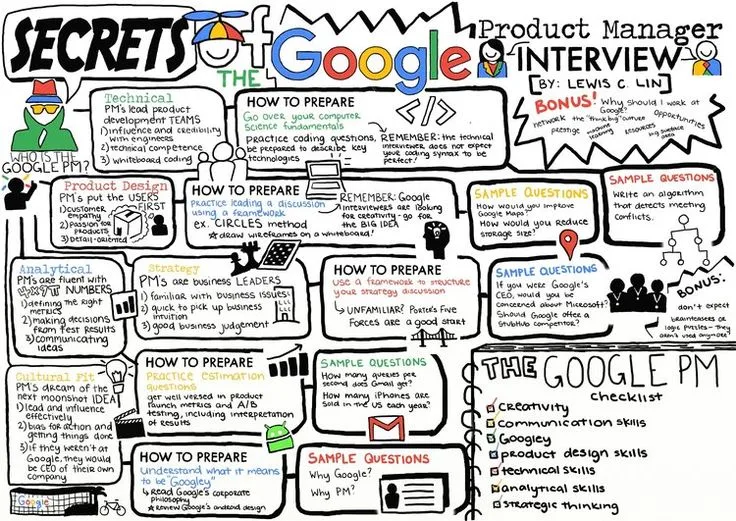
The product manager interview is unlike any other interview in technology. It does not test whether you can write code, design a visual interface, or recite financial accounting standards.
Instead, it tests whether you can think clearly about ambiguous problems under pressure - and whether the quality of your reasoning process reveals the kind of judgment that makes a PM effective. The assessment is largely about how you think, not what you already know.
That is both the appeal and the challenge: there is no finite set of facts to memorize, no certification that proves readiness, and no single correct answer to most questions asked.
A product manager interview process typically consists of 4-6 rounds conducted over 3-6 weeks, including a recruiter screen, hiring manager conversation, product sense interviews, an analytical or metrics round, cross-functional interviews with engineers and designers, and sometimes a written take-home exercise.
Companies that hire PMs rigorously - Google, Meta, Amazon, Stripe, Airbnb, and their cohort - have developed structured formats specifically designed to assess the capabilities that predict PM performance: product sense, quantitative reasoning, metrics thinking, behavioral judgment, and strategic communication.
Understanding these formats in advance is the difference between performing at your actual capability level and being derailed by format unfamiliarity in a high-stakes conversation.
This guide covers every component of the process, the frameworks that structure effective answers, a week-by-week preparation plan, and the patterns that separate candidates who receive offers from those who do not.
"In PM interviews, the goal is not to give the 'right' answer. The goal is to demonstrate that you think in the framework that great PMs use - start with the user, define success clearly, make principled tradeoffs." - Lewis Lin, author of Decode and Conquer
Why PM Interviews Are Structured Differently
Before diving into question types, it is worth understanding why PM interviews evolved into their current form. The role of product manager is inherently cross-functional: PMs work at the intersection of engineering, design, business, and user research without having direct authority over any of those teams.
This means the skills that predict PM success - influencing without authority, structuring ambiguous problems, making defensible trade-offs, communicating crisply across disciplines - are difficult to assess through traditional interviews.
Marty Cagan, founder of the Silicon Valley Product Group and author of Inspired (2018), has written extensively about how the best product companies evaluate PM talent. The core insight: you cannot assess product sense through a resume or behavioral questions alone.
You need to watch someone think through a product problem in real time to understand whether they start with users or features, whether they can hold multiple constraints simultaneously, and whether they can explain their reasoning to a non-expert.
This is why the modern PM interview evolved into a multi-format assessment. Each question type is designed to isolate a different capability, and together they produce a more complete picture than any single format could.
Research from Google's People Operations team (published by Laszlo Bock in Work Rules!, 2015) demonstrated that structured interviews - those using consistent question formats with clear evaluation rubrics - predict job performance approximately 26% better than unstructured interviews.
The PM interview process at top companies reflects this finding: formats are standardized, interviewers are calibrated, and evaluation criteria are documented in advance.
The Five Question Types: What Each Assesses
| Question Type | Primary Skill Assessed | What Interviewers Watch For | Common Mistake | Best Framework |
|---|---|---|---|---|
| Product sense | Customer empathy, structured thinking, prioritization | User-first framing, clear trade-offs, creativity within constraints | Jumping to solutions before defining users and their needs | CIRCLES |
| Estimation | Structured quantitative reasoning | Logical decomposition, explicit assumptions, sanity checks | Over-hedging, failing to commit to numbers, sloppy math | Top-down or bottom-up decomposition |
| Metrics | Data literacy, analytical thinking | Complete metric frameworks with guardrails, structured diagnosis | Picking one vanity metric without considering trade-offs | North star + guardrail framework |
| Behavioral | Judgment, self-awareness, interpersonal skill | Specific actions (not vague descriptions), honest reflection | Spending 80% on context and 20% on what you actually did | STAR |
| Strategy / case | Business judgment, market analysis, prioritization | Clear problem framing, evidence-based reasoning | Solving the wrong problem or jumping to tactics without strategy | Problem framing + options evaluation |
Question Type 1: Product Sense - The Core Differentiator
Product sense questions are the most common and most differentiating question type in PM interviews. They test whether you can think about products the way the best PMs do: starting with real human needs, generating creative solutions, evaluating trade-offs, and communicating your reasoning clearly. They come in three primary forms.
Design From Scratch
"Design a product to help hospital nurses communicate during shift changes." "Build a travel planning tool for families with young children." "Design a feature to help remote workers combat loneliness."
The interviewer is testing four things simultaneously: (1) whether you start with users rather than features, (2) whether you can identify multiple user segments and choose one to focus on with clear reasoning, (3) whether you can generate and prioritize solutions systematically, and (4) whether you can articulate trade-offs transparently.
A real example of what strong looks like: When asked "Design a product for elderly users who have trouble with medication adherence," a strong candidate might spend the first two minutes clarifying the scope ("Are we talking about a standalone app, a hardware device, or a feature within an existing health platform?"), then define three user personas (elderly living alone vs.
elderly with caretakers vs. elderly in assisted living), choose one with clear reasoning ("I'll focus on elderly living alone because they have the least external support and the highest adherence risk"), identify three core needs through the user's eyes, generate solutions for the top need, and evaluate trade-offs before recommending one approach.
Improve an Existing Product
"How would you improve Spotify?" "What would you change about Instagram Stories?" "Pick a feature of Google Maps and redesign it."
These questions test the same core skills but add an additional dimension: analytical judgment about what is currently working and what is not.
Candidates who immediately propose changes without first demonstrating that they understand the product's current value proposition signal that they would be the kind of PM who ships features without understanding the system they are modifying.
The Favorite Product Question
"Tell me about a product you love. Why do you love it? What would you improve?"
The trap here is choosing a product you love viscerally but cannot analyze rigorously. The best answers demonstrate that you have thought carefully about why the product succeeds - what user needs it serves, what design decisions make it effective, and what its genuine weaknesses are.
Choose a product you have studied, not just one you enjoy using.
Structuring Product Sense Answers: The CIRCLES Method
The CIRCLES method, developed by Lewis Lin in Decode and Conquer (first published 2013, now in its 4th edition), provides the most widely-used structure for product sense answers:
- Comprehend the situation: Clarify scope, constraints, and context. Ask 2-3 clarifying questions. "Is this a mobile or web product? Are we building for a specific market?"
- Identify the customer: Define 2-3 user segments. Do not try to design for everyone. Pick one segment and explain why.
- Report customer needs: Articulate the chosen user's goals, frustrations, and context. Speak in the user's voice: "This user is trying to..." not "This feature should..."
- Cut through prioritization: Name the user need you will focus on. Briefly explain why it takes priority over the others.
- List solutions: Generate 3-4 distinct solution ideas. Breadth here demonstrates creativity. You will narrow down next.
- Evaluate tradeoffs: Assess each solution against clear criteria - user value, technical feasibility, strategic fit, time to build - and recommend one. State trade-offs explicitly.
- Summarize: Recap your recommendation and the core reasoning in 30 seconds.
The entire answer should take 15-25 minutes, with the interviewer asking follow-up questions throughout. CIRCLES is not a script to recite; it is a thinking scaffold that prevents you from skipping critical steps under pressure.
Question Type 2: Estimation - Structured Thinking Under Uncertainty
Estimation questions are math problems disguised as business questions. "How many Uber rides happen in New York City on a typical weekday?" "Estimate the annual revenue of all coffee shops in San Francisco." "How much storage does YouTube need to add each day?"
The interviewer does not care about the precise number. They are assessing whether you can decompose a complex problem into manageable components, make reasonable assumptions, calculate from first principles, and check your answer against reality.
How to Structure Estimation Answers
- Confirm what you are estimating: Restate the question. "I'm going to estimate the number of Uber rides taken on a typical Tuesday in Manhattan, the Bronx, Brooklyn, Queens, and Staten Island."
- Choose an approach: Top-down (start with a known large number and decompose) or bottom-up (build from granular components). Top-down: "NYC has 8.3 million people..." Bottom-up: "The average Uber driver completes X rides per shift..."
- State assumptions explicitly: "I'll assume 40% of NYC adults use ride-sharing services at least occasionally, and that the average occasional user takes about 2 rides per week..."
- Calculate in segments: Break the problem into pieces, calculate each piece, show the multiplication.
- Sanity check: Compare against something you know. "That gives me about 1.2 million rides per day, which seems plausible given that Uber reported X globally..."
The narrative is as important as the math. Think aloud. Name your assumptions. Show the structure. A candidate who arrives at a wrong answer through a rigorous and transparent process will score better than one who guesses a correct answer without showing their reasoning.
Common Estimation Pitfalls
Anchoring on a single large number: Candidates who start with "well, there are 330 million Americans" and then try to narrow down often produce shakier estimates than those who build up from specific, grounded assumptions.
Refusing to commit: Saying "it could be anywhere from 100,000 to 5 million" is not an answer. The interviewer wants to see you work through the uncertainty and arrive at a defensible number, even if it is wrong.
Forgetting to sanity-check: Always compare your final number against a real-world reference point. If your estimate of daily Uber rides in NYC exceeds the entire city's population, something has gone wrong.
Question Type 3: Metrics - Measuring What Matters
Metrics questions test your ability to think rigorously about how products succeed and fail in measurable terms. They come in two forms, and each requires a different structure.
"How Would You Measure Success?"
"How would you measure the success of Facebook Marketplace?" "What metrics would you track for a new Slack feature?"
The best answers define a metric framework before picking a single number:
- What does success mean for the user? (Are they completing their task? Are they returning?)
- What does success mean for the business? (Revenue? Engagement? Retention?)
- What are leading indicators that predict both user and business success?
- Pick a primary metric (the north star) and explain why.
- Define guardrail metrics - measures that ensure the primary metric is not being gamed. If your north star is engagement time, your guardrail might be user satisfaction or unsubscribe rate.
This framework reflects how the best product teams actually work. Shreyas Doshi, a former PM leader at Stripe and Twitter, has written extensively about the distinction between vanity metrics and meaningful metrics, emphasizing that the metrics a PM chooses reveal their understanding of what actually drives value.
"A Metric Changed - What Do You Do?"
"YouTube watch time dropped 10% last week. What do you do?" "Uber Eats order completion rate fell by 5% in Europe. Diagnose it."
These questions test your diagnostic reasoning - the ability to move methodically from a symptom to a root cause. Use this structure:
- Confirm the data: Is the drop real? Could it be a measurement, logging, or reporting error?
- Segment the drop: Is it across all regions, or concentrated? All platforms (iOS, Android, web), or one? All user types, or a specific cohort?
- Identify temporal patterns: Did it coincide with a product release, seasonal event, competitor action, or external event (holiday, outage, news)?
- Generate hypotheses ranked by likelihood and impact.
- Describe how you would test each hypothesis - what data would confirm or disconfirm it?
The interviewers want to see disciplined, systematic thinking - not a shotgun blast of possibilities. Start with the most likely explanations and work outward.
Question Type 4: Behavioral - Proving You Have Done It Before
Behavioral questions assess judgment, self-awareness, and interpersonal effectiveness through past experiences. Common PM behavioral questions include:
- "Tell me about a time you disagreed with an engineer on a product decision."
- "Describe a product failure. What did you learn?"
- "Tell me about a time you had to influence a stakeholder without having authority over them."
- "How have you handled a situation where data and your instinct pointed in different directions?"
- "Tell me about a time you had to make a decision with incomplete information."
The STAR Method: Structure That Prevents Rambling
The STAR method (Situation, Task, Action, Result) has been the standard framework for behavioral interview answers across industries for over two decades. Laszlo Bock confirmed in Work Rules! that Google's internal research validated STAR-structured answers as significantly more evaluable than unstructured narratives.
- Situation: Set the context in 2-3 sentences. No more.
- Task: What was your specific role and what was at stake? One sentence.
- Action: What did you actually do? This is 60-70% of your answer. Be specific about your reasoning, not just your actions. "I decided to run a two-week experiment rather than rely on the existing data because..."
- Result: What happened? Include quantifiable outcomes where possible. Be honest about partial successes.
The most common failure: Spending 80% of the answer on Situation and Task, leaving Action as a vague summary. The interviewer wants to understand your specific decisions, your reasoning, and your behavior under pressure. The context is just scaffolding.
Building Your Story Bank
Before any PM interview, prepare 6-8 strong behavioral narratives covering these themes:
- A time you drove measurable impact on a product or business outcome
- A conflict with an engineer, designer, or cross-functional partner that you navigated well
- A decision you made with incomplete or conflicting data
- A product or feature that failed, and what you learned
- A time you influenced a decision without formal authority
- A time you had to make trade-offs between competing priorities
Each story should be adaptable to multiple questions. A story about disagreeing with an engineer can answer questions about conflict, influence, technical judgment, and decision-making depending on which elements you emphasize.
Question Type 5: Strategy and Case Questions
Some companies - particularly at senior PM levels - include product strategy or mini-case questions: "Google is entering the healthcare market - what would you build first?" "Uber Eats has plateaued in Europe - what would you do?" "Should Spotify enter the podcast advertising market?"
These questions test market analysis, strategic prioritization, and business judgment. Structure answers using a modified product sense framework:
- Define the goal: What is the company trying to achieve? Growth? Retention? Revenue diversification?
- Analyze the landscape: Who are the competitors? What are the user needs? What unique advantages does this company bring?
- Identify strategic options: Typically 2-4 distinct approaches. Build vs. buy vs. partner. Horizontal vs. vertical expansion.
- Evaluate each option against clear criteria: market size, competitive positioning, capability fit, execution risk, time to impact.
- Recommend and defend: Pick one approach and articulate why it is the best use of the company's resources given the constraints.
The key differentiator in strategy answers is specificity. Weak candidates offer generic strategy-speak ("we should leverage our core competencies to capture market share").
Strong candidates make specific claims grounded in specific reasoning ("Spotify's advantage in podcasts is its existing 500M+ user base and recommendation algorithm, which means an ad network built on first-party listening data would be differentiated from competitors who rely on third-party data").
The Typical Interview Process: Rounds and Timeline
| Round | Who You Meet | Duration | What Is Assessed | Typical Format |
|---|---|---|---|---|
| Recruiter screen | Recruiter | 30 min | Background, salary expectations, basic fit | Phone or video call |
| Hiring manager interview | Hiring manager | 45-60 min | Role fit, behavioral, light product sense | Video or on-site |
| Product sense loop (1-2 rounds) | Senior PMs | 45-60 min each | Full CIRCLES-style product design, follow-up depth | Video or on-site |
| Metrics / analytical round | Data scientist, analyst PM, or analytics lead | 45-60 min | Metrics frameworks, diagnostic reasoning, quantitative comfort | Video or on-site |
| Cross-functional interviews | Engineering manager + design lead | 30-45 min each | Working style, technical depth, collaboration approach | Video or on-site |
| Written exercise (sometimes) | Take-home | 24-48 hours | PRD writing, strategy doc, or market analysis | Asynchronous |
The full process typically takes 3-6 weeks from initial recruiter contact to offer. At companies like Google and Meta, the timeline can extend to 8+ weeks due to hiring committee reviews. At faster-moving companies like Stripe and startups, it may compress to 2-3 weeks.
The Recruiter Screen: More Important Than You Think
Many candidates treat the recruiter screen as a formality. This is a mistake. Recruiters at top companies are specifically trained to evaluate PM candidates, and their assessment carries real weight in the process.
A 2023 analysis by Lenny Rachitsky (former Airbnb PM, author of Lenny's Newsletter) found that approximately 60-70% of candidates are eliminated at the recruiter screen at major tech companies.
The screen assesses three things: (1) whether your background plausibly fits the role, (2) whether you can articulate your career narrative coherently, and (3) whether your compensation expectations align with the band.
What Separates Good From Great PM Interview Answers
Based on documented hiring manager feedback from Google, Meta, Amazon, and Stripe (compiled from published post-mortems and interview guides), great PM interview answers consistently share five characteristics:
User-first framing: Great candidates start every product question by asking about or stating the user need before any solution is mentioned. Average candidates jump to features within the first 30 seconds.
Marty Cagan calls this the difference between "feature teams" and "empowered product teams" - and it shows up in how candidates think even in interviews.
Explicit trade-off articulation: Great candidates say "I'm choosing this over these alternatives because..." Average candidates present one solution without acknowledging alternatives exist.
The ability to hold multiple options simultaneously and articulate why one is better is the single most reliable signal of strong product judgment.
Comfort with uncertainty: Great candidates make assumptions explicit, state confidence levels, and adjust when new information appears. Average candidates either over-hedge ("it really depends...") or over-assert ("the answer is definitely...").
The right posture is what Annie Duke calls "calibrated confidence" in her book Thinking in Bets (2018) - clear about what you believe while honest about what you do not know.
Genuine curiosity: Great candidates ask substantive clarifying questions before answering - questions that reveal they are thinking about the problem, not just following a procedure. "Is this product targeting consumers or businesses?" is a substantive question. "How long should my answer be?" is a procedural one.
Concise synthesis: Great candidates end with a clean 30-second summary that restates the recommendation and key reasoning. This mirrors what effective PMs do in every meeting: leave the room with aligned understanding.
A 6-Week Preparation Plan
| Weeks | Focus Area | Daily Practice (1-2 hours) | Resources |
|---|---|---|---|
| 1-2 | Product sense fundamentals | Analyze 1-2 products you use daily; write structured teardowns using CIRCLES. Practice answering "How would you improve X?" for 5 different products. | Decode and Conquer (Lin), Cracking the PM Interview (McDowell) |
| 3 | Estimation and metrics | Practice 2-3 estimation problems out loud daily; build a metrics framework vocabulary. Practice "How would you measure success for X?" | Fermi estimation problem sets, Lenny's Newsletter metrics archive |
| 4 | Behavioral stories and strategy | Write out 6-8 STAR stories. Practice telling each in under 3 minutes. Do 1-2 strategy case questions per day. | Inspired (Cagan), Continuous Discovery Habits (Torres) |
| 5-6 | Mock interviews and refinement | Do 3-4 full mock interviews with honest feedback. Record yourself answering product sense questions and watch them back. Refine weak areas. | Exponent, Pramp, or peer mock partners |
The Single Most Impactful Preparation Technique
Record yourself answering a product sense question, then watch it back. The gap between how you think you communicate and how you actually communicate is almost always larger than you expect.
Most candidates discover they use excessive filler words, fail to structure their answers visibly, or spend too long on context and not enough on solutions. Recording closes this gap faster than any other method.
Teresa Torres, author of Continuous Discovery Habits (2021), has noted that the skills that make someone effective in PM interviews - structured thinking, user empathy, trade-off articulation - are the same skills that make them effective as PMs.
Interview preparation, done well, is not separate from professional development. It is professional development.
Company-Specific Patterns
Different companies emphasize different aspects of the PM interview:
Google: Heavy emphasis on analytical and metrics questions. Expects candidates to be comfortable with quantitative reasoning at a level unusual for PM roles. Product sense questions tend to focus on Google-scale products (billions of users, global markets).
Meta: Strong focus on product sense and "product vision" - the ability to articulate where a product should go over a multi-year horizon. Behavioral questions tend to emphasize cross-functional collaboration and influence without authority.
Amazon: The interview is structured around Amazon's 16 Leadership Principles. Every question - product sense, metrics, behavioral - is mapped to a specific Leadership Principle. Candidates who study the LPs and prepare stories mapped to each one have a significant structural advantage.
Stripe: Emphasizes deep technical understanding and developer empathy. Product sense questions often involve API design, developer tools, or payment flows. Expects candidates to be comfortable discussing technical architecture at a level that Google and Meta PM roles typically do not.
Airbnb: Strong focus on design sense and craft - the ability to think carefully about user experience details, not just strategy. Historically included a "cross-functional" round with a heavier design emphasis than most companies.
After the Interview: The Debrief and Decision
Understanding what happens after you leave the room helps calibrate expectations. At most major tech companies, interviewers submit written feedback independently before seeing each other's assessments. This prevents anchoring bias.
Feedback is then discussed in a debrief meeting where the hiring manager and interview panel reach a collective decision.
At Google, a hiring committee (separate from the interview panel) makes the final hire/no-hire decision based on the written feedback. This adds objectivity but also explains why Google's process takes longer than most.
The evaluation typically uses a rubric with categories like product sense, analytical ability, leadership, and cultural fit, each scored on a consistent scale.
A strong signal in product sense can sometimes compensate for a weaker metrics performance, but most companies require at least a "meets bar" rating across all categories.
If you receive a rejection, ask for feedback. Not all companies provide it, but those that do often share specific, actionable observations that accelerate preparation for the next interview.
Practical Takeaways
Prepare for the format, not just the content. Candidates who have internalized CIRCLES and STAR can structure answers under pressure. Candidates who have not will struggle to organize their thinking when an interviewer is watching. The frameworks are not constraints - they are scaffolding that frees you to think about the substance.
Know your behavioral stories before you walk in. Having 6-8 prepared narratives eliminates the panic of trying to recall a relevant experience under pressure. Each story should be adaptable to multiple question types.
Practice out loud, not in your head. Silent practice does not develop the communication skill that interview performance requires. The transfer from "thinking the right answer" to "saying the right answer clearly and concisely" requires verbal practice. Period.
Treat the interview as a product problem. The user is the interviewer. Their need is to assess whether you would be an effective PM at their company. Your job is to make their assessment as easy and accurate as possible - by being structured, clear, and genuinely thoughtful.
Sources & Further Reading
- Lin, L. Decode and Conquer: Answers to Product Management Interviews. Impact Interview, 4th edition, 2021.
- McDowell, G. L. Cracking the PM Interview. CareerCup, 2013.
- Cagan, M. Inspired: How to Create Tech Products Customers Love. Wiley, 2nd edition, 2018.
- Torres, T. Continuous Discovery Habits: Discover Products that Create Customer Value and Business Value. Product Talk, 2021.
- Bock, L. Work Rules!: Insights from Inside Google That Will Transform How You Live and Lead. Twelve, 2015.
- Duke, A. Thinking in Bets: Making Smarter Decisions When You Don't Have All the Facts. Portfolio, 2018.
- Rachitsky, L. "The Ultimate Guide to PM Interviews." Lenny's Newsletter, 2022. lennysnewsletter.com.
- Olsen, D. The Lean Product Playbook: How to Innovate with Minimum Viable Products and Rapid Customer Feedback. Wiley, 2015.
- Banfield, R., Eriksson, M., & Walkingshaw, N. Product Leadership: How Top Product Managers Launch Awesome Products and Build Successful Teams. O'Reilly Media, 2017.
- Doshi, S. "How to Succeed at PM Interviews." shreyas.com, 2022.
- Reforge. "PM Interview Preparation Framework." reforge.com, 2023.
- Google Careers. "Preparing for Your Google Product Manager Interview." careers.google.com, 2024.
- First Round Review. "What Makes a Great Product Manager Interview Answer." firstround.com, 2020.
- Glassdoor. "Product Manager Interview Reviews." glassdoor.com, 2024.