
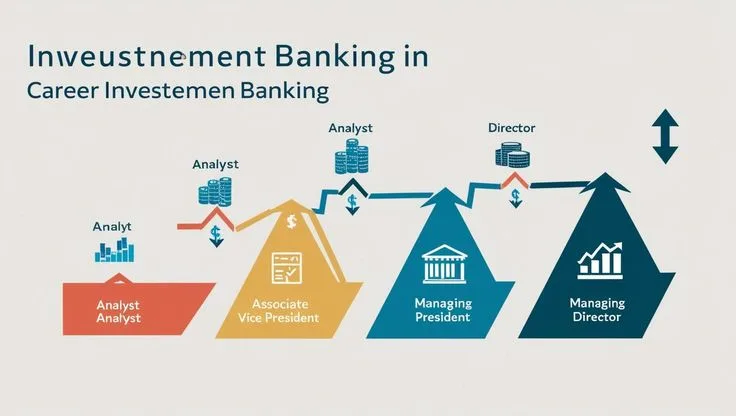
The investment banker career path is one of the most clearly defined career ladders in professional services - and one of the highest attrition rates.
The hierarchy runs from Analyst to Associate to Vice President to Director (or Senior Vice President) to Managing Director, with each promotion taking roughly two to four years and each level narrowing the pyramid dramatically.
The culture of "up or out" means that most people who start as first-year analysts will never reach Managing Director.
That is not a failure of the system; it is the system. Investment banking is designed to be a training ground as much as a destination, and understanding that changes how you should think about the path.
For the minority who stay the full course - 12 to 15 years from analyst to MD - investment banking offers a career that combines financial expertise, client relationships, transaction experience, and eventually the opportunity to earn several million dollars a year advising companies on their most important decisions.
For the majority who exit after two to three years, the credential and skillset open doors into private equity, hedge funds, corporate development, and venture capital that would otherwise be closed.
This article maps the full investment banking career path from entry-level analyst to Managing Director, including typical promotion timelines, the mechanics of up-or-out culture, compensation at each level, common exit opportunities at every stage, and honest observations about who thrives versus who leaves - drawing on Wall Street Oasis community data, Mergers and Inquisitions research, industry compensation surveys, and financial media reporting through 2024.
"Wall Street is a place where people go to be transformed. You enter as a recent graduate with a finance degree and a work ethic. What you become depends on what you discover about yourself under pressure." - William D. Cohan, author of The Last Tycoons
Key Definitions
Analyst: The entry-level position in investment banking, typically filled by recent college graduates. Analysts execute deals, build financial models, prepare pitch books, and run due diligence processes under the direction of associates and VPs.
Associate: The role above analyst, typically reached either by promotion from within after two to three years or by joining from an MBA programme. Associates take on more client-facing responsibility and manage analysts on deals.
VP (Vice President): The first senior level, where bankers begin managing client relationships directly and are expected to contribute to deal origination in addition to execution.
Director / SVP (Senior Vice President): An intermediate level between VP and MD at many banks, serving as a proving ground for the Managing Director designation. Not all banks use this title - some promote directly from VP to MD.
MD (Managing Director): The senior-most client-facing title, responsible for originating transactions, maintaining key client relationships, and generating fee revenue. The rainmaker role.
Bulge bracket: The largest global investment banks - Goldman Sachs, Morgan Stanley, JPMorgan Chase, Bank of America, Citigroup, Barclays, Deutsche Bank, UBS. These banks operate across all product groups and geographies.
Elite boutique: Smaller, advisory-focused firms that compete with bulge brackets on the most prestigious M&A transactions - Evercore, Lazard, Centerview Partners, PJT Partners, Moelis & Company. They typically pay at or above bulge-bracket levels.
Carry (Carried Interest): A share of investment profits, typically 20%, paid to fund managers in private equity and hedge funds. Not available in banking, but a major financial incentive for those who exit to buy-side roles.
Career Path Overview
| Level | Typical Years in Role | All-In Compensation (Bulge Bracket, 2024) | Primary Focus | Up-or-Out Pressure |
|---|---|---|---|---|
| Analyst | Years 1-3 | $180,000-$400,000 | Execution: models, pitch books, due diligence | Moderate (exit expected after 2-3 years) |
| Associate | Years 3-6 | $250,000-$500,000 | Execution + client communication, managing analysts | Moderate (must progress toward VP) |
| VP | Years 6-9 | $500,000-$800,000 | Client management + beginning origination | High (transition from execution to rainmaking) |
| Director / SVP | Years 9-12 | $700,000-$1,500,000 | Client coverage + deal origination, team management | Very High (proving ground for MD) |
| Managing Director | Year 12+ | $1,000,000-$5,000,000+ | Revenue generation, client relationship ownership | Performance-based (revenue determines longevity) |
These figures represent total compensation including base salary, year-end bonus (cash and deferred), and at senior levels, equity-linked compensation. Base salaries are relatively stable; the wide ranges reflect bonus variability driven by deal volume, firm performance, and individual contribution.
Compensation data is drawn from Wall Street Oasis surveys (2023-2024), Mergers and Inquisitions reporting, and Heidrick & Struggles compensation surveys.
Stage 1: Analyst (Years 1-3)
The analyst role is the foundation of the banking pyramid. Analysts are hired in large classes each summer directly from undergraduate programmes, with recruiting beginning as early as sophomore year for the largest banks.
The timeline has compressed significantly over the past decade: Goldman Sachs, Morgan Stanley, and JPMorgan now make offers 18-20 months before start dates.
The first year involves a steep learning curve - financial modelling, PowerPoint pitch books, due diligence, and the mechanics of specific product groups (M&A, leveraged finance, equity capital markets, debt capital markets, restructuring).
The Reality of Analyst Hours
80-100 hours per week during active deal periods is the honest industry average, with 60-70 hours during slower periods. Weekends are frequently working days. The intensity is not evenly distributed - some weeks are manageable, others are genuinely brutal, and the unpredictability itself is a major source of stress.
The 2021 Goldman Sachs analyst survey became a watershed moment. A group of 13 first-year analysts compiled a presentation documenting their experience: averaging 95 hours per week, sleeping five hours per night, and reporting significant declines in mental and physical health.
The presentation went viral after it was published by Bloomberg. Goldman and other banks responded with pay increases and nominal protected weekends, but the fundamental hours structure did not change because it reflects the economics of the business: clients pay premium fees for responsiveness, and deals have deadlines that do not respect work-life boundaries.
Compensation
All-in compensation for first-year analysts at bulge-bracket banks reached $180,000-$200,000 following the 2021-2022 compensation cycle, driven by competition for top talent with technology companies and quantitative trading firms. By the third year, analysts at top banks commonly earn $350,000-$400,000 all-in.
Elite boutiques (Evercore, Centerview, PJT) have historically paid at or above bulge-bracket levels, with first-year all-in compensation sometimes exceeding $200,000.
To contextualize these figures: a first-year analyst earning $190,000 and working 85 hours per week earns approximately $43 per hour - significantly less per hour than many senior software engineers or management consultants working 50-60 hour weeks. The compensation reflects both the intensity and the optionality the credential creates.
The Analyst Exit Decision
After two to three years, analysts face a choice: pursue an associate promotion, exit to private equity or another buy-side role, or leave for an MBA. The majority exit. According to Wall Street Oasis survey data (2023), approximately 60-70% of investment banking analysts leave banking entirely within three years of starting.
This attrition is not a crisis for the banks. It is the design. Banks hire large analyst classes knowing most will leave, precisely because the alumni network generates deal flow for decades afterward. A former Goldman Sachs analyst who becomes CFO of a technology company will remember Goldman when that company needs M&A advice.
The Analyst-to-Associate Promotion
Direct analyst-to-associate promotions exist at most banks but are limited in number. Banks prefer to also hire MBA associates because it refreshes the talent pool with more mature professionals who bring broader experience. At bulge-bracket banks, roughly 20-30% of analyst classes are offered associate promotions.
At elite boutiques, the proportion varies widely - some boutiques promote heavily from within, others almost exclusively hire MBA associates.
Analysts who are not promoted are not fired - they are expected to have arranged their next role by the time their analyst programme ends. Most do, precisely because the buy-side actively recruits from banking analyst classes.
Stage 2: Associate (Years 3-6)
Associates bridge the gap between analyst execution and VP client management. They are responsible for managing analysts on deals, reviewing financial models, interfacing with clients on a day-to-day basis, and drafting the more complex sections of transaction documents.
The associate is the person who ensures deal execution quality - catching errors in models, managing timelines, and serving as the primary point of contact for working-level interactions with clients and counterparties.
Two distinct populations enter at the associate level: promoted analysts and MBA hires. Promoted analysts have deep technical skills and institutional knowledge but sometimes lack the broader perspective that MBA training provides. MBA associates enter with the expectation that they will reach VP within three years.
The cultural dynamics between the two groups - the promoted analysts who feel they "earned it" and the MBA hires who feel their broader experience justifies their position - is a recurring source of friction at many banks.
Those who cannot demonstrate deal execution ability, client instincts, and the beginnings of relationship development are encouraged to exit at this stage. The up-or-out pressure is gentler than at analyst level - partly because associates have invested more, partly because the costs of recruiting MBA associates are high - but it is real.
Pay at the associate level is meaningfully higher than analyst pay ($250,000-$500,000 all-in at bulge brackets as of 2024), and the work is more intellectually demanding.
But the hours remain long, and many associates who entered from MBA programmes find that the lifestyle calculus still favors an exit to private equity or corporate development. For a comparison of these buy-side options, see hedge fund vs private equity vs venture capital.
Stage 3: VP (Years 6-9)
The VP level is where investment banking careers diverge most sharply. Some VPs discover they are genuinely skilled at the client relationship and deal origination side of the business and begin accumulating the credentials for a Director or MD promotion.
Others find that they are excellent execution bankers but not natural rainmakers - and either stay as perpetual VPs or exit to corporate development roles where those skills are valued without the origination pressure.
VPs earn $500,000-$800,000 all-in at bulge brackets and are expected to manage associate and analyst teams, run client conversations, and begin developing their own client coverage areas.
The transition from execution to origination is the critical skill gate at the VP level. Banks do not promote execution-only VPs to Director indefinitely.
This transition is genuinely difficult. The skills that make someone an excellent analyst (financial modeling precision, attention to detail, ability to work 100-hour weeks) are largely different from the skills that make someone an excellent MD (relationship building, business development, strategic advisory, political navigation).
The VP years are where bankers discover whether they can make that transition. Many cannot, and that is not a character flaw - it reflects a genuine difference in aptitude and interest.
The exit opportunities at VP level are fewer and less structured than at the analyst stage because the recruiting pipeline is less systematic. PE firms still hire VPs for principal roles, but less systematically than they hire analysts. Corporate development remains accessible.
Some VPs move to hedge funds if they have relevant sector expertise or a demonstrated investment track record.
Stage 4: Director / SVP (Years 9-12)
The Director or Senior Vice President level is a transitional role - the proving ground before the MD designation. Directors are expected to manage VP and associate teams, cover multiple client accounts, and demonstrate an ability to generate deal flow independently.
At this level, you are no longer being evaluated on how well you execute someone else's deals. You are being evaluated on whether you can find and win your own.
Banks are explicit that not all Directors will become MDs. The pyramid narrows sharply: many more VPs are promoted to Director than Directors are eventually promoted to MD.
According to Heidrick & Struggles' Financial Services Leadership Survey (2023), the promotion rate from Director to MD at large banks typically ranges from 30-50%, depending on the bank and market conditions.
Those who do not make MD typically exit to senior corporate finance roles, join clients directly as CFO or Treasurer, or move to advisory boutiques where the path to partner is shorter.
The up-or-out pressure at Director level is acute and measured in a way that earlier stages are not. There is no "good enough" track - either you are building a book of business, or the exit conversation begins.
This is also the stage where the political dynamics of banking become most intense: deal credits are contested, client relationships are negotiated, and the competition among Directors for limited MD slots can be fierce.
Stage 5: Managing Director (Year 12+)
Managing Directors are the relationship owners and revenue generators of the franchise. Their compensation is directly tied to the deals they bring in and the client relationships they maintain.
MDs who consistently generate significant fee revenue are protected during downturns; MDs who fail to produce can be let go regardless of tenure or reputation.
Compensation at the MD level ranges from $1 million to $5 million or more at bulge brackets, with the variation driven almost entirely by revenue generation. A top-producing MD in a hot sector can earn $3-5 million in a strong year.
An MD in a quiet sector during a downturn might earn $1-1.5 million. The relationship between pay and performance is far more direct at this level than at any previous stage.
The MD title is not the end of the hierarchy. Many banks have a "Partner" or "Senior MD" designation for the most senior and productive MDs.
Goldman Sachs' partner designation - representing roughly 400-500 people out of a firm of 40,000+ employees (approximately 1%) - carries equity participation and significantly enhanced compensation, and remains one of the most coveted designations in finance.
Bloomberg reported in 2022 that Goldman elevated 80 new partners from a pool of approximately 36,000 vice presidents and managing directors.
Life as an MD involves frequent travel, sustained client cultivation, and the political dynamics of managing teams while competing with peers for deal credits.
The work-life balance is generally better than analyst or associate level - MDs control their own schedules to a greater degree - but the pressure to perform, now measured in actual revenue rather than hours worked, is its own form of intensity.
As one former MD described it to the Financial Times: "At analyst level, the currency is hours. At MD level, the currency is revenue. The stress just changes form."
Exit Opportunities by Career Stage
From Analyst (Most Common and Most Structured)
Private equity is the most sought-after exit. Megafunds (Blackstone, KKR, Apollo, Carlyle, TPG) hire cohorts of investment banking analysts through on-cycle recruiting processes that now begin during the first year of the analyst programme - sometimes within months of starting work.
The on-cycle recruiting timeline has compressed to the point of absurdity: in recent years, firms have extended offers to first-year analysts who have been on the job for less than six months, based largely on their bank pedigree and interview performance rather than meaningful deal experience.
PE compensation is comparable to banking all-in compensation at the associate level, with the addition of carried interest that can be worth millions over a fund cycle.
A PE associate at a megafund might earn $300,000-$400,000 in salary and bonus plus a carried interest allocation that could be worth $1-5 million over a 5-7 year fund lifecycle, depending on fund performance. For a detailed comparison, see what is private equity and how does it work.
Hedge funds hire a smaller number of analysts, typically favoring those with strong markets intuition, sector expertise, or quantitative skills.
The path from banking to a fundamental long/short fund is well-established; the path to a macro or quantitative fund is less direct and often requires additional quantitative skills beyond what banking develops.
Corporate development at large operating companies offers significantly better hours, steady compensation ($150,000-$300,000 all-in at large companies), and intellectually interesting work managing acquisitions and strategic partnerships. The trade-off is lower upside and less deal intensity.
For former bankers who want to stay close to deals without the banking lifestyle, corporate development is often the right answer.
Venture capital is competitive and less structured as a recruiting pipeline from banking. VC firms typically want operating experience as well as financial skills, though some hire directly from analyst programmes for roles focused on deal sourcing and financial diligence.
MBA programmes are a formal "reset" for analysts who want to reenter banking at the associate level, switch industries entirely, or develop skills beyond transaction execution.
Harvard Business School's 2023 employment report showed that approximately 30% of students with pre-MBA banking experience returned to financial services after graduation, while 70% moved to other industries - primarily technology, consulting, and entrepreneurship.
From Associate
Many associates exit to PE or corporate development on a similar but less structured timeline. The PE firms that hire associates are typically smaller growth equity or lower-middle-market funds rather than the megafunds that recruit heavily from analyst classes.
The associate-to-VP-of-corporate-development pipeline is well-worn: companies value the combination of technical financial skills and the beginning of client management experience that associates bring.
From VP and Above
VP and Director exits trend toward corporate roles: CFO, VP of Corporate Development, Treasurer, or Finance Director at operating companies. Startup CFO roles increasingly attract former VPs who want equity upside and more direct operational involvement.
Some VPs join private equity at the principal level, though the pipeline is less defined than at the analyst stage.
At the Director and MD level, exits often take the form of joining clients directly in senior roles, founding or joining advisory boutiques, or transitioning to board advisory work. Former senior bankers with deep sector relationships are valued as independent board directors, particularly in industries where M&A activity is frequent.
Product Groups vs. Coverage Groups
An important career decision early in the banking path is between joining a product group (M&A, leveraged finance, equity capital markets, debt capital markets, restructuring) versus an industry coverage group (technology, healthcare, financial institutions, energy, consumer, industrials).
Product group analysts develop deep expertise in a specific transaction type. M&A analysts work on mergers and acquisitions across all industries; LevFin analysts structure leveraged buyout financing; restructuring analysts advise distressed companies. Product expertise is highly portable across sectors.
Coverage group analysts develop deep sector expertise. A healthcare coverage analyst understands FDA approval processes, clinical trial structures, and pharma M&A dynamics.
A technology coverage analyst understands SaaS metrics, cloud infrastructure economics, and tech company valuation methodologies. Sector expertise is valued in equity research, corporate development, and private equity focused on that sector.
For exit opportunities, coverage group experience in a high-activity sector (technology, healthcare) tends to produce stronger private equity exits because funds want sector expertise alongside deal execution skills.
Product group experience, particularly in M&A and restructuring, is valued across all sector-focused funds and provides the most flexibility.
Why Most People Leave by Year 3
The analyst-to-buy-side exit is not a failure; it is the intended function of the system. Banks know that most analysts will leave.
They invest in training these analysts with the understanding that alumni relationships, corporate finance knowledge spread throughout the economy, and deal flow driven by alumni networks are all valuable externalities.
For analysts themselves, the calculus is clear: two to three years of intensive financial training, $400,000-$600,000 in total compensation across the programme, and a credential that opens the most competitive doors in finance - in exchange for sacrificing most non-work time during those years.
Most analysts accept this trade explicitly. The ones who do not understand it going in are typically the ones who feel blindsided by the reality.
The analysts who stay are typically those who genuinely love deal-making, thrive on the intensity, and find the client relationship aspect of senior banking engaging enough to justify the years of work required to get there.
By the time you are a VP or Director, staying in banking is a choice made with full information about what the career demands - and what it provides.
Understanding this dynamic before you start is the single most important piece of career advice for aspiring investment bankers: know whether you are planning a two-year credential or a fifteen-year career, and optimize accordingly.
Sources & Further Reading
- Wall Street Oasis. (2024). Investment Banking Career Path. View source
- Mergers and Inquisitions. (2024). Investment Banking Career Path: Roles, Levels, and Promotions.View source
- Mergers and Inquisitions. (2024). Investment Banking Analyst to Private Equity: The Definitive Guide.
- Cohan, W. D. (2007). The Last Tycoons: The Secret History of Lazard Freres & Co. Doubleday.
- Goldman Sachs first-year analyst survey, reported by Bloomberg. March 2021. View source
- Harvard Business School. (2023). MBA Employment Report.
- Heidrick & Struggles. (2023). Financial Services Leadership Survey.View source
- Bloomberg. (2022). Goldman Sachs Partner List 2022: Who Made It. View source
- Preqin. (2023). Private Equity Talent and Compensation Report.View source
- Financial Times. (2022). Investment bankers and the art of the exit. View source
- Roose, K. (2014). Young Money: Inside the Hidden World of Wall Street's Post-Crash Recruits. Grand Central Publishing.
- Wall Street Oasis. (2023). Investment Banking Compensation Report. View source