
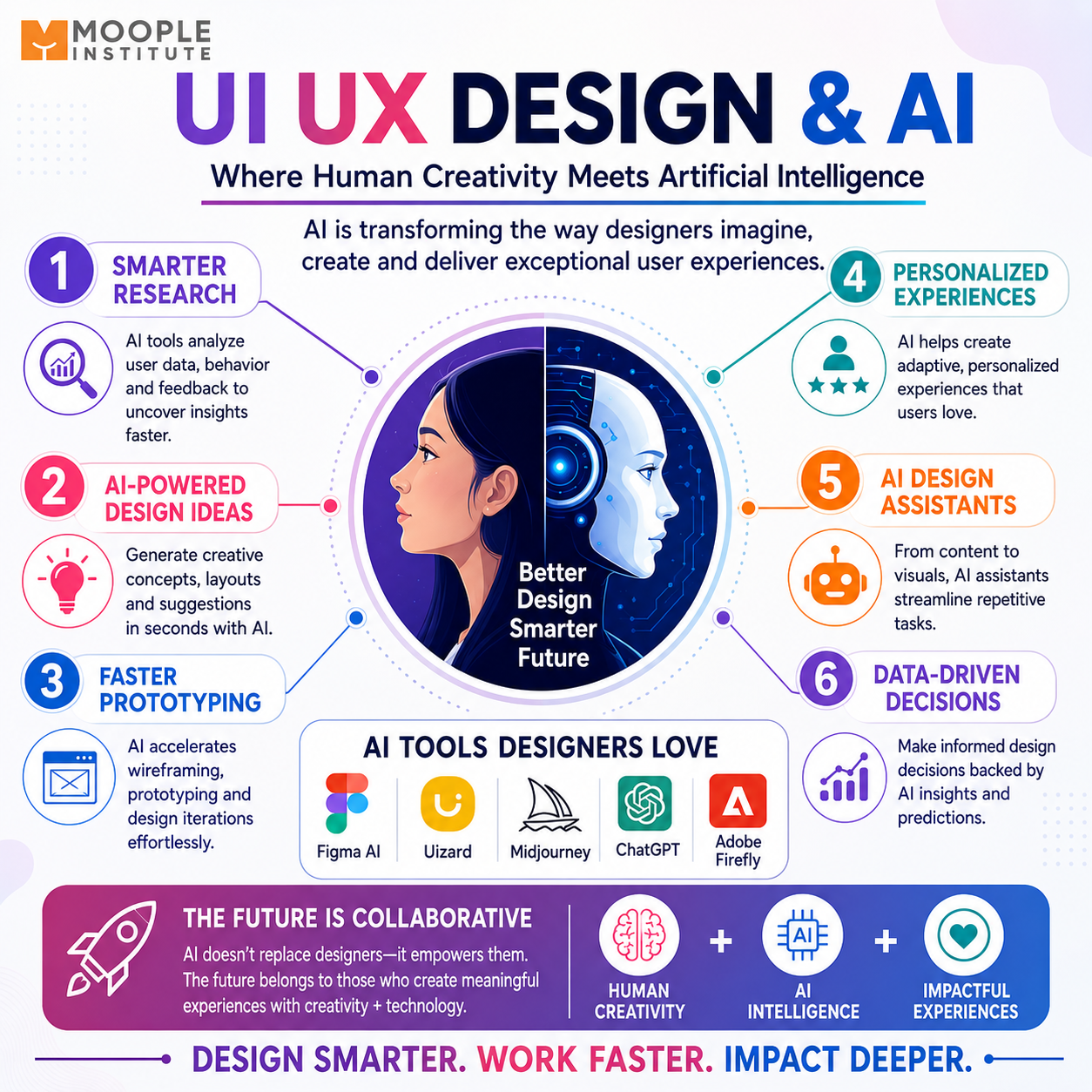
AI is transforming UX design by automating the production work that junior and mid-level designers spend most of their time on - wireframing, generating UI variations, writing documentation, synthesizing research data - while simultaneously creating entirely new categories of design work that did not exist five years ago.
The designers who will thrive are not those who ignore AI tools, nor those who over-rely on AI-generated output without the judgment to evaluate it.
They are the designers who use AI to operate at higher leverage: producing more exploration in less time, generating better research synthesis at scale, and contributing to strategy conversations earlier because the execution work is faster.
Every major technology shift produces two responses in the professions it touches: the catastrophists who predict total replacement, and the dismissers who insist nothing of importance is changing. AI's impact on UX design has generated both responses in abundance, and neither is accurate.
AI is not going to replace UX designers. It is, however, already reshaping what "being a UX designer" means in practice - which skills command premium compensation, which tasks are worth doing manually, and where human judgment remains irreplaceable.
"AI will not replace designers. Designers who use AI will replace designers who do not. But the more important question is: which parts of design judgment can AI acquire, and which parts are structurally out of reach? The answer to that question determines what you should invest in."
- Kim Goodwin, author of Designing for the Digital Age, at IxDA Interaction 24 (2024)
The Shift in Numbers: What Has Actually Changed
The Nielsen Norman Group's 2024 survey of over 400 UX professionals found that 78% reported using AI tools in some part of their design workflow, up from roughly 30% in early 2023. The adoption curve has been steep - faster than the adoption of design systems or collaborative design tools like Figma itself.
But adoption does not mean replacement. The same survey found that only 12% of respondents described AI as having "fundamentally changed" their practice, while 66% described it as a "useful acceleration of existing workflows." The distinction matters: AI is primarily making existing work faster, not making designers unnecessary.
A 2024 report by McKinsey on generative AI's impact on creative professions estimated that approximately 40% of the time UX designers spend on production tasks could be automated or significantly accelerated by current AI tools, but only 5-10% of the time spent on research, strategy, and stakeholder work was similarly affected.
| UX Activity | Pre-AI Time Estimate | AI-Augmented Time | Impact Level |
|---|---|---|---|
| Initial wireframe exploration | 4-8 hours for 3-4 concepts | 1-2 hours with AI generation | High |
| Design variations for testing | 2-4 hours per variant set | 30-60 min with AI | High |
| Research synthesis (5 interviews) | 3-5 hours | 45-90 min with AI assistance | High |
| Documentation and annotation | 1-2 hours per screen | 20-40 min with AI | Moderate |
| Usability test planning and facilitation | Fully manual | AI assists transcription and analysis | Low-Moderate |
| Strategic problem framing | Fully manual | Unchanged | None |
| Stakeholder communication and influence | Fully manual | Unchanged | None |
| Designing AI-powered interfaces | Not previously required | New skill category | New |
The AI Tools UX Designers Are Actually Using
Figma AI
Figma's native AI features, expanded significantly through 2024 and 2025, are the most broadly adopted AI tools in the design profession - largely because they are integrated directly into the tool most designers already use daily.
According to Figma's own usage data, AI features were used by over 60% of active Figma users within six months of launch.
First-draft generation: Figma can generate a first-draft wireframe or component from a text prompt. The output is low-fidelity and requires significant refinement, but it is faster than starting from a blank frame. Designers report using this primarily for exploring initial layout directions, not for production-ready work.
Design rewriting: The ability to apply stylistic variations to an existing design - change the color scheme, adjust the density, adapt to a different breakpoint - automatically. Useful for exploring design system alternatives without manually changing every component instance.
Content population: Auto-filling placeholder content with contextually relevant text and images. Eliminates the "Lorem ipsum" problem in presentation mockups and produces more realistic prototypes for user testing.
Summarization and documentation: AI-assisted generation of design documentation and annotation, summarizing what a design does and why specific decisions were made based on context in the design file.
Galileo AI
Galileo AI generates complete UI designs from natural language descriptions. The tool demonstrated convincingly that AI could produce high-fidelity, visually coherent interfaces from a text prompt - not just rough wireframes but designs that resembled what a trained designer might produce given the same brief.
In practice, Galileo is most useful for rapid ideation: generating five or ten design directions in the time it would take to sketch one wireframe.
The output consistently requires significant editing and critique - AI-generated interfaces tend to apply design conventions without understanding the specific user problem, producing interfaces that look polished but often have structural usability problems.
Professional designers who use Galileo consistently describe it as an ideation accelerator, not a replacement for considered design work. The tool is better at generating visual directions than at solving user experience problems - a distinction that highlights exactly where human design judgment remains essential.
Uizard
Uizard focuses on converting rough sketches and descriptions into interactive prototypes. Its "Autodesigner" feature generates full multi-screen app prototypes from text descriptions.
Like Galileo, it is most valuable for early ideation and stakeholder communication - producing a functional-looking prototype to illustrate a concept before investing in detailed design work.
Uizard is particularly popular among non-designers - product managers, founders, and engineers - who want to create design mockups without design tools expertise.
This creates a specific implication for UX designers: the bar for what constitutes a useful quick prototype has lowered, which means designers are increasingly expected to show a wider range of exploration in the same timeframe.
AI in Research: Dovetail and Synthesis Tools
AI capabilities in user research tooling represent one of the more genuinely transformative applications for UX design. Dovetail's AI features can tag, cluster, and summarize qualitative research data - interview transcripts, usability test notes, support tickets - at a scale and speed that manual analysis cannot match.
A research synthesis that previously required two to three days of manual affinity mapping can now be completed in hours with AI-assisted coding, with a human researcher reviewing and validating the AI's clustering decisions.
This does not replace the researcher's judgment about which patterns are significant and what they mean - it accelerates the mechanical work of organizing raw data enough that research depth becomes more achievable within typical sprint cycles.
Notably and Aurelius offer similar capabilities, using AI to identify patterns across research data and surface insights that might take a human researcher significantly longer to extract from the same volume of transcripts.
AI-Generated Visual Content
Midjourney, Stable Diffusion, and DALL-E are used by UX designers primarily for visual exploration - generating mood board imagery, placeholder illustration concepts, icon directions, and brand identity explorations.
These tools have not replaced illustrators or visual designers at the level of production quality, but they have significantly reduced the cost and time of early visual concept exploration.
A 2024 survey by Creative Bloq found that 45% of designers used AI image generation tools regularly for mood boards and concept exploration, while only 8% used them for final production assets.
Design-to-Code Tools
Vercel's v0 and similar tools represent the next frontier: converting design specifications directly into production-ready code. These tools accept natural language descriptions or design files and generate functional front-end components.
For UX designers, this collapses the traditional handoff gap between design and engineering, enabling designers to produce not just mockups but working prototypes that engineers can iterate on directly.
What AI Cannot Replace in UX Design
User Research and Human Understanding
AI tools can synthesize existing research data, but they cannot conduct user research. They cannot run a moderated usability test, pick up on the hesitation in a participant's voice before they admit that a button label confused them, or probe a surprising finding with a follow-up question that reframes the entire research question.
Steve Portigal, author of Interviewing Users (2013), has emphasized that the value of user research lies not in the data collected but in the interpretive judgment the researcher brings - the ability to recognize when a participant's behavior contradicts their stated preferences, or when an unexpected finding signals an unmet need that no one on the product team had anticipated.
This interpretive capacity is not automatable by current AI systems.
More broadly, AI models do not understand specific user populations. They understand statistical patterns in training data, which reflects the past - not the specific users of a specific product in a specific context, who may have needs and mental models that differ from the general case in ways that matter enormously for design decisions.
Strategic Problem Framing
UX design creates most of its value not by solving problems well but by solving the right problems. The most important design decisions are not which layout to use or what color the button should be - they are "Are we solving the right problem?" and "Is this the right product to build at all?"
These questions require understanding of business context, competitive landscape, user behavior over time, and organizational constraints that AI systems cannot independently synthesize from a design brief.
Jared Spool, founder of Center Centre and UIE, has argued consistently that the highest-value design skill is the ability to frame problems correctly - and that this skill becomes more valuable, not less, as AI handles more of the execution.
Senior designers who are most effective at this kind of strategic problem framing are the least threatened by AI. Junior designers who have not yet developed this skill - whose primary value is execution of wireframes and prototypes - are in the group most affected by AI automation.
Stakeholder Influence and Organizational Navigation
Designing a good product requires more than good design work. It requires convincing a skeptical engineering lead that a technically costly interaction is worth building, persuading a business stakeholder that the design that maximizes short-term conversion will damage long-term user trust, and navigating the political dynamics of organizations where design competes for resources with engineering and marketing.
No AI system can do this work. It requires relationships, organizational context, communication skill, and the kind of interpersonal trust that is built through human interaction over time. As AI handles more production work, the relative importance of these human skills in a designer's value proposition increases.
Are Junior UX Roles at Risk?
This is the question that receives the most attention in the design community, and the honest answer is: partly, directionally, and in ways that should inform how junior designers invest their time.
The entry-level work most directly automatable by current AI tools is precisely the work that junior designers do most - generating initial wireframes from briefs, creating UI variations, producing documentation, building out screens to a pattern established by a senior designer.
These tasks are not going to disappear entirely, but AI tools mean that one designer can produce the output that previously required two or three, at equivalent or higher speed.
This is the same dynamic that affected junior software engineers with the rise of GitHub Copilot and similar coding assistants - the lower end of coding work became faster and required fewer people to produce the same volume.
It did not eliminate junior engineering roles, but it raised the bar for what a junior engineer needs to demonstrate to be worth hiring.
The 2024 UXPA International practitioner survey found that 34% of design managers reported hiring fewer junior designers than they had two years earlier, citing AI tools as one factor (though economic conditions were also cited).
Conversely, 28% reported that AI had created new roles on their teams - particularly around designing AI-powered features and evaluating AI-generated design output.
For UX designers, the implication is clear: junior designers who invest primarily in Figma execution skills, treating research and strategic thinking as something to develop later, are building expertise in the category most at risk from automation.
Junior designers who invest in research skills, communication quality, and the ability to frame design problems well - alongside tool proficiency - are developing the capabilities that AI augments rather than replaces.
"The designers who are most vulnerable to AI are not those who lack technical skill. They are those whose value is entirely in execution and has nothing to do with thinking. AI is very good at execution."
- Nielsen Norman Group, AI Tools for UX Designers Report (2024)
New Skills UX Designers Need Because of AI
Designing AI-Powered Interfaces
The most significant new skill category for UX designers is designing products that use AI as a functional layer. AI-native interfaces - products where the system behaves adaptively, generates personalized output, or assists users through conversational interaction - present UX challenges that traditional design frameworks do not address.
Designing for AI uncertainty: AI systems produce probabilistic outputs that are sometimes wrong. UX designers need to design for graceful failure - error states, transparency about AI confidence levels, and mechanisms for users to correct or override AI decisions.
Google's PAIR (People + AI Research) team published guidelines in 2019 specifically addressing how to design for AI error, recommending that interfaces communicate confidence levels and make correction paths obvious. Most design curricula still do not cover this.
Designing for explainability: Users increasingly want to understand why an AI made a decision - why a recommendation was generated, why a result was ranked a certain way, why an application was rejected.
Designing for explainability is a specialist UX problem that requires collaboration with ML engineers and a working understanding of how the AI system generates its outputs.
The EU's AI Act (2024) includes specific provisions requiring explanations for high-risk AI decisions, making this not just a design nicety but a legal requirement.
Conversational interface design: Chatbots and AI assistants require UX design thinking about dialogue flow, error recovery, persona, and the mechanics of natural language interaction.
This is a distinct discipline from visual UI design, and demand for designers with conversational design skills has grown significantly with the proliferation of AI chat products.
Erika Hall, author of Conversational Design (2018), has argued that conversational design is fundamentally different from screen design because it requires understanding of pragmatics, turn-taking, and the social expectations humans bring to dialogue.
Prompt Engineering for Design Tools
Working effectively with AI design tools requires understanding how to prompt them well - how to specify a design brief in language that produces useful output rather than generic templates.
This is a learnable skill that distinguishes designers who get genuine value from AI tools from those who try them once, find the output mediocre, and dismiss the tools entirely.
Effective prompt engineering for design involves specifying constraints (target audience, device, context of use), desired outcomes (what the user should be able to accomplish), and style parameters (design system, brand guidelines, density) in ways that guide the AI toward relevant output.
It is, in essence, the skill of communicating clearly with a non-human collaborator.
AI Output Evaluation and Critique
Because AI-generated design output can look polished while embodying usability problems - applying design conventions without understanding user context - designers need strong evaluation skills.
The ability to critique AI output against user needs and design principles efficiently is not a new skill in kind (critique has always been central to design practice) but it is a new application of it, at higher speed and volume than traditional design critique typically demands.
A useful framework: treat AI-generated designs the way you would treat a junior designer's first draft. The visual execution may be competent, but the conceptual foundations - does this solve the right problem? does this work for the specific users? does this account for edge cases? - require experienced human evaluation.
Basic AI Literacy
You do not need to build machine learning models, but understanding how large language models work, what retrieval-augmented generation means, how hallucination occurs, and how probabilistic systems fail makes you dramatically more effective at designing AI-powered products.
The Nielsen Norman Group and Interaction Design Foundation curricula on designing for AI are practical starting points. Google's People + AI Guidebook (pair.withgoogle.com) provides concrete design patterns for common AI interaction challenges.
Practical Takeaways for 2026 and Beyond
Adopt AI tools actively and critically. Designers who are experimenting with Figma AI, Galileo, and AI-assisted research synthesis have a genuine advantage in speed of exploration. The critical skill is evaluation - do not ship AI-generated output without rigorous critique against user needs and business constraints.
Invest in the skills AI is worst at. User research, strategic problem framing, stakeholder communication, and organizational influence are the highest-value design activities and the ones least affected by current AI capabilities. This is where career investment produces the most durable return.
Build a portfolio that demonstrates judgment, not just execution. As AI makes wireframe production faster and cheaper, the differentiator in a design portfolio becomes clearer - research insights that shaped direction, strategic decisions with documented rationale, and communication artifacts that demonstrate the designer's ability to influence product outcomes rather than merely produce screens.
Learn to design for AI, not just with AI. The designers who will command the highest compensation in the next decade will not be those who are best at prompting Figma AI to generate layouts.
They will be those who can design the AI-powered products themselves - handling uncertainty, building trust, creating explanations, and designing the human-AI interactions that are becoming central to every product category.
Sources & Further Reading
- Goodwin, K. (2024). Designing for AI: Keynote Address. IxDA Interaction 24 Conference.
- Nielsen Norman Group. (2024). AI Tools for UX Designers: Report and Evaluation. View source
- McKinsey & Company. (2024). The State of AI: Generative AI's Impact on Creative Work.
- Figma. (2024). Figma AI: Features, Capabilities, and Design Workflow Integration. View source
- Dovetail. (2024). AI in User Research: What Machines Can and Cannot Do.
- Galileo AI. (2024). Product Overview and Use Cases. View source
- UXPA International. (2024). AI and the Future of UX Practice: Practitioner Survey 2024. View source
- Google People + AI Research (PAIR). (2019). People + AI Guidebook. View source
- Hall, E. (2018). Conversational Design. A Book Apart.
- Portigal, S. (2013). Interviewing Users: How to Uncover Compelling Insights. Rosenfeld Media.
- Vercel. (2024). v0: AI-Assisted Design-to-Code. View source
- European Union. (2024). Artificial Intelligence Act. View source