
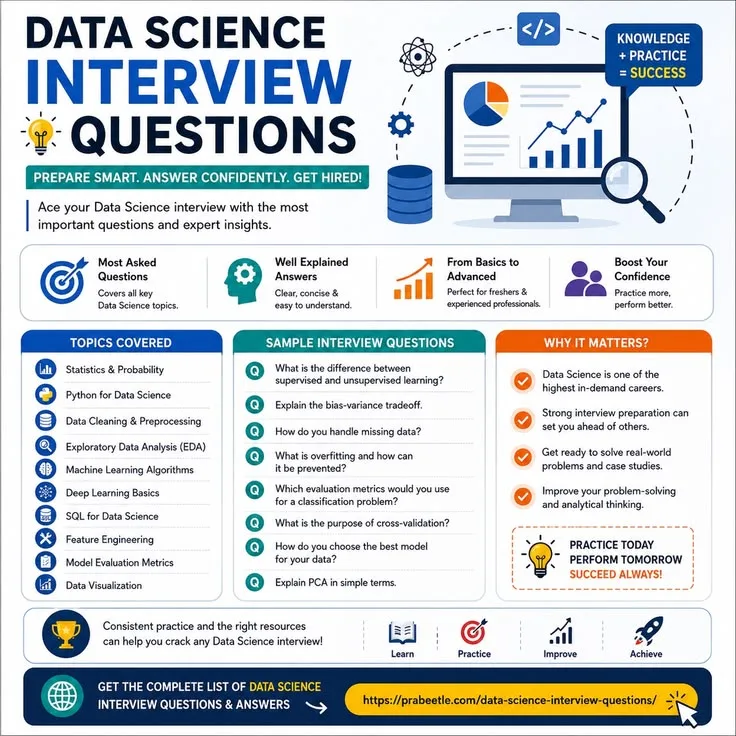
The data scientist interview process is a multi-stage evaluation that typically includes a recruiter screen, SQL or coding assessment, statistics and probability questions, machine learning theory discussion, a take-home project or case study, and a behavioral round.
Unlike software engineering interviews, which have converged on a relatively standardized format, data science interviews remain remarkably inconsistent across companies - reflecting the fact that the role itself means different things at different organizations.
Some companies run rigorous, well-designed processes that accurately predict on-the-job performance. Others run idiosyncratic gauntlets that test a bizarre combination of skills, some of which have no practical relevance to the actual work.
Navigating this landscape requires understanding not just what you will be asked, but what each question is actually designed to measure, how to distinguish a thoughtful hiring process from a poorly designed one, and how to prepare strategically rather than exhaustively.
According to a 2023 analysis by Interviewing.io, the average data scientist candidate goes through 4.7 interview stages and spends roughly 15 to 25 hours preparing for each company - making efficient, targeted preparation not just helpful but essential.
This article covers every major component of the data science interview process, drawing on publicly available data from hiring platforms, published accounts from hiring managers, and the accumulated wisdom of practitioners who have sat on both sides of the table.
"The best data science interviews I've seen test for judgment, not just knowledge. Anyone can memorize the formula for precision and recall.
Very few candidates can tell you when precision matters more than recall and why that depends on the specific business problem." - Josh Wills, former director of data engineering at Slack, 2021
Key Definitions
Hiring screen: An initial filter, usually conducted by a recruiter or via an automated platform, to confirm basic qualifications before investing more time. In data science, this often includes a brief SQL or Python assessment.
Case study interview: A structured problem-solving exercise where the candidate is given a business scenario and asked to work through analytical approach, metric selection, and potential confounders in real time with an interviewer.
Take-home assignment: An offline project where candidates analyze a dataset and present findings. Intended to simulate real work conditions but controversial for the unpaid labor it represents and the potential for disparate impact on candidates with caregiving responsibilities or multiple job commitments.
Cross-validation: The technical assessment of model generalization by training on subsets and evaluating on held-out subsets. Understanding this properly - including the difference between k-fold, stratified k-fold, and time-series split - is a standard interview expectation.
Type I and Type II errors: In hypothesis testing, a Type I error (false positive) rejects a true null hypothesis; a Type II error (false negative) fails to reject a false null hypothesis.
The tradeoff between them is a standard statistics interview topic with practical implications for A/B test design, fraud detection systems, and medical screening algorithms.
The Typical Interview Pipeline
| Stage | Duration | What It Tests | Common Failure Rate |
|---|---|---|---|
| Recruiter screen | 20-30 min | Role fit, basic background, communication | ~40% filtered out |
| Technical screen (SQL/Python) | 45-60 min | SQL, Python, basic statistics | ~35% of remaining |
| Take-home project | Async, 4-8 hrs | Problem framing, analysis, communication | ~25% of remaining |
| Technical round 1: Statistics | 45-60 min | Statistics and probability depth | ~30% of remaining |
| Technical round 2: ML theory | 45-60 min | Model selection, evaluation, tradeoffs | ~25% of remaining |
| Case study round | 45-60 min | Business reasoning, structured thinking | ~20% of remaining |
| Behavioral round | 45-60 min | Communication, stakeholder handling, culture | ~15% of remaining |
| Final decision | - | Debrief, calibration, and offer | Variable |
The exact shape varies considerably by company size and type. Startups often compress this to three or four stages. Large technology companies (Google, Meta, Amazon, Apple) typically run five to six stages with a full virtual on-site.
The take-home project is common at mid-size companies and relatively less common at the largest technology firms, which prefer live case studies for logistical reasons - they receive too many applications to grade thousands of take-homes.
Candidate-reported interview timelines for data scientist positions at major technology companies commonly run several weeks from first contact to offer, though some processes stretch to three months or longer when scheduling delays accumulate.
Stage 1: The SQL Assessment
SQL is tested in some form at nearly every data science interview. SQL screening is close to universal in data science hiring, appearing in some form in the large majority of interview processes across company sizes.
The typical assessment is either a live coding exercise with screen sharing or an asynchronous platform assessment on HackerRank, StrataScratch, DataLemur, or a similar service.
What Good SQL Tests Assess
Well-designed SQL tests assess analytical reasoning with data, not syntax memorization. A strong SQL interview question for a data scientist looks like this: "You have a users table and a transactions table. A user is 'active' if they made at least one transaction in the last 30 days.
Write a query to find the top 3 product categories by revenue among active users."
This tests JOIN logic, date filtering, aggregation, ranking, and the ability to decompose a multi-step problem. It does not test obscure syntax or trick questions about database engine quirks.
What to Expect
Window functions: RANK(), DENSE_RANK(), ROW_NUMBER(), LAG(), LEAD(), and aggregate functions with OVER() clauses are the most commonly tested area and the most commonly weak area in candidate preparation.
A 2023 analysis by StrataScratch found that window functions appeared in 67% of data science SQL interview questions at FAANG-tier companies. Practice these until they are completely natural.
CTEs and subqueries: Common Table Expressions (WITH clauses) are the cleaner alternative to deeply nested subqueries. Knowing when to use them and how to write readable, multi-step CTEs is essential.
Interviewers consistently report that candidates who write clean, well-structured CTEs make a stronger impression than those who produce functionally correct but unreadable nested queries.
GROUP BY and aggregation: Median calculation (not natively supported in all databases - this comes up as a question itself), COUNT DISTINCT, conditional aggregation (CASE WHEN inside aggregates), and handling NULLs in aggregations are all standard territory.
Self-joins and recursive queries: Less common but occasionally appear for problems involving hierarchical data (employee-manager relationships) or sequential events (finding consecutive login days).
How to Prepare
Work through 50 to 100 practice problems on StrataScratch or DataLemur, specifically filtering for interview-tagged questions at your target company or company tier. Focus heavily on window functions and multi-table problems.
Practice writing queries that you could read aloud and explain step by step - because in a live screen-share, you will need to narrate your thought process.
Jay Feng, founder of Interview Query, recommends what he calls the "explain it to the interviewer" test: if you cannot explain each CTE or subquery in one sentence, your query is too complex and needs to be restructured.
Stage 2: Statistics and Probability
This round is critical and one of the most common failure points for candidates who have strong Python and machine learning skills but weak statistical foundations.
Cassie Kozyrkov, Google's former Chief Decision Scientist, has written extensively on Medium and Towards Data Science about statistical literacy, arguing in pieces like "Statistics for people in a hurry" that genuine statistical reasoning is what separates data scientists who generate reliable insights from those who generate confident-sounding noise.
A/B Testing and Experimental Design
Expect detailed questions about how you design and analyze experiments. This is arguably the highest-value statistical skill for industry data scientists, because A/B tests are the primary mechanism by which technology companies make product decisions.
Common questions and what strong answers look like:
How do you determine sample size for an A/B test? The answer requires understanding statistical power (typically targeted at 80%), effect size (the minimum detectable effect that matters to the business), and Type I error rate (typically set at 5%).
You should be able to explain the relationship between these three parameters and why they represent tradeoffs, not independent settings.
What is your primary metric and why? What guardrail metrics would you monitor? This tests business reasoning layered on statistical thinking. A strong candidate chooses a primary metric aligned with business value and identifies guardrail metrics that would catch negative side effects the primary metric would miss.
Your A/B test shows p=0.04. Is the feature a winner? The correct answer is: not necessarily. You need to consider effect size and practical significance (a statistically significant improvement of 0.001% is meaningless), multiple testing correction (did you test multiple metrics?), and whether the sample is representative.
What happens if you stop the test early because you see a significant result? Optional stopping inflates the false positive rate dramatically. Armitage, McPherson, and Rowe (1969) demonstrated this mathematically, and the principle remains one of the most commonly violated in practice.
Evan Miller's widely-cited 2010 blog post "How Not to Run an A/B Test" illustrated that peeking at results and stopping early can inflate Type I error rates from the intended 5% to as high as 26%.
Probability Fundamentals
Common question types include:
- Basic conditional probability using Bayes' theorem - often framed as medical screening problems (given test sensitivity and specificity, what is the probability that a positive result is a true positive?)
- Expected value calculations in business scenarios (should we launch this feature if the expected uplift is X but there is a Y% chance of negative impact?)
- Probability of events with and without replacement
- The Central Limit Theorem: what it says (the sampling distribution of the mean approaches normality as sample size increases, regardless of the underlying distribution) and what its practical implications are (why we can use t-tests even when the raw data is not normally distributed)
How to Explain P-Values Correctly
The technically correct definition: the probability of observing a result at least as extreme as the one you observed, assuming the null hypothesis is true.
The American Statistical Association published an official statement on p-values in 2016 (Wasserstein and Lazar, 2016) precisely because the concept is so widely misunderstood - even among working scientists.
The common incorrect definitions - "the probability that the null hypothesis is true" or "the probability that you made an error" - are frequently given in interviews and are red flags for statistics-literate interviewers.
Getting this wrong is one of the most reliable ways to lose credibility in a data science interview.
The Bias-Variance Tradeoff
Understanding and explaining the bias-variance tradeoff clearly is expected at all levels. The intuition - underfitting (high bias, low variance) versus overfitting (low bias, high variance), and the tradeoff between model complexity and generalization - should be explainable without jargon to a non-technical person.
Hastie, Tibshirani, and Friedman formalized this decomposition in The Elements of Statistical Learning (2009), and it remains one of the most fundamental concepts in predictive modeling.
A strong interview explanation: "If I build a model that is too simple, it will consistently miss the real patterns in the data - that is bias. If I build a model that is too complex, it will learn the noise in my specific training data and fail on new data - that is variance.
The goal is to find the sweet spot where the model captures the real signal without memorizing the noise."
Stage 3: Machine Learning Theory
ML theory questions test whether you understand why methods work, not just how to call them in scikit-learn. The distinction matters because real-world data science constantly requires judgment calls about which method to use, how to interpret unexpected results, and when a model's output should not be trusted.
Model Selection
When to use logistic regression vs gradient boosting vs neural networks - not "neural networks are always best" but an actual discussion of data size, interpretability requirements, training time, feature engineering needs, and whether the decision boundary is likely to be linear.
| Model | Best When | Limitations | Interpretability |
|---|---|---|---|
| Logistic Regression | Linear relationships, small data, need for interpretability | Cannot capture complex nonlinear patterns | High |
| Random Forest | Medium data, mixed feature types, need for robustness | Memory-heavy, slower inference | Medium |
| XGBoost/LightGBM | Structured/tabular data, Kaggle-style prediction tasks | Requires tuning, less interpretable | Medium-Low |
| Neural Networks | Unstructured data (images, text, audio), very large datasets | Need large data, hard to interpret, expensive to train | Low |
| Linear Regression | Continuous outcomes, clear linear relationships | Sensitive to outliers, assumes linearity | High |
Chen and Guestrin's 2016 paper introducing XGBoost remains one of the most cited machine learning papers because gradient boosting dominates tabular data problems in practice.
Understanding how it works - sequential tree building where each tree corrects the errors of the previous ensemble - is expected at companies where these models are primary tools.
Evaluation Metrics
Accuracy, precision, recall, F1, AUC-ROC, and the business contexts where each is appropriate. The classic question: "You have class imbalance in your training data.
What do you do?" has multiple valid approaches (resampling, class weighting, threshold adjustment, using appropriate metrics) and no single right answer - what the interviewer is testing is whether you understand the tradeoffs.
A strong candidate explains that precision matters most when false positives are expensive (spam filtering - you do not want to send legitimate emails to spam), while recall matters most when false negatives are dangerous (cancer screening - you do not want to miss a positive case).
This business-context reasoning is what separates a good answer from a textbook recitation.
Regularization
What L1 and L2 regularization do mathematically and when you would use each. L1 (Lasso) adds the absolute value of weights to the loss function, promoting sparsity - it drives some feature weights to exactly zero, effectively performing feature selection.
L2 (Ridge) adds the squared value of weights, distributing weights more evenly and preventing any single feature from dominating. Elastic Net combines both, controlled by a mixing parameter.
Feature Engineering
Open-ended questions about how you would approach a specific dataset - what features you would create, how you would handle categorical variables (one-hot encoding, target encoding, ordinal encoding), how you would detect and handle outliers, and how you would manage missing data.
These questions test practical experience more than theoretical knowledge.
Stage 4: The Take-Home Project
Take-home projects are the most controversial part of the data science hiring process. When well-designed, they simulate real work and reveal how candidates think, analyze, and communicate.
When poorly designed, they are unpaid consulting exercises that disadvantage candidates with caregiving responsibilities, disabilities, or multiple job commitments.
Anecdotally and in candidate discussions across hiring forums, a large share of data science candidates report spending noticeably more time on take-home projects than the stated estimate.
What a Well-Designed Take-Home Project Looks Like
- Scoped for 4 to 6 hours of work, clearly stated
- Uses a public or synthetic dataset (not proprietary company data that could constitute unpaid consulting)
- Has a specific analytical question, not just "explore this data and tell us what you find"
- Has a defined deliverable format (short written summary, notebook, or slide deck - not all three)
- Is followed by a live debrief where you discuss your choices, limitations, and what you would do differently with more time
What Companies Are Actually Testing
- Can you define a meaningful analytical question and stay focused on it?
- Do you understand the limitations of your analysis and communicate them honestly?
- Can you write clearly for a non-technical audience?
- Do you choose appropriate methods for the problem, or do you apply the most sophisticated approach you know regardless of fit?
- Can you distinguish between correlation and causation in observational data?
How to Execute a Strong Take-Home
Frame the problem explicitly before diving into the data. Spend the first 30 to 60 minutes on exploratory data analysis and document what you find - missing values, outliers, distributional properties, potential data quality issues. Communicate uncertainty honestly. Do not overstate the conclusions from a small or noisy dataset.
Write as if the reader will not look at your code. The narrative should stand alone. Keep visualizations simple, clearly labeled, and directly tied to your analytical narrative.
Use titles that state the finding, not just the variable name: "Revenue per customer declined 23% after the policy change" rather than "Revenue per customer over time."
"The most common take-home mistake is spending 80% of the time on modeling and 20% on communication, when the reverse ratio often produces stronger work.
The candidate who builds a simple logistic regression but communicates brilliantly will almost always outscore the candidate who builds an ensemble model but cannot explain why it matters." - Emily Robinson, co-author of Build a Career in Data Science (2020)
Stage 5: Case Studies and Business Problems
Case study interviews test your ability to structure an ambiguous analytical problem in real time. A typical prompt: "Our mobile app saw a 15% drop in daily active users over the last two weeks. Walk me through how you would investigate this."
The Structure That Works
Clarify the problem - Is this all users or a specific segment? All platforms or one? A sudden drop or gradual decline? How is "active" defined? Has the definition or measurement changed recently?
Form hypotheses about potential causes - product change (new release, removed feature), external event (competitor launch, holiday season), data pipeline issue (logging broken, tracking code removed), seasonal pattern, or a change in user acquisition (new campaign bringing lower-quality traffic).
Describe what data you would look at to test each hypothesis - segment the drop by platform, geography, acquisition source, user tenure. Check if the drop correlates with a specific app version. Look at session depth and duration, not just whether users opened the app.
Discuss prioritization - which hypotheses are most likely given the pattern (sudden vs. gradual, universal vs. segmented) and what you would do if you found the cause.
Acknowledge uncertainty - not every anomaly is a real phenomenon. Sometimes it is broken logging, not a product problem. Sometimes it is seasonal. The best candidates naturally raise this possibility without being prompted.
Interviewers are testing: structured thinking, comfort with ambiguity, ability to prioritize, business instinct, and the intellectual honesty to say "I would need to check X before concluding Y" rather than jumping to confident conclusions.
Stage 6: Behavioral and Communication
Behavioral rounds use the standard STAR format (Situation, Task, Action, Result). Data science-specific behavioral topics include:
- How you handled a situation where your analysis showed something the stakeholder did not want to hear
- How you managed a project where the data was not available or was too poor quality to answer the question
- How you communicated a complex statistical result to a non-technical executive
- A time when you pushed back on a request and how you navigated the disagreement
- How you handled a situation where two stakeholders wanted conflicting analyses from the same data
Prepare 5 to 7 strong stories from your experience that can flex to answer multiple question types. Stories that demonstrate intellectual honesty - saying "the data does not support that conclusion" rather than finding a way to support what the stakeholder wanted - are particularly valued.
According to a 2022 analysis by Interviewing.io, behavioral round performance is the strongest predictor of offer conversion among candidates who pass all technical rounds. Technical skills get you to the final round; communication skills get you the offer.
Salary Negotiation and Leveling
Data scientist compensation varies dramatically by company tier, geography, and level. Understanding the landscape prevents leaving significant money on the table.
| Level | Years Experience | Total Comp (Top Tech, US) | Total Comp (Mid-Market, US) |
|---|---|---|---|
| Entry (L3/IC1) | 0-2 years | $150K-$200K | $90K-$130K |
| Mid (L4/IC2) | 2-5 years | $200K-$300K | $130K-$180K |
| Senior (L5/IC3) | 5-10 years | $300K-$450K | $180K-$250K |
| Staff (L6/IC4) | 8-15 years | $400K-$600K+ | $250K-$350K |
Sources: Levels.fyi (2024), Glassdoor (2024), Blind salary reports. Total compensation includes base salary, equity/RSUs, and bonus.
Key negotiation principles: always negotiate (a widely cited CareerBuilder survey found 73% of employers expect candidates to negotiate), negotiate on total compensation rather than just base salary, and use competing offers as leverage.
The single most effective negotiation tactic is having a credible alternative - another offer or a strong current position you are willing to stay in.
Red Flags in the Interview Process
Not every interview is well-designed, and poor design signals poor organizational culture. Learning to read these signals can save you from accepting a role that will be frustrating:
Take-home projects scoped for more than 8 hours: Either poor scoping or a disguised consulting request. Both are bad signs. If the company cannot scope a reasonable assessment, they likely cannot scope projects well either.
SQL tests focused on syntax trivia: Asking whether you remember the exact syntax for COALESCE or the difference between UNION and UNION ALL suggests the interview was designed by someone who does not do analytical work regularly.
No questions about how you communicate: Interviewers who only test technical skills and never assess communication are likely to hire people who do technically sophisticated work that nobody uses. Data science that does not influence decisions is expensive shelf-ware.
Vague answers when you ask about data infrastructure: "We're building it out" or "it's a work in progress" means the data environment is likely immature. You will spend significant time fighting infrastructure rather than doing analysis.
Ask specifically: what is the data warehouse technology? How fresh is the data? Who maintains the pipelines?
Interviewers who cannot describe what success looks like in the role: If nobody can tell you what a great first year looks like for the person in this position, the role is not well-defined - which typically leads to a frustrating experience of shifting expectations and unclear impact.
No data scientists on the interview panel: If you are only interviewed by engineers and managers, the company may not understand what data science is or how to evaluate it. This often correlates with unrealistic expectations and poor support for the role.
How the Process Differs by Company Type
Large Technology Companies (FAANG and Similar)
Highly structured processes with dedicated data science interview committees. Expect 5-6 rounds over a virtual on-site day. Emphasis on breadth: SQL, statistics, ML theory, case study, and behavioral. Leveling decisions determine compensation, so interview performance matters even after passing.
These companies typically use calibrated rubrics and multiple interviewers to reduce individual bias.
Startups (Seed to Series B)
Compressed processes, often 3-4 rounds total. The founding team or CTO may interview you directly. Take-homes are more common because there is no dedicated recruiting infrastructure.
The bar for communication skills may be lower, but the bar for versatility is higher - they need someone who can do everything from writing SQL to presenting to investors.
Consulting and Analytics Firms
Heavy emphasis on case studies and structured problem-solving. Less focus on ML theory, more focus on business reasoning and stakeholder communication. Excel proficiency may still be tested alongside Python and SQL.
Financial Services
Expect rigorous statistics and probability questions, particularly around time series analysis, risk modeling, and regulatory requirements. Understanding how financial systems work provides helpful context. Domain knowledge is weighted more heavily than at technology companies.
Practical Takeaways
Build SQL fluency around window functions specifically. They are the most commonly tested skill and the most commonly weak area in candidate preparation. A candidate who can fluently write and explain window functions immediately signals competence.
Practice explaining statistical concepts out loud, not just understanding them on paper. The gap between knowing a concept and articulating it clearly is significant and requires deliberate practice. Record yourself explaining p-values, the bias-variance tradeoff, and A/B test design. Listen back critically.
Treat the take-home project as a communication exercise, not a modeling exercise. The best candidates are not those who build the most sophisticated model - they are those who communicate most clearly about their choices, limitations, and findings.
Prepare the correct definition of a p-value. Getting this wrong is a reliable way to lose confidence from a statistics-literate interviewer, and getting it right signals genuine statistical understanding.
Ask thoughtful questions about the data infrastructure, team composition, and how data science work flows to decisions. The information you gather reveals the quality of the role - and asking good questions signals the kind of critical thinking that companies want.
Track your preparation systematically. Use a spreadsheet to log practice problems by topic (SQL, probability, ML), difficulty, and whether you solved them correctly. Identify weak areas from the data, not from gut feeling. The irony of data scientists not using data to guide their own preparation is common and avoidable.
Sources & Further Reading
- Wills, J. (2021). What Makes a Great Data Science Interview? Interview, The Analytics Engineering Roundup.
- Robinson, E. and Nolis, J. (2020). Build a Career in Data Science. Manning Publications. View source
- StrataScratch. (2024). SQL Interview Questions Database. View source
- DataLemur. (2024). SQL and Data Science Interview Questions. View source
- Kozyrkov, C. (2023). Statistics for People in a Hurry. Towards Data Science.
- Wasserstein, R. and Lazar, N. (2016). The ASA Statement on p-Values: Context, Process, and Purpose. The American Statistician, 70(2), 129-133.
- Miller, E. (2010). How Not to Run an A/B Test. View source
- Armitage, P., McPherson, C. K., and Rowe, B. C. (1969). Repeated Significance Tests on Accumulating Data. Journal of the Royal Statistical Society, 132(2), 235-244.
- Hastie, T., Tibshirani, R., and Friedman, J. (2009). The Elements of Statistical Learning (2nd ed.). Springer.
- Chen, T. and Guestrin, C. (2016). XGBoost: A Scalable Tree Boosting System. Proceedings of the 22nd ACM SIGKDD International Conference on Knowledge Discovery and Data Mining.
- Gelman, A. and Loken, E. (2014). The Statistical Crisis in Science. American Scientist, 102(6), 460-465.
- Interviewing.io. (2023). Data Science Interview Performance Analysis. Interviewing.io Blog. View source
- Burtch Works. (2023). Data Science Hiring and Compensation Report. View source
- Glassdoor. (2024). Data Scientist Interview Reports and Salary Data. View source
- Levels.fyi. (2024). Data Scientist Compensation Data. View source
- Feng, J. (2023). The Data Science Interview Book. Interview Query. View source
- McKinney, W. (2022). Python for Data Analysis (3rd ed.). O'Reilly Media.
- Gamma, E., Helm, R., Johnson, R., and Vlissides, J. (1994). Design Patterns: Elements of Reusable Object-Oriented Software. Addison-Wesley.