
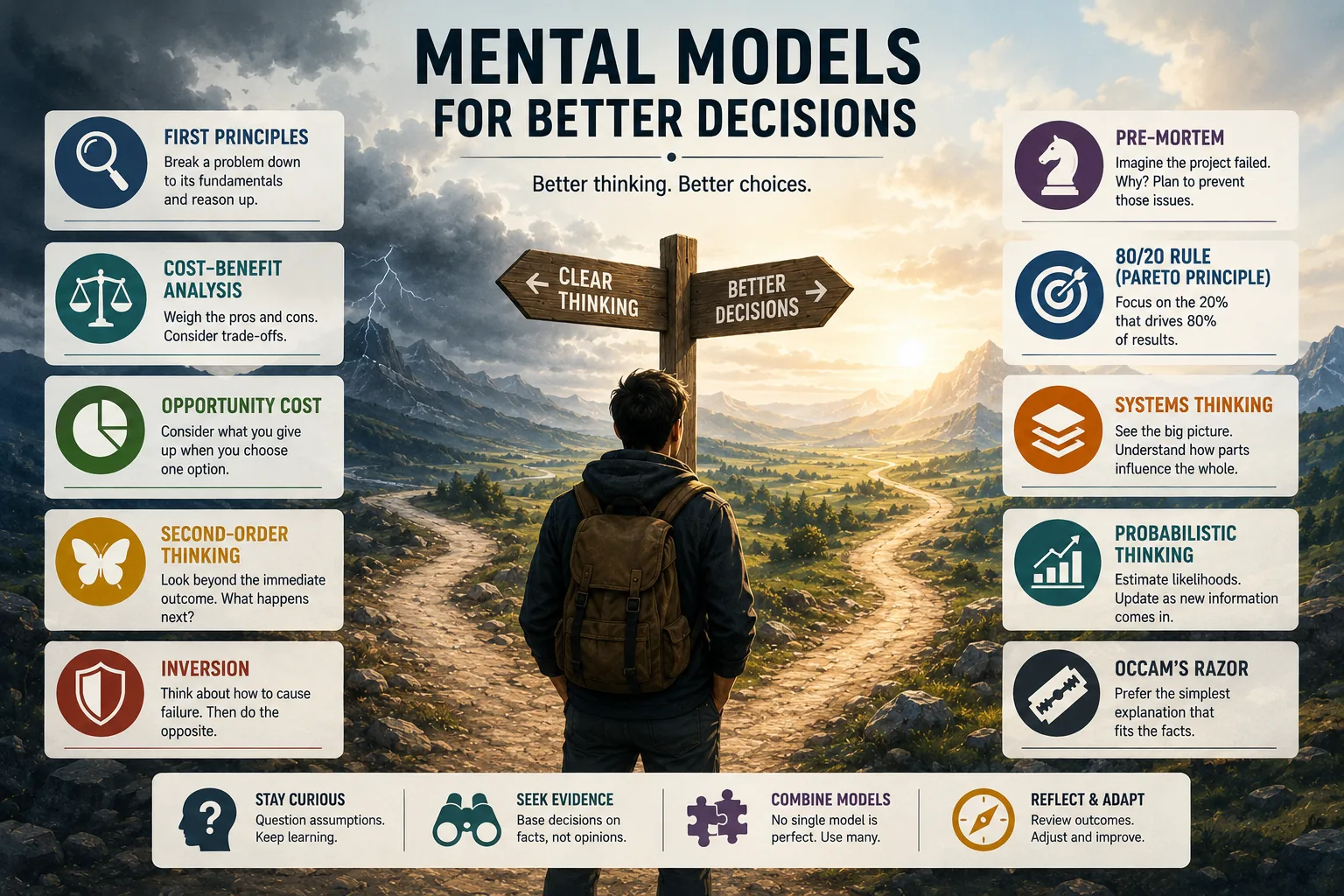
Why Smart People Make Predictable Mistakes
Mental: Two executives face the same problem: declining market share. Both are intelligent, experienced, well-resourced. One panics and slashes prices, triggering a race to the bottom that destroys industry profitability.
The other recognizes a second-order effect-that price cuts produce short-term gains but long-term competitive dynamics that benefit no one-and instead invests in differentiation.
Same IQ. Same information. Completely different outcomes.
The difference? mental models-the thinking tools that determine what you see, what you ignore, and how you interpret cause and effect.
Your brain doesn't process reality directly. It builds models of how things work, then uses those models to navigate the world. When your models match reality, you make good decisions. When they diverge from reality, you make systematically bad decisions while feeling perfectly rational.
"All models are wrong, but some are useful." - George Box
Charlie Munger calls this having a "latticework of mental models"-a interconnected set of thinking tools from multiple disciplines that let you see patterns invisible to people operating with fewer models.
He attributes much of Berkshire Hathaway's success not to superior intelligence but to systematically better thinking frameworks.
"I think it's undeniably true that the human brain must work very hard to understand anything through a mental latticework of theory." - Charlie Munger
Here's what most people miss: You already use mental models constantly. The question isn't whether to use them-it's whether you're using good ones or bad ones, and whether you're aware of which model you're applying.
The Core Models That Matter Most
Second-Order Thinking: Consequences of Consequences
Most people stop thinking at the immediate effect. Second-order thinking asks: "And then what?"
First-order: "Antibiotics kill bacteria → prescribe for infections"
Second-order: "Overuse breeds resistance → future infections become untreatable → careful stewardship now matters"
First-order: "Lower prices → more customers"
Second-order: "Competitors match → everyone has lower margins → quality cuts → customer experience degrades → industry shrinks"
The pattern: First-order effects are obvious and immediate. Second-order effects are subtle and delayed. Third-order effects are complex and unexpected.
| Action | First-Order | Second-Order | Third-Order |
|---|---|---|---|
| Social media outrage | Person is held accountable | Cancel culture emerges | People self-censor legitimate speech |
| Helicopter parenting | Child stays safe | Child doesn't learn risk management | Adult can't handle setbacks |
| Economic stimulus | Economy grows | Inflation rises | Savings lose value, inequality grows |
| Automation | Efficiency increases | Jobs disappear | Political instability, need for retraining systems |
Howard Marks (investor at Oaktree Capital): "First-level thinking is simplistic and superficial... Second-level thinking is deep, complex, and convoluted."
Application technique:
Before deciding, map consequences three levels deep:
- Direct effect → What happens immediately?
- Response effect → How do others react to the direct effect?
- System effect → How does the system reach new equilibrium?
Example - Hiring decision:
- First-order: We get more capacity
- Second-order: Team dynamics change, onboarding burden, cultural dilution risk
- Third-order: Success attracts more hiring → culture fundamentally shifts → company you built becomes different company
Second-order thinking doesn't always change your decision. It changes your preparation for consequences you'd otherwise miss.
Inversion: Solving Problems Backward
Carl Jacobi (mathematician): "Invert, always invert." Instead of asking "How do I succeed?", ask "How would I guarantee failure?"
This isn't pessimism-it's exploiting an asymmetry. Failure modes are often clearer than success requirements. You might not know exactly what makes a great product, but you definitely know that ignoring users, shipping broken code, and burning cash with no revenue guarantees failure.
Munger's approach: He studies business failures obsessively. Not to demoralize himself-to build a checklist of what to avoid. Berkshire's success comes partly from not making errors that destroyed other investors.
Inversion in practice:
| Standard Question | Inverted Question | Insight Revealed |
|---|---|---|
| "How do I build a successful company?" | "What definitely kills companies?" | Insufficient runway, founder conflict, solving non-problems |
| "How do I have a good relationship?" | "What definitely destroys relationships?" | Lack of communication, taking partner for granted, unresolved resentment |
| "How do I stay healthy?" | "What definitely ruins health?" | Sedentary lifestyle, poor sleep, chronic stress, smoking |
| "How do I make good decisions?" | "What causes terrible decisions?" | Deciding while emotional, ignoring base rates, confirmation bias |
The power of inversion: Avoiding stupidity is easier than seeking brilliance. If you systematically avoid major mistakes, above-average results often follow.
Practical application:
Planning a project? Don't just ask "What's the path to success?" Run a pre-mortem: "It's 12 months from now. This failed catastrophically. What happened?"
Teams generate shockingly accurate failure predictions when framed this way. The question structure bypasses optimism bias and political correctness.
First Principles: Building from Bedrock
"You can know the name of a bird in all the languages of the world, but when you're finished, you'll know absolutely nothing whatever about the bird." - Richard Feynman
Aristotle defined first principles as "the first basis from which a thing is known." Elon Musk popularized the modern application: reasoning from fundamental truths rather than reasoning by analogy.
Analogy reasoning: "Other companies do X, so we should do X"
First principles: "What's actually true? What's required by the physics/economics/human nature of the situation?"
Musk's SpaceX example:
Industry analogy: Rockets are expensive (millions per launch) because they've always been expensive.
First principles:
- Rocket is aluminum, titanium, copper, carbon fiber
- Raw materials cost ~2% of rocket price
- Fundamental constraint: materials + labor + overhead
- Question: Why does a rocket cost 50? more than its materials?
Answer: Regulation, legacy processes, lack of competition, limited reusability.
Result: SpaceX builds reusable rockets at fraction of traditional cost by questioning every assumption others treated as fixed.
Business application:
| Reasoning by Analogy | First Principles Reasoning |
|---|---|
| "SaaS companies charge monthly subscriptions" → We should too | What's our actual cost structure? What creates value for customers? Maybe one-time payment fits better |
| "Tech companies have free snacks" → We should too | What actually retains employees? Maybe it's career growth, interesting work, flexibility-not snacks |
| "Competitors use sales teams" → We need sales | How do customers actually want to buy? Maybe product-led growth works better for our segment |
First principles doesn't mean ignoring all analogies-analogies encode useful pattern recognition. It means questioning whether the analogy fits your specific situation.
When to use first principles:
- Breaking into established industries (incumbents optimize for wrong constraints)
- Facing novel problems (no good analogies exist)
- Costs are way out of proportion to fundamentals
- "That's how it's always been done" is the only justification
When NOT to use first principles:
- Well-understood domains with good solutions (don't reinvent accounting)
- Time-sensitive decisions (first principles is slow)
- High cost of experimentation (some fields require learning from others' mistakes)
Opportunity Cost: What You're NOT Doing
Every choice has two costs: what you pay and what you forgo. Most people only count the first.
Fr?d?ric Bastiat (economist): "That Which Is Seen, and That Which Is Not Seen." The direct effect is obvious. The opportunities sacrificed are invisible-but often larger.
Example - Hiring decision:
Visible cost: $150K salary + benefits
Invisible cost: Alternative uses of $150K + management time + opportunity cost of not hiring someone else
You're not just deciding "Is this person worth $150K?" You're deciding "Is this person worth $150K plus the value of the next-best alternative plus the management attention plus the lost flexibility?"
Frame it correctly, and bar for hiring rises substantially.
Career opportunity cost:
You spend 5 years at Company A. Visible: salary earned, skills developed, network built.
Invisible: What you'd have gained spending those 5 years at Company B, or starting a company, or developing different skills.
The sunk cost fallacy is opportunity cost blindness: focusing on past investments (which are gone regardless) instead of comparing forward-looking alternatives.
Practical application technique:
Before committing resources, explicitly name the next-best alternative. Don't compare to "nothing"-compare to the actual thing you'd do instead.
- Should we build feature X? → Compare to: building feature Y, improving infrastructure, reducing tech debt, doing nothing
- Should I take this job? → Compare to: other job offers, staying current role, taking time off, starting something
This forces honest evaluation. "Is X good?" becomes "Is X better than Y?"-much harder question.
Margin of Safety: Engineering for Reality
Benjamin Graham (Warren Buffett's mentor): Don't just calculate what a stock is worth. Buy it for 30-40% less. Why? Your calculation might be wrong.
Margin of safety means building buffers between your plan and failure. Not because you expect the worst case because you can't predict which of many possible surprises will occur.
Engineering example:
Bridge engineers don't design for expected load. They design for expected load times a safety factor. These factors vary a lot by field and consequence (often roughly 1.5-3x for many structures, higher where failure is catastrophic or loads are very uncertain). Not because they expect several times normal load because reality surprises you, models are imperfect, and failure is catastrophic.
Decision-making application:
| Fragile (No Margin) | Robust (With Margin) |
|---|---|
| Budget assuming everything goes as planned | Budget for 30% cost overrun, 40% time overrun |
| Hire exactly the people needed | Maintain capacity buffer for unexpected work |
| Plan assuming steady income | Save 6-12 months expenses despite steady income |
| Launch when product is "good enough" | Launch when product exceeds "good enough" by 40% |
Margin of safety isn't pessimism-it's acknowledging uncertainty. Your estimates are wrong. Market conditions change. People underperform or leave. Margin of safety means you succeed anyway.
Nassim Taleb's version: Antifragility. Don't just survive surprises-position yourself to benefit from them. That requires excess capacity, not optimized-to-the-limit plans.
Rule of thumb: If your plan requires everything going right, your plan is wrong.
Systems Thinking: Feedback Loops and Unintended Consequences
Most people think linearly: A causes B. Systems thinking recognizes feedback loops: A causes B, which reinforces or dampens A, which changes B, and so on.
Balancing loops (negative feedback): System self-corrects
- Body temperature rises → sweat → temperature drops
- Prices rise → demand falls → prices fall
Reinforcing loops (positive feedback): System amplifies
- Success → confidence → more risk-taking → more success (or catastrophic failure)
- Network effects → more users → more value → more users
- Panic selling → price drops → more panic → more selling
Key insight: In systems with feedback loops, small interventions at leverage points produce disproportionate effects. Large interventions at the wrong points accomplish nothing.
Donella Meadows's leverage points (from weakest to strongest):
| Leverage Level | Example |
|---|---|
| 12. Constants, parameters (weakest) | Changing tax rates |
| 9. Material stocks and flows | Building more housing |
| 6. Information flows | Making prices transparent |
| 3. Goals of the system | From GDP growth to wellbeing metrics |
| 1. Paradigms the system operates from (strongest) | Shifting from competition to cooperation |
Most policy interventions target weak leverage points (changing parameters) because they're visible and measurable. Strong leverage points (changing system goals or paradigms) are harder to manipulate but produce fundamental transformation.
Business application:
Declining user engagement. Linear thinking: Add more features (tweak parameters).
Systems thinking:
- What feedback loops exist?
- Low engagement → worse recommendations → lower engagement (reinforcing)
- Solution might be improving core recommendation engine (information flow) or changing goal from "time on site" to "user value delivered" (system goal)
Different model, different intervention point, different outcomes.
Probabilistic Thinking: Updating Beliefs from Evidence
The world is probabilistic, not deterministic. Decisions should be too.
Replace binary thinking ("It will happen" / "It won't happen") with probability distributions. Replace certainty with confidence levels that update as evidence accumulates.
Bayes' Theorem provides the mathematical structure, but the principle is simpler: Start with a prior belief. Encounter evidence. Update your belief proportionally to how much the evidence favors one hypothesis over alternatives.
Example - Evaluating a startup:
Prior: "35% of B2B SaaS startups at this stage succeed" (base rate)
Evidence observed: Strong founding team, validated problem, early traction
Update: Each piece of evidence shifts probability up or down depending on how much that evidence correlates with success.
Result: Maybe 55% confidence in success (not 90%, not certain-calibrated to evidence strength)
Key practices:
- Express confidence numerically → "I'm 65% confident" rather than "probably"
- Track calibration → If you say 70% across 100 predictions, roughly 70 should occur
- Update incrementally → Don't swing from 20% to 80% on weak evidence
- Distinguish types of uncertainty → Measurement uncertainty vs. fundamental unpredictability
Philip Tetlock's superforecasters excel through probabilistic thinking. They don't predict better by having insider information-they update beliefs more systematically than others.
Common error: Treating 60% confidence the same as 90%. That 30-point gap is enormous. At 60%, you should be nearly indifferent. At 90%, you should be highly committed.
Model Selection: Matching Tool to Problem
"When you have a hammer, everything looks like a nail." - Abraham Maslow
No mental model solves every problem. Using the wrong model wastes time or produces bad answers.
Problem Pattern Recognition
| Problem Type | Appropriate Model | Why It Fits |
|---|---|---|
| High complexity, many interdependencies | Systems thinking | Captures feedback loops, unintended consequences |
| High downside risk | Inversion, margin of safety | Focuses on avoiding catastrophic failure |
| Novel situation, no precedent | First principles | No good analogies to reason from |
| Multiple stakeholders, competing interests | Second-order thinking | Reveals how each group responds to changes |
| Resource allocation | Opportunity cost | Forces comparison to alternatives |
| Uncertain outcomes | Probabilistic thinking | Acknowledges uncertainty explicitly |
Example - Deciding to pivot a business:
Wrong model: First principles ("What's fundamentally true about our market?")
Why wrong: You already validated first principles when starting. Problem isn't fundamental understanding-it's execution or fit.
Better models:
- Inversion: "What definitely kills the current approach?"
- Opportunity cost: "What else could we do with these resources?"
- Second-order thinking: "If we pivot, how do employees/customers/investors react?"
Model Stacking: Combining Multiple Lenses
Complex decisions benefit from sequential application of multiple models.
Example - Major hiring decision (C-suite executive):
Step 1 - Opportunity cost: "What else could we do with $400K/year + equity?" (Maybe outsource function, distribute responsibilities, restructure)
Step 2 - Inversion: "What guarantees this hire fails?" (Cultural mismatch, unclear role definition, competing internal candidate resentment)
Step 3 - Second-order thinking: "How does the team react to this hire?" (Relief, threatened, motivated?)
Step 4 - Margin of safety: "What if they underperform or leave in Year 1?" (Can we absorb failure?)
Step 5 - Probabilistic thinking: "How confident are we?" (60%? 80%? 95%? Should confidence level change the decision?)
Each model reveals different considerations. You don't average their conclusions-you synthesize insights into one informed judgment.
Model Mastery: From Knowledge to Skill
Knowing about mental models isn't useful. Using them automatically is.
The Three Stages
Stage 1: Conscious incompetence
You've read about mental models. You don't naturally use them. When reminded, you can apply them awkwardly.
Stage 2: Conscious competence
You deliberately choose models. "Let me apply inversion here." The application is effortful but effective.
Stage 3: Unconscious competence
Models activate automatically based on problem structure. You don't think "I should use second-order thinking"-you naturally ask "And then what happens?"
Most people stay in Stage 1. They collect mental models like trading cards-knowing the names without being able to use them under pressure.
Moving from Stage 1 to Stage 2: Deliberate practice with specific models
Pick ONE model. Use it consciously on 20 decisions. Only then add another model.
Example practice routine - Second-order thinking:
- Next 20 non-trivial decisions: map consequences three levels deep
- Journal the exercise each time
- After 20 reps, the habit starts forming
Moving from Stage 2 to Stage 3: Pattern recognition through repetition
After using a model 50-100 times, you start recognizing problem patterns that match it. "This feels like a second-order problem" becomes intuitive, not analytical.
Avoiding Model Overload
More models ≠ better decisions. Beyond some threshold, additional models create paralysis.
Charlie Munger advocates for 80-100 models from multiple disciplines. But he developed those over 60 years. You don't start with 100 models-you master 5-10 deeply.
Core working set for most people:
| Model | Application Frequency |
|---|---|
| Opportunity cost | Every resource allocation decision (daily) |
| Second-order thinking | Whenever actions affect multiple parties (weekly) |
| Inversion | Risk-heavy decisions (monthly) |
| Probabilistic thinking | Uncertain outcomes (weekly) |
| First principles | Novel problems, innovation (quarterly) |
Specialized models (systems thinking, margin of safety, evolutionary dynamics, game theory): Learn these when you encounter problems they're designed for, not before.
Collector's fallacy: Accumulating mental models feels like progress. Actually using one model repeatedly is progress.
Cross-Domain Transfer: Munger's Latticework
The real power of mental models emerges when you connect them across disciplines.
Example - Evolution + Economics:
Evolutionary principle: Species adapt to environmental pressures; those that don't adapt die.
Economic application: Companies face competitive pressures; those that don't adapt lose market share and die.
Insight: Just as species can over-optimize for current environment (becoming fragile to environmental change), companies can over-optimize for current market conditions (becoming fragile to disruption).
Practical decision impact: Don't just ask "What maximizes profit today?" Ask "What maintains adaptability for unknown future conditions?"
Building Latticework Intentionally
Munger's approach: Study fundamental ideas from multiple disciplines:
- Physics: Thermodynamics (entropy), leverage, critical mass
- Biology: Evolution, ecosystems, homeostasis
- Psychology: Incentives, biases, social proof
- Economics: Opportunity cost, supply/demand, comparative advantage
- Mathematics: Compounding, probability, distributions
- Chemistry: Catalysts, autocatalysis, activation energy
Each discipline provides mental models. The latticework is how they connect.
Example connection - Activation energy (chemistry) + Habit formation (psychology):
Chemical reactions need activation energy to start, after which they proceed spontaneously.
Habit formation needs initial activation energy (willpower, environmental design), after which habits maintain themselves with minimal energy.
Practical application: Don't try maintaining habits through willpower indefinitely. Invest upfront energy in environmental design and triggers, then habits become automatic.
Building your latticework:
- Identify one model from an unfamiliar discipline (quarterly)
- Find analogous patterns in your domain (active search for 2-3 weeks)
- Test the application on real decisions (use it deliberately 5-10 times)
- Connect to existing models (how does this relate to models you already use?)
Over years, this builds a rich web of interconnected thinking tools.
Common Failure Modes
Mis-Application: Wrong Model for the Problem
Using first principles when you need probabilistic thinking. Using inversion when you need systems thinking. Like using a hammer on a screw-the tool is fine, but it's the wrong tool.
Warning signs:
- Model application feels forced
- Analysis produces no useful insights
- Different models yield completely contradictory conclusions
- Stakeholders are confused by your reasoning
Fix: Step back. What's the actual problem structure? What models match that structure?
Over-Confidence: Models Are Maps, Not Territory
Alfred Korzybski: "The map is not the territory." Mental models are simplified representations of reality, not reality itself.
All models are wrong. Some are useful. The usefulness comes from simplifying reality enough to think about it. The danger comes from forgetting you simplified.
Example: "Opportunity cost" is a useful model. It doesn't capture emotional attachment, identity, relationships, or uncertainty. Using it mechanically-"X has higher opportunity cost than Y, therefore I choose X"-ignores everything the model excludes.
Better approach: Models illuminate. They don't decide. You still need judgment about what each model reveals and what it obscures.
Social Signaling: Collecting Models vs. Using Models
Mental models have become fashionable in Silicon Valley and venture capital. Result: People name-drop models to signal sophistication without actually using them.
"Let's think about second-order effects here" (said in meeting to sound smart, not followed by actual second-order analysis)
"This is a first principles problem" (used to dismiss conventional wisdom without doing actual first principles reasoning)
Test: Can you apply the model to a real problem and generate specific insights? If not, you don't really understand it yet.
Rigidity: Forcing Reality into Models
Eager model-users sometimes distort problems to fit their favorite models. If you only know inversion, everything looks like a risk-management problem.
Reality: Some problems don't fit any neat model. Some require judgment without frameworks. Some are genuinely too complex for simplified models to help.
Wisdom: Know when to use models (most high-stakes decisions) and when to rely on pattern recognition or expert intuition (domain-specific problems with rich feedback).
Practical Implementation Framework
30-Day Model Adoption Plan
Week 1: Opportunity Cost
- Every time you commit time/money/attention, write down the alternative you're forgoing
- End of week: Review which opportunity costs you hadn't considered
Week 2: Second-Order Thinking
- Before decisions, map consequences to third order
- Track which second/third-order effects you'd have missed
Week 3: Inversion
- For each goal, list what would guarantee failure
- Compare failure-avoidance strategy to your current approach
Week 4: Integration
- Pick one complex decision
- Apply all three models sequentially
- Synthesize insights into final judgment
Result: Three models you can actually use (not just name-drop), plus integration experience.
Model Journal Template
For significant decisions, record:
Decision: [What you're deciding]
Models applied: [Which models you used]
Model 1 insights:
- What this model revealed
- What this model obscured
- Confidence in this model's applicability
Model 2 insights: [Same structure]
Synthesis: [How insights combine into one judgment]
Final decision: [What you chose and why]
3-month review: [Were the models' predictions accurate? What did you learn?]
This creates feedback loops that improve model selection and application over time.
When Models Conflict: Resolving Contradictions
Different models sometimes yield opposing recommendations. This isn't failure-it's information.
Example - Startup burn rate:
Opportunity cost model: "Every dollar spent is a dollar not invested elsewhere. Minimize burn."
Systems thinking model: "Growth creates reinforcing loops. Underfunding growth now means less to invest later. Maximize growth."
Margin of safety model: "Runway is survival. Extend runway by reducing burn."
All three are correct within their frames. The conflict reveals a genuine trade-off between growth and survival.
Resolution approaches:
1. Identify the binding constraint
Which factor is most limiting? If it's runway (3 months left), margin of safety dominates. If it's growth window (competitors moving fast), systems thinking dominates.
2. Sequence over time
Maybe margin of safety for 6 months (extend runway), then systems thinking (invest in growth once stable).
3. Find strategies that satisfy multiple models
"Efficient growth"-maximizing growth per dollar spent-partially satisfies both opportunity cost and systems thinking.
4. Accept you're making a judgment call
Models inform. They don't eliminate the need to weigh competing considerations and decide.
The Meta-Model: Thinking About Thinking
Mental models are themselves a mental model-a framework for understanding how frameworks work.
Key insights from this meta-level:
Models select what you see: Choose the model, choose what's visible and what's invisible.
Models compound: The model you used yesterday shapes the options you see today. Poor models lock you into increasingly poor decisions.
Models transfer: A model learned in one domain often applies in others. "Evolution" explains species, companies, ideas, technologies.
Models require judgment: They don't eliminate the need to decide-they structure the decision-space so judgment can function better.
The goal isn't perfect models. It's building a diverse toolkit so you can:
- Recognize problem patterns quickly
- Select appropriate analytical frameworks
- Generate insights that would be invisible without the model
- Update your understanding when reality contradicts the model
Master decision-makers aren't people who never use models-they're people who use better models and know when each applies.
"The test of a first-rate intelligence is the ability to hold two opposed ideas in the mind at the same time, and still retain the ability to function." - F. Scott Fitzgerald
What Research Shows About How Mental Models Improve Decisions
The empirical case for deliberate mental model use comes from multiple research traditions spanning cognitive science, expertise studies, and behavioral decision research.
Gary Klein's naturalistic decision making (NDM) research: Klein, a cognitive psychologist, spent decades studying how expert decision-makers - military commanders, firefighters, intensive care nurses, chess grandmasters - make good decisions under time pressure and uncertainty.
His Recognition-Primed Decision (RPD) model, detailed in Sources of Power (1998), found that experienced experts rarely compare multiple options. Instead, they recognize situations as similar to previously encountered patterns and simulate a single course of action to see if it works.
This finding suggested that the mental models experts hold - their schemas for recognizing situation types - were doing more decision-making work than any analytical framework applied deliberately. Experts with richer, more accurate mental models recognized more situation types and generated better responses faster.
Dedre Gentner's analogical reasoning research: Gentner (Northwestern University) documented that expert reasoning relies heavily on structural analogy - mapping the relational structure of a well-understood domain onto a new domain to generate predictions and strategies.
Her research showed that novices use surface similarity (things that look alike) while experts use structural similarity (things that work alike).
The mental model that enables structural analogy transfer is the key cognitive asset distinguishing expert from novice performance across domains from physics problem-solving to legal reasoning.
Philip Tetlock's superforecaster research: Tetlock's Good Judgment Project (2011-2015) identified the mental models that distinguish accurate forecasters from experts.
Superforecasters were characterized by what Tetlock called "foxlike" thinking - drawing on models from multiple domains rather than applying a single dominant framework.
They actively sought disconfirming evidence, decomposed complex questions into tractable components (a first-principles approach), and updated beliefs incrementally using implicit Bayesian logic.
The specific mental models in use varied; what distinguished superforecasters was the practice of applying multiple models and integrating them rather than relying on a single framework.
Charlie Munger's practitioner framework: Munger's 1994 USC Business School commencement address, "A Lesson on Elementary, Worldly Wisdom," articulated the practitioner case for a curated mental model latticework.
His claim - that 80-90 models from a dozen disciplines would handle most of the important decisions an intelligent person faces - has been influential but is often misread as advocacy for collecting many models.
Munger's actual point was about deep fluency in a small, well-chosen set: models applied so repeatedly that they activate automatically in relevant situations.
His empirical evidence was Berkshire Hathaway's track record - the proposition that mental model quality explains investment performance more than information access or analytical computation.
Real-World Case Studies: Mental Models in Practice
Warren Buffett and the concept of moat (competitive advantage): Buffett's application of the "economic moat" mental model - borrowed from the military concept of a defensive perimeter - transformed how practitioners think about business quality.
Rather than evaluating companies on financial metrics alone, Buffett developed a model that asked: what structural advantages prevent competitors from eroding this company's returns?
The model generated four categories of moat: cost advantage, switching costs, network effects, and intangible assets (brands, patents, regulatory licenses).
Applied consistently across decades, this single mental model drove investment decisions in Coca-Cola (brand moat, 1988), American Express (network effects and brand, 1991), and Geico (cost advantage through direct sales, 1996). Each investment was justified by the same underlying model applied to a different context.
Berkshire's long-term annual return of approximately 20% over 55 years represents one of the strongest real-world arguments for systematic mental model application in high-stakes decision-making.
Elon Musk and first-principles reasoning at SpaceX: The development of SpaceX's Falcon 9 rocket illustrates first-principles thinking applied to a domain where industry convention had calcified around assumptions that did not reflect fundamental physics or economics.
Musk's starting point was the material cost of rocket components - roughly 2-3% of commercial launch prices - which implied that historical pricing reflected organizational inefficiency and lack of competition more than physical constraint.
The first-principles model generated a testable hypothesis: if you could manufacture at volume, recover and reuse hardware, and compete against your own legacy costs, you could reduce launch costs by 90%.
The hypothesis required ignoring the consensus view that rocket hardware was inherently single-use and that government procurement structures made competition impossible.
SpaceX achieved reusable first stage landing in December 2015. Commercial launch prices have since fallen from $60,000+ per kilogram to approximately $3,000 per kilogram for Falcon 9, validating the first-principles analysis.
The U.S. military and Boyd's OODA Loop: Colonel John Boyd, USAF, developed the Observe-Orient-Decide-Act (OODA) Loop as a mental model for combat decision-making based on his analysis of kill ratios in Korean War air combat.
Boyd noticed that F-86 pilots had a favorable kill ratio against the technically superior MiG-15, which he attributed to the F-86's bubble canopy (better situational awareness, enhancing the Observe phase) and hydraulic controls (faster maneuver, accelerating the Act phase).
The model predicted that the pilot who could cycle through the OODA Loop faster would consistently win - not because they were smarter but because they could make the opponent's model of the situation obsolete faster than the opponent could update it.
Boyd's OODA Loop was adopted by the U.S. Marine Corps as a foundational doctrine in the 1980s and has since been applied in business strategy, cybersecurity, and competitive intelligence.
Its success reflects a general principle: mental models that accurately capture the structure of competitive dynamics provide durable strategic advantage.
Intel's memory to microprocessor pivot (1985): Andrew Grove's account in Only the Paranoid Survive (1996) of Intel's decision to exit the memory chip business and focus on microprocessors is a case study in second-order thinking and opportunity cost analysis.
Intel had been a memory company; Japanese manufacturers were destroying margins through cost advantages that Intel could not match.
Grove asked CEO Gordon Moore the question that became famous: "If we got kicked out and the board brought in a new CEO, what would he do?" The hypothetical - a second-order model applied to organizational inertia - made clear that a new CEO would exit memory immediately.
The existing team was applying a historical-anchor model (we are a memory company, memory is our identity) rather than an opportunity-cost model (given current resource constraints, what generates the highest returns?). Grove used the second-order frame to override the anchor frame and pivot the company.
Intel's microprocessor business generated roughly $33 billion in revenue in 2022. The memory business was ultimately sold.
The Science Behind Why Mental Models Matter
Mental models improve decisions through specific cognitive mechanisms that have been documented in experimental and naturalistic research.
Chunking and working memory extension: George Miller's 1956 research established that working memory holds approximately 7 items simultaneously; Nelson Cowan's 2001 refinement reduced the estimate to 4 items. Complex decisions involve far more variables than working memory can hold.
Mental models address this constraint by chunking - grouping multiple variables into a single conceptual unit. An expert physician recognizes "septic shock" as a single chunk, not as a list of 15 individual symptoms and vital sign readings.
The chunking allows more complex clinical reasoning to proceed without exceeding working memory limits.
William Chase and Herbert Simon's chess studies (1973) documented this mechanism directly: chess masters could reconstruct positions after 5-second exposures not because of superior memory but because they chunked board positions into recognizable patterns, each occupying one memory slot.
Transfer and structural mapping: Mental models create value primarily through transfer - applying patterns learned in one context to decisions in a new context.
Dedre Gentner's structure-mapping theory (1983) describes how this transfer works: the model preserves the relational structure of the source domain (how elements relate to each other) and maps that structure onto the target domain, generating predictions about how the target domain will behave.
The quality of a mental model for decision purposes depends on whether its relational structure accurately reflects the domain it models.
This is why models imported from physics (feedback loops, critical mass, activation energy) apply usefully to social systems - the relational structures are similar even though the surface content differs completely.
Dual-process activation: Research in the dual-process framework (Kahneman, Stanovich) suggests that mental models that have been repeatedly applied become automatized - they shift from System 2 (slow, effortful, deliberate) to System 1 (fast, automatic, intuitive) processing.
This is both the value and the risk of mental model fluency. An automatized model activates instantly in relevant situations, enabling fast expert decision-making. But automatic activation means the model applies without deliberate verification that the current situation actually matches the model's domain.
Expertise-induced overconfidence - applying a well-calibrated model outside its validity domain - is a failure mode that requires deliberate meta-cognitive monitoring to prevent.
How Mental Model Quality Determines Long-Term Performance: Evidence from Fund Management and Clinical Medicine
The strongest naturalistic evidence for mental model quality as a driver of performance comes from domains where decisions are frequent, outcomes are eventually measurable, and practitioners can be compared against one another over long time periods.
In investment management, the performance persistence literature provides indirect but compelling evidence. Standard finance theory predicts that active managers should not persistently outperform passive indices, because markets incorporate publicly available information.
The empirical record is largely consistent with this prediction: most active funds underperform their benchmark over 10-year periods, after fees. However, a persistent minority does outperform.
Berk and van Binsbergen (2015, Journal of Financial Economics) argued that many mutual-fund managers do show measurable skill, which tends to be captured by fund companies through fees and fund size rather than delivered to investors as excess returns. Distinguishing genuine skill from luck over a decade is difficult, and only a modest fraction of active managers reliably beat their benchmarks after fees.
The question of what distinguishes the skilled minority is harder to pin down. Some research on fund style suggests that managers who apply a consistent, identifiable investment approach (for example a clear value, momentum, or quality tilt) can be easier to evaluate than those whose approach shifts case by case, though a consistent style does not by itself guarantee future outperformance versus past returns.
Warren Buffett's performance over 55 years at Berkshire Hathaway provides the most extensively analyzed single practitioner case.
Academic analysis by Frazzini, Kabiller, and Pedersen (2013), published as an NBER working paper, decomposed Berkshire's returns and found that the majority of the alpha (risk-adjusted outperformance) was attributable to systematic factor exposures - specifically, a consistent tilt toward safe, cheap, high-quality stocks - rather than idiosyncratic stock selection.
This is precisely what Buffett's own mental model predicts: the "economic moat" framework generates systematic exposure to businesses with durable competitive advantages (quality), purchased below intrinsic value (cheap), with predictable earnings streams (safe).
The mental model's power is not that it identifies specific winners - no model can do that reliably - but that it systematically tilts the portfolio toward characteristics empirically associated with long-term outperformance.
In clinical medicine, research on diagnostic expertise (including work by Ericsson and colleagues on expert performance) indicates that experienced clinicians organize knowledge into richer illness scripts and pattern recognition, which supports more accurate diagnosis, especially in ambiguous cases, even when controlling for years of experience and total knowledge base.
The mechanism was structural: richer mental models provided more "hooks" for organizing ambiguous symptom patterns, enabling faster convergence on correct diagnoses when the evidence was incomplete.
Physicians with more elaborate causal models of pathophysiology were better at selecting the next diagnostic test, because they could reason about which test results would most differentiate between their competing hypotheses.
The study directly supports the claim that mental model quality - not just knowledge quantity - is the cognitive variable that matters for expert performance.
The Latticework in Practice: Charlie Munger's Documented Framework Applications
While Munger's advocacy for a latticework of mental models is widely quoted, his specific documented applications of cross-domain models to investment decisions provide the clearest evidence of how the approach works in practice.
Munger's 1994 USC Business School address described the latticework concept but was light on specific case documentation. His letters and meeting transcripts, compiled in Poor Charlie's Almanack (2005), provide more granular examples.
The acquisition of See's Candies in 1972, which Munger has described as a pivotal case study in his development of the moat concept, illustrates the application of multiple models simultaneously.
Munger applied the economics model of pricing power (can the company raise prices without losing customers?) to determine that See's occupied a category where emotional associations with gift-giving created switching costs that standard commodity economics would not predict.
He applied the psychology model of social proof and habitual purchasing to understand why See's box had become a reliable signal of quality and affection in California gift culture. He applied the brand equity model from consumer behavior research to estimate how durable the pricing advantage would be.
No single model was sufficient; the investment case required triangulating across three distinct frameworks from different disciplines.
The most extensively documented Munger framework application is his analysis of Coca-Cola, which Berkshire purchased in 1988 at what many considered an expensive price.
Munger's reasoning, reconstructed from multiple public accounts, applied: the habit formation psychology model (daily beverage consumption becomes automatic and resistant to substitution), the network effects model from economics (global distribution infrastructure creates compounding advantages that no entrant can replicate quickly), the Pavlovian conditioning model from behavioral psychology (Coca-Cola's advertising created positive emotional associations that generated purchase reflexes independent of rational evaluation), and the competitive moat model (the combination of brand, distribution, and consumer psychology created a durable advantage that would survive competitive attacks for decades).
The investment returned approximately 16 times the purchase price over 20 years.
The documented pattern across Munger's investments is that framework selection is situationally specific - he does not apply a fixed set of models to every investment. Rather, he identifies which aspects of a situation are most uncertainty-bearing and selects the models most likely to illuminate those specific aspects.
In consumer businesses, psychology models dominate. In commodity businesses, economics models dominate. In regulated industries, political economy models matter most.
The latticework works not by applying all models to every situation, but by having enough models available that the right one is accessible when needed.
Essential Readings
Foundational Texts:
- Munger, C. (1994). "A Lesson on Elementary, Worldly Wisdom as It Relates to Investment Management & Business." USC Business School speech. [The original latticework lecture]
- Poor Charlie's Almanack: The Wit and Wisdom of Charles T. Munger (2005). Virginia Beach: Donning. [Compilation of Munger's thinking]
- Parrish, S., & Beaubien, R. (2019). The Great Mental Models, Volume 1: General Thinking Concepts. Ottawa: Latticework Publishing.
Specific Models in Depth:
- Marks, H. (2011). The Most Important Thing: Uncommon Sense for the Thoughtful Investor. New York: Columbia University Press. [Second-order thinking]
- Graham, B., & Dodd, D. (1934). Security Analysis. New York: McGraw-Hill. [Margin of safety]
- Meadows, D. H. (2008). Thinking in Systems: A Primer. White River Junction, VT: Chelsea Green. [Systems thinking]
- Taleb, N. N. (2012). Antifragile: Things That Gain from Disorder. New York: Random House. [Robustness, optionality]
Cognitive Science and Decision-Making:
- Kahneman, D. (2011). Thinking, Fast and Slow. New York: Farrar, Straus and Giroux. [Heuristics and biases]
- Tetlock, P. E., & Gardner, D. (2015). Superforecasting: The Art and Science of Prediction. New York: Crown. [Probabilistic thinking]
- Klein, G. (1998). Sources of Power: How People Make Decisions. Cambridge, MA: MIT Press. [Recognition-primed decision model]
First Principles Thinking:
- Musk, E. (2013). "Elon Musk's Mission to Mars." Wired interview. [First principles in practice]
- Clear, J. (2018). Atomic Habits. New York: Avery. [Systems thinking applied to behavior change]
Cross-Domain Models:
- Deutsch, D. (2011). The Beginning of Infinity: Explanations That Transform the World. New York: Viking. [Epistemology, explanatory power]
- Hofstadter, D. R. (1979). G?del, Escher, Bach: An Eternal Golden Braid. New York: Basic Books. [Recursive systems, strange loops]
Practical Application:
- Farnam Street Blog (fs.blog) [Shane Parrish's extensive mental models library]
- Wait But Why (waitbutwhy.com) [First principles thinking applied to complex topics]
This article is part of Better Decisions Under Uncertainty - our practical guide and toolkit for making better choices with incomplete information.