
Google processes roughly 14 billion searches per day. For each one, it attempts to retrieve the most relevant, authoritative, and useful results from an index containing hundreds of billions of web pages - in a fraction of a second.
The mechanism by which it does this has evolved continuously since Larry Page and Sergey Brin published their foundational paper in 1998, through hundreds of updates and the integration of large-scale machine learning, into a system of formidable complexity.
Its core purpose has stayed the same. It is to find and rank the pages most likely to satisfy the person doing the search.
Understanding how the algorithm works has clear practical importance for anyone who puts content online.
Understanding the information environment depends on it as well. What information people find comes down to Google's ranking decisions as well as which voices get amplified and which types of content can be produced economically.
As soon as Google updates its algorithm to give longer, more comprehensive content more reward, the web changes to match.
Penalizing content farms changes the media economics of cheap article production. The algorithm is not neutral infrastructure that stays out of the way. It actively helps to shape what the internet looks like.
Google's algorithm goes from PageRank through the present multi-signal machine-learning system and this article takes it all the way. The meaning of E-E-A-T is explained as well as how it gets used.
Major algorithm updates and what they have done are reviewed and common SEO myths get addressed. At the same time, the article looks at what Google really optimizes for at the level of intent and what that means for content creators, publishers and businesses fighting for organic visibility.
"Google is not trying to rank the best pages. It is trying to rank the pages that the greatest number of users will find most satisfying. These are related but not identical."
Common framing among search quality researchers
Key Definitions
PageRank: The original Google algorithm developed by Larry Page and Sergey Brin, which measured a webpage's importance by the number and quality of links pointing to it. Still a component of Google's system but significantly supplemented by other signals.[7]
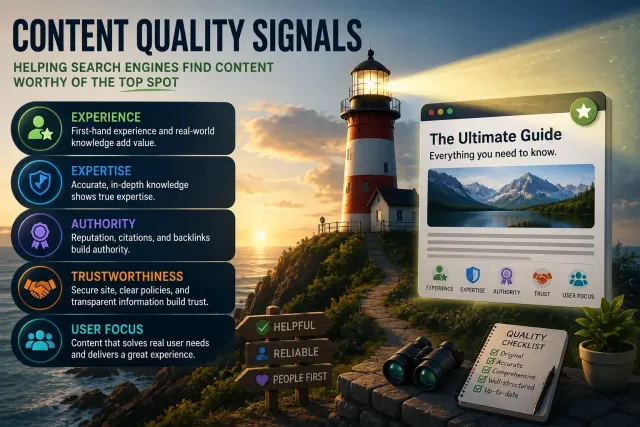
E-E-A-T. Experience, Expertise, Authoritativeness and Trustworthiness. Google's Search Quality Rater Guidelines framework for evaluating content quality, particularly for topics with high stakes for users.
Core update: A broad change to Google's ranking systems that can cause significant fluctuations in search rankings across many topics. Announced publicly but without specific guidance about what changed.
BERT: Bidirectional Encoder Representations from Transformers. A natural language processing model deployed by Google in 2019 to better understand the meaning of search queries, particularly long-tail and conversational queries.
Search intent. The underlying goal behind a search query. It can be informational where someone wants to learn, navigational where they are looking for a specific site, transactional where they want to buy or download or commercial investigation where someone is researching before buying.
RankBrain: Google's first machine-learning ranking component, deployed in 2015, which helps interpret novel and ambiguous queries by relating them to semantically similar queries that have been seen before.
YMYL (Your Money or Your Life): Google's category for topics where inaccurate content could cause real harm to health, finances, legal standing, or safety. E-E-A-T standards are applied most rigorously to YMYL content.
Core Web Vitals: A set of real-world, user-centered performance metrics that Google uses as ranking signals: Largest Contentful Paint (loading performance), Cumulative Layout Shift (visual stability), and Interaction to Next Paint (interactivity responsiveness).[15]
Zero-click search: A search session in which the user finds the answer directly on the search results page - through a featured snippet, knowledge panel, or other SERP feature - without visiting any website.
Google's Major Algorithm Updates Timeline
| Update | Year | Target | Effect |
|---|---|---|---|
| Panda | 2011 | Thin, low-quality, duplicate content | Penalized content farms; introduced site-wide quality signals |
| Penguin | 2012 | Manipulative link building | Penalized artificial links; transformed link building industry |
| Hummingbird | 2013 | Semantic search intent | Enabled understanding of conversational and long-form queries |
| Mobile-Friendly | 2015 | Mobile page usability | Boosted mobile-optimized pages in mobile search |
| RankBrain | 2015 | Novel query interpretation | Machine learning applied to ranking for the first time |
| BERT | 2019 | Natural language understanding | Deep contextual parsing of query meaning |
| Core Web Vitals | 2021 | Page experience signals | Loading speed, visual stability, interactivity added as signals |
| Helpful Content | 2022 | Search-engine-first content | Site-wide signals against AI-generated and thin content |
| March 2024 Core | 2024 | Low-quality scaled content | Large declines for many high-volume content sites |
The PageRank Foundation
The Original Insight
Larry Page and Sergey Brin had as their central insight that the structure of the web held information about the relative importance of pages. Most prior search engines worked mainly by keyword matching and counting how often a search term appeared on a page. That was easy to game and gave poor results.
Page and Brin's 1998 paper, "The Anatomy of a Large-Scale Hypertextual Web Search Engine," introduced PageRank as a way to measure a page's importance based on the link graph.[1]
The intuition was that a link from one page to another represents an editorial judgment - the linking page is effectively endorsing the linked page.
Pages with more endorsements (links) are more important. But not all endorsements are equal. A link from a widely endorsed page carries more weight than a link from an obscure one.
Formally, PageRank simulates a random web surfer who follows links at random, occasionally teleporting to a random page. The PageRank of each page is proportional to the probability that the surfer is on that page at any given time.
Pages that many high-PageRank pages link to receive high PageRank scores in a self-consistent, iterative calculation.
Why PageRank Was a Breakthrough
Technical innovation was not the whole story here. The innovation was also epistemological and PageRank turned the web's structure into a distributed editorial process by taking the collective judgment encoded in the link graph as a quality signal.
This meant that to rank well in early Google, you needed to produce content that real sites would actually link to - which was harder to fake than keyword stuffing.
Search quality improved dramatically compared to what contemporaries offered. Most queries got better results from Google between 1998 and 2002 than from AltaVista, Yahoo or Ask Jeeves and that quality advantage led to fast adoption.
Within four years of its founding, Google had become the dominant search engine globally.
Google still uses PageRank in its system but the weight of the signal has changed markedly compared to others. Individual page PageRank scores are no longer publicly reported by Google and the public PageRank toolbar was retired in 2016.
The Limitations PageRank Revealed
Elegance was also what made PageRank vulnerable. Anyone able to get links by purchase, exchange or manufactured network could make a page appear more important than it was by treating inbound links as editorial votes.
By the mid-2000s, link manipulation had grown into a large industry. Thousands of businesses were offering paid links, private blog networks as well as comment-spam campaigns that were designed to build up PageRank instead of showing genuine editorial endorsement.
Between roughly 2003 and 2012, SEO was largely a cat-and-mouse game between link spammers and Google's spam team and ending that cycle took a ground-up rethink of how links were scored and trusted.
How the Algorithm Has Evolved
Panda (2011): Penalizing Thin Content
As of 2011, much of the web had become made up of low-quality "content farms." These were sites producing large volumes of thin articles stuffed with keywords designed to rank rather than to be useful.
Demand Media's eHow, Associated Content and similar sites put up millions of pages that ranked high for particular search terms but gave little genuine value.
The Panda update in February 2011 targeted this directly. It introduced quality signals that penalized sites with large proportions of low-quality, thin or duplicated content.[12]
Many content farm sites saw their organic search visibility drop a lot from the update and the effect on the media economics of producing low-quality articles was large as well.
Following Panda, Demand Media lost a lot of traffic from Google and that is a measure of how completely the update disrupted the economics of content farm publishing.
Panda introduced the concept of site-wide quality signals - a site with a large proportion of poor content could see all of its pages downranked, not just the specific poor-quality pages.
This created an incentive to maintain quality across a domain rather than allowing low-quality content to accumulate. It remains one of the most consequential single updates in Google's history.
Penguin (2012): Penalizing Manipulative Links
Artificial link building as comment spam, paid links, private blog networks and link exchanges that were made to manipulate PageRank rather than show real editorial support became an industry thrived on because PageRank depended on links.
The Penguin update in April 2012 targeted link manipulation, applying penalties to sites with large proportions of clearly artificial inbound links.[4] Combined with the introduction of the Google Disavow Tool, Penguin fundamentally changed the link building industry: toxic link building became not just ineffective but actively harmful.
The update was initially applied as a periodic refresh (sites could recover only when Penguin recrawled and recalculated). Google moved Penguin to real-time processing in 2016, meaning recoveries and penalties now happen continuously as Google recrawls the web.
The Penguin era also produced one of the most significant SEO case studies in the industry: the JC Penney link scheme uncovered by The New York Times in February 2011, in which the retailer had paid for thousands of manipulative links and ranked first for hundreds of competitive terms as a result.[16]
Once media coverage and a Google manual action came out, JC Penney's rankings fell overnight. This episode showed both how well large-scale link manipulation works and how severe Google's penalty response can be.
Hummingbird (2013): Understanding Intent
Hummingbird in August 2013 was less a penalty-driven update and more a fundamental re-architecture of how Google processed queries. The core query parsing system was replaced by one that could understand natural language. That meant the meaning of a query as a whole and not just the individual keywords.
Conversational queries such as "what's the closest pizza place open now," multi-part questions and queries where the important words are not the keywords themselves ("what do I need to bring to a job interview," where Google needs to match the intent rather than the word "interview") could all be handled by Google thanks to this capability.
Hummingbird was the foundation on which subsequent language understanding advances (RankBrain, BERT, MUM) were built.
BERT (2019) and MUM (2021): Language Understanding
RankBrain in 2015 was Google's first use of machine learning to process search queries, particularly novel queries that had not been seen before. It helped Google better match queries to relevant pages even when the exact query terms were not present in the page text.
BERT (Bidirectional Encoder Representations from Transformers), deployed in late 2019, represented a more fundamental shift. BERT is a large language model that understands context and meaning in language far more deeply than keyword-based approaches.
It enables Google to parse the meaning of queries more accurately - understanding that "can you get medicine for someone pharmacy" is asking about pharmacy policies, not about the word "medicine" in isolation. Google described BERT as affecting one in ten English-language queries at launch.[5]
MUM (Multitask Unified Model) was announced in 2021 and is described as 1,000 times more powerful than BERT. It can understand information across text, images and video simultaneously.[6] The model handles complex, multi-step queries and identifies information in multiple languages.[10]
Semantically rather than syntactically, Google now grasps queries through these language model integrations and what this means practically is large. Writing content that simply "matches keywords" is no longer the operative model of how pages connect to queries.
What matters is whether a page addresses the topic comprehensively enough that the language model can represent it as an answer to the range of queries the topic encompasses.
The Helpful Content System (2022-2024)
In August 2022 and through 2023, Google's Helpful Content Update brought in a new system designed specifically to reward "content created for people" and to down-rank "content created for search engines." What Google called "search engine-first" content was the target of the update. These were articles written to match search query formats and word counts instead of serving readers.
The system brought in a site-wide classifier (conceived like Panda's site-wide signal). It was able to affect a domain's overall visibility depending on how much of its content seemed mainly to be search-engine-optimized instead of genuinely useful.[3]
March 2024 brought the core update that greatly expanded this system. It caused large swings in rankings and major drops for many sites that had depended on high-volume AI-generated or formulaic content production.
Sites that had mainly grown via SEO-optimized content instead of brand reputation or direct audience links saw the update's effect most strongly. That sent a signal that Google was explicitly devaluing the link between how much content there is and how visible it is to search engines.
Lily Ray, who is SEO director at Amsive, analyzed the March 2024 core update independently and found that it brought rank drops of 50 percent or more for dozens of large content sites that had been using SEO-first production models.[14]
Several sites with hundreds of thousands of pages lost nearly all their organic search visibility, giving the most striking example of site-wide quality signals working since Panda.
E-E-A-T: What It Actually Means
The Quality Rater Guidelines
Google employs approximately 10,000 to 16,000 Search Quality Raters - human evaluators who assess search results using a set of guidelines that Google publishes publicly. Quality Raters do not directly change search rankings; they evaluate results that are used as training data for the machine learning systems that do affect rankings.
The Quality Rater Guidelines articulate the E-E-A-T framework as the primary lens for evaluating content quality.[2] The four components are:
- Experience (added in December 2022): whether the content creator has direct, first-hand experience with the subject - a product review written by someone who has actually used the product versus one written from secondary sources.
- Expertise: subject-matter knowledge relevant to the topic - a financial article written by someone with demonstrated finance background versus a generalist.
- Authoritativeness: reputation and recognition within the field - an institution or author that other authoritative sources cite and reference.
- Trustworthiness. This is the foundational factor. It covers accuracy, transparency about sources, clear editorial policies and a secure, properly functional site.
Of all factors, trustworthiness counts most. A writer who is highly expert but regularly puts out inaccurate work is less trustworthy than one who is only moderately expert but is scrupulously accurate.
How E-E-A-T Signals Are Detected
There is a widespread misunderstanding that E-E-A-T is a direct ranking factor and that means a score Google calculates for each page. What is more accurate is that E-E-A-T is a quality system and Google's machine learning systems learn to approximate it by detecting signals that correlate with it.
These signals include: author bylines and biographical information linked to a subject-matter profile; structured data markup identifying author credentials; inbound links from authoritative sources in the same domain of knowledge; press mentions and citations from recognized institutions; editorial transparency pages (about us, editorial policy, corrections process); accurate contact information and physical addresses; and the consistency and accuracy of factual claims across the page.
For practical purposes, E-E-A-T signals are more detectable, and more consequential for rankings, on competitive YMYL topics than on low-stakes informational queries.
A personal recipe blog does not have to prove formal credentials the way a medical site does and a weekend travel guide faces very different quality bars than a retirement tax guide.
YMYL Topics
Applied with special rigor to YMYL (Your Money or Your Life) topics are the E-E-A-T rules. These are areas where inaccurate or untrustworthy content could have large negative effects on users' health, finances, legal standing or safety.
Medical advice, financial guidance, legal information, safety-critical content, and news about important public matters are all YMYL categories.
Google's rules for YMYL topics demand high standards of expertise and authority explicitly. An anonymous author with no credentials writing a medical article gets a lower quality rating than one written by a medical professional who is affiliated with a recognized medical institution and who gives clear sources.
That is why established health information sites such as Mayo Clinic, NHS and Cleveland Clinic rank high for health queries and unbranded content farm articles most often rank less well.
When "Experience" was added to the existing E-A-T system to make it E-E-A-T, that change was notable. It addressed a specific problem. Genuinely expert authors write about things they have not personally experienced. Less credentialed authors have direct first-hand accounts.
On some queries (product reviews, travel recommendations and practical how-to guides), first-hand experience gives signal value apart from any formal expertise credentials.
What Google Is Actually Optimizing For
Stated Goals vs. Practical Reality
Google says its mission is to organize the world's information and make it universally accessible and useful. In search, this means returning results that satisfy user needs. The company describes its ranking systems as designed to reward content that is "helpful, reliable and people-first."
Practically measuring this goal comes down to user satisfaction signals. These are whether searchers click on a result and stay on the page (or go back to search quickly that shows the result was not satisfying or pogosticking), whether they refine their search after looking at results that points to the initial results not being helpful and implicit signals in how they click and behave through the session.
Google explicitly states it uses behavioral signals to evaluate the quality of its ranking systems in aggregate - not to rank individual pages (which would be gameable). But the signals that correlate with user satisfaction in aggregate influence the machine learning systems that do affect rankings.
Search Intent Classification
A critical component of what Google is optimizing for is search intent - matching not just the words in a query but the underlying task the searcher is trying to accomplish. Google classifies queries into four primary intent types:
Informational intent: The searcher wants to learn something. "How does photosynthesis work," "what is a 401k," "history of the Roman Empire." The best results for informational queries are comprehensive, accurate, and well-structured for reading.
Key information comes directly to the SERP in featured snippets and Knowledge Panels for simple queries that ask for info.
Navigational intent. The searcher wants to get to a particular site or page. Search terms like "Facebook login," "Nike official website" and "Gmail." What comes out best is the specific site the searcher is after. And Google most often puts it at the top of results whatever the optimization signals.
Transactional intent: The searcher wants to buy or download something. "Buy running shoes," "download Photoshop," "iPhone 16 Pro deals." The best results include Shopping listings, brand pages, and major retailer product pages.
High commercial relevance and product availability signals matter significantly here.
Commercial investigation. The searcher is researching ahead of purchase. "Best running shoes for flat feet," "iPhone versus Samsung 2024" and "Klaviyo review." Results that put editorial expertise together with practical specificity work best. Guides that compare products, expert reviews and deep product analyses tend to rank well.
Understanding which intent type applies to a target query is prerequisite to producing content that can rank for it.
Even if it is comprehensive, a long-form informational guide that ranks well for "how to start a podcast" (informational intent) will most often not appear for "podcast microphone" (transactional intent).
The Commercial Dimension
Google's search makes up its main revenue source and drives most of Alphabet's annual revenue via ads. Organic search rankings sit adjacent to but separate from paid search results and Google says organic rank cannot be bought and that claim is widely accepted as factual.
However, the commercial dimension of search shapes algorithmic decisions in less direct ways. Google's algorithm developments over time have consistently extended the space for paid results and knowledge panels above organic results, reducing the click-through rates to organic positions.
Featured snippets, Local Packs, Shopping results and People Also Ask boxes show up above conventional organic results in many queries. This changes what "ranking first" means for visibility.
A widely shared analysis by SparkToro found that a growing percentage of Google searches result in zero clicks - users get the answer from the SERP (Search Engine Results Page) itself without visiting any website.[9]
Approximately 58.5 percent of US Google searches in 2024 came up with zero clicks and this proportion grew steadily as Google added more SERP features. That estimate comes from Rand Fishkin's analysis of 2024 clickstream data.[8]
This "zero-click search" trend has significant implications for publishers relying on organic search traffic.
The Current Landscape: AI and the Future of Search
Google's AI Overviews
Google launched AI Overviews (formerly known as Search Generative Experience) in May 2024 in the United States. Large language model-generated summaries appeared at the top of search results for a large share of queries.[17]
Since the arrival of featured snippets in 2014, AI Overviews mark the biggest change to Google's results page format to date.
Semrush, BrightEdge and others did early analysis that showed large differences in how often AI Overview appeared by query type. Informational queries in health, finance and how-to categories had the highest AI Overview rates. Transactional and navigational queries had lower rates.[13]
Organic traffic from the citation does not always go to sites that AI Overviews cite. Several publishers said that despite appearing prominently in results, AI Overview citations brought in little click-through.
How content strategy should respond is still working out, but early signs show that the queries most likely to get an answer from AI Overviews are also the ones with the highest informational intent. These are the same queries that in the past drove the most organic traffic to sites with informational content.
This development poses a structural challenge to content businesses that make money from organic search traffic, whatever the quality of the content.
What Remains Durable
Despite the acceleration of change in Google's systems, several principles have remained consistent across twenty-five years of algorithm evolution: content that genuinely addresses user needs outperforms content that mimics the surface signals of useful content.
Links that come from authoritative sources outperform manufactured ones. At the margins technical performance signals such as page speed, mobile usability and stable layout count.[11] High-stakes topics call for a lot to be demonstrated about expertise and trustworthiness.
From Panda forward through Helpful Content, the path of updates has steadily moved toward raising the floor for what counts as rankable content. Major updates have made it tougher to rank by optimizing surface signals and easier to rank through genuine quality.
The direction has been consistent even when individual updates have been unpredictable.
Common SEO Myths Debunked
Myth: Social media shares boost rankings. Google has said flatly that social numbers like shares, likes and follower counts do not feed into search rankings. A viral post might lead people to link to your page and those links do count, yet the social metrics themselves are ignored.
Myth: Longer content always ranks better. Word count by itself is not a ranking signal. A page only needs to be as long as it takes to answer the reader's question well and stretching an article out with fluff is the exact habit the Helpful Content System penalizes.
Myth: Exact keyword density matters. Google's language models have moved entirely beyond keyword counting. Writing naturally about a topic, using related terms and covering the subject comprehensively, is what signals topical relevance - not hitting a specific keyword percentage.
Myth: Domain age is a major ranking factor. While an established domain with a history of links has some advantage, domain age itself is a weak signal. New domains can rank quickly for topics they cover comprehensively and authoritatively.
Myth: Meta keywords affect rankings. Google has explicitly stated it ignores the meta keywords tag for ranking, which has been true since the early 2000s. Meta descriptions do not directly affect rankings either, though they influence click-through rates.
Myth: You must submit your sitemap to rank. Google crawls the web autonomously and will discover pages through links. Sitemaps help with efficient crawling and indexing of large sites or newly published content, but they are not prerequisites for appearing in search results.
Myth: Publishing more content faster improves rankings. Sites that churn out posts faster than they can keep quality up are prime targets for the Helpful Content System. Putting out a smaller set of thorough, carefully researched articles beats flooding a domain with thin posts every time.
Practical Takeaways
Google's documented systems and algorithm history give content publishers clear guidance that points in a consistent way. Make content that actually answers what searchers want and show clear expertise as well as trustworthiness, above all for YMYL topics.
Link building should come through content quality instead of manipulation. The technical experience of the page must meet modern performance standards (Core Web Vitals such as Largest Contentful Paint, Cumulative Layout Shift and Interaction to Next Paint).
The most durable SEO strategy is alignment with what Google is actually trying to measure (user satisfaction) rather than attempts to optimize for current algorithmic signals that may be updated.
Every major core update has moved in the direction of rewarding content that is genuinely useful to humans and penalizing content optimized mainly for algorithmic signals. Even when each update is unpredictable, the trend is the same.
As algorithms can measure E-E-A-T signals (authorship credentials, institutional affiliation, editorial standards and source citations) through structured data, author pages, citations and link patterns. When content aiming to rank on competitive, high-stakes topics needs to show expertise in ways that search engines can find, demonstrating expertise in measurable ways gives both practical and strategic value.
New uncertainty appears for publishers whose model depends on organic search traffic from informational queries as AI Overviews emerge. The most resilient position is to build a direct audience relationship through email lists, subscriptions and brand recognition that does not rest entirely on Google sending traffic.
Search visibility counts but depending on any one traffic source is structurally weak no matter how algorithms are currently working.
Sources & Further Reading
- Brin, S., & Page, L. (1998). "The anatomy of a large-scale hypertextual web search engine." Computer Networks and ISDN Systems, 30(1-7), 107-117.
- Google. (2023). Search Quality Rater Guidelines. Google LLC.
- Sullivan, D. (2022). "Google's helpful content update." Google Search Central Blog, August 18.
- Cutts, M. (2012). "New Penguin algorithm targets web spam." Google Webmaster Central Blog, April 24.
- Google. (2019). "Understanding searches better than ever before (BERT)." Google Blog, October 25.
- Nayak, P. (2021). "A breakthrough for understanding searches." Google Blog, May 18. (MUM announcement)
- Google. (2023). How Google Search Works: Core Ranking Systems..
- Fishkin, R. (2023). Zero-Click Searches Study: 2022 and 2023 Data. SparkToro Research.
- SparkToro & Datos. (2023). Zero-Click Searches: The Growing Trend and What It Means for SEO. SparkToro Research.
- Google. (2021). Introducing the Multitask Unified Model..
- Illyes, G. (2016). "Rolling out mobile-friendly update." Google Webmaster Central Blog.
- Singhal, A. (2011). "Finding more high-quality sites in search." Google Blog, February 24. (Panda announcement)
- Semrush. (2024). AI Overviews: Impact on Click-Through Rates and Organic Traffic..
- Ray, L. (2024). March 2024 Core Update: Analysis of Impacted Sites. Amsive Research.
- Google. (2021). Evaluating Page Experience for a Better Web.. (Core Web Vitals announcement)
- Schwartz, B. (2023). "JC Penney paid for links that duped Google." Search Engine Land.
- Sullivan, D. (2024). "Google introduces AI Overviews in Search." Google Search Central Blog, May 14.