
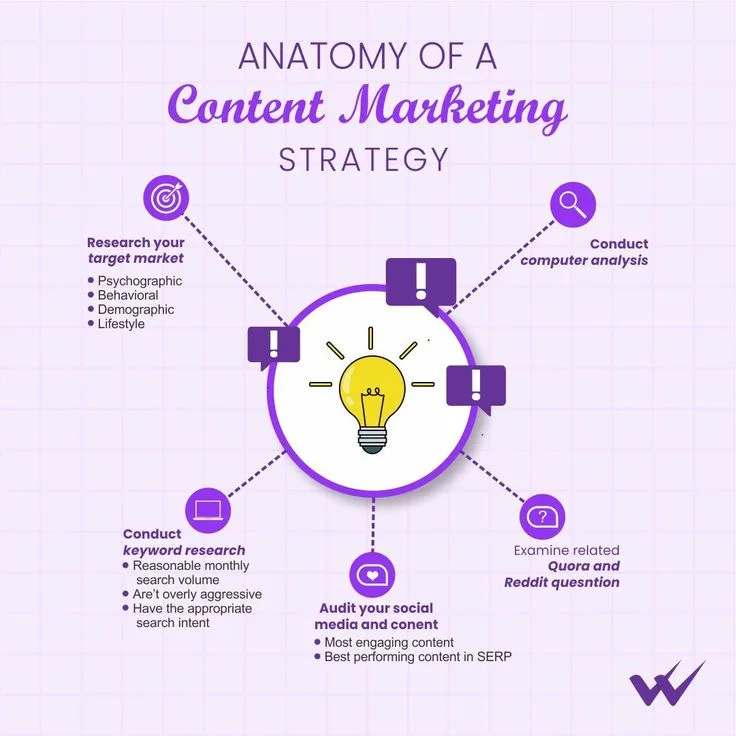
Most organizations that struggle with content share the same underlying problem: they publish without a plan. Blog posts are written because someone had an idea. Social posts go out because the calendar had a gap. Videos are produced because a competitor is doing videos.
The result is a content archive that looks busy but does not accomplish much: it is inconsistent in voice, disconnected from business goals, and largely invisible to the audiences it was meant to reach.
A content strategy is the structured answer to this problem. It is a plan that defines what content an organization will create, for whom, to what end, and how the results will be measured. It is the difference between publishing and communicating, between producing content and building something that works.
This article explains what content strategy actually involves, how to build one from scratch, and what separates strategies that produce measurable results from those that collect dust in a shared document.
What Content Strategy Actually Is
The Definition
Content strategy, as originally defined by Kristina Halvorson in her 2009 book Content Strategy for the Web, is "the practice of planning for the creation, delivery, and governance of useful, usable content." It encompasses not just what to publish but the entire lifecycle of content: how it is created, where it lives, how it is maintained, and how it is eventually retired or updated.
This is a broader definition than many marketers apply. In practice, "content strategy" is often used to mean "content marketing plan": a roadmap for blog posts, social content, and email newsletters.
That narrower usage is fine for most purposes, but the fuller definition matters because it captures something the narrower one misses: content requires governance over time, not just production.
A content strategy is not a one-time deliverable. It is a living framework that evolves as the audience changes, the competitive landscape shifts, and the organization learns from its own performance data.
Ann Handley, Chief Content Officer at MarketingProfs and author of Everybody Writes, describes effective content strategy as "a system that makes it possible to produce great content consistently, not just occasionally." The system is what separates organizations that sustain quality content programs from those that publish brilliantly for three months, then burn out.
What a Content Strategy Is Not
- A content calendar: a calendar is a schedule. A strategy is the logic that determines what goes on the calendar and why.
- A style guide: a style guide governs how content is written. A strategy governs what content is created and what it is meant to achieve.
- An SEO keyword list: keyword research informs a content strategy but does not constitute one. A list of keywords without audience insight, business goals, or a distribution plan is not a strategy.
- A social media plan: social media is one distribution channel. A strategy that covers only one channel, and treats creation and distribution as the same thing, is incomplete.
- A mission statement: many organizations have documented their content mission ("we help [audience] achieve [outcome] through [content type]") without the operational components (audiences, formats, workflows, measurement) that make a mission actionable.
The Business Case for Content Strategy
Before examining what a content strategy contains, it is worth establishing why the investment in strategic planning pays off over ad hoc content production.
Content Marketing Institute's 2023 B2B Content Marketing report found that 64% of the most successful B2B content marketers have a documented content strategy, compared to only 19% of the least successful.
The most successful organizations are more than three times more likely to have a written strategy than the least successful, a correlation that holds consistently across every year CMI has measured it.
The explanation is structural: organizations with documented strategies make better allocation decisions, produce more coherent content architectures, and measure performance more rigorously.
They are less susceptible to the common failure mode of publishing whatever is easiest or most urgent, rather than what will create the most audience value.
Deloitte Insights' marketing analytics research found that companies with integrated, strategy-driven content programs achieve 2.9x higher revenue growth than industry peers without them. Causality here is complex (successful companies may invest more in strategy), but the correlation is consistent across industries and company sizes.
"The best content strategy is not about what you want to say. It is about what your audience is already looking for, and being the most useful answer they can find." (Rand Fishkin, founder of SparkToro and Moz)
The Components of a Working Content Strategy
1. Business Goals and Audience Needs
Every content strategy begins with two questions: what does the organization need to achieve, and what does the audience need to know or do? These are the two inputs that should drive every content decision.
Business goals might include:
- Generating leads for a sales team
- Building brand awareness in a new market
- Establishing thought leadership in a competitive category
- Reducing customer support volume through self-service content
- Retaining existing customers through education and engagement
- Supporting a product launch or category creation
Audience needs are the specific questions, problems, and interests that your content can address. These are discovered through customer interviews, search data analysis, support ticket review, sales call recordings, and competitor content gap analysis.
The overlap between what your business needs and what your audience genuinely finds valuable is the zone where effective content lives.
The mistake is to begin with organizational needs and produce content that serves those needs without sufficient regard for audience utility. Content that primarily serves the publisher's promotional agenda (repackaged product announcements, thinly disguised advertisements) fails both commercially and in search.
Google's algorithms have become increasingly sophisticated at distinguishing self-serving from genuinely useful content.
2. Audience Personas
Audience personas are semi-fictional representations of the real people you are trying to reach. A well-constructed persona includes:
- Role and context: job title, industry, company size (for B2B); life stage, interests, habits (for B2C)
- Goals and motivations: what are they trying to achieve?
- Pain points and challenges: what is standing in their way?
- Information behavior: where do they search for answers? What formats do they prefer?
- Level of sophistication: are they a beginner seeking introductory explanations, or an expert looking for advanced insight?
- Decision-making context: are they the primary decision-maker, an influencer, or an implementer?
Personas prevent the common failure mode of writing for "everyone," which reliably produces content that is relevant to no one in particular. A piece of content that serves a specific, well-understood audience need is almost always more useful, and ranks better, than a piece that tries to cover everything at once.
The caveat: personas can become fictional in a damaging way if they are not grounded in real audience research. The most useful personas are built from actual customer interviews, survey data, and behavioral analytics, not from assumptions about who the organization would like its customers to be.
HubSpot's research found that content organizations using research-based personas achieve 73% higher conversion rates than those using assumption-based personas.
3. Content Audit
Before creating new content, organizations with an existing content library should conduct a content audit: a systematic review of what already exists. An audit typically involves:
- Cataloguing every URL or piece of content in a spreadsheet
- Pulling performance data (traffic, rankings, backlinks, engagement)
- Evaluating quality, accuracy, and alignment with current strategy
- Classifying each piece: keep as-is, update, consolidate, or delete
Audits routinely reveal that 20 to 30 percent of existing content generates the vast majority of organic traffic, while a large portion generates essentially nothing and may actively harm the site's authority through thin content or keyword cannibalization.
| Content Classification | Action | Criteria |
|---|---|---|
| High traffic, high relevance | Keep and maintain | Already performing; refresh periodically |
| Medium traffic, high relevance | Update and improve | Good topic, needs depth or accuracy update |
| Low traffic, high relevance | Promote or optimize | Good content that lacks distribution |
| Duplicate or overlapping | Consolidate | Multiple posts on same topic compete with each other |
| Low traffic, low relevance | Remove or noindex | Dilutes site authority; not serving audience |
| Outdated or inaccurate | Update or delete | Damages credibility; may produce incorrect AI citations |
Ahrefs internal analysis found that updating and republishing old content increased organic traffic by an average of 111% versus leaving content as originally published.
The same Ahrefs study found that consolidating two thin overlapping articles into one comprehensive piece doubled traffic for 72% of the consolidated pieces. The audit is not an administrative exercise: it is often the highest-ROI content activity available.
4. Content Pillars and Topic Architecture
Content pillars are the core themes around which all content is organized. They should sit at the intersection of what your audience cares about and what your organization is credibly positioned to address.
A SaaS company selling project management software might organize content around pillars like:
- Team productivity
- Remote and distributed work
- Project planning and delivery
- Leadership and management
- Work-life integration
Every piece of content (every blog post, guide, case study, video, or podcast episode) should belong to at least one pillar. This creates topical coherence, builds search authority through depth rather than breadth, and makes it far easier to brief writers and evaluate whether proposed content fits the strategy.
The pillar structure also informs internal linking. A network of tightly related posts around a single theme performs better in search than isolated pieces scattered across unrelated topics.
Google's algorithms have become increasingly capable of recognizing topical authority (comprehensive, interlinked coverage of a subject) as a signal of genuine expertise.
HubSpot's topic cluster model (developed around 2017 and now widely adopted) formalizes this architecture: a pillar page covers a broad topic comprehensively, and cluster content covers specific subtopics in depth, with both types of content cross-linked.
Sites implementing this architecture saw an average of 25% increase in organic traffic within 6 months, according to HubSpot's own case studies.
5. Content Formats and Channels
Different goals, audiences, and topics call for different formats. A content strategy should map which formats serve which purposes and which channels will carry them.
| Format | Strengths | Common Goals |
|---|---|---|
| Long-form articles (1,500+ words) | SEO, depth, AI citation | Organic search, thought leadership |
| How-to guides and tutorials | Practical utility, long shelf life | Search, support deflection |
| Case studies | Proof, credibility | Sales enablement, conversion |
| Data reports and original research | Backlinks, press coverage | Authority building, link acquisition |
| Email newsletters | Retention, direct relationship | Loyalty, repeat visits |
| Video | Explanation, engagement, reach | Awareness, social, YouTube search |
| Podcast | Depth, audience relationship | Community, brand authority |
| Social content | Reach, real-time engagement | Awareness, community |
| Webinars | Education, lead generation | Lead nurturing, product demos |
| Interactive tools | Engagement, utility | Lead capture, time on site |
Most strategies involve multiple formats and channels. The key decision is which formats to prioritize given available resources: trying to do everything simultaneously usually means doing nothing well.
Content budget allocation: research from Content Marketing Institute suggests that high-performing content organizations spend approximately 28% of their total marketing budget on content, and they allocate that budget roughly as follows: 40% to content creation, 30% to distribution and promotion, 20% to strategy and planning, and 10% to technology and infrastructure.
Organizations that over-index on creation and under-invest in distribution consistently underperform.
6. Editorial Calendar
An editorial calendar is a schedule of planned content: what will be published, when, in what format, on which channel, and by whom. It is the operational layer of the strategy.
A functional editorial calendar includes:
- Planned publish date
- Title or working title
- Target keyword and search intent
- Content pillar
- Format and primary channel
- Author or owner
- Status (briefed, in progress, in review, published)
- Link to the brief and the final piece
The calendar should be realistic about production capacity. A team that can sustainably produce two well-researched articles per week will outperform a team that sets out to publish daily and burns out within a month.
Orbit Media's 2023 blogging survey found that 33% of bloggers who publish less frequently cite "not enough time" as their primary barrier, but the same research found that publishing frequency matters less than publication quality for organic search outcomes.
7. Governance and Maintenance
A content strategy that does not include a maintenance plan is incomplete. Content decays: statistics become outdated, products change, competitors publish better versions of your articles, and factual errors accumulate. An article published with accurate information in 2022 may be misleading by 2026.
Governance systems include:
- Scheduled content reviews: quarterly for high-traffic pieces, annually for the broader archive
- Update triggers: defined criteria that signal when a piece needs updating (traffic decline, ranking drop, publication date over 18 months, factual date references becoming stale)
- Ownership assignment: every piece of content has a named owner responsible for its accuracy
- Retirement criteria: defined standards for when content should be removed or redirected rather than updated
Measuring Content Performance
The Measurement Hierarchy
Content performance should be measured at three levels:
Reach metrics tell you how many people saw your content and where it appeared:
- Organic search sessions and impressions
- Search rankings for target keywords
- Social reach and impressions
- Email open rate
Engagement metrics tell you whether people found the content useful:
- Time on page and scroll depth
- Bounce rate (in context)
- Return visits
- Comments and shares
Business outcome metrics tell you whether content is contributing to goals:
- Lead generation or form completions
- Email newsletter signups
- Trials started or demos requested
- Revenue influenced (via attribution modeling)
The mistake most content teams make is optimizing only for reach metrics (page views, follower counts) while neglecting the metrics that connect content to business value. Traffic that does not convert to any meaningful action is expensive to produce and hard to justify to stakeholders.
Content Performance Benchmarks
Understanding what "good" looks like requires context. Industry benchmarks provide useful reference points:
| Metric | Below Average | Average | Above Average |
|---|---|---|---|
| Organic traffic growth (YoY) | Under 10% | 10-25% | Over 25% |
| Email open rate (B2B) | Under 15% | 15-25% | Over 25% |
| Lead conversion rate (content) | Under 1% | 1-3% | Over 3% |
| Time on page (long-form) | Under 2 min | 2-4 min | Over 4 min |
| Bounce rate (blog) | Over 85% | 70-85% | Under 70% |
Sources: Campaign Monitor Email Benchmarks 2023; HubSpot State of Marketing Report 2023; Nielsen Norman Group web usability research
Attribution Complexity
Measuring content's contribution to revenue is genuinely difficult. Most buyers, especially in B2B markets, consume multiple pieces of content over weeks or months before taking a purchase action.
Last-click attribution (crediting the final touchpoint before conversion) dramatically undervalues educational content that operates early in the decision process.
Gartner research found that B2B buyers spend 27% of their buying journey doing independent online research, and that this research phase occurs before any vendor engagement.
Content that shapes understanding during this pre-vendor phase has significant influence on which vendors make the consideration set, but that influence is nearly invisible to last-click attribution models.
More sophisticated approaches include multi-touch attribution models, cohort analysis comparing conversion rates of content-engaged versus non-engaged audiences, and self-reported attribution through customer surveys asking "how did you first learn about us?" and "what helped you decide to buy?"
Common Content Strategy Failures
Producing Content Without a Distribution Plan
A strategy that focuses entirely on creation without equal attention to distribution is destined to underperform. Most content, even good content, reaches only a fraction of the audience it could reach if it were actively promoted through email, social, paid amplification, and partnership channels.
The question "how will people find this?" should be answered before the first word is written, not after the piece is published.
Derek Halpern (Social Triggers) popularized the 80/20 rule for content distribution: spend 20% of your time creating and 80% of your time promoting.
While this specific ratio may not apply in all contexts, the underlying principle, that distribution deserves as much strategic attention as creation, is consistently borne out by performance data.
Ignoring Search Intent
Creating content around keywords without understanding the intent behind those searches is a common and costly mistake.
A keyword like "project management" could be searched by someone who wants to understand the discipline, someone looking for software, or someone searching for a specific methodology.
Content optimized for the keyword but misaligned with the intent will rank poorly and fail users who do find it.
Search intent falls into four categories: informational (I want to learn something), navigational (I want to find a specific site), transactional (I want to buy something), and commercial investigation (I am researching before buying). Each requires a different content approach.
The fastest way to determine dominant intent for a query is to examine what Google currently ranks: the types of pages in the top results reflect Google's assessment of what searchers are actually looking for.
Neglecting Content Maintenance
Content decays. Statistics become outdated. Products change. Competitors publish better versions of your articles. A content strategy without a maintenance plan will gradually accumulate an archive of outdated, inaccurate, or superseded content that damages rather than builds trust.
The cost of neglected content compounds in two ways. First, declining articles pull down the site's average quality signals, potentially affecting rankings for newer, better content.
Second, outdated or inaccurate content damages credibility when readers encounter it, particularly on topics where accuracy matters professionally (health, finance, legal, technical).
High-performing content teams schedule regular reviews of key assets (typically quarterly for high-traffic pieces and annually for the broader archive) with defined criteria for when a piece needs updating.
Building Strategy Around Production Volume Rather Than Value
The "publish more" impulse is understandable but counterproductive. Search algorithms increasingly reward depth, expertise, and genuine usefulness over volume. A site with fifty authoritative, well-researched articles on a coherent topic typically outperforms a site with five hundred thin, generic articles on scattered topics.
Semrush's analysis of 700,000 articles found that articles over 3,000 words receive 3x more traffic and 4x more shares than shorter articles. The marginal cost of making an article comprehensive rather than surface-level is modest; the marginal return is substantial.
The right question is not "how much can we produce?" but "what would be genuinely more useful than anything else on this topic?"
Content Strategy for AI Answer Engines
An increasingly important consideration is how content performs not just in traditional search results but in AI-generated answers from systems like ChatGPT, Perplexity, and Google's AI Overviews.
AI answer engines tend to cite content that is:
- Factually accurate and well-sourced: claims with citations or original data are more likely to be cited
- Clearly structured: content with explicit headings, definitions, and question-answer formats is easier for AI systems to extract and attribute
- Comprehensive: deep coverage of a topic signals authority to both search algorithms and AI training data
- Frequently updated: content that is kept current is more likely to be treated as reliable
- From recognized authorities: AI systems have a bias toward citing sources that are already authoritative in their domain
SparkToro research found that sources cited in Google AI Overviews tend to have significantly higher domain authority, more backlinks, and more thorough structured data implementations than sources that rank in traditional results but are not cited in AI answers.
This does not require a fundamentally different approach from good SEO, but it does emphasize the value of original research, clear definitions, and explicit answers to specific questions within longer articles.
The principle is: if a knowledgeable journalist were writing a quick explainer on this topic and needed a citable fact or clear definition, would they find one in your content?
Building a Content Strategy: A Starting Framework
For organizations building a content strategy for the first time, a practical sequence is:
- Define business goals and success metrics: what does content need to achieve, and how will you know if it is working?
- Research and document your audience: interviews, surveys, keyword research, competitor content gaps
- Audit existing content: assess what you have and what to keep, fix, consolidate, or remove
- Define content pillars: three to six core themes at the intersection of audience need and business relevance
- Map content to the buyer or reader journey: what do people need to know at different stages of awareness or consideration?
- Choose formats and channels: based on audience preferences and available production resources
- Build a realistic editorial calendar: with clear ownership and defined workflows
- Establish measurement infrastructure: ensure analytics are properly configured before publishing
- Review and iterate: set a quarterly rhythm of reviewing performance and adjusting priorities
No strategy survives contact with reality perfectly intact, but organizations with a clear strategy adapt more effectively than those without one, because they have a shared framework for deciding what to change.
The Minimum Viable Strategy
For small teams or organizations just beginning to build a content program, a minimum viable strategy can be documented in a single page:
- Audience: [One primary persona description]
- Primary goal: [One measurable business outcome content should drive]
- Content pillars: [Two to three core topic areas]
- Primary format: [One content format to invest in deeply]
- Primary channel: [One distribution channel to build first]
- Success metric: [One metric to track quarterly]
- Cadence: [Realistic publication frequency]
Starting with constraints forces prioritization. A team that commits to doing one thing well (producing one comprehensive article per week on a tightly defined topic and distributing it via email) will outperform a team that tries to produce blog posts, social content, video, podcast episodes, and newsletters simultaneously and spreads effort too thin across all of them.
Key Takeaways
- A content strategy defines what to create, for whom, why, and how success will be measured: it is the logic that drives the calendar, not the calendar itself
- Effective strategies begin with the intersection of business goals and genuine audience needs
- Documented strategies produce substantially better marketing outcomes than undocumented ones; research consistently shows a 3x+ performance gap between the most and least strategic content programs
- A content audit should precede new content investment in any organization with an existing library: updating existing content is often higher ROI than creating new content
- Content pillars create topical coherence and build search authority through depth rather than breadth
- Performance measurement should connect to business outcomes, not just traffic metrics; last-click attribution systematically undercounts content's contribution to revenue
- Common failures include producing without a distribution plan, ignoring search intent, and neglecting ongoing content maintenance
- AI answer engines reward factual accuracy, clear structure, and original depth: the same qualities that drive long-term search performance
- A minimum viable strategy with clear constraints and realistic production commitments outperforms ambitious, overextended strategies that collapse under their own complexity