
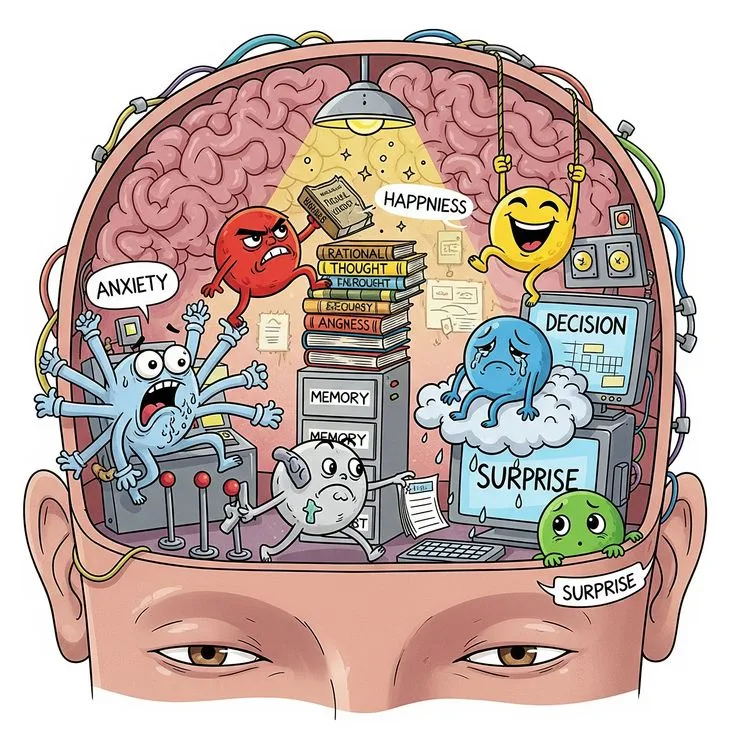
Neuroscience: In 1994, Antonio Damasio published an account of a patient he called "Elliot" - an intelligent, articulate man who had undergone surgery to remove a meningioma, a tumor pressing against his frontal lobes. The surgery was technically successful.
Elliot retained his vocabulary, his memory, his general knowledge, his reasoning capacity, and his measured IQ. He could hold a normal conversation. He could describe ethical dilemmas clearly and analyze them sensibly.
But in the months after his surgery, his life fell apart. He made disastrous business decisions, fell in with a dubious partner whose schemes were obviously fraudulent, lost his job, lost his savings, separated from his family.
When Damasio and his colleagues tested him systematically, they found something peculiar: Elliot could not decide what to eat for lunch.
He could not decide whether to file papers alphabetically or chronologically. He could not make the simplest choices without interminable deliberation that led nowhere.
What Elliot had lost was not intelligence. It was feeling. The tumor had disrupted the connection between his emotional memory systems and his decision-making circuitry - and without emotional tagging of past outcomes, without the somatic markers that tell us what has worked and what has cost us, the machinery of choice seized up.
This case opened a new era in the scientific understanding of decision-making. For centuries, the dominant view in Western thought had been that emotion was the enemy of good decisions - that feeling was what led people astray, and that reason, properly disciplined, would reveal the correct choice.
Descartes' separation of mind and body, and its descendant in rationalist philosophy and classical economics, implied that the ideal decision-maker would be coldly rational, undistorted by sentiment.
Damasio's evidence from Elliot and from dozens of similar patients pointed to the opposite conclusion: emotion is not the distortion of good decisions but their infrastructure.[1] The brain that cannot feel cannot choose.
The neuroscience of decision-making has expanded enormously since Damasio's early work.
We now have detailed accounts of how the brain assigns value to options, how it learns from experience through dopamine-based reinforcement signals, how it balances immediacy against delayed gratification, and how it navigates the special challenges of social and moral choice.
The picture that emerges is not of a rational calculator occasionally distorted by emotion, but of a complex, multi-system architecture in which reason and feeling are continuously intertwined - and in which the wisdom of that architecture, built over millions of years of evolution, is often well ahead of our conscious understanding.
"Emotion is not a luxury: it is an expression of basic mechanisms of life regulation developed in evolution, and is indispensable for rational decision making." - Antonio Damasio, Descartes' Error: Emotion, Reason, and the Human Brain (1994)
Key Definitions
Somatic marker: A bodily state (a feeling of unease, excitement, dread, or rightness) associated with a past outcome, which tags options in current decisions and biases choice before or alongside conscious deliberation.
Dopamine: A neuromodulator central to reward learning; dopamine neurons signal reward prediction errors - the difference between expected and received outcomes - that update the brain's value estimates through experience.
Reward prediction error: The signal computed by dopamine neurons: positive when outcomes are better than expected, negative when worse, zero when exactly as predicted; the neural implementation of reinforcement learning.
Temporal difference learning: A computational algorithm from machine learning that matches the pattern of dopamine reward prediction errors; the brain appears to implement something similar to update value estimates from experience.
Orbitofrontal cortex (OFC): A region of the prefrontal cortex that encodes the subjective value of options regardless of sensory modality, sometimes described as providing a "common currency" of value for comparison across different types of options.
Anterior cingulate cortex (ACC): A prefrontal region that monitors outcomes, signals errors and conflicts, and according to influential models, allocates cognitive control by computing expected costs and benefits of effortful deliberation.
Delay discounting: The tendency to prefer smaller, immediate rewards over larger, delayed ones; steeper discounting is associated with impulsivity; mediated by competition between limbic (immediacy-preferring) and lateral PFC (patient) systems.
Drift-diffusion model (DDM): A computational model of decision-making as noisy evidence accumulation to a threshold; provides good accounts of both choice behavior and response time distributions.
Key Brain Regions in Decision-Making
| Brain Region | Role in Decision-Making | Effect of Damage | Associated System |
|---|---|---|---|
| Ventromedial prefrontal cortex (vmPFC) | Stores somatic markers; encodes subjective value from past outcomes | Impaired real-world choices despite intact cognition (Elliot / Phineas Gage) | Emotion-guided choice |
| Orbitofrontal cortex (OFC) | "Common currency" of value; integrates rewards across modalities | Loss of sensitivity to reward value; impulsive choices | Value encoding |
| Anterior cingulate cortex (ACC) | Monitors outcomes; signals conflicts; allocates cognitive control | Reduced error detection; poor performance monitoring | Cognitive control |
| Dorsolateral prefrontal cortex (dlPFC) | Working memory; deliberate reasoning; suppressing impulsive responses | Impaired deliberate reasoning; increased impulsivity | Executive control |
| Amygdala | Emotional tagging; fear and threat responses; rapid value signals | Reduced emotional responsiveness; poor risk assessment | Emotional salience |
| Ventral striatum / nucleus accumbens | Reward anticipation; dopamine prediction error reception | Reduced reward sensitivity; anhedonia | Reward learning |
| Insula | Interoceptive signals (gut feelings, bodily states); risk sensitivity | Reduced risk aversion; smokers with insula damage stop craving more easily | Somatic states |
The Somatic Marker Hypothesis and the Iowa Gambling Task
Damasio's theoretical account of how emotion guides decisions was grounded in a specific experimental paradigm developed with his colleagues: the Iowa Gambling Task (IGT). Participants are given four decks of cards. Two decks (A and B) offer large immediate rewards but larger average losses over time - they are losing decks.
Two decks (C and D) offer smaller immediate rewards but smaller average losses - they are winning decks. Normal participants must learn through experience which decks are profitable; there is no rule to apply, only the accumulated experience of wins and losses.
The critical finding was in the psychophysiology. Damasio's team attached electrodes to participants' hands to measure skin conductance - a measure of sympathetic nervous system arousal, the bodily component of emotional response.
Normal participants, even before they could consciously identify which decks were risky, began generating anticipatory skin conductance responses when they reached toward the bad decks. Their bodies were signaling danger before their minds had worked it out.
Patients with damage to the ventromedial prefrontal cortex never generated these signals, and they continued to choose the bad decks indefinitely - even, in some cases, after they could articulate the deck structure correctly.
The interpretation is that the vmPFC stores associations between past choices and their emotional consequences - what Damasio calls somatic markers - and that these associations generate bodily signals that influence choices at the point of decision.
The prefrontal cortex is, in this model, partly an organ of emotional memory, storing not just the fact of past outcomes but their feeling-tone, and using that feeling-tone to bias current choices toward options associated with past success and away from those associated with past harm.
This is a form of fast, implicit learning that runs in parallel with slower, explicit deliberation - and in complex, partially known environments, it is often more reliable.
The somatic marker framework has been extended and refined since 1994. Neuroimaging studies have confirmed that vmPFC and OFC activation correlates with subjective value signals in choice tasks.
The hypothesis has been challenged on some points - the IGT can be solved without intact emotion, and some researchers question the mechanism - but the core insight, that bodily states contribute to decision quality and that their absence impairs it, has held up across many replications and clinical observations.
Dopamine and the Architecture of Learning
The most precisely characterized mechanism in decision neuroscience is the dopamine reward prediction error signal discovered by Wolfram Schultz and colleagues in their 1997 Science paper.
Schultz was recording from dopamine neurons in the ventral tegmental area (VTA) and substantia nigra (SNc) of monkeys learning simple stimulus-reward associations.[2]
What he found was striking: dopamine neurons fired not merely to rewards, but in a pattern that precisely matched the requirements for reinforcement learning.
When an unexpected reward arrived, dopamine neurons fired above baseline. As the animal learned the association between a predictive stimulus (a tone or light) and the reward, the dopamine response shifted: it moved to the stimulus, not the reward.
If the stimulus appeared but the expected reward failed to arrive, dopamine activity dropped below baseline - a negative signal.
The pattern was exactly what computational reinforcement learning theory, developed independently by Sutton and Barto, predicts should drive optimal learning: update value estimates upward when outcomes exceed predictions, downward when they fall short, and make no update when outcomes match predictions exactly.
This discovery unified animal learning theory, human psychology, and computational modeling. The brain appeared to be implementing temporal difference learning - a form of reinforcement learning that can handle delayed rewards by propagating value estimates backward in time from outcomes to predictive cues.
Every dopamine burst and dip is, in effect, a teaching signal updating the brain's model of how actions map to outcomes.
The basal ganglia - particularly the striatum, comprising the caudate nucleus, putamen, and nucleus accumbens - are the primary recipients of these dopamine teaching signals.
The striatum learns action-outcome associations: when an action produces dopamine release (unexpected reward), the striatal pathways mediating that action are strengthened through synaptic plasticity. Through repetition, this process builds the value representations that guide future choices.
As behaviors become well-learned and habitual, the locus of activity within the striatum shifts from the caudate (associated with flexible, goal-directed behavior) to the putamen (associated with automatic, stimulus-response habits).
This shift explains a familiar subjective experience: when you first learn a new skill or decision routine, it requires deliberate attention; after sufficient practice, it flows automatically.
The learning phase recruits the full value-learning system; execution eventually relies on more efficient habitual circuits.
Value Signals and the Common Currency Problem
One of the fundamental challenges the brain must solve is comparing options of fundamentally different types. How do you weigh the pleasure of eating chocolate against the satisfaction of completing a project against the comfort of seeing a friend?
These options differ in sensory modality, in timing, in social content, and in dozens of other dimensions. Yet we make such comparisons constantly and rapidly. How?
The orbitofrontal cortex appears to provide at least part of the answer. In 2006, Camillo Padoa-Schioppa and John Assad published a landmark study in Nature recording from OFC neurons in monkeys choosing between different quantities of different juices.[3]
They found that OFC neurons encoded the subjective value of options independent of which specific juice was being considered, independent of the sensory properties of the stimulus, and independent of the motor action required to obtain it.
The OFC appeared to represent value in an abstract, modality-independent code - providing something like a common currency that allows options of any type to be placed on a single scale for comparison.
This finding aligned with earlier human neuroimaging research showing OFC and vmPFC activation correlating with subjective value across different types of options - food, money, social approval, abstract symbols.
Antonio Rangel, Colin Camerer, and Read Montague's 2008 review in Nature Reviews Neuroscience synthesized this work into a computational framework distinguishing the processes of representing value (OFC/vmPFC), selecting among options (ACC and dorsomedial PFC), and learning from outcomes (striatum and dopamine system).[6]
The drift-diffusion model, originally developed by Roger Ratcliff in 1978 to account for response times in perceptual decisions, has been extended to value-based decisions with considerable success.
In this framework, decisions are modeled as a noisy accumulation of evidence - or value difference - toward a threshold, at which point the leading option is selected.
Neurons in the lateral intraparietal cortex of monkeys accumulate evidence for perceptual decisions; analogous accumulation processes occur in medial PFC for value-based choices.
The model accounts naturally for the speed-accuracy tradeoff: a higher threshold means slower, more accurate decisions; a lower threshold means faster, more error-prone ones.
The Cost of Effort and the Role of the ACC
The anterior cingulate cortex occupies a peculiar position in the prefrontal landscape: anatomically between the emotional limbic system and the executive lateral PFC, it functions as a monitor and allocator of cognitive resources.
Amitai Shenhav, Matthew Botvinick, and Jonathan Cohen's 2013 "expected value of control" theory provides the most integrated account of ACC function.[5]
In their model, the ACC is constantly computing the expected benefit of engaging effortful cognitive control against its expected cost.
When a task demands accuracy and the benefit of accuracy is high, the ACC signals for increased control allocation - more attention, more deliberate processing, more inhibition of automatic responses.
When the cost of control exceeds its benefit - when the task is difficult and the stakes low - the ACC reduces control allocation, and behavior defaults toward less effortful, more heuristic responses.
This model has important implications for decision fatigue. If the ACC is computing cost-benefit ratios for control allocation, then sustained demands on cognitive control will shift these calculations over time - not necessarily because a glucose resource is depleted, but because the subjective cost of effort increases with fatigue while the expected benefit remains constant or declines.
Decisions made after sustained cognitive engagement will therefore show characteristic signs: more reliance on defaults and status quo, less consideration of alternatives, reduced resistance to immediate temptations.
The phenomenon of simplified decision-making after exhaustion is real, even if the glucose-depletion mechanism proposed by Roy Baumeister's original ego depletion model has not replicated reliably.
Time, Temptation, and the Patience of the Prefrontal Cortex
Samuel McClure and colleagues' 2004 Science paper on the neural basis of intertemporal choice proposed that two systems compete when immediate rewards are available.[4]
Their fMRI experiment showed that choices involving immediately available options disproportionately activated limbic and paralimbic regions - ventral striatum, medial OFC, medial PFC - while both immediate and delayed reward options activated lateral PFC and parietal regions.
They framed this as a beta system (limbic, responding strongly to immediacy) competing with a delta system (prefrontal, computing value across all time horizons), and proposed that self-control consisted in the delta system overriding the beta system's preference for the immediate option.
The "beta-delta" story has been refined by subsequent work. The neural pattern is more graded than a clean two-system story - the ventral striatum responds to both immediate and delayed rewards - and the magnitude of delay discounting varies continuously with the length of the delay.
Nevertheless, the directional finding holds: immediate reward availability recruits limbic systems more strongly, and lateral PFC activity correlates with more patient choices.
Individual differences in delay discounting correlate with lateral PFC integrity; disrupting PFC activity with transcranial magnetic stimulation increases impulsivity. People with greater PFC volume and connectivity show less steep discounting.
This framework illuminates a range of important real-world phenomena. Addiction, at the neural level, involves pathological steepening of the discount curve for drugs versus other rewards, driven by altered dopamine signaling in reward circuits.
Poverty, research suggests, may impose cognitive loads that effectively reduce the PFC resources available for patient deliberation. Meditation and mindfulness practices that strengthen prefrontal regulation may, according to some evidence, flatten discount curves over time.
Social Decisions, Fairness, and the Moral Brain
Individual value-based choice represents only part of the brain's decision repertoire. A substantial fraction of the decisions that matter most - whom to trust, whether to cooperate, how to respond to unfairness - are social. Social decisions recruit additional neural machinery beyond the core value network.
Mentalizing - inferring the mental states, intentions, and beliefs of others - is reliably mediated by the temporoparietal junction, medial PFC, and posterior superior temporal sulcus.
These regions are recruited both for strategic social reasoning (predicting how a partner will behave in a negotiation) and for moral judgment (assessing whether an action was intentional and assigning blame).
The TPJ's role in moral judgment is particularly well documented: disrupting TPJ activity with TMS affects participants' judgments of failed attempts at harm, suggesting that intention attribution - not just outcome assessment - is central to moral evaluation.
The anterior insula processes fairness as a social emotion. Ultimatum game studies - in which one player proposes a split of money and the other accepts or rejects, with rejection meaning both players get nothing - consistently show anterior insula activation when participants receive low offers, with activation magnitude predicting rejection probability.
The brain appears to encode unfairness as aversive in a way that motivates costly punishment of unfair behavior.
Henrich and colleagues' cross-cultural research in 15 small-scale societies (American Economic Review, 2001) showed that this pattern is not culturally parochial - rejection of unfair offers, even at cost to the rejector, is close to universal, suggesting the fairness-processing circuit is part of our evolved social architecture.[7]
Perhaps most strikingly, research by Jorge Moll and colleagues showed that altruistic behavior - charitable giving - activates the same striatal reward circuits that respond to rewards for the self. The subgenual anterior cingulate and nucleus accumbens show genuine reward signals when people donate to causes they value.
This suggests that prosocial behavior is intrinsically motivating at the neural level - not merely calculated sacrifice for external rewards - which helps explain the robustness of human cooperation and the positive affect that accompanies helping others.
What the Neuroscience Means for Understanding Choice
The accumulated picture from two decades of decision neuroscience overturns several deeply held intuitions. Reason and emotion are not opposed systems where one should ideally dominate the other; they are intertwined at every level of the architecture.
The "rational" prefrontal cortex uses emotional memory to guide deliberation; the "emotional" limbic system encodes value signals that are essential inputs to rational choice. Damage either and decision-making suffers.
Equally important, decision-making is not a single process but a family of processes: value learning, value representation, option comparison, evidence accumulation, control allocation, social modeling.
These processes run in parallel, interact continuously, and are differentially recruited depending on what kind of decision is being made.
A habitual choice on the way to work recruits different systems than a life-changing career decision; a social negotiation recruits different circuits than a financial calculation.
Understanding this architecture helps explain why decision quality varies so dramatically across contexts - and why designing environments that support rather than tax our decision systems matters enormously.
For a broader account of the cognitive architectures underlying System 1 and System 2, see dual-process-theory-explained. For how habits form and what that means for behavior change, see how-habits-form-and-change.
For the decision-relevant effects of anxiety on cognition, see what causes-anxiety.
Sources & Further Reading
- Damasio, A. R. (1994). Descartes' Error: Emotion, Reason, and the Human Brain. Putnam.
- Schultz, W., Dayan, P., & Montague, P. R. (1997). A neural substrate of prediction and reward. Science, 275(5306), 1593-1599. DOI: 10.1126/science.275.5306.1593
- Padoa-Schioppa, C., & Assad, J. A. (2006). Neurons in the orbitofrontal cortex encode economic value. Nature, 441(7090), 223-226. DOI: 10.1038/nature04676
- McClure, S. M., Laibson, D. I., Loewenstein, G., & Cohen, J. D. (2004). Separate neural systems value immediate and delayed monetary rewards. Science, 306(5695), 503-507. DOI: 10.1126/science.1100907
- Shenhav, A., Botvinick, M. M., & Cohen, J. D. (2013). The expected value of control: An integrative theory of anterior cingulate cortex function. Neuron, 79(2), 217-240. DOI: 10.1016/j.neuron.2013.07.007
- Rangel, A., Camerer, C., & Montague, P. R. (2008). A framework for studying the neuroscience of value-based decision making. Nature Reviews Neuroscience, 9(7), 545-556. DOI: 10.1038/nrn2357
- Henrich, J., et al. (2001). In search of homo economicus: Behavioral experiments in 15 small-scale societies. American Economic Review, 91(2), 73-78. DOI: 10.1257/aer.91.2.73