
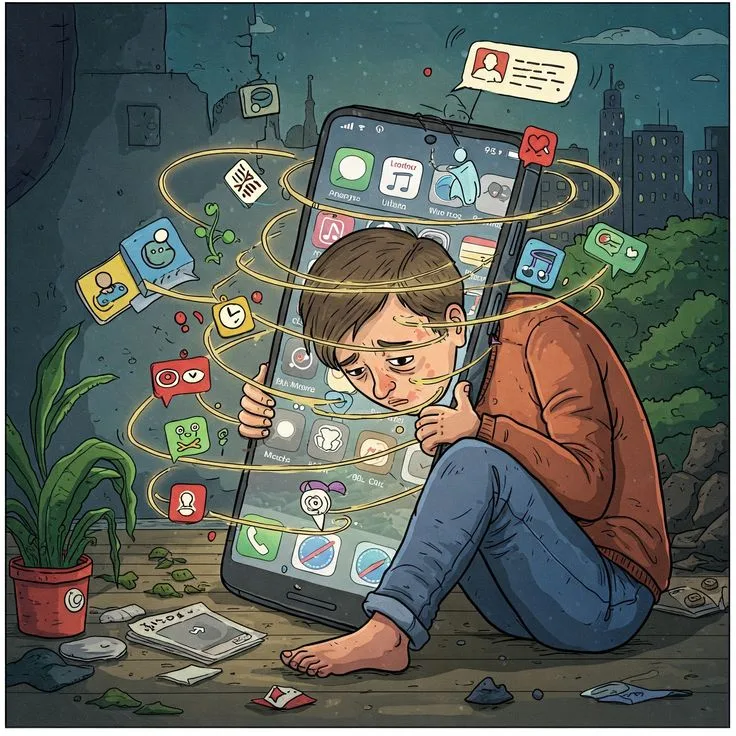
Become: Sean Parker was the first president of Facebook. In a 2017 interview at an Axios event, he described with unusual candor the thought process that had guided the platform's design from the beginning. "How do we consume as much of your time and conscious attention as possible?" he said.
The answer, he explained, was to give users "a little dopamine hit every once in a while, because someone liked or commented on a photo or a post," creating "a social-validation feedback loop." He said the people who built these platforms, himself included, understood what they were doing.
"And we did it anyway." Parker was not describing a side effect or an unintended consequence. He was describing the goal.
That admission, from inside the architecture of the attention economy, crystallized something that researchers in behavioral neuroscience, human-computer interaction, and clinical psychology had been working toward for years: a comprehensive account of why smartphones have become the most behaviorally compelling objects in human history, why the average person checks their phone 52 times per day, and why the compulsion to do so operates largely below the level of conscious decision.
The answer is not a failure of character or willpower. It is the predictable result of applying the most powerful principles in behavioral psychology to devices that are always present, always connected, and always offering the possibility of something new.
This is not a simple story about dopamine and slot machines, though that metaphor contains truth.
It is a story about the intersection of evolutionary psychology, behavioral engineering, social neuroscience, and economic incentives - about what happens when trillion-dollar companies deploy the full toolkit of human behavioral science against the attentional systems of users who have no comparable counter-toolkit.
"We have created a world in which online connection has become primary, especially for the young. And in doing so, we may have inadvertently disconnected ourselves from the world we live in." - Tristan Harris, former Google design ethicist
Key Definitions
Variable reward schedule: A reinforcement pattern in which rewards are delivered unpredictably, shown by B.F. Skinner's research to produce the most persistent and compulsion-resistant behavior. Slot machines and social media notifications both operate on this principle.
Hook Model: Nir Eyal's four-stage behavioral loop - trigger, action, variable reward, investment - describing how digital products create habitual use patterns.[2] Documented in Eyal's 2014 book Hooked: How to Build Habit-Forming Products.
Persuasive technology: BJ Fogg's term for technology designed specifically to change human attitudes and behaviors.[1] Fogg founded the Behavior Design Lab at Stanford, which trained many of the designers who built the engagement systems of major social platforms.
Dopaminergic anticipation: The neurochemical state of wanting and seeking, driven by dopamine in the mesolimbic pathway. Distinguished by neuroscientist Kent Berridge from the experience of pleasure or "liking," which involves separate opioid systems.
Mere presence effect: The finding by Adrian Ward and colleagues at the University of Texas (2017) that the mere presence of a smartphone - even face down and silenced - reduces available cognitive capacity by occupying a portion of working memory with the effort of not attending to it.
Phantom vibration syndrome: The perception of a vibration alert from a phone that has not vibrated. Documented in multiple surveys with prevalence rates of 68-89% among smartphone users; believed to reflect hypervigilance to phone signals that has become a background cognitive state.
The Hook Model: How Digital Products Engineer Compulsion
| Stage | Design mechanism | Examples in social media | Psychological principle |
|---|---|---|---|
| Trigger (external) | Notification badge, push alert, icon | Red badge on app icon; "X liked your post" | Classical conditioning; Pavlovian cue |
| Trigger (internal) | Emotional state maps to app open | Boredom open Instagram; anxiety open Twitter; loneliness open any platform | Internal triggers more powerful; cannot be disabled |
| Action | Frictionless interface; swipe gesture | One tap to open; infinite scroll; swipe-to-refresh | BJ Fogg motivation ability model; reduce friction |
| Variable reward | Unpredictable content quality in feed | Sometimes interesting, sometimes boring; sometimes validated, sometimes ignored | Skinner variable ratio schedule - most compulsion-resistant pattern |
| Investment | User-generated value locked in platform | Follower list; message history; posted memories; curated profile | Sunk cost; switching cost; value deposits make leaving costly |
The Slot Machine in Your Pocket
In his 1938 book The Behavior of Organisms, B.F. Skinner described the results of experiments in which rats received food pellets from a lever.[10] When the lever delivered pellets on a fixed schedule - every fifth press, say - the rats pressed steadily and rested after each delivery.
When the lever delivered pellets randomly, sometimes after one press, sometimes after twenty, never predictably - the rats pressed obsessively, with almost no rest, even when no pellets arrived for extended periods.
Skinner called this a variable ratio reinforcement schedule, and he identified it as the most powerful known mechanism for maintaining persistent behavior.
That principle, now a foundational element of behavioral science, was eventually imported directly into the design of digital products.
Natasha Dow Schull, an anthropologist at NYU who spent years studying gambling machine design in Las Vegas, documented in her 2012 book Addiction by Design how slot machine engineers had refined variable ratio schedules over decades into near-perfectly optimized behavioral traps.[9]
The machines were tuned not merely to produce winning but to produce an anticipatory state - a continuous forward-leaning attention - that kept players in what Schull called "the zone": a dissociative state of absorption that players described as the actual goal of gambling, more desired than the money itself.
When BJ Fogg began teaching his Behavior Design curriculum at Stanford in the 2000s, students who absorbed his principles went on to apply them to mobile applications with one crucial advantage over slot machines: the devices could be in users' pockets at all times, rather than requiring a trip to a casino.
The variable reward of social media - the unpredictable arrival of a like, a comment, a new follower, a piece of news - could follow users everywhere, at all times, making the anticipatory state continuous rather than situational.
Aza Raskin, who invented the infinite scroll mechanism while working at a startup before it became ubiquitous on social platforms, later estimated in a 2018 interview that infinite scroll was responsible for approximately 200,000 extra hours of scrolling per day across the internet.
"It's not that they intended for it to be this way," he said of the engineers who built these systems.
"It's just there was no one in the room saying, 'Wait - should we do this?'" Raskin founded the Center for Humane Technology alongside Tristan Harris, a former Google design ethicist who testified before the U.S.[12]
Senate in 2017 that the attention economy had created a race to the bottom of the brain stem - a competition among platforms to capture attention by targeting the most primitive and compelling drives.
The Neuroscience: What Dopamine Is Actually Doing
The phrase "dopamine hit" has become the default shorthand for explaining phone addiction, but the neuroscience it gestures at is more specific - and more important - than the phrase implies.
Kent Berridge, a neuroscientist at the University of Michigan, has spent his career distinguishing between two neurochemical systems that people conflate under the general term "reward": wanting and liking.[7] The wanting system is dopaminergic - it drives anticipation, seeking, and approach behavior.
The liking system involves opioid receptors and generates the subjective experience of pleasure or satisfaction. These are separable systems that can be dissociated experimentally.
Rats whose dopamine systems are destroyed stop seeking food even though they still display pleasure responses when food is placed in their mouths; rats in which liking systems are disrupted will work obsessively to obtain rewards that they no longer enjoy.
The relevance to phone behavior is direct. The experience of checking a phone - picking it up, unlocking it, opening an app - is driven by the wanting system.
The anticipatory dopamine surge that motivates checking is typically larger than the satisfaction that checking delivers, because checking reliably delivers something, but variably delivers something rewarding.
This is why the experience of checking can feel compulsive even when it rarely feels genuinely satisfying: the dopaminergic wanting system is not calibrated by the liking system's actual outputs in the way a simple reward-learning model would predict.
Robert Sapolsky, a neuroendocrinologist at Stanford, has described this mechanism in lectures and in his 2017 book Behave with particular clarity.[8] Dopamine neurons, he explains, respond maximally not to reward itself but to a cue that predicts a possible reward with uncertain probability.
The anticipation of possible reward generates more dopaminergic activity than the certain receipt of the same reward. This is not a design flaw in the brain; it is an adaptation that makes organisms maximally motivated to engage with uncertain environments. But it is also the precise mechanism that variable reward schedules exploit.
Every notification is a possible reward - a message from someone who matters, a piece of news that is genuinely important, a social validation that feels good.
The certainty of some notifications being trivial does not suppress the dopaminergic anticipation, because the possibility of a rewarding one is sufficient to sustain the wanting. The phone is never not potentially interesting. That is the trap.
The Hook Model and Deliberate Behavioral Engineering
Nir Eyal's 2014 book Hooked: How to Build Habit-Forming Products describes a four-stage cycle that he terms the Hook Model, derived from his analysis of the most behaviorally compelling digital products. The four stages are trigger, action, variable reward, and investment.
The trigger can be external (a notification, an icon badge, someone else picking up their phone) or internal (a moment of boredom, anxiety, loneliness, or uncertainty). Internal triggers are more powerful than external ones because they cannot be turned off - they follow the user everywhere.
Apps that successfully associate their brand with powerful internal emotional states become self-triggering: boredom becomes a cue to open Instagram, anxiety becomes a cue to open Twitter, loneliness becomes a cue to open any platform where other people appear present.
The action must be made as frictionless as possible - the number of steps between trigger and engagement minimized to the point where the behavior becomes nearly automatic. Every second of loading time, every confirmation screen, every additional tap represents friction that behavioral design tries to eliminate.
The swipe gesture, one of the most physically natural human movements, is not accidentally the dominant interface action for content consumption.
The variable reward is the content of the experience - the unpredictable mix of interesting and boring, flattering and neutral, validating and ignoring, that the feed delivers. What matters is that the user cannot know in advance which category the next item will be, so each refresh constitutes a new trial in a variable ratio schedule.
The investment stage is the element that distinguishes social platforms from other variable reward systems and makes them peculiarly difficult to disengage from.
When users post content, build follower lists, establish messaging histories, and accumulate profile-stored memories, they deposit value into the platform - value that would be lost upon leaving.
The more a user has invested in a platform, the more the cost of leaving increases, independent of how much ongoing benefit the platform provides. This is the social media equivalent of the sunk cost fallacy, engineered into the product architecture.
Sean Parker, Chamath Palihapitiya, and the Insider Confessions
The most striking evidence that these mechanisms were deliberately engineered rather than accidentally discovered comes from former platform insiders who have spoken publicly about the design intentions.
Sean Parker's 2017 admission that Facebook was designed to give users "a dopamine hit every once in a while" and that this was understood to be "exploiting a vulnerability in human psychology" has already been noted.
Chamath Palihapitiya, the former Facebook Vice President for User Growth, told an audience at Stanford's Graduate School of Business in 2017 that the short-term dopamine-driven feedback loops Facebook had created were "destroying how society works." He added: "I can control my use, and that is a hard problem.
But my kids don't get to use that sh*t." Both Parker and Palihapitiya had made their fortunes building these systems before expressing concern about them.
Tristan Harris, who was a design ethicist at Google before leaving to found the Center for Humane Technology, has argued that the problem is structural and competitive rather than a matter of individual company ethics.
In the attention economy, where advertising revenue is proportional to user attention, any platform that voluntarily makes its product less engaging loses advertising revenue to competitors that do not.
The competitive pressure creates a race toward the most behaviorally compelling - and therefore most exploitative - product design, regardless of what individual engineers or executives believe about the ethics of what they are building.
The Mere Presence Effect and Cognitive Taxation
Adrian Ward, a psychologist at the McCombs School of Business at the University of Texas at Austin, published a study in 2017 in the Journal of the Association for Consumer Research that demonstrated one of the most practically significant findings in the smartphone compulsion literature: the mere presence of a smartphone on a desk reduced participants' cognitive performance even when it was face down, silent, and not in use.[5]
The study, conducted with 520 smartphone users, randomly assigned participants to have their phones on their desk face down, in their pocket or bag, or in another room. All participants were told to silence their phones and focus on the cognitive tasks.
Those whose phones were in another room significantly outperformed those whose phones were on the desk, with those in the pocket/bag condition performing in between.
The effect was mediated by what Ward and colleagues called "brain drain" - the cognitive resources occupied by the effortful suppression of the habitual impulse to attend to the phone, even when the phone was not actively generating stimulation.
The finding has implications that extend well beyond the lab. If the mere physical presence of a phone reduces cognitive capacity even when the phone is not being used, then the widespread practice of keeping phones on desks during work, school, and conversation represents a continuous low-level cognitive tax.
The brain is continuously not-checking the phone, which requires attentional resources, rather than being simply free of the phone's competing claims on attention.
Phantom vibration syndrome - the perception of a phone vibrating when it has not - illustrates the same phenomenon from a different angle.
Surveys by Robert Rosenberger and Michelle Drouin have found that approximately 68-89% of smartphone users experience phantom vibrations regularly, and that the phenomenon is more common in heavier smartphone users.[11]
The perceptual phenomenon suggests that the brain's attentional monitoring of potential phone signals has become a persistent background process - a form of hypervigilance to social-signal possibilities that cannot be fully switched off.
Separation Anxiety and the Biology of Disconnection
Multiple studies have examined the physiological responses people show when separated from their smartphones, and the findings suggest that for many users, the experience of phone separation resembles mild stress or anxiety rather than neutral absence.
Russell Clayton and colleagues at the University of Missouri published a 2015 study in which participants completed cognitive performance tasks while their phones were either present or had been moved to another room under the pretext of Bluetooth testing.[6]
When the phone rang during the separated condition and participants could not answer it, they showed significantly elevated heart rate and blood pressure, higher self-reported anxiety, and worse performance on cognitive tasks.
Notably, the performance decrements appeared even before the phone rang - the anticipatory state of phone separation itself impaired cognition.
These physiological responses do not constitute addiction in a clinical sense, but they demonstrate that the relationship between heavy smartphone users and their devices has acquired some of the properties of dependent relationships: the absence of the thing produces distress, and the anticipation of that distress motivates behavior to maintain proximity.
Cal Newport, a computer scientist at Georgetown University whose 2019 book Digital Minimalism offers one of the most practically grounded frameworks for addressing smartphone compulsion, describes this as the difference between using a tool purposefully and being in a relationship with a device - one in which the device's needs (constant attention) increasingly govern the user's behavior.
Average Use and the Daily Reality
Current behavioral data on smartphone use suggests the scale of the issue. App analytics aggregated from hundreds of millions of devices consistently find average use of 4-6 hours per day among adults, with teenagers averaging closer to 7-9 hours including gaming and video.
Americans unlock their phones an average of 52 times per day according to app analytics firm data published by Asurion in 2020.
A 2021 review published in PLOS ONE found that 61 studies across different methodologies documented significant rates of "problematic smartphone use," with estimates ranging widely depending on the definition used but typically falling between 10 and 30 percent of smartphone users.
These figures reflect not just entertainment choices but a fundamental restructuring of human attention.
Adam Alter, a psychologist at NYU Stern School of Business and author of the 2017 book Irresistible: The Rise of Addictive Technology, has argued that the behavioral compulsions created by modern technology represent a public health issue on the scale of obesity - a case where environmental design has outrun human biological capacity for resistance, and where individual willpower is an inadequate response to a systemic design problem.[3]
Practical Takeaways
Change the environment, not just your intentions. The research on habit change consistently shows that environmental redesign outperforms willpower-based approaches. Move the phone out of the bedroom. Remove social apps from the home screen.
Put the phone in a drawer during meals and conversations. These are structural changes that reduce the frequency of automatic checking without requiring ongoing effortful resistance.
Turn off all notifications except direct communications. Notifications are external triggers that initiate Hook Model cycles. Limiting notifications to calls and direct messages from specific people removes the vast majority of external trigger inputs and substantially reduces checking frequency for most users.
Try grayscale mode. Research and practitioner experience suggest that removing color from the phone display reduces visual appeal and unconscious attention pull. Most smartphones allow this in accessibility settings.
Conduct a use audit before you try to change. Most people substantially underestimate their own phone use. Spend one week with your phone's screen time feature turned on and review the actual data. The number is almost always surprising and is more motivating than abstract concern about phone use.
Apply the 30-day digital declutter. Cal Newport's framework - removing all optional digital technologies for 30 days, then selectively reintroducing only those that pass a deliberate evaluation of whether they serve identified values - is the most comprehensive evidence-adjacent framework currently available.[4]
The 30-day period is long enough to break habits and create enough distance to evaluate what you actually miss versus what you thought you would miss.
Address the underlying triggers. If boredom, anxiety, loneliness, or uncertainty are the internal triggers that prompt phone checking, those states need direct attention.
The phone is often a symptom of needs that it cannot genuinely meet - the compulsive checking of social media for connection when what is needed is actual human contact, or the checking of news when what is needed is a sense of control over an uncertain situation.
Sources & Further Reading
- Fogg, B. J. (2003). Persuasive Technology: Using Computers to Change What We Think and Do. Morgan Kaufmann.
- Eyal, N. (2014). Hooked: How to Build Habit-Forming Products. Portfolio/Penguin.
- Alter, A. (2017). Irresistible: The Rise of Addictive Technology and the Business of Keeping Us Hooked. Penguin Press.
- Newport, C. (2019). Digital Minimalism: Choosing a Focused Life in a Noisy World. Portfolio/Penguin.
- Ward, A. F., Duke, K., Gneezy, A., & Bos, M. W. (2017). Brain drain: The mere presence of one's own smartphone reduces available cognitive capacity. Journal of the Association for Consumer Research, 2(2), 140-154.
- Clayton, R. B., Leshner, G., & Almond, A. (2015). The extended iSelf: The impact of iPhone separation on cognition, emotion, and physiology. Journal of Computer-Mediated Communication, 20(2), 119-135.
- Berridge, K. C., & Robinson, T. E. (2016). Liking, wanting, and the incentive-salience theory of addiction. American Psychologist, 71(8), 670-679.
- Sapolsky, R. M. (2017). Behave: The Biology of Humans at Our Best and Worst. Penguin Press.
- Schull, N. D. (2012). Addiction by Design: Machine Gambling in Las Vegas. Princeton University Press.
- Skinner, B. F. (1938). The Behavior of Organisms: An Experimental Analysis. Appleton-Century-Crofts.
- Rosenberger, R., & Drouin, M. (2014). Phantom phone signals: An investigation of phantom vibration and ringing among college students and young adults. Computers in Human Behavior, 30, 173-179.
- Harris, T. (2017). Testimony to the Senate Commerce Committee on Social Media's Effects on Democracy. U.S. Senate.
Related reading: How Social Media Affects Mental Health: What the Research Really Shows | Why People Procrastinate: The Psychology Behind Putting Things Off