
Human judgment combines fast, automatic intuitions with slower, effortful reasoning that requires attention and working memory. Dual process theory describes these systems and the different roles they play when people form impressions, solve problems, or make deliberate choices under uncertainty.
What Is Dual Process Theory?
Dual process theory is a psychological framework proposing that human thought and judgment operate through two distinct systems: a fast, automatic, unconscious process (System 1) and a slow, deliberate, effortful process (System 2).
System 1 generates rapid intuitions and impressions with no sense of conscious control, while System 2 handles careful reasoning that requires sustained attention and working memory.
The theory, developed across decades by researchers including Daniel Kahneman, Amos Tversky, and Keith Stanovich, explains why intelligent people reliably make predictable errors and why intuition often overrides deliberate reasoning at the moment of decision.
Consider the following problem. A bat and a ball together cost $1.10. The bat costs $1.00 more than the ball. How much does the ball cost?
An answer arrives almost immediately: 10 cents. It comes without effort, without hesitation, and with a feeling of self-evidence. It is wrong. If the ball costs 10 cents and the bat costs $1.00 more, then the bat costs $1.10, and together they cost $1.20 - not $1.10.
The correct answer is 5 cents. Deriving it requires nothing more than simple algebra, but it requires something that the first answer did not require: the willingness to slow down, to check, to distrust the quick sense of having already solved the problem.
Shane Frederick published this question - along with two others of similar structure - in the Journal of Economic Perspectives in 2005 as the Cognitive Reflection Test (CRT).[10] He administered it to approximately 3,400 students across elite American universities including Harvard, MIT, and Princeton.
More than fifty percent of those students answered 10 cents. Cognitive sophistication is no guarantee against the fast, confident, and wrong answer.
Now consider a second demonstration. In 1983, Amos Tversky and Daniel Kahneman published a paper in Psychological Review describing a woman named Linda: thirty-one years old, single, outspoken, very bright, majoring in philosophy, deeply concerned with issues of discrimination and social justice, active in antinuclear demonstrations.
Participants were asked to rank a list of statements about Linda by probability. The critical comparison was between "Linda is a bank teller" and "Linda is a bank teller and is active in the feminist movement." Eighty-five percent of participants ranked the conjunction as more probable than the constituent.
This is a logical impossibility - the probability of two events occurring together cannot exceed the probability of either event occurring alone. The participants knew this in the abstract. Most had training in probability. But something more powerful than their explicit knowledge was operating.
The description of Linda felt so congruent with the feminist bank teller that the conjunction seemed not just plausible but necessary. The feeling of fit had displaced the calculation of probability.
These two experiments - separated by twenty-two years - point to the same underlying phenomenon: that human beings regularly reason with a process that is fast, associative, confident, and capable of spectacular error, and that a second, slower, more effortful process exists to correct it but often fails to engage.
"System 1 operates automatically and quickly, with little or no effort and no sense of voluntary control." - Daniel Kahneman, 2011
System 1 vs. System 2: A Structural Comparison
| Dimension | System 1 | System 2 |
|---|---|---|
| Speed | Milliseconds; runs continuously and in parallel | Seconds to minutes; engaged serially and on demand |
| Consciousness | Largely inaccessible; outputs arrive as feelings, intuitions, or impressions | Conscious; reasoning steps are available for inspection and verbal report |
| Effort | Effortless; minimal metabolic and attentional cost | Effortful; requires working memory and sustained attention; can be depleted |
| Capacity | High capacity; handles multiple streams simultaneously | Low capacity; serial; easily overloaded; bottlenecked by attentional resources |
| Error type | Conjunction fallacies, base rate neglect, attribute substitution, availability errors, anchoring, belief bias | Rationalization of intuitive conclusions, motivated skepticism, planning fallacy, myside bias, selective evidence search |
| Evolutionary history | Phylogenetically older; shared with many non-human animals; adapted to rapid threat detection and pattern recognition in familiar environments | Phylogenetically recent; associated with language and abstract reasoning; expanded dramatically with Homo sapiens |
| Neural correlates | Amygdala, basal ganglia, striatum, ventromedial prefrontal cortex; fast, stimulus-driven activation | Lateral prefrontal cortex, anterior cingulate cortex, parietal regions; slow, goal-directed activation |
| Examples | Reading a face for emotion, driving a familiar route, catching a ball, recoiling from a snake, intuitive numerical estimates | Solving a differential equation, weighing the pros and cons of a financial decision, planning a route in a new city, checking a logical argument |
The Cognitive Science: Researchers, Journals, Findings
The framework known as dual process theory was not the invention of any single mind. It crystallized from at least four partially independent research traditions, each of which contributed empirical anomalies and theoretical structures that eventually merged into the dominant model.
Epstein's Cognitive-Experiential Self-Theory (1994)
The earliest fully articulated dual-process account within academic psychology came from Seymour Epstein at the University of Massachusetts. In a 1994 paper in Psychological Review (Vol. 101, No. 4, pp. 709-726), Epstein proposed two fundamentally different processing systems operating in parallel.[4]
The experiential system is holistic, associative, affectively driven, and encoded in concrete images and narratives; it is fast and operates largely outside awareness.
The rational system is analytic, intentional, logical, and encoded in abstract language; it is slow, deliberate, and accessible to conscious inspection.
Epstein was explicit that the experiential system was not a degraded or primitive version of the rational one - it was a different kind of processing with its own adaptive coherence and internal logic.
He grounded CEST in empirical work on superstitious behavior, showing that individuals who explicitly and sincerely rejected magical beliefs would nonetheless act on them in behavioral paradigms where the experiential system was engaged.
The person who knows that touching wood has no causal efficacy still reaches for it when the situation feels sufficiently charged.
Sloman's Empirical Case (1996)
Steven Sloman at Brown University published "The Empirical Case for Two Systems of Reasoning" in Psychological Review (1996, Vol.[5] 103, No. 1, pp. 3-45).
Sloman's contribution was largely analytical: he surveyed evidence across syllogistic reasoning, probability judgment, categorization, and problem-solving, and argued that the cumulative pattern demanded two distinct processing systems with different computational principles.
His key criterion was simultaneous contradictory belief: people routinely hold two judgments about the same object at the same time - one associative, one rule-based - without resolving them into a single verdict.
A participant can simultaneously believe that a logical conclusion follows from the premises (rule-based output) and that it is false (associative output from prior world knowledge), and can report both beliefs without experiencing them as contradictory.
The two processes do not compete to extinction; they coexist, each generating its own output, with behavioral response reflecting a resolution between them.
Evans's "In Two Minds" (2003)
Jonathan Evans, whose research on belief bias had already provided key empirical support for a dual-process account, published a major theoretical review in Trends in Cognitive Sciences in 2003 (Vol.[9] 7, No. 10, pp.
454-459) under the title "In two minds: dual-process accounts of reasoning." This paper served as a synthetic statement of where the field stood at the turn of the millennium.
Evans mapped the theoretical landscape, clarified the distinction between implicit and explicit processes, and addressed the critical question of whether the two systems are best characterized as independent systems or as two ends of a single processing continuum.
He argued for the former while acknowledging the difficulty of specifying the boundary. The paper became one of the most cited works in the field and helped consolidate the two-systems vocabulary as a working consensus across cognitive psychology and behavioral economics.
Stanovich and West: Naming the Architecture (2000)
The specific labels "System 1" and "System 2" entered the literature through Keith Stanovich and Richard West's 2000 paper in Behavioral and Brain Sciences (Vol.[8] 23, No. 5, pp. 645-726).
Stanovich and West were engaging a live debate: were documented violations of rationality norms evidence against the norms themselves, or evidence of deficiencies in human cognition? Their answer: the violations were real and systematic, but they were not uniform.
Individual differences in cognitive ability and cognitive style predicted compliance with normative standards. Higher-analytic individuals were more likely to inhibit initial intuitions and apply formal rules.
Stanovich and West used System 1 and System 2 as theoretical shorthand - not as claims about neural substrate or modular architecture, but as markers for two classes of process that differed in their accessibility to intentional control, their resource demands, and their relationship to normative rationality.
Four Named Case Studies
Case Study 1: The Trolley Problem and Moral Intuition - Greene et al. (2001)
Joshua Greene, Leigh Nystrom, Andrew Engell, John Darley, and Jonathan Cohen published a neuroimaging study in Science in 2001 (Vol.[7] 293, pp. 2105-2108) that applied dual-process theory directly to moral psychology.
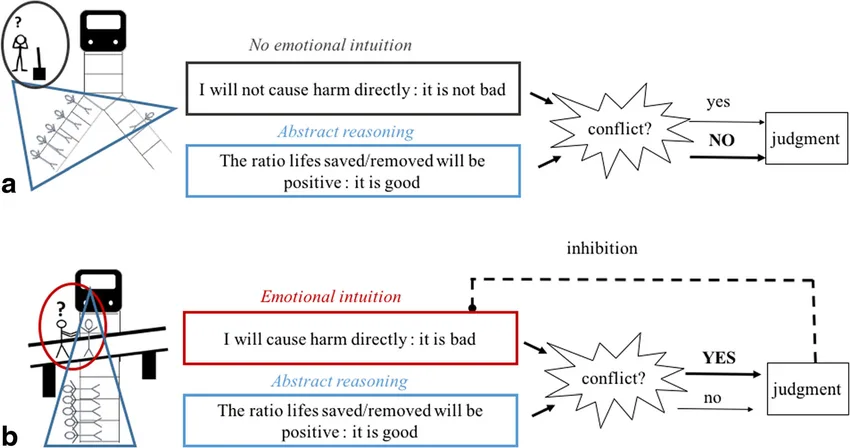
Participants inside an fMRI scanner were presented with two versions of the trolley problem: a standard footbridge dilemma (push a large man off a bridge to stop a runaway trolley from killing five people) and a switch dilemma (pull a lever to divert the trolley onto a side track where it will kill one person).
Philosophically, both involve redirecting harm from five to one. But most people find the footbridge case morally repugnant and the switch case acceptable, even when the outcomes are formally equivalent. Greene et al.
found that the footbridge dilemma - which involves direct physical violence - recruited regions associated with emotional processing, including the medial prefrontal cortex and posterior cingulate.
The switch dilemma recruited regions associated with deliberative cognition: lateral prefrontal and parietal areas.
Moreover, participants who eventually chose to push the man in the footbridge dilemma - the utilitarian choice - showed greater activation in working memory regions and took significantly longer to respond, as if overriding a strong emotional response.
Greene interpreted this as direct neural evidence for dual-process architecture in moral judgment: emotional intuitions (System 1) produce the deontological response; deliberate reasoning (System 2) can sometimes override it in the direction of utilitarian calculation.
The paper was influential and controversial in equal measure, generating debate about the relationship between normative moral theory and psychological mechanism that continues today.
Case Study 2: The Conjunction Fallacy - Tversky and Kahneman (1983)
The Linda problem, published in Psychological Review (1983, Vol. 90, No. 4, pp. 293-315), demonstrated the conjunction fallacy: the systematic overestimation of the probability of a conjunction relative to its constituent events.
The finding survived changes in stakes, transparent presentation of the logical constraint, and statistical training.
Kahneman and Tversky attributed it to the representativeness heuristic: Linda's description is highly representative of the feminist activist category, and the conjunction captures that representativeness while the bare category does not.[2]
The heuristic is tracking something real - Linda's profile does resemble the feminist more than the bank teller alone - but representativeness is not probability. System 1 conflates them, and the error persists even when System 2 is nominally engaged.
This experiment became the empirical foundation of dual-process theory before the framework existed to receive it.
Case Study 3: The Cognitive Reflection Test - Frederick (2005)
Frederick's CRT, published in the Journal of Economic Perspectives (2005, Vol. 19, No. 4, pp. 25-42), provided the field with a brief, psychometrically tractable instrument for measuring the tendency to override intuitive responses.
Each item generates a compelling but incorrect intuitive answer that must be inhibited before the correct answer can be computed.
Frederick found that CRT scores predicted behavior across a range of decision-making domains: high scorers were more patient in intertemporal choice, more accurate in probability judgment, and less susceptible to framing effects.
The CRT's correlation with SAT scores and IQ measures was positive but modest, indicating it captures something beyond general cognitive capacity - specifically, the disposition to distrust one's own first answers.
The bat and ball problem became the emblematic illustration of confident System 1 overreach, because the wrong answer (10 cents) is not random noise; it is the coherent response to a different question ("how much more expensive is the bat?") that System 1 has silently substituted for the question that was actually asked.
Case Study 4: The APE Model and Attitude Formation - Gawronski and Bodenhausen (2006)
Bertram Gawronski and Galen Bodenhausen published their Associative-Propositional Evaluation (APE) model in Psychological Bulletin in 2006 (Vol.[11] 132, No. 5, pp. 692-731).
The APE model extended dual-process theory to the domain of attitude formation and change, proposing that evaluative responses arise from two distinct but interacting processes: associative processes that generate affective reactions based on learned associations (linked to System 1) and propositional processes that assess the validity of those reactions by subjecting them to logical analysis (linked to System 2).
The model made specific predictions about when the two processes would conflict and when attitude change produced by persuasion versus conditioning would generalize.
Crucially, it predicted that propositional reasoning could change explicit attitudes without changing the underlying associative network, and vice versa - that new associations could form without altering propositionally held beliefs.
This dissociation between implicit and explicit attitude measures, extensively documented in the implicit social cognition literature, became central evidence for the claim that the two systems are not merely different speeds of the same process but different kinds of representation entirely.
Intellectual Lineage: Who Influenced Whom
The genealogy of dual-process theory runs through several partially independent intellectual traditions.
The oldest strand traces to William James, who distinguished in his 1890 Principles of Psychology between associative thought - governed by habit, contiguity, and emotional resonance - and reasoning proper, governed by selective attention and systematic comparison.
Freud's distinction between primary and secondary process thought carried a parallel structure into the clinical tradition: the primary process operates by wish-fulfillment, condensation, and displacement; the secondary process operates by reality-testing, delay of gratification, and logical constraint.
Neither James nor Freud constructed an empirical research program capable of testing these claims rigorously, but both shaped the conceptual vocabulary available to later researchers.
Within twentieth-century academic psychology, the immediate precursor was the heuristics and biases program inaugurated by Kahneman and Tversky in a series of papers beginning in the early 1970s, most systematically in their 1974 Science paper "Judgment under uncertainty: Heuristics and biases." This program documented systematic and patterned deviations from normative rationality across a wide range of probability judgment and decision tasks, and it demonstrated that these deviations were not random noise - they were the predictable outputs of identifiable mental shortcuts.[1]
The heuristics were not adequately explained by existing models of cognition. They required an explanatory framework. Dual-process theory would eventually provide it.
Peter Wason's work on deductive reasoning, particularly his selection task (described in Quarterly Journal of Experimental Psychology), had already established that people systematically fail to seek falsifying evidence even when explicitly instructed to test logical rules.[3]
Wason himself did not frame this in dual-process terms, but the pattern fit naturally: a confirmation-seeking, associative mode operating against a formally instructed analytic one.
Epstein (1994) drew on clinical psychology and the personality tradition rooted in ego psychology. Sloman (1996) drew on connectionist models and symbolic AI, borrowing the contrast between pattern-completion networks and explicit rule-following programs as a formal analog to the psychological distinction.
Stanovich and West (2000) drew on psychometrics and individual differences research, contributing the insight that analytic engagement is partly dispositional - that cognitive miserliness is a stable individual trait, not merely situational.
Evans, across four decades of research, provided the foundational empirical work on belief bias, conditional reasoning, and the development of explicit dual-process theory.[6]
Kahneman's 2011 popular synthesis, Thinking, Fast and Slow (Farrar, Straus and Giroux), drew all of these strands into a unified account that reached well beyond the academic audience.[13] System 1 and System 2 became part of the common vocabulary of behavioral economics, public policy, and management science.
The influence was substantial enough that the framework's critics began to complain that its rhetorical success had outrun its empirical warrant.
Empirical Research: Converging Evidence
The evidentiary base for dual-process distinctions is broad and draws from multiple methodologies.
Neuroimaging studies have found that tasks associated with analytic reasoning recruit lateral prefrontal and parietal cortex, while tasks associated with heuristic or intuitive responding show greater involvement of medial prefrontal cortex, amygdala, and striatum (Goel and Dolan, 2003, Cognitive Brain Research; Greene et al., 2001, Science).
These findings are consistent with, though they do not prove, a distinction between processing modes with different neural implementations.
Time pressure experiments have consistently shown that restricting available response time increases heuristic responding: more conjunction fallacies, more base rate neglect, more attribute substitution under time pressure, and somewhat less of each when deliberation time is extended (Finucane et al., 2000, Journal of Behavioral Decision Making).
Working memory load studies are particularly telling. Evans and Curtis-Holmes (2005, Psychonomic Bulletin and Review) showed that concurrent digit loads amplified belief bias in syllogistic reasoning - the believability of conclusions had a stronger effect on acceptance when participants were simultaneously maintaining an unrelated memory load.
Wim De Neys (2006, Psychological Science) replicated analogous findings with the conjunction fallacy. These results support the view that analytic override of intuitive output is resource-dependent in ways that intuitive processing is not - which is the central functional prediction of the dual-process framework.
Individual difference research has consistently found that measures of analytic thinking style - including the CRT, the Need for Cognition scale, and active open-minded thinking measures - predict susceptibility to a wide range of cognitive biases, even when general intelligence is statistically controlled (Stanovich and West, 2008, Journal of Personality and Social Psychology; Toplak, West, and Stanovich, 2011, Thinking and Reasoning).
This dissociation between capacity and disposition is important: it suggests that System 2 engagement is not simply a function of having sufficient cognitive resources, but of being disposed to deploy them.
Limits, Critiques, and Necessary Nuances
Dual-process theory has attracted serious, sophisticated criticism. Some of it has sharpened the framework; some of it challenges its foundations.
The Continuum Problem: Keren and Schul (2009)
Gideon Keren and Yaacov Schul published a pointed critique in Perspectives on Psychological Science (2009, Vol.[12] 4, No. 6, pp.
533-548) titled "A case against a unified dual-systems account." Their argument was not that fast and slow processes do not exist, but that the specific claim of exactly two coherent systems - each internally unified, each reliably distinguishable from the other - was a theoretical commitment the data did not justify.
The empirical findings show processing that varies along multiple dimensions - speed, effort, awareness, controllability, reliance on affect - and it is not established that these dimensions co-vary cleanly enough to yield exactly two natural categories. The systems may be taxonomic conveniences rather than psychologically real kinds.
Unimodel and Rule-Based Intuition: Kruglanski and Gigerenzer (2011)
Arie Kruglanski, developing his unimodel (Psychological Bulletin, 2001), argued that both intuitive and analytic responses can be understood as instances of the same inferential process - the application of an if-then rule linking evidence to a conclusion - and that apparent differences between systems are differences in the accessibility, automaticity, and content of the rules applied, not in the nature of the underlying inference.
Gerd Gigerenzer, in a jointly authored piece with Wolfgang Gaissmaier in Annual Review of Psychology (2011, Vol.[14]
62, pp. 451-482), pressed a related but differently motivated argument: many of the errors attributed to System 1 are ecologically rational responses to real-world statistical structure, and the characterization of the intuitive system as prone to error relative to the analytic system fundamentally misrepresents the adaptive function of fast, frugal cognition.
Heuristics often outperform deliberate calculation in environments with limited information and time - environments that resemble the evolutionary context in which they were shaped. The normative framework against which intuitions are measured may itself be inappropriate.
The Myth of the Cognitive Revolution: Melnikoff and Bargh (2018)
David Melnikoff and John Bargh published a more fundamental challenge in Trends in Cognitive Sciences (2018, Vol.[17] 22, No. 3, pp.
184-186) under the title "The myth of the cognitive revolution." They argued that the distinction between automatic and controlled processing - on which dual-process theory ultimately rests - has been systematically misunderstood, and that there is no empirical basis for treating goal-directedness, intentionality, and awareness as co-varying properties that reliably distinguish two processing types.
A process can be automatic in one sense (unintentional) without being automatic in others (unconscious, uncontrollable). The conflation of these distinct properties within the single category of "System 1" has produced theoretical confusion disguised as explanatory clarity.
The paper argued that much of what the cognitive revolution claimed to establish about unconscious processing has not been empirically vindicated at the level of causal mechanism.
Evans's Own Revisions (2012)
Evans, one of the principal architects of the framework, has revised his position substantially.[15] His 2012 paper "Questions and challenges for the new psychology of reasoning" (Thinking and Reasoning, Vol. 18, No. 1, pp.
5-31) acknowledged what he called the magical System 2 problem: many accounts implicitly treat System 2 as capable of correcting any error and reasoning accurately in any domain when given sufficient time and motivation.
But the empirical evidence does not support this. Educated adults make systematic errors in formal logic, probability judgment, and causal inference under conditions of full time, low load, and high motivation. System 2 is not clean - it is subject to motivated reasoning, myside bias, rationalization, and emotional contamination.
The division of cognitive labor is not between a biased System 1 and a reliable System 2; it is between two error-prone systems with different error profiles.
The "Default Interventionist" Resolution
Evans and Stanovich (2013, Perspectives on Psychological Science, Vol.[16] 8, No. 3, pp. 223-241) responded to critics by clarifying what the framework does and does not commit to.
System 1 and System 2, they argued, are claims about two classes of process - autonomous and nonautonomous, respectively - distinguished by whether they require intentional initiation and whether they can be controlled by the reasoner.
They are not claims about discrete neural modules, nor claims about exactly two computational mechanisms, nor claims about the reliability of either process.
The default interventionist model they defended holds that System 1 operates continuously and generates responses as its default outputs; System 2 can intervene, but often does not, because intervention is costly and the intuitive output does not always generate a detectable conflict signal.
This is a more defensible and more empirically tractable position than the popular caricature of System 1 as simply irrational and System 2 as the seat of reason.
Sources & Further Reading
Tversky, A., and Kahneman, D. (1974). Judgment under uncertainty: Heuristics and biases. Science, 185(4157), 1124-1131.
Tversky, A., and Kahneman, D. (1983). Extensional versus intuitive reasoning: The conjunction fallacy in probability judgment. Psychological Review, 90(4), 293-315.
Wason, P. C. (1966). Reasoning. In B. M. Foss (Ed.), New Horizons in Psychology. Penguin.
Epstein, S. (1994). Integration of the cognitive and the psychodynamic unconscious. Psychological Review, 101(4), 709-726.
Sloman, S. A. (1996). The empirical case for two systems of reasoning. Psychological Review, 103(1), 3-45.
Evans, J. St. B. T., Barston, J. L., and Pollard, P. (1983). On the conflict between logic and belief in syllogistic reasoning. Acta Psychologica, 54(1-3), 107-137.
Greene, J. D., Sommerville, R. B., Nystrom, L. E., Darley, J. M., and Cohen, J. D. (2001). An fMRI investigation of emotional engagement in moral judgment. Science, 293(5537), 2105-2108.
Stanovich, K. E., and West, R. F. (2000). Individual differences in reasoning: Implications for the rationality debate. Behavioral and Brain Sciences, 23(5), 645-726.
Evans, J. St. B. T. (2003). In two minds: Dual-process accounts of reasoning. Trends in Cognitive Sciences, 7(10), 454-459.
Frederick, S. (2005). Cognitive reflection and decision making. Journal of Economic Perspectives, 19(4), 25-42.
Gawronski, B., and Bodenhausen, G. V. (2006). Associative and propositional processes in evaluation: An integrative review of implicit and explicit attitude change. Psychological Bulletin, 132(5), 692-731.
Keren, G., and Schul, Y. (2009). A case against a unified dual-systems account. Perspectives on Psychological Science, 4(6), 533-548.
Kahneman, D. (2011). Thinking, Fast and Slow. Farrar, Straus and Giroux.
Gigerenzer, G., and Gaissmaier, W. (2011). Heuristic decision making. Annual Review of Psychology, 62, 451-482.
Evans, J. St. B. T. (2012). Questions and challenges for the new psychology of reasoning. Thinking and Reasoning, 18(1), 5-31.
Evans, J. St. B. T., and Stanovich, K. E. (2013). Dual-process theories of higher cognition: Advancing the debate. Perspectives on Psychological Science, 8(3), 223-241.
Melnikoff, D. E., and Bargh, J. A. (2018). The mythical number two. Trends in Cognitive Sciences, 22(4), 280-293.