
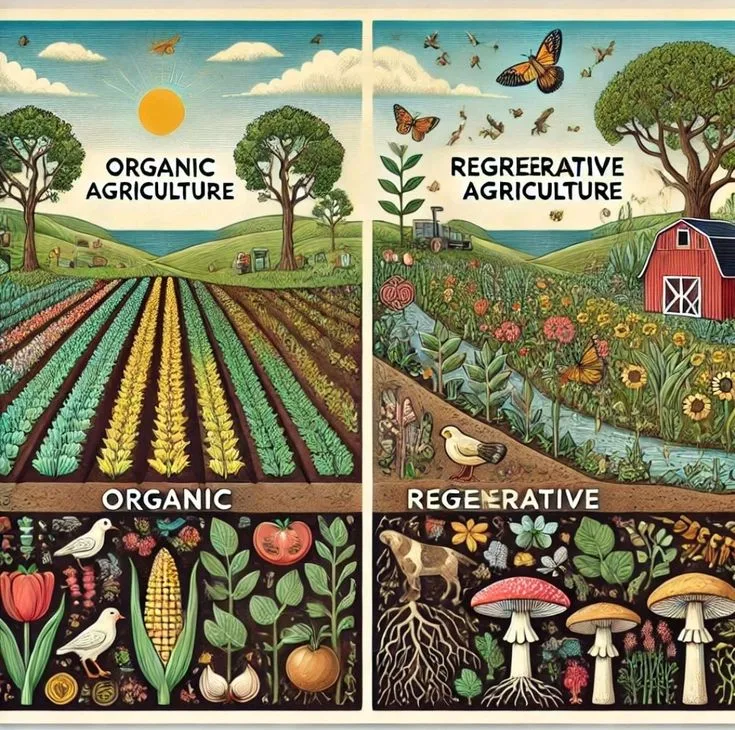
Regenerative: In 1987, the Rodale Institute published a document that quietly introduced a word, one that would spend the next three decades mostly at the margins of agricultural discourse before exploding into corporate sustainability reports, food system policy debates, and climate mitigation proposals.
That word was "regenerative," and the distinction it drew was deliberately pointed: Robert Rodale argued that sustainability simply was not ambitious enough. A farm that sustains current conditions, after all, sustains whatever damage has already been done to get there. Regenerative agriculture sets its sights higher, aiming to reverse that damage and leave soil more alive, more carbon-rich, and more ecologically complex than it was before farming ever began.
The stakes here are not small. Conventional agriculture since World War Two has reduced the organic matter content in American topsoil by an estimated fifty to seventy percent compared to pre-European-settlement levels, according to assessments by researchers including David Pimentel at Cornell University.[8] Soil erosion alone costs the United States roughly $37 billion a year in lost productivity, water treatment, and downstream ecosystem damage, and agriculture accounts for something like ten to twelve percent of global greenhouse gas emissions directly, with land-use change pushing that figure substantially higher still.
If degraded soil could genuinely be rebuilt at scale, the implications for climate stabilization, water security, and agricultural productivity over the coming decades would be significant. That is a large conditional, though. The science behind regenerative agriculture's core practices is real and growing, but the headline claims, that these methods can sequester enough carbon to offset industrial emissions outright, or reverse desertification across whole continents, deserve more scrutiny than the enthusiasm around them usually allows.
The actual literature paints a more layered picture: robust support for some practices, genuinely contested evidence for others, and real unresolved challenges around measurement, yield, and equity.
"To forget how to dig the earth and to tend the soil is to forget ourselves." - Mahatma Gandhi
Key Definitions
Regenerative agriculture: a set of farming and land management practices built to actively improve soil health, biodiversity, and ecosystem function over time, going past merely sustaining current conditions toward actively restoring degraded biological and physical soil properties.
Soil organic matter (SOM): the accumulated layer of decomposed biological material in soil, plant residue, microbial biomass, and stable humus compounds together. It runs roughly 58 percent carbon by weight and stands as the primary measure of a soil's biological health, water retention, and long-term fertility.
No-till farming: a cultivation system where soil goes unplowed and mechanically undisturbed between growing seasons, which preserves soil structure, fungal networks, and accumulated organic matter that would otherwise break down through oxidation and erosion.
Cover crops: plants grown between cash crop seasons specifically to protect and enrich the soil rather than to be harvested themselves. They cut erosion, fix atmospheric nitrogen in the case of legumes, and feed soil biology through root exudates and their eventual incorporation back into the ground.
Mycorrhizal fungi: soil fungi that form a symbiotic relationship with plant roots, extending a root system's effective reach and letting a plant access water and nutrients, phosphorus in particular, that the roots alone never could. These networks get disrupted by tillage and form a key piece of biological soil health.
Core Regenerative Agriculture Practices: Evidence Summary
| Practice | Mechanism | Evidence quality | Effect on soil organic matter | Trade-offs / caveats |
|---|---|---|---|---|
| No-till / reduced tillage | Preserves soil structure, fungal networks, organic matter from oxidation; reduces erosion | Strong; decades of comparative data | +0.1-0.9 t C/ha/year in multiple meta-analyses | Weed pressure increases; herbicide use often rises; benefits depth-dependent |
| Cover crops | Continuous root activity feeds soil biology; reduces erosion; nitrogen fixation (legumes) | Moderate-strong; many RCTs and observational studies | +0.1-0.5 t C/ha/year | Seed costs; water competition in dry climates; termination management required |
| Diverse crop rotations | Disrupts pest cycles; varied root architectures; different residue inputs | Strong for pest suppression, yield stability; moderate for SOM | Moderate positive effect; diversity-dependent | Complexity of planning; market access for non-commodity crops |
| Integrated livestock / managed grazing | Manure inputs; hoof action; root stimulation through grazing; carbon return via urine | Mixed; high variability; some studies show SOM gains, others losses | Highly context-dependent; overgrazing causes loss | Grazing management skill-intensive; methane emissions from ruminants are significant |
| Agroforestry | Trees add permanent carbon above- and belowground; root depth diversification; microclimate moderation | Moderate-strong; established in tropical and temperate systems | +0.3-3.4 t C/ha/year in meta-analyses; wide range | Long establishment timeline; requires capital; changes in crop yield during establishment |
| Compost application | Directly adds stabilized organic matter; feeds soil biology | Strong for soil biology; moderate for long-term C storage | Variable; some carbon rapidly mineralized | Transport costs; availability; nitrogen content management |
Beyond Sustainability: What Regenerative Agriculture Actually Means
Regenerative agriculture has no single, legally enforced definition. No regulatory body certifies it, and no federal standard spells out what practices it requires or prohibits.
That is simultaneously its greatest vulnerability, since it leaves the door open for any company willing to use the label to greenwash with it, and a genuine reflection of ecological complexity. A no-till grain farmer in Kansas and a mixed agroforestry operation in Costa Rica both use the term, and their practices share real principles without ever being identical to each other.
The contrast with organic certification is instructive here. The USDA National Organic Program, established under the Organic Foods Production Act of 1990, defines organic farming mostly by what it prohibits: synthetic pesticides, synthetic fertilizers, genetic engineering, irradiation. A farm can hold organic certification while tilling aggressively every season, running no cover crops, and steadily depleting its own soil organic matter the whole time, because the certification was never designed to say anything about soil outcomes in the first place.
Regenerative agriculture takes the opposite approach, defining itself by what it aims to build rather than what it refuses to use. The Regenerative Organic Certified standard, developed by the Rodale Institute and launched in 2018, tries to codify a genuinely higher bar: demonstrated soil health improvement on top of the usual organic input restrictions, plus additional provisions for animal welfare and farmworker equity.
That standard still covers only a tiny sliver of the farmland claiming to practice regenerative methods, though, and most of the growth in "regenerative" supply chains has happened under brand-specific definitions rather than any real third-party certification.
Synthesizing across the Rodale Institute's own framework, the agroecology tradition associated with Miguel Altieri at UC Berkeley, and the agroforestry research centers working in this space, five principles keep recurring: minimal soil disturbance, continuous soil cover, maximized plant diversity, living roots in the soil year-round, and the integration of livestock. None of these are arbitrary, each reflects a specific mechanism through which soil biology gets maintained or enhanced, but how they translate into an actual farming practice varies considerably by region, climate, and crop system.
The three sisters system, corn, beans, and squash planted together, used by indigenous farming cultures across North America for centuries, is a well-documented example of these polyculture principles at work: corn provides the structure, beans fix the nitrogen, squash blankets the ground, and together the three produce higher aggregate nutrition per unit of land than any monoculture of the three ever could alone.
The Underground World: Soil Biology and the Food Web
The case for regenerative agriculture ultimately rests on soil biology, and understanding why these practices matter means understanding what actually lives in soil and what it does there.
Conventional agriculture treats soil mostly as a physical substrate, a medium for anchoring roots and delivering nutrients, managed through synthetic inputs calibrated to crop demand. Regenerative agriculture treats it as a living system instead, one where the organisms themselves are the actual mechanism behind productivity and resilience.
Elaine Ingham at Oregon State University, and later the Rodale Institute, developed the soil food web framework through decades of research into how soil organisms relate to each other.[6] A teaspoon of healthy agricultural soil holds roughly a billion bacteria, spread across thousands of species performing complementary jobs: fixing nitrogen, solubilizing phosphorus, suppressing pathogens, building structural aggregates. That same teaspoon also holds several yards of fungal filaments, or hyphae, along with protozoa grazing on bacteria and releasing the nitrogen those bacteria accumulated back into a form plants can actually use, plus nematodes, mites, and springtails performing similar grazing and cycling work at a larger scale.
In genuinely healthy soil, this whole system cycles nutrients continuously without needing a synthetic input to prop it up.
Mycorrhizal fungi sit particularly close to the center of plant nutrition, and increasingly to how ecosystems connect at the landscape scale. Roughly ninety percent of land plant species form a mycorrhizal partnership under natural conditions: the fungus colonizes the plant's roots and sends fine hyphae outward into the surrounding soil, exploring a volume many times larger than the root system alone could ever reach.
Those hyphae are thin enough to slip into soil pores no root could enter, pulling in phosphorus and water in conditions that would otherwise leave the plant short. In return, the plant feeds the fungus photosynthetically fixed carbon, and in some systems up to thirty percent of a plant's total carbon fixation flows belowground specifically to feed that mycorrhizal network.
Suzanne Simard at the University of British Columbia documented, through research published across the 1990s and later summarized in her 2021 book "Finding the Mother Tree," that mycorrhizal networks connect multiple plants into a shared underground web, enabling nutrients and carbon to pass between individuals of the same species and even different ones entirely.[7] Older trees can subsidize younger seedlings through these same networks in ways that shape how a forest actually regenerates over time.
The agricultural implications are still being worked out, but the finding reshaped how scientists understand the ecological role of soil networks and sparked real interest in farming practices that protect this fungal infrastructure rather than tearing through it. Tillage disrupts a mycorrhizal network immediately, and rebuilding one after a switch to no-till takes years, not seasons.
Soil organic matter does several jobs at once. Each percentage point it gains lets an acre of soil hold onto roughly 20,000 additional gallons of water, according to USDA Agricultural Research Service estimates, a difference that matters enormously for drought resilience as precipitation grows more erratic under climate change. It also supplies the substrate for nutrient cycling, which can reduce dependence on synthetic fertilizer, itself energy- and emissions-intensive to manufacture, and it stores real carbon: running roughly 58 percent carbon by weight, rebuilding organic matter in depleted soil represents a genuine pathway for drawing carbon back out of the atmosphere.
The Science of Soil Carbon Sequestration: Evidence and Limits
The carbon sequestration case for regenerative agriculture is genuinely real, but assessing it honestly takes some real precision. The evidence runs from robust for specific practices all the way down to speculative once the claims scale up to the whole food system.
The Rodale Institute's Farming Systems Trial, begun in 1981 in Kutztown, Pennsylvania, is the longest continuously running side-by-side comparison of organic, regenerative, and conventional farming anywhere in North America.[1] Across four decades of measurement, the organically managed plots have consistently built up significantly more soil organic matter and carbon than the conventionally managed plots running on synthetic fertilizer and herbicide.
It remains the most-cited long-term evidence for regenerative agriculture's soil-building capacity, though being a single site limits how far its findings can really generalize to other soils, climates, and farming systems.
The cover crop evidence runs considerably broader. A 2015 meta-analysis by Poeplau and Don, published in Agriculture, Ecosystems and Environment, pulled together 139 data points from published studies across North America, Europe, Asia, and Australia.[2] Cover crops raised soil organic carbon by an average of 0.32 megagrams of carbon per hectare per year, a meaningful accumulation that, sustained across large areas over decades, adds up to real atmospheric carbon removal.
A 2012 meta-analysis by Gattinger and colleagues, published in the Proceedings of the National Academy of Sciences and pulling together data from 74 studies worldwide, found significantly higher soil organic carbon in organic versus non-organic farming systems, with a weighted mean difference of 3.50 megagrams of carbon per hectare in the topsoil.[3]
The real challenge sits in the net accounting. Tim Searchinger and colleagues at Princeton University and the World Resources Institute laid out the most rigorous critique in their 2019 report, "Creating a Sustainable Food Future." Their argument: regenerative agriculture's carbon sequestration has to be measured against total food system emissions, land-use change included.[5] If a regenerative farm produces a lower yield per acre, more land has to be converted elsewhere to keep total food production steady, and that land conversion could release more carbon than the regenerative practices ever sequestered back home.
Whether this yield gap actually drives additional conversion in practice depends on a lot of factors outside any single farm's control, but the argument still points at a real gap in farm-level carbon accounting that leaves out the downstream land-use consequences.
A second real constraint comes from the physical ceiling on soil carbon itself. Soil eventually settles into a new equilibrium level of organic matter under a given management regime and simply stops accumulating more carbon past that point. Most credible estimates put the global soil carbon sequestration potential from agricultural practice changes somewhere in the range of several hundred million tons of carbon equivalent a year, significant as a complementary strategy, but nowhere near enough to substitute for direct emissions reductions in energy and industry.
Holistic Planned Grazing: A Contested Practice
No part of regenerative agriculture has generated more controversy than Allan Savory's holistic planned grazing methodology.
Savory, a Zimbabwean ecologist and former military officer, built his approach out of observations of wild herbivore behavior on the African savanna in the 1960s, then refined it over the following decades on rangelands in Zimbabwe, Mexico, and the United States. His central claim is that large ruminant herds, moved intensively and frequently across the land in a pattern that mimics wild prey herds under predator pressure, bunching tightly, grazing and trampling heavily, then moving on and not returning until the land has fully recovered, can regenerate degraded grassland, restore the water cycle, and reverse desertification.
The proposed mechanism is that concentrated hoof action breaks up the soil crust, works plant material into the ground, and carves out micro-catchments for water infiltration, with the following rest period letting the plants fully recover.
Savory's 2013 TED talk, "How to Fight Desertification and Reverse Climate Change," reached 18 million views, and his claim in it was explicit: properly managed livestock across the world's grasslands could sequester enough carbon to return atmospheric CO2 to pre-industrial levels. That claim drew enormous enthusiasm from sustainable agriculture advocates, and just as sustained a wave of criticism from range ecologists.
The most comprehensive scientific response came from a 2008 meta-analysis by David Briske and seven colleagues at Texas A&M University, published in Rangeland Ecology and Management under the title "Rotational Grazing on Rangelands: Reconciliation of Perception and Experimental Evidence." Briske reviewed more than 100 peer-reviewed studies comparing rotational and continuous grazing systems and found no consistent evidence that rotational grazing actually outperforms continuous grazing on plant production, plant species diversity, or soil carbon.[4] A 2013 follow-up review from the same group, examining additional published evidence, landed on the identical conclusion.
The scientific consensus within professional range ecology simply does not back Savory's large-scale desertification reversal claims.
The picture is not entirely negative, though: some research in specific arid and semi-arid contexts has found real, measurable benefits from intensive rotation, particularly in restoring bare patches and improving water infiltration in severely degraded areas. And the broader principle, that ruminant-grazed grassland maintained at the right stocking density with adequate rest can stay productive and biologically healthy, is not actually in dispute.
Most regenerative agriculture researchers draw a careful line between the well-supported value of integrating grazing animals into a diverse farming system, which the agroecology literature backs up broadly, and Savory's specific methodology along with its planetary-scale climate claims, which the literature simply does not support.
Agroforestry and Biodiversity: Trees in the System
Agroforestry, integrating trees, shrubs, crops, and livestock into one managed system, counts among regenerative agriculture's most ecologically productive components, and it is the area with the strongest evidence for both carbon sequestration and biodiversity outcomes.
These systems take several different forms. Alley cropping places rows of nitrogen-fixing or fruit trees between crop rows, where their leaf litter and root turnover add organic matter continuously and their deeper roots reach nutrients an annual crop never could. Silvopasture integrates trees directly with livestock grazing, providing shade that cuts animal heat stress, extra forage, and timber or fruit income alongside the livestock itself.
Complex multi-story polyculture, especially common in tropical regions, mimics the structure of a natural forest, canopy trees, mid-story fruit and nut trees, shrubs, and ground-level crops, all producing at once.
Carbon sequestration in an agroforestry system stacks: woody biomass above ground stores real carbon for decades or even centuries, while a tree's deep root system adds to soil carbon at depths an annual crop never reaches at all. Kim and colleagues, publishing in Agriculture, Ecosystems and Environment in 2016, found temperate agroforestry systems sequestering between 0.3 and 3.9 metric tons of carbon per hectare per year depending on tree density, species, and how mature the system was, a range that reflects genuine diversity across systems rather than sloppy measurement.[11]
Wes Jackson founded The Land Institute in Salina, Kansas in 1976 with a specific mission: developing a perennial grain crop that could replace annual cereals and eliminate the need for annual tillage altogether. Kernza, a perennial wheatgrass that came out of The Land Institute's breeding program, has since reached commercial scale through partnerships with General Mills and Patagonia Provisions.
Its root system extends up to ten feet deep, compared to roughly three to six feet for winter wheat, which contributes substantially to deep soil carbon, though current Kernza grain yields still sit at only about twenty-five percent of conventional wheat as of 2024, and breeding work on Kernza continues in an effort to close that gap.
The Savanna Institute, established in 2013 and based in Chicago, focuses specifically on temperate agroforestry research and farmer training, developing systems adapted to Midwestern growing conditions.
The biodiversity benefits of agroforestry and other diverse perennial systems have been documented consistently. Studies comparing a monoculture field against a diverse agroforestry system find substantially higher populations of pollinators, beneficial insects, and farmland birds, with cascading benefits for natural pest control that reduce how much pesticide a farm actually needs.
Miguel Altieri at UC Berkeley has documented indigenous agroecological systems, including the milpa polycultures of Mesoamerica and the chakra systems of Andean communities, as working examples of high-diversity, high-productivity agriculture developed over centuries of real ecological experimentation.[12]
Economics, Carbon Markets, and the Scaling Question
Whether regenerative agriculture actually pays off for an individual farmer depends heavily on context, and an honest look at it means separating demonstration-scale success stories from the scalability questions that remain genuinely unanswered.
Transition costs are real. Moving from conventional to no-till cultivation means modifying or replacing equipment, cover crop seed adds a direct input cost on top of that, and yields typically dip for two to five years during the biological transition as soil life rebuilds and farmers develop real skill with a new management approach. A farmer absorbing those costs with no additional income coming in needs patient capital or transitional financial support, neither of which conventional agricultural lending has traditionally offered.
Premium consumer markets offer one real pathway through this. General Mills has enrolled hundreds of thousands of acres of its wheat and oat supply chains in regenerative sourcing programs, and Patagonia Provisions, Applegate Farms, and similar brands have built supply chains around regenerative sourcing with real price premiums paid to the producers enrolled. White Oak Pastures in Bluffton, Georgia, featured in a 2019 General Mills-commissioned case study, showed improved long-run profitability over a ten-year regenerative transition, but it took patient capital, years of upfront investment, and access to a premium branded market to actually make the economics work.
That premium market still remains small relative to total global food production, though.
Carbon credit markets for soil sequestration pulled in significant investment starting around 2019, with companies like Indigo Ag, Nori, and the Soil Carbon Initiative building platforms that pay farmers per verified ton of carbon sequestered. The economics here stay genuinely uncertain: verification is expensive because soil carbon varies substantially across a single field and by season, which means intensive sampling is needed just to attribute a measured change to actual management rather than ordinary weather variability.
Permanence is not guaranteed either, since sequestered carbon can be released again if management changes or drought kills off the soil biology holding it there. Several prominent agricultural carbon programs have come under real scrutiny from independent researchers, and from a 2022 analysis by the Cornucopia Institute, over their methodology, how they account for permanence, and the risk of issuing more credits than carbon was actually sequestered.
The fundamental scaling question comes down to closing, or tolerating, a real yield gap. Meta-analyses consistently find lower yields in organic and regenerative systems. Seufert, Ramankutty, and Foley, publishing in Nature in 2012, found roughly twenty-five percent lower yields on average.[9] Ponisio and colleagues, publishing in the Proceedings of the Royal Society B in 2015, found a nineteen to twenty-five percent yield gap that could be partially narrowed through multi-cropping and crop rotation.[10] Closing that gap fully, through plant breeding adapted to low-input systems, refined agronomic practice, and a dietary shift away from animal-product-intensive diets, is theoretically possible, but it would require changes to the food system that reach well beyond anything farmers or the agricultural sector could achieve on their own.
Criticisms and Honest Assessment
The most substantive criticism of regenerative agriculture's climate claims rests on that same net accounting problem.
Searchinger and Waite's 2019 World Resources Institute analysis argued that because the world needs substantially more food by 2050 while also cutting agricultural emissions, any practice that lowers yield per acre adds pressure to convert land for farming somewhere else, potentially offsetting whatever sequestration benefit was gained on the existing farmland. That does not disprove the value of regenerative practices on land already being farmed, but it does challenge the claim that regenerative agriculture can address the food supply problem and deliver net climate mitigation at the same time, without a dramatic reduction in food waste or a real shift in global diets.
The definition problem opens the door to greenwashing that quietly undermines the whole concept's credibility. A major food company can claim regenerative sourcing for a supply chain that has adopted just one or two practices, reduced tillage, say, or a bit of cover cropping, with no verified improvement in actual soil health outcomes behind it. The Cornucopia Institute's 2022 analysis found inconsistency, and a frequent absence of real outcome verification, in the regenerative claims made by large food brands.
Without standardized measurement of soil organic matter, biodiversity, and water outcomes over time, "regenerative" risks becoming a marketing term rather than an agricultural standard with any demonstrable environmental meaning behind it.
The measurement problem is technical but still consequential. Soil carbon varies substantially by location within a single field, by depth, by season, and year to year with the weather. Attributing an observed change accurately to management rather than to rainfall variability or a temperature anomaly needs real experimental design, control plots, multiple sampling points, multi-year time series, that most commercial verification schemes simply do not implement with that kind of rigor.
That gap creates real, systematic uncertainty about whether an observed soil carbon change actually reflects an improvement from management at all.
In the Global South, where most of the world's farmland actually sits, the premium consumer markets and carbon market infrastructure that make regenerative agriculture economically viable in wealthy countries are the least developed. A farmer in sub-Saharan Africa or South Asia cannot access a premium retail price or a sophisticated carbon verification market for soil improvements achieved under genuinely resource-constrained conditions.
The indigenous agroecological systems found across these same regions, documented by Altieri and other researchers, embody regenerative principles developed over centuries with no access to modern supply chain marketing at all. Their continued marginalization in agricultural development policy reflects a failure of institutional priorities, not a failure of the underlying agricultural science.
See also: What Is Carbon Pricing? and What Is Complexity?.
Sources & Further Reading
Rodale Institute. Regenerative Organic Agriculture and Climate Change. Kutztown, PA: Rodale Institute, 2020.
Poeplau, C. and Don, A. "Carbon sequestration in agricultural soils via cultivation of cover crops - a meta-analysis." Agriculture, Ecosystems and Environment 200 (2015): 33-41.
Gattinger, A. et al. "Enhanced top soil carbon stocks under organic farming." Proceedings of the National Academy of Sciences 109, no. 44 (2012): 18226-18231.
Briske, D.D. et al. "Rotational grazing on rangelands: Reconciliation of perception and experimental evidence." Rangeland Ecology and Management 61, no. 1 (2008): 3-17.
Searchinger, T. et al. Creating a Sustainable Food Future. Washington, DC: World Resources Institute, 2019.
Ingham, E. The Soil Food Web. USDA Natural Resources Conservation Service, 2009.
Simard, S. Finding the Mother Tree: Discovering the Wisdom of the Forest. New York: Knopf, 2021.
Pimentel, D. et al. "Environmental and economic costs of soil erosion and conservation benefits." Science 267, no. 5201 (1995): 1117-1123.
Seufert, V., Ramankutty, N., and Foley, J.A. "Comparing the yields of organic and conventional agriculture." Nature 485 (2012): 229-232.
Ponisio, L.C. et al. "Diversification practices reduce organic to conventional yield gap." Proceedings of the Royal Society B 282 (2015): 20141396.
Kim, D-G. et al. "Scaling up of agroforestry can improve ecosystem services in Europe." Agriculture, Ecosystems and Environment 229 (2016): 203-212.
Altieri, M.A. Agroecology: The Science of Sustainable Agriculture. Boulder, CO: Westview Press, 1995.