
Stress: In the mid-1930s, an endocrinologist named Hans Selye was injecting rats with various purified extracts to determine what harmful substances they contained. A diligent but admittedly clumsy researcher, Selye spent more time than he would have liked chasing escaped rats and dropping them.
What he noticed was that all the rats developed the same three physiological changes: enlarged adrenal glands, atrophied immune tissue (thymus, spleen, lymph nodes), and bleeding stomach ulcers.
And this happened regardless of which extract he had injected - even the extracts that should have been completely inert.
Selye initially thought he had discovered a new hormone. It took years for the full realization to emerge: the damage was not from the injected substance. It was from the stress of being repeatedly handled, chased, and injected.
The three changes - adrenal enlargement, immune atrophy, gastric ulceration - were the biological signature of what Selye would call "the general adaptation syndrome": the body's predictable response to chronic, inescapable demand.
Selye had discovered that stress itself could cause physical illness. This seems obvious now - it is embedded in everyday language ("stressed out," "stress eating," "stress-related illness"). But in the 1930s, it was a radical proposition.
The dominant biomedical model held that specific diseases had specific physical causes - bacteria, viruses, toxins, genetic defects.
The idea that a psychological or environmental condition could produce physical damage across multiple organ systems required a reconceptualization of the relationship between mind and body that is still being worked out.
"It is not stress that kills us; it is our reaction to it." - Hans Selye
Key Definitions
Stress response - The coordinated biological reaction to perceived threat: activation of the sympathetic nervous system (immediate), HPA axis activation (minutes), and behavioral changes. Adaptive in acute settings; damaging when chronic.
HPA axis - The hypothalamic-pituitary-adrenal axis: the hormonal cascade that produces the sustained stress response. Hypothalamus releases CRH ? pituitary releases ACTH ? adrenal cortex releases cortisol.
Cortisol - The primary glucocorticoid stress hormone. In acute stress: mobilizes glucose, redirects blood flow, modulates immunity. Under chronic elevation: pro-inflammatory, pro-diabetic, immunosuppressive, hippocampus-damaging.
Allostatic load - McEwen's term for the cumulative physiological cost of repeated or chronic stress adaptation: the wear on cardiovascular, metabolic, immune, and neuroendocrine systems from sustained regulatory demand.[2] High allostatic load predicts disease and mortality.
Fight-or-flight response - The acute sympathetic nervous system response to threat: adrenaline and noradrenaline release, heart rate increase, blood pressure increase, blood redistribution to muscles, digestive inhibition, pupil dilation.
Adaptive for physical threat; often counterproductive for psychological stress that requires no physical response.
Tend-and-befriend response - Shelley Taylor's characterization of an alternative stress response pattern, more common in women: rather than fighting or fleeing, seeking social support and protecting offspring. Associated with oxytocin and endorphin release; produces a qualitatively different physiological profile than fight-or-flight.
Inflammatory cytokines - Immune signaling proteins (IL-1, IL-6, TNF-alpha) released during stress that produce systemic inflammation. Bridge the psychological and physical consequences of stress: both acute stress and chronic psychological burden elevate these markers.
Telomere length - The length of protective caps on chromosomes. Shortens with each cell division; extreme shortening is associated with cell senescence and death. Chronic psychological stress is associated with accelerated telomere shortening - a molecular marker of accelerated biological aging.
Glucocorticoid receptor - The receptor through which cortisol acts on target cells. Abundant in the hippocampus, immune cells, and prefrontal cortex. Prolonged cortisol exposure downregulates these receptors, reducing negative feedback and contributing to HPA axis dysregulation.
Social gradient of health - The finding that health outcomes improve at every step up the socioeconomic ladder, not just between "poor" and "not poor." The gradient is continuous and steep, and is substantially explained by differential exposure to chronic social stress.
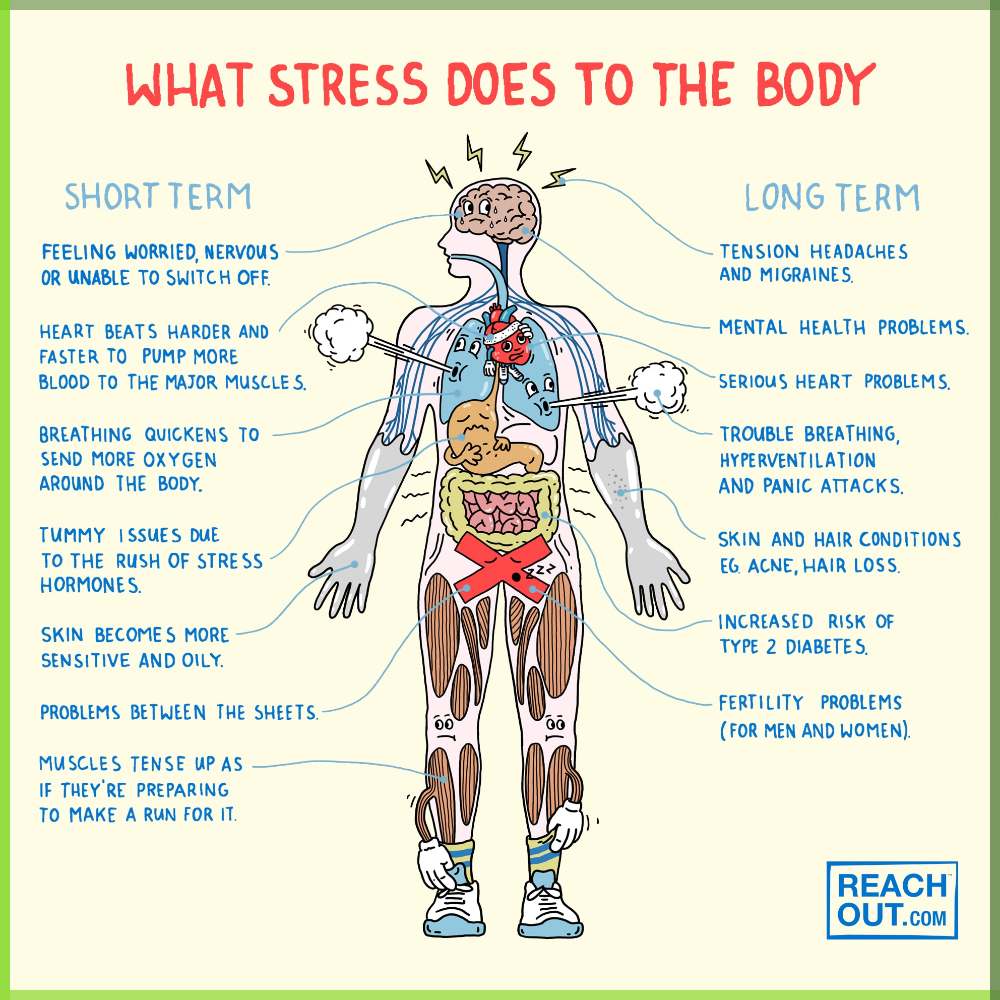
Stress Effects by Body System
| Body System | Acute Stress Effect (adaptive) | Chronic Stress Effect (damaging) | Associated Conditions |
|---|---|---|---|
| Cardiovascular | Increased heart rate, blood pressure, cardiac output | Sustained hypertension, arterial wall damage, plaque formation | Hypertension, coronary artery disease, stroke, heart attack |
| Immune | Initial enhancement then selective suppression of some functions | Chronic low-grade inflammation; reduced immune surveillance | Autoimmune flares, slower wound healing, increased infection risk |
| Metabolic | Glucose mobilization, fat breakdown for fuel | Insulin resistance, visceral fat accumulation, metabolic syndrome | Type 2 diabetes, metabolic syndrome, obesity |
| Gastrointestinal | Digestion paused; blood redirected | Intestinal permeability changes, gut microbiome disruption, ulcers | IBS, gastric ulcers, Crohn's flares |
| Neurological (brain) | Enhanced alertness, hippocampal activity for learning | Hippocampal atrophy, PFC thinning, amygdala hyperactivity | Depression, anxiety disorders, impaired memory, cognitive decline |
| Reproductive | Testosterone and estrogen suppression | Reduced libido, menstrual irregularity, reduced fertility | Infertility, sexual dysfunction, delayed puberty |
| Cellular / aging | None (immediate) | Accelerated telomere shortening; increased oxidative stress | Accelerated biological aging, increased cancer risk |
The Acute Stress Response: Adaptive and Temporary
To understand how stress damages, it helps to begin with how the stress response is supposed to work.
Robert Sapolsky's metaphor - elaborated in Why Zebras Don't Get Ulcers - is instructive: imagine you are a zebra, and a lion is chasing you.[1] Your body needs to respond rapidly and appropriately. The stress response delivers:
Within seconds: The amygdala detects the threat and signals the hypothalamus. The sympathetic nervous system activates immediately. The adrenal medulla releases adrenaline and noradrenaline into the bloodstream. Heart rate and blood pressure surge.
Blood is redirected from the digestive system and skin to the large muscle groups. Pupils dilate. Airways dilate. The liver dumps glucose into the bloodstream for fuel.
Within minutes: The HPA axis activates more slowly. CRH from the hypothalamus → ACTH from the pituitary ? cortisol from the adrenal cortex. Cortisol amplifies and sustains the response: it maintains glucose mobilization, modulates the immune response, and increases the sensitivity of the cardiovascular system to adrenaline.
After the threat passes: Cortisol provides negative feedback to the hypothalamus and pituitary, shutting down the cascade. The sympathetic nervous system returns to baseline. The body resumes its maintenance functions.
This system is elegant and effective. For a zebra that is either eaten or escapes, it works perfectly - the stress response activates, does its job, and resolves. The problem Selye identified, and Sapolsky expanded upon, is what happens when the stress response cannot resolve because the threat is psychological, chronic, and inescapable.
When Stress Becomes Chronic: The Biological Cascade
The modern human sources of chronic stress - unmanageable workloads, financial insecurity, relationship conflict, social marginalization, chronic pain, caregiving demands - are not resolved by fighting or fleeing. They persist.
And a stress response that evolved for acute physical threats is poorly designed for the sustained demands of modern social life.
Cardiovascular System
The cardiovascular changes that are adaptive for running from a lion become damaging when sustained chronically:
Elevated heart rate and blood pressure - helpful for delivering oxygen to muscles during physical exertion - produce, over years, endothelial dysfunction (damage to the arterial lining), arterial stiffness, and left ventricular hypertrophy (thickening of the heart muscle).
These changes are among the most well-documented pathways from chronic stress to cardiovascular disease.
Cortisol's pro-atherogenic effects - chronic cortisol elevation promotes visceral fat deposition (the metabolically active abdominal fat associated with cardiovascular risk), increases LDL cholesterol and triglycerides, promotes insulin resistance, and drives low-grade systemic inflammation that contributes to atherosclerotic plaque development.
The Whitehall Studies - a series of longitudinal investigations of British civil servants begun in the 1960s - demonstrated the social gradient of cardiovascular disease: at every step down the employment hierarchy, cardiovascular mortality increased.
The gradient was continuous - middle managers had worse outcomes than senior managers; clerical workers worse than middle managers. This gradient is substantially explained by differential chronic stress exposure.
Platelet aggregation and coagulation - stress activates platelet activation pathways, increasing thrombotic risk. Acute mental stress can trigger myocardial infarction in people with existing cardiovascular disease by triggering plaque rupture in an already-sensitized system.
Immune System
The immune effects of chronic stress are complex - not simply suppression or activation, but dysregulation:
Adaptive function impaired: wound healing slows. Antibody responses to vaccines are reduced. NK cell activity falls. Lymphocyte proliferation is suppressed.
Chronic stress reliably increases infection susceptibility - Sheldon Cohen's volunteer cold virus exposure studies showed that people under chronic stress were two to three times more likely to develop clinical infection after direct viral exposure.[4]
The most dramatic direct measurement came from Janice Kiecolt-Glaser's work with spousal caregivers of Alzheimer's patients - a model of severe, inescapable chronic stress.[3] Standardized wounds healed about 24% more slowly in caregivers than matched controls.
The immune system's capacity for tissue repair was measurably impaired by months of caregiving stress.
Chronic inflammation paradox: while adaptive immunity is suppressed, pro-inflammatory markers (CRP, IL-6, TNF-alpha) are elevated. This is not a contradiction - the inflammatory response is dysregulated, not simply reduced.
The result is a chronic low-grade inflammatory state that contributes to cardiovascular disease, metabolic syndrome, depression, and accelerated aging.
The Brain
The brain is simultaneously the generator of the stress response and one of its primary targets of damage.
The hippocampus is the most vulnerable brain region to chronic stress effects.[7] It contains dense glucocorticoid receptors - making it highly sensitive to cortisol. Chronic cortisol exposure:
- Suppresses hippocampal neurogenesis (the production of new neurons)
- Causes dendritic retraction (neurons shrink their branching connections)
- Can cause hippocampal cell death at very high sustained concentrations
- Reduces BDNF expression
The result is reduced hippocampal volume - documented in people with PTSD, major depression, Cushing's syndrome (chronic cortisol excess), and chronic occupational stress.
The hippocampus matters for memory formation, spatial navigation, and - critically - providing negative feedback to the HPA axis. A damaged hippocampus means a more dysregulated stress response.
The prefrontal cortex - governing executive function, decision-making, impulse control, and emotional regulation - is functionally impaired by acute stress (the amygdala hijack) and structurally damaged by chronic stress.
Studies of people under chronic stress show reduced PFC volume and connectivity, and impaired performance on executive function tasks.
The PFC is the part of the brain that keeps the stress response calibrated to the actual threat level - its impairment means stress responses become less discriminating and harder to regulate.
The amygdala shows the opposite pattern from the hippocampus and PFC under chronic stress: it enlarges and becomes more reactive.
The combination - an enlarged, hyperreactive threat-detection center coupled with an impaired regulatory system - is the neural signature of chronic stress vulnerability: more sensitive to threat, less able to modulate the response.
Metabolic System
Cortisol's metabolic effects, helpful in acute stress, are profoundly damaging chronically:
Insulin resistance: cortisol promotes glucose production and reduces cellular glucose uptake. Chronic cortisol elevation chronically elevates blood glucose and drives the compensatory insulin overproduction that eventually produces insulin resistance and type 2 diabetes.
Visceral fat deposition: glucocorticoids specifically promote fat storage in visceral (abdominal) depots. Visceral fat is not inert - it is metabolically active, secreting its own inflammatory cytokines and contributing to the chronic inflammation loop.
Muscle catabolism: cortisol catabolizes muscle protein to maintain glucose availability. In acute stress this is adaptive; chronically, it contributes to reduced muscle mass and the metabolic consequences of lean tissue loss.
Telomeres and Biological Aging
One of the most striking findings about chronic stress is its effect on telomere length - the protective caps on chromosomes that shorten with each cell division. Telomere shortening is a marker of biological aging; cells with critically short telomeres senesce or die.
Elissa Epel and Elizabeth Blackburn (2009 Nobel Prize in Physiology or Medicine for the discovery of telomerase) published a landmark study finding that mothers caregiving for chronically ill children - a severe chronic stressor - had significantly shorter telomeres than control mothers, with the difference equivalent to approximately 9-17 years of accelerated biological aging.[5]
Subsequent research has confirmed the association: chronic work stress, relationship conflict, early life adversity, racial discrimination, poverty, and PTSD are all associated with shorter telomeres.
The stress-telomere link operates through oxidative stress and inflammatory pathways - cortisol and inflammatory cytokines directly damage telomeres and suppress telomerase (the enzyme that repairs them).
Telomere length doesn't translate simply to life expectancy, but it is the most direct molecular marker of accelerated cellular aging from chronic stress - connecting the psychological experience of chronic stress to the chemistry of cellular senescence.
The Social Determinants
Chronic stress is not equally distributed. It follows the contours of social inequality with remarkable precision.
The social gradient of health - documented most rigorously in the Whitehall Studies by Michael Marmot - shows that at every step down the socioeconomic ladder, health outcomes worsen.[6] This is not simply an effect of poverty on health - it is a gradient that runs continuously from the bottom to the top of the social hierarchy.
Even wealthy professionals have worse health outcomes than the very highest status, and the effect is not explained by differences in access to medical care.
The mechanism is chronic stress. Lower socioeconomic status means less control over one's environment and work (autonomy - a powerful buffer against stress-induced HPA axis activation); less secure resources; greater exposure to environmental stressors; less access to the social support that buffers the physiological stress response; and less access to the behaviors (exercise, sleep, high-quality food) that reduce allostatic load.
This framing transforms chronic stress from a personal challenge to manage into a societal structure to address. The biological damage of chronic stress is real and measurable - but its distribution is not random.
It concentrates in exactly the populations that structural inequalities have placed under the most sustained, inescapable demand.
What Reduces Chronic Stress Damage
Mindfulness-Based Stress Reduction (MBSR) - Jon Kabat-Zinn's 8-week structured program - has the most robust evidence for reducing chronic stress biomarkers among psychological interventions.[8]
Meta-analyses document reduced cortisol, inflammatory markers, blood pressure, and objective biological aging markers in participants across diverse populations.
Exercise directly addresses multiple stress pathways: normalizes HPA axis reactivity; reduces resting inflammatory markers; increases hippocampal neurogenesis; improves PFC function and emotional regulation; and provides an accessible, potent buffer against the physiological stress response.
The evidence for exercise as a stress reduction intervention is arguably stronger than for any pharmaceutical option.
Social support is one of the most powerful biological buffers. The presence of a supportive other during a stressor directly reduces cortisol and cardiovascular reactivity - measured in real time.
The effect operates through both parasympathetic activation (oxytocin, endorphins released by positive social contact) and cognitive reappraisal (social support enables reframing stressors as challenges rather than threats).
Control and autonomy have outsized stress-buffering effects - not simply because they reduce objective burden but because perceived control strongly moderates HPA axis activation.
The "job demand-control" model (Karasek) predicts cardiovascular disease risk from the combination of high demands and low control more accurately than either factor alone.
Sleep restores HPA axis regulation; protects hippocampal volume; and reduces inflammatory markers. Chronic sleep deprivation and chronic stress are bidirectionally linked - each worsens the other - making sleep hygiene one of the most practically important interventions for breaking the stress-damage cycle.
For related concepts, see what causes depression, how to manage anxiety, and what happens when you don't sleep.
Sources & Further Reading
- Sapolsky, R. M. (2004). Why Zebras Don't Get Ulcers: The Acclaimed Guide to Stress, Stress-Related Diseases, and Coping. Holt Paperbacks.
- McEwen, B. S. (1998). Stress, Adaptation, and Disease: Allostasis and Allostatic Load. Annals of the New York Academy of Sciences, 840(1), 33-44. DOI: 10.1111/j.1749-6632.1998.tb09546.x
- Kiecolt-Glaser, J. K., Marucha, P. T., Malarkey, W. B., Mercado, A. M., & Glaser, R. (1995). Slowing of Wound Healing by Psychological Stress. The Lancet, 346(8984), 1194-1196. DOI: 10.1016/S0140-6736(95)92899-5
- Cohen, S., Tyrrell, D. A. J., & Smith, A. P. (1991). Psychological Stress and Susceptibility to the Common Cold. New England Journal of Medicine, 325(9), 606-612. DOI: 10.1056/NEJM199108293250903
- Epel, E. S., et al. (2004). Accelerated Telomere Shortening in Response to Life Stress. Proceedings of the National Academy of Sciences, 101(49), 17312-17315. DOI: 10.1073/pnas.0407162101
- Marmot, M. (2004). The Status Syndrome: How Social Standing Affects Our Health and Longevity. Times Books.
- Lupien, S. J., McEwen, B. S., Gunnar, M. R., & Heim, C. (2009). Effects of Stress Throughout the Lifespan on the Brain, Behaviour and Cognition. Nature Reviews Neuroscience, 10(6), 434-445. DOI: 10.1038/nrn2639
- Kabat-Zinn, J. (1982). An Outpatient Program in Behavioral Medicine for Chronic Pain Patients Based on the Practice of Mindfulness Meditation. General Hospital Psychiatry, 4(1), 33-47. DOI: 10.1016/0163-8343(82)90026-3
Health note: This article is general educational information about how a topic works, not medical, psychological, or mental-health advice, diagnosis, or treatment. Everyone's situation is different, and research findings describe groups, not individuals.
If you are struggling or have concerns about your health, please talk to a qualified professional such as a doctor or licensed therapist.
If you are in crisis or thinking about harming yourself, contact your local emergency services or a crisis line right away, in the US you can call or text 988 (Suicide & Crisis Lifeline); elsewhere, find local lines at findahelpline.com.