
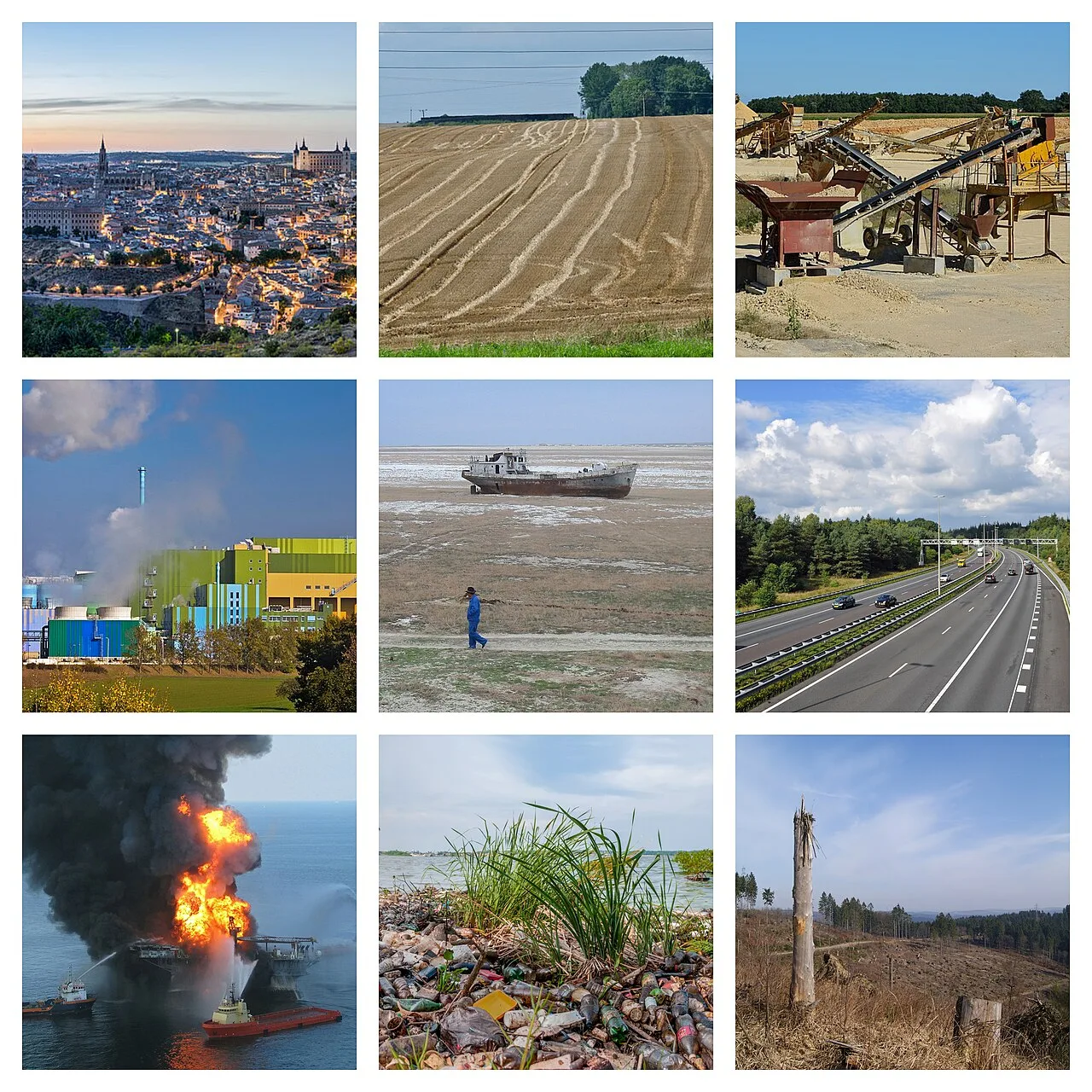
Anthropocene: In February 2000, at a conference of the International Geosphere-Biosphere Programme in Cuernavaca, Mexico, a speaker was describing current global environmental changes using the framework of the Holocene - the geological epoch that began around 11,700 years ago, when the last ice age ended and Earth settled into the relatively stable, warm conditions that permitted the development of agriculture and civilization.
The atmospheric chemist Paul Crutzen, sitting in the audience, felt a mounting impatience.
Then he interrupted. "Stop using that word," he said. "We're not in the Holocene anymore. We're in the - the Anthropocene!" He later admitted that he had invented the term on the spot, combining the Greek words for human and new.[1] The room fell silent, then resumed - but the word stuck.
Crutzen was not proposing a casual metaphor. He was making a geological argument: that the sum of human activities had altered Earth's systems so fundamentally and so measurably that geologists of the future would be able to identify the current epoch as distinctly different from the Holocene in the stratigraphic record - the layers of rock and sediment through which Earth's history is read.
He published the idea first in a 2000 article co-authored with biologist Eugene Stoermer and then in a short letter in Nature in 2002, and it ignited one of the most consequential scientific debates of the early 21st century.[2]
The debate has since escaped the confines of geology and earth science. "Anthropocene" is now used by historians, political theorists, philosophers, lawyers, and artists as a framework for thinking about the human condition in an age of planetary transformation.
It carries a weight that purely geological terminology rarely achieves, because it forces a reckoning with a question that civilization had managed largely to avoid: what kind of thing have we become, and what do we owe the world we have made?
"We are the first generation to feel the effect of climate change and the last generation that can do something about it." - Barack Obama, Address to the United Nations General Assembly (2014)
Key Definitions
Anthropocene: A proposed geological epoch, not yet formally ratified, characterized by the dominance of human activity as the primary force shaping Earth's systems - atmosphere, hydrosphere, biosphere, and lithosphere.
Holocene: The current formally recognized geological epoch, beginning approximately 11,700 years ago at the end of the last ice age, characterized by relatively stable and warm climatic conditions that permitted the development of agriculture and civilization.
GSSP (Global Boundary Stratotype Section and Point): The specific physical location in the geological record where the beginning of a geological time unit is formally defined - the "golden spike" that marks the boundary.
Great Acceleration: The dramatic, exponential increase in both human socioeconomic activities and Earth system changes that began around 1950, documented by Will Steffen and colleagues in graphs showing near-vertical increases across 24 indicators simultaneously.
Planetary boundaries: The nine biophysical thresholds proposed by Johan Rockstrom and colleagues within which human activity can continue without risking abrupt, irreversible change to Earth's life-support systems.[4]
Sixth mass extinction: The ongoing episode of accelerated biodiversity loss driven by human activity, estimated at 100-1,000 times the background extinction rate.
Haber-Bosch process: The industrial synthesis of ammonia from atmospheric nitrogen and hydrogen, developed by Fritz Haber and Carl Bosch in the early 20th century, which made artificial fertilizers available at scale and now feeds approximately half of humanity - while simultaneously disrupting the global nitrogen cycle.
Biogeochemical flows: The cycling of nutrients (particularly nitrogen and phosphorus) through the biosphere, atmosphere, and hydrosphere - one of the nine planetary boundaries, now transgressed by human agricultural activity.
Novel entities: New substances introduced into the environment by human activity - including synthetic chemicals, plastics, and genetically modified organisms - that have no natural precedent and whose effects on Earth systems are difficult to predict.
The Great Acceleration: Key Indicators Since 1950
| Indicator | Pre-1950 level | 2020 level | Change factor | Planetary implication |
|---|---|---|---|---|
| Atmospheric CO2 | ~280 ppm (pre-industrial) ~310 ppm (1950) | ~415 ppm | +50% from pre-industrial | Forcing global temperature rise; ocean acidification |
| Human population | 2.5 billion (1950) | 7.8 billion (2020) | 3 since 1950 | Pressure on land, water, food systems, biodiversity |
| Primary energy use | ~75 EJ/year (1950) | ~600 EJ/year | 8 | Combustion emissions; resource extraction footprint |
| Nitrogen fixed artificially (Haber-Bosch) | ~10 Tg N/year (1950) | ~120-140 Tg N/year | ~12 | Nitrogen cascade: eutrophication, dead zones, N2O emissions |
| Plastics produced | Near zero (commercial production began ~1950) | ~400 million t/year | From 0 | Microplastics in all ecosystems including deep ocean, Arctic ice, human blood |
| Global freshwater use | ~1,000 km/year (1950) | ~4,000 km/year | 4 | Aquifer depletion; river flow reduction; wetland loss |
| Vertebrate wildlife populations | Baseline (1970 used as reference) | 69% (1970-2020 per WWF Living Planet Report) | 69% | Sixth mass extinction underway; 1-8% of species face extinction per decade |
| Urban land area | ~300,000 km (est. 1950) | ~750,000 km (2015) | 2.5 | Habitat fragmentation; heat island effects; impervious surface runoff |
Sources: IPCC AR6, WWF Living Planet Report 2022, Steffen et al. 2015 Great Acceleration data
The Geological Argument
Geology measures time in the evidence left in rock and sediment. Each geological period, epoch, and age is defined by distinctive markers - changes in fossil assemblages, geochemical signatures, magnetic reversals - that can be identified at specific locations in the stratigraphic record around the world.
The formal machinery for ratifying these divisions runs through the International Commission on Stratigraphy (ICS), which maintains the Geological Time Scale.
The Anthropocene Working Group (AWG), formed in 2009 under the ICS, spent fifteen years assembling the evidence for formal designation. Their analysis identified several strong stratigraphic signals of human planetary impact.[8] The strongest and most globally synchronous is the radioactive fallout from nuclear weapons testing.
From 1945 to 1963, when the Partial Nuclear Test Ban Treaty drove most testing underground, atmospheric nuclear tests deposited a distinctive layer of radioactive isotopes - particularly plutonium-239 and carbon-14 - in sediments and ice cores worldwide.
The peak of this signal, around 1952-1964, appears in lake sediments, coral skeletons, tree rings, and ice cores across the planet simultaneously. It is a cleaner, more globally synchronous stratigraphic marker than almost anything in the pre-human geological record.
Other Anthropocene signatures are equally striking. Microplastic particles - fragments of the synthetic polymers that have been produced in the tens of millions of tons since the 1950s - now appear in sediments from the deep ocean trenches to Antarctic ice, in every soil core and lake sediment sampled since the 1960s.
The fossil record of the Anthropocene will be marked by an extraordinary abundance of chicken bones: the broiler chicken, selectively bred for rapid weight gain and raised by the billions for human consumption, is now the most abundant bird species on Earth by biomass, with a distinctive skeletal morphology that leaves no natural precedent in the fossil record.
Concrete - a mixture of crushed rock, sand, water, and cement - now constitutes the largest flow of any mineral substance on Earth, and has been produced in sufficient volume to cover the entire surface of the planet in a thin layer.
The carbon dioxide spike in ice cores, atmospheric nitrogen enrichment, and the extinction signal in microfossils complete the picture.
The AWG proposed Crawford Lake in Ontario as the GSSP - the physical location where the Anthropocene's beginning, circa 1950-1952, would be formally marked. In March 2024, however, the Subcommission on Quaternary Stratigraphy voted against formally designating the Anthropocene as an official geological epoch.
The majority concluded that the proposed boundary did not fully meet the technical requirements for a new epoch - particularly the criterion of a sufficiently distinct change relative to the Holocene.
The vote was close and the debate continues; some geologists believe a revised proposal will eventually succeed, while others argue that the Anthropocene should be understood as a concept rather than a formal stratigraphic unit.
The Great Acceleration
The visual heart of the Anthropocene argument is the set of graphs published by Will Steffen, Paul Crutzen, John McNeill, and colleagues, most comprehensively in a 2015 paper in The Anthropocene Review.[3]
Twelve socioeconomic trends and twelve Earth system trends, each plotted from 1750 to the present, share a single visual structure: essentially flat for most of human history, a modest uptick in the 19th and early 20th centuries, and then a near-vertical exponential increase beginning around 1950.
The socioeconomic indicators include global population (from roughly 2.5 billion in 1950 to 8 billion in 2023), real gross domestic product (a tenfold increase in the same period), primary energy use, fertilizer consumption, international air travel, and telecommunications.
The Earth system indicators include atmospheric CO2 (from approximately 310 ppm in 1950 to over 420 ppm today), methane, nitrous oxide, surface temperature anomaly, ocean acidification, tropical forest loss, and terrestrial biosphere degradation.
What the graphs make unmistakably clear is that the human impact on Earth's systems is not a gradual, linear process that has been building since the invention of agriculture or the Industrial Revolution, but a sudden phase transition that began in the mid-20th century.
The post-World War II economic expansion, the consumer revolution, the Green Revolution in agriculture, the petrochemical industry, the automobile, and the global spread of electricity-dependent lifestyles created a qualitative change in the relationship between human civilization and the planetary systems that support it.
This is what the Great Acceleration captures: not just growth, but a change in kind.
The nitrogen story illustrates both the achievement and the cost of the Great Acceleration with particular clarity.
Fritz Haber's development of the process for synthesizing ammonia from atmospheric nitrogen - perfected by Carl Bosch for industrial scale in the early 20th century - is one of the most consequential technological achievements in history.
The Haber-Bosch process broke the bottleneck that had limited agricultural productivity to the availability of natural nitrogen inputs (manure, legumes, guano).
Jan Willem Erisman and colleagues estimated in 2008 that the nitrogen from Haber-Bosch fertilizers now feeds approximately half of the global population - that roughly four billion people alive today owe their existence to this invention.[7]
But the same nitrogen that feeds humanity is also the largest source of water pollution in most agricultural regions, drives coastal dead zones (hypoxic zones where excess nitrogen from agricultural runoff strips oxygen from the water), causes algal blooms in lakes and rivers, contributes to greenhouse gas emissions through nitrous oxide, and represents one of the most severely transgressed planetary boundaries.
Planetary Boundaries: The Safe Operating Space
Johan Rockstrom and twenty-eight co-authors introduced the planetary boundaries framework in a 2009 Nature paper that became one of the most widely read and cited environmental science publications of the decade.
The framework identifies nine Earth system processes that together maintain the stability of the Holocene-like conditions in which civilization developed, and proposes quantitative boundaries for each - thresholds below which human activity can continue safely, and above which the risk of abrupt, non-linear, potentially irreversible change at the planetary scale increases sharply.
The nine boundaries address: climate change (measured as atmospheric CO2 concentration and radiative forcing); biosphere integrity (biodiversity loss rates and functional diversity); land-system change (the fraction of global land surface converted from natural to agricultural uses); freshwater change (global freshwater use); biogeochemical flows (the rate of anthropogenic fixation of nitrogen and phosphorus and their flows to the oceans);
ocean acidification (the saturation state of surface seawater with respect to aragonite, a form of calcium carbonate used by marine organisms); atmospheric aerosol loading (the regional loading of aerosols in the atmosphere); stratospheric ozone depletion; and novel entities.
A 2023 update to the framework, published in Science Advances, assessed that six of the nine boundaries have been transgressed.[5] Climate change: transgressed, with CO2 concentration now above 420 ppm against a proposed boundary of 350 ppm.
Biosphere integrity: transgressed, with extinction rates far above the proposed safe boundary of 10 extinctions per million species per year. Land-system change: transgressed, with approximately 50% of ice-free land surface converted to agricultural use.
Freshwater change: transgressed. Biogeochemical flows: transgressed, with nitrogen and phosphorus flows to the oceans far above safe limits.
Novel entities: transgressed, with plastic production, synthetic chemical proliferation, and genetically modified organisms now constituting an unmanaged experiment in Earth system responses to new materials.
The framework has been criticized - some scientists argue the boundaries are too precisely specified for systems that are genuinely uncertain, and that the threshold concept oversimplifies complex dynamics - but its value as a framework for communicating the scale and simultaneity of human planetary impact has made it indispensable in global environmental policy discussions.
The Sixth Mass Extinction
Earth has experienced five previous mass extinctions - episodes in which more than 75% of species were eliminated in geologically brief periods.
The most famous, the end-Cretaceous event 66 million years ago, was caused by an asteroid impact that produced a years-long "impact winter." The largest, the end-Permian event 252 million years ago (the "Great Dying"), eliminated approximately 96% of marine species and 70% of terrestrial vertebrate species, possibly through the combination of volcanic eruption and ocean acidification.
The current episode of biodiversity loss is increasingly described by biologists as a sixth mass extinction, caused not by an asteroid or volcanic eruption but by the expansion of human civilization. The evidence is extensive.
Background extinction rates - the rate at which species disappear in the absence of unusual disruption - are estimated at 0.1 to 1 species per million species per year.
Current rates are estimated by Gerardo Ceballos, Paul Ehrlich, and colleagues at 100 to 1,000 times the background rate, though precise numbers are deeply uncertain given how many species remain undescribed.[6]
The more tractable data come from population trends: the Living Planet Index, compiled by the Zoological Society of London and WWF, tracks the population trends of vertebrate species and found an average decline of 68% between 1970 and 2016.
The primary driver of the sixth mass extinction is habitat loss through land conversion - the transformation of forests, grasslands, wetlands, and coastal ecosystems into agricultural land, urban development, and resource extraction zones.
Approximately 75% of terrestrial environments and 66% of marine environments have been "significantly altered" by human activity, according to the 2019 IPBES Global Assessment.[10]
Secondary drivers include overexploitation (hunting, fishing, and harvesting), pollution, invasive species, and climate change - the last of which is projected to become the dominant driver of extinction in coming decades as temperature increases exceed the thermal tolerance of species and disrupt the seasonal timing on which ecological relationships depend.
The implications extend beyond the intrinsic loss of biological diversity. Ecosystems provide the services on which human civilization depends - pollination of food crops, water purification, climate regulation, carbon sequestration, disease control, and nutrient cycling.
The degradation of biodiversity reduces the resilience of these systems and the reliability of these services, creating what biologists describe as a silent crisis of ecological infrastructure.
Chemistry and the Ocean: Acidification and Plastics
Among the most alarming and least visible Anthropocene transformations is the acidification of the ocean. The ocean absorbs approximately 25% of the CO2 emitted by human activities each year. When CO2 dissolves in seawater, it forms carbonic acid, which dissociates to produce bicarbonate ions and hydrogen ions.
The increase in hydrogen ion concentration lowers pH - the ocean is now approximately 0.1 pH units more acidic than it was before industrialization, representing a 30% increase in acidity (pH is a logarithmic scale).
This rate of acidification is faster than any experienced in the past 300 million years, and it is projected to increase to 0.3-0.5 pH units below pre-industrial levels by 2100 under high-emissions scenarios.
Ocean acidification directly impairs the ability of marine organisms to build calcium carbonate shells and skeletons.[9] Corals, oysters, mussels, sea urchins, and many planktonic organisms at the base of the marine food web all depend on calcium carbonate structures.
As waters become more acidic, the energy cost of building these structures increases and dissolution becomes more likely.
The combined effect of ocean warming (which bleaches corals) and acidification (which impairs their rebuilding capacity) threatens the long-term viability of coral reef ecosystems, which support an estimated 25% of all marine species despite covering less than 0.1% of the ocean floor.
Microplastics have become one of the most ubiquitous tracers of the Anthropocene. Synthetic polymers are now found in every corner of the planet: deep ocean sediments, Antarctic ice, Arctic snow, the air above the Pyrenees, and the bodies of marine and terrestrial animals from polar bears to deep-sea fish.
A 2022 study published in Environment International found microplastics in the blood of 17 of 22 healthy adult volunteers tested. Microplastics have been detected in human breast milk, placental tissue, and lung tissue.
The health implications are still being determined, but the ubiquity of microplastics in the environment is itself a stratigraphic signal - a layer of human-made polymer fragments that will persist in sediments for thousands of years.
The Anthropocene and Ethics
The Anthropocene forces a rethinking of some of the most basic categories of ethics and political philosophy. If human activity now shapes the atmosphere, the oceans, the climate, and the biosphere, then decisions made today will determine the conditions of life for thousands of years. The geological time scale has entered the political.
This raises questions of intergenerational justice that existing ethical frameworks struggle to address. Future generations who will inherit the planet being transformed today cannot vote, cannot consent, and have no institutional representation in current political processes.
The philosopher Derek Parfit's work on population ethics and the non-identity problem is relevant: our choices about carbon emissions, biodiversity loss, and ecosystem transformation are choices about what kind of world future people will be born into, and about how many people there will be.
Whether we have obligations to maximize the number of future people, to maximize their welfare, or simply not to make the world worse than it would otherwise be are questions without easy answers.
Climate justice asks a different but equally challenging question: within the current global political order, who bears the burden of Anthropocene transformation?
The richest 10% of the global population are responsible for approximately 50% of cumulative greenhouse gas emissions; the poorest 50% are responsible for about 10% and are typically the most vulnerable to climate disruption.
The global distribution of responsibility and vulnerability is almost perfectly inverted.
This inversion - which reproduces, on a planetary scale, patterns of colonial extraction and exploitation - is at the center of climate justice arguments that the wealthiest nations and individuals owe both mitigation (reducing emissions) and adaptation finance to the most affected communities.
See also: How Climate Change Works, What Is Climate Justice, How Evolution Works
Sources & Further Reading
- Crutzen, P. J., & Stoermer, E. F. (2000). The 'Anthropocene.' Global Change Newsletter, 41, 17-18.
- Crutzen, P. J. (2002). Geology of mankind. Nature, 415, 23. DOI: 10.1038/415023a
- Steffen, W., Broadgate, W., Deutsch, L., Gaffney, O., & Ludwig, C. (2015). The trajectory of the Anthropocene: The Great Acceleration. The Anthropocene Review, 2(1), 81-98. DOI: 10.1177/2053019614564785
- Rockstrom, J., Steffen, W., Noone, K., et al. (2009). A safe operating space for humanity. Nature, 461, 472-475. DOI: 10.1038/461472a
- Richardson, K., Steffen, W., Lucht, W., et al. (2023). Earth beyond six of nine planetary boundaries. Science Advances, 9(37). DOI: 10.1126/sciadv.adh2458
- Ceballos, G., Ehrlich, P. R., & Dirzo, R. (2017). Biological annihilation via the ongoing sixth mass extinction signaled by vertebrate population losses and declines. PNAS, 114(30), E6089-E6096. DOI: 10.1073/pnas.1704949114
- Erisman, J. W., Sutton, M. A., Galloway, J., Klimont, Z., & Winiwarter, W. (2008). How a century of ammonia synthesis changed the world. Nature Geoscience, 1, 636-639. DOI: 10.1038/ngeo325
- Waters, C. N., Zalasiewicz, J., Summerhayes, C., et al. (2016). The Anthropocene is functionally and stratigraphically distinct from the Holocene. Science, 351(6269). DOI: 10.1126/science.aad2622
- Doney, S. C., Fabry, V. J., Feely, R. A., & Kleypas, J. A. (2009). Ocean acidification: The other CO2 problem. Annual Review of Marine Science, 1, 169-192. DOI: 10.1146/annurev.marine.010908.163834
- IPBES. (2019). Global Assessment Report on Biodiversity and Ecosystem Services. IPBES Secretariat.