
Apartheid: On February 11, 1990, after 27 years in prison, Nelson Mandela walked out of Victor Verster Prison through a crowd of thousands to a global television audience of hundreds of millions. He raised his fist, clasped Winnie Mandela's hand, and smiled.
South Africa's state-imposed system of racial separation - apartheid - had survived for 42 years. In four more years, it would be gone.
The transition that followed, managed without the civil war that most observers, most South Africans, and most government planners had anticipated, produced the Truth and Reconciliation Commission - one of the most studied experiments in collective trauma processing in history.
It also left unresolved questions about economic justice that persist to this day.
The story of apartheid contains elements that illuminate much larger questions: about how racist systems are constructed and justified; about how resistance builds and what forms it takes; about the role of international pressure; about whether negotiated transitions can produce genuine change or merely preserve old hierarchies in new forms; and about what truth-telling can and cannot accomplish in the aftermath of systematic oppression.
It is a story that is not yet finished.
South Africa's current economic inequality - some of the worst in the world, concentrated almost entirely along racial lines - is part of that unfinished story.
How apartheid began, how it functioned in the daily lives of millions of people for four decades, how resistance built and was crushed and built again, how it ended, and what was left unresolved when it did - these are not merely historical questions.
They are a case study in the creation and dismantling of a racially ordered society that has no close parallel anywhere in the world.
"Without memory, there is no healing. Without forgiveness, there is no future."
- Desmond Tutu, No Future Without Forgiveness (1999)
| Year | Key Event | Significance |
|---|---|---|
| 1948 | National Party election victory | Apartheid formally implemented |
| 1950-53 | Population Registration and Group Areas Acts | Legal racial classification enforced |
| 1960 | Sharpeville Massacre | 69 protesters killed; ANC banned |
| 1964 | Rivonia Trial | Mandela imprisoned for 27 years |
| 1976 | Soweto Uprising | Student resistance brutally suppressed |
| 1990 | Mandela released; ANC unbanned | Negotiations begin |
| 1994 | First universal elections | Mandela elected; apartheid formally ends |
Key Definitions
Apartheid: Afrikaans for "separateness"; a legal and political system of comprehensive racial segregation and white minority rule in South Africa from 1948 to the early 1990s, codified through hundreds of pieces of legislation.[9]
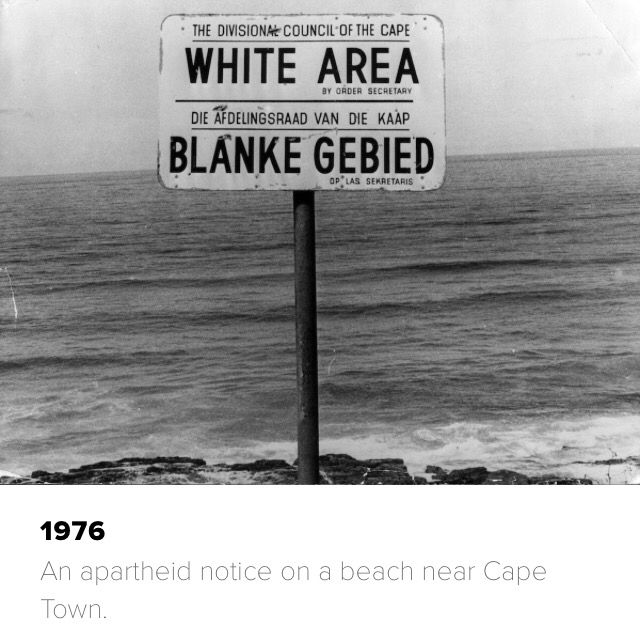
Group Areas Act (1950): Legislation designating separate residential areas for each racial group; used to forcibly remove non-white populations from areas designated for whites.
Pass Laws: Legislation requiring Black South Africans to carry a passbook ("dompas") at all times in white-designated areas, obtain employer endorsement, and have government permission to live or work in any area.
Bantustans (homelands): Nominally independent territories to which Black South Africans were assigned nominal citizenship; ten in total, covering 13% of the land for 80% of the population. None were recognized internationally except by South Africa itself.
ANC (African National Congress): Founded 1912, the primary political organization representing Black South Africans; banned from 1960 to 1990; led by Nelson Mandela; won South Africa's first democratic election in 1994.
PAC (Pan Africanist Congress): Breakaway from the ANC in 1959, taking a more Africanist position excluding white membership; banned alongside the ANC in 1960.
Sharpeville Massacre: March 21, 1960 - police killed 69 protesters and wounded 180 at a PAC anti-pass law demonstration in Sharpeville township.
Soweto Uprising: June 16, 1976 - students in Soweto protested the imposition of Afrikaans as a language of instruction; police killed at least 176 people.
Truth and Reconciliation Commission (TRC): Established 1995, chaired by Archbishop Desmond Tutu; offered conditional amnesty to perpetrators of politically motivated human rights violations in exchange for full public disclosure.[10]
Restorative vs retributive justice: Retributive justice focuses on punishment of perpetrators; restorative justice focuses on acknowledgment, truth-telling, and repairing harm. The TRC was designed around a restorative model.
Transitional justice: The field studying how post-conflict and post-authoritarian societies address past atrocities; South Africa's TRC became one of the field's most studied cases.[5]
Origins: Colonialism, Conflict, and the 1948 Election
Apartheid did not emerge from nothing. South Africa's history of racial domination predates apartheid by centuries, beginning with Dutch settlement at the Cape in 1652, the dispossession of Khoisan and later Xhosa and Zulu peoples, the importation of enslaved people from Madagascar, India, and East Africa, and the construction of a colonial economy built on coerced non-white labor.
The Anglo-Boer Wars of 1899-1902 reshaped South African politics in ways that directly led to apartheid. Britain defeated the Boer republics but chose reconciliation over punishment, creating the Union of South Africa in 1910 as a self-governing dominion.[2]
The constitution was explicitly for white South Africans only. The Native Land Act of 1913 restricted Black land ownership to 7% of the country (later extended to 13%), confining 80% of the population to a fraction of the land, destroying African farming economies, and creating a landless labor force for white-owned mines and farms.
The Afrikaner nationalist movement grew throughout the early twentieth century, rooted in a distinct cultural and linguistic identity forged in the Boer Wars, animated by Calvinist theology that provided religious justification for racial hierarchy, and shaped by genuine economic grievances of poor Afrikaners who competed with Black workers.
The ideology of Baasskap - white supremacy - was elaborated into a comprehensive political philosophy by organizations including the Broederbond (a secret Afrikaner society) and the academic Hendrik Verwoerd, who would become the primary architect of apartheid legislation.
In the 1948 election, the National Party, led by D.F. Malan, campaigned on a platform of apartheid - a more systematic, theoretically complete version of racial segregation than existed under the previous United Party government.
They won narrowly, largely due to rural constituency weighting that overrepresented conservative Afrikaner voters.[7] The consequences were enormous.
Within five years, the National Party had passed the foundational legislation of the apartheid state: the Population Registration Act (1950), classifying every South African by race; the Group Areas Act (1950), designating separate residential areas; and the Suppression of Communism Act (1950), broadly interpreted to outlaw any opposition.
Further laws followed: the Separate Amenities Act (1953), formalizing segregation of public spaces; and the Bantu Education Act (1953), creating deliberately inferior education for Black children.
How Apartheid Functioned
The daily mechanics of apartheid were pervasive and deliberately humiliating. The Pass Law system required Black South Africans to carry a passbook containing their photograph, employment record, residential permission, and tax payment history at all times in white-designated areas.
Failure to produce it meant immediate arrest. In the peak years of Pass Law enforcement, hundreds of thousands of people were arrested annually for pass law violations.
The labor control system was its essential function. Black workers could obtain contracts to work in white-designated areas - primarily mines, farms, and urban households and industries - but could not bring their families, could not settle permanently, and were legally required to return to their designated homelands when contracts expired.
The practical result was the systematic destruction of Black family life: men living in single-sex hostels near mines, wives and children in impoverished rural homelands, families seeing each other only during annual leave.
The Bantustan System
The intellectual justification of apartheid's mature form, developed under Verwoerd as Prime Minister from 1958 to 1966, was the homeland or Bantustan system.
The theory was that South Africa was not one nation but many, each with its own homeland, and that Black South Africans were citizens of their respective ethnic homelands - not of South Africa.
Ten homelands were established: Transkei, Bophuthatswana, Venda, Ciskei (the TBVC states, which were given nominal "independence"), and six others that remained nominally autonomous within South Africa.
In practice, homelands were designated for the least economically productive land, lacked infrastructure, industries, or tax bases, and could not support their assigned populations. They were labor reservoirs for white South Africa. Their nominal independence was not recognized by any government in the world other than South Africa.
The system involved forced removals of approximately 3.5 million people between 1960 and 1983, bulldozing established communities and depositing people in distant rural areas.[8]
Enforcement
The security apparatus that enforced apartheid was comprehensive and brutal. The security police conducted surveillance, infiltration, and interrogation. The Bureau of State Security (BOSS), headed by Hendrik van den Bergh, conducted political killings and operations against anti-apartheid activists domestically and internationally.
Steve Biko, founder of the Black Consciousness Movement, was beaten to death in security police detention in September 1977.
His death, documented by the photographic evidence of his injuries, was presented by police as resulting from a hunger strike - a lie that required a coroner and multiple doctors to participate. He was 30 years old.
Resistance
Black South African resistance to racial domination predates apartheid. The ANC was founded in 1912, two years after the formation of the Union, specifically to contest Black exclusion from political life.
For its first four decades, the ANC pursued a strategy of petitions, delegations, and nonviolent protest - a strategy that produced little change.
The ANC Youth League, formed in 1944 by Nelson Mandela, Walter Sisulu, Oliver Tambo, and others, pushed the organization toward more active resistance. The Defiance Campaign of 1952 mobilized over 8,000 volunteers to deliberately violate unjust laws and accept arrest.
The Freedom Charter of 1955 - adopted by the Congress of the People at Kliptown - articulated a vision of a non-racial, democratic South Africa that became the ANC's foundational document.
The Sharpeville Massacre of March 21, 1960, was the turning point. The PAC had called for mass demonstrations against the Pass Laws, and thousands gathered outside the Sharpeville police station without their passes. Police opened fire without warning, killing 69 people and wounding 180 - the majority shot in the back.[6]
The government declared a State of Emergency, arrested 18,000 people, and banned both the ANC and PAC. The space for legal, nonviolent resistance had been closed.
Mandela and the ANC responded by forming Umkhonto we Sizwe (MK), the armed wing of the ANC, in 1961.[1] MK's initial strategy targeted infrastructure rather than people, attempting to minimize casualties. The Rivonia Trial of 1963-64 prosecuted Mandela, Walter Sisulu, Govan Mbeki, and others for sabotage.
Mandela's statement from the dock - "I have cherished the ideal of a democratic and free society... It is an ideal for which I am prepared to die" - became one of the most celebrated political speeches of the twentieth century. He was sentenced to life imprisonment on Robben Island.
Black Consciousness and Soweto
The 1970s saw the rise of the Black Consciousness Movement, articulated by Steve Biko and the South African Students' Organization.
Black Consciousness rejected the liberal white-led opposition to apartheid in favor of Black psychological liberation - the rejection of internalized inferiority - as a precondition for political liberation.
It was an intellectual and cultural movement as much as a political one, and its influence on a generation of activists was profound.
The Soweto Uprising of June 16, 1976, was sparked by a specific grievance - a government order requiring 50% of instruction in Black schools to be conducted in Afrikaans, the language associated with the oppressor. Students organized and marched.
Police shot into the crowd. Hector Pieterson, 12 years old, was among the first killed; the photograph of his body being carried by a fellow student, taken by Sam Nzima, circled the world.
At least 176 people died in the initial uprising; the protests spread across South Africa and continued for months. June 16 is now Youth Day in South Africa, a public holiday commemorating the uprising.
The International Campaign
South Africa's international isolation was painstakingly built over decades. The UN General Assembly had condemned apartheid from the 1960s, but the Security Council was initially blocked by Western vetoes.
The mandatory arms embargo of 1977, following Biko's death and the banning of 18 Black consciousness organizations, was the first mandatory Security Council action against South Africa.
The divestment movement grew on American university campuses through the 1970s and 1980s.
The Sullivan Principles, adopted by over 150 American companies operating in South Africa, required equal pay, desegregated facilities, and investment in Black advancement - but became a target of anti-apartheid activists who argued that any American business presence legitimized the regime.
Harvard, Yale, and other universities faced persistent student campaigns for divestment. Hampshire College became the first US college to divest in 1977.
The sports boycott was particularly painful for South Africa, a nation that had made cricket and rugby central elements of national identity. South African sports teams were excluded from the Olympics from 1964 and from most international competition.
The cultural boycott, endorsed by the United Nations, saw major artists refuse to perform in South Africa.
The US Comprehensive Anti-Apartheid Act of 1986, passed over President Reagan's veto by Congress, imposed the most comprehensive sanctions: trade embargoes, ban on new investment, prohibition on importing South African products. South African banks lost access to international credit.
The South African Reserve Bank's own records documented severe economic deterioration. The rand collapsed. Growth stagnated.
Whether sanctions or internal resistance was the decisive factor in forcing negotiations remains debated among historians, but most agree they significantly raised the economic and political costs of apartheid's continuation.
The Transition
P.W. Botha's government attempted to manage apartheid's crisis through limited reforms in the 1980s - repealing the prohibition on interracial marriage, establishing a Tricameral Parliament that gave Coloured and Indian South Africans token representation while excluding Black South Africans entirely.
His 1985 "Rubicon" speech, widely anticipated as announcing major reforms, instead doubled down, further destroying international confidence. When he suffered a stroke in 1989, his party replaced him with F.W. de Klerk.
De Klerk, a conservative National Party man who had given no indication of radical reformism, concluded that negotiations were necessary for the National Party's survival in a post-apartheid South Africa.
On February 2, 1990, he addressed Parliament and announced the unbanning of the ANC, PAC, and South African Communist Party, and committed to releasing political prisoners. Nine days later, Mandela walked free.
The negotiations that followed - through the Convention for a Democratic South Africa (CODESA) - were fractured and repeatedly nearly derailed. Right-wing white resistance, embodied in organizations like the Afrikaner Weerstandsbeweging (AWB), threatened violence.
The Inkatha Freedom Party-ANC violence in KwaZulu-Natal killed thousands. Chris Hani, leader of the SACP and among the most popular ANC figures, was assassinated on April 10, 1993, by a Polish immigrant with connections to right-wing organizations.
His murder threatened to trigger the civil war that had been averted. Mandela, not the still-serving white government, went on national television that night to appeal for calm and to hold the process together.
The April 1994 election - four days of voting, the first in which all South Africans could participate - produced a 62.6% ANC majority. On May 10, 1994, Nelson Mandela was inaugurated as President of South Africa.
The Truth and Reconciliation Commission
South Africa faced the choice that all transitional societies face: how to address past atrocities without triggering the retributive violence that would undermine the transition, while also not simply granting blanket amnesty that would make mockery of the victims' suffering. The TRC's design was an attempt at a third way.
Archbishop Desmond Tutu chaired the Commission, his moral authority and infectious humanity giving it a character that transcended legal process.[3]
The Commission's central mechanism was the amnesty-for-truth trade-off: perpetrators who applied for amnesty, appeared before the Commission, and gave full and truthful disclosure of politically motivated crimes committed between 1960 and 1994 could receive individual amnesty from criminal prosecution.
This was not amnesty-for-forgiveness - perpetrators were not required to apologize, and forgiveness was left to individual victims. It was also not blanket amnesty - amnesty was individual, conditional on full disclosure, and required political motivation for the crime.
The Commission heard over 22,000 victim statements. It granted amnesty to approximately 1,500 applicants and denied it to about 5,000 others.
Its findings documented gross human rights violations on all sides - including by the ANC, which had conducted bombings that killed civilians and operated brutal military camps - though the overwhelming majority of violations were by the apartheid state.
What the TRC Achieved and Failed to Achieve
The TRC's achievements were genuine. It created an authoritative, documented record of atrocities that could not later be denied. Many families learned for the first time what had happened to missing relatives.
It established a national narrative acknowledging the crimes of apartheid as systematic and state-sanctioned rather than the actions of rogue individuals. Its model of restorative justice has been adapted in post-conflict societies from Rwanda to Sierra Leone to Colombia.
But the critique articulated by Mahmood Mamdani in Citizen and Subject (1996) and subsequent work cuts deep: the TRC offered political amnesty without economic restitution.[4] Apartheid was not only a system of political violence - it was a system of economic extraction and dispossession.
The wealth accumulated by white South Africans through decades of forced Black labor, stolen land, and deliberately inferior Black education was not addressed. The reparations paid to TRC victims were modest - a one-time payment of approximately 30,000 rand (then about $6,000) for recognized victims.
The economic structures of apartheid - concentrated white land ownership, the industrial and mining wealth built on apartheid labor, the enormous educational and opportunity gaps - remained essentially intact.
Three decades after apartheid's formal end, South Africa's Gini coefficient (a measure of income inequality) is among the highest in the world. Land reform has been slow and contested.
The ANC government's own economic policies, influenced by the negotiated transition's implicit agreements to respect existing property rights, have done comparatively little to redistribute the economic legacy of apartheid.
Mamdani's question remains unresolved: can a society truly reconcile without redistributing?
Cross-References
Sources & Further Reading
Mandela, N. (1994). Long Walk to Freedom: The Autobiography of Nelson Mandela. Little, Brown.
Thompson, L. (2001). A History of South Africa (3rd ed.). Yale University Press.
Tutu, D. (1999). No Future Without Forgiveness. Doubleday.
Mamdani, M. (1996). Citizen and Subject: Contemporary Africa and the Legacy of Late Colonialism. Princeton University Press.
Gibson, J. L. (2004). Overcoming Apartheid: Can Truth Reconcile a Divided Nation? Russell Sage Foundation.
Lodge, T. (2011). Sharpeville: An Apartheid Massacre and Its Consequences. Oxford University Press.
Davenport, T. R. H., & Saunders, C. (2000). South Africa: A Modern History (5th ed.). Macmillan.
Beinart, W. (2001). Twentieth-Century South Africa (2nd ed.). Oxford University Press.
Worden, N. (2012). The Making of Modern South Africa: Conquest, Apartheid, Democracy (5th ed.). Wiley-Blackwell.
Truth and Reconciliation Commission of South Africa. (1998). Truth and Reconciliation Commission of South Africa Report (Vols. 1-5). Government of South Africa.