
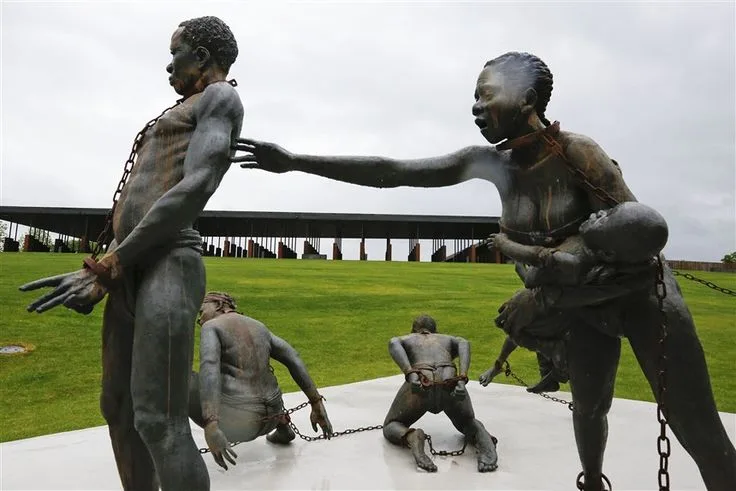
Between 1500 and 1900, approximately 12.5 million Africans were forcibly transported across the Atlantic Ocean to the Americas as enslaved people. Of those, roughly 10.7 million survived the crossing. This was the largest forced migration in human history.
Brazil received approximately 4.9 million enslaved people. The Caribbean received 4.0 million. North America, which looms largest in American historical memory, received approximately 388,000 - the smallest major share.
Yet the US enslaved population grew to nearly 4 million by 1860, because the transatlantic trade had been banned in 1808 and enslaved people were bred and sold domestically, generating enormous fortunes for traders and planters alike.
When slavery was abolished in the United States in 1865, formerly enslaved people and their descendants did not achieve formal legal equality for another century.
They would wait until the Civil Rights Act of 1964 and the Voting Rights Act of 1965 to recover rights guaranteed - then stripped - by Reconstruction-era constitutional amendments.
The economic and health disparities created by slavery, its legal aftermath, and the deliberate government policies that followed have not closed in the decades since. They remain measurable, documented, and contested.
Understanding American history - its politics, its economics, its persistent inequalities - requires understanding slavery not as a historical episode that ended but as a foundational institution whose consequences compound forward through time.
The same is true for understanding global history. Slavery is not a uniquely American story, nor a uniquely Western one.
It is a human story, recurring across civilizations and centuries, with a particular American and Atlantic chapter whose scale, racial organization, and institutional legacy make it impossible to understand modern life without examining.
"Historians have long treated slavery and capitalism as separate spheres. But the plantation was a factory.
The enslaved were workers whose productivity was maximized through calculated violence, and the wealth they generated built the financial infrastructure of the modern world." - Edward Baptist, The Half Has Never Been Told (2014)
| Form of Slavery | Period / Region | Characteristics |
|---|---|---|
| Ancient chattel slavery | Antiquity (Greece, Rome) | Slaves as property; war captives; household labor |
| Feudal serfdom | Medieval Europe | Bound to land; obligatory labor to lord |
| Atlantic slave trade | 1500s-1800s | Transatlantic trade; racial chattel slavery |
| Plantation slavery | Americas 1600s-1865 | Cash-crop labor; brutal conditions; hereditary |
| Indentured servitude | 1800s-early 1900s | Contracted labor; debt bondage; colonial replacement |
| Contemporary forms | Present | Forced labor, sex trafficking, domestic servitude |
Key Definitions
Chattel slavery - A form of slavery in which enslaved people are legally classified as personal property (chattel), bought and sold like goods, with no legal personhood or rights.
Transatlantic slave trade - The forced transportation of approximately 12.5 million Africans to the Americas between 1500 and 1900, organized primarily by Portuguese, British, Dutch, French, and Spanish merchants and states.
Middle Passage - The sea crossing from West Africa to the Americas, the middle leg of the triangular trade route. Conditions were designed to maximize cargo volume; mortality ranged from 10 to 15 percent.
Abolitionism - The political movement to end slavery. In Britain, it achieved abolition of the slave trade in 1807 and of slavery in British colonies in 1833. In the US, it culminated in the 13th Amendment in 1865.
Reconstruction - The period from 1865 to 1877 during which the federal government attempted to reintegrate former Confederate states and establish civil and political rights for formerly enslaved people.
Sharecropping - A system in which tenant farmers (often formerly enslaved people) worked land in exchange for a share of the crop, with the landlord controlling credit, supplies, and accounts in ways that kept workers in perpetual debt.
Jim Crow laws - State and local laws enforcing racial segregation in the American South from the end of Reconstruction (1877) through the Civil Rights era (1965).
Redlining - The systematic denial of mortgage loans and other financial services to residents of predominantly Black neighborhoods, practiced by private banks and institutionalized by federal government agencies from the 1930s through the 1960s.
Racial wealth gap - The measurable difference in accumulated assets between white and Black American households, currently approximately 10 to 1 by median wealth according to the Federal Reserve's 2019 Survey of Consumer Finances.[6]
Reparations - Compensation paid to a group for historical injustice. The reparations debate concerns whether the US government owes compensation to Black Americans for slavery, Jim Crow, and related harms.
Structural racism - Racial inequality produced not by individual prejudice but by the cumulative effect of laws, policies, institutions, and social norms that systematically disadvantage people of color.
Freedmen's Bureau - The Bureau of Refugees, Freedmen, and Abandoned Lands, established in 1865 to provide food, medical care, schools, and labor contracts for formerly enslaved people. Abolished by Congress in 1872.
Black Codes - Laws passed by Southern states immediately after the Civil War designed to restrict the freedom of Black people and maintain their availability as cheap labor.
Convict leasing - A post-Reconstruction system in which prisoners - disproportionately Black people arrested on minor or fabricated charges - were leased to private businesses as forced laborers. Described by historians as a reconstitution of slavery under legal cover.
The Scale and Structure of the Transatlantic Slave Trade
The most comprehensive scholarly account of the transatlantic slave trade is the Trans-Atlantic Slave Trade Database, compiled over decades by historians David Eltis and David Richardson, published in their 2010 atlas and available as an open database.[1]
It documents approximately 36,000 slaving voyages, carrying 12.5 million Africans between 1500 and 1900. Brazil was by far the largest destination - 4.9 million people - because of the insatiable labor demand of its sugar, then coffee, economies.
The Caribbean sugar islands received approximately 4.0 million. North America, despite producing the dominant historical narrative of Atlantic slavery in the English-speaking world, received roughly 388,000.
The trade was organized around three commodity chains. Sugar, cultivated first on Portuguese Atlantic islands and then in Brazil and the Caribbean, was the original driver.
By the 17th century, Caribbean sugar islands like Barbados and Jamaica were among the most profitable territories on earth, their wealth produced entirely by enslaved labor.
Tobacco, grown in Virginia and Maryland, drove the early English trade. Cotton, grown across the Deep South, dominated the 19th century.
Each commodity required intensive, year-round physical labor under conditions so brutal that mortality rates on Caribbean plantations were high enough that planters calculated it was cheaper to import new enslaved people than to allow existing ones to survive by providing adequate food and rest.
The economics of slavery were not peripheral to American capitalism - they were foundational. In 1860, on the eve of the Civil War, the monetary value of the approximately 4 million enslaved people in the United States was estimated at roughly $3.5 billion.
This was more than the combined value of all American banks, railroads, and manufacturing facilities. Enslaved people were the dominant form of collateral in American financial markets; mortgages on enslaved people were bundled and sold as securities in the forerunners of modern financial instruments.
When abolitionists argued for emancipation, slaveholders argued - correctly from a financial standpoint - that it would destroy the equivalent of trillions of dollars in property.
The domestic slave trade intensified after the international trade was banned in 1808. Slave traders bought enslaved people in the Upper South - Virginia, Maryland - where soils were depleted and tobacco no longer profitable, and marched or shipped them to the cotton and sugar economies of the Deep South.
An estimated 1 million people were sold in the domestic trade between 1820 and 1860, forcibly separating families and communities. This internal commerce was enormous: New Orleans was the largest slave market in North America.[9]
The Middle Passage and Its Violence
The sea crossing from West Africa to the Americas was the defining horror of the transatlantic slave trade. Ships were designed - or retrofitted - to carry the maximum possible number of human bodies.
Enslaved people were chained below decks in spaces often less than five feet high, laid side by side with only inches of space between them.
They were brought above deck briefly for exercise and forced to dance. Those who refused to eat were force-fed. The bodies of those who died were thrown overboard.
The Slave Ship Brooks, a British vessel, became the most powerful abolitionist image of the 18th century when its diagram was published in 1788. The illustration showed 454 human beings arranged geometrically in the ship's hold - every inch of space occupied.
The ship had reportedly carried as many as 609. The diagram circulated across Europe and the Americas, making visceral what had been abstractions in parliamentary debates. William Wilberforce used it in his speeches to the British Parliament.
Mortality during the crossing averaged roughly 10 to 15 percent, though in earlier centuries and during epidemic outbreaks it was far higher. Dysentery - called the "bloody flux" - was the primary killer. Smallpox, typhoid fever, and scurvy also killed large numbers.
The dead were thrown overboard with such frequency that sharks learned to follow slave ships across the Atlantic.
The Zong massacre of 1781 crystallized the legal and moral structure of the trade. The captain of the British slave ship Zong, Luke Collingwood, ordered 132 sick enslaved Africans thrown overboard alive.
His stated reason was that the ship's water supply was running low; the actual reason, historians argue, was that the ship's owners could collect insurance on enslaved people who died at sea but not on those who arrived dead.
British courts treated the case initially as a routine insurance dispute - the enslaved were cargo.
Abolitionists Granville Sharp and Olaudah Equiano brought the case to public attention. It became a galvanizing event for the British abolitionist movement, leading eventually to the Dolben Act of 1788, which regulated the number of enslaved people ships could carry per ton.
The abolitionist argument was simple: this is a trade in human beings, not cargo, and no economic argument can justify it. The pro-slavery argument was equally frank: the trade generates immense wealth, supports thousands of jobs, and is sanctioned by law, custom, and scripture.
The abolitionists won the argument - in Britain by 1807, in the United States by 1865 - but only after centuries of organized moral and political struggle.
How Slavery Shaped America
The 1619 Project, launched by the New York Times in 2019 under lead writer Nikole Hannah-Jones, argued that 1619 - when the first enslaved Africans arrived in the Virginia colony - should be understood as a founding date of America, not merely a footnote to 1776.
The project's central historical claim was that slavery and its racial ideology were not incidental to but constitutive of American political, economic, and cultural development.
It sparked fierce debate among historians, with some, including Gordon Wood and Sean Wilentz, criticizing specific factual claims, and others, including Ibram X. Kendi, largely defending the project's framing.
Historian Edward Baptist's 2014 book "The Half Has Never Been Told" made the economic case in full.[2] The cotton economy of the antebellum South, Baptist argued, was not a backward, pre-capitalist relic of feudalism.
It was a dynamic, technologically sophisticated system of forced labor whose productivity - driven by systematic torture, including whipping quotas designed to maximize cotton picking - generated the capital flows that financed Northern industrialization.
By the 1830s, cotton was the United States' largest export by a substantial margin. The banks that financed cotton plantations were the same banks that financed Northern factories. The ships that carried cotton were built in Northern yards and insured by Northern companies.
The Constitution incorporated slavery in three explicit provisions: the three-fifths clause, which counted enslaved people as three-fifths of a person for purposes of congressional apportionment, giving slaveholding states disproportionate representation; the slave trade clause, which prohibited Congress from banning the international slave trade before 1808; and the fugitive slave clause, which required free states to return escaped enslaved people to their enslavers.
These were not embarrassing compromises reluctantly accepted by anti-slavery founders - they were the price of union, without which the Constitution could not have been ratified.
The political crisis over slavery's expansion into western territories drove four decades of increasingly violent sectional conflict, culminating in the election of Abraham Lincoln in 1860 and Southern secession. The Confederate states' own declarations of secession leave no ambiguity about the cause.
Mississippi's declaration stated: "Our position is thoroughly identified with the institution of slavery - the greatest material interest of the world." South Carolina's cited the "increasing hostility on the part of the non-slaveholding States to the institution of slavery."
The Confederacy's vice president, Alexander Stephens, explicitly repudiated the Declaration of Independence's premise that all men are created equal: his Cornerstone Speech of 1861 declared that the Confederacy was founded on the "great truth that the negro is not equal to the white man."
Reconstruction and Its Failure
The 13th Amendment, ratified in December 1865, abolished slavery - with an exception that would be exploited for decades: "except as a punishment for crime whereof the party shall have been duly convicted." The 14th Amendment (1868) guaranteed equal citizenship.
The 15th Amendment (1870) guaranteed the right to vote regardless of race. These constitutional changes were remarkable achievements, produced by a coalition of Radical Republicans, abolitionist activists, and formerly enslaved people themselves.[8]
The Freedmen's Bureau, established in 1865 and operating until 1872, provided real services: it helped negotiate labor contracts, established schools (educating nearly 250,000 people by 1870), operated hospitals, and attempted to adjudicate disputes between formerly enslaved people and white employers.
During Reconstruction, Black men voted and held office across the South. Hiram Revels and Blanche Bruce served in the US Senate. Joseph Rainey and Robert Brown Elliott served in the House of Representatives. Mississippi, South Carolina, and Louisiana had Black state officials at multiple levels.
This transformation was met with organized, violent resistance from the beginning. The Ku Klux Klan, founded in Pulaski, Tennessee in 1865, conducted a systematic campaign of murder, arson, and torture against Black voters, officeholders, and their white Republican allies.
Congressional investigations documented the scale of Klan terrorism in detail. Federal anti-Klan legislation in 1871 temporarily suppressed the organization, but the underlying social structure it defended - white supremacy and the subordination of Black labor - reconstituted itself through other means.
The decisive political blow came with the disputed 1876 presidential election. Republican Rutherford Hayes and Democrat Samuel Tilden both claimed victory; the outcome turned on disputed electoral votes from three Southern states.
The Hayes-Tilden Compromise of 1877 awarded Hayes the presidency in exchange for the withdrawal of federal troops from the South.
Without federal protection, Reconstruction governments collapsed rapidly. What followed was the systematic reassertion of white political supremacy through violence, disenfranchisement, and economic coercion.
Sharecropping became the dominant labor system: formerly enslaved people worked land owned by white planters in exchange for a share of the crop, with the landlord controlling the credit and the accounts.
The system was structured so that sharecroppers were perpetually indebted, unable to leave without repaying debts that were calculated to always exceed earnings.
Convict leasing went further: state governments arrested Black people on minor charges (vagrancy, petty theft, breach of contract) and leased their labor to private businesses - coal mines, railroad construction, turpentine farms - that worked many to death.
This was slavery under a legal fiction, enabled by the 13th Amendment's punishment clause. Scholars estimate that between 1877 and 1950, more than 3,000 lynchings were documented across the South, with the true number certainly higher.
Lynching functioned not merely as revenge but as a mechanism of social terror, communicating that any exercise of political or economic independence by Black people could be punished by death, and that the law would not intervene.
The Long Shadow: From Redlining to the Racial Wealth Gap
The New Deal of the 1930s created the conditions for the American middle class - through subsidized mortgages, labor protections, and social insurance - and largely excluded Black Americans from it.
Historian Richard Rothstein's 2017 book "The Color of Law: A Forgotten History of How Our Government Segregated America" documents this as deliberate government policy, not merely private discrimination.[3]
The Home Owners' Loan Corporation, created in 1933, mapped American cities in color-coded grades.
Neighborhoods classified as "hazardous" - colored red on the maps - were those that included Black residents, regardless of economic conditions. Federal Housing Administration guidelines explicitly discouraged loans to racially mixed or "infiltrated" neighborhoods. Private banks followed these maps.
The result was that homeownership - the primary wealth-building mechanism for the American middle class through the 20th century - was systematically denied to Black families at the precise historical moment when it became most financially advantageous.
A house purchased with an FHA-backed mortgage in a white suburb in 1945 for $10,000 might be worth $400,000 today. The family that could not buy that house because of redlining did not accumulate that wealth.
The GI Bill of 1944 provided returning veterans with education benefits and home loan guarantees that created the postwar middle class. But its administration through state and local institutions - particularly in the South - meant that most Black veterans were denied its benefits.
Of the first 67,000 mortgages insured by the GI Bill in Mississippi, fewer than a hundred went to Black veterans.
The measurable result is visible in Federal Reserve data. The 2019 Survey of Consumer Finances found median white household wealth at $171,000 and median Black household wealth at $17,600 - a ratio of roughly 9.7 to 1.
This gap is not explained by income differences alone; it reflects the compounded result of decades of wealth-building opportunities extended to white families and denied to Black families by explicit government policy.
Economist Darrick Hamilton and sociologist William Darity Jr. have written extensively on this as a structural problem requiring structural solutions.
Health disparities follow the same pattern. Black Americans have higher rates of hypertension, diabetes, maternal mortality, and COVID-19 mortality than white Americans - disparities that persist after controlling for income, reflecting the health effects of chronic stress, environmental exposures, and differential access to medical care produced by decades of residential segregation.
The Reparations Debate
The intellectual case for reparations to Black Americans rests on several foundations. First, the legal precedent: the United States has paid reparations before. The Civil Liberties Act of 1988 provided $20,000 and a formal government apology to each surviving Japanese American who had been interned during World War II.
Germany has paid more than $80 billion in reparations to Holocaust survivors and the state of Israel. The question is not whether reparations are possible but whether the political will exists.
Second, the economic case: Economists William Darity Jr.[4] and A. Kirsten Mullen, in their 2020 book "From Here to Equality: Reparations for Black Americans in the Twenty-First Century," calculate the compounded value of unpaid labor, stolen land, denied opportunity, and the effects of redlining and discriminatory policy.
They propose a figure in the range of $14 trillion - roughly two-thirds of annual US GDP - as the amount needed to close the racial wealth gap. Their proposed mechanism identifies as beneficiaries descendants of people enslaved in the United States before 1865.
Third, the moral argument: Ta-Nehisi Coates's 2014 Atlantic essay "The Case for Reparations" made the case to a mass audience, centering not just slavery but the 20th-century dispossession through redlining as the most legally actionable harm - a harm for which identifiable government agencies bear clear responsibility.[5]
Coates supported H.R. 40, the bill introduced by Representative John Conyers in every Congress since 1989, which called not for reparations but merely for a commission to study the question.
The "40 acres and a mule" precedent is often cited: Union General William Sherman's Special Field Order No. 15 in January 1865 confiscated roughly 400,000 acres of Confederate coastal land and redistributed it in 40-acre plots to formerly enslaved families.
President Andrew Johnson reversed this order after Lincoln's assassination, restoring the land to its Confederate owners. This original broken promise - land reform promised and then denied - is where many reparations advocates argue the obligation originates.
In 2021, Evanston, Illinois became the first US city to formally begin a reparations program, allocating $10 million for housing grants to Black residents affected by discriminatory city policies between 1919 and 1969. The program is limited in scale but significant as a legal and political precedent.
Global Context: Slavery in World History
Slavery is not uniquely American, Western, or racial. It has existed across virtually every human civilization in recorded history.
The ancient Greeks kept enslaved people - Aristotle argued that some people were "natural slaves." The Roman economy depended on enslaved labor; at the height of the empire, perhaps one-third of the population of Italy was enslaved.
The legal category of the enslaved person as property - rather than as a person with rights - was Roman law.
The Arab slave trade operated from the 7th century CE through the 19th century, transporting an estimated 11 to 17 million Africans across the Sahara, the Red Sea, and the Indian Ocean. Enslaved people also included Central Asian, European, and South Asian people.
Ottoman institutions of slavery included the devshirme system, which recruited enslaved boys from Christian families to staff the administration and military - some of whom rose to considerable power. The Barbary states of North Africa enslaved an estimated 1 to 1.25 million Europeans between 1530 and 1780.
Serfdom in Russia bound peasants to land and lords in conditions that scholars debate as to their similarity to chattel slavery. Russian serfs could be bought and sold with the land they worked. They could not marry, move, or practice trades without their lord's permission.
Serfdom was not abolished in Russia until 1861 - the same year as the American Civil War. The emancipation came with conditions (peasants had to pay "redemption payments" for the land they received) that kept many in effective debt bondage for decades.
Contemporary slavery remains a massive global problem. The International Labour Organization estimates that approximately 40 million people are currently in some form of modern slavery: forced labor in construction, agriculture, and domestic service; forced marriage; debt bondage; and sex trafficking.[7]
The highest concentrations are in South and Southeast Asia and sub-Saharan Africa. An estimated 25 million people are in forced labor globally, generating approximately $150 billion in illegal profits annually.
What made the transatlantic slave trade historically distinctive was not that it existed but that it was organized around race - equating Blackness with enslavement in a way that created a racial ideology justifying the institution and that persisted as a social and legal reality long after the institution's formal abolition.
Sources & Further Reading
Eltis, David, and David Richardson. Atlas of the Transatlantic Slave Trade. Yale University Press, 2010. View source
Baptist, Edward E. The Half Has Never Been Told: Slavery and the Making of American Capitalism. Basic Books, 2014.
Rothstein, Richard. The Color of Law: A Forgotten History of How Our Government Segregated America. Liveright, 2017.
Darity, William A., Jr., and A. Kirsten Mullen. From Here to Equality: Reparations for Black Americans in the Twenty-First Century. University of North Carolina Press, 2020.
Coates, Ta-Nehisi. "The Case for Reparations." The Atlantic, June 2014. View source
Federal Reserve. Survey of Consumer Finances, 2019. View source
International Labour Organization. Global Estimates of Modern Slavery, 2022.
Du Bois, W.E.B. Black Reconstruction in America. Harcourt, Brace and Company, 1935.
Johnson, Walter. Soul by Soul: Life Inside the Antebellum Slave Market. Harvard University Press, 1999.