
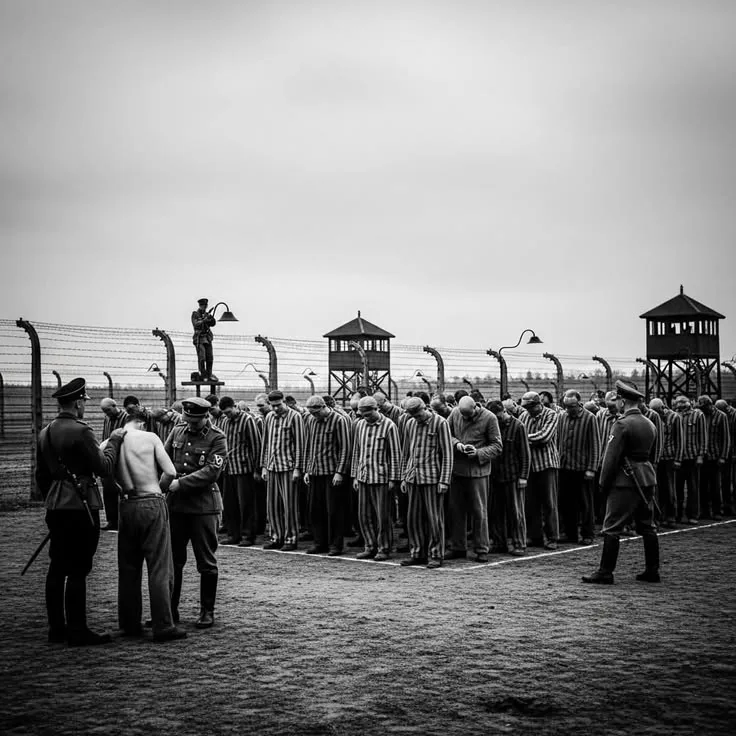
Understanding: Between 1941 and 1945, approximately six million Jews were systematically murdered by the Nazi German state and its collaborators - roughly two-thirds of European Jewry.
Another five to six million non-Jewish victims died in the same system: Soviet prisoners of war, Polish civilians, Roma, disabled people, gay men, political prisoners, Jehovah's Witnesses.
The Holocaust was not a war crime that happened alongside World War II. It was a planned, bureaucratically administered, industrialized genocide that required the participation of hundreds of thousands of ordinary people across occupied Europe. How did it happen?
The question has occupied historians, philosophers, sociologists, and psychologists for eighty years. The answers have changed significantly over time. Early accounts emphasized the singular evil of Hitler and a small circle of fanatics, implying that once those individuals were removed, the possibility of such an event would vanish.
Subsequent research made the picture far more disturbing: the Holocaust required not a handful of monsters but the active cooperation of hundreds of thousands of ordinary Germans and collaborators across Europe, acting within institutional structures, following orders that descended through bureaucratic chains, making individually small contributions that together constituted industrialized mass murder.
The question became not only "What caused this?" but "What does it mean that ordinary people did this?"
No account of the Holocaust can be adequate to its reality. What follows is an account of what historians have learned, what the major debates have been, and why understanding the causes and mechanisms of the Holocaust remains urgently important for anyone who cares about preventing genocide.
"The Holocaust was not simply the work of a handful of madmen. It was a project of the German state, administered by a modern bureaucracy, carried out by hundreds of thousands of ordinary people, and witnessed by millions who did not intervene." - Raul Hilberg, The Destruction of the European Jews (1961, revised 1985)
| Factor | Role in the Holocaust |
|---|---|
| Nazi racial ideology | Provided pseudoscientific justification for genocide |
| Antisemitic legislation (1933-38) | Stripped Jews of rights progressively |
| Bureaucratic apparatus | Enabled systematic identification and deportation |
| State propaganda | Dehumanized victims for broader German society |
| Occupied territories | Extended reach to millions of European Jews |
| Einsatzgruppen | Mass shootings of Jews in occupied Soviet Union |
| Wannsee Conference (1942) | Coordinated the "Final Solution" across agencies |
| Death camps (1942-45) | Industrialized mass murder at unprecedented scale |
Key Definitions
Holocaust (Shoah): The state-sponsored systematic persecution and murder of approximately six million Jews by the Nazi German government and its collaborators between 1933 and 1945. "Shoah" (Hebrew for "catastrophe") is the term preferred by many Jewish communities and scholars.
Final Solution (Endlösung): The Nazi euphemism for the plan to murder all Jews under German control, formalized at the Wannsee Conference of January 1942.
Einsatzgruppen: Mobile killing units of the SS that followed the German army into the Soviet Union beginning in June 1941, shooting approximately 1.5 million Jews (and hundreds of thousands of others) in mass executions.
Extermination camps vs concentration camps: Concentration camps were facilities for forced labor, political imprisonment, and brutal conditions that killed through overwork, starvation, and disease.
Extermination camps (Vernichtungslager) - Auschwitz-Birkenau, Belzec, Sobibor, Treblinka, Majdanek, Chelmno - were specifically designed for immediate mass killing, primarily of Jews, using gas chambers.
Wannsee Conference: A January 20, 1942 meeting of fifteen senior Nazi officials to coordinate the logistics of the Final Solution across all of German-occupied and allied Europe.
Intentionalism vs functionalism: The central historiographical debate about whether the Holocaust was planned from Hitler's earliest ideology (intentionalism) or emerged through bureaucratic radicalization during wartime (functionalism).
Eliminationist antisemitism: Daniel Goldhagen's term for a specifically German cultural belief, predating Nazism, that Jews needed to be physically eliminated from German society - his proposed explanation for why ordinary Germans participated in genocide.
Cumulative radicalization: Hans Mommsen's concept of how the Holocaust emerged through an escalating spiral of persecution in which competing Nazi agencies each escalated measures beyond what had been previously authorized.
Judenräte: Jewish councils appointed by Nazi authorities to administer Jewish communities in occupied territories, forced into impossible positions of mediating between their communities and the SS.
Perpetrator studies: The scholarly field examining who participated in the Holocaust, why, and through what psychological and institutional mechanisms.
T4 program: The Nazi program of systematically murdering people with disabilities under the euphemism "euthanasia," begun in 1939. Approximately 200,000 disabled Germans were killed under T4.
The program was a rehearsal for the Holocaust: it developed the administrative procedures, the personnel, and the killing technology (gas chambers) later deployed in the extermination camps.
The Historiographical Debate
Intentionalism vs Functionalism
The debate that has structured Holocaust historiography since the 1970s is the question of whether the genocide was the deliberate execution of a long-held plan or an improvised outcome of wartime chaos.
Intentionalists, most prominently Lucy Dawidowicz in The War Against the Jews (1975), argued that Hitler harbored a coherent intention to destroy the Jews from early in his political career - that his statements in Mein Kampf and elsewhere were not rhetorical but programmatic.[5]
The Holocaust was, on this view, the fulfillment of an ideological agenda that drove Nazi policy from the beginning.
Functionalists, including Martin Broszat and Hans Mommsen, argued that no such master plan existed.[11] The Nazis pursued contradictory anti-Jewish policies in the 1930s - emigration, persecution, exclusion - without a clear endpoint.
The shift to systematic murder in 1941 was not the execution of a pre-existing plan but the outcome of cumulative radicalization: competing Nazi agencies escalating measures beyond what had been previously authorized, solving the "Jewish question" in the territories under their control through increasingly extreme means because other solutions had failed.
The synthesis that now commands most scholarly support comes from moderate functionalists including Christopher Browning. Browning acknowledges that Hitler's antisemitism was genuine, extreme, and essential - without it, the genocide would not have happened.
But the specific form the Final Solution took emerged through a process of radicalization in 1941, driven by the invasion of the Soviet Union, the failure of emigration and ghettoization, the initiative of middle-level perpetrators, and Hitler's authorization of increasingly extreme measures in an atmosphere of ideological intoxication following early military successes.
The practical implication of this debate is significant: if the Holocaust was purely the product of Hitler's plan, it becomes an exceptional event dependent on an exceptional individual. If it emerged through bureaucratic and institutional processes, it has structural features that could recur in different contexts.
The Raul Hilberg Revolution
Raul Hilberg's three-volume The Destruction of the European Jews (1961, expanded 1985) remains the foundational scholarly work on the Holocaust's administrative machinery.[8]
Hilberg's central contribution was to trace the bureaucratic process of destruction across multiple German ministries and agencies - showing how lawyers drafted legislation, railway officials scheduled deportation trains, financial bureaucrats managed the expropriation of assets, and industrial managers operated the camps - without any single individual being responsible for the whole.
Hilberg's analysis produced the disturbing insight that the Holocaust was simultaneously the product of a totalitarian ideology and a bureaucratic process that could operate through functionaries who understood their individual contribution in narrow, professionalized terms.
The railway official who scheduled the trains to Auschwitz was not responsible for what happened at the destination; the camp commandant was not responsible for the decision to deport; the deportation officer was not responsible for the gas chambers.
The system as a whole produced genocide through the aggregate of individually bounded decisions.
The Long History of European Antisemitism
From Medieval to Modern
The Holocaust was not the inevitable product of European antisemitism, but it was impossible without it.
Jewish communities had faced persecution, exclusion, forced conversion, and mass murder across medieval Europe: expulsions from England (1290), France (1306), and Spain (1492); the Rhineland massacres during the First Crusade (1096); the accusation of ritual murder (blood libel) that provided justification for pogroms across centuries.
The 19th century transformed antisemitism from a religious prejudice into a racial ideology. Writers including Arthur de Gobineau and Houston Stewart Chamberlain developed theories of biological racial hierarchy in which Jews were classified as a distinct and permanently alien race whose presence corrupted European civilization.
This racial antisemitism was distinct from and more dangerous than religious antisemitism: religious Jews could convert, but racial Jews could not change their nature.
The Dreyfus Affair of 1894-1906, in which a Jewish French army officer was falsely convicted of treason in a case driven by antisemitic sentiment, exposed the depth of racial antisemitism in France - a liberal republic - and prompted Theodor Herzl to conclude that Jewish assimilation into European society was impossible.
The Sociological Roots of Modern Antisemitism
Hannah Arendt's analysis in The Origins of Totalitarianism (1951) located the sources of modern antisemitism in the structural position of Jews in European societies: visible as a group, identified with finance and commerce, associated in the public mind with an emerging and disruptive capitalism, and simultaneously excluded from the national identities constructed by 19th-century nationalism.[1]
Jews were, on this account, structurally available as scapegoats for the dislocations of modernity - urbanization, industrial capitalism, political liberalization - that created anxiety and resentment across European societies.
Sociologist Zygmunt Bauman, in Modernity and the Holocaust (1989), argued that the Holocaust was not a regression to pre-modern barbarism but a product of modernity itself.[3]
The bureaucratic rationality, scientific categories, and state organizational capacity that made the Holocaust possible were features of modern civilization, not atavisms. The implication is deeply uncomfortable: the Holocaust was not a departure from modern civilization but its product.
Why Germany?
Germany was not historically the most antisemitic country in Europe. Russia had the most extensive history of state-sponsored pogroms. Poland and Romania had large, impoverished Jewish communities that faced intense legal discrimination. France had the Dreyfus Affair.
Germany in the early twentieth century had a relatively well-integrated Jewish middle class.
What Germany had that distinguished it was a specific political and economic crisis - the humiliation of World War I defeat and the conditions attributed to it, hyperinflation in 1923, the Great Depression from 1929 - that made radical nationalist explanations of German suffering politically resonant, and a political system (the Weimar Republic) too fragile to contain the forces that exploited that resonance.
The Nazis were not the inevitable product of German antisemitism.
They were a specific political movement that exploited genuine grievances, used antisemitism as an explanation for German suffering, and achieved power through political means that could have failed at multiple points.
The political scientist Robert Paxton, in The Anatomy of Fascism (2004), demonstrated that Nazism required the collaboration of traditional German elites - industrialists, military officers, conservative politicians - who believed they could control Hitler while using his popular mobilization to destroy the left.[14]
They were catastrophically wrong. Their miscalculation illustrates a recurring pattern: the normalization and instrumentalization of extremism by establishment actors who believe they can manage it.
The Nazi Rise and Radicalization
From Persecution to Genocide: 1933-1945
The path from Hitler's appointment as Chancellor in January 1933 to the death camps of 1942-45 was not a straight line but a series of escalating steps, each made possible by the previous one.
1933: A nationwide boycott of Jewish businesses, organized by the Nazi party but only partially observed. The Law for the Restoration of the Professional Civil Service excluded Jews from government positions. Jews were approximately 0.76% of the German population - 525,000 people.
1935: The Nuremberg Laws stripped Jews of German citizenship and criminalized marriage and sexual relations between Jews and non-Jews. Jews were defined racially, not religiously.
1938: Kristallnacht (November 9-10) - a coordinated nationwide pogrom in which Jewish businesses, homes, and synagogues were destroyed, approximately 100 Jews killed immediately, and 30,000 arrested and sent to concentration camps. The event was organized by the SS and participated in by thousands of ordinary Germans.
By 1939, the combination of legal exclusion, economic expropriation, and terror had driven approximately 700,000 Jews to emigrate from Germany and Austria.
The response of receiving countries was deeply inadequate: the July 1938 Evian Conference, convened to address the Jewish refugee crisis, produced almost no increase in refugee admissions. Country after country declined to raise immigration quotas, leaving European Jews trapped.
1939-1941: The conquest of Poland brought approximately 3 million Polish Jews under German control. Ghettoization - confining Jews to overcrowded urban areas - killed tens of thousands through starvation and disease.
The Warsaw Ghetto, where approximately 400,000 Jews were confined in an area of 1.3 square miles, had death rates from disease and starvation that reached 1,000 per month by 1941.
1941: The invasion of the Soviet Union marked the decisive turn to mass murder. The Einsatzgruppen, four mobile killing units operating behind the front, shot approximately 1.5 million Jews in the first year of the campaign.
The massacre at Babi Yar (September 29-30, 1941), where 33,771 Kyiv Jews were shot in two days, exemplified the scale and method.
1942-1945: The Wannsee Conference (January 1942) systematized the Final Solution. The Operation Reinhard extermination camps - Belzec, Sobibor, Treblinka - killed approximately 1.7 million Jews using carbon monoxide from diesel engines.
Auschwitz-Birkenau, the largest killing center, killed approximately 1.1 million Jews using Zyklon B gas, its victims transported by train from across occupied Europe.
The T4 Program as a Precursor
The T4 program (named after its administrative address at Tiergartenstrasse 4 in Berlin) began in 1939 and ordered the systematic murder of disabled Germans. Approximately 200,000 people were killed.
The program was publicly protested by Catholic Bishop Clemens von Galen in 1941 - one of the few examples of public German opposition to any Nazi policy - and was formally halted, though killings continued more covertly.
T4 was directly connected to the genocide: the same personnel who administered the disability killings were transferred to Operation Reinhard in 1942. Christian Wirth, an SS officer who had managed the T4 killing facilities, became the operational commander of the Reinhard camps.
The administrative procedures, the chemistry of mass gassing, and the disposal of bodies had all been tested and refined in T4.
The Perpetrators
Ordinary Men
Christopher Browning's 1992 study Ordinary Men examined Reserve Police Battalion 101 - a unit of approximately 500 middle-aged German men, mostly from Hamburg's working class, who had not been selected for ideological fervor and were not members of the SS.[4]
Between 1942 and 1943 they participated in the shooting of at least 38,000 Jews and the deportation of 45,000 more to Treblinka.
When their commander offered them the explicit chance to opt out of shooting operations, fewer than a dozen did so initially, and even those who initially stepped out eventually participated.
Browning argued that the mechanism was not primarily ideology but conformity pressure, peer cohesion, careerism, and a gradual process of moral desensitization - the same mechanisms that Milgram's obedience experiments had identified as sufficient to produce compliance with authority instructions to inflict harm on strangers.
Stanley Milgram's famous 1963 experiment at Yale, published as Obedience to Authority (1974), found that approximately 65 percent of ordinary American subjects would administer what they believed were painful electric shocks to strangers when instructed to do so by an authority figure.[10]
Milgram designed the experiment specifically to understand how ordinary people could participate in the Holocaust. The implication - that most ordinary people, under the right institutional conditions, will comply with destructive authority - was deeply disturbing and has never been fully refuted.
Daniel Goldhagen's Hitler's Willing Executioners (1996) contested Browning's interpretation directly.
Goldhagen argued that the same evidence demonstrated that the perpetrators were motivated primarily by a specifically German "eliminationist antisemitism" - a deep cultural belief that Jews needed to be physically eliminated - and that this ideological motivation was sufficient to explain their behavior.[7]
Goldhagen's thesis was widely discussed but heavily criticized by professional historians, who pointed to its inability to explain non-German perpetrators (Romanians, Ukrainians, Latvians) who behaved with equal brutality, its overgeneralization of German antisemitic attitudes, and its selective use of evidence.
The current scholarly understanding, reflected in Christian Gerlach's comparative work on perpetrators in multiple contexts, is that perpetrators were heterogeneous: some were genuine ideological antisemites, some were careerists following orders, some were opportunists, and many were influenced by multiple factors simultaneously.
Institutional authority structures, peer conformity, and the gradual normalization of atrocity were at least as important as ideology in explaining individual participation.
The Bystanders
Non-Jewish Germans
What did ordinary Germans know about the extermination of Jews? Robert Gellately's research, using wartime German newspaper archives, demonstrated that the persecution, deportation, and brutal treatment of Jews was extensively reported in the Nazi press and therefore known to German readers throughout the war.[6]
Peter Longerich's 2006 study Holocaust: The Nazi Persecution and Murder of the Jews argues that while the specific details of the death camps were not publicly known, the general fact of mass murder was.[13]
The responses of non-Jewish Germans ranged from active participation to enthusiastic approval to passive acceptance to private discomfort expressed only in private. Active resistance was rare.
The records of the Security Service (SD) reports on German public opinion show that most Germans were focused primarily on the war and their own survival; antisemitic persecution was noted with varying degrees of approval or discomfort but rarely provoked moral crisis.
European Collaboration
The Holocaust required and received collaboration from non-German institutions and individuals across Europe.
The Vichy French government enacted its own antisemitic legislation before being required to do so by the Germans, and French police organized the Vel d'Hiv roundup of July 1942 without significant German involvement - arresting 13,152 Parisian Jews, including 4,115 children, and holding them in the Velodrome d'Hiver cycling stadium before deportation to Auschwitz.
Romanian authorities perpetrated mass killings in Iasi and in Bessarabia largely without German direction. Ukrainian, Latvian, and Lithuanian police participated actively in Einsatzgruppen operations.
The collaboration was not universal. Denmark is the most celebrated counter-example: in October 1943, when the German occupation authorities ordered the deportation of Danish Jews, Danish citizens organized a large-scale rescue, ferrying approximately 7,000 Jews to neutral Sweden in fishing boats within a matter of days.
Approximately 99 percent of Denmark's Jewish population survived the war.
The Danish case poses a direct question to explanations based on antisemitic culture: Danish society in 1943 was not more enlightened than other European societies in the abstract.
What differed was specific leadership, specific civic networks, geographic opportunity, and the presence of a nearby neutral state. The structural conditions for rescue existed; they were mobilized.
The Rescuers
What Distinguished Those Who Helped
Yad Vashem, Israel's Holocaust memorial authority, has recognized over 28,000 non-Jews as Righteous Among the Nations for risking their lives to save Jews. The actual number was certainly much higher.
Famous rescuers include Raoul Wallenberg, the Swedish diplomat who issued protective passports to tens of thousands of Hungarian Jews; the village of Le Chambon-sur-Lignon in southern France, where approximately 3,500 Jews were sheltered; and Oskar Schindler, who used his factory to protect over 1,200 Jews.
Samuel and Pearl Oliner's 1988 research The Altruistic Personality, based on interviews with 406 rescuers and 126 non-rescuers in multiple European countries, examined what distinguished those who helped from those who did not.[12]
The findings were nuanced: rescuers were not distinguished by extraordinary courage, risk tolerance, or pre-existing strong relationships with Jews.
They were distinguished by a specific moral socialization: they had typically been raised with moral frameworks that extended care and obligation beyond family and ethnic in-group; they had internalized values of equity and care rather than merely obedience to authority; and they had parents who had modeled helping behavior toward outsiders.
Structural factors also mattered: rescuers were more likely to have material resources, rural locations offering hiding places, and community support for rescue activity.
The Oliner research suggests that the disposition to rescue was not an innate individual characteristic but something shaped by specific developmental and social conditions - with important implications for how moral education and civic culture might reduce bystanderism in future crises.
The Jewish Experience: Resistance, Survival, and the Impossible Choices
Armed Resistance
A persistent and harmful myth portrays Holocaust victims as passive. In reality, Jews resisted under conditions of almost unimaginable disadvantage: unarmed, confined in ghettos or camps, subject to collective reprisals in which the killing of one German soldier could result in the murder of dozens or hundreds of Jews.
The Warsaw Ghetto Uprising of April-May 1943 was the largest single act of Jewish resistance.
When the Germans began the final deportation of the remaining ghetto population, fighters of the Jewish Combat Organization (ZOB) and the Jewish Military Union (ZZW) resisted for nearly a month with a handful of pistols, rifles, and improvised weapons.
The uprising was eventually suppressed, the ghetto burned to the ground, and the survivors murdered or deported. But the uprising demonstrated that resistance was possible and inspired subsequent uprisings in Treblinka, Sobibor, and Auschwitz-Birkenau.
The Sobibor uprising of October 1943 was the most successful: approximately 300 prisoners escaped, and while the majority were subsequently caught and killed, approximately 50 survived the war. The camp was closed and demolished after the uprising.
Survivor Leon Feldhendler and escapee Alexander Pechersky, a Soviet Jewish prisoner of war who led the revolt, are central figures of Holocaust memory in Poland and Russia.
The Judenrat Dilemma
The Judenräte - Jewish councils appointed by Nazi authorities in occupied territories - faced the most impossible moral situation in the entire tragedy.
Required to administer deportations they knew were leading to death, some council leaders attempted to buy time, negotiate exemptions, or warn their communities while complying with enough Nazi demands to remain in post. Others became complicit in ways that remain deeply contested.
Adam Czerniaków, chairman of the Warsaw Judenrat, committed suicide on July 23, 1942, when he received orders to provide 6,000 Jews per day for deportation and realized the deportations were to death.
His diary, preserved and published after the war, remains one of the most profound documents of the impossible choices imposed on Jewish leadership under the Nazi occupation.
Hannah Arendt's controversial coverage of the 1961 Eichmann trial in Jerusalem - published as Eichmann in Jerusalem: A Report on the Banality of Evil (1963) - sparked one of the most contentious debates in Holocaust literature.[2]
Arendt's observation that some Judenrat leaders cooperated with deportations was received as blaming victims and generated enormous controversy.
Her concept of the "banality of evil" - that Eichmann was not a demonic monster but a bureaucratic functionary with limited moral imagination - remains one of the most discussed and debated ideas in the literature of genocide.
After the Holocaust
Justice and Law
The Nuremberg Trials (1945-46) established two precedents that transformed international law. First, individuals could be held criminally responsible for crimes against humanity committed on behalf of a state - the defense of "following orders" was explicitly rejected.
Second, certain acts - the extermination of populations, crimes against humanity - fell outside the normal laws of war and constituted offenses against international law regardless of domestic legality.
Raphael Lemkin, a Polish Jewish lawyer who had lost most of his family in the genocide, had coined the word "genocide" in 1944 and campaigned relentlessly for its legal codification.
The UN Genocide Convention was adopted in December 1948, defining genocide as acts committed with intent to destroy, in whole or in part, a national, ethnic, racial, or religious group, and obligating signatory states to prevent and punish it.
The Adolf Eichmann trial in Jerusalem in 1961 - in which the SS officer who had administered the logistics of the Final Solution was tried, convicted, and executed - established a second major legal precedent: that war criminals could be prosecuted anywhere in the world, that the passage of time did not extinguish criminal responsibility, and that the scale and systematicity of the Holocaust warranted a distinctive legal framework.
Memory and Denial
Holocaust denial - the false claim that the Holocaust was fabricated, exaggerated, or substantially different from the historical record - emerged almost immediately after the war and has persisted as a form of antisemitic propaganda.
Denial takes various forms: denying that the gas chambers existed, claiming the death toll figures are exaggerated, or asserting that the Holocaust was a Jewish-invented propaganda tool.
All these claims are refuted by the overwhelming documentary and physical evidence: Nazi records themselves documented the process, and the physical remains of the camps are preserved and accessible.
The Irving v. Lipstadt trial of 2000 produced perhaps the most comprehensive legal examination of Holocaust denial.[9]
When British historian David Irving sued American scholar Deborah Lipstadt for characterizing him as a Holocaust denier, a British court found that Irving had deliberately distorted historical evidence to support Holocaust denial, and that the characterization was accurate and defensible.
The court's 349-page judgment constitutes a systematic refutation of denial claims using the documentary record.
Lessons and Warning Signs
Gregory Stanton's research on genocide prevention identifies warning signs - classification, symbolization, discrimination, dehumanization, organization, polarization, persecution, extermination, denial - that the Holocaust exemplified in sequence.[15]
The application of this framework to subsequent cases (Cambodia, Rwanda, Bosnia, Darfur) has been imperfect, as the political will to intervene has consistently lagged behind the warning signs.
But the conceptual framework, and the legal infrastructure built from the ashes of the Holocaust, represent humanity's attempt to learn from the event that made those constructions necessary.
The Holocaust's most disturbing lesson may be the one that Browning, Milgram, Bauman, and Arendt converge on from different directions: that genocide does not require exceptional people or exceptional evil.
It requires the right institutional conditions, the right political climate, the right degree of dehumanization, and enough ordinary people willing to follow orders, conform to peer norms, and avoid the discomfort of moral resistance. The warning signs are not exotic or unprecedented.
They are recognizable features of political life that, at sufficient intensity and in the right combination, have produced catastrophe before and could again.
Sources & Further Reading
- Arendt, H. (1951). The Origins of Totalitarianism. Harcourt Brace.
- Arendt, H. (1963). Eichmann in Jerusalem: A Report on the Banality of Evil. Viking Press.
- Bauman, Z. (1989). Modernity and the Holocaust. Cornell University Press.
- Browning, C. R. (1992). Ordinary Men: Reserve Police Battalion 101 and the Final Solution in Poland. HarperCollins.
- Dawidowicz, L. S. (1975). The War Against the Jews, 1933-1945. Holt, Rinehart and Winston.
- Gellately, R. (2001). Backing Hitler: Consent and Coercion in Nazi Germany. Oxford University Press.
- Goldhagen, D. J. (1996). Hitler's Willing Executioners: Ordinary Germans and the Holocaust. Alfred A. Knopf.
- Hilberg, R. (1961/1985). The Destruction of the European Jews (3 vols.). Holmes and Meier.
- Lipstadt, D. (2005). History on Trial: My Day in Court with a Holocaust Denier. Ecco Press.
- Milgram, S. (1974). Obedience to Authority: An Experimental View. Harper & Row.
- Mommsen, H. (1983). The Realization of the Unthinkable: The "Final Solution of the Jewish Question" in the Third Reich. In G. Hirschfeld (Ed.), The Policies of Genocide. Allen and Unwin.
- Oliner, S. P., & Oliner, P. M. (1988). The Altruistic Personality: Rescuers of Jews in Nazi Europe. Free Press.
- Longerich, P. (2010). Holocaust: The Nazi Persecution and Murder of the Jews. Oxford University Press.
- Paxton, R. O. (2004). The Anatomy of Fascism. Alfred A. Knopf.
- Stanton, G. H. (2013). The Ten Stages of Genocide. Genocide Watch.
See also: Why good people do bad things, What is nationalism, Why democracies fail