
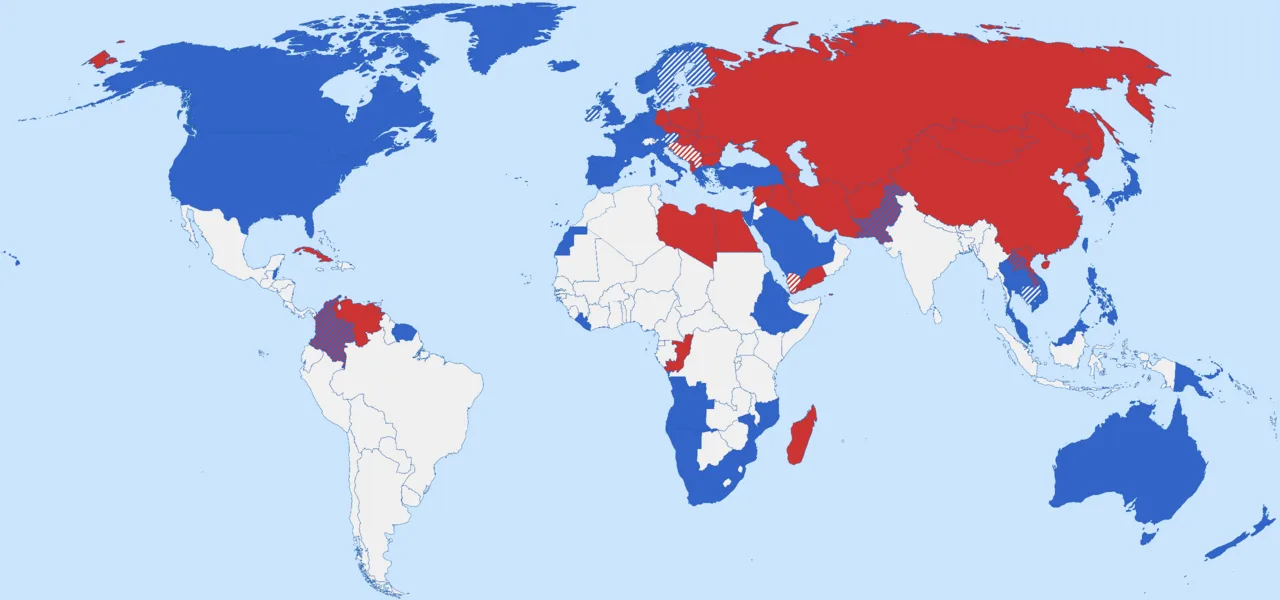
The cold war was a global rivalry between the United States and the Soviet Union, conducted through ideological competition, arms races, espionage, economic pressure, alliances, and proxy wars rather than direct superpower conflict. Nuclear deterrence prevented open war while making annihilation possible. Its phases ran from containment and early crises through detente, renewed confrontation, and the Soviet dissolution, with consequences far beyond either power.
On August 6, 1945, an American B-29 bomber dropped a single uranium bomb on the Japanese city of Hiroshima, killing approximately 80,000 people immediately and perhaps 140,000 by the end of the year. Three days later, a second bomb destroyed Nagasaki.
Within a week, Japan had surrendered and the Second World War was over. The weapon that ended one age immediately inaugurated another. The United States now possessed the most destructive instrument in human history, and within four years, so would the Soviet Union.
For the next four and a half decades, the world lived under the shadow of arsenals capable of ending civilisation, held in check by the paradox that any attempt to use them would guarantee mutual annihilation.
The Cold War was the name given to the sustained global rivalry between the United States and the Soviet Union that lasted from roughly 1947 to 1991.[2] It was cold only in the sense that the two superpowers never fought each other directly - a restraint imposed by nuclear deterrence rather than by goodwill.
In Korea, Vietnam, Angola, Afghanistan, and dozens of other places, the rivalry produced very hot wars that killed millions of people who were not American or Soviet.
The Cold War was simultaneously a military standoff, an ideological contest between capitalism and communism, a competition for influence in the post-colonial world, a race for technological and scientific supremacy, and a domestic political force that shaped institutions, culture, and individual lives on both sides of the Iron Curtain.
At its heart, the Cold War was a contest between two universalist ideologies, each claiming to offer the correct model for all of humanity. American liberal capitalism and Soviet Marxism-Leninism were not simply competing national interests - they were competing visions of history, justice, and human possibility.
This ideological dimension distinguished the Cold War from earlier great-power rivalries and explains both its global reach and its distinctive intensity.
"The issue of whether the world will live in freedom depends upon the outcome of the struggle between democracy and totalitarian regimes. In this situation, free peoples must rely on their own efforts and resources for maintaining their freedom."
- President Harry S. Truman, address to Congress, March 12, 1947
| Phase | Period | Key Events |
|---|---|---|
| Early Cold War | 1947-1953 | Truman Doctrine; Marshall Plan; Berlin Blockade; NATO; Korean War |
| Thaw and escalation | 1953-1962 | Sputnik; Hungarian Revolution; Berlin Wall; Cuban Missile Crisis |
| Detente | 1963-1979 | Hotline; SALT I; Nixon in China; Helsinki Accords |
| Second Cold War | 1979-1985 | Soviet Afghanistan invasion; Reagan Doctrine; arms buildup |
| Gorbachev era and end | 1985-1991 | Glasnost; perestroika; fall of Berlin Wall; Soviet dissolution |
| Post-Cold War reckoning | 1991-present | NATO expansion; Yugoslav wars; Iraq; Ukraine; echo debates |
Key Definitions
Cold War: The period of geopolitical tension, ideological rivalry, and military competition between the United States and Soviet Union and their respective allies from approximately 1947 to 1991, characterised by the absence of direct military conflict between the superpowers and the use of proxy wars, espionage, economic pressure, and propaganda as instruments of competition.[11]
Containment: The American grand strategy for the Cold War, derived from George Kennan's analysis, which held that the Soviet Union would expand wherever it encountered weakness and could be deterred by firm resistance; rather than seeking to roll back Soviet power, the United States should build up strength at strategic points to prevent further expansion.
Deterrence: The strategy of preventing attack by threatening unacceptable retaliation; in the nuclear context, Mutual Assured Destruction (MAD) held that any nuclear first strike would be met with a retaliatory strike capable of inflicting unacceptable damage, making nuclear war irrational for both sides.
Proxy war: A conflict in which two competing powers support opposing sides without engaging directly; Korea, Vietnam, the Arab-Israeli conflicts, and the Soviet-Afghan War were all proxy conflicts through which the superpowers competed without directly fighting each other.
Iron Curtain: Winston Churchill's phrase, used in his 1946 Fulton, Missouri speech, for the boundary dividing Soviet-controlled Eastern Europe from the Western democracies.
Deterrence stability: The condition in which neither side believes it can launch a disarming first strike without suffering unacceptable retaliation - the foundation of nuclear peace throughout the Cold War.
Stability was threatened by accuracy improvements that made enemy missiles potentially destroyable in a first strike, generating the "use it or lose it" instability that kept strategists awake.
Origins: From Alliance to Rivalry
The wartime alliance between the United States, the Soviet Union, and Great Britain was always a marriage of convenience rather than conviction. The three powers shared virtually nothing beyond the immediate necessity of defeating Nazi Germany and Imperial Japan.
Roosevelt's hope that personal relations with Stalin and postwar cooperation in a reformed international order - the United Nations - could sustain the alliance proved impossible to translate into institutions after Roosevelt's death in April 1945.
The structural causes of the Cold War ran deeper than personality or misunderstanding. The Soviet Union had suffered approximately 27 million dead in the Second World War - more than any other combatant by an enormous margin, representing roughly 14 percent of its total population.
The German invasion of June 1941 had been the fourth invasion of Russia from the West in 130 years (Napoleonic France in 1812; Germany in 1914-18; Germany again in 1941-45, with Japan attacking simultaneously from the east in 1904-5).
Stalin's insistence on a buffer of subservient states in Eastern Europe was not paranoia - it was a rational response to a genuine and recent pattern of catastrophic vulnerability.
The Western allies' insistence on democratic self-determination for liberated nations was equally grounded in principle: the Atlantic Charter of 1941 had committed the United States and Britain to "the right of all peoples to choose the form of government under which they will live." These positions were irreconcilable in practice.
Poland, divided for so long and fought over so recently, was the immediate flashpoint: the Soviet-backed Lublin Poles versus the London Poles who had constituted the government in exile throughout the war.
The Yalta Conference (February 1945) and the Potsdam Conference (July-August 1945) papered over fundamental disagreements about the postwar order in Europe.
The ambiguities of the Yalta agreements - on Polish borders, on "free elections" in Eastern Europe, on the occupation zones of Germany - allowed both sides to accuse the other of bad faith in subsequent months.
Historians have debated ever since whether the Cold War was inevitable given the structural situation or whether different personalities, different decisions at specific junctures, might have produced a less hostile postwar settlement.[3]
Kennan's Analysis and the Truman Doctrine
George Kennan, the State Department's most perceptive Soviet analyst, sent the Long Telegram from Moscow in February 1946 - 8,000 words that became the most influential diplomatic cable in American history.
Kennan argued that Soviet foreign policy was driven by a combination of traditional Russian insecurity and the ideological necessity of portraying the capitalist world as hostile. The Soviet Union would probe for weakness everywhere and respond only to firm resistance.
This led to his prescription of containment: the patient application of counterforce at every point where Soviet pressure threatened Western interests.
Kennan elaborated the argument publicly (under the pseudonym "X") in the 1947 Foreign Affairs article "The Sources of Soviet Conduct." The Soviet system, he argued, contained the seeds of its own decline - internal contradictions that patient Western resistance would allow to mature into collapse.[1]
He was substantially right, though it took four decades.
Kennan's analysis was formalised as American policy in the Truman Doctrine (March 1947), delivered in an address to Congress requesting aid for Greece and Turkey against Communist pressure.[12]
Truman framed the issue in sweeping ideological terms as a choice between two ways of life - one free, one totalitarian - that the United States had a responsibility to defend globally.
Critics, including Kennan himself, worried that the universalist formulation committed the United States to more than it could or should undertake.
His concern proved prescient: the Truman Doctrine's logic of universal commitment would eventually lead to Vietnam.
The Marshall Plan (June 1947) offered massive economic reconstruction assistance to European nations, including - deliberately - the Soviet bloc, which Stalin refused.
The plan was partly humanitarian and partly strategic: economically devastated Western European nations with strong Communist parties were seen as vulnerable to Soviet-backed political takeover without American support.
Between 1948 and 1952, the United States provided approximately 13 billion dollars (roughly 140 billion in today's money) in economic assistance.
It succeeded dramatically in stabilising Western European capitalism and remains one of the most effective uses of American foreign policy resources in the country's history. The contrast with the post-Cold War management of Eastern Europe - where no comparable reconstruction effort was mounted - is instructive.
Berlin: The Divided City as Cold War Symbol
No city concentrated the Cold War's tensions more intensely than Berlin, divided at the end of the war among American, British, French, and Soviet occupation zones and located 110 miles inside Soviet-occupied eastern Germany.
The Berlin Blockade (June 1948 to May 1949) was Stalin's attempt to force the Western powers out of their Berlin sectors by cutting off all land access.
The Western response was the Berlin Airlift: Anglo-American aircraft flew approximately 2.3 million tons of supplies into the city over eleven months, at the peak landing a plane every three minutes.
At its height, Allied aircraft were delivering more tonnage into Berlin daily than had previously been transported by rail.
Stalin lifted the blockade rather than risk shooting down Western aircraft, and the airlift became one of the early Western victories of the Cold War - demonstrating that firm resistance could work and that Berlin could not be abandoned without catastrophic consequences for Western credibility.
The Berlin Wall, erected overnight beginning August 13, 1961, was the East German solution to a haemorrhage of population: approximately 3.5 million people had fled East Germany to the West since 1949, disproportionately professionals and the educated, threatening the viability of the regime.
Walter Ulbricht, the East German leader, had been denied permission to seal the border by Khrushchev for years, but the crisis had become acute - in August 1961 alone, approximately 1,000 people per day were crossing.
The Wall divided streets, neighbourhoods, and families without warning. Over its twenty-eight-year existence, it killed at least 140 people attempting to cross it.
Its construction was embarrassing - an admission that socialist East Germany could not retain its own citizens without coercion - but it stabilised the situation by ending the exodus.
The Wall's fall on November 9, 1989, was one of the most dramatic and joyful events of the twentieth century.
East Germany opened its borders not as a planned policy but through a miscommunication at a press conference - the government spokesman, Gunter Schabowski, announced new travel regulations and when asked when they took effect, replied "immediately, without delay." Crowds overwhelmed checkpoints; people danced on top of the wall and began hammering it down with picks.
Within a year, German reunification was complete. The twenty-eight-year history of the Wall, from its overnight construction to its joyful destruction, compressed the entire human meaning of the Cold War into a single structure.
The Nuclear Competition and Its Logic
The nuclear competition between the superpowers operated according to a distinctive and often counterintuitive strategic logic.
The fundamental stability condition of the nuclear standoff was what Herman Kahn and Albert Wohlstetter called second-strike capability: each side needed to maintain, even after absorbing a full nuclear first strike, sufficient surviving weapons to inflict unacceptable damage on the attacker.
If either side lost second-strike capability - if a sufficiently accurate first strike could destroy the enemy's retaliatory forces - the strategic situation became destabilising, as the side whose weapons were vulnerable faced a "use it or lose it" incentive in a crisis.
This logic drove the arms race in counterintuitive directions. More accurate missiles were not simply better - they were destabilising, because they made the other side's land-based missiles vulnerable to a disarming first strike.
More survivable weapons - submarines, hardened silos, dispersal - were stabilising because they guaranteed second-strike capability.
The RAND Corporation and academic strategic theorists including Bernard Brodie, Albert Wohlstetter, and Thomas Schelling developed the intellectual framework of nuclear deterrence theory in the 1950s and 1960s.
Schelling's 'The Strategy of Conflict' (1960) and 'Arms and Influence' (1966) remain foundational texts.[14]
By 1983, the combined American and Soviet nuclear arsenals contained approximately 65,000 warheads.
A comprehensive exchange between these arsenals, modelled by researchers including Carl Sagan and his colleagues in their 1983 "nuclear winter" paper in Science, would have injected sufficient soot and ash into the stratosphere to block sunlight, drop global temperatures by several degrees, and potentially collapse agricultural systems worldwide - killing many times more people through famine and exposure than the initial blasts.[17]
The term "Mutual Assured Destruction" was not merely rhetorical: it was an accurate description of the strategic situation, and it was this situation that deterred nuclear war.
At their peak, the Soviet Union and United States were spending an estimated 40 to 50 billion dollars annually each on nuclear forces alone, in addition to vast conventional military establishments.
The economic burden was asymmetric: the Soviet Union, with a GDP approximately half that of the United States, was devoting a substantially larger share of its output to military competition, a structural disadvantage that Gorbachev's advisers explicitly identified as a primary motivation for seeking arms control agreements.
The Korean War and the Proxy War Template
The Korean War (1950-1953) established the template for Cold War proxy conflict: two local forces representing opposite sides of the ideological divide, each backed by one or more great powers, fighting a limited war constrained by the fear of superpower escalation.
The war began when North Korean forces crossed the 38th parallel in June 1950, quickly overrunning most of South Korea.
The United Nations (with the Soviet Union boycotting the Security Council in a dispute over Chinese representation) authorised a military response, and General Douglas MacArthur's forces ultimately drove north nearly to the Chinese border - at which point China intervened massively, driving back to roughly the original dividing line.
MacArthur's demand to expand the war, including possible use of nuclear weapons, led Truman to relieve him of command in one of the most dramatic civil-military confrontations in American history.[8]
The war ended in 1953 in an armistice that restored essentially the pre-war borders, at a cost of approximately 36,000 American lives, over 100,000 allied casualties, and an estimated three to four million Korean and Chinese deaths.
It established the deterrence logic that would govern proxy conflicts for the next four decades: neither side would allow the other a decisive victory, but neither would allow the conflict to escalate to direct superpower confrontation.
In retrospect, the Korean War also demonstrated that conventional military force remained a usable instrument despite nuclear weapons - a finding that structured both superpowers' subsequent military planning.
David Halberstam's 'The Coldest Winter' (2007), drawing on extensive interviews with veterans and newly declassified documents, reconstructed the war's military dynamics in detail, emphasising how MacArthur's intelligence failures and his refusal to credit warnings of Chinese intervention turned a potential total victory into the stalemate that defined the peninsula's division for the next seventy years.[9]
The Cuban Missile Crisis: Thirteen Days
The Cuban Missile Crisis of October 1962 was the single most dangerous episode of the Cold War. Over thirteen days, the world came closer to nuclear exchange than at any other point in the atomic age - and was pulled back from the brink in ways that only decades of archival research fully revealed.
The crisis began when American U-2 reconnaissance photographs revealed Soviet intermediate-range ballistic missile sites under construction in Cuba. President Kennedy faced a stark choice: accept missiles 90 miles from Florida capable of striking most major American cities, or risk war by demanding their removal.
He chose a naval quarantine - the word "blockade" was avoided because a blockade was legally an act of war - announced publicly on October 22.[10]
The thirteen days combined high-level diplomacy, military pressure, and terrifying near-accidents.
On October 27, "Black Saturday," three separate incidents could have triggered war: a U-2 was shot down over Cuba, American destroyers attacked a Soviet submarine that American commanders did not know was armed with a nuclear torpedo, and a separate U-2 that had taken off from Alaska accidentally strayed into Soviet airspace over Siberia.
On the submarine B-59, whose communications with Moscow had failed, the captain Valentin Savitsky wanted to launch the nuclear torpedo, believing war might already have started.
Under protocol, two officers had to agree. Vasili Arkhipov, the flotilla commander aboard by chance, refused. His refusal may have prevented nuclear exchange.
The resolution came through a combination of Khrushchev's offer to remove missiles in exchange for an American non-invasion pledge, and a secret back-channel agreement - publicly denied for twenty-five years - by which the United States would remove Jupiter missiles from Turkey.[5]
Both sides had reasons to accept a solution that allowed each to claim partial victory.
The full details of the crisis's near-misses only became known decades later, through declassification and the "retrospective conferences" held in the 1990s at which American, Soviet, and Cuban participants compared notes.
Robert McNamara, who had been Kennedy's Secretary of Defense, said after learning the full story at a 1992 Havana conference: "We came very close.
Closer than we knew." The historians James Blight and David Welch (1989) documented these revelations in 'On the Brink,' reconstructing how much of the crisis's outcome had depended on specific individuals' decisions under conditions of extreme uncertainty and time pressure.[13]
McCarthyism: The Cold War at Home
The Cold War was not only an international competition but a domestic political force that reshaped American institutions, constrained political debate, and destroyed careers and lives through the machinery of anti-Communist investigation.
Senator Joseph McCarthy's particular contribution was the weaponisation of accusation: his Senate subcommittee investigations between 1950 and 1954 relied on innuendo, guilt by association, and theatrical confrontation rather than documented evidence.
His influence drew on genuine public anxiety - the Soviet atomic test in 1949, the fall of China, the Korean War - and a political environment in which the label "Communist" functioned as a conversation-stopper.
He never successfully prosecuted a Communist, but he ended or damaged hundreds of careers, contributing to a chilling effect on political speech and association that lasted well beyond his own fall.
The broader anti-Communist machinery - HUAC, the Hollywood blacklist, the FBI under J. Edgar Hoover, the Smith Act prosecutions - was larger than McCarthy and preceded him. An estimated 320 writers, directors, and actors were blacklisted by Hollywood studios between 1947 and 1960.
Dalton Trumbo, Lillian Hellman, and Langston Hughes were among the prominent creative figures whose careers were disrupted or destroyed. Arthur Miller's 'The Crucible' (1953), set during the Salem witch trials, was understood by audiences and authorities alike as an allegory for McCarthyism.
Hoover's FBI maintained surveillance files on politicians, civil rights leaders, and intellectuals, and used the information for political blackmail and suppression of dissent that had nothing to do with genuine national security concerns.
Martin Luther King Jr. was surveilled and his private life used against him by the FBI, which sent him a letter encouraging him to commit suicide - operations that the Senate Church Committee investigation of 1975-76 documented in detail and that had no plausible security justification.
McCarthy was ultimately destroyed by his overreach in the Army-McCarthy hearings of 1954, broadcast nationally on television, during which attorney Joseph Welch's question - "Have you no sense of decency, sir? At long last, have you left no sense of decency?" - captured a shift in public mood.
The Senate censured McCarthy in December 1954. He died in 1957, largely forgotten, of hepatitis complicated by alcoholism.
The McCarthyite episode produced lasting distortions in American political culture.
Ellen Schrecker's research (1998) documented how the anti-Communist purges removed a generation of leftist organisers from the labour movement, civil rights organisations, and educational institutions - shifting the ideological centre of American politics rightward in ways that persisted long after the specific crisis passed.[15]
The Space Race: Science as Ideology
The space race was the Cold War's most visible technological competition and its most effective propaganda vehicle. When the Soviet Union launched Sputnik - the world's first artificial satellite - on October 4, 1957, the shock in the United States was profound and immediate.
A beeping metal sphere orbiting the Earth at 18,000 miles per hour demonstrated that Soviet rockets were capable of reaching any point on the planet.
Eisenhower's public reassurances that Sputnik posed no military threat were technically correct but politically inadequate; the American public perceived a technological gap that demanded response.
The political consequences were substantial. Congress passed the National Defense Education Act in 1958, channelling unprecedented federal funding into science and mathematics education. NASA was established in July 1958.
The space race consumed approximately 25 billion dollars of American public investment between 1961 and 1969 (over 180 billion in current terms) - an investment in scientific infrastructure whose returns extended far beyond the Apollo programme itself into materials science, computing, telecommunications, and medical technology.
The Soviets achieved the early milestones: first satellite, first animal in space (Laika, 1957), first human in space (Yuri Gagarin, April 12, 1961), first spacewalk (Alexei Leonov, 1965).
The Americans won the moon (Neil Armstrong and Buzz Aldrin, July 20, 1969) - the most watched television broadcast in history, with an estimated 600 million viewers worldwide.
The Apollo landing was simultaneously a genuine human achievement and a carefully choreographed ideological statement: it proved that American capitalism could mobilise resources for a national goal at least as effectively as Soviet central planning.
Both superpowers understood that scientific prestige was a form of soft power, particularly in the developing world where both were competing for influence. The space race was inseparable from the broader ideological competition.
Detente and Its Collapse
The period of relative relaxation in superpower tensions from the late 1960s through the mid-1970s - detente - produced the most significant arms control agreements of the Cold War and opened diplomatic channels that had been closed since 1949.
Nixon's opening to China in 1971-1972, engineered by National Security Adviser Henry Kissinger, was the strategic masterstroke of the era: by triangulating against the Soviet Union - exploiting the Sino-Soviet split that had developed since the late 1950s - the United States created leverage on both Communist powers simultaneously.
The Sino-Soviet split itself, rooted in ideological disputes and territorial claims, had been a major factor in both powers' calculations for over a decade.
The Strategic Arms Limitation Talks (SALT I), signed in 1972, capped ballistic missile launchers on both sides - the first negotiated constraints on the nuclear competition.
The Helsinki Accords (1975) ratified postwar European borders (securing a longstanding Soviet objective) while including human rights language that Soviet dissidents and Eastern European activists would invoke for the next decade.
Detente rested on the premise that stable management of the superpower rivalry required ongoing communication and negotiated agreements, and that nuclear war was so catastrophic that even hostile states had a mutual interest in its prevention.
Its collapse came from multiple directions: Soviet adventurism in Africa and Central America, which American conservatives argued showed that the Soviets were exploiting detente as cover for expansion; the fall of Iran (1979), which exposed American weakness in the Middle East; and most decisively, the Soviet invasion of Afghanistan in December 1979.
Ronald Reagan's election in 1980 brought to power a president who fundamentally rejected detente's premises.
Reagan's defence buildup, his deployment of Pershing II missiles in Europe, his Strategic Defense Initiative (ballistic missile defence research), and his support for anti-Communist insurgencies through the Reagan Doctrine created new pressures on the Soviet system.
The early 1980s were genuinely frightening: the Soviet leadership, aging, paranoid, and led by a series of dying men, misread the NATO exercise Able Archer 83 as possible cover for a real nuclear first strike and prepared countermeasures.
Documents declassified in the 2010s confirmed that the Soviet fear of an American nuclear surprise attack during this period was genuine and intense - not propaganda.
The Soviet Collapse and Cold War's End
Mikhail Gorbachev became General Secretary of the Soviet Communist Party in March 1985 at fifty-four, young by recent standards, and immediately signalled that the system required fundamental reform.
His twin policies of glasnost (openness - relaxation of censorship and encouragement of public discussion) and perestroika (restructuring - limited market reforms and anti-corruption campaigns) were intended to revitalise the system, not destroy it.
The consequences were profoundly unintended. Glasnost released nationalist movements in the Baltic states, Ukraine, and the Caucasus that the Soviet system had suppressed for decades.
The Baltic states - Estonia, Latvia, Lithuania - had been forcibly incorporated into the Soviet Union following the Molotov-Ribbentrop Pact of 1939 and had never accepted the occupation as legitimate.
When the glasnost-era press began publishing the secret protocols - the side agreements by which Stalin and Hitler had divided Eastern Europe in 1939 - Soviet legal authority in the Baltics collapsed morally before it collapsed practically.
Gorbachev's refusal to use military force to suppress these movements - as Khrushchev had used force in Hungary in 1956 and Brezhnev in Czechoslovakia in 1968 - proved decisive: without the threat of force, the Soviet system could not hold together.
The economic crisis was equally critical. By the mid-1980s, Soviet GDP growth had fallen to near zero, the oil price collapse of 1986 had devastated export revenues, and the combination of technological backwardness and military burden was producing visible stagnation.
Vladislav Zubok's research (2007) and the later work of scholars with access to Soviet archives documented how clearly Soviet planners understood the depth of the system's structural problems.[7] Gorbachev was attempting genuine reform, not merely surface adjustment.[4]
The Eastern European dominoes fell in 1989 with remarkable speed: Poland in June (with the first semi-free elections, in which Solidarity won 99 of 100 Senate seats), Hungary in October (opening its border with Austria, allowing East Germans to flee to the West), Czechoslovakia in November (the Velvet Revolution, in which student demonstrations produced a regime change in ten days), Romania in December (with the execution of Ceausescu).
The Berlin Wall fell on November 9.
The Soviet Union itself dissolved in stages. A failed coup against Gorbachev by Communist hardliners in August 1991 destroyed the last vestiges of Communist Party authority. The Baltic states and then other Soviet republics declared independence.
On December 25, 1991, Gorbachev resigned and the Soviet flag was lowered over the Kremlin for the last time. The Cold War was over.
"I understand that the process is painful but necessary. I am leaving office with a sense of anxiety. But also with hope, with faith in you, your wisdom and strength of spirit. We are the heirs of a great civilisation." - Mikhail Gorbachev, resignation speech, December 25, 1991
The Cold War in the Developing World
The Cold War's most destructive impact was not in Europe, where nuclear deterrence maintained an armed peace for forty-five years, but in the developing world, where the superpower competition played out in proxy conflicts that killed millions.
Odd Arne Westad's 'The Cold War: A World History' (2017) recentred the history on what he called the "Global Cold War" - the competition for influence in Asia, Africa, and Latin America that was as central to both superpowers' strategies as the European standoff.[6]
Between 1946 and 1991, approximately 11 million people were killed in Cold War-related conflicts in the developing world (Sivard, 1993).[16]
The wars in Korea, Vietnam, the Cambodian genocide, the Angolan civil war, the Mozambican civil war, the Ethiopian and Somali wars, the Nicaraguan conflict, the Guatemalan civil war - all were shaped, sustained, and often initiated by superpower competition.
American support for anti-Communist authoritarian regimes - Pinochet's Chile (after the CIA-assisted coup of 1973), Mobutu's Zaire, Suharto's Indonesia (after the 1965 massacre of estimated 500,000 to one million suspected Communists), Somoza's Nicaragua - damaged the credibility of American democracy promotion in ways that echo through subsequent decades.
The stated American goal of defending freedom was visibly contradicted by alliances with some of the most repressive governments of the twentieth century.
The Soviet intervention in Afghanistan (1979-1989) was the USSR's Vietnam: a guerrilla war against a foreign occupier that could not be won, costing approximately 15,000 Soviet lives and an estimated one million Afghan lives, destroying the myth of Soviet military invincibility, and contributing significantly to the demoralisation that preceded the Soviet collapse.
The American response - arming and financing the mujahideen through Pakistan's ISI, a programme that eventually channelled approximately 3 billion dollars to anti-Soviet fighters - succeeded in accelerating Soviet withdrawal.
It also created the infrastructure and ideological networks from which the Taliban and al-Qaeda would emerge in the following decade.
Enduring Legacies
The Cold War ended more than three decades ago, but its structures continue to shape the international order, American domestic politics, and the security landscape in ways that are frequently underappreciated.
NATO's expansion from 12 to 32 members - incorporating nearly all the former Warsaw Pact states and three former Soviet republics - is the geopolitical legacy most actively contested in contemporary politics.
The debate over whether expansion provoked Russian aggression or whether Russian behaviour demonstrated exactly why expansion was necessary has been given violent new relevance by the 2022 Russian invasion of Ukraine.
Nuclear arsenals, substantially reduced from Cold War peaks through the START process, remain civilisation-ending in scale. The arms control architecture is eroding: the INF Treaty collapsed in 2019, and New START expired without renewal amid the deep US-Russian hostility of the Ukraine war era.
The number of countries with nuclear weapons has grown from two in 1949 to nine by the 2020s.
The intelligence community, the national security bureaucracy, and the surveillance apparatus built for Cold War competition remain substantial institutional facts. Cold War-era legal authorities underpinned the mass surveillance programmes revealed by Edward Snowden in 2013.
The classification system that expanded dramatically during the Cold War remains largely in place.
Historians and policy analysts continue to debate the lessons of the Cold War's end. Was the Soviet collapse inevitable, or could different policy choices have produced a reformed Soviet state rather than its dissolution? Did Western policies accelerate or simply accompany Soviet collapse?
Did the West squander the post-Cold War peace by failing to integrate Russia into a new European security order - or was Russian revanchism inevitable regardless of Western policy?
These questions have acquired renewed urgency as competition between the United States and China develops into what some analysts call a "New Cold War" - though whether the US-China rivalry reproduces the binary ideological structure of the original remains contested.
For more on related topics, see the articles at /culture/global-cross-cultural/why-the-cold-war-shaped-the-modern-world, /culture/global-cross-cultural/what was-the-space-race, /culture/global-cross-cultural/what caused-world-war-two, /culture/global-cross-cultural/what-is-communism, and /culture/global-cross-cultural/what-is-democracy.
Sources & Further Reading
- Kennan, George F. ("X"). "The Sources of Soviet Conduct." Foreign Affairs 25.4 (1947): 566-582.
- Gaddis, John Lewis. The Cold War: A New History. Penguin Press, 2005.
- Gaddis, John Lewis. We Now Know: Rethinking Cold War History. Oxford University Press, 1997.
- Matlock, Jack F. Reagan and Gorbachev: How the Cold War Ended. Random House, 2004.
- Fursenko, Aleksandr, and Timothy Naftali. One Hell of a Gamble: Khrushchev, Castro, and Kennedy, 1958-1964. Norton, 1997.
- Westad, Odd Arne. The Cold War: A World History. Basic Books, 2017.
- Zubok, Vladislav M. A Failed Empire: The Soviet Union in the Cold War from Stalin to Gorbachev. University of North Carolina Press, 2007.
- McCullough, David. Truman. Simon and Schuster, 1992.
- Halberstam, David. The Coldest Winter: America and the Korean War. Hyperion, 2007.
- Schlesinger, Arthur M., Jr. A Thousand Days: John F. Kennedy in the White House. Houghton Mifflin, 1965.
- Andrew, Christopher, and Vasili Mitrokhin. The Mitrokhin Archive: The KGB in Europe and the West. Allen Lane, 1999.
- Leffler, Melvyn P. A Preponderance of Power: National Security, the Truman Administration, and the Cold War. Stanford University Press, 1992.
- Blight, J. G., & Welch, D. A. (1989). On the Brink: Americans and Soviets Reexamine the Cuban Missile Crisis. Hill and Wang.
- Schelling, T. C. (1960). The Strategy of Conflict. Harvard University Press.
- Schrecker, E. (1998). Many Are the Crimes: McCarthyism in America. Little, Brown.
- Sivard, R. L. (1993). World Military and Social Expenditures. World Priorities.
- Sagan, C., et al. (1983). Nuclear winter: Global consequences of multiple nuclear explosions. Science, 222(4630), 1283-1292.