
Mongol: In the spring of 1220, the army of Genghis Khan arrived outside the walls of Samarkand - one of the great cities of the Islamic world, a center of scholarship, trade, and architecture that had flourished for centuries at the crossroads of the Silk Road.
The city was garrisoned by a substantial force and surrounded by formidable fortifications. Within days, it had fallen. The Khwarezm governor fled. Many of the inhabitants were massacred; the survivors were enslaved or conscripted.
The mosques were converted to stables. A city that had taken centuries to build was effectively erased as a political and cultural center in less than a week.
Samarkand was not unique. In the course of less than three years, the Mongol armies under Genghis Khan and his generals swept through the Khwarezm Empire - a wealthy, sophisticated Islamic state covering modern Iran, Afghanistan, Uzbekistan, and Turkmenistan - leaving a trail of devastation that contemporaries and later historians have struggled to characterize accurately.
Estimates of deaths in the Khwarezm campaign range from one to three million.
The ancient city of Merv, then possibly the largest city in the world, was reportedly destroyed so thoroughly that historians could not locate it for centuries. Persian geographers writing a generation later described landscapes of ruins and bones where flourishing agricultural regions had been.[5]
How did a confederation of nomadic pastoralists from the Mongolian steppe, organized around kinship ties and pastoralism, become, within a single lifetime, the masters of the largest contiguous land empire in recorded history? The question is not purely military.
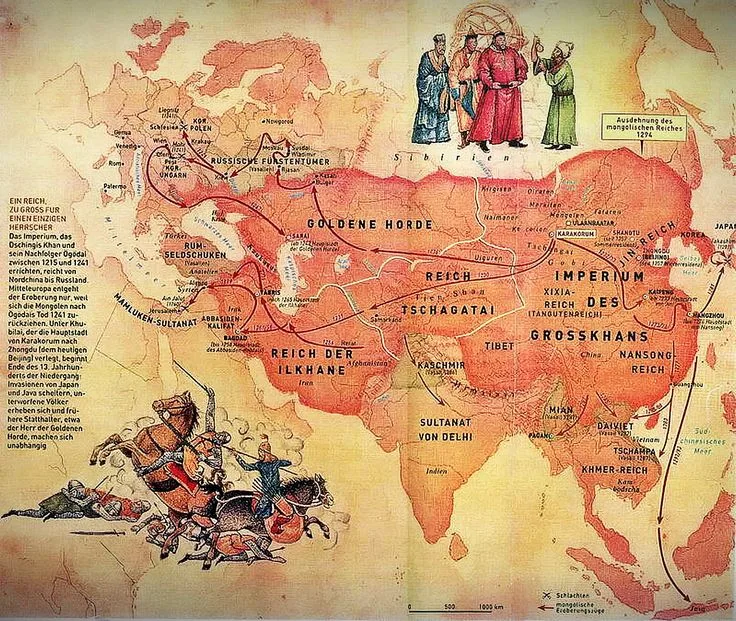
The Mongol Empire at its peak administered territories from the Pacific coast of China to the Danube, from the Arctic forests of Siberia to the Persian Gulf - a span of civilizations, languages, religions, and political traditions of staggering diversity.
Understanding how it was built, how it was governed, and why it ultimately fragmented is an essential chapter in world history.
"They came, they uprooted, they burned, they slew, they plundered and they departed." - Juvayni, History of the World Conqueror (c. 1260), describing the Mongol conquest of Khurasan
| Khan / Leader | Period | Territorial Achievement |
|---|---|---|
| Genghis Khan | 1206-1227 | Unified Mongol tribes; conquered Northern China, Central Asia |
| Ogedei Khan | 1229-1241 | Invaded Russia, Poland, Hungary; China campaigns |
| Mongke Khan | 1251-1259 | Conquered Song China (in progress), invaded Persia |
| Kublai Khan | 1260-1294 | Completed conquest of China; founded Yuan Dynasty |
| Hulagu Khan | 1256-1265 | Destroyed Abbasid Caliphate; conquered Baghdad |
| At peak (1270s) | - | Empire spanned ~24 million sq km; largest contiguous land empire |
Key Definitions
Mongol Empire - The political entity founded by Genghis Khan in 1206 and expanded by his successors, reaching its greatest territorial extent of approximately 24 million square kilometers under Kublai Khan in the 1270s-1280s. The largest contiguous land empire in recorded history.
Kurultai - A great assembly of Mongolian leaders convened to make major political decisions, including the election of a Great Khan.[6]
Tumen - The largest unit of the Mongol decimal military system, consisting of 10,000 soldiers, itself composed of ten mingans (thousands), each composed of ten zuuns (hundreds), each composed of ten arbans (tens).
Yam - The Mongol postal relay system, a network of stations spaced approximately 25-40 miles apart stocked with horses, food, and accommodation, enabling rapid communication and travel across the empire.
Paiza - A tablet of bronze, silver, or gold authorizing the bearer to travel under imperial protection and requisition horses, food, and lodging at Yam stations.
Pax Mongolica - The period of relative peace and stability within the Mongol Empire (roughly 1250s-1350s) during which trade and travel across Eurasia occurred at unprecedented scale.
Khanate - A political unit governed by a Khan. After Genghis Khan's death in 1227, the empire was divided among his descendants into four principal khanates: the Yuan Dynasty (China), the Ilkhanate (Persia/Middle East), the Golden Horde (Russia/Central Asia), and the Chagatai Khanate (Central Asia).[2]
Chinggisid legitimacy - The claim to political authority derived from descent from Genghis Khan (Chinggis Khan), which remained a prerequisite for rulership across much of Central Asia for centuries after the empire's dissolution.
Origins: Temujin and the Unification of the Steppe
The Steppe World Before Genghis Khan
The Mongolian steppe in the twelfth century was a world of competing tribal confederations - the Mongols, Tatars, Merkits, Naimans, Kereit, and others - that alternated between alliance and warfare in a fluid, constantly shifting political landscape.
Wealth was measured in livestock; status was determined by lineage and military prowess; and the fundamental social unit was the clan.
The great powers to the south - the Jin Dynasty of northern China, the Khwarezm Empire to the west - regarded the nomads primarily as a threat to be managed through tribute, divide-and-rule tactics, and occasional punitive campaigns.
Temujin was born approximately 1162 into the Borjigin clan, nominally aristocratic but materially precarious. His father Yesugei was poisoned by Tatar rivals when Temujin was approximately nine years old. The family was abandoned by their clan and spent years in poverty on the margins of steppe society.
Temujin's adolescence involved enslavement by the rival Tayichiut clan, escape, and the slow construction of a political identity through alliance, marriage, and warfare.
The Rise of Genghis Khan
Temujin's rise took approximately three decades of systematic expansion. He forged a blood brotherhood (anda) with Jamukha, an alliance with the powerful Kereit leader Toghrul (whom the Jin recognized as "Wang Khan"), and a political marriage to Borte of the Khongirad clan.
These alliances were as important as military victories. Through the 1190s and 1200s, Temujin defeated the Tatars (who had murdered his father), the Merkits, the Naimans, and ultimately the Kereit - absorbing their peoples, livestock, and fighting men into his growing confederation.
In 1206, a Kurultai on the Onon River in Mongolia proclaimed Temujin the Genghis Khan - Universal Ruler or Oceanic Khan, the etymology being disputed.[3] The proclamation was not merely a recognition of military supremacy. Genghis Khan immediately undertook a fundamental reorganization of Mongolian society.
He broke up existing clan structures - the traditional basis of steppe political organization - and reorganized the entire population into decimal military units: arbans of ten, zuuns of a hundred, mingans of a thousand, and tumens of ten thousand.[4]
Commanders at each level were appointed on merit, not birth. Loyalty was owed to Genghis Khan and to the unit, not to clan leaders. This reorganization - transforming a collection of competing clans into a disciplined military hierarchy - was as important as any tactical innovation in explaining Mongol military success.[7]
Military System and Conquest
Why the Mongols Won
The Mongol military combined genuine tactical innovation with logistical capabilities and strategic intelligence that no contemporary force could match.
Mobility was the foundational advantage. Mongol cavalry could travel approximately 100 miles per day on campaign - roughly three to four times the speed of typical infantry-heavy medieval armies. Each Mongol warrior maintained a string of horses (typically three to five), rotating between them to maintain speed over long distances.
This allowed the Mongols to concentrate forces faster than enemies could respond, to conduct simultaneous operations on multiple fronts, and to pursue retreating enemies before they could regroup.
Firepower complemented mobility. The Mongol composite bow - constructed from laminated wood, horn (on the belly), and sinew (on the back) - was a technological marvel. Its effective range reached approximately 200-350 meters, substantially exceeding the bows of Chinese, Persian, and European adversaries.
Mongol archers could fire accurately from horseback at full gallop, delivering devastating volleys before closing to melee. The combination of rapid movement and long-range firepower was fundamentally different from the shock tactics of contemporary heavy cavalry.
The feigned retreat was their most devastating tactical maneuver. Mongol units would simulate panic and flight, drawing pursuing cavalry - trained to exploit a fleeing enemy - into prepared killing grounds where other Mongol units had encircled them.
The tactic required the discipline to retreat convincingly under pressure and the coordination to close the trap at the right moment. No contemporary army had the training to resist the temptation to pursue a seemingly fleeing enemy.
Siege warfare was a capability the Mongols acquired through conquest rather than invention. After defeating the Jin Dynasty's northern territories, they incorporated Chinese engineers skilled in the construction and operation of trebuchets, battering rams, and mining equipment.
By the time of the Khwarezm campaign (1219-1221), Mongol armies could reduce fortified cities that would have been impregnable to pure cavalry forces.
The Scope of Conquest
The conquests under Genghis Khan and his immediate successors were staggering in both speed and scale. The campaign against the Jin Dynasty of northern China began in 1211 and concluded (under Ogedei Khan) in 1234, after Genghis Khan's death.
The Khwarezm campaign of 1219-1221 destroyed one of the wealthiest and most cultured states in the Islamic world in approximately two years. Genghis Khan's generals extended Mongol reach into the Caucasus and into Kievan Rus (the Battle of the Kalka River, 1223).
Under Ogedei Khan (1229-1241), the expansion continued. The Golden Horde campaign under Batu Khan and the general Subutai devastated Kievan Rus in 1237-1240 - destroying Kiev, Vladimir, and other cities - and then swept into Poland and Hungary.
The Battle of Legnica (April 9, 1241) and the Battle of Mohi (April 11, 1241), won simultaneously in Poland and Hungary, demonstrated a logistical and strategic coordination across hundreds of miles that exceeded anything European military commanders could achieve.
The Mongol advance into Western Europe halted upon news of Ogedei Khan's death in December 1241, not because of military defeat.
The campaign against the Abbasid Caliphate under Hulagu Khan culminated in the siege and sack of Baghdad in February 1258 - destroying the political and cultural center of the Islamic world.
The Mongol advance into the Middle East was halted at the Battle of Ain Jalut in 1260, where the Egyptian Mamluk army inflicted the first major defeat on a Mongol force, preventing the conquest of Egypt and North Africa.
The Pax Mongolica: Trade, Exchange, and Plague
The Empire as Trade Network
The destruction wrought by Mongol conquest was eventually followed, within the areas the empire controlled, by a period of relative peace that enabled trade and travel at a scale not previously possible.
The Yam relay system - a network of postal stations across the empire, each stocked with horses, food, and accommodation for authorized travelers - was the infrastructure that made this possible.
Travelers carrying the paiza, the bronze or gold tablet authorizing imperial protection, could move thousands of miles with relative safety.
Marco Polo's journey from Venice to China and back (approximately 1271-1295) is the most famous product of the Pax Mongolica.[9]
Polo traveled under the protection of the Kublai Khan's court, served in administrative positions in the Yuan Dynasty, and returned to Venice after approximately seventeen years with observations of Chinese civilization - paper money, coal as fuel, cities of unprecedented size - that his contemporaries found difficult to believe.
His account, dictated in a Genoese prison and circulated as The Description of the World, influenced European geographical imagination for two centuries and contributed to the motivation behind subsequent expeditions to Asia, including Columbus's.
The Silk Road reached its final great flourishing under Mongol rule. Technologies, ideas, and peoples circulated between East Asia, Central Asia, the Middle East, and Europe.[1] Paper money, papermaking, printing, gunpowder, and cast iron foundry techniques traveled westward.
Islamic astronomical and mathematical knowledge moved eastward. The Mongol courts were cosmopolitan employers: Kublai Khan's court included Tibetan Buddhist lamas, Nestorian Christian advisors, Islamic financiers, and Chinese bureaucrats.
The Black Death
The same infrastructure that enabled trade also transmitted disease. The Black Death - almost certainly caused by Yersinia pestis, the bacterium responsible for bubonic plague - spread westward along Mongol-maintained trade routes from a reservoir in Central Asia beginning in the 1340s.
It reached the Crimea by 1346. Genoese merchants fleeing the siege of Caffa (where the besieging Mongol army was itself devastated by plague, with some accounts claiming Mongol commanders catapulted plague-infected corpses over the walls) carried the disease to Sicily in 1347.
Within five years, the plague had killed between one-third and one-half of Europe's population - perhaps 25 million people, with subsequent waves continuing for decades.
The Black Death traveled along Mongol trade routes not as an act of Mongol biological warfare but as an unintended consequence of the connectivity the empire had created. The same network that moved silk and porcelain and ideas also moved rats and fleas and bacteria.
The plague devastated not only Europe but the Mongol Empire's own population base and trade revenues, contributing to the empire's fragmentation.
Baghdad 1258: The Destruction of the Islamic World's Center
The siege and sack of Baghdad in February 1258 stands as one of the most consequential events in medieval history. Hulagu Khan, commanding the Ilkhanate forces, besieged the city after Caliph Al-Musta'sim refused to submit and failed to adequately prepare the city's defenses.
The Caliph had relied on reassurances from some advisors that Baghdad was inviolable and that divine protection would stop the Mongols. It did not.
The siege lasted approximately two weeks. When the city fell, the scale of the massacre shocked even contemporaries accustomed to Mongol violence. Medieval Islamic sources cite figures of 800,000 to 2 million dead; modern historians typically estimate 200,000-800,000, acknowledging substantial uncertainty.
The Caliph himself was executed - reportedly wrapped in felt and trampled by horses to avoid spilling royal blood on the ground, in accordance with a Mongol prohibition. The 500-year Abbasid Caliphate, which had claimed authority over the Islamic world since 750 CE, was extinguished.
The destruction of the House of Wisdom (Bayt al-Hikmah) - the great library and intellectual center that had accumulated manuscripts in philosophy, mathematics, astronomy, medicine, and literature over centuries - is the most symbolically powerful dimension of the event.
Arabic accounts describe the Tigris running black with ink from manuscripts thrown into the river. A civilization that had preserved and advanced Greek philosophy, developed algebra, made fundamental contributions to astronomy and medicine - the intellectual inheritance of the Islamic Golden Age - was thrown into the water.
Historians debate how much the Mongol destruction accelerated versus merely punctuated a decline that was already underway. The Abbasid Caliphate had been politically diminished for centuries before 1258 - real power had long rested with Seljuk sultans and other military forces.
The intellectual and cultural vitality of the Islamic world did not end with Baghdad; Cairo, under the Mamluks who stopped the Mongol advance, became the new center. But the psychological impact of the destruction of the Caliphate was profound and lasting.
Notably, within a generation the Mongol Ilkhanate converted to Islam, and Hulagu's successors became patrons of Islamic art and scholarship.
Fragmentation and Fall
The Four Khanates
The unity of the Mongol Empire was always more precarious than its military success suggested. Mongol political culture lacked a stable succession mechanism: territory was expected to be divided among the ruler's sons, creating proliferating competing claims rather than consolidated succession.
After Genghis Khan's death in 1227, the empire was governed by a series of Great Khans elected by Kurultai, but the authority of the Great Khan over the regional rulers became increasingly nominal.
The decisive fracture came after the death of Mongke Khan in 1259. Mongke's succession triggered a civil war between his brothers Kublai and Ariq Boke.[10]
Kublai won but was never accepted as legitimate by the other khanates, and the empire effectively split into four: the Yuan Dynasty in China under Kublai; the Ilkhanate in Persia and the Middle East under Hulagu's line; the Golden Horde in Russia and Central Asia under Batu's line; and the Chagatai Khanate in Central Asia.[8]
These khanates frequently warred with each other rather than cooperating, and the coordinated strategic operations that had made the empire so formidable became impossible.
Different Trajectories
The four khanates followed different trajectories of decline. The Yuan Dynasty in China, weakened by economic mismanagement, flooding of the Yellow River, and popular resentment of Mongol rule, was overthrown by the Red Turban Rebellion under Zhu Yuanzhang, who established the Ming Dynasty in 1368 and drove the last Yuan ruler back to Mongolia.
The Ilkhanate collapsed in the 1330s after a succession crisis and was absorbed by competing successor states.
The Golden Horde fragmented through the fourteenth and fifteenth centuries under pressure from the rising Moscow principality and internal dynastic conflicts.
Timur (Tamerlane), a Turkic-Mongol military leader who arose in Samarkand in the 1370s, reconquered much of the former Mongol Empire in campaigns of extraordinary violence - he claimed to have killed perhaps 17 million people, though this figure is likely exaggerated.
Timur, who lacked Chinggisid descent, always ruled through puppet Chinggisid khans to maintain legitimacy. He represents both the persistence and the transformation of the Mongol political tradition.
Legacy
The Mongol Empire's legacy is paradoxical: a system built on destruction that facilitated unprecedented exchange; a political order that collapsed into successor states that shaped Eurasia for centuries; a demographic catastrophe that also produced lasting genetic, cultural, and institutional inheritance.[11]
Chinggisid legitimacy - the claim to authority through descent from Genghis Khan - remained the primary basis for political rule across Central Asia for centuries after the empire's dissolution.
As late as the eighteenth century, rulers across Central Asia required either Chinggisid blood or marriage into Chinggisid families to claim legitimate authority.
The Mughal Empire (founded by Babur, a Timurid with Chinggisid descent, in 1526) and the Kazakh Khanate were among the many polities that drew their legitimacy partly from this lineage.
The genetic legacy is documented: a 2003 study by Zerjal and colleagues identified a Y-chromosome lineage, almost certainly descending from Genghis Khan or his close male relatives, present in approximately 8% of men across a broad swath of Asia - roughly 16 million men in the modern world.[12]
This reflects both the reproductive success of Chinggisid rulers and the sexual violence accompanying conquest.
In Russia, the Golden Horde's two-century domination - the Tatar Yoke - shaped Russian political culture, administrative vocabulary, and territorial ambitions in ways historians continue to debate. The argument that Russian political centralism bears a Mongol imprint is contested but influential.
In China, the Yuan Dynasty's brief rule left limited institutional legacy, but the memory of Mongol conquest shaped the Ming Dynasty's political culture and its early suspicion of foreign engagement.
For related articles, see what is the Silk Road and what was the Islamic Golden Age.
Sources & Further Reading
- Allsen, T. T. (2001). Culture and Conquest in Mongol Eurasia. Cambridge University Press.
- Atwood, C. P. (2004). Encyclopedia of Mongolia and the Mongol Empire. Facts on File.
- Biran, M. (2007). Chinggis Khan. Oneworld Publications.
- Fitzhugh, W., Rossabi, M., & Honeychurch, W. (Eds.). (2009). Genghis Khan and the Mongol Empire. Smithsonian Institution.
- Juvaini, A. M. (c. 1260). The History of the World Conqueror (J. A. Boyle, Trans., 1958). Harvard University Press.
- Lane, G. (2004). Genghis Khan and Mongol Rule. Greenwood Press.
- May, T. (2012). The Mongol Conquests in World History. Reaktion Books.
- Morgan, D. O. (1986). The Mongols. Blackwell.
- Polo, M. (c. 1300). The Description of the World (R. Latham, Trans., 1958). Penguin.
- Rossabi, M. (1988). Khubilai Khan: His Life and Times. University of California Press.
- Weatherford, J. (2004). Genghis Khan and the Making of the Modern World. Crown.
- Zerjal, T., et al. (2003). The genetic legacy of the Mongols. American Journal of Human Genetics, 72(3), 717-721.