
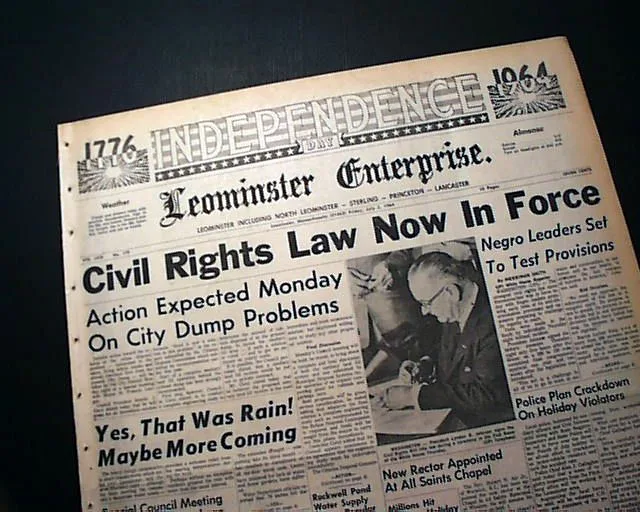
The american civil rights movement emerged from decades of resistance to Jim Crow, combining legal strategy, community institutions, organizing, nonviolent direct action, and changing political opportunities. Its iconic confrontations depended on preparation by groups such as the NAACP, SCLC, and SNCC, not spontaneous courage alone. Court rulings, boycotts, sit-ins, federal enforcement, and mass mobilization dismantled much legal segregation while leaving de facto inequalities unresolved.
On December 1, 1955, Rosa Parks boarded a Montgomery, Alabama city bus after work at the Montgomery Fair department store, where she was a seamstress. She was tired - not, as the legend later insisted, physically tired from her feet, but tired, as she told an interviewer decades later, of giving in.
When the bus driver, James Blake, ordered her to give up her seat to a white passenger standing in the aisle, she refused. She was arrested and taken to the city jail, charged with violating Montgomery's bus segregation ordinance.
Four days later, the Montgomery Bus Boycott began, and it lasted 381 days until the United States Supreme Court ruled in Browder v. Gayle that bus segregation was unconstitutional.
What the legend omits is the infrastructure behind that refusal. Parks was not a stranger to organized resistance. She had been the secretary of the Montgomery chapter of the NAACP for more than a decade.
In the summer of 1955, she had attended the Highlander Folk School in Monteagle, Tennessee, a training center where labor organizers and civil rights activists learned the tactics and philosophy of nonviolent resistance.
She was familiar with the legal strategies being developed by the NAACP Legal Defense Fund.
Earlier that year, a fifteen-year-old named Claudette Colvin had refused to give up her bus seat in Montgomery, but the NAACP had decided her circumstances made her a less reliable plaintiff. Parks's case was different: she was an adult of unimpeachable character and professional standing.
The NAACP had been looking for the right test case. They had found one.
The myth of spontaneous mass movements - the lone individual whose courage ignites a spontaneous uprising - persists because it is a more satisfying story than the truth, which is that durable social change requires years of institutional preparation, strategic calculation, organizational capacity, and a theory of change sustained through failure before the moments of dramatic public confrontation that history remembers.
The civil rights movement was not a spontaneous uprising.
It was the culmination of decades of legal strategy, community organizing, and political consciousness-raising that created the conditions for dramatic action to succeed where raw courage alone had previously been insufficient.
"Letter from Birmingham Jail" - Martin Luther King Jr., April 16, 1963: "We know through painful experience that freedom is never voluntarily given by the oppressor; it must be demanded by the oppressed."[3]
| Milestone Event | Year | Significance |
|---|---|---|
| Brown v. Board of Education | 1954 | Supreme Court struck down school segregation |
| Montgomery Bus Boycott | 1955-56 | First major nonviolent mass protest |
| Little Rock Central High | 1957 | Federal troops enforced desegregation |
| Greensboro Sit-ins | 1960 | Sparked student-led nonviolent direct action |
| Freedom Rides | 1961 | Challenged interstate bus segregation |
| March on Washington | 1963 | King's "I Have a Dream" speech; 250,000 attendees |
| Civil Rights Act | 1964 | Outlawed discrimination in public life |
| Voting Rights Act | 1965 | Protected Black voting rights |
Key Definitions
Jim Crow laws: State and local statutes enacted primarily in Southern states from the 1870s through the 1950s, enforcing racial segregation in public life and codifying the second-class citizenship of Black Americans.
De jure vs de facto segregation: De jure segregation is enforced by law; de facto segregation results from private discrimination, residential patterns, and institutional practices not written in statute. The civil rights movement most effectively dismantled de jure segregation.
NAACP: National Association for the Advancement of Colored People, founded 1909, the oldest and largest civil rights organization, which developed the legal strategy that culminated in Brown v. Board of Education.
Brown v. Board of Education (1954): The Supreme Court's unanimous decision overturning Plessy v. Ferguson and declaring state-mandated public school segregation unconstitutional.
Nonviolent direct action: The strategic use of peaceful confrontation - sit-ins, marches, boycotts - to expose injustice and force a moral and political reckoning, developed theoretically through Gandhi's satyagraha and applied tactically by King and SCLC.
SNCC: Student Nonviolent Coordinating Committee, founded 1960, which brought young activists into the movement and organized voter registration in the Deep South.
SCLC: Southern Christian Leadership Conference, founded 1957 by King and other ministers, which coordinated major campaigns including Birmingham and Selma.
Political opportunity structure: The sociological concept, developed by Doug McAdam, Charles Tilly, and Sidney Tarrow, that social movements succeed or fail partly based on the openness of the political system and the presence of sympathetic elites.
Cognitive liberation: McAdam's term for the collective belief within a movement that change is possible and that participants' actions can bring it about - a necessary psychological condition for sustained mobilization.
COINTELPRO: The FBI's covert counterintelligence program, 1956-1971, which targeted civil rights and radical organizations through surveillance, informant infiltration, and deliberate disruption.
Before the Movement
The civil rights movement of the 1950s and 1960s cannot be understood without the previous eight decades of systematic racial hierarchy it was challenging.
The collapse of Reconstruction in 1877 - when federal troops were withdrawn from the South as part of the Hayes-Tilden compromise that resolved the disputed 1876 election - handed Southern states back to former Confederates who systematically dismantled the brief experiment in multiracial democracy.
The Supreme Court's 1896 decision in Plessy v. Ferguson provided constitutional legitimacy for "separate but equal" arrangements, greenlighting the comprehensive Jim Crow system that followed.
Jim Crow was not merely a collection of signs on bathroom doors. It was a totalizing system of social control enforced by economic dependence, legal disadvantage, and the ever-present threat of violence.
Lynching served as the terror infrastructure of the system: between 1877 and 1950, more than 4,000 Black Americans were lynched in Southern states, the vast majority of these murders going unprosecuted.
Ida B. Wells-Barnett documented the pattern systematically in the 1890s, producing investigative journalism that exposed the economic and political motivations behind lynching as social control.
She paid for this work with her safety in Memphis: after her newspaper was destroyed by a white mob and she received death threats, she was forced into permanent exile from the South.
The Great Migration transformed the political geography of civil rights. Between 1910 and 1970, approximately six million Black Americans left the South for Northern cities - Chicago, Detroit, New York, Philadelphia, Los Angeles.
They left to escape Jim Crow terror and to pursue economic opportunity in industrial cities, but they also discovered that the North had its own forms of racial hierarchy: residential segregation enforced through restrictive covenants and redlining, employment discrimination, and police brutality that were de facto rather than de jure but no less real.
The migration created concentrated Black communities with political voice, economic resources, and organizational capacity that the dispersed rural South had not been able to develop. It created the base for the NAACP's growth and for the development of Black political power in Northern cities.
World War II created contradictions that could not be indefinitely sustained. Black Americans fought and died in segregated military units for a country that denied them the rights they were dying to defend. The Double V campaign - victory over fascism abroad and victory over racism at home - articulated the demand.
When veterans returned, many were unwilling to return to prewar deference. The international context mattered too: the United States was competing with the Soviet Union for the allegiance of newly independent African and Asian nations, and American racial apartheid was a propaganda gift to Soviet critics.
The State Department tracked foreign press coverage of racial incidents; the Truman administration's 1947 civil rights report noted explicitly that racial discrimination was a foreign policy liability.
The Legal Strategy
The NAACP's Legal Defense Fund, led from 1940 by Thurgood Marshall, pursued a deliberate, decades-long legal strategy to dismantle Jim Crow through the courts. Marshall understood that frontal assault on Plessy v.
Ferguson required extensive groundwork: building a record demonstrating that separate facilities were inherently unequal, finding the right cases and plaintiffs, and winning intermediate victories that progressively narrowed the scope of the "separate but equal" doctrine.
The graduate school cases were crucial stepping stones. In Sweatt v. Painter (1950), the Court ruled that the University of Texas Law School's hastily established "Black law school" could not provide equal legal education because it lacked the intangible qualities - faculty reputation, alumni network, standing in the professional community - of the established white school.
In McLaurin v. Oklahoma State Regents (1950), decided the same day, the Court ruled that a Black doctoral student admitted to the University of Oklahoma but segregated within the university - assigned to a specified desk in the library, a specific table in the cafeteria - was being denied the equal protection required by the Fourteenth Amendment.
These cases established that equality could not be achieved through mere physical facility parity; the intangible dimensions of educational experience mattered.
Brown v. Board of Education, argued before the Supreme Court in December 1952 and reargued in December 1953, combined five cases from Kansas, South Carolina, Virginia, Delaware, and the District of Columbia.
Marshall's argument incorporated the social science research of Kenneth and Mamie Clark, who had shown that Black children in segregated schools preferred white dolls over dolls that resembled them - evidence that segregation had produced measurable psychological harm in children.
Chief Justice Earl Warren, newly appointed by Eisenhower, worked for months to achieve a unanimous decision, understanding that a divided court would give segregationists arguments for non-compliance. The unanimous ruling on May 17, 1954, declared state-mandated school segregation unconstitutional, overturning Plessy v. Ferguson.
The limits were apparent almost immediately. Brown II in 1955 ordered desegregation with "all deliberate speed" - a formulation that permitted indefinite delay. Southern states declared "massive resistance." Virginia closed public schools rather than integrate them.
A decade after Brown, less than 2% of Black students in the Deep South attended schools with white students.
The Movement's Core Events
The Montgomery Bus Boycott established the template that the movement would follow for the next decade: economic pressure combined with legal challenge, coordinated through Black community institutions, led by charismatic ministers, sustained by collective discipline.[4]
The 381-day boycott - during which Black residents of Montgomery walked, carpooled, and found any alternative to the bus system - cost the city transit system an estimated 65% of its ridership revenue.[1] Martin Luther King Jr., who had arrived in Montgomery only a year before, emerged as its public voice and national spokesperson.
The lunch counter sit-in movement began on February 1, 1960, when four students from North Carolina Agricultural and Technical College - Ezell Blair Jr., Franklin McCain, Joseph McNeil, and David Richmond - sat down at the whites-only Woolworth's lunch counter in Greensboro and refused to leave after being denied service.
Within two months, the tactic had spread to 55 cities across the South. The sit-ins were not spontaneous either: many participants had been trained in nonviolent resistance techniques by CORE and SCLC affiliates.
The Student Nonviolent Coordinating Committee emerged from a conference of student activists that spring, becoming the movement's youth wing and its most radical element.
The Freedom Riders of 1961 tested whether the Supreme Court's ruling in Boynton v. Virginia - that segregation in interstate travel facilities was unconstitutional - would be enforced in practice. Interracial groups of riders traveled by bus into the Deep South, where they were met with organized violence.
In Anniston, Alabama, a bus was firebombed. In Birmingham, Freedom Riders were beaten by a mob while police deliberately absented themselves.
In Montgomery, they were beaten again. The violence forced the Kennedy administration's hand, compelling the Interstate Commerce Commission to issue regulations enforcing desegregation of interstate travel facilities.
Birmingham in 1963 was a calculated escalation. King and SCLC chose Birmingham as a target specifically because Bull Connor's predictable brutality would produce the crisis that would force federal action.[5] Project C - for Confrontation - was planned months in advance.
When Connor turned fire hoses and police dogs on peaceful demonstrators, including children recruited through the Children's Crusade, the images were broadcast nationally and internationally.
They produced the shift in public opinion and political urgency that enabled Kennedy to propose comprehensive civil rights legislation.
The March on Washington on August 28, 1963, drew 250,000 people - the largest demonstration in American history to that point - providing the moral demonstration that mass public support existed for the legislation Kennedy had proposed.
Legislative Victories
Lyndon Johnson, who became president after Kennedy's assassination in November 1963, brought to civil rights legislation the same political skills he had applied to obststructing it as Senate Majority Leader in the 1950s. Johnson understood the legislative mechanics of the Senate with an intimacy no president since had equaled.
He pushed the Civil Rights Act of 1964 through a 75-day Senate filibuster - the longest in Senate history - by building a bipartisan coalition that included enough Republican votes to invoke cloture.
The Act banned discrimination in public accommodations and employment on the basis of race, color, religion, sex, or national origin, and created the Equal Employment Opportunity Commission to enforce employment provisions.
Freedom Summer 1964 brought hundreds of Northern white college students to Mississippi to assist with voter registration, motivated in part by the calculation that white student casualties would attract press attention that Mississippi's ongoing violence against Black activists had not.
The murder of three civil rights workers - James Chaney, Andrew Goodman, and Michael Schwerner - in Neshoba County, Mississippi, drew exactly that attention, though the national media response was itself evidence of the racial calculus the organizers had anticipated: Goodman and Schwerner were white.
The Selma to Montgomery marches of March 1965 produced the final legislative breakthrough. "Bloody Sunday" on March 7, when state troopers attacked 600 marchers on the Edmund Pettus Bridge with nightsticks and tear gas, was broadcast on national television.
Johnson went before a joint session of Congress two days later, in what many consider his greatest speech, declaring "We shall overcome" - adopting the movement's anthem.
The Voting Rights Act of 1965 outlawed literacy tests and other devices used to disenfranchise Black voters, and required federal preclearance of voting law changes in covered jurisdictions. Black voter registration in Mississippi increased from 6.7% to nearly 60% within two years.
Why It Succeeded
Doug McAdam's political process model, developed in his 1982 book "Political Process and the Development of Black Insurgency," identifies the combination of factors that distinguishes successful social movements from failed ones: political opportunity, organizational strength, and cognitive liberation.[2]
The civil rights movement had all three in exceptional measure at the moment of its greatest success.
Political opportunity had been created by decades of structural change. The Cold War gave racial justice an international dimension that made intransigence costly. The Great Migration had created Black political constituencies in northern states that could not be ignored by national politicians.
The New Deal had shifted Black voters from the Republican to the Democratic Party, creating tensions within the Democratic coalition between Northern liberals and Southern segregationists that were destabilizing.
The federal judiciary, shaped by Roosevelt's appointments, was more sympathetic to civil rights claims than it had been since Reconstruction.
Organizational strength was the movement's genuine achievement. The NAACP's 450,000 members and decades of legal infrastructure; the Black church's organizational capacity, financial resources, and leadership training; HBCUs producing politically educated young people.
The complementary roles of SCLC's mass campaigns, SNCC's grassroots organizing, CORE's direct action tactics, and the NAACP's legal strategy - these constituted a movement ecosystem rather than a single organization.
King's tactical genius - his ability to select campaigns in places where violent repression would produce useful images, to frame moral demands in language that reached white moderates without abandoning the movement's core commitments, to maintain nonviolent discipline in the face of brutal provocation - was genuine and consequential.
The strategy of accepting suffering without retaliation was not passive; it was calculated to force the contradiction between American democratic self-image and American racial practice into public view where it could not be ignored.
The Movement's Divisions and Limits
The movement's unity was always more apparent than real, and the divisions became more visible as it moved north and addressed economic rather than formal legal inequality.
The generational tensions between SNCC's young activists and SCLC's ministerial leadership were real from the beginning: SNCC organizers in Mississippi spent years doing the slow, dangerous work of building community trust and registering voters, and resented SCLC's tendency to arrive for dramatic confrontations that generated national headlines and then move on, leaving the local organizers to face the retaliation.
Stokely Carmichael's 1966 "Black Power" speech at a rally in Greenwood, Mississippi, captured a shift that had been building. He had spent years in SNCC's most dangerous Mississippi voter registration work; he had been arrested 27 times.
When he shouted "Black Power" at Greenwood - not "freedom," not "integration" - the phrase crystallized a generation's impatience with the slow pace of legal change and with the implicit demand that Black Americans conduct their resistance on terms acceptable to white moderates.
The split between the integrationist framework of King and SCLC and the Black Power framework of Carmichael and the younger SNCC was real, though often overstated in retrospect: both frameworks were responses to genuine experiences and produced genuine insights about what remained unaddressed by formal civil rights law.
The FBI's COINTELPRO program was conducting covert operations against the entire movement throughout this period. FBI agents wiretapped King's hotel rooms and phones beginning in 1963, and J.
Edgar Hoover sent an anonymous package to King in 1964 containing recordings of his personal life and a letter implying he should kill himself.
COINTELPRO infiltrated and disrupted organizations, forged letters to create interorganizational conflicts, and tipped off hostile authorities to activists' plans.
The program's exposure in 1971 by the Citizens' Commission to Investigate the FBI revealed the extraordinary resources the US government had deployed against the very movement whose legislative victories it was simultaneously enforcing.
Legacy and Continuing Struggle
The Voting Rights Act's enforcement mechanism - Section 5 preclearance, requiring jurisdictions with histories of discrimination to obtain federal approval before changing voting laws - was effectively dismantled by the Supreme Court's 2013 decision in Shelby County v.
Holder. Justice Ruth Bader Ginsburg's dissent compared the majority's reasoning to "throwing away your umbrella in a rainstorm because you are not getting wet." Within hours of the decision, several covered states began implementing voting restriction laws they had held in reserve, including voter ID requirements, polling place reductions, and restrictions on early voting.
Michelle Alexander's 2010 book "The New Jim Crow" argued that mass incarceration had become a new system for producing the racial hierarchy that formal civil rights law had dismantled, operating through a nominally race-neutral criminal justice system that produced racially disparate outcomes at every stage.[6]
William Darity and colleagues' research has documented that the racial wealth gap - the difference in median family wealth between Black and white Americans - has remained essentially unchanged since the 1970s, driven by compounding historical disadvantage in housing, inheritance, and capital accumulation that anti-discrimination law alone cannot address.
The Black Lives Matter movement, emerging in response to the acquittal of George Zimmerman in 2013 and growing dramatically after the police killings of Michael Brown, Eric Garner, and others in 2014-15, represents the continuation of a struggle that the civil rights movement's legislative victories did not complete.
The contrast with the 1960s movement is instructive: BLM emerged decentralized, without the organizational infrastructure that made the 1960s movement legislatively effective, facing a political environment without the Cold War pressures that had created federal incentives for civil rights reform.
The question of what lessons the 1960s movement holds for contemporary racial justice work is live, contested, and consequential.
Cross-References
Sources & Further Reading
- Branch, T. (1988). Parting the Waters: America in the King Years 1954-63. Simon and Schuster.
- McAdam, D. (1982). Political Process and the Development of Black Insurgency, 1930-1970. University of Chicago Press.
- King, M. L. (1963). Letter from Birmingham Jail. April 16, 1963.
- Morris, A. D. (1984). The Origins of the Civil Rights Movement: Black Communities Organizing for Change. Free Press.
- Garrow, D. J. (1986). Bearing the Cross: Martin Luther King, Jr., and the Southern Christian Leadership Conference. William Morrow.
- Alexander, M. (2010). The New Jim Crow: Mass Incarceration in the Age of Colorblindness. New Press.