
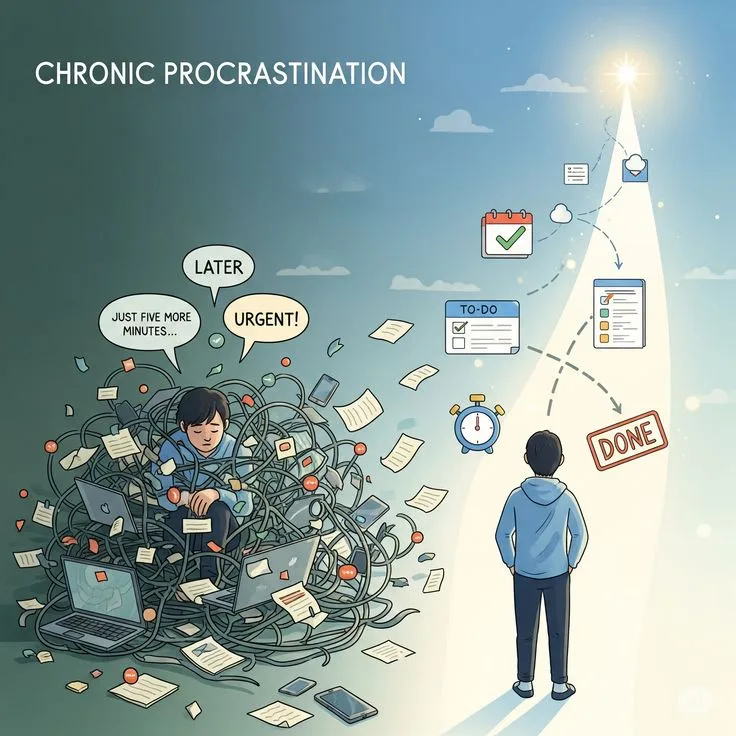
Chronic: There is a peculiar form of suffering unique to the modern educated professional. It involves knowing exactly what you need to do - a report that is three days overdue, an email that has been sitting in drafts for a week, a conversation you have been avoiding for a month - and being completely unable to make yourself do it.
Instead, you reorganize your desktop. You clean your apartment. You answer every other email. You watch videos explaining why you are watching videos instead of working.
This is not laziness. Lazy people do not experience the grinding guilt and self-recrimination of the chronic procrastinator. Laziness is indifference to effort; procrastination is a war between intention and action, conducted largely in the prefrontal cortex and the limbic system, with high casualties on both sides.
Procrastination is among the most studied topics in psychology - not because it is intellectually exotic but because it is so universal and so resistant to obvious solutions. Everyone who procrastinates knows it is irrational. Everyone who procrastinates intends to stop.
Almost no one stops simply by knowing better or intending harder. The gap between knowing and doing is the subject of decades of research, and the findings reveal something surprising: procrastination is not primarily a problem of time management, self-discipline, or laziness. It is a problem of emotion regulation.
"Procrastination is not a time management problem. It is an emotion regulation problem." - Fuschia Sirois, Procrastination: What It Is, Why It's a Problem, and What You Can Do About It (2022)
Key Definitions
Procrastination - Voluntarily delaying an intended action despite expecting to be worse off for the delay. The key elements: voluntary (not forced delay), intended action (you meant to do it), and harmful delay (you know it will cost you).
Procrastination is distinct from strategic delay (deliberately waiting for more information), rational prioritization (choosing a more urgent task), and simple forgetting.
Temporal discounting (hyperbolic discounting) - The tendency to value immediate rewards more than delayed rewards, with the discounting rate declining over time - following a hyperbolic rather than exponential curve. A reward tomorrow is discounted much more steeply than a reward in a month versus two months.
This creates "preference reversals": we rationally plan to start a task next week, but when next week arrives, we again prefer the immediate reward of avoidance.
Present bias - The specific form of temporal discounting in which the present moment is disproportionately valued. Present bias is why we set alarm clocks for 6am but hit snooze at 6am - our preferences genuinely change between planning and the moment of action.
Avoidance - Behavior motivated by escape from or prevention of aversive stimuli (fear, anxiety, discomfort, boredom). In the short term, avoidance is highly reinforcing: the aversive feeling decreases when the avoided stimulus is removed.
This negative reinforcement makes avoidance behaviors self-perpetuating. Procrastination is a specific form of task avoidance.
Self-regulation failure - The inability to control one's own thoughts, emotions, or behaviors in service of longer-term goals. Procrastination is a self-regulation failure: the person's behavior (avoidance) is inconsistent with their own goals and intentions.
Executive function - Higher-order cognitive processes managed primarily by the prefrontal cortex: planning, goal-directed attention, impulse control, task initiation, working memory, and cognitive flexibility. Executive function deficits - common in ADHD, depression, and other conditions - make procrastination more likely.
Task aversiveness - The degree to which a task is experienced as unpleasant: boring, anxiety-provoking, frustrating, ambiguous, or resentment-generating. Task aversiveness is the single strongest predictor of procrastination at the individual task level.
Procrastination-wellbeing paradox - Despite providing short-term mood relief, procrastination reliably produces worse long-term wellbeing.
Meta-analyses by Fuschia Sirois show chronic procrastinators report higher stress, worse physical health outcomes (delayed medical care, medication non-adherence), and higher rates of anxiety and depression.[2]
Implementation intention - A specific "if-then" plan linking a situational cue to an intended behavior: "When X happens, I will do Y." Research by Peter Gollwitzer shows implementation intentions dramatically improve follow-through compared to goal intentions alone.
How Common Is Procrastination? The Research Landscape
Procrastination is not a marginal behavioral quirk. Piers Steel's (2007) comprehensive meta-analysis in Psychological Bulletin - covering more than 800 studies - estimated that approximately 20 to 25 percent of adults worldwide are chronic procrastinators, meaning procrastination is a persistent, cross-domain pattern that significantly interferes with their functioning.
In student populations, estimates range from 70 to 95 percent reporting some degree of problematic procrastination, with approximately 50 percent describing it as a consistent problem.
Steel's analysis also tracked trends over time. Between the 1970s and the 2000s, self-reported procrastination rates in Western countries roughly quadrupled - from approximately 5 percent describing chronic procrastination to around 26 percent.
This increase coincides with the dramatic expansion of information technology and entertainment options, consistent with the view that proliferating low-effort, high-reward alternatives make task-switching and avoidance increasingly easy.
A 2016 study by Beutel and colleagues in PLOS ONE, drawing on a German population sample of over 3,500 adults, found that procrastination was strongly associated with lower life satisfaction, higher distress, and younger age - with the highest rates in adults aged 18 to 29, declining steadily through middle and older adulthood.[9]
The age gradient may reflect both developmental increases in self-regulatory capacity and the narrowing of the gap between immediate desire and long-term consequence that often accompanies aging and accumulated responsibility.
Common Procrastination Patterns and Their Drivers
| Pattern | Surface Behavior | Underlying Driver | Most Effective Counter-Strategy |
|---|---|---|---|
| Perfectionist avoidance | Preparing endlessly, never starting | Fear of producing imperfect work | Time-boxing; "good enough" standard-setting |
| Task-aversion procrastination | Avoiding boring or frustrating work | Emotion regulation; negative affect escape | Smallest possible first step; environmental cues |
| Overwhelm-based avoidance | Starting many things, finishing none | Ambiguity about where to start | Task breakdown; single next action |
| Deadline-dependent work | Only starting when deadline is imminent | Temporal discounting; urgency as motivator | Artificial near deadlines; implementation intentions |
| Social-comparison procrastination | Delay due to envy or intimidation | Performance anxiety; identity threat | Self-compassion; decoupling identity from outcome |
| ADHD-pattern procrastination | Chronic task initiation failure | Dopaminergic PFC dysfunction | Treatment of underlying ADHD; external structure |
| Resentment-based avoidance | Delaying tasks that feel imposed | Autonomy threat; values conflict | Autonomy reframing; values connection |
The Neuroscience: Two Systems at War
The Limbic System's Veto
Procrastination research using fMRI neuroimaging consistently finds that procrastinating individuals show greater amygdala activity when contemplating unpleasant tasks. The amygdala is generating an aversive signal: "this feels bad, avoid it."
This emotional response is not irrational in the immediate moment; it is accurately representing the fact that starting the task will feel uncomfortable. What it cannot represent is the longer-term cost of not starting. The amygdala does not process time well; it processes threat now.
The aversive signal is reinforced through negative reinforcement: when you switch from the unpleasant task to something else, the aversive signal decreases. This relief is real and immediate.
Each episode of successful avoidance slightly strengthens the avoidance association - the task becomes more aversive over time, not less. This is the self-reinforcing nature of the procrastination loop.
A 2018 neuroimaging study by Schluter and colleagues found that chronic procrastinators had a significantly larger amygdala than non-procrastinators, and showed weaker functional connectivity between the amygdala and the dorsal anterior cingulate cortex (dACC) - the region responsible for translating intentions into actions and filtering emotional signals from the amygdala.[11]
The procrastinator's brain is not simply more emotional; it is less equipped to translate motivation into action against emotional opposition.
The Prefrontal Cortex's Struggle
The prefrontal cortex (PFC) - particularly the dorsolateral PFC - is the seat of executive function: planning, impulse control, working memory, and the ability to maintain goal states in mind against competing impulses. The PFC knows the deadline matters; it has the plan; it can articulate the cost of delay.
The problem: PFC function is resource-dependent. Under fatigue, stress, negative mood, or high cognitive load, PFC regulation of limbic impulses weakens.
The "battle" between doing the important task (PFC goal) and the short-term relief of avoidance (limbic preference) is more likely to be won by the limbic system when cognitive resources are depleted.
This is why procrastination is worst when we are tired, stressed, or already cognitively depleted - not when we are fresh. Starting difficult tasks at the beginning of the day, before PFC resources are depleted, is not just folk wisdom; it reflects the neuroscience of PFC-limbic regulation.
Roy Baumeister's research on ego depletion - the finding that acts of self-control deplete a shared self-regulatory resource - directly maps onto this neural model.
Baumeister and colleagues' studies find that people who exercise self-control earlier in a session (e.g., resisting tempting food) show reduced self-control in subsequent unrelated tasks.[8]
The resource model predicts that procrastination should be highest after demanding self-regulatory episodes, a prediction supported by experience-sampling studies.
Temporal Discounting in the Brain
Neuroimaging studies on intertemporal choice reveal two systems:
- Limbic system (including ventral striatum and medial PFC): Responds strongly to immediate rewards; relatively insensitive to delayed rewards
- Lateral prefrontal cortex: Responds to delayed rewards; processes abstract future consequences
Procrastination correlates with disproportionate limbic system activation when contemplating task completion: the future reward (deadline met, work done, relief from guilt) simply does not feel as real as the immediate cost (starting the uncomfortable task now).
Piers Steel's temporal motivation theory (2007) synthesizes these findings into a formula: the motivation to act is a function of expectancy of success, task value, impulsivity, and the delay until the consequence - with delay being the strongest driver of avoidance.
Steel's formula, derived from a meta-analysis of 216 procrastination studies, has been described as the most comprehensive quantitative synthesis of procrastination research produced to date.[3]
Its core insight is that even tasks with high value and high probability of success will be avoided if the consequence is sufficiently distant - a prediction consistent with the observation that students procrastinate on coursework due in three months while working diligently on assignments due tomorrow.
Why Standard Advice Does Not Work
"Just Do It"
"Just do it" fails because it treats procrastination as a failure of motivation or decision, when the mechanism is emotional avoidance. The person who procrastinates has decided, many times, to not procrastinate. The decision is not the problem.
Time Management Systems
Calendars, to-do lists, and productivity apps address the organizational symptoms of procrastination without touching the cause.
Procrastinators often have sophisticated productivity systems - the problem is that the system tells them what to do at 9am, but at 9am, the task still feels aversive and avoidance still feels better. Time management treats procrastination as a scheduling problem; it is not.
Research directly comparing time management interventions to emotion-focused interventions for procrastination consistently favors the emotion-focused approach.
Sirois and Pychyl's (2013) review in Social and Personality Psychology Compass concluded that procrastination interventions that target self-regulatory failure and emotional avoidance show stronger effects than those focused on time management skills alone.
Self-Criticism and Guilt
Shame about procrastination is nearly universal among chronic procrastinators - and makes the problem worse. Research by Michael Wohl, Timothy Pychyl, and Shannon Bennett (2010) found that students who forgave themselves for procrastinating on their first exam procrastinated less on the second exam.[4]
Guilt and shame increase negative affect, which increases the aversiveness of facing the task, which increases avoidance. Harshness toward the self is counterproductive.
This finding is among the most robust and counterintuitive in the procrastination literature. The common cultural narrative holds that feeling bad about procrastination should reduce it, by making the cost of avoidance salient.
The evidence shows the opposite: self-condemnation increases the negative emotional state that makes task initiation more difficult. The guilt and the procrastination maintain each other in a bidirectional loop.
Motivational Thinking
"Think about how good you'll feel when it's done!" The motivational approach attempts to make future rewards feel more immediate and real. It works occasionally for some people in some contexts, but it fails to address the immediate emotional cost that makes the task aversive.
The future reward may be large; it is still future, and the brain's discounting of future states means the motivational calculus does not change much.
Research on mental contrasting by Gabriele Oettingen and colleagues provides a partial exception to this pattern.
Oettingen found that people who both visualize a desired future outcome AND specifically identify the obstacles standing between present reality and that future (a technique she calls "WOOP" - Wish, Outcome, Obstacle, Plan) show better goal pursuit than those who either solely fantasize about the positive future or solely think about obstacles.[12]
Pure positive visualization, without confronting obstacles, was actually associated with reduced goal pursuit - possibly because pure positive thinking produces satisfying but illusory feelings of having already arrived at the desired state.
What Actually Works: Evidence-Based Approaches
Emotion-Focused Strategies
Since procrastination is an emotion regulation failure, directly addressing the emotion is more effective than cognitive or organizational strategies alone.
Identifying the specific aversive emotion: Writing down what specifically feels bad about a task ("I'm afraid of failing," "this is boring," "I don't know where to start") makes the emotional obstacle concrete and addressable.
Diffuse avoidance often resolves when the specific emotional driver is named.
Self-compassion: Kristin Neff's self-compassion framework applied to procrastination: acknowledge the difficulty, recognize that procrastination is universal (common humanity), and respond with kindness rather than judgment. The goal is not complacency but removing the shame that amplifies avoidance.
The Wohl et al. finding - that self-forgiveness reduces future procrastination - is one of the most robust and counterintuitive in the literature.
A 2019 study by Gagnon, Dionne, and Pychyl published in PLOS ONE found that a brief self-compassion intervention - participants wrote a short letter to themselves from the perspective of a kind, understanding friend about a recent procrastination episode - significantly reduced subsequent procrastination behavior compared to controls, while also reducing negative affect.[13]
The effect persisted at four-week follow-up.
Reframing task meaning: Some aversiveness is addressable by reframing why the task matters - connecting it to values, personal meaning, or positive identity rather than external obligation.
Self-determination theory research shows that "identified motivation" (I am doing this because it reflects my values) produces much better task initiation than "introjected motivation" (I am doing this because I'll feel guilty if I don't).
The shift from "I have to write this report" to "I choose to write this report because I care about my professional reputation" reduces aversiveness through autonomy restoration.
Behavioral Strategies
Implementation intentions: Peter Gollwitzer's research (meta-analysis effect size d 0.65, across hundreds of studies) shows that forming a specific when where-how plan dramatically increases follow-through.[5]
"I will work on the report at 9am on Monday in my office with my phone off" is more effective than "I will work on the report this week." The specificity pre-commits behavior and eliminates the deliberation that enables avoidance.
The mechanism of implementation intentions is that they automate the initiation response: when the specified cue occurs (9am, Monday, in the office), the intended action is triggered without requiring a fresh decision.
By taking the decision out of the present moment, implementation intentions bypass the avoidance mechanism that operates at the moment of action.
Reducing task granularity: The most aversive moment of a task is often starting. Breaking a task into its smallest possible first action - not "write the report" but "open a new document and write one sentence" - dramatically reduces the activation energy required.
Brian Tracy's "eat the frog" principle and James Clear's "two-minute rule" operationalize this: the goal is to make the first action trivially small, bypassing the avoidance threshold.
Environmental design: Removing cues for competing activities (phone in another room, social media blocked, email notifications off) reduces the attentional competition that fuels avoidance.
The procrastinator who "can't stop checking social media" is not weak-willed; they are being systematically cued by a device engineered to be maximally engaging. Removing the device removes the cue.
Research by Gloria Mark at the University of California Irvine found that it takes an average of 23 minutes to fully regain focus after a digital interruption - suggesting that the cost of each distraction episode is far greater than the duration of the distraction itself.
Environmental interventions that prevent interruption therefore have multiplicative effects on focused work time.
Structured procrastination (John Perry): If you must procrastinate, procrastinate productively. Deliberately structure your task list so that the most important task is at the top and moderately important tasks are below it.
Avoidance of the top task is channeled into the moderately important tasks, producing net productivity. This is a coping strategy rather than a solution, but it is empirically better than undirected avoidance.
Time blocking and Pomodoro: Working in fixed intervals (25 minutes of focused work, 5 minute break) reduces the psychological size of the commitment ("I only have to do this for 25 minutes") and creates natural stopping points that reduce open-ended avoidance.
The technique's primary mechanism is converting an open-ended obligation (threatening to the avoidance system) into a bounded time trial.
Addressing Underlying Causes
For chronic, life-impairing procrastination, the strategies above are often insufficient without addressing underlying causes:
ADHD: Impaired dopaminergic function in prefrontal circuits produces deficits in task initiation, time perception ("time blindness"), and maintaining goal focus. Stimulant medications improve PFC dopamine function and dramatically reduce procrastination in many individuals with ADHD.
Russell Barkley's research emphasizes that ADHD is fundamentally a disorder of self-regulation across time, of which procrastination is a primary symptom - and that behavioral strategies work better when combined with treatment of the underlying condition.
Barkley's research on ADHD and time perception is particularly relevant here. He argues that people with ADHD experience time fundamentally differently - not merely managing it poorly, but perceiving the interval between present and future as largely inaccessible.
The future, in this account, is functionally "non-existent" to the ADHD brain in a way that makes delay costs particularly invisible.
This explains why the standard motivational calculus fails for ADHD procrastinators: the future cost simply does not register with appropriate weight, regardless of intellectual knowledge that it exists.
Anxiety: For procrastination driven by fear of failure or perfectionism, cognitive-behavioral therapy targeting catastrophizing, perfectionism, and avoidance is effective.
Exposure-based approaches - approaching the feared task in graduated steps, experiencing that the feared outcome is manageable - directly address avoidance conditioning.
Paul Hewitt and Gordon Flett's research on socially prescribed perfectionism - perfectionism driven by the belief that others demand flawless performance from you - is particularly associated with procrastination and psychological distress.
Unlike self-oriented perfectionism (setting high standards for yourself) or other-oriented perfectionism (demanding high standards from others), socially prescribed perfectionism produces shame-based avoidance: the task is avoided because any imperfect outcome will be shameful.
Effective intervention requires not just improved time management but restructuring the shame-laden evaluation system driving the avoidance.
Depression: Anhedonia and reduced motivation in depression impair task initiation independently of procrastination mechanisms. Behavioral activation - scheduling and completing small activities regardless of motivation - is a core CBT-D technique and directly targets procrastination-like avoidance.
The activation itself, through BDNF and HPA mechanisms, often improves motivation over time.
Procrastination Across the Lifespan
One underexplored dimension of procrastination research is its variation across developmental stages and life circumstances.
Fuschia Sirois's large-scale study (2014) in PLOS ONE, drawing on a community sample of over 3,000 adults, found that procrastination was associated with younger age, worse health behaviors (less exercise, worse sleep, more smoking), higher perceived stress, and lower conscientiousness - consistent with other research but also clarifying that the relationship is not simply a reflection of a single personality trait.
The relationship between procrastination and health behavior has significant practical implications.
People with chronic illness are at particular risk: procrastination-related delays in seeking medical care, filling prescriptions, and attending follow-up appointments compound disease severity for conditions where early intervention is critical.
Sirois's (2016) research found that procrastination significantly predicted health outcomes in individuals with hypertension and arthritis, operating through the mediating variable of health behavior delays.[7]
Research on older adults by Ferrari and colleagues consistently finds lower rates of chronic procrastination among people over 65, even after controlling for the reduction in work-related demands.[6]
The pattern suggests that developmental increases in conscientiousness and self-regulatory capacity, documented by personality researchers including Brent Roberts, contribute to reduced procrastination as part of the broader maturation of personality through adulthood.
Procrastination and Identity
Perhaps the most durable finding in procrastination research is the relationship between procrastination and identity. People who think of themselves as "a procrastinator" - where procrastination is a stable trait, not a behavior pattern - are harder to help and less likely to change.
The identity label creates an explanatory framework ("of course I didn't do it, I'm a procrastinator") that removes agency and forecloses change.
James Clear's "identity-based habits" framework offers a corrective: instead of trying to stop being a procrastinator, focus on small behavioral evidence that you are "someone who starts things." Each small completion - each time you do the task - is a vote for the identity you want to build.[10]
This is consistent with what the neuroscience suggests. Habits and identities are built from repeated small behaviors. The amygdala can be trained: tasks that were aversive become less so as they are repeatedly associated with completion and the relief and pride that follow.
The war between the limbic system and the prefrontal cortex can, over time, be won - not by willpower but by changing what the limbic system has learned to expect.
Compassionate Reattribution
Timothy Pychyl, one of the leading researchers on procrastination at Carleton University, argues that the most powerful shift available to a chronic procrastinator is reattribution: moving from understanding procrastination as a character flaw ("I am lazy," "I have no willpower") to understanding it as a learned pattern of emotional avoidance that can be unlearned.[1]
The reattribution is not exculpatory - it does not remove responsibility for changing - but it replaces shame-based paralysis with problem-solving orientation.
"The first step in addressing procrastination is recognizing that it is not about time management or laziness. It is an emotional coping response - a short-term solution to an uncomfortable feeling that creates long-term costs." - Timothy Pychyl, Solving the Procrastination Puzzle (2013)
Pychyl's clinical and research work emphasizes that procrastinators are not deficient in willpower in some fixed, constitutional sense. They are people who have learned a specific coping pattern - avoidance - in response to emotional discomfort, and who have maintained it because it reliably delivers short-term relief.
Like any learned pattern, it can be changed. The key is identifying what specifically makes the task aversive, replacing avoidance with a more adaptive response, and building a self-perception that is not organized around the procrastinator identity.
Sources & Further Reading
- Pychyl, T. A. (2013). Solving the Procrastination Puzzle: A Concise Guide to Strategies for Change. TarcherPerigee.
- Sirois, F. M., & Pychyl, T. A. (2013). Procrastination and the Priority of Short-Term Mood Regulation: Consequences for Future Self. Social and Personality Psychology Compass, 7(2), 115-127.
- Steel, P. (2007). The Nature of Procrastination: A Meta-Analytic and Theoretical Review of Quintessential Self-Regulatory Failure. Psychological Bulletin, 133(1), 65-94.
- Wohl, M. J. A., Pychyl, T. A., & Bennett, S. H. (2010). I Forgive Myself, Now I Can Study. Personality and Individual Differences, 48(7), 803-808.
- Gollwitzer, P. M., & Sheeran, P. (2006). Implementation Intentions and Goal Achievement: A Meta-Analysis of Effects and Processes. Advances in Experimental Social Psychology, 38, 69-119.
- Ferrari, J. R., Johnson, J. L., & McCown, W. G. (1995). Procrastination and Task Avoidance: Theory, Research, and Treatment. Plenum Press.
- Sirois, F. M. (2022). Procrastination: What It Is, Why It's a Problem, and What You Can Do About It. American Psychological Association.
- Baumeister, R. F., & Tierney, J. (2011). Willpower: Rediscovering the Greatest Human Strength. Penguin Press.
- Beutel, M. E., et al. (2016). Procrastination, Distress and Life Satisfaction Across the Age Range. PLOS ONE, 11(2), e0148054.
- Clear, J. (2018). Atomic Habits. Avery.
- Schluter, R. S., et al. (2014). Functional brain connectivity associated with procrastination and its relation to self-regulation and emotional control. Neuropsychologia, 64, 111-121.
- Oettingen, G. (2014). Rethinking Positive Thinking: Inside the New Science of Motivation. Current Books.
- Sirois, F. M. (2014). Procrastination and stress: Exploring the role of self-compassion. Self and Identity, 13(2), 128-145.