
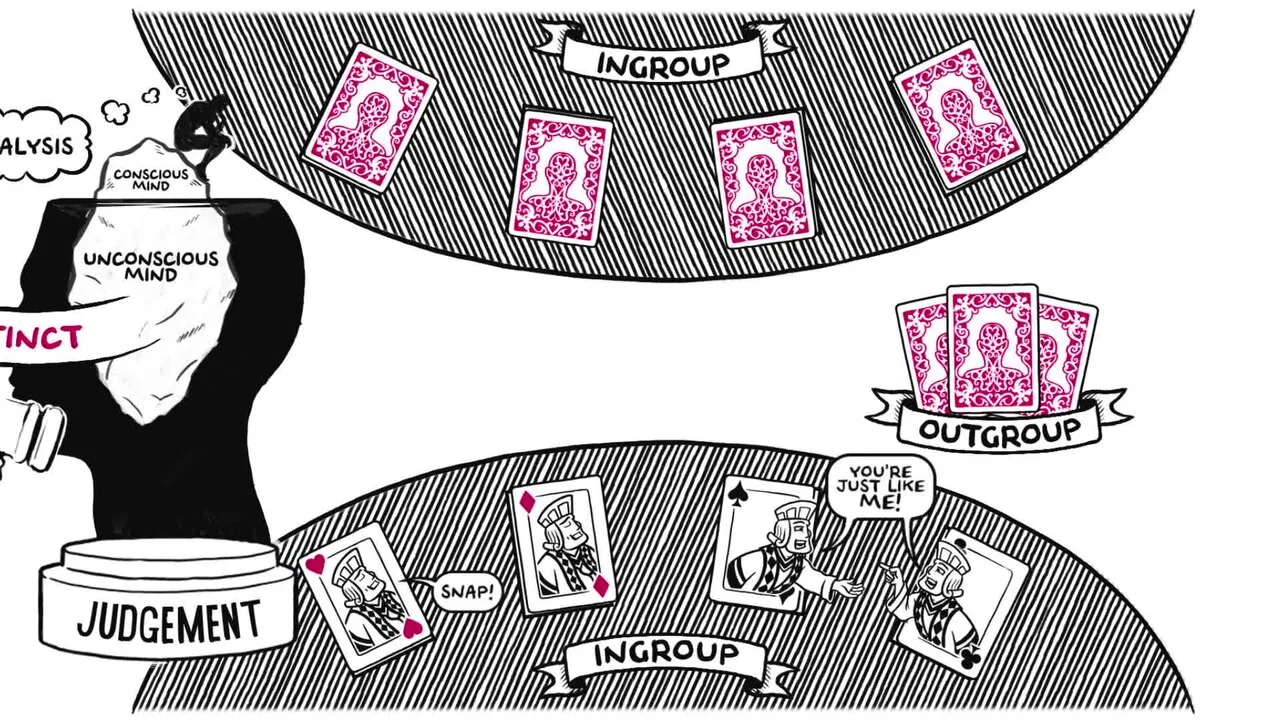
Understanding cognitive bias starts with heuristics: they make fast, good-enough judgments possible, but their predictable blind spots can produce errors that compound rather than cancel out.
Understanding cognitive bias involves recognizing patterns such as confirmation seeking, availability, anchoring, hindsight, and overconfidence.
Practical safeguards include checking base rates, making independent estimates, keeping prediction records, and actively looking for evidence that could disprove a favored view.
"The confidence people have in their intuitions is not a reliable guide to their validity." - Daniel Kahneman
Understanding cognitive bias starts with a simple test a British psychologist named Peter Wason gave his students in 1960. He showed them the sequence "2, 4, 6" and told them it followed a rule.
Their job was to discover the rule by proposing their own three-number sequences, and Wason would tell them only whether each proposal did or did not follow the rule.
Most students immediately proposed sequences like "8, 10, 12" or "100, 200, 300." Each time, Wason confirmed: yes, that follows the rule.
The students announced their hypothesis with confidence: the rule is "ascending numbers with a constant interval," or "even numbers," or some variant thereof.
The actual rule was simply: any three numbers in ascending order.
What Wason's experiment revealed was not a lack of intelligence. His students were Oxford undergraduates. What it revealed was a deep structural feature of human reasoning: people search for evidence that confirms their hypotheses and rarely think to test the cases that would disprove them.
Almost none of the students proposed a sequence like "3, 11, 47" - which would also follow the rule - because it violated their working theory. They sought confirmation rather than falsification.
This tendency is what psychologists call confirmation bias, and it is one of approximately 200 documented cognitive biases - systematic errors in thinking that cause people to reach predictably wrong conclusions, often without any awareness that their reasoning has gone astray.
What Cognitive Biases Are
A cognitive bias is not a random error. Random errors would cancel out over time; you would be wrong in different directions on different days, and on average your judgments would be accurate.
Cognitive biases are systematic: they push reasoning consistently in the same direction, which means they compound rather than cancel. They produce not noise but directional distortion.
They arise from what psychologists call heuristics - mental shortcuts that allow the brain to process information quickly without exhaustive analysis. Heuristics are not malfunctions.
They are solutions to a real problem: the world throws far more information at the brain than it can deliberately process, and decisions often need to be made in seconds, not days. Heuristics sacrifice thoroughness for speed, and most of the time they work well enough.
The problem arises in specific situations where the shortcut produces systematically wrong answers - and where the brain cannot tell from the inside that it has gone wrong.
As Daniel Kahneman, who shared the Nobel Prize in Economics in 2002 for his work on judgment under uncertainty, put it: "The confidence people have in their intuitions is not a reliable guide to their validity."
The Evolutionary Origins
The evolutionary case for heuristics is straightforward. Homo sapiens evolved in environments where fast, good-enough judgments about threats, food sources, social allies, and enemies were far more adaptive than slow, accurate ones.
An ancestor who spent three minutes carefully evaluating whether the sound in the grass was a predator was less likely to survive than one who was startled into defensive action within a fraction of a second.
Social cognition was especially critical. Humans are intensely social animals, and reading the intentions, emotions, and trustworthiness of other people quickly - using heuristics rather than deliberate analysis - was essential for navigating complex tribal environments.
Much of what we now call bias is adaptive social cognition deployed in contexts where it does not belong.
The mismatch between the environments where our cognitive shortcuts evolved and the environments where we now use them is at the heart of why biases cause so much modern trouble.
The shortcuts that worked brilliantly in small social groups with immediate feedback loops produce systematic errors in financial markets, organizational hierarchies, medical diagnosis, and legal proceedings - environments our minds did not evolve to navigate.
"I have a name for a big list of standard stupidities that cause terrible mistakes, and I call it the Psychology of Human Misjudgment. If you know them, it helps to avoid them." - Charlie Munger
The Biases That Matter Most
| Bias Name | Description | Example | How to Counter It |
|---|---|---|---|
| Confirmation bias | Seeking information that confirms existing beliefs while ignoring disconfirming evidence | A physician who stops considering alternative diagnoses once the first hypothesis feels plausible | Actively seek disconfirming evidence; use pre-mortems and red teams |
| Availability heuristic | Judging probability by how easily examples come to mind | Fearing plane crashes more than car crashes because crashes are vivid in memory | Check base rates; consult statistics rather than relying on recalled examples |
| Anchoring | Over-relying on the first piece of information encountered when making estimates | The opening number in a salary negotiation disproportionately shapes the final offer | Make your own estimate before seeing others'; be aware of who sets the first anchor |
| Sunk cost fallacy | Continuing an investment because of past costs rather than future value | Staying in a failing project because "we've already spent so much" | Evaluate decisions forward-looking only; ask what you would choose if starting fresh today |
| Dunning-Kruger effect | Low-ability individuals overestimating their competence due to lack of metacognitive awareness | A first-year medical student who feels confident about complex diagnoses | Seek structured feedback; evaluate reasoning process, not confidence level |
| Hindsight bias | Believing after the fact that an outcome was predictable all along | "I knew that startup would fail" - said after it had already failed | Keep records of predictions before outcomes; review judgment before knowing results |
| Overconfidence | Expressing more certainty in predictions than track records warrant | Professional forecasters who assign 90% confidence to predictions that are right 60% of the time | Track your forecasting record; practice calibrated uncertainty |
| Halo effect | A positive impression in one area colors judgment across all others | A charismatic interview candidate receiving higher ratings on unrelated skills | Use structured evaluation criteria; rate each dimension independently |
Confirmation Bias
Wason's 1960 experiment established confirmation bias as a laboratory phenomenon. Subsequent decades of research have shown it operating in consequential real-world domains with troubling reliability.
In medicine, studies of diagnostic reasoning have shown that once a physician has formed an initial working hypothesis about a patient's diagnosis, disconfirming evidence is systematically underweighted.
Research on diagnostic error (Graber, Franklin & Gordon, 2005, Archives of Internal Medicine) found that cognitive factors contributed to most diagnostic errors; autopsy-based estimates suggest 40,000 to 80,000 US hospital deaths per year involve diagnostic error.
In investing, confirmation bias causes fund managers and individual investors to seek out analyses that support positions they already hold, while discounting or ignoring research that questions them.
This is why professional analysts who cover a stock they already own tend to produce more favorable ratings over time. The positions they hold shape the information they attend to, which reinforces the positions.
The insidious quality of confirmation bias is that it feels like diligence. When you seek out information about a decision you are considering, you feel you are doing thorough research. The bias operates in the selection and interpretation of that information, not in the feeling of effort.
The Availability Heuristic
Amos Tversky and Daniel Kahneman described the availability heuristic in a landmark 1973 paper. The central finding: people judge the probability of an event by how easily examples of it come to mind.
If an event is easy to recall - because it was dramatic, recent, emotionally vivid, or heavily covered in media - it feels more common than it actually is.
This produces consistent and predictable distortions in risk perception. After the September 11 attacks, air travel in the United States dropped significantly while car travel increased.
The result was a measurable increase in highway fatalities: people drove rather than flew because plane crashes felt more probable than car crashes, despite the statistical reality being precisely the opposite.
By Gerd Gigerenzer's estimates, the switch to driving may have caused more than 1,500 additional traffic deaths in the year following the attacks.
The same mechanism explains why people fear shark attacks and lightning strikes far more than heart disease, even though cardiovascular disease kills orders of magnitude more people. Shark attacks are dramatically vivid; heart disease is slow, common, and undramatic.
Organizations are not immune. After a high-profile data breach at a competitor, security teams divert enormous resources to preventing the exact type of attack that was covered in the news.
That type of attack is now well-known and therefore being actively patched industry-wide, while less-salient threats are underinvested in.
Anchoring
Tversky and Kahneman also described anchoring, which has become one of the most replicated findings in behavioral economics. When people must estimate an uncertain quantity, they are heavily influenced by the first number they encounter - even when that number is arbitrary and irrelevant.
In a famous study, Tversky and Kahneman asked participants to spin a wheel that was rigged to land on either 10 or 65.[2] They then asked: what percentage of African countries are in the United Nations?
People who saw the wheel land on 65 gave median estimates of 45%; people who saw it land on 10 gave median estimates of 25%. The random number anchored subsequent numerical reasoning even though participants knew the wheel was random.
In salary negotiations, the first number mentioned - whether by the employer or the candidate - disproportionately determines the final offer. Research by Adam Galinsky and Thomas Mussweiler shows that making the first offer in a negotiation provides a significant anchoring advantage.
The implications are concrete: whoever sets the initial anchor in a negotiation frames the entire subsequent discussion.
Retail pricing exploits anchoring systematically. The "original price" that appears beside a sale price is not informational - it is an anchor designed to make the sale price feel like a bargain regardless of what the item is actually worth.[6]
Real estate agents show overpriced "anchor" properties first to make subsequent listings feel more reasonably priced.
The Sunk Cost Fallacy
The Concorde supersonic airliner is the canonical business school case study of the sunk cost fallacy. By the mid-1970s, it was clear to both British and French government engineers and economists that the Concorde program was not commercially viable.
Operating costs were too high, ticket prices unacceptably premium, and the planes too small. But billions had already been spent. Neither government could bring itself to stop. The Concorde flew at a loss for 27 years, finally retiring in 2003.
The rational treatment of sunk costs is straightforward: money already spent cannot be recovered, so it should be irrelevant to decisions about the future. The question is always forward-looking: given where we are right now, is continuing the best use of future resources?
Yet the emotional attachment to past investment is so powerful that it overrides this reasoning in individuals and organizations alike.
Business examples are everywhere. Companies continue funding failing product lines because of prior investment.
Investors hold losing stocks long past the rational exit point because selling would "make the loss real." People stay in careers, cities, and relationships that no longer serve them because of the years already invested.
In each case, the sunk cost - the years, the money, the effort - is treated as an argument for the future when it is logically irrelevant to it.
The Dunning-Kruger Effect
"The trouble with the world is that the stupid are cocksure and the intelligent are full of doubt." - a sentiment echoed by Nassim Taleb when describing how rare genuine epistemic humility is among experts.
In 1999, David Dunning and Justin Kruger at Cornell University published a paper that has since become one of the most cited and most mischaracterized in psychology.
The finding: people with low ability in a domain not only perform poorly but also lack the metacognitive ability to recognize their own poor performance. They systematically overestimate their competence.
The popular reduction - "stupid people think they're smart" - misses the nuance. The effect is not about stupidity. It is about the relationship between competence and self-assessment. Beginners in any domain cannot yet perceive the full scope of what they do not know.
A first-year medical student thinks they understand diagnosis because they do not yet know enough to see how much they are missing. An experienced clinician knows how much uncertainty exists in diagnosis and expresses appropriate calibration.
The effect also runs in the other direction, which is less often discussed. Dunning and Kruger found that high-performing people tended to underestimate their performance relative to peers.[3]
Having a full picture of the domain's complexity, and seeing clearly how much they themselves still do not know, leads experts to assume that others see the same complexity - when in fact others are simply operating from incomplete maps.
This has significant implications for how organizations evaluate talent. Overconfident novices can be mistaken for expertise because confidence reads as competence. Genuinely expert people can be overlooked because their carefully hedged claims read as uncertainty.
The solution is to evaluate reasoning process and track record, not confidence.
Hindsight Bias and Overconfidence
After an event occurs, people consistently overestimate how predictable it was beforehand.[4]
"I knew that would happen", the feeling of hindsight bias, rewrites memory to make the outcome seem obvious in retrospect, which conveniently protects the ego while preventing genuine learning about what was actually uncertain.
Overconfidence is perhaps the most pervasive and damaging bias in high-stakes professional settings.
Research by Philip Tetlock at the University of Pennsylvania, summarized in Expert Political Judgment (2005), found that professional forecasters - economists, political analysts, intelligence experts - consistently express far more certainty in their predictions than their track records warrant.[5]
Calibrated uncertainty, where a claim of "70% probability" turns out to be right about 70% of the time, is a rare skill and one that requires deliberate training to develop.
"We are not endowed by nature with an ability to assess correctly the probability of rare events. Our track record in predicting the future is poor, but we don't know it." - Nassim Taleb
Bias in Organizations
Individual cognitive biases scale into organizational failures in ways that can be catastrophic.
In hiring, three biases interact with particularly damaging results. The halo effect - where a positive impression in one dimension colors judgment across all others - means that likeable candidates receive higher ratings across every dimension than the evidence supports.
Affinity bias means hiring managers favor candidates who remind them of themselves, which systematically reproduces existing demographic and cultural patterns. Confirmation bias means interviewers seek information confirming their initial impression rather than actively looking for disconfirming evidence.
The result, consistently documented across industries, is that hiring decisions correlate more strongly with how well an interview candidate performed in the first five minutes than with a systematic assessment of their qualifications.
Unstructured interviews - the default format at most companies - are among the weakest predictors of job performance, with a validity coefficient of around 0.18 according to a meta-analysis by Schmidt and Hunter.
In strategy, overconfidence and confirmation bias combine in the planning fallacy: the near-universal tendency for project teams to underestimate time, cost, and complexity. The Sydney Opera House was projected to cost $7 million and open in 1963.
It opened in 1973 at a cost of $102 million. Boston's Big Dig highway project was budgeted at $2.8 billion; it cost $14.6 billion. These are extreme cases of a pattern that appears at every scale, from individual project estimates to national infrastructure programs.
The planning fallacy persists even when decision-makers are explicitly warned about it, because teams focus on the internal logic of their specific plan rather than on the historical distribution of outcomes for similar projects.
That historical distribution is the "outside view" that Kahneman and Tversky articulated as the reliable corrective.
Debiasing: What Actually Works
The sobering finding from debiasing research is that knowing about a bias does not reliably prevent it from affecting your thinking. A person who has read extensively about the anchoring effect is still substantially anchored by initial numbers in negotiation. Awareness is necessary but not sufficient.
What does work is structural intervention - changing the process rather than trying to change the thinker.
Pre-mortem analysis, developed by Gary Klein, bypasses optimism bias in planning by asking decision-makers to imagine that the plan has already failed before they commit to it. The hypothetical frame unlocks honesty that would otherwise be socially suppressed.
Blind evaluation removes the information that activates certain biases. When orchestras switched to blind auditions - performers playing behind screens - the proportion of women hired increased dramatically.
When medical schools evaluate applications with demographic information removed, women and candidates from underrepresented groups advance at higher rates. The bias does not disappear; the information that triggers it is simply not available.
Checklists and structured evaluation criteria force explicit assessment of dimensions that confirmation bias would otherwise allow you to skip. The checklist does not make you smarter; it makes it harder to selectively ignore the evidence you do not want to see.
Red teams - groups explicitly charged with arguing against a proposed plan - institutionalize the devil's advocate function that social pressure usually suppresses. Amazon uses red teaming for major product decisions. The US military uses it for operational planning.
The function is to surface the considerations that optimism and groupthink have hidden.
Reference class forecasting, formalized by Bent Flyvbjerg, corrects the planning fallacy by anchoring estimates in the historical distribution of outcomes for similar projects rather than in the internal logic of the specific plan.
When Flyvbjerg applied this method to infrastructure project cost estimation across 258 projects in 20 nations, he found it reduced overruns by 50% compared to standard forecasting methods.
Practical Takeaways
"The person who tells the most compelling story wins. Not the best argument, not the most data." - Richard Thaler, on why nudging behavior is often more effective than appealing to rationality
The goal of understanding cognitive bias is not to become unbiased - the research suggests this is not achievable - but to design your thinking and your processes so that consequential biases are more likely to be caught before they cause damage.
The highest-leverage intervention is to build time and structure into significant decisions.
System 1 thinking, the fast and intuitive mode, is the vector through which most bias enters.[1]System 2 thinking, the slow and deliberate mode, is more capable of catching errors, but only if you give it the chance to engage.
For high-stakes judgments, actively seek disconfirming evidence. Ask not "what supports my current view?" but "what would have to be true for my current view to be wrong, and what evidence bears on that?" This is uncomfortable, which is why it works.
In organizations, address bias through process design rather than by assuming individuals will correct themselves. Structured interviews, blind review stages, pre-mortems, and explicit decision criteria are not bureaucratic overhead. They are the infrastructure of epistemic hygiene.
Finally, track your record. Calibration - the match between your confidence and your accuracy - can only be measured over time and across many judgments. People who keep records of their predictions and review them honestly improve their calibration measurably.
People who do not tend to maintain the same level of miscalibration regardless of experience or intelligence.
The human brain is not a defective machine. It is an extraordinarily capable pattern-recognition system that produces predictable errors under specific conditions. Understanding those conditions is how you stop the errors from being predictable.
The Cost of Cognitive Bias: Documented Case Studies
Quantifying what cognitive bias actually costs - in money, lives, and organizational outcomes - has moved from theoretical concern to documented measurement.
Infrastructure project planning is the domain with the most comprehensive cost data. Bent Flyvbjerg at the University of Oxford analyzed 16,000+ projects across 136 countries in later work; the 2002 study analyzed 258 projects in 20 nations.
He found that 92% experienced cost overruns, with an average overrun of 39% for rail projects, 20% for bridges and tunnels, and 15% for road projects.
Project leaders consistently underestimated costs by focusing on the "inside view" - their specific project's logic - rather than the "outside view" - what similar projects historically cost.
Flyvbjerg's reference class forecasting method, which anchors estimates in historical distributions of similar projects rather than case-specific optimism, was mandated for Danish public transport projects in 2007 and reduced average overruns by 50% over the following decade.
The 2008 global financial crisis provides the most expensive documented case study in motivated reasoning and overconfidence.
A 2009 report by the Financial Crisis Inquiry Commission found that executives at major financial institutions consistently dismissed risk assessments from their own internal analysts that challenged the assumption housing prices would continue rising.
At Citigroup, risk officers warned in 2006 that the bank's collateralized debt obligation exposure posed systemic risk; the warnings were not acted upon.
At Bear Stearns, two internal hedge funds that failed in June 2007 - triggering the crisis's early stages - had risk managers who had flagged concentration risk, but their reports were not escalated to senior leadership.
The commission identified overconfidence and motivated reasoning (executives did not want to hear information contradicting profitable strategies) as primary cognitive contributors, alongside regulatory and structural failures.
Hiring decisions have been studied as a domain where halo effect and confirmation bias produce measurable economic waste.
Frank Schmidt and John Hunter's 1998 meta-analysis of 85 years of personnel selection research, synthesizing 85 years of research findings, examined unstructured interviews, the most common hiring method.
It found that unstructured interviews had a validity coefficient of approximately 0.18, meaning they explained only about 3% of variance in subsequent job performance.
Structured interviews (with standardized questions rated against predetermined criteria) showed validity of 0.51. General cognitive ability tests showed validity of 0.51. Work samples showed 0.54.
Companies that rely on unstructured interviews - which are dominated by halo effect, first impressions, and similarity bias - systematically select worse candidates than those using structured assessments, at a documented economic cost.
Google's internal people analytics research, published in a 2013 Harvard Business Review article by Laszlo Bock, confirmed the Schmidt-Hunter findings and led Google to redesign its hiring process around structured behavioral interviews with standardized rubrics.
Interventions That Work: Evidence From Debiasing Research
The practical question of what actually reduces cognitive bias in consequential decisions has generated a substantial research literature, with important distinctions between what works and what merely feels like it should work.
Blind auditions in orchestra hiring represent the clearest natural experiment in debiasing through information removal. When major American orchestras began using screens to hide performers' identities during auditions in the 1970s and 1980s, the proportion of women hired increased substantially.
Claudia Goldin and Cecilia Rouse's analysis, published in the American Economic Review in 2000, found that blind auditions increased the probability of women advancing from preliminary rounds by about 50%, and may have accounted for a substantial share of the increase in women among new hires.
The intervention did not train evaluators to be less biased; it removed the information that activated gender bias from their decision environment.
Structured decision-making in child welfare was studied by Emily Putnam-Hornstein at the University of California, Berkeley. California's child protective services historically relied on caseworker judgment to assess risk of child maltreatment following a report.
Research using predictive risk modeling found that structured tools were more accurate than unstructured judgment in predicting which children would experience subsequent maltreatment.
Caseworker judgment was biased by factors including neighborhood race and socioeconomic status that were not predictive of actual risk once controlled for.
The structured tool reduced racial disparities in investigation rates by 12%.
Pre-mortem analysis was tested by Gary Klein and colleagues in organizational settings.
In a 2007 Harvard Business Review article, Klein described pre-mortems - asking teams before a decision to imagine the plan had failed and explain why - as a way to surface planning weaknesses.
The mechanism is that the hypothetical future failure frame licenses voicing concerns that optimism bias and conformity pressure would otherwise suppress.
Research by Deborah Mitchell, Edward Russo, and Nancy Pennington (1989) in Organizational Behavior and Human Decision Processes provided the experimental basis.
Prospective hindsight, imagining a future event as having already occurred, improved the generation of reasons for that event by 25% compared to standard prospective thinking.
Calibration training through feedback has been validated by Philip Tetlock's Good Judgment Project. Between 2011 and 2015, Tetlock and colleagues tracked thousands of forecasters making over a million predictions about political, economic, and geopolitical events.
Participants who received training in probabilistic thinking and actively tracked their forecasting accuracy improved their Brier scores (a measure of forecasting accuracy) relative to untrained controls - a substantial improvement given that the task was highly uncertain.
The training's most effective element was not instruction in any specific forecasting method but practice in expressing precise numerical probabilities and reviewing outcomes against those probabilities.
This feedback loop - the core of calibration training - proved more effective than any substantive knowledge about the domains being predicted.
Sources & Further Reading
- Kahneman, D. (2011). "Thinking, Fast and Slow". Farrar, Straus and Giroux.
- Tversky, A. & Kahneman, D. (1974). "Judgment under uncertainty: Heuristics and biases." Science, 185(4157), 1124-1131.
- Kruger, J. & Dunning, D. (1999). "Unskilled and unaware of it: How difficulties in recognizing one's own incompetence lead to inflated self-assessments." Journal of Personality and Social Psychology, 77(6), 1121-1134.
- Fischhoff, B. (1975). "Hindsight is not equal to foresight: The effect of outcome knowledge on judgment under uncertainty." Journal of Experimental Psychology: Human Perception and Performance, 1(3), 288-299.
- Tetlock, P.E. (2005). "Expert Political Judgment: How Good Is It? How Can We Know?" Princeton University Press.
- Ariely, D. (2008). "Predictably Irrational: The Hidden Forces That Shape Our Decisions". HarperCollins.