
Intelligence: In 1904, Alfred Binet and Theodore Simon received a commission from the French Ministry of Public Instruction.
The Paris school system was expanding rapidly under new compulsory education laws, and the ministry needed a way to identify children who were struggling to keep pace with regular classroom instruction so they could receive additional support.
Binet was skeptical of the abstract philosophical debates about intelligence then fashionable in European academic circles and wanted something practical: a set of tasks that would identify which children needed help, without stigmatizing them as permanently limited.
The result, published in 1905, was the first modern intelligence test - a battery of thirty tasks arranged in order of difficulty, from following a lit match with the eyes to completing sentences and defining abstract words. Binet was explicit that the scale measured current performance, not fixed capacity.
He believed intelligence was modifiable and that the purpose of identifying lagging children was to intervene, educate, and improve.
What happened next was not what Binet intended. His scale was imported to the United States, translated and extended by Lewis Terman at Stanford, and within a generation had become the intellectual foundation for the American eugenics movement.
The Army Alpha and Beta tests administered to 1.75 million recruits in the First World War were used not to help men who needed support but to rank groups by presumed hereditary worth. Immigration restriction laws drew on IQ data to argue for limiting entry from Southern and Eastern Europe.
The same instrument invented to help Paris schoolchildren became a tool for exclusion, sterilization policy, and racial hierarchy - a history that continues to shadow intelligence research today and that any honest account of the science must confront directly.
The science itself, however, has become far more sophisticated, far more humble about what IQ scores mean, and far more interesting than either its boosters or its critics often acknowledge.
The question of what intelligence is - what we are actually measuring, how it develops, what it predicts, and what it does not - sits at the intersection of cognitive science, developmental psychology, genetics, and education.
The answers are more nuanced and more empirically grounded than the culture war that has always surrounded this topic.
"The concept of intelligence is one of the most contested in all of psychology, yet the empirical findings about cognitive ability are among the most replicated in the entire discipline." - Richard E. Nisbett et al., American Psychologist (2012)
Key Definitions
General intelligence (g): A statistical construct representing the common variance shared across diverse cognitive tests. When a battery of tests is factor-analyzed, scores tend to correlate positively with one another - this positive manifold is what g captures. It is the most replicated finding in differential psychology.
Fluid intelligence (Gf): The capacity to reason, identify patterns, and solve novel problems independent of acquired knowledge. Measured by tasks like matrix reasoning, abstract analogies, and working memory tasks. Peaks in the early twenties and shows age-related decline.
| Intelligence Theory | Proponent | Key Claim | Evidence |
|---|---|---|---|
| General factor (g) | Charles Spearman, 1904 | Single general cognitive ability underlies all mental tests | Factor analysis consistently extracts a g factor |
| Multiple Intelligences | Howard Gardner, 1983 | 8+ distinct intelligences (linguistic, musical, spatial, etc.) | Influential in education; not well-supported by psychometric research |
| Triarchic Theory | Robert Sternberg, 1985 | Analytical, creative, and practical intelligence | Predictive validity for real-world success beyond g |
| Fluid and Crystallized | Raymond Cattell, 1963 | Fluid (novel reasoning) vs. crystallized (accumulated knowledge) | Well-supported; widely used in cognitive research |
Crystallized intelligence (Gc): Accumulated knowledge and verbal ability derived from education and experience. Measured by vocabulary, general knowledge, and reading comprehension. Continues to grow through middle age and often peaks in the sixties and seventies.
Flynn effect: The documented increase in average IQ scores over the twentieth century, approximately three IQ points per decade in many countries. Named for James Flynn, who systematically documented the phenomenon in 1984.
Heritability: A population statistic estimating what proportion of individual differences in a trait are attributable to genetic variation in a specific population under specific environmental conditions. Not a statement about the contribution of genes to any individual's intelligence.
CHC model: The Cattell-Horn-Carroll hierarchical model of intelligence, currently the dominant psychometric framework, organizing cognitive abilities into a three-stratum hierarchy with g at the apex, broad abilities (including Gf and Gc) at the second level, and specific narrow abilities at the third.
Positive manifold: The empirical observation that all cognitive tests correlate positively with one another. This is Spearman's original finding and the empirical foundation for the concept of g.
Spearman's Discovery and What It Means
Charles Spearman was a British psychologist working at the turn of the twentieth century who had a strong conviction that human cognitive ability was not a miscellaneous collection of unrelated faculties but had some underlying unity.
In 1904, the same year Binet and Simon were developing their practical test in Paris, Spearman published a paper in the American Journal of Psychology presenting what he called the first objective determination and measurement of general intelligence.[6]
He had administered a battery of different cognitive tests to schoolchildren and found, using a novel statistical technique he was developing simultaneously - which would become factor analysis - that performance on every test was positively correlated with performance on every other test.
Children who did well on tests of verbal ability also tended to do well on tests of numerical reasoning, spatial tasks, and memory. This positive manifold - the systematic tendency for scores to move together - was what Spearman called g.
The finding is not trivial or artifactual. Across more than a century of subsequent research, using hundreds of different test batteries in dozens of countries and cultures, the positive manifold has been consistently replicated.
It is, as many researchers have observed, the most replicated finding in the history of differential psychology.
Something is being measured by all of these cognitive tasks that they share in common, and whatever that something is, it matters for real-world outcomes in ways that have been documented extensively.
What is g, biologically? That question remains open. Neural efficiency theories propose that more intelligent brains process information faster and with less metabolic effort.
Inspection time studies - measuring how quickly individuals can detect which of two unequal lines is longer - show correlations with IQ in the range of 0.5, suggesting that some component of g is related to basic processing speed.
Working memory capacity correlates highly with measures of fluid intelligence.
Brain imaging studies show correlations between g and gray matter volume in frontal and parietal regions, and with the efficiency of network connectivity between those regions. None of this resolves what g "really is" at a fundamental level, but the biological correlates are real and consistent across laboratories.
Fluid and Crystallized Intelligence: The Cattell-Horn Framework
Raymond Cattell studied under Spearman and eventually proposed a refinement that has become the basis of all modern psychometric models. Cattell argued in 1966 that g was not unitary but had at least two major components with different developmental trajectories.[2]
Fluid intelligence was the capacity for abstract reasoning and novel problem-solving - the ability to figure things out in the moment.
Crystallized intelligence was the accumulated product of applying fluid intelligence to learning over a lifetime - the knowledge, vocabulary, and procedural competencies built up through education and experience.
The developmental profiles of these two abilities are strikingly different. Fluid intelligence peaks in the early twenties and then shows a gradual, accelerating decline through adulthood.
This is why twenty-two-year-olds tend to outperform forty-five-year-olds on novel reasoning tasks and why mathematicians and theoretical physicists tend to do their most innovative work young.
Crystallized intelligence, by contrast, continues growing. Vocabulary, general knowledge, and the ability to apply accumulated expertise keep expanding through middle age and may not peak until the sixties or seventies.
The sixty-year-old may struggle with an abstract matrix reasoning task but will often outperform the twenty-two-year-old in domains requiring deep knowledge and expert judgment.
John Horn extended the Cattell model to include additional broad abilities - processing speed, short-term memory, long-term storage and retrieval, visual-spatial processing - and John Carroll's 1993 reanalysis of all available factor-analytic data in the published literature produced the three-stratum model that synthesizes Spearman's g with Cattell and Horn's broader abilities.
The resulting Cattell-Horn-Carroll (CHC) model is now the organizing framework for modern intelligence assessment, used in the design of IQ batteries including the Woodcock-Johnson and recent revisions of the WISC and WAIS.
The Flynn Effect: Intelligence Is Not Fixed
One of the most striking empirical discoveries in the history of intelligence research came from a New Zealand political scientist named James Flynn who had no particular investment in psychometrics but was curious about a statistical anomaly.
In 1984, Flynn reported that Americans' average IQ scores had increased massively between 1932 and 1978 - by approximately thirty IQ points, which is two full standard deviations.[3] He subsequently documented similar gains in fourteen other nations, all showing consistent increases of roughly three points per decade.
The implications are startling. Since IQ tests are normalized so that the average is always 100, each generation's tests are recalibrated. But if you apply a 1932 test to a modern sample without recalibration, the modern sample averages around 130.
Conversely, if you applied today's norms to 1932 test-takers, the average person of that era would score around 70 - in the range that contemporary norms classify as intellectual disability. Someone perfectly average in 1932 would score at the bottom of the current distribution.
The gains are far too rapid to be genetic - evolution does not work on this timescale - which means that intelligence as measured by IQ tests is substantially shaped by environmental factors.
Flynn's own interpretation emphasized the growing demands for abstract, hypothetical thinking in modern life: more schooling, greater exposure to complex visual media, greater familiarity with tests and the kind of rule-based reasoning they require.
Better childhood nutrition - particularly the reduction of lead exposure, the introduction of iodized salt, and improved protein intake - has also been implicated.
The Flynn effect is powerful evidence that IQ scores are not measuring some fixed biological substrate impervious to environment; they are measuring cognitive skills that develop in response to environmental demands and opportunities.
An additional wrinkle: the Flynn effect appears to be reversing in some countries. Scandinavian nations, which showed some of the largest gains in the twentieth century, began showing declining scores in birth cohorts from the 1980s onwards.
The reasons are debated - changes in education systems, the nature of modern media consumption, or perhaps the ceiling effects of nutrition-based gains - but the reversal is itself evidence of environmental sensitivity, cutting in both directions.
What IQ Predicts - and What It Does Not
Frank Schmidt and John Hunter conducted in 1998 one of the most comprehensive meta-analyses in the history of industrial-organizational psychology, synthesizing decades of studies on personnel selection.[5]
Their conclusion: general cognitive ability, as measured by IQ-type tests, is the single best predictor of job performance across virtually all jobs, with a validity coefficient of approximately 0.54 for complex positions.
It outperforms personality assessments, reference checks, interviews (except highly structured ones), and most other selection methods.
The relationship between cognitive ability and job performance is not merely a reflection of credentials - it reflects the ongoing demands of complex work for learning, problem-solving, and adapting to novel situations.
The predictive reach of cognitive ability extends beyond jobs. A study published in the British Medical Journal followed a cohort from childhood cognitive testing to mortality forty years later.
Higher childhood IQ was associated with lower all-cause mortality - the relationship held after controlling for social class, education, and other confounders.
Similar findings have been replicated elsewhere: more cognitively able individuals smoke less, wear seatbelts more consistently, manage chronic illness more effectively, and make health decisions that compound over time.
These effects are modest but robust, and they partly explain why cognitive ability has become relevant to public health as well as education and employment.
But IQ is not a comprehensive account of human effectiveness. It is a measure of certain cognitive skills - particularly those emphasized in formal education - and it fails to capture dimensions of functioning that matter significantly in many contexts.
Social intelligence, the ability to read and navigate interpersonal situations effectively, is not well measured by standard cognitive tests and has real predictive value for relationship quality and leadership.
Creativity, especially in domains requiring divergent thinking and tolerance of ambiguity, correlates only modestly with IQ above certain thresholds. Conscientiousness and self-regulation predict academic and occupational success independently of cognitive ability, and in some longitudinal studies predict outcomes as strongly.
The person with a very high IQ who cannot persist through difficulty, manage their own emotions, or collaborate with others will often be outperformed in real-world settings by someone with more modest scores and greater self-discipline.
Gardner's Multiple Intelligences: Popular but Poorly Supported
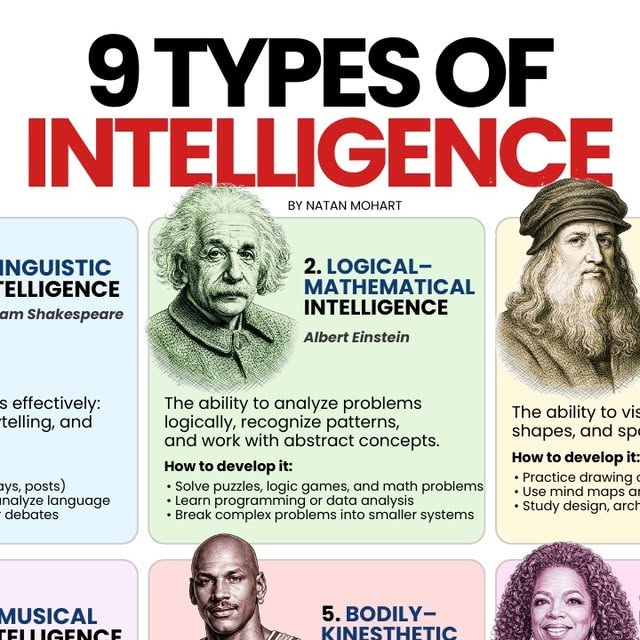
Howard Gardner's 1983 book Frames of Mind proposed that human intelligence is not a unitary capacity but consists of at least eight distinct intelligences: linguistic, logical-mathematical, spatial, musical, bodily-kinesthetic, interpersonal, intrapersonal, and naturalistic.
The theory became enormously influential in education, inspiring curricula designed to engage students across all eight modes and reassure every child that they were intelligent in their own way.
The scientific assessment of multiple intelligences theory is considerably less enthusiastic. The central problem is that Gardner's proposed intelligences all correlate positively with one another - they show the positive manifold that Spearman identified more than a century ago.
If they were truly independent intelligences, they would need to be uncorrelated. But when students who excel at music are tested on other abilities, they tend to score higher than average on linguistic and mathematical tasks too.
This is exactly what the g factor predicts and what a genuinely multiple intelligences framework cannot accommodate.
Gardner explicitly excluded factor analysis as a method and preferred neurological and developmental criteria for defining intelligences, which has prevented standard empirical testing of his framework.
Educators have found the theory valuable because it encourages attending to diverse student strengths - a genuinely good pedagogical instinct - but the underlying scientific claim, that human cognitive abilities are organized into distinct non-correlated multiple intelligences, is not supported by the best available evidence.
This does not mean that all human abilities reduce to a single dimension. The CHC model acknowledges many distinct cognitive capacities. But they are organized hierarchically with g at the top, not laterally as independent intelligences of equal status.
Heritability, Environment, and the Race/IQ Debate
Twin and adoption studies have consistently found that individual differences in cognitive ability are substantially heritable.
The estimates from childhood studies are typically in the range of forty to fifty percent; heritability estimates from adult twin studies, including the Minnesota Study of Twins Reared Apart directed by Thomas Bouchard, are higher, commonly in the sixty to eighty percent range.[1]
Bouchard's study, published in Science in 1990, found that identical twins raised in different families since infancy had IQ correlations of approximately 0.70 - nearly as high as the correlation between the same person tested twice.
This is a remarkable finding about the reach of genetic influence on cognition even across different environments.
But heritability estimates are widely misunderstood. Heritability is a population statistic describing variation within a population under a particular range of environmental conditions.
It does not describe the proportion of any individual's IQ that is "genetic." Most importantly, heritability within a population says nothing about the causes of differences between populations.
If all members of one group are malnourished and all members of another group are well nourished, the difference in height between the groups is entirely environmental in cause even if heritability within each group is high.
This is directly relevant to the most charged topic in intelligence research: group differences in average test scores. Average IQ scores differ across racial and ethnic groups in the United States, a finding that has been documented for decades and periodically weaponized for racist ends.
A task force of prominent intelligence researchers published in 2012 in American Psychologist - led by Richard Nisbett - a comprehensive review of what the science actually shows.[4]
Their conclusions were definitive: the group differences in measured cognitive ability reflect environmental factors, not genetic ones.
The environmental factors include differences in educational quality, socioeconomic resources, exposure to environmental toxins (lead in particular), stereotype threat (the cognitive burden of performing under the shadow of a negative group stereotype), and historical discrimination that compounds across generations.
The evidence cited by Nisbett and colleagues includes: the Flynn effect, proving that measured IQ is environmentally malleable at a scale larger than any group difference; and studies showing that gaps narrow dramatically when environmental conditions are equalized.
It also includes the fact that every immigrant group that has moved from poorer to richer educational environments has shown rapid score increases within a generation or two, and the complete absence of any direct genetic evidence for group cognitive differences.
Cross-cultural comparisons are also instructive - see why cultures think differently for a broader account of how cognitive styles and abilities vary across cultural contexts.
The scientific consensus is clear. Group differences in measured IQ are real. Their causes are environmental. Treating them as fixed biological destiny is both empirically incorrect and morally consequential.
Intelligence Across the Lifespan
The developmental trajectory of cognitive ability has become much better understood in recent decades.
Cognitive abilities in early childhood are partly predictive of later IQ but not strongly so - a child's IQ is far less stable at age five than at age fifteen, reflecting the large role of developmental timing and experience in early cognitive growth.
By late adolescence, IQ shows high test-retest stability; the correlation between an IQ measured at eighteen and one measured at forty is typically above 0.80.
The age-related divergence between fluid and crystallized abilities described by Cattell and Horn means that what intelligence "is" changes in character across adulthood.
The fifty-year-old expert is not less intelligent than the twenty-five-year-old novice; they are intelligent in different ways, drawing more heavily on organized knowledge structures and experienced judgment and less on raw processing speed.
Measures of g that heavily weight fluid abilities will tend to underestimate the cognitive capacities of older adults in ways that matter for real decisions about hiring, retirement, and medical competence assessment.
Notably, individual variation in cognitive aging is large. Some cognitive functions show little decline until very late in life; others show early and consistent decline.
Physical exercise, continued intellectual engagement, social connection, and metabolic health are all associated with better preservation of cognitive function in aging, suggesting that the developmental trajectory of intelligence continues to be shaped by modifiable factors well into later life.
The Heritability Paradox: Genes, Environments, and Gene-Environment Interaction
The finding that intelligence is substantially heritable in adulthood - with estimates often reaching 60 to 80 percent in studies like Bouchard's - sits in apparent tension with the Flynn effect, which proves that average intelligence can shift by two full standard deviations in a single generation as a result of environmental changes.
These findings are not actually contradictory, but reconciling them requires precision about what heritability means.
Heritability tells us about the sources of variation in a population at a specific time, in a specific range of environments.
When most children in a given society have access to reasonably adequate nutrition and basic education, the remaining variation in cognitive outcomes is largely explained by genetic differences - because the major environmental determinants are roughly equalized.
This does not mean the environment matters little; it means the environment is not varying much within that population.
When environments are radically varied - as they were across the twentieth century, with expanding education, reduced lead exposure, improved nutrition, and greater access to abstract cognitive demands - the environmental sources of variation dominate.
The most sophisticated contemporary perspective involves gene-environment interaction: the same genes may produce different outcomes in different environments, and genetically different individuals may respond differently to the same environmental enrichment.
Early childhood enrichment programs like the Abecedarian Project found substantial and lasting cognitive gains for disadvantaged children - effects that were not explained by baseline genetic differences.
The heritability of intelligence is not a ceiling on what education and environmental enrichment can achieve; it is a description of what determines variation under current conditions.
What Intelligence Research Is Actually Good For
The most honest summary of intelligence research is that g is real, it measures something about how people process and use information that has broad consequences for their lives, its development is substantially shaped by genetic variation and substantially shaped by environmental conditions, and its measurement captures important but not comprehensive dimensions of human cognitive capacity.
IQ tests, used as they were designed to be used - to identify strengths and weaknesses, to target educational support, to match individuals with suitable demands - serve valuable functions.
Used as they were misused historically - to rank the innate worth of human groups, to justify exclusion, to substitute for humane judgment - they caused enormous harm.
The Flynn effect remains the most important corrective to deterministic readings of intelligence research.
It proves, with data from entire national populations over multiple generations, that intelligence as measured by tests is not a fixed natural endowment but a capacity that grows in response to educational opportunity, nutrition, environmental enrichment, and cultural demand for abstract thinking.
The goal of intelligence research at its best is not to sort humans into permanent categories but to understand the conditions under which human cognitive capacity flourishes - and to create more of them.
Understanding the limits of IQ also matters practically. For hiring decisions, for educational placement, for clinical assessment, and for policy design, cognitive test scores provide genuinely useful information - but that information is always incomplete, always situated within social and environmental contexts that shape what scores mean, and always subject to the error of confusing current performance with fixed potential.
Binet understood this when he invented the field. It remains the central insight more than a century later.
Sources & Further Reading
- Bouchard, T. J., Lykken, D. T., McGue, M., Segal, N. L., & Tellegen, A. (1990). Sources of human psychological differences: The Minnesota study of twins reared apart. Science, 250(4978), 223-228. DOI: 10.1126/science.2218526
- Cattell, R. B. (1966). The theory of fluid and crystallized general intelligence checked at the 5-6 year-old level. British Journal of Educational Psychology, 36(2), 152-163.
- Flynn, J. R. (1984). The mean IQ of Americans: Massive gains 1932 to 1978. Psychological Bulletin, 95(1), 29-51. DOI: 10.1037/0033-2909.95.1.29
- Nisbett, R. E., Aronson, J., Blair, C., Dickens, W., Flynn, J., Halpern, D. F., & Turkheimer, E. (2012). Intelligence: New findings and theoretical developments. American Psychologist, 67(2), 130-159. DOI: 10.1037/a0026699
- Schmidt, F. L., & Hunter, J. E. (1998). The validity and utility of selection methods in personnel psychology: Practical and theoretical implications of 85 years of research findings. Psychological Bulletin, 124(2), 262-274. DOI: 10.1037/0033-2909.124.2.262
- Spearman, C. (1904). 'General Intelligence,' objectively determined and measured. American Journal of Psychology, 15(2), 201-292.