
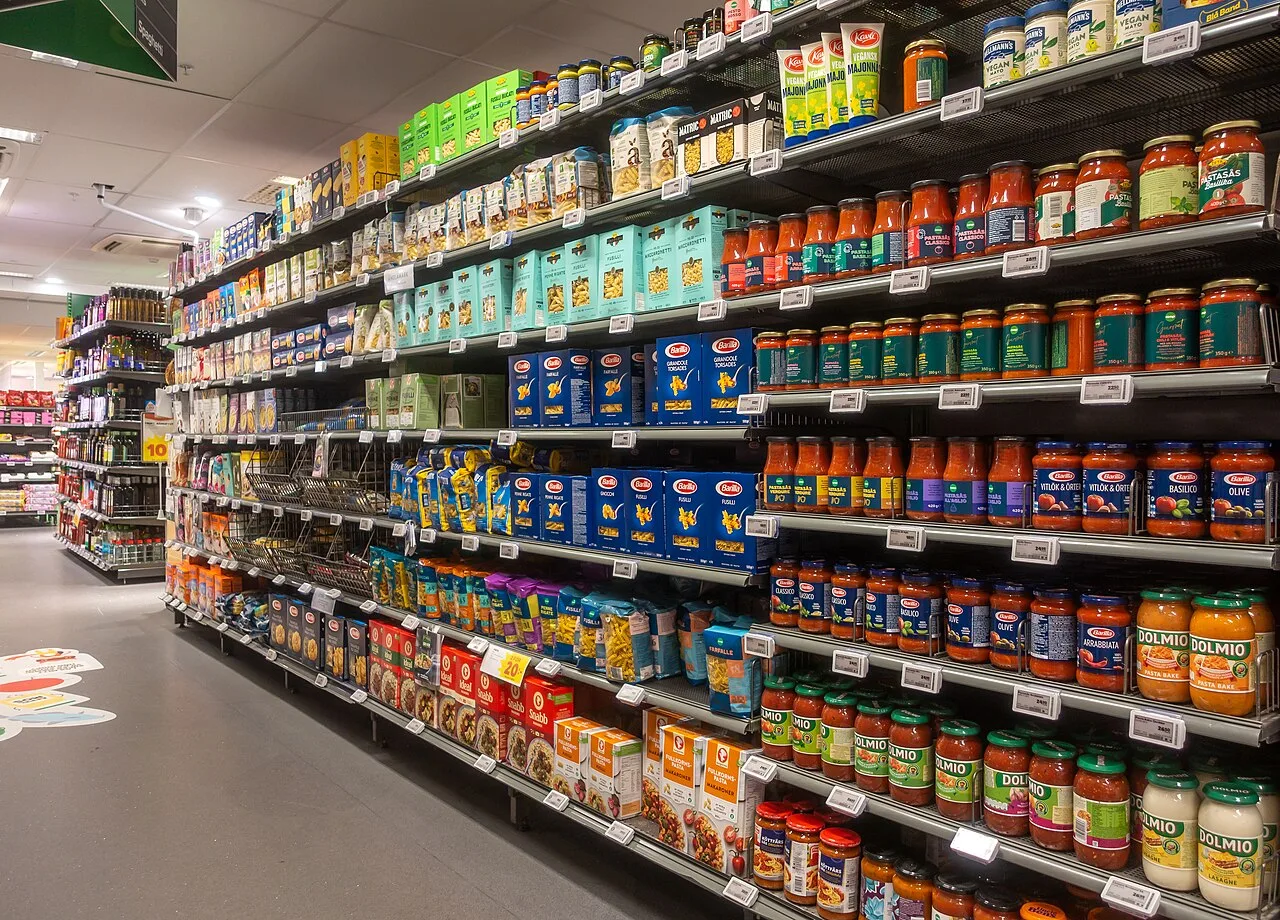
More options can attract attention while making it harder to choose, complete a purchase, or feel satisfied afterward. Choice overload describes this cost of abundance, showing why a smaller assortment may produce more action than a much larger display for consumers.
On a Saturday morning in 1995, inside Draeger's Market - a high-end grocery store in Menlo Park, California known for its extraordinary range of products - two Columbia University researchers set up a display table in the jam aisle.
Sheena Iyengar and Mark Lepper, a social psychologist and her doctoral collaborator, alternated every few hours between two configurations: a tasting display featuring 24 varieties of Wilkin & Sons jam, and a display featuring just 6.[1]
The 24-jam display, with its visual abundance and sensory richness, attracted 60 percent of passing customers who stopped to taste. The 6-jam display attracted 40 percent. By that metric, the larger assortment was winning.
Then the researchers tracked purchases. Of the customers who stopped at the 24-variety display, 3 percent went on to buy a jar of jam. Of those who stopped at the 6-variety display, 30 percent made a purchase. Ten times as many people bought jam when they had faced one-quarter as many options.
Iyengar and Lepper published these results in 2000 in the Journal of Personality and Social Psychology, in a paper titled "When Choice Is Demotivating: Can One Desire Too Much of a Good Thing?" The finding entered behavioral science as one of its most quoted and contested results - a clean, counterintuitive demonstration that the freedom to choose, in sufficient quantity, can suppress the act of choosing altogether.
This phenomenon - known variously as choice overload, the paradox of choice, or overchoice - describes the cognitive and emotional deterioration that occurs when the number of available options exceeds the mind's comfortable processing range.
It runs against one of the foundational assumptions of classical economics: that more options always benefit the chooser, because one can always ignore the extras and select as if only the preferred options existed.
What the research reveals instead is that options are not passive. Their mere presence generates cognitive work, emotional anticipation, and, eventually, paralysis or regret.
"The more options there are, the more easily a consumer could reconstruct desirable features in an alternative, and the less satisfied the consumer becomes." - Barry Schwartz, 2004
What the Research Shows
The Jam Study and Its Immediate Successors
Iyengar and Lepper did not stop at jam. In two additional studies reported in the same 2000 paper, they examined choice among essay topics (6 versus 30 options) and among chocolates (6 versus 30 varieties). The essay study was conducted with undergraduates at Stanford University.
Students who chose from 6 essay topics were more likely to write an essay at all, and those who did write produced essays rated as significantly higher quality by independent judges.
Students given 30 topics were less likely to complete the assignment and, when they did, submitted essays of measurably lower quality.
The chocolate study found that participants who chose from the smaller assortment reported greater enjoyment of their selection and greater overall satisfaction than those who had chosen from the larger assortment - even though both groups had access to the same chocolates.
What unified these findings was not merely an effect on behavior but an effect on the subjective experience of choosing.
The researchers proposed two mechanisms: that large assortments increased the difficulty of choice (raising cognitive load and the probability of choosing nothing), and that they raised the anticipated regret of any chosen option relative to the unchosen alternatives.
When 23 jams remain on the table after you pick your jar, those 23 unchosen jams become a constant reminder of roads not taken.
Retirement Savings and the 401(k) Effect
In 2004, Iyengar, Gur Huberman, and Wei Jiang published a study as a chapter in Pension Design and Structure (Oxford University Press) examining participation rates in 401(k) retirement plans across 638 companies and nearly 800,000 employees.[5]
Their dataset offered a natural experiment: different companies offered different numbers of fund options to their employees, ranging from 2 to 59.
Controlling for income, age, and other demographic variables, the researchers found a consistent negative relationship between the number of fund options offered and employee participation rates.
For every 10 additional fund options added to a plan, participation declined by approximately 1.5 to 2 percentage points.
The practical implications were sobering. These were employees who stood to benefit from tax-advantaged retirement savings regardless of which fund they selected. The objectively best choice - participation in any fund - was being suppressed by the presence of too many objectively fine alternatives.
Employees facing dozens of options were more likely to opt out entirely, deferring the difficult choice indefinitely and forgoing matching employer contributions in the process.
This was not a laboratory curiosity. The choice overload effect was costing real workers measurable portions of their retirement security.
Scheibehenne, Greifeneder, and Todd: The Zero-Effect Meta-Analysis
In 2010, Benjamin Scheibehenne, Rainer Greifeneder, and Peter Todd published a comprehensive meta-analysis in the Journal of Consumer Research examining 50 experimental studies that had compared outcome variables across high- and low-choice conditions.[3]
Their headline finding was discomfiting for anyone who had accepted the jam study as settled science: averaged across all 50 studies, the effect size for choice overload was essentially zero (mean d = 0.02).
This was not a dismissal of the phenomenon but a demand for precision about when it occurs. The meta-analysis found enormous heterogeneity across studies - some found strong overload effects, some found no effect, and some found that more options improved outcomes.
The problem was that the literature had not yet identified the conditions under which each pattern prevailed. Scheibehenne and colleagues called for a theoretical framework that could predict when choice overload would and would not manifest, rather than treating the jam study as a universal law.
Their paper was initially read by some as a refutation of Iyengar and Lepper, but the more careful reading is that it identified the research agenda: choice overload is real, but conditional. Its conditions needed to be specified.
Chernev, Bockenholt, and Goodman: Specifying the Conditions
That specification came in a 2015 meta-analysis by Alexander Chernev, Ulf Bockenholt, and Joseph Goodman, published in the Journal of Consumer Psychology.[4]
Analyzing 99 studies, the researchers identified four moderating factors that reliably determined whether choice overload would appear: the complexity of the choice task, the alignability of options (whether they can be easily compared on shared dimensions), decision goals (whether the chooser aims to find the best option or a satisfactory one), and the decision maker's prior preference uncertainty.
Chernev and colleagues found that choice overload was most likely when the choice task was complex, options were difficult to compare, the chooser lacked clear prior preferences, and the goal was to find the optimal rather than a good-enough option.[9]
When these conditions were reversed - simple task, comparable options, clear preferences, satisficing goal - additional options did not produce overload and sometimes improved decisions.
The meta-analysis estimated an average effect size of d = 0.37 across studies where overload conditions were met, a moderate and practically meaningful effect.
This framework transformed choice overload from a paradox into a conditional phenomenon: a tendency that activates under specific cognitive and contextual conditions rather than a universal psychological law.
Reutskaja and Hogarth: The Inverted U
Elena Reutskaja and Robin Hogarth, in a 2009 paper published in Psychology and Marketing, proposed that the relationship between number of options and satisfaction follows an inverted-U curve rather than a monotonic one in either direction.[6]
Their experiments, which varied assortment sizes and tracked both decision quality and subjective wellbeing, found that satisfaction and choice quality peaked at intermediate set sizes and declined on both ends - both too few options (leaving genuine preferences unmet) and too many (producing overload) were suboptimal.
This inverted-U model has important practical implications. The question is not "should we offer more or fewer options?" but "where on the curve are we, and in which direction should we move?" Organizations operating with three product variants and high customer dissatisfaction may need to expand their assortment.
Organizations offering 50 variants and high abandonment rates may need to reduce it. The optimal range varies by category, by customer expertise, and by the structural properties of the options themselves.
The Cognitive Mechanisms
Three cognitive mechanisms underlie choice overload, and they tend to compound one another as assortment size grows.
The first is decision fatigue. The act of deliberating among options consumes a finite mental resource.
Roy Baumeister and colleagues have documented, across a program of research spanning the late 1990s through the 2010s, that self-regulatory capacity depletes with use - a phenomenon initially described as "ego depletion," though its precise neurological substrate remains debated.
Regardless of the underlying mechanism, the behavioral signature is clear: people who face many sequential choices make progressively lower-quality decisions, or default increasingly to no-choice options, as their deliberative resources deplete.
Jonah Lehrer and others have popularized the observation that judges grant fewer paroles as the day progresses; more rigorous studies have confirmed that decision quality degrades under conditions of high choice volume and duration.
The second mechanism is regret anticipation. When many options exist, the probability that the unchosen alternatives contain something superior to what was selected rises - or at least the perception of that probability rises. Iyengar and Lepper's research highlighted this explicitly.
Barry Schwartz, in his 2004 book The Paradox of Choice: Why More Is Less, formalized the concept through the distinction between maximizers and satisficers.[2]
Maximizers, who aim to identify the objectively best option, are particularly vulnerable to regret: they cannot settle for good-enough because they are haunted by the possibility that the optimum lies among the unchosen alternatives.
As assortment size grows, the psychological cost of maximizing strategies escalates rapidly, producing anxiety before the choice and regret after it.
Satisficers, who select the first option that meets a threshold of acceptability, are more insulated from choice overload because their decision rule is immune to the size of the rejected set.
The third mechanism is opportunity cost salience. Every option chosen forecloses all others. In small choice sets, the opportunity cost of a selection is modest - there were few alternatives. In large choice sets, opportunity cost becomes vivid and psychologically heavy.
Schwartz described this as the "opportunity costs of opportunity costs": not merely that you gave up something by choosing, but that the awareness of what you gave up actively diminishes the pleasure of what you chose.
This mechanism explains why the dissatisfaction associated with choice overload can persist after the choice is made and the option is consumed.
The jam you purchased from the 24-variety display is objectively the same jam regardless of how many alternatives you faced, but it tastes worse - or feels less satisfying - because of what you know you might have chosen instead.
Intellectual Lineage
The idea that abundance can be burdensome predates behavioral science. Classical philosophy, from Stoic arguments against excessive attachment to external goods through to Kierkegaard's "anxiety of possibility," recognizes that unlimited latitude can be paralyzing rather than liberating.
The sociologist Georg Simmel observed in his 1903 essay "The Metropolis and Mental Life" that urban dwellers, bombarded with stimulation, develop a blasé attitude as a protective adaptation against sensory and decisional overload. These are proto-versions of choice overload - the intuition without the experimental method.
The scientific study of the phenomenon has a more traceable lineage. The psychologist Alvin Toffler coined the term "overchoice" in his 1970 book Future Shock, describing the disorientation produced by too many options as a feature of modern consumer society.[11]
Toffler was working in the tradition of social commentary rather than experimental psychology, but the observation anticipates the empirical literature by three decades.
The modern experimental tradition traces to Iyengar and Lepper's 1995 dissertation-era fieldwork and their landmark 2000 publication.
Barry Schwartz synthesized the behavioral science into accessible form with The Paradox of Choice in 2004, which introduced the maximizer-satisficer distinction to a general audience and argued that Western affluent societies had created a "tyranny of freedom" through consumer abundance.
Schwartz drew on Herbert Simon's foundational 1956 paper in Psychological Review, "Rational Choice and the Structure of the Environment," which introduced satisficing as a concept - the idea that humans and other animals do not optimize but rather search for options that satisfy a threshold criterion.[7]
Simon's framework, developed to describe bounded rationality in organizations, became central to understanding why choice overload affects maximizers more severely than satisficers.
The field matured through the 2000s and 2010s as researchers moved from demonstration to mechanism. The Scheibehenne et al. 2010 and Chernev et al. 2015 meta-analyses represented the discipline's effort to consolidate contradictory findings into a coherent conditional framework.
Simultaneously, researchers from marketing (Botti and Iyengar), economics (Huberman and Jiang), and cognitive psychology (Greifeneder, Todd) were examining choice overload in field settings - retirement accounts, medical decisions, online shopping - where the phenomenon's practical stakes were not hypothetical.
Four Named Case Studies
Case Study 1: The Jam Aisle at Draeger's Market
The Iyengar and Lepper jam study remains the foundational demonstration of choice overload in a naturalistic setting.
Conducted at Draeger's grocery store in Menlo Park, California - a store chosen specifically because its premium positioning and wide assortment attracted shoppers accustomed to high selection - the study found that 60 percent of customers stopped at a 24-jam display, compared with 40 percent at a 6-jam display.
But 30 percent of those who stopped at 6 jams purchased, while only 3 percent of those who stopped at 24 jams did so.
The absolute purchase rate per passing customer was thus dramatically higher in the limited-choice condition. The study's enduring influence lies partly in its setting: this was not a laboratory, but an actual store with real purchasing decisions and real money.
The ecological validity lent its findings a weight that laboratory demonstrations alone could not achieve.
Its limitations have also been well-documented - the study had a small sample, the two conditions were not simultaneous, and the effect size has not always replicated - but as an orienting demonstration, it catalyzed a generation of research.
Case Study 2: 401(k) Retirement Fund Participation
The Iyengar, Huberman, and Jiang 2004 study of 401(k) plans across 638 companies is arguably the most consequential demonstration of choice overload's real-world costs. The study's administrative dataset - covering nearly 800,000 employees - provided statistical power sufficient to detect small effects with high confidence.
The finding that each additional 10 fund options reduced participation by 1.5 to 2 percentage points does not sound dramatic in isolation.
But compounded across hundreds of companies and hundreds of thousands of employees, across decades of foregone tax advantages and employer matching contributions, the aggregate cost is enormous.
The study also found that when participation occurred in high-choice plans, employees tended to default toward simpler options - money market funds and stable value funds - rather than diversified portfolios, potentially reducing long-term returns.
Choice overload was thus operating at two levels: suppressing participation and, among those who did participate, distorting portfolio construction away from objectively superior allocations.
Case Study 3: The Netflix Paradox
Netflix presents one of the most studied contemporary instances of choice overload in a digital environment.
The platform's library in major markets has comprised tens of thousands of titles - a figure that has both grown and, in some periods, been deliberately reduced as executives responded to evidence that catalog size and subscriber satisfaction were not monotonically related.
Research by Reto Hofstetter and collaborators, as well as internal Netflix data cited in industry reporting, has indicated that a substantial proportion of Netflix sessions end in abandonment - the user scrolling through options without selecting anything and eventually switching off.
The phenomenon is colloquially described as "Netflix paralysis." Netflix has responded with increasingly aggressive recommendation systems designed to reduce the effective choice set presented to any individual user at any moment.
Personalization algorithms attempt to surface 10 to 20 options from a catalog of tens of thousands, essentially recreating the 6-jam condition from within a 24,000-jam store. The success of these systems is partial: recommendation quality and user engagement have improved, but the scroll-and-abandon pattern has not been eliminated.
The Netflix case illustrates that digital environments amplify choice overload by removing many of the natural constraints - physical shelf space, geographic proximity, opening hours - that had previously limited consumer exposure to large assortments.
Case Study 4: Medical Treatment Decisions
The application of choice overload to medical contexts has generated research with particularly high ethical stakes.
Angela Fagerlin, Brian Zikmund-Fisher, and Peter Ubel have published extensively on how patients respond to multiple treatment options, finding that larger option sets frequently produce decision avoidance, delegation of choice to physicians, or selection of the status quo (no treatment) even when treatment would be medically beneficial.
A 2009 paper by Botti, Orfali, and Iyengar in the Journal of Consumer Research examined a specific case: parents asked to make end-of-life decisions for infants in neonatal intensive care units.[8]
Parents who were given more direct choice in the decision - a condition that might seem to represent respect for autonomy - reported significantly higher levels of distress and guilt than parents who were guided more explicitly by medical staff.
The mechanism appeared to be not merely the difficulty of the choice but the burden of causal responsibility: when you chose from many options, you own the outcome in a way that feels different from accepting a physician's recommendation.
The implication is that the autonomy preserved by large medical choice sets can impose psychological costs that undermine patient wellbeing, and that the structuring of medical decisions - framing, defaults, the number of options explicitly presented - is itself a form of medical intervention with measurable consequences.
When More Choice Is Genuinely Better
The conditional nature of choice overload means that its opposite is also real: there are circumstances under which expanding options genuinely benefits decision makers, and treating choice reduction as a universal prescription would be as mistaken as treating abundance as one.
Expert choosers are systematically more resistant to choice overload. Chernev's 2003 research in the Journal of Consumer Research found that individuals with strong prior preferences - those who knew what they wanted before encountering the choice set - experienced less overload with large assortments and sometimes benefited from expanded options.
The mechanism is straightforward: experts use large choice sets to find the one thing that meets their specific, pre-formed criteria.
A wine expert scanning a 200-bottle wine list is not paralyzed - they are filtering. A novice facing the same list is choosing without a stable preference structure, and every bottle is equally unknown.
When options are well-organized and easily comparable, choice overload is substantially reduced.
Iyengar and Kamenica's research, along with Chernev et al.'s meta-analysis, found that organizing options into clear categories, providing comparison dimensions, and enabling systematic elimination - rather than forcing holistic evaluation of each option - allows decision makers to process larger sets without cognitive deterioration.
Good information architecture, in other words, can partly substitute for reduced assortment size.
When the stakes of a wrong choice are low, the regret mechanism weakens and choice overload diminishes. Choosing among 50 varieties of olive oil at a specialty store may produce less overload than choosing among 15 health insurance plans, because the cost of a suboptimal olive oil selection is negligible and recoverable.
High-stakes, irreversible decisions - insurance, medical treatment, investment portfolios - amplify the salience of opportunity cost and regret, intensifying overload for any given assortment size.
Finally, when culturally or individually, a person values the expression of autonomy through selection, large choice sets can produce satisfaction independent of decision quality.
Cross-cultural research by Iyengar and Lepper, published in 2000 in the Journal of Personality and Social Psychology, found that Anglo-American children (raised in a cultural context that prizes individual choice) performed better and reported more satisfaction when they chose their own activity than when a trusted adult chose for them.
Asian-American children raised in a more collectivist framework showed the opposite pattern.[12] The paradox of choice is partly a cultural phenomenon: it is most pronounced in populations for whom individual choice is a primary signal of autonomy and identity.
Related Concepts
Choice overload is adjacent to, but distinct from, several closely related psychological phenomena. The table below clarifies these distinctions.
| Concept | Core Definition | Relationship to Choice Overload |
|---|---|---|
| Choice Overload | Cognitive and emotional deterioration when option sets exceed comfortable processing range, suppressing choice or reducing satisfaction | The primary concept |
| Decision Fatigue | Decline in decision quality as a consequence of depleting deliberative resources through sustained choosing | A mechanism underlying choice overload; also operates independently of option count |
| Status Quo Bias | Preference for current state of affairs; tendency to maintain existing decisions rather than change them | Choice overload can produce status quo bias as a specific form of avoidance; the two concepts share the outcome of inaction but differ in cause |
| Satisficing vs. Maximizing | Herbert Simon's distinction between selecting the first acceptable option (satisficing) and searching for the optimum (maximizing) | Maximizing strategy amplifies choice overload; satisficing provides partial insulation |
| Regret Aversion | Decision avoidance or suboptimal choices made to minimize anticipated feelings of regret | A mechanism of choice overload; regret aversion is the emotional driver that large option sets intensify |
| Information Overload | Cognitive impairment from excessive information volume, independent of number of choices | Overlapping but distinct: information overload concerns data quantity, choice overload concerns option quantity; both involve cognitive capacity limits |
| Paradox of Autonomy | The finding that freely chosen options and self-determined decisions do not always produce better outcomes than externally constrained ones | A broader framing of which choice overload is a specific instance; the paradox of autonomy encompasses choice overload but also includes other freedom-wellbeing tensions |
Practical Implications
The research on choice overload has been translated into design principles across retail, digital product design, public policy, and healthcare. The most robust of these interventions do not eliminate choice but restructure how it is presented.
Reducing the effective choice set presented at any given moment - through curated recommendations, categorical organization, or progressive disclosure - addresses the cognitive mechanism without removing the underlying variety. The strategy preserves optionality for those who wish to seek it while reducing the default cognitive burden.
IKEA's catalog structure, Amazon's "customers also bought" systems, and healthcare plan comparison tools that highlight the top three options for a given use case all represent applications of this principle.
Default options represent a powerful structural intervention. Richard Thaler and Cass Sunstein's work on choice architecture, developed in their 2008 book Nudge, established that the default option in any choice system - the outcome that occurs if the decision maker does nothing - exercises disproportionate influence on final choices.[10]
In contexts where choice overload would produce avoidance, a well-designed default can ensure a good outcome even when the active choice fails.
Automatic enrollment in retirement savings plans, with the option to opt out or modify, dramatically increases participation relative to opt-in systems, effectively overriding the paralysis that large fund menus would otherwise produce.
The medical literature has increasingly advocated for "choice-preserving, burden-reducing" frameworks that combine explicit physician recommendation with patient autonomy.
Rather than presenting a patient with seven treatment options of equal narrative weight, a clinician might say "Based on your profile, I recommend option A; options B through G are also available and here is how they compare." This structure preserves the patient's right to choose while reducing the cognitive burden to a manageable comparison.
The Limits of the Paradox
It is important not to overread the choice overload literature into a blanket argument for paternalistic restriction of options. The Scheibehenne et al. 2010 meta-analysis's near-zero average effect is a genuine finding that demands respect.
Many documented choice overload effects are small in absolute magnitude. The phenomenon is real but not overwhelming, conditional not universal.
Moreover, the argument for restricted choice carries its own risks. Assortments reduced by corporate or governmental decision-makers reflect those actors' judgments about what the population wants - judgments that may be systematically biased toward majority preferences, existing market data, and the preferences of the powerful.
Minority tastes, emerging preferences, and the needs of users whose requirements differ from the median all benefit from larger option sets.
A market that offers 6 jam varieties instead of 24 may eliminate the one variety that suited a person with dietary restrictions, regional taste preferences, or culinary traditions outside the mainstream.
The sophisticated prescription from the research is therefore not "fewer choices" but "better structured choices" - assortments that are organized, comparable, expert-navigable, and equipped with defaults that serve common needs while preserving access for those with specific requirements.
The paradox of choice is not that freedom is bad, but that freedom without structure can be its own kind of constraint.
Sources & Further Reading
Iyengar, S. S., & Lepper, M. R. (2000). When choice is demotivating: Can one desire too much of a good thing? Journal of Personality and Social Psychology, 79(6), 995-1006.
Schwartz, B. (2004). The Paradox of Choice: Why More Is Less. Ecco Press.
Scheibehenne, B., Greifeneder, R., & Todd, P. M. (2010). Can there ever be too many options? A meta-analytic review of choice overload. Journal of Consumer Research, 37(3), 409-425.
Chernev, A., Bockenholt, U., & Goodman, J. (2015). Choice overload: A conceptual review and meta-analysis. Journal of Consumer Psychology, 25(2), 333-358.
Iyengar, S. S., Huberman, G., & Jiang, W. (2004). How much choice is too much? Contributions to 401(k) retirement plans. In O. S. Mitchell & S. P. Utkus (Eds.), Pension Design and Structure: New Lessons from Behavioral Finance (pp. 83-95). Oxford University Press.
Reutskaja, E., & Hogarth, R. M. (2009). Satisfaction in choice as a function of the number of alternatives: When "goods satiate." Psychology and Marketing, 26(3), 197-203.
Simon, H. A. (1956). Rational choice and the structure of the environment. Psychological Review, 63(2), 129-138.
Botti, S., & Iyengar, S. S. (2006). The dark side of choice: When choice impairs social welfare. Journal of Public Policy and Marketing, 25(1), 24-38.
Chernev, A. (2003). When more is less and less is more: The role of ideal point availability and assortment in consumer choice. Journal of Consumer Research, 30(2), 170-183.
Thaler, R. H., & Sunstein, C. R. (2008). Nudge: Improving Decisions About Health, Wealth, and Happiness. Yale University Press.
Toffler, A. (1970). Future Shock. Random House.
Iyengar, S. S., & Lepper, M. R. (1999). Rethinking the value of choice: A cultural perspective on intrinsic motivation. Journal of Personality and Social Psychology, 76(3), 349-366.