
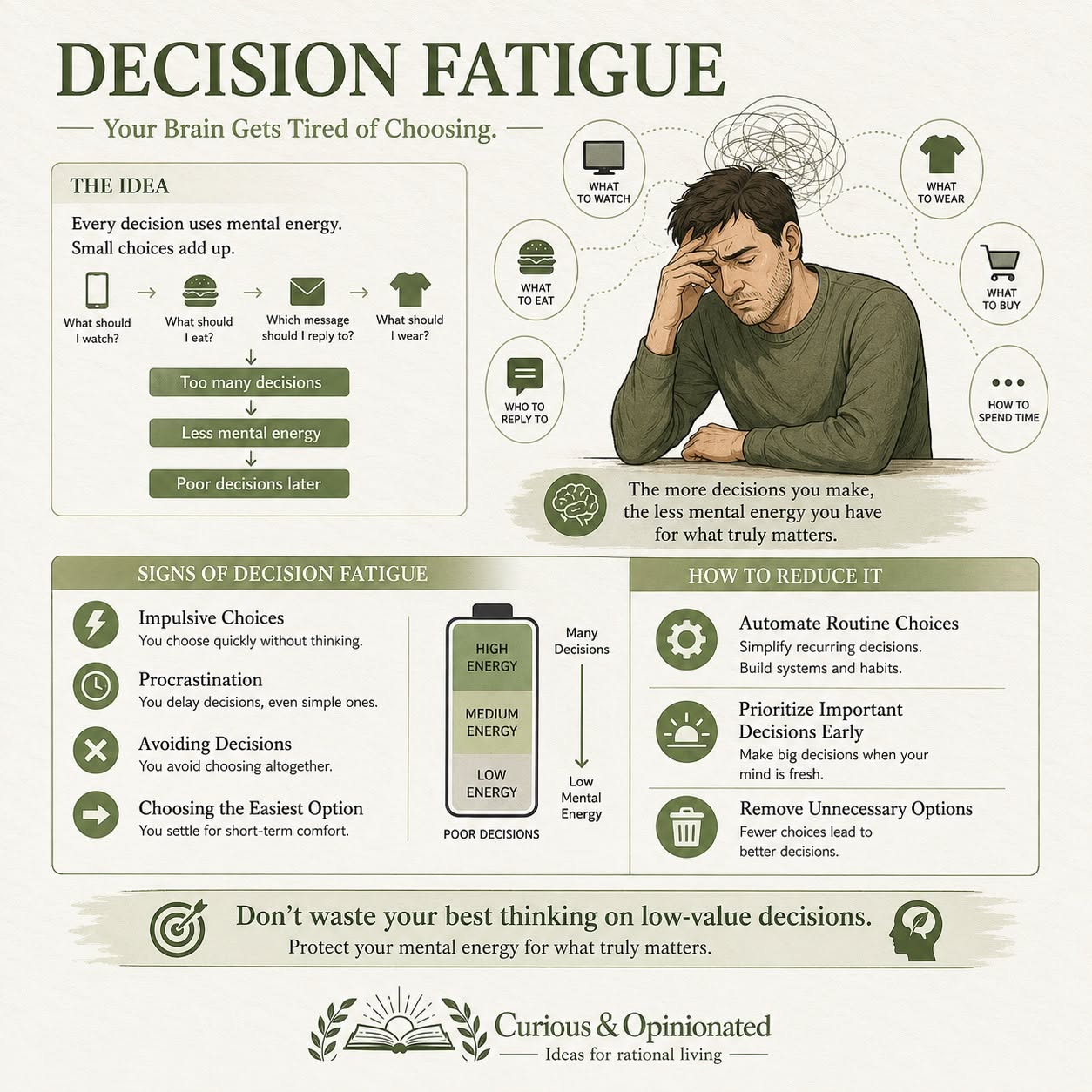
By mid-afternoon on a busy day, something shifts. The morning decisions - which priorities to tackle first, how to frame a difficult email, whether to push back in that meeting - felt manageable. Now, faced with a straightforward question about dinner, you feel unexpectedly paralyzed.
You default to the familiar option. You order the same thing you always order. You agree to plans you did not particularly want, because agreeing requires less deliberation than declining.
If this sounds familiar, you have experienced something that researchers have spent decades trying to understand and measure: the deterioration of decision quality that follows from an accumulated load of prior choices.
Decision fatigue describes the phenomenon in which the quality of decisions degrades after an extended period of choosing.
The concept emerged from social psychology in the late 1990s and became widely discussed after a series of studies appeared to show dramatic, real-world consequences - judges granting parole more often right after breaks, shoppers making impulsive purchases late in a mall trip, consumers accepting expensive add-ons at car dealerships when positioned at the end of a long negotiation.
These findings were compelling and intuitively resonant. They also turned out to be more complicated than the popular narrative suggested.
Understanding what decision fatigue actually is - and what the science genuinely supports versus what has been overstated - matters because the concept has been used to justify a wide range of productivity advice, from wearing the same clothing every day to outsourcing small choices entirely.
Some of this advice is grounded in real effects. Some of it rests on research that has not replicated cleanly. This article examines both the solid ground and the contested terrain, and offers strategies for managing decision load that hold up regardless of the underlying mechanism.
"The selection of information is the beginning of wisdom. The key question is not what to choose, but what to pay attention to when choosing." - adapted from Herbert Simon
Key Definitions
Decision fatigue: The hypothesized decline in decision quality following an extended period of decision-making, attributed to the depletion of cognitive resources associated with evaluating options and committing to choices.
Ego depletion: The original theoretical framework proposed by Roy Baumeister (1998) to explain decision fatigue and related phenomena. Ego depletion holds that self-control, decision-making, and other acts of volition draw on a limited resource that depletes with use and recovers with rest.
| Factor | Effect on Decision Quality | Notes |
|---|---|---|
| Number of prior decisions | Degrades quality; increases default to status quo or impulsive choice | Effect most pronounced for novel, high-stakes decisions |
| Time of day | Later decisions tend toward shortcuts and defaults | Judges grant fewer paroles as day progresses (Danziger et al.) |
| Glucose availability | Some improvement after eating; effect modest and contested | Original ego depletion theory; replication mixed |
| Decision complexity | More complex choices accelerate fatigue | Irreversible and high-stakes decisions are most draining |
| Experience and routine | Reduces fatigue by automating familiar decisions | Experts in a domain rely on pattern recognition, not deliberation |
Choice overload: A related but distinct phenomenon described by Barry Schwartz and by Sheena Iyengar and Mark Lepper, in which having too many options increases cognitive burden, reduces the likelihood of making any choice, and decreases satisfaction with the choice made.
Status quo bias: The tendency to maintain existing conditions rather than incur the cognitive cost of evaluating and committing to an alternative. Decision fatigue may increase reliance on status quo options as a form of cognitive conservation.
Cognitive bandwidth: A metaphor used by Eldar Shafir and Sendhil Mullainathan to describe the mental capacity available for deliberate thought and decision-making, which can be consumed by competing preoccupations, particularly financial stress.
Baumeister's Ego Depletion: The Original Framework
The 1998 Radish Experiment
Roy Baumeister and colleagues at Case Western Reserve University published what would become one of the most cited studies in social psychology in 1998 in the Journal of Personality and Social Psychology.[1]
Participants were brought into a room that smelled of freshly baked cookies and seated in front of a plate of cookies and chocolate alongside a plate of radishes.
Some participants were told to eat radishes and resist the cookies. Others were told they could eat cookies freely. A third group had no food interaction.
All participants then worked on what was described as a study of problem-solving: an unsolvable geometric puzzle. Participants who had resisted the cookies gave up on the puzzle significantly sooner than those who had freely eaten cookies or had no food interaction.
Baumeister interpreted this as evidence that the act of resisting the tempting food had depleted a self-regulatory resource, leaving less capacity for persistence on the subsequent task. He called this ego depletion.
The 1998 paper generated over a thousand citations and spawned hundreds of follow-up studies appearing to confirm the basic effect across diverse contexts: resisting food temptation, suppressing emotions, making purchasing decisions, and many other acts of self-control all appeared to deplete the same resource, impairing subsequent performance on tasks requiring similar control.[11]
The Glucose Hypothesis
A particularly influential extension of the ego depletion model proposed that the limited resource was glucose: that acts of self-control consumed blood glucose, and that consuming a sugary drink could restore depleted self-control.
Several studies in the mid-2000s reported findings consistent with this hypothesis. The idea became popular in mainstream accounts of willpower.
Subsequent direct tests of the glucose hypothesis produced inconsistent results, and a re-analysis of the methodology raised concerns about publication bias. The current scientific understanding does not support glucose as the specific fuel for a self-control resource in the way the original hypothesis proposed.
The Replication Crisis: Hagger et al. (2016)
The Pre-Registered Multi-Lab Failure
In 2016, Martin Hagger at Curtin University coordinated a pre-registered replication effort involving 23 independent laboratories across multiple countries, with over 2,000 participants total.[2]
A pre-registered study commits its analysis plan in advance, preventing researchers from adjusting methods or analyses after seeing results - a practice that inflates false positive rates in standard research. This replication used the same basic paradigm as the original ego depletion studies.
The result: no significant ego depletion effect was found at the aggregate level. Individual labs produced scattered positive and negative results, consistent with chance variation around a null effect. This was a serious scientific challenge.
A finding that had been replicated in hundreds of individual studies, which had generated theories, interventions, and a widely read popular book (Willpower by Baumeister and John Tierney, 2011), did not hold up under rigorous multi-site testing.[10]
The replication failure does not prove that ego depletion does not exist in any form. It does mean that the original effect size was likely substantially overstated, that the effect is not as universal or robust as claimed, and that moderating factors not accounted for in the original research are significant.
Dweck and Job: The Role of Belief
One of the most important moderating factors came from research by Carol Dweck and Veronika Job at Stanford University (2010).[7] They found that the ego depletion effect appeared to depend on participants' implicit theories about the nature of willpower.
Participants who endorsed beliefs consistent with a limited-resource theory (statements like "after a strenuous mental activity, your energy is depleted and you must rest to get it refueled") showed classic depletion effects in standard paradigms.
Participants who endorsed a non-limited theory (statements like "mental activities do not drain your energy") showed no depletion effect and sometimes showed improved performance following self-control exertion.
This finding is significant in two directions. It partially explains why ego depletion has been easier to replicate in Western, individualistic cultural contexts where a limited-resource theory of willpower is culturally prevalent.
It also implies that the belief itself may be a significant part of the mechanism: people who believe willpower is limited act as though it is limited, and this self-fulfilling quality may explain some portion of the original findings.
The Israeli Judges Study: A Vivid but Disputed Finding
Danziger et al. (2011)
A 2011 study by Shai Danziger and colleagues at Ben-Gurion University analyzed over 1,000 parole decisions by experienced Israeli judges over a 10-month period.[3]
The headline finding was dramatic: the probability of a favorable ruling (granting parole) was approximately 65% at the start of each judicial session, dropped sharply to near zero just before a food break, then returned to approximately 65% after the break.
The pattern held across morning and afternoon sessions and across the two mid-day food breaks.
Danziger's interpretation was that the judges experienced decision fatigue as their session progressed, defaulting to the safer and cognitively easier choice (denying parole, which maintains the status quo) as their decision-making resources depleted.
Food breaks restored their capacity. The study became a canonical example in popular accounts of decision fatigue and was featured in books, TED talks, and articles throughout the 2010s.
The Challenges to Danziger's Interpretation
Andreas Glockner (2016) and other researchers have raised substantive alternative explanations.[4] The most compelling: the pattern may reflect rational scheduling behavior rather than fatigue.
Judges may schedule more straightforward cases (which are more likely to result in parole) earlier in sessions or immediately after breaks, while deferring complex cases to the end of blocks.
The sharp drop to zero just before breaks may reflect judges avoiding complex decisions when they know they will shortly be interrupted, not fatigue.
Glockner's reanalysis suggested that case order was not random and that the statistical controls in the original study were insufficient to rule out scheduling confounds.
The judges study remains interesting and relevant, but it is not the clean demonstration of decision fatigue that it was initially presented as. It illustrates a broader issue in this research area: vivid, intuitive findings attract attention and propagate rapidly, while their methodological complications receive less coverage.
Choice Overload: The Jam Study
Iyengar and Lepper (2000)
Sheena Iyengar and Mark Lepper conducted a series of field and laboratory experiments examining whether having more choices was always beneficial.[5] In their best-known study, published in 2000, they set up a tasting booth at a California grocery store.
On some days the booth displayed 24 varieties of jam; on others, just 6. They measured how many people stopped to sample (more at the large display) and how many actually purchased (far more from the small display: about 30% of visitors to the 6-jam booth bought a jar, versus about 3% of visitors to the 24-jam booth).
This jam study became the empirical cornerstone of Barry Schwartz's 2004 book The Paradox of Choice, which argued that the abundance of options available in modern consumer and professional contexts creates cognitive burden, decision avoidance, and post-decision regret rather than the satisfaction that economic theory predicted.[6]
More choices require more comparison, create more opportunity for regret about the unchosen options, and raise the standard against which the chosen option is evaluated.
The jam study has been the subject of several meta-analyses producing mixed conclusions: some meta-analyses find a consistent choice overload effect, others find that it is highly context-dependent and does not generalize reliably.
The conditions under which reducing options helps (versus hurts) involve factors including how similar the options are, how experienced the chooser is, and how much the choice matters.
Nevertheless, the core finding - that more options do not always produce better choices or more satisfaction - is robust enough to inform practical design of decision environments.
Poverty, Scarcity, and Decision Bandwidth
Mani, Mullainathan, Shafir, and Zhao
While the ego depletion literature has faced significant replication challenges, a related body of work on cognitive bandwidth and scarcity has attracted considerable empirical support.
Eldar Shafir at Princeton and Sendhil Mullainathan at Harvard published Scarcity: Why Having Too Little Means So Much in 2013, drawing on experimental and field evidence showing that people experiencing financial scarcity perform worse on tests of cognitive function - not because poverty reduces intelligence, but because financial worry consumes working memory and attentional capacity.[8]
Mani, Mullainathan, Shafir, and Zhao (2013) conducted experiments showing that inducing participants to think about financial scarcity impaired subsequent performance on cognitive tasks requiring executive function.
The mechanism was not depletion in the Baumeister sense but attentional tunneling: scarcity caused the mind to focus narrowly on the scarce resource, leaving less capacity for other cognitive demands.
The practical significance is substantial. People in poverty face more consequential daily decisions (how to allocate limited money, whether to pay which bill) under higher stakes and with less margin for error, while simultaneously operating with reduced cognitive bandwidth due to financial preoccupation.
This reframes decision fatigue not merely as a personal productivity problem but as a structural feature of how scarcity imposes cognitive costs.
The implication for policy is that simplifying administrative requirements for people in poverty (reducing paperwork, default enrollment in benefits programs) can improve outcomes by reducing the decision burden placed on those with the least cognitive bandwidth to spare.
Practical Strategies for Reducing Decision Load
Routinization and Pre-Commitment
The most robust practical implication of the decision fatigue literature, regardless of the exact mechanism, is that decisions that occur automatically - through habit or pre-committed rules - do not consume the cognitive resources that deliberate decisions consume.
Brian Galla and Angela Duckworth's 2015 research found that high self-discipline individuals were distinguished not by exceptional resistance to temptation but by having fewer temptations to resist in the first place, through structured habits.[9]
Routinizing recurring choices removes them from the active decision queue. A standard weekly menu eliminates the daily question of what to cook. A capsule wardrobe eliminates the morning clothing decision.
A consistent exercise time, treated as an appointment rather than a daily judgment call, removes the question of whether to exercise today.
The goal is not rigid uniformity but strategic automation of low-stakes, recurring decisions to preserve deliberate decision capacity for the choices that genuinely require it.
Temporal Positioning of Important Decisions
If decision quality does decline with accumulated decision load across a day - and there is enough evidence to make this a reasonable working assumption even if the mechanism is uncertain - then scheduling consequential decisions earlier in the day, before cognitive resources have been taxed, is a sensible precaution.
Negotiations, difficult conversations, complex planning, and significant commitments are better handled when the decision-maker is fresh. Deferring non-urgent decisions that arise late in the day is similarly prudent.
Reducing Option Sets
Barry Schwartz's paradox of choice, combined with Iyengar and Lepper's jam research, supports deliberately limiting option sets in contexts where choice overload is likely.
This applies at the personal level (limiting the range of options you allow yourself to consider for low-stakes decisions) and at the design level (structuring choices for others by providing fewer, better-curated options rather than comprehensive lists).
Default options - where the choice is made for you unless you actively opt out - can significantly reduce decision burden, which is why default enrollment in retirement savings plans dramatically increases participation rates compared to opt-in structures.[12]
Practical Takeaways
Identify your recurring decisions and automate them. Clothing, meals, exercise timing, and commute routes are candidates for routinization. Each one removed from active deliberation preserves capacity for decisions that matter.
Front-load consequential decisions. Schedule important commitments, negotiations, and evaluations earlier in the day and earlier in the week when decision quality is likely to be higher.
Reduce option sets deliberately. When you can control the choice architecture, fewer well-curated options usually produce better outcomes than comprehensive option lists. Apply this to your own choices and to choices you design for others.
Recognize late-day decision patterns. If you notice yourself accepting defaults, making impulsive choices, or feeling paralyzed by simple decisions in the afternoon or evening, that is useful information about your decision load. Defer what can be deferred.
Be skeptical of simple narratives. The willpower and decision fatigue literature has been overstated in popular accounts. The underlying effects are real but more context-dependent and smaller than often claimed.
Design-based approaches (changing the environment) tend to be more reliable than effort-based approaches (trying harder to decide well when depleted).
Minimize irrelevant decisions around focused work. As explored in how to improve focus, decision fatigue compounds with attention depletion. Pre-deciding what to work on before a focus session eliminates the decision load of figuring it out mid-session.
Sources & Further Reading
- Baumeister, R. F., Bratslavsky, E., Muraven, M., and Tice, D. M. "Ego Depletion: Is the Active Self a Limited Resource?" Journal of Personality and Social Psychology, 1998.
- Hagger, M. S., et al. "A Multilab Preregistered Replication of the Ego-Depletion Effect." Perspectives on Psychological Science, 2016.
- Danziger, S., Levav, J., and Avnaim-Pesso, L. "Extraneous Factors in Judicial Decisions." Proceedings of the National Academy of Sciences, 2011.
- Glockner, A. "The Irrational Hungry Judge Effect Revisited." Judgment and Decision Making, 2016.
- Iyengar, S. S., and Lepper, M. R. "When Choice Is Demotivating: Can One Desire Too Much of a Good Thing?" Journal of Personality and Social Psychology, 2000.
- Schwartz, B. The Paradox of Choice: Why More Is Less. Ecco, 2004.
- Job, V., Dweck, C. S., and Walton, G. M. "Ego Depletion: Is It All in Your Head? Implicit Theories About Willpower Affect Self-Regulation." Psychological Science, 2010.
- Mullainathan, S., and Shafir, E. Scarcity: Why Having Too Little Means So Much. Times Books, 2013.
- Galla, B. M., and Duckworth, A. L. "More Than Resisting Temptation: Beneficial Habits Mediate the Relationship Between Self-Control and Positive Life Outcomes." Journal of Personality and Social Psychology, 2015.
- Tierney, J., and Baumeister, R. F. Willpower: Rediscovering the Greatest Human Strength. Penguin Press, 2011.
- Vohs, K. D., et al. "Making Choices Impairs Subsequent Self-Control: A Limited Resource Account of Decision Making, Self-Regulation, and Active Initiative." Journal of Personality and Social Psychology, 2008.
- Thaler, R. H., and Sunstein, C. R. Nudge: Improving Decisions About Health, Wealth, and Happiness. Yale University Press, 2008.
Article Word Count: 3,011