
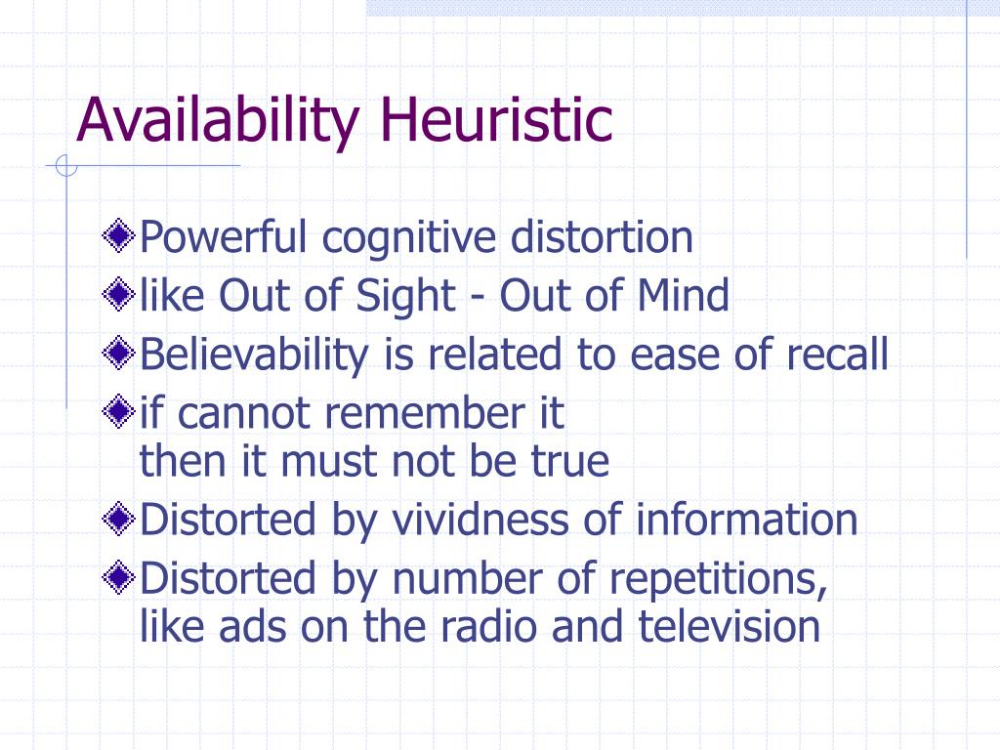
In availability heuristic psychology, ease of recall is treated as a poor substitute for a frequency count, yet it often guides judgments about what is common, dangerous, or likely. This shortcut makes vivid or easily remembered examples feel more representative than information that is harder to retrieve.
"A person is said to employ the availability heuristic whenever he estimates frequency or probability by the ease with which instances come to mind." (Tversky & Kahneman, 1973)
The Opening Demonstration
In 1973, Amos Tversky and Daniel Kahneman posed a deceptively simple question to experimental subjects: in English, are there more words that begin with the letter K, or more words that have K as their third letter?
Think about it for a moment. Words that begin with K come readily to mind: king, kitchen, knife, known, keep, kind, key, knock. Words with K in the third position take considerably more effort to generate: ask, awkward, bake, bike, bike, cake, fake, ink, lake, like, make, take. The first group feels more numerous. It feels more available.
The subjects in Tversky and Kahneman's experiment judged the same way: most said there are more words beginning with K. They were wrong. Common English words are roughly three times more likely to have K as their third letter than as their first letter.
The initial position of a letter is simply a more efficient retrieval cue: it is how mental lexicons are organized. We search memory alphabetically by first letter. We do not search it by third letter. So words beginning with K pour out easily, and the ease of that pouring is mistaken for statistical evidence that they are more numerous.
This demonstration, published in the journal Cognitive Psychology in 1973, established the empirical core of what Tversky and Kahneman called the availability heuristic. It has not lost any of its power in the half-century since.
One-Sentence Definition
The availability heuristic is the cognitive tendency to judge the frequency or probability of an event by the ease with which relevant instances can be brought to mind, rather than by objective statistical information.
Availability Heuristic vs. Statistical Base Rates
The most consequential gap in human probabilistic reasoning is the gap between what the mind finds easy to retrieve and what is actually frequent or probable. The following table maps that gap across five domains where the two systematically diverge.
| Availability (What Comes to Mind Easily) | Statistical Base Rate (What Is Actually More Common) |
|---|---|
| Plane crashes, dramatic, visually vivid, intensively covered by news media for days after any incident | Car accidents: Americans face roughly 65 times greater risk per mile traveled by road than by air; road deaths exceed 40,000 per year vs. fewer than 500 in typical commercial aviation years |
| Shark attacks, viscerally terrifying, narratively compelling, disproportionately reported and depicted in film and television | Drowning, rip currents, and common jellyfish stings: the lifetime risk of a shark fatality is approximately 1-in-11 million; drowning generally kills thousands of Americans annually |
| Homicide, featured prominently in news, crime dramas, and public discourse; easily generated as a cause of death | Diabetes and stomach cancer: homicide causes approximately 20,000 deaths per year in the United States; diabetes causes roughly 100,000; subjects in Lichtenstein et al.'s 1978 studies judged homicide more common than diabetes |
| Tornado deaths, dramatic, visually striking, frequent subjects of weather journalism and viral video | Asthma deaths: asthma kills roughly twenty times as many Americans per year as tornadoes; subjects in the same 1978 research consistently overestimated tornado mortality relative to asthma |
| Terrorist attacks, subject to wall-to-wall media coverage, political amplification, and enduring cultural salience following September 11, 2001 | Workplace accidents and preventable medical errors: the Institute of Medicine estimated in 1999 that medical errors alone kill between 44,000 and 98,000 Americans per year; terrorism deaths in the United States in most years number in the dozens |
The pattern across all five rows is the same: what is emotionally salient, narratively dramatic, and media-amplified becomes cognitively available; what is statistically dominant but experientially invisible does not.
The mind, consulting availability as a proxy for probability, produces a risk map that is systematically inverted relative to the actuarial one.
Cognitive Science: The Mechanisms and the Researchers
The availability heuristic as a formal theoretical construct was introduced by Amos Tversky and Daniel Kahneman in their 1973 paper "Availability: A Heuristic for Judging Frequency and Probability," published in Cognitive Psychology, volume 5.
The paper emerged from a broader program of research on human judgment under uncertainty that the two Israeli psychologists had begun in the late 1960s at Hebrew University, motivated by a shared conviction that the dominant economic models of rationality described almost no one they had ever met.
Their experimental toolkit in the 1973 paper was varied and revealing. Beyond the K-letter demonstration, they showed that subjects who were asked to imagine a vivid event subsequently judged it more probable than subjects who received no such instruction.
They showed that events with which subjects had more associative connections, more pathways into memory, were judged more likely.
They distinguished between several sub-types of availability: ease of recall (how easily instances are generated), retrievability of instances (whether specific examples can be named), imaginability (how easily an event can be mentally simulated), and illusory correlation (whether two things seem to co-occur because their pairing is memorable).
The most significant theoretical refinement of the original model came in 1991. Norbert Schwarz, Herbert Bless, Fritz Strack, Gabi Klumpp, Helga Rittenauer-Schatka, and Annette Simons published "Ease of Retrieval as Information: Another Look at the Availability Heuristic" in the Journal of Personality and Social Psychology, volume 61.
Their experiment asked participants to recall either six or twelve examples of their own assertive behavior.
By naive content-based logic, recalling twelve examples should produce higher self-ratings of assertiveness: more evidence should mean stronger belief. The actual result inverted this prediction entirely.
Participants who recalled twelve examples rated themselves as less assertive than those who recalled six. The reason is that generating twelve examples of assertive behavior is genuinely difficult. Memory becomes strained. The search feels laborious.
That subjective experience of difficulty, that sense of effortful, frustrated retrieval, is registered as evidence that assertive behavior is rare in one's own life. The experience of retrieval, not its product, is what drives the judgment.
Schwarz and colleagues established that availability is fundamentally about felt fluency: a metacognitive signal produced by the ease or difficulty of mental search, not a count of retrieved instances.
This distinction has broad implications. It means that beyond a certain threshold, being forced to generate more examples of something can paradoxically decrease belief in its frequency, because the effort of generation is itself informative.
The finding has been replicated in consumer product research (asking people to think of many reasons to buy a product can reduce purchase intention), health behavior (generating many reasons to exercise can decrease reported exercise intentions), and relationship satisfaction (generating many reasons to appreciate a partner can reduce felt satisfaction).
In each case, the strain of retrieval is interpreted as evidence against the proposition, overriding the informational content of the retrieved material.
Paul Slovic, working at Decision Research in Eugene, Oregon, extended the framework into real-world risk perception throughout the 1970s and 1980s.
His work with Baruch Fischhoff and Sarah Lichtenstein, particularly the 1978 studies on perceived mortality risk published in Environment and Behavior and related work in Policy Sciences, provided the foundational empirical demonstration that availability distortions were not laboratory curiosities: they operated at scale across the full range of risks that people face, with systematic and measurable consequences for how people estimated the danger of their world.
Slovic later introduced the psychometric paradigm of risk, captured in his chapter in The Perception of Risk (Earthscan, 2000), which mapped perceived risks along dimensions including dread and novelty/unknownness.
These dimensions predict precisely which risks will be cognitively available: risks that score high on dread (uncontrollable, catastrophic, inequitable, not offset by benefits) and high on unknownness (new, unobservable, delayed in effect, not understood by science) are most vivid, most emotionally charged, and therefore most easily retrieved.
The psychometric structure of perceived risk is, in part, a map of what the availability heuristic amplifies.
Jonathan Renshon, Jooa Julia Lee, and Dustin Tingley, publishing in Political Psychology in 2015, found that physiological arousal (measured via skin conductance response) enhanced availability-based reasoning in political judgment tasks, suggesting that the heuristic is modulated by the body's affective state.
When people are physiologically aroused, emotionally salient information becomes more available and more influential over judgment.
The finding connects the cognitive mechanism to the broader affective architecture of the brain, implicating the amygdala and its role in emotional memory consolidation as a structural driver of availability distortions.
Intellectual Lineage
The availability heuristic did not appear from nowhere. It crystallized a set of ideas scattered across several decades of psychology and statistics, and it sits within a broader theoretical tradition that stretches back at least to Herbert Simon.
Simon's bounded rationality program, launched in a series of papers beginning in 1955 and formalized in his 1957 book Models of Man, argued that humans do not optimize: they satisfice. Cognitive resources are limited; the environment is complex; perfect calculation is neither possible nor necessary.
Heuristics are the tools by which satisficing is accomplished. They are reasonable approximations that work well enough, most of the time, in most environments.
The availability heuristic fits precisely within this framework: it is a satisficing strategy for probability judgment that exploits a genuine statistical regularity (frequency and memorability are correlated in natural environments) to produce fast, low-effort probability estimates.
Simon's framework predicted the existence of availability-like mechanisms before Tversky and Kahneman named them.
Frederick Bartlett's work on reconstructive memory, published in his 1932 monograph Remembering: A Study in Experimental and Social Psychology, established the theoretical basis for understanding why retrieval ease varies across events.
Bartlett demonstrated that memory does not record: it reconstructs. Remembering is an active process shaped by schemas, expectation, prior knowledge, and emotional significance.
Events that are emotionally significant, schematically coherent, and frequently rehearsed are reconstructed more fluently than events that are mundane, schematically anomalous, or encountered once without emotional resonance.
Bartlett's reconstructive model implies that availability, the fluency of retrieval, will track emotional salience and rehearsal frequency rather than objective occurrence frequency. The availability heuristic is, in part, a consequence of how memory works.
Brian Combs and Paul Slovic published "Newspaper Coverage of Causes of Death" in Journalism Quarterly in 1979, providing one of the most direct demonstrations of the media-memory-availability chain.
They systematically compared news coverage of various causes of death in two Oregon newspapers with actual mortality statistics from death certificates.
The correlation between news coverage and perceived frequency of death was far higher than the correlation between actual frequency and perceived frequency.
Causes of death that received disproportionate news coverage were overestimated in perceived frequency; causes receiving little coverage were underestimated.
The study established empirically what Slovic's risk perception work implied theoretically: public risk perception is substantially a function of media coverage, and media coverage selects for drama rather than mortality.
Sarah Lichtenstein, Paul Slovic, Baruch Fischhoff, Mark Layman, and Barbara Combs published "Judged Frequency of Lethal Events" in the Journal of Experimental Psychology: Human Learning and Memory in 1978.
Their study asked subjects to judge the relative frequency of pairs of lethal events, which kills more people, tornadoes or asthma?
Across forty-one pairs, the results showed that dramatic, media-covered causes of death were overestimated relative to mundane ones; that the more dramatic cause in each pair was more often judged as more frequent; and that the magnitude of overestimation tracked the drama and media salience of the cause.
Homicide was judged as common as diabetes; in reality diabetes kills approximately five times as many people. The study provided the quantitative foundation for claims about the real-world consequences of the availability heuristic in risk perception.
Timur Kuran and Cass Sunstein introduced the availability cascade concept in a 1999 paper in the Stanford Law Review, titled "Availability Cascades and Risk Regulation." Their argument extended the individual-level cognitive mechanism to the level of social dynamics and regulatory policy.
An availability cascade, in their account, is a self-reinforcing process by which a salient event generates media coverage that increases its cognitive availability, which generates public fear, which generates political attention, which generates further media coverage, which generates further availability: a feedback loop that can amplify a triggering event far beyond any justified response and can persist long after the original event's statistical significance has faded.
Kuran and Sunstein documented how availability cascades had shaped American environmental regulation, financial regulation, and drug policy in ways that were not obviously proportionate to the underlying risks.
Kahneman synthesized this entire lineage in his 2011 book Thinking, Fast and Slow, which made the heuristics-and-biases program accessible to a general audience and won him a broad readership that his academic papers, however influential, had not reached.
Kahneman framed the availability heuristic within his dual-process theory: it is a product of System 1, the fast, automatic, associative processing mode, which uses retrieval fluency as a proxy for frequency precisely because calculating actual frequencies is a System 2 operation: slow, deliberate, effortful, and costly.
The book remains the most thorough non-technical account of the heuristic's mechanisms, consequences, and limits.
Empirical Research
The empirical literature on the availability heuristic is one of the largest and most replicated bodies of research in cognitive psychology and behavioral science. The major findings span five decades and a wide range of methodologies, from simple laboratory experiments to analyses of national mortality statistics.
Tversky and Kahneman's original 1973 experiments in Cognitive Psychology established the foundational phenomena: the K-letter demonstration, the imaginability studies, the associative fluency studies. These were small laboratory experiments, but their internal validity was high and their theoretical framing was precise.
The central finding, that ease of mental search drives frequency and probability judgments, has been confirmed repeatedly across cultures, age groups, and domains.
Lichtenstein, Slovic, Fischhoff, Layman, and Combs's 1978 study in the Journal of Experimental Psychology: Human Learning and Memory moved the phenomenon out of the laboratory and into real-world mortality risk estimation.
Their forty-one paired comparisons of lethal causes of death showed the same pattern across a much more consequential domain.
The magnitude of the errors was striking: subjects judged motor vehicle accidents to cause about as many deaths as all diseases combined, when in reality diseases kill roughly sixteen times as many people.
They judged homicide to kill more people than diabetes, when diabetes kills approximately five times as many. They judged floods to be more lethal than asthma, when asthma kills roughly twenty times as many.
Combs and Slovic's 1979 analysis in Journalism Quarterly supplied the mediating link: news coverage frequency correlated more strongly with perceived mortality frequency than actual mortality frequency did. The study compared coverage in two Oregon newspapers over one year with state-level mortality data.
Dramatic deaths, accidents, homicides, natural disasters, received far more coverage relative to their actuarial weight than deaths from chronic disease. Perceived frequency tracked coverage, not reality.
Schwarz et al.'s 1991 Journal of Personality and Social Psychology paper on ease of retrieval introduced the most theoretically significant refinement: the dissociation between content and fluency.
The six-vs.-twelve assertiveness examples experiment showed that generating more examples can decrease belief in the proposition they are supposed to support.
This finding has been confirmed in dozens of subsequent studies. A 1994 replication by Schwarz and colleagues showed the same pattern for judging the safety of a car: asking people to generate many accident scenarios for a particular model reduced their concern about that model's safety because the difficulty of generating scenarios was interpreted as evidence of the car's safety.
A 2002 study by Haddock found the same pattern in political attitude formation: thinking of many reasons to oppose a policy reduced opposition, because the effort of generation was interpreted as evidence against the intensity of the attitude.
Gerd Gigerenzer's 2004 paper in Psychological Science, "Dread Risk, September 11, and Fatal Traffic Accidents," applied the availability framework to the post-September 11 period and produced one of the most arresting quantifications of availability heuristic consequences in the literature.
Using data from the National Safety Council and comparing to historical baselines, Gigerenzer estimated that American road fatalities increased by approximately 1,595 deaths in the twelve months following September 11, 2001, deaths directly attributable to the shift from air travel to road travel.
The mechanism was straightforward availability: the attacks had made the risk of flying catastrophically available, while the risk of driving remained cognitively invisible despite being actuarially far higher.
The paper provided a rare case where the mortality consequences of a collective availability distortion could be estimated from national statistics.
Viscusi and Hamilton's work on Superfund environmental cleanup, published through the 1990s, documented availability cascade effects in regulatory priority-setting.
Sites associated with dramatic public incidents, chemical leaks that had received intense local news coverage, were prioritized for cleanup over sites with higher actuarial health risk rankings.
The researchers concluded that public pressure, itself driven by availability distortions, was systematically misallocating regulatory resources away from the highest-risk sites.
Mark Graber, Nancy Franklin, and Ruthanna Gordon's 2005 study in the Archives of Internal Medicine analyzed 100 cases of diagnostic error in internal medicine and found that cognitive factors, including availability-driven premature closure, were implicated in 74% of them.
Physicians were anchoring to the most memorable recent diagnosis rather than the most statistically probable given the patient's presentation.
Patrick Croskerry's 2002 review in Academic Emergency Medicine identified availability as one of the most common cognitive biases in emergency diagnostic reasoning, noting that the high-stakes, time-pressured environment of emergency medicine creates optimal conditions for heuristic-driven judgment.
Limits and Nuances
The availability heuristic is not a universal cognitive disease. It is a context-sensitive strategy whose accuracy depends heavily on the relationship between retrieval ease and actual frequency in the relevant environment.
Gerd Gigerenzen, who documented the post-9/11 traffic death toll and thus provided one of the most damning quantitative indictments of availability-driven error, has also been the heuristic's most careful defender in contexts where it operates accurately.
In Gut Feelings (Viking, 2007) and Rationality for Mortals (Oxford, 2008), Gigerenzen argues that the framing of heuristics as "biases" is itself biased: it evaluates cognitive strategies against a normative standard of full probabilistic calculation without asking whether those strategies are accurate in the environments where humans actually operate.
A heuristic that works well in its native environment is not irrational: it is ecologically valid.
In environments where personal experience provides a representative sample of the relevant category, retrieval ease is a reasonable guide. A driver who easily recalls dangerous intersections in her city is likely recalling genuinely dangerous intersections: her experience tracks local reality.
A physician who easily recalls a common presentation of a frequent diagnosis is using accurate, experience-calibrated availability.
A voter who easily recalls corruption scandals in local government may be accurately reflecting the actual frequency of such scandals in their local information environment. In each of these cases, availability functions as intended.
The heuristic fails when the information environment is non-representative: when some events are dramatically over-reported relative to their frequency, and others are dramatically under-reported.
This is the defining feature of mass media environments, where selection for narrative interest, emotional engagement, and novelty ensures that the events most available to memory are precisely those least representative of statistical reality.
The modern information environment has, in effect, created a systematic wedge between retrieval ease and actual frequency across a wide range of important risk categories.
Norbert Schwarz's ease-of-retrieval findings introduce a further nuance: the relationship between availability and judgment is not monotonic. At low levels of example generation, more examples increase perceived frequency.
At high levels, more examples decrease perceived frequency, because the effort of generation overrides the informational content of the examples themselves.
This means that attempts to increase awareness of a risk by forcing people to generate many examples of it can paradoxically reduce their concern about the risk, an ironic implication for public health communication strategies that rely on example elaboration.
The availability heuristic also interacts with individual differences in ways that complicate general claims.
Research by Slovic and colleagues has found that affect (emotional response to a stimulus) functions as a parallel availability mechanism: events that evoke strong negative affect are more vividly available and more strongly influence risk judgment than events that evoke weak affect, even when the events are matched for statistical frequency.
This "affect heuristic," as Slovic labeled it in a 2002 paper in Psychological Bulletin, is closely entangled with availability: affect and retrieval fluency tend to covary, because emotional significance enhances memory encoding and retrieval.
But the two mechanisms can be experimentally dissociated, and each contributes independently to risk judgment.
Finally, availability interacts with expertise in ways that both attenuate and redirect its effects. Kahneman and Gary Klein's 2009 paper in American Psychologist, "Conditions for Intuitive Expertise: A Failure to Disagree," examined when intuitive judgment, which is fundamentally availability-based, can be trusted.
Their conclusion was that expertise-based availability is accurate when the expert has accumulated experience in a high-validity environment with rapid, unambiguous feedback.
Firefighters, chess grandmasters, and experienced emergency physicians can develop finely calibrated availability mechanisms because their experience provides representative feedback loops.
Experts in low-validity environments, stock forecasters, political pundits, clinical interviewers predicting long-term outcomes, develop confident availability-based intuitions that are not calibrated to reality, because the feedback loops are too slow, too noisy, or too ambiguous to produce genuine learning.
The availability mechanism operates regardless; what differs is whether it has been trained on representative data.
Numbered References
Tversky, A., & Kahneman, D. (1973). Availability: A heuristic for judging frequency and probability. Cognitive Psychology, 5(2), 207-232.
Lichtenstein, S., Slovic, P., Fischhoff, B., Layman, M., & Combs, B. (1978). Judged frequency of lethal events. Journal of Experimental Psychology: Human Learning and Memory, 4(6), 551-578.
Combs, B., & Slovic, P. (1979). Newspaper coverage of causes of death. Journalism Quarterly, 56(4), 837-843.
Fischhoff, B., Slovic, P., Lichtenstein, S., Read, S., & Combs, B. (1978). How safe is safe enough? A psychometric study of attitudes towards technological risks and benefits. Policy Sciences, 9(2), 127-152.
Schwarz, N., Bless, H., Strack, F., Klumpp, G., Rittenauer-Schatka, H., & Simons, A. (1991). Ease of retrieval as information: Another look at the availability heuristic. Journal of Personality and Social Psychology, 61(2), 195-202.
Kuran, T., & Sunstein, C. R. (1999). Availability cascades and risk regulation. Stanford Law Review, 51(4), 683-768.
Gigerenzer, G. (2004). Dread risk, September 11, and fatal traffic accidents. Psychological Science, 15(4), 286-287.
Graber, M. L., Franklin, N., & Gordon, R. (2005). Diagnostic error in internal medicine. Archives of Internal Medicine, 165(13), 1493-1499.
Croskerry, P. (2002). Achieving quality in clinical decision making: Cognitive strategies and detection of bias. Academic Emergency Medicine, 9(11), 1184-1204.
Slovic, P. (2000). The Perception of Risk. Earthscan Publications.
Kahneman, D., & Klein, G. (2009). Conditions for intuitive expertise: A failure to disagree. American Psychologist, 64(6), 515-526.
Renshon, J., Lee, J. J., & Tingley, D. (2015). Physiological arousal and political beliefs. Political Psychology, 36(5), 569-585.