
Understanding: In 1992, a pair of psychologists at Cornell University attended the Barcelona Olympic Games with video cameras and a specific question: do athletes who win a lesser medal feel worse than those who win a greater one? The obvious answer is yes.
Silver is better than bronze, and a rational agent who finishes second should feel better than one who finishes third.
When Victoria Medvec, Scott Madey, and Thomas Gilovich analyzed footage of athletes' facial expressions at the moment of receiving their medals, then had independent judges rate the apparent happiness of each medalist, the results inverted common sense entirely.[2]
Bronze medalists, on average, appeared measurably happier than silver medalists.
Their 1995 paper in the Journal of Personality and Social Psychology - "When Less Is More: Counterfactual Thinking and Satisfaction Among Olympic Medalists" - argued that the difference was driven not by objective rank but by the direction of the comparison each athlete naturally made.
Silver medalists compared themselves upward, to the gold they had just missed.
Bronze medalists compared themselves downward, to the fourth-place finish they had narrowly avoided. Same podium, same rational hierarchy of achievement. Opposite emotional outcomes - because the mind does not evaluate outcomes in isolation.
It evaluates them against a reference point, and that reference point is almost always another person.
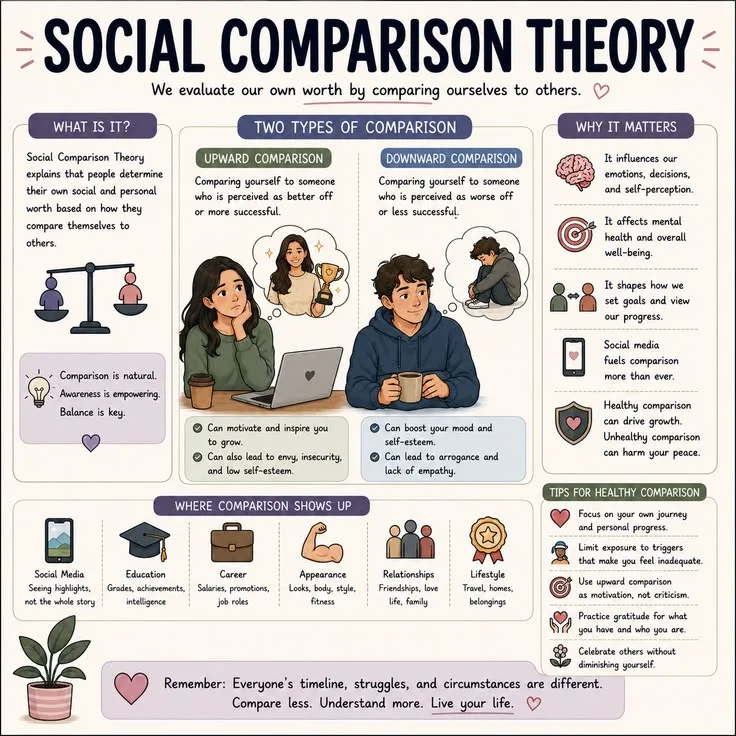
Social comparison theory holds that human beings evaluate their own opinions, abilities, and circumstances by comparing themselves to other people - and that this comparative process is not an incidental habit but a core feature of how the mind constructs self-knowledge.
"There exists a drive in people to evaluate their opinions and abilities by comparing themselves with others." - Leon Festinger, 1954
Upward vs. Downward Social Comparison
The most fundamental structural distinction in social comparison research is directional: whether the comparison target is perceived as better or worse than oneself along the relevant dimension.
| Dimension | Upward Social Comparison | Downward Social Comparison |
|---|---|---|
| Direction of comparison | Comparing oneself to someone perceived as superior | Comparing oneself to someone perceived as inferior |
| Typical emotional outcome | Envy, inspiration, dissatisfaction, anxiety | Comfort, gratitude, enhanced self-esteem |
| Primary motivational function | Self-improvement, goal-setting, information-seeking | Self-enhancement, mood repair, threat buffering |
| Context of frequent occurrence | Ambition, performance feedback, social media exposure | Coping with illness, failure, or threat to self-concept |
| Backfire risk | Can produce despair or hopelessness when gap is perceived as unbridgeable | Can produce complacency, or moral revulsion when target is pitied |
| Prototypical example | A junior employee comparing their salary to a senior colleague's | A cancer patient comparing their prognosis to someone with a more aggressive diagnosis |
| Moderating variable | Perceived relevance of target to one's own trajectory | Perceived similarity between self and target |
Neither direction is uniformly beneficial or harmful. The same upward comparison that motivates one person to train harder can push another into depressive withdrawal. The same downward comparison that restores a patient's sense of control can, in a different context, produce smug disengagement.
The theory's real explanatory power lies not in predicting which direction people choose but in explaining why they choose the comparisons they do, under which conditions, and with what consequences.
Festinger's Foundation: The 1954 Paper
Leon Festinger published "A Theory of Social Comparison Processes" in Human Relations in 1954 - a paper that introduced, within a single conceptual framework, propositions that continue to organize research in social psychology, behavioral economics, and clinical science.
Festinger was then at the University of Minnesota, and the paper emerged from his broader program on social influence and opinion formation. The theory was originally framed around two objects of comparison: opinions (beliefs about the world) and abilities (estimates of one's own competence).
Festinger proposed that both are subject to the same comparative logic.
The paper's core argument runs as follows. Human beings possess a drive to evaluate their opinions and abilities accurately. Physical reality provides one source of evaluation - if I believe the bridge will hold my weight, I can walk across it and check.
But for a vast range of human concerns - Am I a good parent? Is my political view well-reasoned? Am I competent at my job? - no direct physical test is available.
In these domains, the mind turns to social reality: the opinions and demonstrated abilities of other people serve as the primary standard against which one's own standing is calibrated.
This is not laziness or error. It is the only feasible strategy for self-evaluation in domains where no objective benchmark exists.
Festinger added a second proposition that proved especially generative: people prefer to compare themselves to others who are similar to themselves on the relevant dimension.[1] A recreational runner evaluating their performance cares primarily about other recreational runners, not elite marathon athletes.
A first-year medical student assesses her understanding of pharmacology relative to classmates, not to attending physicians. Similarity functions as a validity criterion: a comparison to someone vastly different provides little usable information about where one actually stands.
This preference for similar comparison targets is now called the "similarity hypothesis," and it has held up with remarkable consistency across decades of experimental and field research.
The paper also introduced a unidirectional drive upward: when the comparison involves abilities, Festinger proposed, there is a pressure to perform better than others, not merely to assess one's current standing. This drive distinguishes ability from opinion comparison.
With opinions, equilibrium is achievable - if everyone around me holds a belief, I can adopt it and comparison ceases. With abilities, the pressure to outperform persists: even if I am performing well, knowing someone nearby is performing better generates a further impetus to close the gap.
Cognitive Science: The Mechanisms of Comparison
Counterfactual Thinking
The mechanism connecting social comparison to emotion was substantially clarified by the Cornell research program that produced the Olympic medalist study.
Medvec, Madey, and Gilovich drew on the earlier work of Daniel Kahneman and Dale Miller, whose 1986 paper in Psychological Review - "Norm Theory: Comparing Reality to Its Alternatives" - established that emotional responses to outcomes are determined not by the outcomes themselves but by how easily alternative outcomes come to mind.[9]
The mind automatically generates counterfactuals: what might have happened instead. For the silver medalist, the vivid counterfactual is gold; for the bronze, it is finishing out of the medals entirely.
These counterfactuals function as implicit comparison targets - and they produce the same emotional dynamics as comparisons to actual other people.
Selective Accessibility
Thomas Mussweiler, working at the University of Wurzburg and later Cologne, developed what is probably the most precise cognitive account of social comparison processes.
His selective accessibility model, outlined in a series of papers published in the Journal of Personality and Social Psychology between 1997 and 2003, proposes that when a person encounters a comparison target, the mind tests a hypothesis - "Am I similar to this person?" or "Am I different from this person?" - and retrieves from memory information consistent with whichever hypothesis is activated.
This selective retrieval temporarily makes certain self-knowledge more accessible than other self-knowledge, and the more accessible information then dominates the subsequent self-evaluation.
Mussweiler's model explains a finding that had long puzzled researchers: social comparison sometimes produces assimilation (one's self-assessment moves toward the comparison target) and sometimes produces contrast (it moves away).[8] The direction depends on which hypothesis is activated.
If the mind is primed to seek similarities, assimilation follows. If primed to seek differences, contrast follows. This is not merely a laboratory curiosity - it maps onto real-world conditions in which the framing of a comparison determines whether it is inspiring or deflating.
Neural Substrates
Imaging studies published in the 2000s and 2010s identified neural correlates of social comparison consistent with the behavioral literature.
A 2012 study by Fliessbach and colleagues, published in Science, found that striatal activity - associated with reward processing - was modulated not by absolute reward magnitude but by relative reward: participants showed greater striatal activation when paid more than a person in an adjacent room performing the same task, and suppressed activation when paid less, even when their own absolute payment was unchanged.
The ventral striatum and medial prefrontal cortex, both implicated in valuation and self-referential processing, appear to be the primary neural machinery through which social comparison produces its motivational and emotional effects.
These findings suggest that the drive toward social comparison is not a culturally imposed habit but is embedded in the architecture of the brain's reward system.
Four Case Studies
Case Study 1: The Easterlin Paradox and National Happiness
In 1974, economist Richard Easterlin published an analysis of survey data on income and happiness across multiple countries and time periods. His finding - now known as the Easterlin paradox - was that within a given country at a given time, richer people are happier than poorer people.
This much is unsurprising. The paradox is that as a country as a whole becomes richer over time, average happiness does not increase. The United States in 2000 was substantially wealthier than the United States in 1950, but Americans were not substantially happier.
Easterlin's interpretation, elaborated in a 1995 paper in the Journal of Economic Behavior and Organization, was that happiness is determined primarily by relative income - how much you earn compared to those around you - rather than absolute income.[5]
Becoming richer makes you happier only if you become richer relative to your reference group. If everyone in your country becomes richer at the same rate, the comparison point moves with you, and subjective wellbeing remains constant.
The theory predicts, and the data confirm, that redistributing income in a way that reduces inequality (rather than merely raising average income) will produce greater aggregate happiness - because it compresses the relative gaps that drive social comparison distress.
Easterlin's work remains contested - some subsequent analyses by Stevenson and Wolfers, published in the Brookings Papers on Economic Activity in 2008, argue that absolute income does matter beyond social comparison effects - but the paradox he identified has forced economists to incorporate social comparison dynamics into models of wellbeing that classical utility theory had treated as irrelevant.
Case Study 2: Lottery Winners and Their Neighbors
One of the most direct tests of relative income effects comes from a study by Jonathan Gardner, Andrew Oswald, and Nattavudh Powdthavee, published in the Review of Economics and Statistics in 2013.[12]
Using data from the British Household Panel Survey, the researchers tracked self-reported life satisfaction for both lottery winners and for people living in the same postal area as lottery winners.
The central finding: lottery winners reported increased life satisfaction - a result consistent with the idea that absolute income matters - but their neighbors reported decreased life satisfaction, even though their own income had not changed.
The lottery win elevated the comparison standard in the local social environment, making neighbors feel relatively worse off without any deterioration in their objective circumstances.
A windfall that makes one person richer makes surrounding people subjectively poorer, not through any material mechanism but through the pure arithmetic of comparison.
The study estimated that winning a modest lottery prize (around 1,000 British pounds) produced measurable positive effects on the winner's satisfaction that dissipated substantially within two years - consistent with hedonic adaptation - while the negative spillover to neighbors persisted somewhat longer.
The research is not merely an interesting economic puzzle. It documents a mechanism by which inequality generates wellbeing costs that aggregate statistics on average income cannot capture.
Case Study 3: Social Comparison in Medical Coping
Joanne Wood's 1989 paper in the Journal of Personality and Social Psychology - "Theory and Research Concerning Social Comparisons of Personal Attributes" - synthesized the growing literature on comparison in clinical populations and introduced a framework distinguishing the function of comparison from its direction.
Wood examined patients coping with breast cancer and found a robust preference for downward comparison: women who were more ill than average compared themselves to women who were doing worse, and reported higher wellbeing as a result.
But Wood's key theoretical contribution was the concept of comparison function as a moderating variable.[4] Comparisons can serve self-evaluation (accurately locating oneself on a dimension), self-improvement (learning how to do better), or self-enhancement (feeling better about oneself).
In threatening circumstances - serious illness, job loss, relationship failure - the self-enhancement function dominates. People select comparison targets who make them feel better, not those who provide the most accurate information.
This is psychologically adaptive in the short term but can create distortions in self-assessment: a patient who consistently compares to those in worse condition may underestimate her own risk or delay seeking additional treatment.
Thomas Wills's 1981 paper in Psychological Bulletin - "Downward Comparison Principles in Social Psychology" - had earlier formalized this insight: under threat, people actively seek out information about worse-off others, and this search is motivated, not incidental.[3]
The clinical implications are substantial: therapeutic interventions that restructure a patient's implicit comparison set can produce meaningful changes in emotional outcomes independent of any change in the patient's actual condition.
Case Study 4: Instagram and the Architecture of Upward Comparison
Erin A. Vogel, Jason P. Rose, Lindsay R. Roberts, and Katheryn Eckles published "Social Comparison, Social Media, and Self-Evaluation" in Psychology of Popular Media Culture in 2014, examining how Facebook use affected self-perception.[6]
Participants who viewed a Facebook profile of an attractive, accomplished peer reported lower self-evaluations across physical appearance, social life, and academic standing than those who viewed a neutral profile.
The study was an early empirical confirmation of what subsequent research has replicated extensively: social media platforms create comparison environments that are structurally biased toward upward comparison. The mechanism is selection and curation.
People post their best photographs, their achievements, their trips and celebrations. The resulting feed represents not a random sample of others' lives but an optimized sample - systematically skewed toward the upper tail of each dimension.
A user scrolling Instagram is not receiving an unbiased view of how peers are doing; she is receiving a continuous feed of peak experiences, curated appearances, and publicly performed successes.
For each upward comparison available in ordinary face-to-face life, social media multiplies the exposure by orders of magnitude and removes the contextual cues - the bad days, the ordinary moments, the private struggles - that would normally calibrate the comparison.
A 2018 meta-analysis by Yoon and Rollings, published in Cyberpsychology, Behavior, and Social Networking, covering 39 studies and over 25,000 participants, found a consistent negative association between passive social media consumption and wellbeing, with social comparison identified as the primary mediating mechanism.
The effect size was modest (r = -0.18 on average) but consistent across platforms, countries, and age groups.
Active social media use - posting, commenting, direct messaging - showed a much weaker and sometimes positive association, consistent with the interpretation that passive consumption drives comparison while active participation drives social connection.
Intellectual Lineage: Where the Theory Came From
Festinger's 1954 paper did not emerge from nothing. Its intellectual genealogy runs through several distinct traditions that social psychology had only recently begun to integrate.
The most direct ancestor is the concept of the reference group, developed by Herbert Hyman in a 1942 paper and elaborated by Robert Merton and Alice Kitt Rossi in their analysis of The American Soldier data in 1950.
Hyman had noticed that people's subjective sense of status was determined not by their absolute position in a social hierarchy but by the group they used as a reference point for comparison.
A soldier's satisfaction with his own promotion rate depended on the promotion rate of the soldiers he compared himself to - and different soldiers, in the same objective position, compared themselves to different reference groups.
Merton and Kitt Rossi showed that satisfaction among American soldiers bore little relationship to objective conditions and a strong relationship to the conditions of whatever comparison group a soldier had implicitly or explicitly adopted.
Festinger formalized this observation and provided a motivational account: people select reference groups not randomly but according to rules (primarily similarity), and the selection itself is driven by a goal (accurate self-evaluation).
A second ancestor is the social psychology of attitude formation and change, which occupied Festinger's research program throughout the late 1940s and early 1950s.
If opinions are formed and maintained through social comparison, then influence - the mechanism by which one person's opinion shifts toward another's - is a comparison process operating in reverse: not self-evaluation through other, but self-revision in response to the comparison revealing a gap.
This connection between comparison theory and attitude change led directly to Festinger's next major theoretical contribution: cognitive dissonance theory, published in 1957. The two theories share an underlying logic - discrepancy produces drive, drive produces change - but apply it to different content.
A third lineage runs through the sociology of relative deprivation, formalized by W.G. Runciman in his 1966 book Relative Deprivation and Social Justice.
Runciman distinguished between two forms of relative deprivation: egoistic (comparing one's own position to others' individual positions) and fraternalistic (comparing one's group's position to other groups').
The distinction matters because political movements are often driven by fraternalistic deprivation - a group that is objectively improving may revolt when it begins to compare itself to another group doing better still.
This is the comparison mechanism operating at collective scale, producing political consequences that purely economic analyses of absolute deprivation cannot explain.
Empirical Research: What the Evidence Shows
The Buunk and Gibbons Review
Bram Buunk and Frederick Gibbons published a comprehensive review of social comparison research in 2007 in Organizational Behavior and Human Decision Processes - "Social Comparison: The End of a Theory and the Emergence of a Field."
The review's deliberately provocative title reflected the authors' assessment that Festinger's original theory, as a unified predictive model, had largely been superseded by a proliferation of more specific models addressing particular comparison conditions.[7]
What had emerged in its place was not a successor theory but a research field - a cluster of empirical programs studying comparison processes in health behavior, organizational psychology, economics, consumer behavior, and developmental psychology, each producing robust local findings that connected to the Festingerian framework without being derivable from it.
Buunk and Gibbons identified several consensus findings that had survived the theoretical fragmentation: the preference for similar comparators, the asymmetric emotional effects of upward versus downward comparison depending on perceived controllability, the role of social comparison in maintaining group cohesion, and the clinical relevance of comparison processes in depression and anxiety.
Their review also documented the field's methodological maturation: early reliance on self-report had been supplemented by behavioral measures, implicit association tests, experience sampling methods tracking comparison in real time, and neural imaging.
Depression and Upward Comparison
Clinical research consistently finds that depression is associated with distinctive patterns of social comparison.
A 2003 study by Swallow and Kuiper, and subsequent work by Gilbert and colleagues at the University of Derby, found that depressed individuals engage in more frequent upward comparison, interpret such comparisons as indicating permanent and global inferiority, and are less able to shift to downward comparison as a mood-repair strategy.
This is consistent with Beck's cognitive model of depression, in which negative automatic thoughts include systematic distortions of self-appraisal - but social comparison theory adds a social dimension that cognitive theory alone does not capture.
The depressed person's problem is not merely that they think negatively about themselves in isolation; it is that they construct a comparison environment, through selective attention and interpretation, that continuously confirms their negative self-appraisal.
An important practical implication: cognitive-behavioral interventions that specifically target comparison processes - helping patients identify the implicit comparison targets they are using, examine the representativeness of those targets, and deliberately access downward comparison information - produce improvements in self-evaluation independent of broader cognitive restructuring.
Organizational Applications
Social comparison has been extensively studied in workplace contexts. A 2012 study by Greenberg, Ashton-James, and Ashkanasy, reviewing experimental and field evidence in organizational settings, found that pay transparency consistently increased social comparison activity among employees, with consequences that depended heavily on the comparison outcome.
Employees who discovered they were paid less than comparable peers showed decremented performance, increased intention to quit, and reduced organizational commitment - a pattern consistent with equity theory (Adams 1965) but with a specific social comparison mechanism underlying it.
Employees who discovered they were paid more showed a more complex response: initial elevation in performance (presumably self-enhancement motivated), followed by reduced effort once the favorable comparison was internalized as normative.
The organizational implication, which many companies have belatedly recognized, is that pay secrecy does not eliminate social comparison - it merely makes the comparisons less accurate and more anxiety-generating.
Limits and Nuances
When Comparison Does Not Occur
Social comparison theory, in its Festingerian form, posits a universal drive to compare - but the evidence shows substantial individual and situational variation in comparison frequency and intensity.
Frank Gibbons and Bram Buunk developed the Iowa-Netherlands Comparison Orientation Measure (INCOM) in 1999, published in the Journal of Personality and Social Psychology, to assess individual differences in the tendency to compare.[10]
People high in comparison orientation show stronger emotional reactions to comparison information, make comparisons more frequently across more domains, and show greater behavioral responsiveness to comparison feedback.
People low in comparison orientation are not immune to the effects of comparison information, but they actively seek it less. The construct shows moderate heritability in twin studies, suggesting a dispositional component, while also being sensitive to situational variables including threat level and domain importance.
The Relevance Constraint
Festinger's similarity hypothesis implies a corollary: comparisons to highly dissimilar others provide little information and should have little impact. The evidence supports this with qualification.
Very distant comparisons - an office worker comparing their salary to that of a professional athlete - do produce emotional effects, but primarily through contrast (the gap is so obvious as to be uninformative about one's actual standing).
The most psychologically potent comparisons are those where the target is similar in most respects but different on the dimension being evaluated.
This is precisely the situation that generates the most ambiguity about one's standing - and thus the most sustained comparison activity and the strongest emotional response.
The Distinction Between Comparison and Envy
Social comparison and envy are related but distinct constructs. Upward social comparison produces envy as one possible outcome, but not as a necessary one. The distinguishing variable appears to be perceived deservingness and controllability.
Richard Smith and Sung Hee Kim's 2007 paper in Psychological Bulletin - "Comprehending Envy" - reviewed evidence that upward comparison produces envy when the comparison target is perceived to have obtained an advantage undeservedly or through luck, and produces admiration or inspiration when the advantage is seen as deserved and potentially attainable through effort.[11]
The same objective comparison - someone else earns more than I do - can produce either emotion depending on the causal attribution applied to the target's superior position.
This is a substantial nuance: it means that the social comparison framework cannot predict emotional outcomes without a separate analysis of the causal beliefs the comparer brings to the comparison.
Cultural Variation
The vast majority of social comparison research was conducted in Western, educated, industrialized, rich, and democratic (WEIRD) populations - a limitation that the field has only partially addressed.
Cross-cultural work by Heine and colleagues at the University of British Columbia found that East Asian participants showed less evidence of the self-enhancing comparison bias common in North American samples, and were more likely to use social comparison for self-improvement rather than self-enhancement.
Collectivist cultures may produce comparison dynamics oriented toward group-level outcomes rather than individual standing, with different reference groups (in-group performance versus out-group performance) taking precedence.
These are genuine moderations of the basic theory, not refutations of it - the drive to evaluate one's standing relative to others appears universal; the social reference group that is most salient, and the function that comparison serves, vary across cultural contexts.
Sources & Further Reading
Festinger, L. (1954). A theory of social comparison processes. Human Relations, 7(2), 117-140.
Medvec, V. H., Madey, S. F., & Gilovich, T. (1995). When less is more: Counterfactual thinking and satisfaction among Olympic medalists. Journal of Personality and Social Psychology, 69(4), 603-610.
Wills, T. A. (1981). Downward comparison principles in social psychology. Psychological Bulletin, 90(2), 245-271.
Wood, J. V. (1989). Theory and research concerning social comparisons of personal attributes. Journal of Personality and Social Psychology, 57(3), 520-537.
Easterlin, R. A. (1995). Will raising the incomes of all increase the happiness of all? Journal of Economic Behavior and Organization, 27(1), 35-47.
Vogel, E. A., Rose, J. P., Roberts, L. R., & Eckles, K. (2014). Social comparison, social media, and self-evaluation. Psychology of Popular Media Culture, 3(4), 206-222.
Buunk, B. P., & Gibbons, F. X. (2007). Social comparison: The end of a theory and the emergence of a field. Organizational Behavior and Human Decision Processes, 102(1), 3-21.
Mussweiler, T. (2003). Comparison processes in social judgment: Mechanisms and consequences. Psychological Review, 110(3), 472-489.
Kahneman, D., & Miller, D. T. (1986). Norm theory: Comparing reality to its alternatives. Psychological Review, 93(2), 136-153.
Gibbons, F. X., & Buunk, B. P. (1999). Individual differences in social comparison: Development of a scale of social comparison orientation. Journal of Personality and Social Psychology, 76(1), 129-142.
Smith, R. H., & Kim, S. H. (2007). Comprehending envy. Psychological Bulletin, 133(1), 46-64.
Gardner, J., Oswald, A. J., & Powdthavee, N. (2013). Dissecting the cause of a wellbeing shock: A study of lottery winners. Review of Economics and Statistics, 95(5), 1778-1789.