
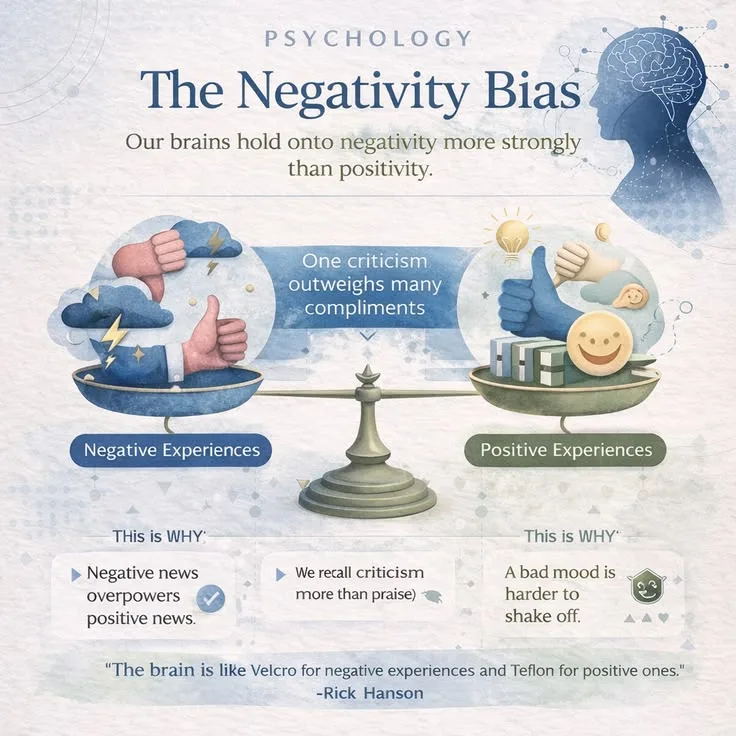
Negative experiences, information, and feedback often have more influence on thought, emotion, memory, and behavior than positive events of equal strength. Negativity bias is this general asymmetry, not merely a response to unpleasant things. It connects to but differs from loss aversion, pessimism, availability, learned helplessness, and other effects that can be shaped by the stronger processing of negative inputs.
In the early 1990s, John Gottman and his colleagues at the University of Washington set up what became known informally as "the Love Lab" - a suite of rooms in Seattle equipped with video cameras, heart-rate monitors, and coding systems capable of breaking down human interaction into discrete emotional units.
Couples were invited in and asked simply to talk - about their relationship, about a recent conflict, about whatever was on their minds.
Gottman's team then analyzed the footage frame by frame, cataloguing each expression, each micro-gesture, each verbal exchange as positive or negative in emotional valence.
From this data, Gottman drew a conclusion that became one of the most cited findings in relationship science: marriages that lasted were characterized by a ratio of positive to negative interactions of roughly 5 to 1.[4]
Five moments of warmth, humor, affection, or interest for every one moment of criticism, contempt, defensiveness, or stonewalling.
Marriages headed for divorce clustered around a ratio of 0.8 to 1 - negative interactions nearly matching or exceeding positive ones.
The asymmetry embedded in that finding is the subject of this article. One criticism does not simply cancel one compliment. In the emotional arithmetic of human experience, a single negative event weighs approximately as much as five positive ones.
The ledger is not balanced. It has never been balanced. And the reason it is not balanced is not arbitrary: it reflects a deep structural feature of cognition that researchers have now traced from the single neuron to the macro level of political systems and media markets. That structural feature is called the negativity bias.
"Bad is stronger than good - negative events and information have a greater impact on psychological processes than positive events of the same magnitude." - Roy Baumeister, 2001
Defining the Phenomenon
The negativity bias refers to the empirically established tendency for negative events, stimuli, and information to exert a disproportionate influence on cognition, emotion, judgment, memory, and behavior relative to positive events, stimuli, and information of objectively equivalent magnitude.
It is not merely that humans respond to negative things - that would be unremarkable. The bias is that the response is asymmetric: negative inputs carry more weight, produce larger changes in psychological state, are encoded more deeply in memory, and require more compensatory positive input to neutralize.
The phenomenon was given its most comprehensive early treatment in a landmark 2001 review paper by Roy Baumeister, Ellen Bratslavsky, Catrin Finkenauer, and Kathleen Vohs, published in the Review of General Psychology under the title "Bad Is Stronger Than Good."
The paper surveyed evidence from more than a dozen distinct domains - from initial impressions and learning to relationships and health - and reached a sweeping empirical conclusion: across virtually every domain examined, bad events were more powerful than good events of equivalent objective strength.
The authors found that negative information was weighted more heavily in forming first impressions, that bad moods were more difficult to shift than good ones, that traumatic experiences left longer psychological traces than positive ones, that negative social feedback influenced behavior more than positive feedback, and that financial losses were responded to more intensely than equivalent gains.
"Bad," they concluded, "is stronger than good as a general principle of psychological life."
The negativity bias is related to, but distinct from, a cluster of related phenomena. Understanding what it is requires understanding what it is not.
| Concept | Core Definition | Key Mechanism | Relationship to Negativity Bias |
|---|---|---|---|
| Negativity Bias | Negative events exert disproportionate influence across cognition, memory, emotion, and behavior | Asymmetric processing weight assigned to negative vs. positive inputs | The foundational asymmetry from which many effects flow |
| Loss Aversion | Losses feel roughly twice as painful as equivalent gains feel pleasurable | Reference-point-based asymmetry in the value function (Kahneman & Tversky) | A domain-specific manifestation of negativity bias in decisions under risk |
| Availability Heuristic | Probability is judged by how easily examples come to mind | Fluency-based probability estimation | Interacts with negativity bias since negative events are more vividly encoded and thus more available |
| Negativity Dominance | A negative element can corrupt or overwhelm the positive valence of a composite | Configural processing; the whole is worse than the sum of its parts | A specific mechanism within negativity bias; described by Rozin & Royzman (2001) |
| Pessimism Bias | Systematic tendency to overestimate the probability of bad outcomes | Probabilistic miscalibration in the negative direction | A downstream consequence of negativity bias applied to forecasting |
| Learned Helplessness | Repeated negative events produce generalized passivity and withdrawal | Conditioning; perceived uncontrollability | Can be potentiated by negativity bias through differential encoding of failed attempts |
| Confirmation Bias | Seeking and weighting evidence that confirms existing beliefs | Motivated cognition, prior belief anchoring | Interacts with negativity bias when the existing belief is itself negative or threat-focused |
Intellectual Lineage
The intellectual history of the negativity bias is not a single straight line but a convergence of several research traditions that, by the late 1990s, had accumulated enough overlapping evidence to warrant a unified theoretical treatment.
The earliest systematic work bearing on the phenomenon came from the psychology of emotion and conditioning.
The behaviorist tradition of the early twentieth century documented, in animals and humans, the well-established finding that punishment tends to produce faster behavioral change than reward of equivalent magnitude - a practical observation that pointed toward an asymmetry in psychological weight without yet theorizing it clearly.
Pavlov's work on conditioned fear responses showed that aversive conditioning was acquired rapidly and extinguished slowly, while appetitive conditioning followed the reverse pattern.
The cognitive revolution of the 1950s and 1960s opened new routes to the question. Research on impression formation by Solomon Asch at the New School for Social Research in the 1940s and 1950s had already shown that negative traits played a disproportionate role in determining overall character judgments.
Asch's configural model of impression formation held that individuals integrated trait information holistically, but that negative central traits - such as "cold" - restructured the entire impression more dramatically than positive central traits.
Norman Anderson's subsequent work in the 1960s and 1970s using information integration theory confirmed the negativity effect in impression formation across many experimental conditions.
Kahneman and Tversky's introduction of prospect theory in 1979, published in Econometrica, was a watershed moment not because it invented the negativity bias concept but because it provided the first rigorous mathematical formalization of a specific asymmetry - loss aversion - within a domain (decision-making under risk) where precise measurement was possible.[10][3]
Prospect theory demonstrated that the value function was kinked at the reference point, with the loss side having a steeper slope than the gain side.
The loss aversion coefficient - the ratio of the slopes - was estimated at approximately 2 to 2.5. For every dollar of subjective value a gain produced, a loss of equal size produced two to two and a half dollars of subjective pain.
The 1990s saw the question opened up beyond decision theory. Baumeister and colleagues had been gathering evidence across social psychology.
Ito and colleagues were examining the event-related potential (ERP) findings from cognitive neuroscience showing that negative stimuli produced larger amplitude P300 components than positive stimuli - a neural index of attentional capture and resource allocation.[8]
Jonathan Haidt and colleagues were beginning to develop moral psychology research showing that disgust - a prototypically negative emotion - had uniquely contagious and resistant properties.
All of these threads were woven together in the 2001 Baumeister et al.[1] review, which served as a consolidating document for what had become a broad empirical consensus.
Paul Rozin and Edward Royzman, in their companion 2001 paper "Negativity Bias, Negativity Dominance, and Contagion," published in Personality and Social Psychology Review, added important conceptual texture.[2]
They distinguished among four related but separable phenomena: negative potency (negative entities are stronger than corresponding positive entities) and steeper negative gradients (the subjective response to negative events scales more steeply with approach or proximity).
The other two phenomena were negativity dominance (the combination of negative and positive elements produces an outcome more negative than a simple summation would predict) and negative differentiation (the cognitive system devotes more categories and distinctions to negative phenomena than to positive ones).
Their concept of negativity dominance - that a negative element does not merely subtract from but actively contaminates the positive - was particularly influential in explaining findings in disgust research, moral judgment, and interpersonal evaluation.
What the Research Shows
Attention and Initial Processing
The earliest processing advantage for negative stimuli appears before consciousness.
Studies using event-related potentials have consistently found that threatening or negative images and words elicit larger early ERP components - particularly the P1 and N1 at 100-150 milliseconds post-stimulus - than neutral or positive stimuli, indicating that the bias operates at the level of automatic attentional orienting rather than deliberate scrutiny.
A seminal study by Arne Ohman and colleagues at the Karolinska Institute in Stockholm found that fearful faces were detected more rapidly than happy faces in visual search arrays, even when the fearful faces were masked, suggesting the processing advantage occurred outside conscious awareness.[11]
A 1998 study by Tiffany Ito, Jeff Cacioppo, and colleagues, published in the Journal of Personality and Social Psychology, used ERPs to examine how the brain responds to positive and negative images controlled for arousal and complexity.
Negative images produced reliably larger late positive potential (LPP) amplitudes than positive images - indicating greater sustained attentional engagement and elaborative processing - and the effect was robust across participants.
This attentional asymmetry has downstream consequences: stimuli that receive more processing tend to be encoded more deeply in memory, to be more readily retrieved, and to exert greater influence on subsequent judgment.
Memory
Research on autobiographical memory has consistently found that negative events, particularly emotionally intense or traumatic ones, are often remembered with greater vividness and durability than positive events of equivalent emotional intensity.
This is not simply because negative events are rare or surprising. Studies that control for emotional intensity find that the memory advantage for negative material persists.
Daniel Reisberg and Paula Hertel, in their edited volume on memory and emotion published by Oxford University Press in 2004, reviewed the evidence and concluded that negative emotional content consistently enhances consolidation in long-term memory, likely through the elevated norepinephrine release that accompanies negative arousal - which acts on the amygdala to strengthen hippocampal consolidation.
The finding has practical significance. A single public humiliation is typically remembered for years; a comparable public success fades more quickly. A single instance of betrayal by a friend restructures the entire retrospective account of the friendship.
The asymmetry in memory encoding means that over time, negative events accumulate disproportionate influence on self-narrative and expectations.
The Neural Architecture of Asymmetry
The amygdala's role in the negativity bias has been progressively clarified over the past two decades. The amygdala is not simply a fear center - it is a relevance detection system that responds to both positive and negative emotional stimuli.
But its response is asymmetric in its threat-detection function. Joseph LeDoux's work, summarized in his 1996 book The Emotional Brain, established the existence of a fast subcortical route from sensory thalamus to amygdala that allows threat-relevant stimuli to trigger a defensive response before the slower cortical route - through which conscious evaluation occurs - has completed its processing.[12]
This architecture creates a temporal priority for negative information: the alarm sounds before the deliberate assessment can intervene.
Functional imaging research has expanded this picture. A 2004 study by Elizabeth Phelps and colleagues at New York University found that individual differences in amygdala reactivity to threat-related stimuli predicted both the degree of behavioral loss aversion in economic gambles and the intensity of autobiographical memory for negative events.[6]
The amygdala, in other words, serves as a common node linking the attention, memory, and decision-making aspects of the negativity bias - a single neural structure through which the asymmetry is amplified across multiple psychological domains.[7]
Political Psychology and Media Consumption
Stuart Soroka at the University of Michigan and, previously, at McGill University has developed one of the most rigorous research programs on negativity bias outside the laboratory.
In a series of studies using both psychophysiological methods and large-scale content analysis, Soroka and colleagues examined how individuals actually respond to political news and information.
Their 2014 book Negative News and the associated papers documented a consistent finding: news consumers respond more strongly, physiologically and attentionally, to negative political content than to positive content - and media organizations, operating under competitive market pressure, have systematically responded to this bias by producing more negative content.
A 2019 study by Soroka, Patrick Fournier, and Lilach Nir, published in the Proceedings of the National Academy of Sciences, measured skin conductance and cardiac responses in a large cross-national sample of participants watching news clips of varying emotional valence.[5]
Negative news clips produced larger physiological arousal responses in every country studied - a finding that held across 17 politically and culturally diverse nations.
The implication is that the negativity bias in news consumption is not culturally constructed but reflects a shared human response pattern that media institutions have discovered, consciously or not, and built their economics around.
Four Named Case Studies
Case Study 1: Gottman's Marriage Laboratory and the 5-to-1 Ratio
John Gottman and colleagues at the University of Washington's Family Research Laboratory conducted a systematic longitudinal program of research beginning in the late 1970s and continuing through the 1990s, tracking hundreds of married couples over periods of four to fourteen years and examining which patterns of interaction predicted marital stability versus dissolution.
The methodology combined observational coding of interactions - using the Specific Affect Coding System (SPAFF) developed by Gottman and colleagues - with physiological monitoring and retrospective interview.
The central empirical finding was the 5-to-1 ratio: stable, enduring marriages showed a positive-to-negative interaction ratio of approximately 5 to 1, with some stable couples showing ratios considerably higher.
Couples in which the ratio had fallen below 1 to 1 - meaning negative interactions matched or outnumbered positive ones - were on a trajectory toward divorce with predictive accuracy Gottman's team estimated at approximately 90 percent over a four-year follow-up horizon.
The ratio was not symmetrical. It was not that positive and negative interactions cancelled each other out at 1 to 1, as a naive balanced ledger would imply.
A negative interaction - defined as one of Gottman's "Four Horsemen": criticism, contempt, defensiveness, or stonewalling - carried roughly five times the psychological weight of a positive one.
A single episode of contempt required approximately five episodes of genuine warmth to restore emotional equilibrium to the relationship.
The finding operationalizes the negativity bias in one of the most consequential domains of human experience.
It demonstrates that the asymmetry is not a laboratory artifact but a governing principle of long-term close relationships, and that understanding it has practical implications for relationship maintenance that are both counterintuitive and measurable.
Case Study 2: News Media and the Architecture of Negativity
The economics of news media have produced a natural large-scale demonstration of the negativity bias in information consumption.
Since at least the nineteenth century - when the American "penny press" discovered that crime news sold papers - editors and publishers have observed that negative stories, catastrophes, scandals, and threats attract more attention than stories of equivalent magnitude describing positive events.
The digital era has transformed this from editorial intuition into algorithmic certainty.
Research by Marc Trussler and Stuart Soroka at McGill University, published in Political Communication in 2014, used an elegant eye-tracking design to examine what political news readers actually consumed versus what they reported preferring.[9]
Participants expressed strong preferences for positive news in self-report measures. When left to browse news content freely, with their reading tracked by eye movements, they consistently spent more time on negative political content.
The discrepancy between stated preferences and actual behavior was large and systematic. People preferred to believe they wanted good news. Their attention went to bad news.
The consequences scale to the information environment as a whole. A media system operating under competitive market pressure, where attention is the scarce commodity being sold to advertisers, will systematically overweight negative content because that is what disproportionately captures and holds attention.
This is not a conspiracy or a deliberate editorial choice - it is the aggregate result of thousands of individual decisions guided by audience response data, all operating under the same underlying attentional asymmetry.
The result is an information environment that presents a systematically distorted picture of the world: more dangerous, more corrupt, and more divided than the best available data actually support.
Case Study 3: Online Reviews and the Asymmetric Power of the 1-Star Rating
The architecture of online consumer review platforms has created a highly quantified and commercially consequential domain in which the negativity bias can be observed in precise economic terms.
Research on online review systems consistently shows that negative reviews exert a disproportionate influence on consumer decisions and product or business performance relative to positive reviews of equivalent strength.
A 2011 study by David Sparks and colleagues examined the relative influence of positive and negative user reviews on purchase intentions in online retail.
Controlling for the total number of reviews, a single 1-star review was found to require approximately five to seven 4- or 5-star reviews to neutralize in terms of the marginal consumer's purchase probability.
The asymmetry was further confirmed by research published in Management Science by Duan, Gu, and Whinston examining box office revenues: negative word-of-mouth exerted measurably larger negative effects on revenues than positive word-of-mouth exerted positive effects, dollar for dollar.
The practical implication for businesses is stark: a single highly negative customer interaction - documented publicly and permanently - requires sustained positive reviews to counteract. This is not simply because consumers are cynical about positive reviews.
It is because, at the level of cognitive processing, negative signals carry more diagnostic weight in risk-averse decision-making. A reviewer who claims a restaurant was excellent provides moderate positive information.
A reviewer who claims they found a foreign object in their food provides information the brain treats as potentially catastrophic, activating threat-detection processing and weighting it far more heavily. The asymmetry is not a flaw in the review system.
It is the review system accurately reflecting the asymmetry in how humans process information relevant to potential harm.
Case Study 4: Workplace Feedback and the Cost of Criticism
The applied psychology of workplace feedback provides a fourth domain in which the negativity bias can be traced from laboratory finding to measurable organizational outcome.
Research by Jack Zenger and Joseph Folkman, published in the Harvard Business Review in 2013 and based on a large dataset of 360-degree feedback reviews, found that managers dramatically underestimated the negative impact of critical feedback on employee performance and motivation.
Critical feedback - even when technically accurate, constructive in intent, and balanced with positive commentary - tended to produce defensive responses, reduced motivation, and in many cases behavioral withdrawal, in proportions that surprised managers who had given it.
The underlying mechanism had been documented in laboratory conditions by Roy Baumeister and colleagues in a series of studies in the 1990s.
A single significant piece of negative social feedback - being told one was disliked, criticized for a valued performance, or rejected in a social context - produced measurable declines in cognitive performance on subsequent tasks.
This effect was both larger and more persistent than the performance benefits from equivalent positive feedback.
Baumeister termed the phenomenon "ego depletion by negative feedback": the emotional processing demands of a significant criticism consumed cognitive resources that would otherwise be available for productive work, in a way that positive feedback of equivalent magnitude did not generate surplus resources.
The workplace implication is that the familiar management advice to "sandwich" negative feedback between positive comments - a technique known colloquially as the "feedback sandwich" - while intuitively appealing, underestimates the magnitude of the asymmetry.
The criticism at the center of the sandwich tends to dominate the emotional experience regardless of the positive content surrounding it, because the brain's threat-detection system gives it priority in attentional and emotional processing.
When the Negativity Bias Is Adaptive
The universality of the negativity bias across cultures, species, and neural systems is not puzzling once the evolutionary context is considered.
The asymmetric weighting of negative information is not a design flaw in human cognition - it is the solution to an engineering problem that faced ancestral hominids operating in environments where negative events had asymmetric consequences.
The logic is simple and compelling. Imagine an organism confronted with a novel stimulus: it can be a threat or an opportunity. If the organism treats it as an opportunity when it is actually a threat, the cost could be death.
If the organism treats it as a threat when it is actually an opportunity, the cost is a missed meal or a missed mating opportunity.
In environments of genuine scarcity and predation, false negatives (missing a real threat) are far more costly than false positives (treating a harmless stimulus as threatening).
Natural selection will favor organisms biased toward threat detection even at the cost of many false alarms. The negativity bias is precisely this bias: calibrated to the asymmetric stakes of the ancestral environment.
The adaptive value is not limited to predator detection. In social environments, the consequences of being socially rejected, betrayed, or ostracized were potentially lethal in ancestral conditions.
Rapid detection and strong encoding of negative social signals - criticism from a high-status individual, signs of distrust in a potential partner, indications of factionalism within the group - would have had survival value.
The negativity bias in social cognition is continuous with the negativity bias in threat detection. It is the same algorithm applied to a different domain.
The bias remains adaptive in modern conditions within a limited range. In genuinely dangerous environments, the asymmetric weighting of negative signals preserves life. In environments with real social stakes, attention to negative feedback enables course correction that complacency with positive signals would not.
In financial contexts, heightened sensitivity to potential losses can prevent catastrophic risk-taking.
The problem is not the existence of the bias but its calibration to an ancestral environment and its subsequent mismatch with the modern world, where the decision architecture - markets, media, relationships, institutions - is organized in ways that trigger and amplify the bias in contexts where its costs greatly outweigh its benefits.
The research literature is clear about the conditions under which the negativity bias produces its worst outcomes: when the frequency of negative signals in the environment is artificially high relative to the actual frequency of threats (as in attention-economy media systems), and when the negative signals concern low-probability events that the asymmetric weighting elevates to unwarranted salience (plane crashes, terrorist attacks, rare crimes).
A third condition is when the asymmetric emotional processing of negative information drives decisions in domains - markets, long-term relationships, workforce management - where calm probability estimation would produce better outcomes than fear-amplified loss avoidance.
The Scope of Roy Baumeister's Research Program
Among the researchers who have contributed most broadly to the understanding of the negativity bias, Roy Baumeister stands out for the sheer domain breadth of his empirical program.
Beginning with research on self-esteem in the 1980s and expanding through social rejection, ego depletion, the meaning of life, and ultimately the comprehensive 2001 review, Baumeister's work consistently found the negative-stronger-than-positive asymmetry appearing wherever he looked.
In research on social exclusion, Baumeister and colleagues found that the experience of social rejection produced disproportionate and lasting effects on well-being, self-concept, and behavior.
In research on what he termed "the power of bad" in feedback and relationships, he found consistent asymmetries in how negative evaluations influenced behavior versus positive ones.
In work on human sexuality and emotion published with various collaborators through the 1990s, he found that negative emotional events in close relationships carried more weight in retrospective evaluations than positive ones.
And in the 2001 review itself, he synthesized evidence from learning, memory, impression formation, moral judgment, health psychology, and economics to argue that the asymmetry was not domain-specific but reflected something fundamental about how the mind processes relevance and assigns weight.
What Baumeister's broad program demonstrated was that the negativity bias is not an artifact of any particular experimental paradigm or research tradition. It appears whether the researcher is measuring neural activity, behavioral choices, memory recall, social judgment, or economic transaction data.
The convergence of evidence across methods is one of the strongest arguments for treating the negativity bias as a genuine structural feature of cognition rather than a domain-specific heuristic.
Sources & Further Reading
Baumeister, R. F., Bratslavsky, E., Finkenauer, C., & Vohs, K. D. (2001). Bad is stronger than good. Review of General Psychology, 5(4), 323-370.
Rozin, P., & Royzman, E. B. (2001). Negativity bias, negativity dominance, and contagion. Personality and Social Psychology Review, 5(4), 296-320.
Kahneman, D., & Tversky, A. (1979). Prospect theory: An analysis of decision under risk. Econometrica, 47(2), 263-291.
Gottman, J. M. (1994). What Predicts Divorce? The Relationship Between Marital Processes and Marital Outcomes. Lawrence Erlbaum Associates.
Soroka, S., Fournier, P., & Nir, L. (2019). Cross-national evidence of a negativity bias in psychophysiological reactions to news. Proceedings of the National Academy of Sciences, 116(38), 18888-18892.
Tom, S. M., Fox, C. R., Trepel, C., & Poldrack, R. A. (2007). The neural basis of loss aversion in decision-making under risk. Science, 315(5811), 515-518.
De Martino, B., Camerer, C. F., & Adolphs, R. (2010). Amygdala damage eliminates monetary loss aversion. Proceedings of the National Academy of Sciences, 107(8), 3788-3792.
Ito, T. A., Larsen, J. T., Smith, N. K., & Cacioppo, J. T. (1998). Negative information weighs more heavily on the brain: The negativity bias in evaluative categorizations. Journal of Personality and Social Psychology, 75(4), 887-900.
Trussler, M., & Soroka, S. (2014). Consumer demand for cynical and negative news frames. Political Communication, 31(3), 392-412.
Kahneman, D., Knetsch, J. L., & Thaler, R. H. (1990). Experimental tests of the endowment effect and the Coase theorem. Journal of Political Economy, 98(6), 1325-1348.
Ohman, A., Lundqvist, D., & Esteves, F. (2001). The face in the crowd revisited: A threat advantage with schematic stimuli. Journal of Personality and Social Psychology, 80(3), 381-396.
LeDoux, J. E. (1996). The Emotional Brain: The Mysterious Underpinnings of Emotional Life. Simon & Schuster.